ROUND TABLE 50 – WHAT ARE THE CHARACTERISTICS OF AN ELITE “IN-GAME COACH? – EPISODE 755

Welcome to the 50th edition of the Coach’s Corner Round Table on the Hoop Heads Podcast. Each episode of the Coach’s Corner Round Table will feature our All-Star lineup of guests answering a single basketball question. A new Coach’s Corner Round Table will drop around the 15th of each month.
February’s Round Table question is: What are the characteristics of an elite “in-game” coach?
Our Coaching Lineup this month:
- Dominic Amorosa – Strake Jesuit (TX) College Prep
- Andy Farrell – University of Dayton
- Dr. Bob Greczanik – Energetic Sports Lab
- Jeff Huber – Elyria Catholic (OH) High School
- Liz Kay – Wahconah (MA) High School
- Bob Krizancic – Mentor (OH) High School
- Dell Leonard – Mountain Home (AR) High School
- Dan Miller – San Marcos (TX) High School
- Matthew Raidbard – Author of Lead Like a Pro
- Don Showalter – USA Basketball
- John Shulman – University of Alabama Huntsville
Please enjoy this Round Table episode of the Hoop Heads Podcast and once you’re finished listening please give the show a five star rating and review after you subscribe on your favorite podcast app.
If you are a basketball coach at any level please check out our Hoop Heads Coaching Mentorship Program. You’ll get matched with one of our experienced Head Coaches and develop a relationship that will help take your coaching, your team, your program, and your mindset to another level.
Be sure to follow us on twitter and Instagram @hoopheadspod for the latest updates on episodes, guests, and events from the Hoop Heads Pod.

Like this show? Please leave us a review here — even one sentence helps! Consider including your Twitter handle so we can thank you personally!

We’re excited to partner with Dr. Dish, the world’s best shooting machine! Mention the Hoop Heads Podcast when you place your order and get $300 off a brand new state of the art Dr. Dish Shooting Machine!

Prepare like the pros with the all new FastDraw and FastScout. FastDraw has been the number one play diagramming software for coaches for years, and now with it’s integrated web platform, coaches have the ability to add video to plays and share them directly to their players Android and iPhones via their mobile app. Coaches can also create customized scouting reports, upload and send game and practice film straight to the mobile app. Your players and staff have never been as prepared for games as they will after using FastDraw & FastScout. You’ll see quickly why FastModel Sports has the most compelling and intuitive basketball software out there! In addition to a great product, they also provide basketball coaching content and resources through their blog and playbank, which features over 8,000 free plays and drills from their online coaching community. For access to these plays and more information, visit fastmodelsports.com or follow them on Twitter @FastModel.
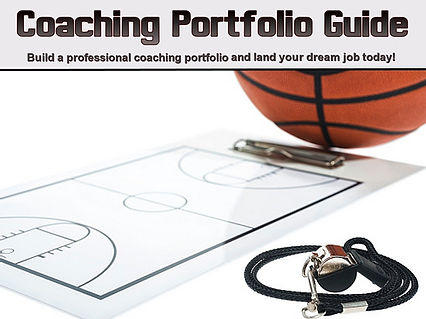
Your first impression is everything when applying for a new coaching job. A professional coaching portfolio is the tool that highlights your coaching achievements and philosophies and, most of all, helps separate you and your abilities from the other applicants.
The key to landing a new coaching job is to demonstrate to the hiring committee your attention to detail, level of preparedness, and your professionalism. Not only does a coaching portfolio allow you to exhibit these qualities, it also allows you to present your personal philosophies on coaching, leadership, and program development in an organized manner.
The Coaching Portfolio Guide is an instructional, membership-based website that helps you develop a personalized portfolio. Each section of the portfolio guide provides detailed instructions on how to organize your portfolio in a professional manner. The guide also provides sample documents for each section of your portfolio that you can copy, modify, and add to your personal portfolio.
The first Training Camp – Elite Skill Development and Performance Combine will be held on the campus of Western Reserve Academy, just outside of Cleveland, OH powered by Unleashed Potential & the Hoop Heads Podcast. The camp is designed for boys rising to grades 6-9 and will take place June 29 – July 1, 2023. An emphasis on improving your individual skills in the context of a team environment will be the hallmark of the Training Camp.
Mike Klinzing from Head Start Basketball/The Hoop Heads Podcast & Joe Stasyszyn from Unleashed Potential will serve as the Camp Directors of this inaugural Training Camp.
Campers can expect 3 days of hard work, intense skills instruction, and learning how to be a great teammate on and off the court at the Training Camp. Players will participate in 10 Elite Skill Development Sessions led by some of the best coaches from across the country. Visit headstartbasketball.com to get registered.
THANKS COACHES!
If you enjoyed this episode let our coaches know by clicking on the links below and sending them a quick shout out on Twitter:
Click here to thank Dominic Amorosa on Twitter!
Click here to thank Andy Farrell on Twitter!
Click here to thank Jeff Huber on Twitter!
Click here to thank Liz Kay on Twitter!
Click here to thank Bob Krizancic on Twitter!
Click here to thank Dell Leonard on Twitter!
Click here to thank Dan Miller on Twitter!
Click here to thank Matthew Raidbard on Twitter!
Click here to thank Don Showalter on Twitter!
Click here to thank John Shulman on Twitter!
Click here to let Mike & Jason know about your number one takeaway from this episode!
And if you want us to answer your questions on one of our upcoming weekly NBA episodes, drop us a line at [email protected].
TRANSCRIPT FOR ROUND TABLE 50 – WHAT ARE THE CHARACTERISTICS OF AN ELITE “IN-GAME COACH? – EPISODE 755
[00:00:00] Narrator: The Hoop Heads Podcast is brought to you by Head Start Basketball.
[00:00:21] Mike Klinzing: Hello and welcome to the 50th edition of the Coach’s Corner Round Table on the Hoop Heads Podcast. Each episode of the Coach’s Corner Round Table will feature our All-Star lineup of guests answering a single basketball question. A new Coach’s Corner Round Table will drop around the 15th of each month.
February’s Round Table question is: What are the characteristics of an elite “in-game” coach?
Our Coaching Lineup this month:
- Dominic Amorosa – Strake Jesuit (TX) College Prep
- Andy Farrell – University of Dayton
- Jeff Huber – Elyria Catholic (OH) High School
- Liz Kay – Wahconah (MA) High School
- Bob Krizancic – Mentor (OH) High School
- Dell Leonard – Mountain Home (AR) High School
- Dan Miller – San Marcos (TX) High School
- Matthew Raidbard – Author of Lead Like a Pro
- Don Showalter – USA Basketball
- John Shulman – University of Alabama Huntsville
Please enjoy this Round Table episode of the Hoop Heads Podcast and once you’re finished listening please give the show a five star rating and review after you subscribe on your favorite podcast app.
If you are a basketball coach at any level please check out our Hoop Heads Coaching Mentorship Program. You’ll get matched with one of our experienced Head Coaches and develop a relationship that will help take your coaching, your team, your program, and your mindset to another level.
Be sure to follow us on twitter and Instagram @hoopheadspod for the latest updates on episodes, guests, and events from the Hoop Heads Pod.
Hey Hoop Heads! This February, our partners and friends at Dr. Dish Basketball are offering $1,250 off the Dr. Dish Rebel +. You can also subscribe to their 30 day free daily motivational email series for coaches. Check out their new goal setting feature at drdishbasketball.com and follow their incredible content @drdishbball on Twitter, Instagram, Facebook, and YouTube. Mention the Hoop Heads Podcast and save an extra $300 on the Dr. Dish Rebel, All-Star and CT models. Visit drdishbasketball.com for details. Get your Dr. Dish Shooting Machine today.
[00:02:30] Ryan Berry: Hi, this is Ryan Berry, boys head basketball coach at Fairview High School in Cleveland, Ohio, and you’re listening to the Hoop Heads Podcast.
[00:02:40] Mike Klinzing: Prepare like the pros with the all-new Fast Draw and Fast Scout. Fast Draw has been the number one play diagramming software for coaches for years. You’ll quickly see why Fast Model Sports has the most compelling and intuitive basketball software out there. For a limited time, Fast Model is offering Hoop Heads listeners 15% off Fast Draw and Fast Scout.
Just use the code HHP15 at checkout to grab your discount and you’ll be on your way to more efficient game prep and improved communication with your team. Fast Model also has new coaching content every week on their blog, plus play and drill diagrams in its play bank. Check out the links in the show notes for more. Fast Model Sports is the best in basketball.
Let’s hear from our panel about the characteristics of an elite “in-game” coach.
Dominic Amorosa, Strake Jesuit College Prep in Houston, Texas
[00:03:40] Dominic Amorosa: This is Dominic Amorosa from Stake Jesuit in Houston, Texas. Elite in-game coaches are able to keep their emotions in check, see the entire game, communicate with their assistants and their players and their officials, and keep their poise regardless of the situation.
[00:03:59] Mike Klinzing: Andy Farrell from the University of Dayton.
[00:04:08] Andy Farrell: I think what makes a really good in game coach is somebody that can stick with the game plan they had coming into the game, but then also that fine line of balancing when and realizing when that game plan isn’t working and you need to do a complete one. And shift.
I think that’s a really, really hard thing to do because in the preparation prior to the game, you are believing the game plan for a specific reason, things that you saw. And sometimes it’s easy to just switch right away when you’re, you know, down by eight points, down by 10 points. But at the same time, sticking with that game plan, knowing the cumulative effect over, you know, a 32, 40, 48 minute game, whatever it may be, depending on the level.
But then at the same time, it’s when you’re, you know, down by eight or 10 and realizing, hey, this isn’t going to get much. That you need to completely alter your course, whether it’s changing your defense, changing your offense philosophy, substitution patterns, playing small, playing big, whatever it may be.
I think that that’s what makes a really, really elite in-game coach is knowing that balance and knowing your team so well. I also think there’s something to be said for somebody that can get their most out of their players, I think that’s almost like a cliche and obvious thing, but at the same time, like those guys are the ones out there, guys or girls are the ones out there that are shooting the ball that are, you know, not turning the ball over or are turning the ball over.
So, How well can you be pouring into your players so that they are the ones that are performing to the best of their abilities within the game plan and the confines of what the game plan, the team makeup is and everything like that. So someone that can really, really always be locking in on their players to get the most out of them from any game situation, even if they’ve missed a couple shots in a row, or even if they’ve made a couple shots in a row to continue to, to pour into them and build confide.
[00:05:53] Mike Klinzing: Jeff Huber, Elyria Catholic High School in Ohio.
[00:05:59] Jeff Huber: Hi, this is Jeff Huber from Elyria Catholic High School and this month’s round table question is, what qualities define an elite in-game coach? Couple things immediately jump out to me. I think one characteristic is the ability to be both firm and flexible. You know, I think when you come in with a plan or a certain identity for your team, that if right off the bat you’re struggling and things aren’t going well, there’s a fine line between immediately ditching what you’re doing.
I think a lot of times you have to kind of, you know, maybe power through some initial struggles and stay true to who you are, but you also do have to have that flexibility to make changes when changes are needed. And I think that’s really more an art than a science, but certainly I think the best coaches have that ability.
I think a second quality would be the ability to kind of zoom out, you know, to regulate your emotions and to kind of see the game almost from like 10,000 feet so that you’re not getting so wrapped up in every possession or every call, or every mistake that you let your emotion take away from your best qualities as a coach.
And then finally, I would say the third thing, and this is related, is. Being, being the coach that your team needs them to be in that moment. So if your team needs someone to calm ’em down because they’re overly emotional you, you model that. If your team needs someone to get ’em going a little bit because they’re coming out flat, you model that.
But again, I think that kind of goes back to zooming out and, and kind of seeing what’s needed in the moment and not basing it upon maybe your feelings, but upon what’s going to be most valuable for your team at that time.
[00:07:28] Mike Klinzing: Liz Kay from Wahconah High School in Dalton, Massachusetts.
[00:07:34] Liz Kay: Hey Hoop Heads, it’s Liz Kay from Wahconah Regional High School in Dalton, Massachusetts, and it’s been a while, so I’m excited to hop on this month’s Roundtable on Elite in-game coaching. As you can imagine, I’m a big believer in-game coaching really obviously starts on the practice court.
You have to have a great knowledge of your personnel, the strengths and weaknesses of your assistant coaching staff and where you can utilize them best and, and obviously practicing situations that you may encounter during a game, whether it be with five seconds to go, one minute to go, two minutes to go, et cetera.
I think additionally you have to have a philosophy on when and how you’re going to use your time. And when they’re necessary, and when you would rather your kids play through those moments. You know, in addition to obviously preying upon your strengths of what you do defensively and offensively to put your kids in a position to be successful.
But at the end of the day, the kids have to be confident in what you’re selling to them, especially when they might be used to going through the motions in. But then obviously dealing with the adversity and emotions of a game, they need to be able to adjust accordingly. So you don’t want, really want, or at least I don’t think you really want to be putting in something new, drawn up on a clipboard during a game.
They should have already seen it before. Additionally, you know, other coaches adjust to what you do as. So you need to have a plan A, you need to have a plan B, you need to have a plan C, and, and even within that, really constantly being aware of the player personnel and what adjustments another coach is making throughout the game so that you can best counteract that.
Examples of that for us is that we do spend carve out some time at least two or three times a week, if not more, and especially more so as we go into the post season for situational basketball practice. We also spend a lot of time with film work, as many of you do, to hopefully be proactive in anticipation of adjustments that other coaches might make, and then in game making sure that we have those top 2, 3, 4 things at the forefront of our minds to look for as we might see them during the game.
My assistants certainly have focuses that they are looking at, that I might miss during a game. And the ability to, you know, see those immediately and make adjustments on the fly is really, really important. Somewhat vague, but I hope that this gives a little bit of guidance and some thoughts on in game coaching.
Hope you’re all, well, good luck in the post season to anybody who’s there or is anticipating be there, and I wish you all well. Thanks.
[00:10:17] Mike Klinzing: Bob Krizancic, Mentor High School Mentor,
Ohio
[00:10:24] Bob Krizancic: Coach Bob Krizancic, Mentor High School. Great question. An elite in-game coach has his players ready, his staff ready, and definitely himself for all the challenge that’ll come up in each game.
You know, preparation is a key to success. We always tell our players, if we’re to be a state championship caliber team, then we need state championship practices. So again, I think in practice physically and mentally, make sure your team is totally prepared for anything that comes up in a game. Best of luck.
[00:11:07] Mike Klinzing: The first Training Camp Elite Skill Development and Performance Combine will be held on the campus of Western Reserve Academy just outside of Cleveland, Ohio, powered by Unleashed Potential and the Hoop Heads Podcast. The camp is designed for boys rising to grades six through nine and will take place June 29th through July 1st, 2023.
An emphasis on improving individual skills in the context of a team environment will be the hallmark of the Training Camp. Mike Klinzing from Head Start Basketball and the Hoop Heads Podcast, and Joe Stasyszyn from Unleashed Potential will serve as the camp directors of this inaugural Training Camp. Campers can expect three days of hard work, intense skill instruction, and learning how to be a great teammate on and off the court.
At the Training Camp, players will participate in 10 elite skill development sessions led by some of the best coaches from across the country. Visit headstart basketball.com to get registered.
[00:12:07] Mike Klinzing: Dell Leonard, Mountain Home High School, Mountain Home, Arkansas.
[00:12:13] Dell Leonard: The question this week is, what are the characteristics of an elite in-game coach? A great in-game coach is an expert in his or her field, and they’re meticulously prepared before the game starts, during games. They recognize the defense quickly and they have their team prepared to tack any defense.
Great in-game. Coaches aren’t afraid to make mistakes. They’re very passionate and energetic, but they also know when to stay calm as the team’s leader. I believe great in-game coaches give confidence during the games to players instead of taking that confidence away. They continue to teach in games.
They communicate at a high level verbally and non-verbally, and they continue to motivate their players to always work hard. I believe great in-game coaches respond in the right way to the good and the bad. With players and officials, they disregard the irrelevant. They continue to teach the details during games, and they not only communicate, but they communicate.
Honestly, communication methods are both direct and indirect. They’re clear, they’re consistent, and they’re honest. Rather than telling players what they want to hear, they tell ’em the truth. There’s no time to sugarcoat during games. Great coaches in games are consistent. They coach with a quiet confidence and their players mirror that on the floor.
I also believe that all coaches make mistakes and great M game coaches. When they make a mistake, they learn from it and they get better because of it. Thanks again for having me. Hoop Heads.
[00:13:50] Mike Klinzing: Dan Miller, San Marcos High School in San Marcos, Texas.
[00:13:57] Dan Miller: I think great coaching is done mostly in practice. But it also is done in games.
Elite coaches in games, I would say are coaches who know the pulse of their team and, and when to take somebody out and when to put somebody in. Elite coaches are making adjustments throughout the game, not waiting to halftime to change something that. Maybe isn’t working. If it’s pick and roll coverage, the Plan A isn’t working.
You don’t have to wait the halftime to, to change that or to get in or out of a press. Elite coaches can see during the game that that adjustments need to be made or, or something’s working. Stick with it. Elite coaches maybe aren’t stubborn through the game, you know, they’re willing to try something different, but also they’re listening to their staff.
It’s not just a one man band. You’re utilizing your staff, you’re utilizing your bench players and the whole team, elite coaches in the game are getting contributions from the entire team to complete that mission to win the game.
[00:15:03] Mike Klinzing: Matthew Raidbard, author of Lead Like a Pro.
[00:15:10] Matthew Raidbard: Hey, Hoop Heads Nation. This is Coach Matt Raidbard back for another Hoop Heads Round Table. This time discussing what are the characteristics of an elite in-game coach. There’s a few things that I always think about and look for when assessing whether I think a coach is elite within game. You know, first and foremost is what’s the game plan coming right out of the gates?
Does the team get off to a strong start? Does it look like they’re executing crisp on top of things? Good energy, a sense of urgency? That tells me generally that the preparation was there, the focus was there, the intensity was there, that the coach got them ready to play. And I consider that part of the in-game process because that preparation is directly affecting immediately what happens in the game.
From there, I always look at what happens after timeouts, you know, when there’s a media, when coach calls a timeout, are you setting a good play? Are you not necessarily scoring, cause we always want to score, but are you getting the shot that you want from the player that you want in the spot that you want?
Does the coach have that level of control and mastery over what’s going on with the game? And have they obviously done the preparation so that their team is able to execute it in those moments? And then I look at in-game adjustments, not necessarily what comes out of halftime, because that could be a little deceiving.
You know, sometimes coach gives that fiery halftime speech and the team comes out playing hard for four minutes and then kind of tails off because there wasn’t really an adjustment made. There was just a motivational speech. But what are the actual in-game adjustments? You know, did the coach switch some defensive principles?
Is the coach running different plays or trying to execute different offensively is the coach throwing in little wrinkles, looking to exploit little things that the other team is doing, or mismatches? Those are kind of the things I look at. And you know, when you add those things up, that’s what makes the difference.
Those aftertime out plays, those set pieces, those adjustments that get you a few extra baskets, those make the difference in close games. And over the course of the season, I think they separate good teams from great teams. Great teams from elite or championship teams. Thanks Hoop Heads Nation.
[00:17:24] Mike Klinzing: Don Showalter USA Basketball.
[00:17:30] Don Showalter: Hi, Don Showalter here from USA Basketball. What are the characteristics of an elite in-game coach? I think there’s probably two of ’em that stick out my mind. First one is being a great teacher, if you’re an in-game coach, you have to be able to teach, communicate what you want done, especially communication during a time out.
Being a good teacher involves making sure that you have eye contact with your players. They’re engaged in what you’re saying and the good, really good elite coaches have that knack and ability to do that. So, being a great teacher, I think. This is the first one.
Second one I think is obviously being organized, you know what are you going to tell your players on the timeout when the game is close? I think the great, the best coaches are the ones that are highly organized, have down what they want to do, what they want to run. You hear a lot of the sportscasters say, that was a great play to run after a timeout.
Well, you have to be organized in order to make that decision quickly during a timeout. So I think organization is really, really important. And I think the third thing that I’ve seen all characteristics of elite coaches is they’re adaptable. You know, they’re adaptable to what the other team is doing.
You have to be adaptable to who you have in the game. Maybe you run a play for a certain person and they fouled out. You have to be adaptable in putting something else in. So I think you know, obviously being a great teacher being organized and being adaptable, the three things I would say three characteristics that set elite coaches in game strategies apart from coaches who are probably not quite that level yet.
Thank you and hope all are doing well.
[00:19:18] Mike Klinzing: John Shulman, University of Alabama, Huntsville, and the 720 Sports Group.
[00:19:25] John Shulman: This is John Shulman, head basketball coach at the University of Alabama in Huntsville, UAH. And this month’s question is worth the characteristics of an elite in-game coach. Really a good question. I think they’re hard to find.
I think I think it’s a very difficult thing to be an elite in-game coach. The first thing I would turn the question a little bit, is, I think if you want to win basketball games, you really don’t need to be an elite game in-game coach. Because I think you do all your coaching.
Just be honest. I think you need to do the majority of your coaching in practice to have your team prepared so you’re not over there having to coach every single play, every single pass, every single dribble, every single defensive situation that you’ve already gone over it. How you guard this ball screen if it’s a middle, third out, a third.
How you guard this action against the zone, how you guard this action against. What if they hard hedge? What if, whatever that you’ve already covered at in practice and you’re not having to be an elite in game coach. But here’s what I think, because that’s the question. I think you have one major characteristic of an elite end game coach is, and I am very average at this, but can he stay kind of in the moment?
Does he get a little scatterbrained or does this coach stay very calm and can he think not getting overly excited to stay calm and be able to think? That’s why I write a bunch of notes on a card for myself so I can, it helps me think in a game, but can you stay calm, cool, and collective and. Almost to be an elite in-game coach is to watch the game.
Almost like a fan is. Just watch the game. And I think very few coaches can literally just watch the game and make those decisions because we get emotional with officials. Get emotional with players, get emotional with the score of the game, and so just to be able to sit back and remove yourself from the emotion of the game and watch the game, I think is the key to being an elite in-game Coach.
I would say this being a delegator is probably important. To be an elite end game coach. You know, I’ve said before many times, I, I try not to, I call under OB plays, side OB plays, but I don’t call our dead ball plays. I give that responsibility to our assistants. And so that helps me. Think a little bit better and try to manage the game better.
Just be calling Ds and under OB and side ob so I can manage the game. If you try to do everything in game, you ain’t gonna do anything worth a flip. So be a great delegator and be a great thinker. Stay unemotional. And I think you got a shot of being a pretty good in-game coach. Hope this helps and everybody have a great month as we head towards tournament time and playoff basketball.
Good luck to everybody. I appreciate your time. Take care. Thanks.
[00:22:36] Mike Klinzing: Thanks for checking out this month’s Hoop Heads Podcast Round Table. We’ll be back next month with another question for our all-star lineup of coaches.
Your first impression is everything. When applying for a new coaching job, a professional coaching portfolio is the tool that highlights your coaching, achievements and philosophies. And most of all helps separate you and your abilities from the other applicants, the Coaching Portfolio Guide is an instructional membership based website that helps you develop a personalized portfolio. Each section of the portfolio guide provides detailed instructions on how to organize your portfolio in a professional manner. The guide also provides sample documents for each section of your portfolio that you can copy, modify and add to your personal portfolio.
As a Hoop Heads Pod listener, you can get your Coaching Portfolio Guide for just $25. Visit https://www.coachingportfolioguide.com/hoopheads to learn more
[00:26:02] Narrator: Thanks for listening to the Hoop Heads Podcast presented by Head Start Basketball.