ROUND TABLE 92 – IF EVERY COACH IN THE COUNTRY HAD TO COPY ONE THING FROM YOUR PROGRAM, WHAT WOULD YOU WANT IT TO BE? – EPISODE 1286
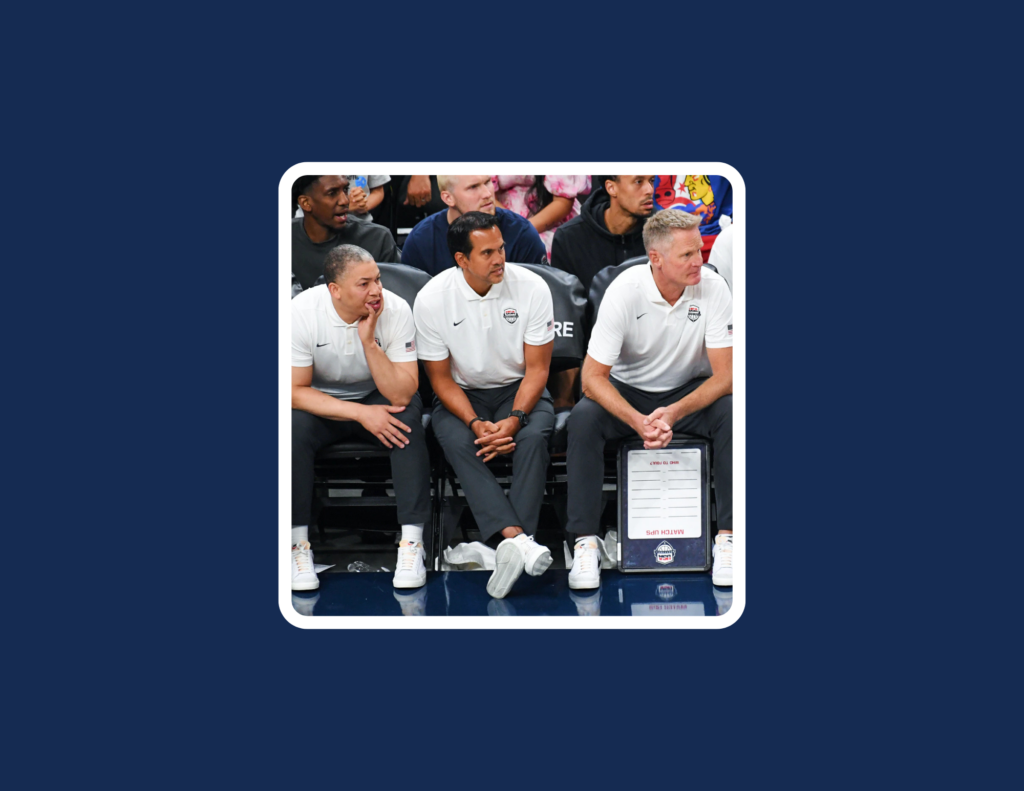

Welcome to the 92nd edition of the Coach’s Corner Round Table on the Hoop Heads Podcast. Each episode of the Coach’s Corner Round Table will feature our All-Star lineup of guests answering a single basketball question. A new Coach’s Corner Round Table will drop around the 15th of each month.
August’s Round Table question is: If every coach in the country had to copy one thing from your program, what would you want it to be?
Our Coaching Lineup this month:
- Jerry Buckley – Bishop Kenny (FL) High School
- Erik Buehler – Arapahoe (CO) High School
- Chris DeLisio – Olmsted Falls (OH) High School
- Matt Elkin – Stanford University
- Stephen Halstead – Grace College
- Joe Harris – Lake Chelan (WA) High School
- Dave Hixon – Amherst College
- Mike Koehler – Elkhart Lake (WI) High School
- Bob Krizancic – Mentor (OH) High
- Chris Richardson – Wheeling University
- Don Showalter – USA Basketball
- John Shulman – University of Central Arkansas
Please enjoy this Round Table episode of the Hoop Heads Podcast and once you’re finished listening please give the show a five star rating and review after you subscribe on your favorite podcast app.
Be sure to follow us on twitter and Instagram @hoopheadspod for the latest updates on episodes, guests, and events from the Hoop Heads Pod.
Let’s hear from our panel about the one thing they’d want every coach in the country to copy from their program.
If you listen to and love the Hoop Heads Podcast, please consider giving us a small tip that will help in our quest to become the #1 basketball coaching podcast.
THANKS COACHES!
If you enjoyed this episode let our coaches know by clicking on the links below and sending them a quick shout out on Twitter:
Click here to thank Jerry Buckley on Twitter!
Click here to thank Erik Buehler on Twitter!
Click here to thank Chris DeLisio on Twitter!
Click here to thank Matt Elkin on Twitter!
Click here to thank Stephen Halstead on Twitter!
Click here to thank Joe Harris on Twitter!
Click here to thank Dave Hixon on Twitter!
Click here to thank Mike Koehler on Twitter!
Click here to thank Bob Krizancic on Twitter!
Click here to thank Chris Richardson on Twitter!
Click here to thank Don Showalter on Twitter!
Click here to thank John Shulman on Twitter!
Like this show? Please leave us a review here — even one sentence helps! Consider including your Twitter handle so we can thank you personally!
And if you want us to answer your questions on one of our upcoming weekly NBA episodes, drop us a line at [email protected].

Give With Hoops is a groundbreaking initiative that fuses basketball analytics with modern sponsorship. Built for teams who see data as opportunity, from AAU programs to college powerhouses.
By tying on-court performance directly to community and sponsor engagement, Give With Hoops help programs raise more while deepening support from those who believe in the game.
Traditional fundraising disconnects donors from the action. Sell candy bars, wash cars, beg for donations, it’s exhausting and ineffective. Players perform better when their stats matter beyond the scoreboard. That’s why Give With Hoops was created.
Give With Hoops connects game performance to community support. Every basket, rebound, and assist becomes a chance to raise funds. Transparent, exciting, and proven to raise 3x more than traditional methods.
The D3 Recruiting Playbook is your step-by-step guide to getting recruited as a college athlete at the NCAA Division 3 level. This course is designed by former D3 Athletes to take you from zero interest from college coaches to securing your first offer and putting you on the path to committing.
Your first impression is everything when applying for a new coaching job. A professional coaching portfolio is the tool that highlights your coaching achievements and philosophies and, most of all, helps separate you and your abilities from the other applicants.
The key to landing a new coaching job is to demonstrate to the hiring committee your attention to detail, level of preparedness, and your professionalism. Not only does a coaching portfolio allow you to exhibit these qualities, it also allows you to present your personal philosophies on coaching, leadership, and program development in an organized manner.
The Coaching Portfolio Guide is an instructional, membership-based website that helps you develop a personalized portfolio. Each section of the portfolio guide provides detailed instructions on how to organize your portfolio in a professional manner. The guide also provides sample documents for each section of your portfolio that you can copy, modify, and add to your personal portfolio.
TRANSCRIPT FOR ROUND TABLE 92 – IF EVERY COACH IN THE COUNTRY HAD TO COPY ONE THING FROM YOUR PROGRAM, WHAT WOULD YOU WANT IT TO BE? – EPISODE 1286
[00:00:00] Narrator: The Hoop Heads Podcast is brought to you by Head Start Basketball.
[00:00:20] Mike Klinzing: Hello, and welcome to the 92nd edition of the Coaches Corner Round Table on the Hoop Heads Podcast. Each episode of the Coaches Corner Round Table will feature our all-star lineup of guests answering a single basketball question. A new Coaches Corner Round Table will drop around the 15th of each month.
August’s Round Table question is: If every coach in the country had to copy one thing from your program, what would you want it to be?
Our coaching lineup this month includes:
Jerry Buckley – Bishop Kenny (FL) High School
Erik Buehler – Arapahoe (CO) High School
Chris DeLisio – Olmsted Falls (OH) High School
Matt Elkin – Stanford University
Stephen Halstead – Grace College
Joe Harris – Lake Chelan (WA) High School
Dave Hixon – Amherst College
Mike Koehler – Elkhart Lake (WI) High School
Bob Krizancic – Mentor (OH) High
Chris Richardson – Wheeling University
Don Showalter – USA Basketball
John Shulman – University of Central Arkansas
Please enjoy this Round Table episode of the Hoop Heads Podcast. And once you finish listening, please give the show a five-star rating and review after you subscribe on your favorite podcast app. Be sure to follow us on Twitter and Instagram @hoopheadspod for the latest updates on episodes, guests, and events from the Hoop Heads Podcast.
Ever since I founded Head Start Basketball in 1993, we’ve helped young players develop their skills, confidence, and love for the game. Now we’re partnering with coaches and athletic programs to bring the Head Start Basketball camp experience to new communities. Our camps run for five days, three hours per day, and serve boys and girls in grades one through six.
You or someone on your staff directs the on-court portion of the camp while Head Start Basketball manages registration, promotion, parent communication, T-shirts, trophies, website setup, and administration. There are no upfront camp planning headaches, and the profits are divided 50/50 between your program and Head Start Basketball.
If you want to reach more families or strengthen your youth basketball pipeline or just create additional revenue for your program, visit headstartbasketball.com to explore hosting a camp
Are you or an athlete you know planning to go D3? Check out the D3 Recruiting Playbook from D3 Direct. Their playbook gives you a clear step-by-step roadmap to the recruiting process, what coaches value, key milestones from early high school through application season, and how to build a targeted list of schools that fit your needs.
The playbook demystifies researching D3 programs and how to stand out without chasing every camp or showcase. The modules cover things like writing emails to coaches, building an effective highlight tape, using social media well, planning camps and visits, and navigating application strategy. You’ll get templates, checklists, and an outreach plan to communicate confidently, learn how to compare financial packages, and avoid common missteps.
By the end, you’ll have a prioritized school list and a decision framework you can use to land your best fit opportunity. Click on the link in the show notes to get your D3 Recruiting Playbook from D3 Direct.
Let’s hear from our panel about the one thing they’d want every coach in the country to copy from their program
Jerry Buckley, Bishop Kenny High School, Jacksonville, Florida
[00:03:41] Jerry Buckley: Hi, this is Jerry Buckley answering this month’s Round Table question. I think one thing, if somebody was to copy something from our program, was actually something I copied from a podcast years ago. I heard Mike Jones, who at the time was the head coach at DeMatha Catholic High School and is now at Old Dominion, and he talked about meeting with every one of his players in the preseason, along with their parents to discuss roles and playing time and all that different stuff.
And we started doing that years ago. It’s definitely time-consuming, but I think it definitely has helped as far as opening up the lines of communication in various ways. Even for the guys that play a lot, sometimes the message never really gets home to what the discussion was in a meeting between just coaches and players, especially in high school.
So again, I think this applies mainly to high school, not as much to college, but that’s really been great for us. And I think it’s, important to have good face time with your parents. They get to ask questions. And I think usually going into the season’s been very successful, too. Again, there’s always going to be ups and downs and playing time and roles and things like that happen over the course of the season.
But I think it’s always a really good way to start and hopefully gets out in front of some issues that may eventually happen at some point.
[00:04:59] Mike Klinzing: Erik Buehler, Arapahoe High School, Centennial, Colorado.
[00:05:04] Erik Buehler: Hey, what’s up hoop heads? This is Erik Buehler at Arapahoe High School in Colorado, and this month we were asked for the Round Table question, if every coach in the country had to take something from your program, what would you want it to be?
This is a really good question, and I’ve, I had to think long and hard about it. I’m very proud of like the culture pieces we have. I’m very proud of like some of the unique things we do with just preparing ourselves for games mentally and visualization and calming our anxiety and things like that I think are unique.
But I’m going to go with a, a defense that our head coach, Coach Boley, runs that’s it’s a zone matchup and I hate to call it that ’cause he’d be mad if I said it, and I hope he’s not going to be mad at me for sharing this. But it’s a zone that… It’s a half-court zone that is very nuanced and has some pretty unique rules, and it makes it very hard for anyone to run a traditional zone-breaking offense or patterned offense against it.
You kinda have to read and react more, and you actually just have to make plays and make shots against it. It’s very tough to score against, and it’s very confusing for kids a-and players to score against, and I’m still learning the little nuances of it after learning it three years ago. So I can’t imagine what a coach watching on film thinks or sees or game plans for.
It’s the most unique half-court zone that I’ve ever seen, and I’m really proud to learn it and understand it and that we have it in our toolbox. So that’s what I’m sharing today. It’s a, a one-one-three zone that we love to run, our guys buy into, and I think if more coaches had it in their toolbox, they would have a lot more success on defense.
Thanks for having me again, guys. Can’t wait to talk to you next time. Be good.
[00:07:07] Mike Klinzing: Chris DeLisio, Olmsted Falls High School, Olmsted Falls, Ohio
[00:07:13] Chris DeLisio: Hey, Hoop Heads. Chris DeLisio from Olmsted Falls. Thinking about the number one thing that I would probably pass on to other coaches that we do, that we’re proud of, is our leadership training and mental toughness training that we do with all our players.
We have classroom sessions where we take kids through strategies for both of these traits that we want out of our players for both basketball and life. So we do those over the course of the season and mix in different scenarios and try to really get our players to participate in addition to teaching them direct responses and common things that they happen to encounter as they go through the season.
Whether it’s leadership moments that they have the opportunity to take advantage of, or moments where they may have difficulty, mentally, confidence, all the things that we know that athletes are experiencing more and more. So that’s probably the thing that I’m most proud of that our program does that I would pass along to another coach.
[00:08:30] Mike Klinzing: Matt Elkin, men’s basketball assistant coach at Stanford University
[00:08:38] Matt Elkin: If every coach in the country could copy one thing from our program, I think it would be the way that we measure our shooting numbers in the off-season, doing certain drills repetitively, keeping track of data and scores, and using them to hold guys accountable and basically track shooting progress throughout the summer in a fun and competitive way.
[00:09:03] Mike Klinzing: Stephen Halstead from Grace College.
[00:09:07] Stephen Halstead: Hey, Mike. This is Stephen Halstead from Grace College, and the question for the Round Table this month is, “If every coach in the country had to copy one thing from your program, what would it be?” And this, I think this is a, a deep underlying theme of our program, and it goes back to even Coach Kessler and how long he coached at Grace.
But it’s just how much that our staff cares about the person and the individual more than the basketball player. Specifically we’re trying to grow them in their faith a- and as a man, that they can be a Christ follower, that they can be a great husband one day, a great father one day, and that they can continue to influence others.
And obviously we coach basketball along the way, but that’s obviously the most important thing in our program.
[00:09:48] Mike Klinzing: Joe Harris, Lake Chelan High School, Lake Chelan, Washington.
[00:09:54] Joe Harris: Hello, Hoop Heads. This is Joe Harris from Lake Chelan with this month’s Round Table question, asking, “If every coach in the country had to copy one thing from our program, what would that be?”
I’d really want it to be the way we developed our culture, specifically the way we developed our players as people before athletes, and how we always played together and with effort, how we held our players accountable, and how the program really invested in them and created an environment where they genuinely care about one another.
Our goal really was to build confident and disciplined a- and selfless athletes who carry those qualities with them long after they left our program. These are the standards that our culture was really built on, and I’m hoping that this is something that you can take with you. Appreciate the opportunity to share.
[00:10:45] Mike Klinzing: Give with Hoops is the first platform turning basketball analytics into fundraising impact. Every stat tells a story, and now every story drives sponsorship, engagement, and team growth. Programs nationwide are transforming basketball stats into funding power. Learn to use performance data to attract sponsors, engage fans, and raise more with every play.
Give with Hoops will help you raise three times more money for your program, as their stat-based pledges consistently outperform traditional fundraisers. Visit givewithhoops.com/hoop-heads-podcast to learn more and take your fundraising to the next level. Give with Hoops
Dave Hixon, Basketball Hall of Famer from Amherst College
[00:11:36] Dave Hixon: Hoop heads. Dave Hixon here, retired, Amherst College. I gave a lot of thought to this, and I’ve come up with really some, I think some really good drills that certainly all of my assistants that have become head coaches have implemented. But, what it came down was something a little different, and bear with me just for a minute.
And so what we used to do was that just before, a week before the beginning of the season, we would rank order… Everybody had to rank order the players as in to how good they were how much of an impact they were going to have in our program. And they had to put themselves in that ranking. And what they would do is they would circle their name, and everything would be confidential to me and the assistants, but we’d get the list back, and it gave us a ton, and it gave us a ton of discussion.
And so what we’d do, too, at the end of it, we’d have two or three questions, which I’ll talk about in a second, that we had to answer, too. And the amount of discussion that we had and how much closer I got to my players was a really important thing. And for instance we had a really good player who ranked himself 12th.
The players ranked him seventh. So that was a disconnect, a d- disconnect of a plus five. That’s a positive thing, and what I’ve have to do is I’ve have to work with that kid about confidence because certainly he’s not confident enough as everybody else is confident in him. And on the other hand, if we had somebody that was ranked 12th and they ranked themselves sixth, then we got probably a little bit of a disconnect.
That was a negative disconnect of minus six. And, we worked on that, too. What would people What was their perspective as to why they thought they were better than they were? And so anyway, it was an interesting thing. It all came, it came about when I had a soccer team back in the day, long time ago, before we could cut anybody.
It was a freshman soccer team. We had 50, I want to say 58 kids with 18 to 28 jerseys, and I had to sort that out. But anyway then we’d ask questions at, toward the end, and some of the questions were, “What’s your biggest goal for the year?” Of course, most of them raised their hand and say is it an individual goal, or is it a team goal?”
And I’d say, “That’s part of the question. What’s your biggest goal?” And, a couple times we had things that were identified, players’ attitudes, that one kid came in and said, “Hey, my number one goal is to be first team All-NESCAC.” And, we brought that in, and I thought, “Wow, really? What about all the other stuff?”
And so sure enough he didn’t become first team All-NESCAC, but we won a national championship. He became player of the, the year in the tournament and in the championship game, and he hugged me and said, “Coach, I think that was a lot better than first team All-NESCAC.” Anyway, you can do it any way you want to do it, but I tell you what, it really it really opens up discussion.
Now, I– just a warning, I did have one of my former players recently object to his AD’s exercise that we just talked about because she said that it was traumatizing for the kids to have to rate themselves like that, and it’s not about, it’s not about truth. It’s about feelings. And so I don’t know where to go with that.
But anyway, just a heads-up on that one. Anyway, we had a ton of fun with it. It was a wonderful exercise. God bless you all. Have a good summer. Bye.
[00:15:04] Mike Klinzing: Mike Koehler from Elkhart Lake High School in Elkhart Lake, Wisconsin.
[00:15:11] Mike Koehler: Mike Koehler, boys basketball coach at Elkhart Lake High School in Wisconsin. This month’s question is, if every coach in the country had to copy one thing from your program, what would you want it to be?
Very good question. My answer is flexibility and creativity. I coach at a small public high school, and in any given year, we have thirteen to fifteen players. That’s freshman to senior in the overall program. In fact, this past year it was eleven players, twelve including a foreign exchange student with little prior basketball experience.
Thus, my coaching reality is probably a little bit different than many other high school coaches, and obviously much different compared to coaches beyond the high school level. With program numbers like that, we all– we still are able to field a, a JV and varsity team each year. So being flexible and creative sort of defines what I need to do in any number of ways, from practice planning to preparing for games, right?
If you had a scout team with only freshmen and sophomores, everything of course is going to look fantastic. To the in-game decisions I, I have to make, given, the obvious depth issues we have with program numbers like that. Being flexible and creative by necessity I think has made me a better coach and given me some unique insights.
So to other coaches out there, the conditions and context in which you coach will perhaps never be ideal, right? Whatever your definition of ideal may be. But if you’re flexible and creative in your approach to player development practice and game preparation, game execution, and the many other aspects of coaching, the players actually in your program, I think will benefit.
And after all, that’s what the big picture goal is.
[00:17:12] Mike Klinzing: Bob Krizancic, Mentor High School, Mentor, Ohio
Coach K, Mentor High School. The one thing I would love every program in the country to copy from us is our style. We’ve won. We’ve been in the top 10 in scoring in the state probably 10 out of the last 12 years.
We press, we run. Our two shots are a power move or a three, about 98% of our shots. Our practice style is seven-second shot clock, and to just get after the ball. We want to score within seven seconds, and we want to make something happen on the defensive end within seven seconds. It’s a fun way to play. It’s proven to be successful, and I think coaches would love coaching that type of game
[00:18:05] Mike Klinzing: Chris Richardson from Wheeling University
[00:18:09] Chris Richardson: This is Chris Richardson, head men’s basketball coach at Wheeling University, with this month’s Round Table question.
If every coach in the country had to copy one thing from our program, I would want it to be that, and I know this sounds cliché, there’s have to be a better way to say it, but we try to treat the janitor with the same respect that we do the CEO. Here on a very small campus, we always tell our guys, “Your logo never comes off.
You’re going to stand out. We want you to stand out for the right reasons, and the biggest way to do that is with the relationships you develop, how you treat people you interact with every day.” One of our first practices of the year, inevitably Lewis who’s the head janitor in our gymnasium, will be walking through, and we’ll make sure every player gets to meet him.
That there is no misunderstanding about how important he is to our team, that he’s as vital to our team as any of the coaches any of the players, any of the administrators. And we’ll do the same thing with, people from security who walk by, maintenance workers, so on and so forth.
We expect the same thing when they interact with workers in the cafeteria, workers in different offices on campus, certainly faculty and staff. But because of the size of our campus, they’re really able to develop those relationships with people. They know Lewis’ favorite team just like they know that our president is on the front row of every game.
And it works really well on a small campus, but I think it can work on any size campus if you emphasize it enough. Treat everyone with the same amount of respect. The golden rule I think is a big thing that we really harp on with the people we interact with on a daily basis.
[00:18:05] Mike Klinzing: Don Showalter from USA Basketball
[00:19:51] Don Showalter: Don Showalter here from USA Basketball. One thing that I would hope that coaches would take away from viewing my program would be the ability to build relationships with your players and also with parents. I think this takes a lot of work, a lot of time, but the relationships built certainly build trust with the players.
And if you don’t have trust with your players in your program, you probably can’t coach them very hard. So the relationship building I think is of the utmost importance. And how you do this is you have to spend time with your players both on an individual basis and as a team on a team basis. So I think this is one thing that I would hope coaches would take away from my programs. Thank you.
[00:20:48] Mike Klinzing: John Shulman from the University of Central Arkansas
[00:20:54] John Shulman: This is John Shulman, head basketball coach at the University of Central Arkansas. And the question this month, if every coach in the country had to copy one thing from your program, what would it be? That’s a great question. I got a couple answers, so it’s probably not one thing, but I do a couple things that we do.
I would hope that they would copy just habits. We do three on three jump to the ball, and three on three screen away, and two on two weak side box outs every single day from when we start practice. And it’s not a 20-minute thing. It’s a, starts at three minutes on each side, and then we go to two minutes.
But just the habits that we do every single day, I really believe in those habits. And I think that would be one thing that they would, that it is really cool to copy. And it’s not a cool thing, and it’s more of a kinda don’t get bored with the basics type thing. The other thing is our, if you want to copy something from our program, and I wish I had more to do with it, but offensively.
Offensively we’re really good, running Princeton offense and doing some different things. We don’t do shooting drills just to do shooting drills. Every shooting drill that we do is really exactly an offensive action, and so they know exactly what shots they’re going to get every single time in our offense.
So that’s what we do every single day. And every time we work on shooting it’s literally we’re working on offense. So I love that part of our offense and love that part of our kind of our individual work. Hope this helps at all. We’re really proud of what we do in our program. But remember, like everybody does great things out there, and everybody wants to win, and not everybody’s going to win.
I love what we do in our program, and last year was the second year in 20 years that Central Arkansas had a winning season. So everything doesn’t work all the time. We just try to do our best. I love what Ben McCollum says “Results lie. Process tells the truth.” Keep on coaching the process.
It’s hard. It’s hard, but, we’d won 11 in a row last year, and I kept saying, “The results are lying, guys. The process tells the truth,” because we weren’t playing great basketball. So don’t always believe the results. Keep doing the process. And hope good luck as school begins. Take care.
[00:23:28] Mike Klinzing: Thanks for checking out this month’s Coaches Corner Round Table on the Hoop Heads Podcast.
We’ll be back next month with another question for our all-star lineup of guests
Your first impression is everything when applying for a new coaching job. A professional coaching portfolio is the tool that highlights your coaching achievements and philosophies, and most of all, helps separate you and your abilities from the other applicants. The Coaching Portfolio Guide is an instructional membership-based website that helps you develop a personalized portfolio.
Each section of the portfolio guide provides detailed instructions on how to organize your portfolio in a professional manner. The guide also provides sample documents for each section of your portfolio that you can copy, modify, and add to your personal portfolio. As a Hoop Head’s Pod listener, you can get your coaching portfolio guide for just twenty-five dollars.
Visit coachingportfolioguide.com/hoopheads to learn more.
[00:24:29] Narrator: Thanks for listening to the Hoop Heads Podcast presented by Head Start Basketball.