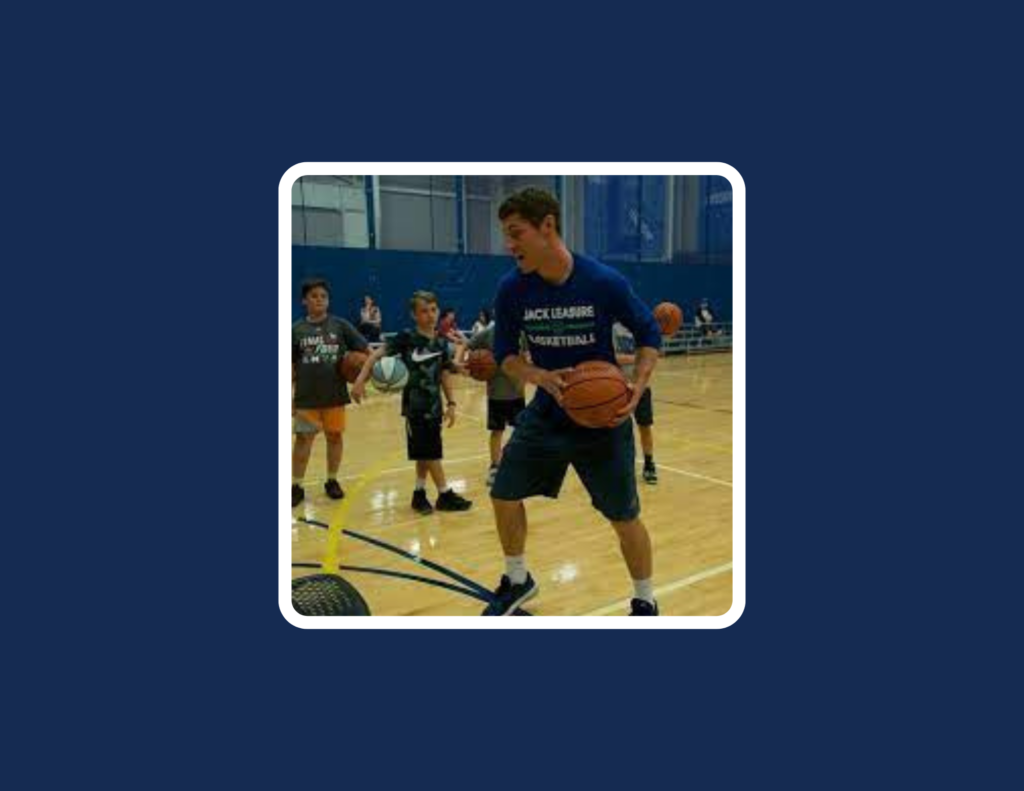
JACK LEASURE – MCQUAID JESUIT (NY) HIGH SCHOOL BOYS’ BASKETBALL HEAD COACH & FOUNDER OF JACK LEASURE SHOOTING & SKILLS CAMP – EPISODE 851
Website – jackleasurecamp.blogspot.com
Email – [email protected]
Twitter – @Coach_Leasure44
If you listen to and love the Hoop Heads Podcast, please consider giving us a small tip that will help in our quest to become the #1 basketball coaching podcast.

Jack Leasure is the Head Coach at McQuaid Jesuit High School in Rochester, New York. He is also the Founder of Jack Leasure Shooting and Skills Camp.
Jack played his collegiate basketball at Coastal Carolina where he ranks first in school history in 3 pointers made, Free Throw %, and minutes played. He was named the 2006 Big South Conference Player of the Year.
Jack played professionally from 2009 -2013 in New Zealand and Austria before returning home to his alma mater McQuaid Jesuit High School where he won a state championship as a player in 2003.
If you’re looking to improve your coaching please consider joining the Hoop Heads Mentorship Program. We believe that having a mentor is the best way to maximize your potential and become a transformational coach. By matching you up with one of our experienced mentors you’ll develop a one on one relationship that will help your coaching, your team, your program, and your mindset. The Hoop Heads Mentorship Program delivers mentoring services to basketball coaches at all levels through our team of experienced Head Coaches. Find out more at hoopheadspod.com or shoot me an email directly [email protected]
Be sure to follow us on Twitter and Instagram @hoopheadspod for the latest updates on episodes, guests, and events from the Hoop Heads Pod.
Have your notebook handy as you listen to this episode with Jack Leasure, Boys’ Basketball Head Coach at McQuaid Jesuit High School in Rochester, New York and the Founder of Jack Leasure Shooting & Skills Camp.
What We Discuss with Jack Leasure
- Growing up in Rochester, New York with a Dad who loved Pete Maravich
- “I just kind of found that same love, just the ability to kind of work by yourself and make yourself better.”
- The importance of having a plan when you’re working on your game
- Winning a New York state championship at McQuaid Jesuit High School as a player
- His decision to attend Coastal Carolina
- “I was kind of just focused on, I’m just going to get better. I’m just trying to get better. Just keep getting better. Keep getting better. And if I get good enough, I’ll get an opportunity.”
- Taking advantage of the time between his senior season of high school and his freshman year of college
- Playing for three different coaches at Coastal Carolina
- “At the high school level, if you don’t have good players. it doesn’t matter. You’re as good as the players you got.”
- How NBA pre-draft workouts test your conditioning and toughness
- His experience playing overseas in Austria & New Zealand
- “It’s never easy to play your last competitive game.”
- His decision to stop playing and take the head coaching job at his alma mater, McQuaid Jesuit
- The benefits of playing a lot of 5 on 5 in practice
- “Everything that you’re trying to cover will always come up and we can stop and teach it in the moment rather than trying to recreate it.”
- Maintaining the flow in practice while not allowing bad habits to be built
- “How are you helping your team in the other 95% of the time when you don’t have the ball?”
- The importance of offensive rebounding
- “I found that when we’re better with man to man principles, we can press and we can play zone better. So we kind of start from there and then build it.”
- “We tend to take who we got, see what works well, defensively, offensively, and try to figure that out as the season goes on.”
- Getting started training other players back when he was in high school
- Balancing his training business with coaching his high school team and family responsibilities
- “I’m trying to create a strong reputation where kids feel like they’re getting better when they’re spending time with me.”
- “Players at any level, if they feel like you’re getting them better, they’re going to want to be around you.”
- “My first question is always, what do you want to get better at?”
- “I felt like confidence for me came from that, that I was probably spending more time than you.”
- “Great shooters don’t care that they miss because they’ve already spent so much time and missed so many shots that they’re just they’re used to it.”
- “Great shooters energy goes more towards what’s the adjustment?”
- “You haven’t earned the right to be mad about that miss.”
- The positives of the camp environment for young players
Like this show? Please leave us a review here — even one sentence helps! Consider including your Twitter handle so we can thank you personally!
We’re excited to partner with Dr. Dish, the world’s best shooting machine! Mention the Hoop Heads Podcast when you place your order and get $300 off a brand new state of the art Dr. Dish Shooting Machine!

Prepare like the pros with the all new FastDraw and FastScout. FastDraw has been the number one play diagramming software for coaches for years, and now with it’s integrated web platform, coaches have the ability to add video to plays and share them directly to their players Android and iPhones via their mobile app. Coaches can also create customized scouting reports, upload and send game and practice film straight to the mobile app. Your players and staff have never been as prepared for games as they will after using FastDraw & FastScout. You’ll see quickly why FastModel Sports has the most compelling and intuitive basketball software out there! In addition to a great product, they also provide basketball coaching content and resources through their blog and playbank, which features over 8,000 free plays and drills from their online coaching community. For access to these plays and more information, visit fastmodelsports.com or follow them on Twitter @FastModel. Use Promo code HHP15 to save 15%
Your first impression is everything when applying for a new coaching job. A professional coaching portfolio is the tool that highlights your coaching achievements and philosophies and, most of all, helps separate you and your abilities from the other applicants.
The key to landing a new coaching job is to demonstrate to the hiring committee your attention to detail, level of preparedness, and your professionalism. Not only does a coaching portfolio allow you to exhibit these qualities, it also allows you to present your personal philosophies on coaching, leadership, and program development in an organized manner.
The Coaching Portfolio Guide is an instructional, membership-based website that helps you develop a personalized portfolio. Each section of the portfolio guide provides detailed instructions on how to organize your portfolio in a professional manner. The guide also provides sample documents for each section of your portfolio that you can copy, modify, and add to your personal portfolio.
Whether you’re a beginner basketball player looking for a place to start or a seasoned vet looking to level up your skills, your new go-to secret weapon is Train.
Train is a basketball training and education platform that gives you on-demand access to premium basketball courses created by expert coaches and trainers from around the world.
Want to get better at blowing by your defender? Learn setup drills with NBA & international pro trainer Marius Williams or how to use the punch drag with NBA trainer Kerry Darting.
Looking to level up your catch and shoot skills? Practice space shooting workouts with former lead female trainer for Kobe Bryant’s Mamba League, San Dixon.
Or if you’re just starting out, learn the basics of shooting and finishing at the basket from international champion, 3 time Romanian player of the year, and Train co-founder, Vlad Moldoveanu.
Train has 32 (and counting) actionable, expert-led, on demand basketball training courses that teach you exactly how to improve your ball handling, shooting, attacking, and more!
For a limited time, Hoop Heads listeners get 35% off monthly, annual, and lifetime plans. Click the button below to start a 7-day free trial and claim your discount.

SportsLab360 is an online platform that empowers youth basketball players to increase their Basketball IQ. It is made up of engaging, interactive modules that focus on different tactical concepts, from the basics of reading a ball screen, to specific offenses such as the dribble drive. Coaches assign these modules as basketball homework for their players, and can track player progress and scoring, as well as input custom notes within the modules.
By working through the modules before practice, players arrive with a cognitive head-start on the topic, and coaches can get much more out of a single practice. Simply put, rather than having to try and progress from A all the way to Z, SportsLab360 takes care of the first letters of the alphabet, allowing coaches to more quickly move on to the next layer, imprinting their own philosophy and style of play.
SportsLab360 launched in soccer about 6 years ago with lots of success, and have just recently launched in basketball.
THANKS, JACK LEASURE
If you enjoyed this episode with Jack Leasure let him know by clicking on the link below and sending him a quick shoutout on Twitter:
Click here to thank Jack Leasure on Twitter
Click here to let Mike & Jason know about your number one takeaway from this episode!
And if you want us to answer your questions on one of our upcoming weekly NBA episodes, drop us a line at [email protected].
TRANSCRIPT FOR JACK LEASURE – MCQUAID JESUIT (NY) HIGH SCHOOL BOYS’ BASKETBALL HEAD COACH & FOUNDER OF JACK LEASURE SHOOTING & SKILLS CAMP – EPISODE 851
[00:00:00] Mike Klinzing: Hello and welcome to the Hoop Heads Podcast. It’s Mike Klinzing here without my co-host Jason Sunkle tonight, but I am pleased to be joined by Jack Leasure. Jack, welcome to Hoop Heads Pod.
[00:00:16] Jack Leasure: Absolutely. Thanksfor having me, Mike.
[00:00:19] Mike Klinzing: Jack thrilled to have you on looking forward to diving into all the things that you’ve been able to do in your career.
Let’s start by going back in time to when you were a kid. Tell me a little bit about your first experiences with the game of basketball.
[00:00:33] Jack Leasure: Yeah my, my dad I kind of all starts around with my dad who still coaches with me now, which is cool. But you know, he was like a junkie, and he didn’t really get it from anywhere except he just loved watching Pete Maravich as a kid so he would watch the Homework basketball and all that stuff. And just grew up kind of loving how he could just make himself better in the driveway by himself so he, he kind of passed it on to me watching Syracuse basketball growing up and together we kind of grew in the game together. And I just kind of found that same love, just the ability to kind of work by yourself and make yourself better.
And yeah. So I wasn’t playing AAU as a eight year old or anything like that, but you know, grew up around three, four, five, start, starting to be around it a lot, and then kind of caught the bug around probably 11, 12, where I was, it was really important to me and I was trying to spend a little time every day doing it.
And then that just steadily grew.
[00:01:46] Mike Klinzing: Who was your guy growing up for Syracuse?
[00:01:46] Jack Leasure: I really liked Mike Hopkins which is funny. I, cause he, he recruited one of our guys, Isaiah Stewart, not that long ago. And Isaiah played for him at Washington, but I told him that when he came on.
Or when he was around, I said you were my favorite player growing up. And he said, you have to be making that up. He’s like, I was nobody’s favorite player, but he wasn’t one of mine cause he was smart and he shot it well, took charges did a lot of little things to help his team win and it was fun to watch.
[00:02:21] Mike Klinzing: It’s funny how the players that you gravitate to when you’re a kid and who you like, and it’s always interesting. I think people go one of two ways. I think they go with a player that they can kind of see themselves in, or they go the other way. They pick out a player who’s completely diametrically opposite of who they are, who they could be.
As a player. And I think I always went that direction. I was like, yeah, I always want to be the guys that can run and jump and dunk and do all this stuff. And that was the exact opposite of who I was. Like I, I despised watching the players who were like me that were more ground bound and did kind of the fundamental stuff.
Those are the guys I’m like, I like I could do that. I don’t want to, I don’t want to be like that guy. I want to be like Jordan or Dominique.
[00:03:03] Jack Leasure: For sure. For sure. I think I was the opposite. I like Kirk Heinrich and I liked I liked all these guys that did exactly what I felt like I could do.
[00:03:15] Mike Klinzing: But then I think most
people fall into one of those two camps.
[00:03:16] Jack Leasure: Yeah, I think you’re right. I think you’re right.
[00:03:21] Mike Klinzing: Did you play other sports growing up?
[00:03:21] Jack Leasure: I did. I played soccer and baseball which really loved baseball and my son’s playing now and I’ve always been a big fan, but. I stopped around eighth grade.
I say all the time, my dad told me, my dad kind of encouraged me to play as long as I could. And he said, around eighth grade, I’d be playing shortstop in the summer and I’d be watching over my shoulder, pick up games in the park. And he said, yeah, if you don’t want to play anymore, that’s probably time.
[00:03:56] Mike Klinzing: As you started getting serious about basketball, what did it look like in terms of your training? Did you have a formal way of going about it or was it more haphazard?
[00:04:06] Jack Leasure: Well, my I never had a trainer, which is so common now, I’m training that’s what I do but I never had that.
I had a guy who played at McQuaid before me, Cade Lemke, who now coaches, he actually played at Virginia under Pete Gillen, and then now he coaches the Blue Ridge School in Virginia, but he was awesome. And he would just come back and work with the guys. So that was one of the guys that sort of inspired me.
But my dad was always really good about just saying, Hey, look, If you’re in the driveway shooting around, you’re not getting better like you got to kind of go with a plan. So once I started to get serious about it he would be there with me sometimes, but most of the time it was just he was encouraging me to go with a plan, do ball handling, do form shooting, get into shots you’re getting in games.
And so eventually I started to really enjoy making that on my own. And that was really, I think what helped me play as far as I was able to play.
[00:05:16] Mike Klinzing: As you got into high school, what are some of your favorite memories of being a high school basketball player? Do you have one that stands out?
[00:05:23] Jack Leasure: Well I, McQuaid, like I was saying, Cade Lemke, the guy named Chris Fox, who played at McQuaid. Those guys were around 97. And I remember going to watch those guys play. And I said this is where I want to play. This is a fun environment watching best, it was really good basketball.
They won a state championship that year. And so I was in about sixth, seventh grade. I was like this is what I want to play basketball here. I want to play varsity basketball here. I want to try to do what those guys did. And so I ended up being on a really good team in 2003 with Tyler Ralph, who was New York state, Mr. Basketball now a big time trainer in Dallas, and then two other Division I guys Ryan Patanello played at Virginia, and Marty O’Sullivan played at Fairfield. So that year we were number two in the nation, and the first, number one was St. Vincent St. Mary. And it was just an unbelievable run 27 and 0.
We won the state and then we ended up going back for the federation tournament, we lost to Lincoln and Sebastian Telfair and those guys. But that season in general, that run winning the state was probably my best memory in high school, just cause we had gone to the state final the year before and kind of worked as a group with kind of this collective vision for a whole year leading up to it. And it was culmination of a lot of things. So that was probably the most special piece.
[00:06:52] Mike Klinzing: At any point during your high school career, are you thinking as a coach or are you strictly thinking as a player at this point?
[00:07:00] Jack Leasure: I was always a player. And even early on as a coach, I feel like I was too much thinking like a player. And even now I just feel like I’ve always kind of looked at it from that angle. But yeah, I don’t think I ever was like in the back of my mind eventually I want to coach. I was just all about like, I want to try to get to the highest level I could.
And, and then when I stopped, it just felt right. And I was kind of ready for the new challenge, but I think I’ve always kind of come from that side of thinking like a player.
[00:07:33] Mike Klinzing: When you have dreams, are your dreams about being a player or your dreams about being a coach?
[00:07:38] Jack Leasure: Definitely still a player. Yeah, that’s a good question.
People always ask me that all the time. I have a bad one all the time. Yeah, like, I was a shooter. Like, that was how I added value probably the most. And I have this dream where the ceiling’s too low. And it’s like, I can’t get a shot off here. Yeah, that’s this bad dream that I’ve had more than once.
[00:08:03] Mike Klinzing: So I always have dreams as a player, and I always have a dream that it’s always takes various forms, but it always ends up in a fact that we end up losing some game that was An important game. And just like most dreams, it’s like completely nebulous what that game is. But you know, those dreams where you wake up and you think it’s real and you’re like depressed for like the first 20 minutes when you’re awake, I’m like, yeah, we lost that game.
And then I have to remember, oh, that was just a dream.
[00:08:30] Jack Leasure: Right. Yeah. There’s so real that it stays with you a little bit.
[00:08:34] Mike Klinzing: Exactly. No question about that. All right. Tell me a little bit about the recruiting process for you. What that looked like. Obviously, you’ve got some really good players on your team, so you guys are getting a lot of attention that both as a high school team, I’m sure, through your experiences with AAU, but just talk a little bit about the decision to go to Coastal Carolina and what your recruitment was like.
[00:08:53] Jack Leasure: Yeah, I really benefited from the group I played with. We had five division one six division one players over the span of four years. Two years there. And so we played kind of big time events and we had all the benefits of playing a, if you were to play for like a national powerhouse so I really benefited from that.
And I had a lot of interest that was kind of like from really all levels, but I had no offers until late in my senior year and it was always kind of like we like the way you play. We just don’t know if you have the athleticism at this level. So I had a good senior year and had some big games in that year.
And I was lucky enough to get a couple Ivy league offers and then three scholarship offers. Sort of towards the end of that year. So I kind of had to gamble a little bit to kind of wait it out, but I ended up committing in April to Coastal Carolina and loved every minute of my time there. When you think
[00:10:00] Mike Klinzing: When you think back to that decision. And obviously, as we said, you played with some outstanding players. You got to play in a lot of big events against, I’m sure lots of very good opponents, how frustrating was it at least early in the process that you maybe weren’t getting as many looks as you thought you might have deserved? Was that something that ever crossed your mind?
[00:10:24] Jack Leasure: Not really. I feel like I had a pretty good head on my shoulders for that age, because I’ve coached so many kids now at that age, and I can see how frustrating it is at times to be sort of overshadowed or have probably fewer touches and points than you should get because you got better players around you or maybe you’re not getting the interest you wanted.
But I feel like I was kind of just focused on, I’m just going to get better. I’m just trying to get better. Just keep getting better. Keep getting better. And if I get good enough, I’ll get an opportunity. And so I think. That’s sort of ended up being the right mindset.
And I think it’s what really a lot of high school kids could do better with. Cause it’s always like if it’s not going well, I’m going to leave and go somewhere else. Or I need to reclass or I need to go to this prep school to make it right. Whereas the truth is it all comes down to, if you’re not good enough, you’re not, nobody wants you, you know?
And so at some point you got to be good enough, no matter where you go, what grade you’re in. So I do feel like I did have that mindset at that time. And that helped me get an opportunity.
[00:11:43] Mike Klinzing: That’s really good advice I think for kids because obviously with the advent of social media and how prevalent it’s become in terms of kids posting, I got this offer, I got that offer and then seeing what other people are posting and hearing, it’s just so much easier now to know what everybody else.
Is doing, whereas in the past prior to social media, yeah, maybe you knew what the guys in your immediate area were doing or where they were going to go to school, but you didn’t know guys from across the state or across the country. And certainly not guys who are playing at mid major division one or division two, division three, like none of that stuff was around.
Whereas now you can go on Twitter and you can find a million posts in a day about this guy got that offer from here and there. And I think it’s, it’s harder to probably keep your head on your shoulders. Today and not just be spinning around looking at what everybody. At what everybody else is posting and doing, it’s good that you were able to have that, that mindset back then.
And it obviously put you in a spot where you ended up having a really, really successful career at Coastal Carolina. So talk about what pushed you over the top. What made Coastal Carolina the right choice for you?
[00:12:52] Jack Leasure: Yeah. I went into a team that kind of really only needed what I did so I played a lot right away.
That’s something that is hard to find to play a lot of the freshmen at any level, college basketball. But so I benefited from that. I think, I say this to a lot of the kids that I coach that are getting ready for their freshman year too. That I feel like I really took advantage of kind of April through September, August of that summer, because I think a lot of kids like they’re going to college, it’s their grad parties, kind of drinking, sort of mailing it in a little bit. And I was like I was really focused that during that time. So I came in, I think to some degree, even more ready than some of the college guys that were already there that also tend to be in that mode quite a bit.
So. I think that was a positive thing because it helped me be ready to play a lot as a freshman, and then that kind of carried over to my sophomore year where we had a really good year under Buzz Peterson and really probably should have made the tournament but lost by one in the final, but we had a great year that year.
I just benefited from falling into a really good fit and being in a place where I also really liked it to be and enjoyed kind of everything outside of basketball too. So you know, in some sense, I think I got lucky a little bit that one of the very few offers I had.
[00:14:29] Mike Klinzing: Yeah, it’s funny how sometimes that works. I had one offer coming out of high school way back when, and ended up in the right spot. And I played a lot less than you did as a freshman, but I would say my last three years in terms of I’m looking at your minutes played right here in front of me right now.
And it looks like pretty much unless you, unless you fouled out of a game or it was a blowout, you were pretty much on the floor. And I feel like my last three years were. Very similar. And again, obviously that makes for a great experience being able to be out on the floor and be able to play and feel like, Hey, my coaches are confident in me that I can be out there that amount of minutes.
And then that allows you to really again, continue to develop as a player and improve and have a great experience.
[00:15:12] Jack Leasure: Absolutely. Yeah. Well put.
[00:15:16] Mike Klinzing: All right. So when you think about that college experience and you think back to the teammates you had, the coaching staff that you worked with, who were some of the people that you feel like during that time had the biggest influence on you?
Would you say it was a teammate, a member of the coaching staff? Who do you think had the biggest impact on kind of who you were as a college player?
[00:15:41] Jack Leasure: The one thing about when I came in my freshman year, what I didn’t realize was like, that was kind of my head coach at the time was Pete Strickland, who was great.
And it’s been around the game for a long time, but I learned a ton from him. What I didn’t realize was that was sort of like his last chance was that year to like win. So we did not, we were under 500 that year. And so he got fired that year. So we ended up having a new coach, Buzz Peterson, the next two years.
And then Buzz left after my junior year to go to Charlotte in the NBA. And he’s still there now, but so I ended up playing for three head coaches. And the last one was Cliff Ellis, who’s still at Coastal Carolina. But at the time that felt like a little bit of turmoil, but now as a being a trainer, being a coach, it was such a benefit to have, to learn from all those guys and then also learn from their assistants and guys like Mike Boynton, who’s now the head coach at Oklahoma State was an assistant.
And Ed Conroe is one of my favorite coaches I’ve ever played for. He’s the head coach at the Citadel, but the list goes on, but it was a really good little snippet of three, four years of just like this whole bunch of different angles of coaching and different ways of learning and teaching the game that I was able to kind of soak in.
[00:17:06] Mike Klinzing: Can you point to maybe one thing from each of those three that you kind of carry with you that are part of who you are now as a coach?
[00:17:14] Jack Leasure: Yeah, you know Pete, Pete Strickland, my first coach I felt like he was really good with like the skill stuff, like specific skills teaching, individual work, that kind of stuff.
I felt like he put a lot of emphasis in that. And so when I first started coaching, I was intent on a chunk of that practice plan has got to be skills because it’s easy to sort of forget about that, especially as the season goes on and you’re dialed in the scouting and all the little things you got to get better at as a team.
And you forget that the players got to keep getting better all year and if you don’t have, especially at the high school level, if you don’t have good players. it doesn’t matter. You’re as good as the players you got. So I felt like Pete helped me with that.
I think Buzz always had great practices, we just went hard. And he was always mapped out well. And most coaches, the college level can say that, but I felt like I learned that from him and then Cliff was excellent with scouting reports and preparation. So those two and even to have all three with kind of three different strengths really for them was a benefit to me to learn all those things.
[00:18:34] Mike Klinzing: I always say that I played for the same high school coach and the same college coach, and when I started coaching, that was really all I knew was those two systems and those two sets of drills and those two philosophies. And I think the misnomer is that when you’re a pretty good player, that you think that, Hey, I’m going to be a pretty good coach.
And I know I certainly thought that when I was 23, but you look back on it in retrospect and you’re like, Man, I knew nothing about the coaching profession, about what it means to be a good coach. I mean, I knew what it was to be a good player. But the only thing I knew about coaching was what I observed from my high school coach and my college coach, and like you, I had no thoughts whatsoever while I was playing of ever coaching.
So it wasn’t like I was at a practice in college and thinking about it from, Hey, what are the coaches doing here? What’s their perspective on why they’re choosing this drill or that drill, or why are they doing this with us? Everything that I did and thought. What’s from a player perspective. Nothing was from a coaching perspective.
So when I eventually ended up coaching, I look back now and I’m like, man, I was terrible because I didn’t, I didn’t know anything. I only knew, I only knew two, I only had two perspectives on coaching. And at that point, my ego was still too big. And I just thought, Hey, I can do this because I’m a player.
So. I think from your perspective, it was probably felt somewhat chaotic in the moment. But retrospectively as a coach, I’m sure that as you’ve said it, you felt like it really benefited you to see all those different systems and ways of, of just going about it.
[00:20:13] Jack Leasure: Yeah. A hundred percent. Yeah.
[00:20:16] Mike Klinzing: Were you… At this point during your college career, what were you thinking about in terms of career?
So, what are you majoring in? What are you thinking about? Obviously, you’re going to have an opportunity, which we’ll talk about here, to play overseas when you’re done. But what were you thinking about, hey, if playing doesn’t work out, what were you thinking about career wise?
[00:20:38] Jack Leasure: Yeah I was a history major. My goal was to get my master’s in teaching afterwards. So in the back of my mind, I was headed towards I’d like to teach, probably coach if I’m teaching that kind of thing. And then as it went on, I had a real good senior year. We had a handful of injuries that year.
And so I ended up having to kind of score a lot and play the point and do some other things. So we didn’t have as good of a season as a team, but a lot was put on my shoulders. And I had a strong senior year, but towards the end of that year, there was a couple of NBA teams that had shown some interest in just at least doing a workout so I was thinking, all right, well I have even, even a small amount of interest at that level, I probably could play overseas.
So I was deciding that that was what I was hoping to do. So I did one workout with Charlotte and I had two others that were like kind of had me sort of on a list you could say. And then I got an offer early on in in that off season and I chose not to take it, which looking back, I was like, I should have just taken it.
And then I ended up waiting like another two months and went to Austria in January of 2009. Which was great the whole overseas experience to me was. was awesome. You know, my only regret is I didn’t do it longer.
[00:22:12] Mike Klinzing: All right, before we jump into that, what was the experience like in those NBA workouts?
What do you remember from those? What’d they have you guys doing?
[00:22:19] Jack Leasure: Yeah, it’s funny. Anthony Lamb played for the Golden State Warriors last year started some games with a two way you know, it’s really filled a role really nice for him last year, but he’s a Rochester guy.
And so I’ve had him for training kind of probably every day, the last few weeks here. And so I’m kind of trying to draw from that experience a little bit right now, because he’s getting ready for a workout with the Celtics next week. But what I remember is a lot of conditioning, like they were trying, they’re trying to see what you can do, but everything was built around conditioning in between. So like they, they didn’t care if you could make 23s in a row while you’re fresh, they wanted to see you do it kind of while you’re tired. So it was nothing super. Complicated, but they tried to make, they really made it game like, and so as a trainer now, you just, that one workout, I draw still draw from that a little bit of toughness test too.
[00:23:20] Mike Klinzing: For sure.
[00:23:22] Jack Leasure: Yeah. See what you’re made of
[00:23:26] Mike Klinzing: To get overseas. How’d you go about getting an agent and figuring out sort of the logistics of making that happen?
[00:23:34] Jack Leasure: Yeah. I had an agent just kind of approached me. My senior year and said they’ve had players experience in that. And so they were able to help me get my start.
When I eventually got to New Zealand, the team was like, Hey, we just want you to keep coming back as long as you want to play. So I told my agent said, Hey I’m probably good. So I kind of was without an agent my last couple of years, but I was just kind of going back to that same team it was low budget enough where they were like, Hey, if you don’t have an agent, we can give that money to you.
And I was like, all right, I’ll take it a little different than an NBA contract, you know? But so yeah, New Zealand. I love it, my first son was actually born there. And we went back another year with him. And we did that for four years and kind of probably would have done it longer. My second son was due to be born that year.
And then I took the job at McQuaid. That would have been my fifth year playing overseas. How hard was it to walk away? I kind of felt, I felt really excited about the McQuaid job. And so that took away from it a little bit because it wasn’t like I was just walking away from basketball in general.
But I kept playing a lot. I played in some of those, like the TBT now, the kind of where, before that started, there was some of those around our area that I did a handful. So I was still playing, I was still coaching still around basketball a lot, so. It wasn’t as tough as some other transitions might be, but yeah, it’s never easy to play your last competitive game.
[00:25:22] Mike Klinzing: What’s your craziest story from playing overseas, PG 13 version?
[00:25:27] Jack Leasure: Yeah. You know, It’s not to some degree, it’s not what people think. Like you think you sort of think pro basketball, you think of way NBA guys get treated, but, the way you travel, the way all that stuff is different.
In New Zealand, it was really good. Like we pretty much flew everywhere, but there’s other times where you’re riding like I, here’s, I’ll give you an example when I, when I went to Austria, I flew into Ljubljana, Slovenia. So if you look, if you look and look up Ljubljana. You know, it’s got I would, it’s probably got 10 vowels in it so I’m trying to read the name of the city from the ticket and I’m like, I don’t even know where I’m going.
Like, I honestly don’t even know where this place is. And so I show up this kid who I looked like he was 14 he’s like in broken English, like you come with me basically. And so I hop in this van with him and we’re going through what they call the Ljubljana pass through these mountains, just like swerving in and out.
And in this. This like beat up van. And I’m like, what did I just agree to here? You know? So it’s not you know, it’s different from what you might think for pro basketball, but I ended up being everything was fine, he got me to where I needed to go, I played that night.
And played well and kind of rolled from there.
[00:26:58] Mike Klinzing: What’s your favorite city you played in?
[00:27:02] Jack Leasure: I loved traveling around in New Zealand that, that from the North Island to the South Island, it’s like whole different cultures, really so it was, it was fun kind of experiencing that, that range.
I loved Wellington, New Zealand is a really cool city it’s a capital city, but it’s not like huge it’s like 500,000. And then there was a place in there called Nelson that was kind of a smaller town, kind of really coastal feeling. But there was a number of really cool, I mean, New Zealand is just a beautiful place in the world.
I felt lucky to play there because there’s a lot of ugly places that guys are traveling overseas to play. And it was a great experience. You always got your paycheck. That’s right. Yeah. That’s the one thing I could always count on there.
You know, not everybody can count on that. I definitely heard cause wherever you go, you got at least one American teammate that’s been to a bunch of other countries too. And so yeah, everybody had stories of where they went and who pays and who doesn’t say go to this league cause they pay well, or don’t go here cause they’ll stiff you.
[00:28:20] Mike Klinzing: I’ve heard plenty of those stories. All right. So you come back stateside and how do you get the opportunity back at your alma mater? How does that. Opportunity come to you?
[00:28:31] Jack Leasure: Well, it came up when I originally took it, I was thinking I’ll just keep going back to New Zealand because New Zealand plays kind of opposite our, it plays like March through July or February through July, something like that, so I was hoping to be able to go there.
After the high school season ended that was what I was originally planning. It would have been tough, but, so I never ended up doing that. But when I took it though, I was thinking maybe I can still play. But… I dove right into it. I was kind of loved every minute of it.
Loved kind of the day by day, just sort of working to build something with the kids. I started out with a pretty good group, which was fun with a couple of good senior guards that were good leaders and workers and kind of set the foundation. And then we had not, I think two years later, we had Isaiah Stewart, who’s now at the Pistons.
And so that kind of brought a lot of excitement and a lot of guys wanted to come play for him, play with him, and then we had some really good groups kind of between 2016 and 2020. We went to three straight three straight championships and won two of them. And so it was fun. It was a really cool experience kind of right off the bat with all that coming together.
I’ve always loved practice and kind of the day to day just trying to like the same as the same as a player I just always kind of loved the process of getting better and Chipping away at a goal. So that’s kind of always been my favorite piece of it.
So even now, even this past year is my 10th year, but you know, I had a coach that came on and helped a bunch this year. Who was actually, when Isaiah was at Washington, he was a grad assistant at Washington from, but played, also played for me at McQuaid his first year. But he, he did all our scouting and film pretty much this year and you know, made it nice to be able to just kind of focus on those basketball pieces that I enjoy the most.
[00:30:40] Mike Klinzing: Designing practice. What’s your thoughts on… How you put a practice together, both in terms of the drills and the actual things that you’re doing during practice. And then what’s your process before the practice for planning it out and putting it together?
[00:30:56] Jack Leasure: Yeah. I listened to a podcast actually that Jeff Van Gundy did that I’ve always, I’ve met Jeff once or twice, and he’s got strong connections with Nazareth college in Rochester.
And he also coached at McQuaid for a year. So I’ve had that kind of small connection with him, but I listened to a podcast he did and he said in the podcast, like if I was coaching high school again, I would play five on five for 80 to 90 percent of that practice. And it seems like it almost seems like careless a little bit, but he said with kind of with the one restriction of like, I can stop this whenever I want and point things out.
So early on, I had very little five on five and I found that the kids weren’t as excited to practice. And the last couple of years we’ve played, we’ve tried to kind of get through the first half hour or so with the foundational skill stuff we want to do as individuals and as a team, and then just try to play as much as possible for the next whether it’s an hour, 90 more minutes.
And I found everything that I had written down from that game before or that we wanted to cover would, would just come up organically. And so the kids are you get whatever conditioning you want, if you’re playing a lot, that you can’t beat it. You can’t beat playing because 17s or suicides just don’t compare to condition you get from playing and then everything that you’re trying to cover just will always come up and we can stop and teach it in the moment rather than trying to recreate it.
So that’s, that’s where I’ve sort of headed with that. And sometimes I feel like I finished practice and I’m like, shoot, we should have played more. Like I spent too much time on that. I’m never finishing it saying, shoot, I wish we didn’t play so much, you know? So that’s kind of where I’ve headed the last couple of years.
[00:33:05] Mike Klinzing: All right. So to go along with that question, I know one of the things that coaches, I don’t know if struggle with is the right word, but one of the things that I think coaches have to try to balance out then is when you’re doing a lot of that playing and you’re doing it and it’s free flow and, and practice is moving along, then you have to figure out how to balance where you step in and what things that, what coaching points you try to make when you talk to a player about, Hey, What did you see here?
Or, Hey, we want you to do this, or, Hey, that was the wrong read. Just how do you balance interrupting the flow of practice and play with making sure that you’re actually getting some coaching points across as that stuff is going on?
[00:33:47] Jack Leasure: Yeah, I think that’s hard. I think that there’s definitely times where I feel like it just gets choppy because you’re having to stop so much.
Because you can’t let bad habits go because you’re not getting better from that, but you also want to make sure you’re kind of keeping the flow of the game. So I found that kind of early on in the season, it feels like it’s very broken up and then slowly it just kind of gets better and better.
But yeah, that’s the tough thing. And I think as a coach too, I think so much like a player that I’ll tend to not call a timeout when I probably should have, right? I maybe needed a sub in a spot. I probably shouldn’t because I just kind of want to see the game go and as a player, like you don’t want coaches calling a timeout, let’s just play so that would be probably an area where I need to when I’m coaching, I’m having to remind myself or write it down beforehand.
Like don’t forget that you’re a coach, like be dialed into that and be ready for those moments where players need you to do that.
[00:35:00] Mike Klinzing: What are the foundational things from a team standpoint that all things being equal, you like to build your teams around. Obviously there can be differences year to year based on your personnel, but when you think about yourself as a coach and what’s important to you, what are your team, what do you want your teams to be known for?
What do you guys do that’s sort of your signature?
[00:35:22] Jack Leasure: Yeah. You know, that’s a good question. We have sort of like some, some staples for our program that we talk about 95 percent a lot, which is probably something you’ve heard before. There’s something I got from Billy Donovan, just watching like a thing Billy Donovan did, but they talk about how even if you’re LeBron and you’re, and you’re a ball dominant guard or You know, whoever it may be, even if you’re that guy, you’re not having the ball more than 5 percent of the time around the floor.
So how are you helping your team in the other 95%? So that, that’s like one of the things we really focus on. I’ve found that kind of the most impactful thing in that 95 percent is offensive rebounding. So we really try to stress that we try to work on that, like specific drills to work on offensive rebounding and boxing on the boxing out on the offensive end.
But I found that all our best teams are typically winning in that area. So we focus on that. Defensively, we’ve mostly been like a pack line gap focus team. We play a lot of man to man. I’ve always kind of made that the focus defensively. I found that when we’re better with man to man principles, we can press and we can play zone better. So we kind of start from there and then build it. And then whatever the team strengths are, whatever we feel like they do well, we’ll sort of start gearing towards that as the season progresses, but I’ve never been a guy that syas we’re going to play this offense from fifth grade on, and that’s all we’re going to play.
And that was actually something from Buzz Peterson. He said we’re going to run whatever offense you guys are best at. So we tend to take who we got, see what works well, defensively, offensively, and try to figure that out as the season goes on. And one piece is that we, we tend to, we tend to start slow and finish strong and part of that is we, we play, we play a tough schedule every year, but it also is it takes some time for us to figure all that out.
[00:37:39] Mike Klinzing: So as you’re putting together. Your offense, your defense in a given year, you clearly have some beliefs and philosophies that are important to you. But then what I hear you saying is you’re also adaptable based on your personnel. And so, in order to be adaptable, you have to sort of have that toolbox to go into and say, okay, here’s what I have.
What can we do to take advantage of that? Where do you go as a coach to continue to learn the game, to study it? What are some of the things that you do to just improve your craft as a coach?
[00:38:14] Jack Leasure: Yeah, that’s a good question. I would say I just, I don’t watch a ton of basketball, but whenever I do, I’m like, I wish I would I have five kids, so it gets harder and harder to find that time.
But whenever I do, I’m like I need to watch more basketball. So, whenever I’m watching, I just… either I keep a notepad by me or I go to my notepad because I’m like, I can’t forget to write that down. Like I can’t not write that down. So I’m usually writing down at least one or two sets or things I saw defensively that I kind of want to make sure I remember, whenever I’m watching games, that’s probably where I gain the most things. I’ll occasionally come across like videos, but I don’t love being like on my phone and scrolling through social media, so occasionally I’ll get something from that, but usually it’s from just watching basketball.
[00:39:09] Mike Klinzing: What are you guys doing right now off season wise in the fall heading into your official practices and maybe just so people know, talk a little bit about the rules. That you have to follow because obviously all across the country, different states have different rules, but just kind of what your off season looks like from a high school perspective.
I want to, I want to dive into your training part of it too, which I know is a big part of what you do, but just from right now, let’s stay focused on the high school part.
[00:39:37] Jack Leasure: Yeah. So we don’t really have any specific rules in New York where like, you can’t be with the guys for certain times. I’ve always felt like from the start, like it’s not really in the spirit of the rules though, to like be practicing year round.
And I think it’s just counterproductive with kids that age. So we’ll generally do like in the spring, we’ll do just kind of a couple times a week, more individual focused for really whoever’s not playing other sports and wants to be there. So I don’t make anything mandatory until. Right about now, we start to be like, look, hey, if, if you are not playing another sport, you really need to be here.
You can’t just not be showing up now. So in September and October we’ll do three days a week of lifting and then skills kind of to follow two of those. And then we play in a fall league for eight weeks, one night a week. So it’s not too heavy, but it’s enough where we’re starting to build and gear towards our season, which is early mid November.
[00:40:43] Mike Klinzing: Getting your team prepared and obviously doing that stuff in the off season gets you ready heading into the beginning of your practices and, and obviously heading into your schedule, which you talked about. You guys are playing a really good schedule, which sometimes leads you to slow starts and then your team builds over time.
How do you think about leadership development? Is there anything specific that you do related to leadership either to develop leaders specifically or to give the leaders on your team the space or opportunity to lead if that question makes any sense?
[00:41:23] Jack Leasure: Yeah, that’s a great question. I feel like that’s more important than people know and guys like yourself have coached you know how valuable that is to have a guy who’s a point guard on the floor a coach on the floor, a point guard is a coach on the floor or whoever it is whatever position.
But I try to find little windows where to sort of open up Space for leaders to step in basically. And I’m not the best at it. I’ll tend to just coach, coach, coach, but I try to remind myself to, Hey maybe I’ll just step away in this time out maybe it’s appropriate this moment and we’ll just see who sort of steps in and starts being a leader so I think I don’t know that there’s anything super specific that I try to do in that regard, but I just try to be mindful of I guess creating windows for guys to fill.
[00:42:23] Mike Klinzing: It’s one of those things that, what I always think when it comes to leadership is exactly what you said, which is you kind of have to give guys opportunities and space to be able to.
Because so often you talk to coaches in all different levels and one of the things that you hear a lot is, man, we just don’t have. This team doesn’t have any leaders or we just we need better leadership on our team. And then I think a lot of times the coaches tend to, again, I think it’s our personality, right?
Especially if you’re a player where you kind of, as a player, you kind of micromanage yourself, right? To try to get the maximum out of yourself as a player. And then as a coach, if you micromanage everything, leadership is one of those things that you end up micromanaging and then kids never really get an opportunity.
To lead and consequently then when things, when adversity strikes, instead of those kids looking to each other or looking to kind of take the reins. They all just turn and look at coach because they never really have had the opportunity to sort of deal with that adversity. And so I love it when I hear coaches say, Hey, I try to give these little opportunities for players to step in and take that leadership role because.
If you can do it in practice in a situation where there’s not a tremendous amount of adversity, but you’re sort of, again, you’re putting those training wheels on and getting players used to it so that when there is a situation where you need a leader to handle something, they’ve at least been put in that position to be able to do it.
[00:43:54] Jack Leasure: Right, right. Yeah, that’s well put. That’s well put.
[00:43:59] Mike Klinzing: Let’s shift from your role as a high school coach to what you do on the training, skill development, camp side of it on the more quote private business. How’d you get that started and then how do you balance that with what you do as a high school coach?
And then we can dive into some of the more nitty gritty stuff.
[00:44:22] Jack Leasure: Yeah, it’s a good question. I actually started doing it like in high school. There’s just a couple younger players and I wasn’t really being paid for it or anything like that. I just enjoyed it. I love making myself better.
I’m going to show you kind of some of the stuff I do. So there’s a couple of young players who asked me to sort of help them along. And then when I got into college when I would come back in the summer, I started doing it and people would just pay me for that. So it was very, very little at the time.
It was like a couple of kids. And then when I was playing overseas I was home enough where I could sort of make a steady schedule in the off season and sort of supplement what I was doing, what I was making overseas, because lot of those leagues, you’re not getting paid crazy money or a huge living by any means.
So it was a good way to sort of set that up. I did, I started, I actually probably where I started to really grow though, was, my second year overseas, I came back, I was like, I’m going to do a camp this year, so once I did the camp. Some of the training kind of it kind of was fed from the camp.
Like there’s enough kids coming to the camp every year where they were like, Hey, can we continue doing this beyond. So I’ve always enjoyed it. I’ve always I always feel like it’s a nice break between the high school team and the training side, because the high school team, you have a lot of fun things, but you have plenty of like you’re dealing with parents who are upset like you got five guys that can play on the floor and you probably have 13 or 14 on the team.
And you know, the numbers have it right. You’re going to have some that are upset. So you’re dealing with that. And then with the training, like you just never have that kind of thing. It’s they may be coming to you complaining about another coach, but you kind of have all the good with training like that so it’s all positive. It’s all trying to fill the upside and, and trying to help kids just reach their potential. So it’s a nice little break. I kind of focus more on the training in the, I’m doing a lot of training in the off season, summer, spring, fall. And then during the season, I kind of shut it down.
I’ll have a little youth program that we do kind of once a week. But. For the most part, I’m focused on the team during that time. So it creates kind of a nice, by the time the season’s over, you’re sort of ready for the training side. And by the time the training’s over. You know, at the end of that block, you’re sort of ready for the season and the challenges that brings.
So it’s been fun. It’s been, I’ve been doing it 10 years now and you’re always learning and things are changing and it’s been fun.
[00:47:16] Mike Klinzing: Before we dive into the details of sort of how you run the actual on court basketball side of this. Let’s talk a little bit about the business side.
Is there anything on the business side of it where, whether it’s doing the website stuff or Collecting all the information and sending emails and just kind of all the things that are non basketball related. So the administrative side of the business, is there one part of that that you really like? And is there one part of that that you really dislike?
Do either, does anything fit neatly into one of those two categories?
[00:47:53] Jack Leasure: Yeah. You know, I don’t dislike it. I would say I probably prefer to have it just to have it crossed off but I feel like over time of just like sort of create a little system where it’s you’re signing up online. You’re registering through a third party system where I’m not having to handle cash and checks as much as I did 10 years ago. So Shout out to League Apps. Yeah, exactly. Yeah. League Apps. Right. So those kinds of things over time it makes it all that stuff a little bit easier.
But yeah, I mean, it’s like any business though there’s going to be pieces to it where it’s like this is kind of the tedious part and then this is the fun part, but yeah, there’s pluses and minuses, right?
[00:48:51] Mike Klinzing: Absolutely. Walk me through the onboarding process when you get a new player that you start working with.
[00:48:56] Jack Leasure: You know, right now mine’s pretty rudimentary. It’s basically a text or an email, like my son wants to start doing some training when can we set up dates and I’m just kind of sending dates. I’m starting to try to figure out how I can or exactly what program I should be doing to make sure that that’s a little bit less clunky where they can just sort of sign up for open times online and get right to a schedule.
So it’s been the one nice thing is I’ve been able to sort of build my schedule with what fits with a bigger family and, and build it around what I’m doing with my McQuaid team and so that’s been good. But it really has been, the training side of it’s been really good over the last 10 years because it’s really been solely word of mouth. I’ve done a decent amount of advertising. I do a fair amount of videos, but I’m not crazy on social media. It’s really been kind of a word of mouth grassroots kind of thing that’s grown. And just trying to create a strong reputation where kids feel like they’re getting better when they’re spending time with me.
So that’s kind of been my biggest focus is like. Let’s create a really good product where people are showing up and they’re realizing that they’re getting a lot out of it and then they’re going to want to come back and they’re going to tell other people about it. So that would be my advice for somebody who’s doing it is, make sure that’s the number one focus.
Cause if, if, But players at any level, if they feel like you’re getting them better, they’re going to want to be around you.
[00:50:41] Mike Klinzing: Yeah, that is great advice. I don’t think there’s any better advice that you could give to a trainer. Somebody who wants to build a good business is. A give those players value where they feel like after they’ve worked with you, that they’ve gotten better.
And guys that I’ve been around that do that, they’re plenty busy and they have a hard time servicing everybody who wants to, who wants to work with them. So with that being said, for you, you have five kids. You’re a high school head coach. And you’re doing all this training. What does it look like in terms of you budgeting your time?
So, I know one of the things that I don’t do much training anymore, but for a while, when I first got out of high school coaching, I was doing it a lot. And my challenge was always trying to find Enough time to be able to serve all the people that wanted to work with me. And it got to the point where it was really difficult for me to pencil in a kid for if they wanted to come once a week with just the number of hours that I could make myself available, it just got to be really difficult.
So how do you schedule kids out to make sure that they’re getting to see you as many times as they want to, as many times as they need to, and yet still have time for your other responsibilities?
[00:52:06] Jack Leasure: Yeah, that’s probably my biggest challenge is just kind of finding enough hours in a day for all of it. But I just try to map it out ahead of time figure out where I’m, you really need to figure out where you’re needed at home first and where my kids schedules are and then from there, I kind of figure out where we’re plugging in our McQuaid workouts.
And then just try to fill the rest of it for the most part, I feel like I’m making sure that there is opportunities for every kid who wants it. Like you said there’s always for me, at least right now is a difficulty in finding time for everybody.
So usually if, if I can’t get a kid in the fall season. You know, as the different sports kind of turn around, usually there’s a little more opening in the next season or I’ll find some time during the winter season, something like that. So we’ll usually find some time at some point, but yeah, that’s definitely the biggest challenge for me, trying to balance all those things.
[00:53:20] Mike Klinzing: How many hours a week are you working?
[00:53:22] Jack Leasure: As far as training there, there’s been times like during COVID when nobody had school where I was doing like 35 sessions a week but there was nothing else going on. And now it’s less it’s kind of fit in with the rest of it where it might be 15 to 20 sessions, one hour sessions or whatever.
But then it’s hard to try to calculate that without calculating what you’re doing on the computer and your kind of admin work as well, if you were in a nine to five job, that would sort of be all encompassing. So it’s not crazy. It certainly gives you the freedom to be able to do a varsity job and be available to your family.
But yeah, you definitely can see where it’s tough to kind of plug all that in.
[00:54:23] Mike Klinzing: What does a workout with you look like? Do you kind of have a formula that you use with each kid that then you tweak based upon their abilities and what they need in terms of we’re working on shooting or we’re working on ball handling or we’re working on whatever it may be, how do you go about putting together the lesson plan for the training session?
[00:54:46] Jack Leasure: Yeah, that’s a good question. I think when I first started I was like, kind of writing it down ahead of time, like a practice plan, and I found that, like, especially when I have a lot, like, usually every week, at least every week, I’m having a new kid come in, right? So, like, you don’t really know what to expect and you kind of don’t really know what they need that day, what they want to get better at, how they want to spend that time.
So, Yeah. now I feel like my first question is always, what do you want to get better at? And if they’re kind of like taken off, caught off guard there, then I know, right, all right, they’re looking I’m going to see where they’re at and I’m going to just try to make sure that I’m dialing into the specific things that I know right away they need to improve at.
So I kind of have a bank in my brain of all right, this is a guy who just wants to get better at shooting today. And so this is the level he’s at. Here’s where we’re going to start. And then we’ll kind of progress to whether it’s working on drills that are focused on rhythm, drills that are focused on balance and footwork, drills that are just focused on form and kind of line and lift and that kind of thing.
The other side of it is maybe they, maybe they want to focus on their ball handling and footwork there. You know, even if it’s sometimes they’ll come in and say defense, that’s a rare one for me. I’m like, yeah, you don’t get that very often. Right. But so yeah, I usually am asking that question what do you want to get better at?
And then In my mind, I’m watching them and trying to decide right away what they need to get better at. And then we’re trying to get right to the meat and potatoes right away.
[00:56:35] Mike Klinzing: What do the conversations look like that you have with parents of the kids that you’re training?
[00:56:40] Jack Leasure: For the most part, it’s pretty simple. I’ll ask them beforehand, like I said, like how do we want to spend this time? I don’t want you to come in for an hour or you’re paying money. And leave like I wish he had done more on attacking the basket and finishes and whatever it is that he needs to get better at.
So most of the time it’s geared towards that. And then sometimes they’ll have questions on what do you see that he needs to improve at? You know, what if he’s going to play beyond high school, what level do you think he’s at? So there’s some questions like that.
And then like I said before, there’s some complaints about what kind of coaching they’re getting outside in their high school program or in their modified program, whatever it is. So usually those conversations are pretty basic. Most people are pretty positive and just excited to be there and excited for the kid to have a chance to improve.
So yeah, pretty straightforward with that though.
[00:57:45] Mike Klinzing: Do you use film at all in your training?
[00:57:48] Jack Leasure: Occasionally, if I feel like a kid, well, like with, with the McQuaid team, we watch a lot of film, like, team with them and stuff. But as far as the individual stuff, I usually only use it for shooting, specifics.
So if I see a kid that’s like, I’m trying to. Can I use words to describe a concept and they’re not sort of processing it or understanding what they’re doing wrong? So I’ll just take a video with my phone and sort of show them right in the drill like hey Here’s where we’re at and coach says your elbows out, right?
But the problem is your right foot is pointed towards the right corner, right? So now your hips out your shoulders out and now your elbows fighting all that to try to get back in So like, we want to correct all that. We got to get your base better. We got to get forward, down and through.
Improve all that stuff to get you back on a better line and underneath the basketball, that kind of thing. So usually… Sometimes a visual learner might pick that up better and I usually am trying to be mindful of that so that I can use that tool if I need to, but I don’t use it a lot really.
[00:59:02] Mike Klinzing: When you are working with a kid and they’re struggling with a particular concept, whatever it may be, it could be something with their shot, could be something with dribbling. What’s something that you do to kind of help them break through that, that wall? And maybe I guess to go along with that, I think one of the things that I hear a lot from parents when it comes to training is, is that, Hey, my kid’s not confident.
Like that’s something I used to hear a lot. And sometimes when you see a kid struggling with a particular skill, that’s kind of what people sort of perceive it to be. And my response to parents was always like, you’re going to get more confident when you get more confident.
So, when you’re, you’re thinking about helping a kid with their, with their mental game or with their confidence or with their ability to maybe try new things, what are you talking to them about? Or how do you approach that piece of it?
[01:00:01] Jack Leasure: Yeah, that’s a great point. And that’s great advice. But yeah, I agree.
I think, I feel like one thing I’ve said, like, since I started doing camps is the repetition and the time that you’re spending by yourself. You’re gaining muscle memory, but you’re also, I feel like gaining one way to look at it is confidence, but it’s like this sort of mental edge I feel like over your opponent.
Like I always felt like that was kind of my strength was like how I prepared, how it worked. I never felt like I stepped on the floor and looked across and like that guy’s probably worked harder than I have. You know, so I felt like confidence for me came from that, that I was probably spending more time than you.
So I think you’re right, the more time you’re spending, the more confident you’re going to get in that skill just because you’re building that skill and building the rep, building the muscle memory, the reps, whatever it is, but you’re also just gaining this confidence from knowing your shot better or knowing your skills, knowing yourself as a player better, but then also just this advantage of having spent more time, I think the one thing I try to draw on with shooting specifically is I’ll always say watch your favorite shooters, like watch them.
Everybody loves to watch just the shot and then when they make shots, right. But like watch them when they miss, watch, watch how they prepare beforehand and but specifically when they miss, like there’s no reaction so like a lot of the kids that are a little new to it, when they miss shots, they’re like this big emotional reaction that they’re wasting physical and mental energy on. And so that’s one thing I try to harp on is like great shooters don’t care that they miss because they’ve already spent so much time and missed so many shots that they’re just they’re used to it.
And their energy goes more towards what’s the adjustment? There’s always an adjustment. So that’s one little piece that I try to use to help them get thinking in a different way.
[01:02:13] Mike Klinzing: Yeah, I love that idea of adjustments. We had it’s been, I don’t know, probably over a year, we had Mark Hendrickson on who he pitched in the major leagues and also played in the NBA for the Sixers.
So he’s one of, I think 13 guys that have played in major league baseball and in the NBA. And he said that what he felt like was the biggest difference between professional athletes and I mean, besides the obvious, but he said that their ability to make adjustments and know their own have a feel for whether it’s a pitcher having a feel for their release point or a shooter having a feel for.
What their shot is supposed to feel like. They can make, they can instantly make those corrections because they can self diagnose. And he felt like professional athletes just had that ability to self analyze themselves and make those corrections. At such a higher level than athletes that didn’t get to that major league baseball or NBA level.
And I think that’s kind of what you’re speaking to is if you can have that ability to make those adjustments and to be able to put that miss behind you, right? It’s like, Hey, that shot’s already gone. You can’t focus on it. Whereas players who are less experienced, maybe have less of a feel. They tend to have those big reactions, like you said, to miss shots instead of just putting an analytical mind to it very, very quickly and then getting ready to move on to the next shot because you’ve done that so many times, you know what it’s supposed to feel like.
[01:03:45] Jack Leasure: Yeah. Yeah. No, that’s perfect. That’s exactly what I meant by this. The being able to self diagnose. I have a good friend who coaches girls basketball here kind of in our area. And he said to me one day, we were talking about a similar thing. And he was like I have this one girl and I want to say this to her, but I don’t want it to sound mean, is like, you haven’t earned the right to be mad about that miss.
Right. Yeah. So you’ll see that a lot, even with some kids who maybe are a little bit nervous and new to it and like are a little fish out of water, like they’ll overreact like, Oh, I should I should be making that. Yeah. You haven’t earned that right yet.
[01:04:25] Mike Klinzing: I think about that when I see dudes on the golf course slamming their club on the ground and swearing and stuff like, how much have you practiced golf that you have the right to get all mad?
I’m like, when I go out on the golf course, I know I’m going to be horrible. And so I really don’t get too upset about it.
[01:04:43] Jack Leasure: Yeah. You can’t walk out here and expect to shoot 80 when you haven’t touched a club in a month, right?
[01:04:50] Mike Klinzing: All right. Tell me a little about the camp side of your business.
[01:04:54] Jack Leasure: Yeah. the camps. Yeah. Like I said before, it’s kind of where everything started for me. And so this next year will be our 15th, my 15th year doing it. And I’ve always loved, I mean, I went to plenty, I was lucky enough to go to plenty of camps, Five Star and Eastern Invitational.
I went to a good smaller one growing up. And I felt like I learned a lot in those, those windows of time. And yeah, so I’ve always enjoyed kind of building a camp, kind of bringing in coaches from all over the area, not just kind of coaches that work for me. This past year I had 11 coaches that were former campers in camp, which is cool.
You know, as it’s dating me a little bit, but you know, that piece of it is, is fun too. I think when you’re at camps, there’s just a lot of the social side of it and like the relationship you build, relationships you build through sports and basketball specifically. You know, camp’s kind of a fun way for that to all to come together.
[01:05:57] Mike Klinzing: Yeah, I, I mean, I’ve been doing camp now for the summer, will be, let me think, 30, I think 31 years that I, oh wow. I’ve been doing camp and so it’s just so much fun to be able to get out there. And just like you, I’ve got guys that. Have worked for went to camp when they were kids and now they’re, they’re working for me as coaches and I’ll get some of the younger kids that are still maybe in high school that went and they’re sort of the junior counselors and that kind of thing.
You grow them into. Becoming full time coaches. And that’s just one of the things that it’s really fun. And I think when you start looking at the camp environment out there, they’re just, there aren’t that many, there aren’t nearly as many camps as there were when you and I were kids I think that every, everything has shifted towards AAU and playing travel basketball and playing more games.
And so I do think that there’s a place out there for a good camp that again, gives kids an environment where they can learn and have some fun and be with their friends and have it be an environment that is a positive one. Cause I think kids, again, it’s so pressurized when you start talking about travel leagues and AAU and we’re going down to second, third, fourth graders that I think one of the things that I always enjoy the most about my camp is that I feel like it’s kind of a pressure free environment.
Like it’s one of the few places where kids play, where I might have a camp of. 70 kids and maybe I’ll have one parent that hangs around and mostly that’s because they got a kid who’s young, who’s maybe a little bit nervous about being there, but for the most part, everybody else is gone. Whereas you think about AAU basketball or travel basketball and the parent behavior sometimes that you see in the stands and yelling, you’re like, man, no wonder these kids, they’re so shell shocked and they, they don’t develop that love for the game. And I feel like sometimes the camp environment is a safe environment for kids to just kind of come out and really learn to develop a love for the games.
[01:07:58] Jack Leasure: Yeah. Yeah. And, and for the most part, like at least, I think that’s exactly right.
But for when we do like, we do three on three at camp and like, they don’t even have a coach, like just the refs out there with them. And so the ref is sort of like making sure that they’re playing the right way. And they’re giving them basic little things, but they don’t have a coach on them.
They don’t have a parent on them. They don’t have somebody else’s parent on them, it’s definitely an opportunity to kind of eliminate all those things.
[01:08:33] Mike Klinzing: It’s great. I mean, I love it. We do the exact same thing with games where we just have an official and you’re making sure that everybody touches the ball and kind of giving them basic concepts and reminding them of little things to do.
But it’s one of the few environments again, where there’s not somebody breathing over their shoulder that, whether that be a parent or a coach and look, you can go back 20 or 30 years. And I think back to the way I grew up and. Most of my basketball that I learned, I learned without a parent or a coach around, it was me on my driveway or as I got older, going down to the playground and playing with people and nowadays kids don’t, they don’t get nearly that many opportunities to, to do that and play freely the way that, yeah, the way that I got to play.
And so I think that’s one of the things that always keeps kids coming back to camp, at least from my perspective is. I just think it’s an environment that’s, that’s low pressure and yet one where they can still learn and have fun.
[01:09:25] Jack Leasure: Yeah, that’s exactly right. I think.
[01:09:31] Mike Klinzing: All right. I want to wrap up with one final two part question.
Part one, when you look ahead over the next year or two, what do you see as being your biggest challenge? And you can frame that from whatever perspective you want, whether from the training camp side or the high school coach side or combine them, however you want to do that. So your biggest challenge in the second part is.
Your biggest joy when you think about what you get to do. Each and every day, what brings you the most joy? So biggest challenge, biggest joy.
[01:10:02] Jack Leasure: Good questions. Yeah. Biggest challenge, I think it’s getting harder and harder for a high school coach, I think it’s getting harder and harder to keep a group together.
Like, I think, like I was saying, we had a stretch of years where like we kept a group together. It really improved and like grew and I think that’s changing like just like in college, like everybody leaves so fast and moves around so much, like there’s just so much turnover. So that I think as a coach, I got to figure out sort of how to best advise and guide kids who are trying to make that decision to possibly leave and reclass and do things like that.
And then also being able to adjust around that. And like, if, if that is the nature of everything, like how do you kind of build a program if it’s going to be like it is to some degree in college where you have to sort of expect some turnover.
So I think that’s probably the biggest challenge ahead. I think that’s. That high school is sort of heading in that direction a little bit. And then biggest joy, my older boys are starting to play basketball now. And I’ve always been like I don’t want to push them into it at all.
Cause you know, there’s no upside there’s no win in that but they, they seem to start to really enjoy it now. So that’s been a lot of fun with basketball is kind of watching them grow and enjoy it. And like I was saying with Anthony Lamb working out, they’re in the gym, just sort of watching him and like, cool, this this guy played with Steph Curry last year like getting to experience that.
So like having them alongside that experience has been really fun. How old’s your oldest? He is 11. He’s in fifth grade and last year was like his last, his first season playing like on a team for a full season and he’s not one where like he’s like first choice isn’t going to be I’m going to go shoot, but lwhen other kids are around and it’s time to play, like he loves it so it’s cool to see him sort of light up in those situations.
[01:12:14] Mike Klinzing: That sounds exactly like my son. My son’s a senior in high school this year. And that description that you just gave of your son who’s in fifth grade, I would say was exactly like what my son was like. And it sounds like from our conversation and from what everything that I read kind of prepping for this, that you were wired in a similar way to me where you couldn’t get enough and you were, you were out there working on your game all the time and you know, trying to navigate that as a dad with a kid who doesn’t, isn’t wired that same way.
Even though the pitfalls you know, for me, sometimes it was a, it was a struggle not to say, hey, let’s, let’s do this. Let’s, let’s go and do that. And I’d always provide opportunities. And then at 1 point when my son was my son was coming out of his 9th grade year. And all of a sudden it was like the, the, the, the switch just completely flipped and I was like, Oh yeah, now I see he’s my kid.
It didn’t look that way for a while. And all of a sudden you know, the, the light bulb came on. So I guess my, my advice to you from someone who’s been down the next 5 or 6 years is keep doing what you’re doing. You’re doing it. Right. And just keep giving them opportunities and they’re going to, they’re going to find their way.
And 1 day you’ll be surprised that all of a sudden that. Yeah. That lights that, that switch might flip and you might get someone who’s got a similar drive as you do. Not that it matters one way or the other, but it’s cool when you see that light switch come on.
All right. Before we get out, Jack, I want to give you a chance to share how people can get in touch with you. Find out more about what you’re doing. So share social media, website, email. And after you do that, I will jump back in and wrap things up.
[01:13:57] Jack Leasure: Yeah, email is [email protected] and then all, kind of all, everything that we have as far as camps and training is at www.jackleisurebasketball.com. So yeah, it’s continuing to grow and anybody who is excited to be a part of it and wants to get better, I always say if it’s your first time touching a ball or you’re getting ready for your fifth NBA season.
You know, you’re in the right place. That’s kind of how I start a lot of our camps. Cause we’re always just about kind of getting better at basic things, getting to the highest level you can at some foundational things and building strong fundamentals. So hopefully we can add some more campers, some more trainers, trainees and campers.
[01:14:47] Mike Klinzing: Love it, man. Love it. And I can’t thank you enough for taking the time tonight out of your schedule to jump on with us and share more about your story and just all the things that you’ve been doing in the game and the impact that you’re making.
So thank you for that. And to everyone out there, thanks for listening and we will catch you on our next episode. Thanks.