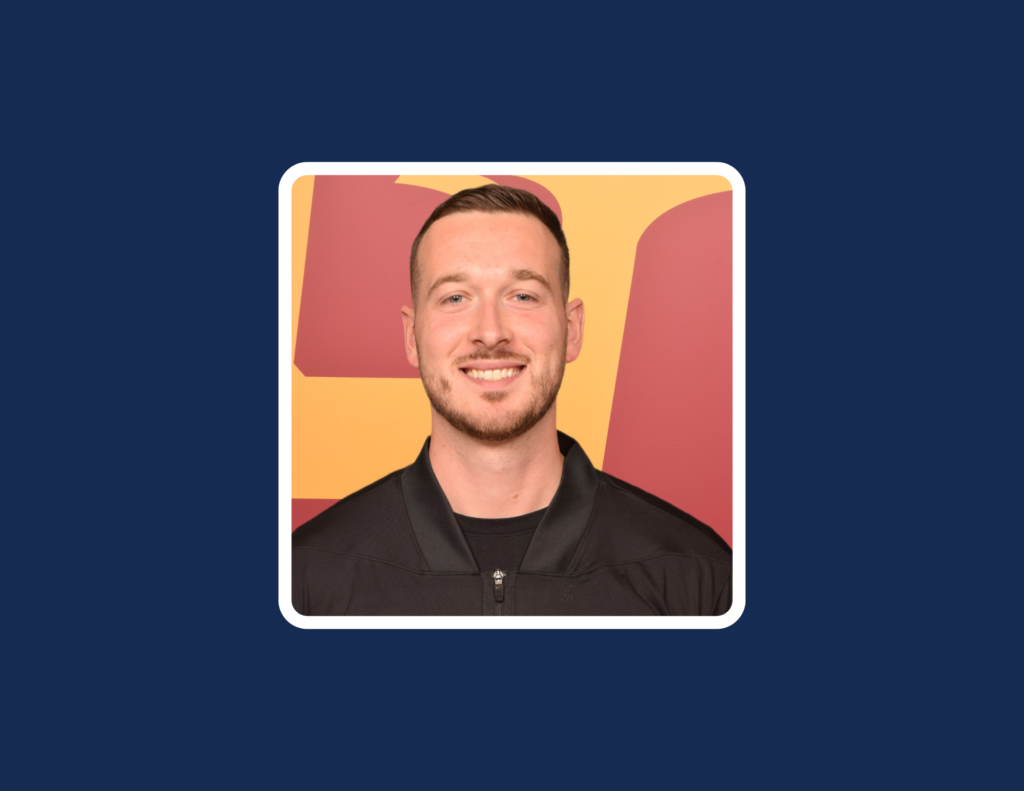
EASTON BAZZOLI – GANNON UNIVERSITY MEN’S BASKETBALL HEAD COACH, 2026 NCAA D2 NATIONAL CHAMPIONS – EPISODE 1253

Website – https://gannonsports.com/sports/mens-basketball
Email – [email protected]
Twitter/X – @EastonBazzoli
If you listen to and love the Hoop Heads Podcast, please consider giving us a small tip that will help in our quest to become the #1 basketball coaching podcast.
Easton Bazzoli is the Head Men’s Basketball Coach at Gannon University where he led the Golden Knights to the 2026 Division 2 National Championship. In two seasons as the head coach Bazzoli has compiled a 61-10 overall record. He spent one season as an assistant to Jordan Fee in 2023-24 where he helped the team to a record of 32-3 and an appearance in the Elite Eight.
Bazzoli Previously served as an assistant at Union University, helping guide the Bulldogs to a 96-71 record during his six seasons at the school.
Bazzoli played his college basketball at NCAA Division II Cedarville (Ohio) University from 2013-17. Easton was a four-year starter for the Yellow Jackets, appearing in 114 games with 95 starts. He finished his collegiate career with 973 points and 526 rebounds, along with 201 assists and 112 steals while serving as a two-time team captain.
On this episode Mike & Easton discuss the 2026 D2 National Championship Season for Gannon University. Easton talks about the importance of fostering a culture of relentless effort and unwavering character among his players, emphasizing that success is not merely a product of talent, but rather a culmination of commitment and cohesion within the team. He candidly reflects on the challenges of maintaining this mindset, particularly in the wake of victory, and the delicate balance between nurturing a winning culture while avoiding the pitfalls of entitlement. We dive into his coaching philosophy, which prioritizes adaptability and decision-making over rigid rules, thereby empowering players to respond dynamically to the ebbs and flows of the game. Bazzoli reflects on the transformative journey of his team from previous seasons to the 2026 D2 National Championship.
Follow us on Twitter and Instagram @hoopheadspod for the latest updates on episodes, guests, and events from the Hoop Heads Pod.
Make sure you’re subscribed to the Hoop Heads Pod on Spotify or wherever you get your podcasts and while you’re there please leave us a 5 star rating and review. Your ratings help your friends and coaching colleagues find the show. If you really love what you’re hearing recommend the Hoop Heads Pod to someone and get them to join you as a part of Hoop Heads Nation.
Be sure to take down some notes as you listen to this episode with Easton Bazzoli, Head Men’s Basketball Coach at Gannon University, 2026 Division 2 National Champions.
What We Discuss with Easton Bazzoli
- The journey to winning the 2026 NCAA Division 2 Men’s Basketball National Championship
- Building and maintaining a relentless work ethic in his players
- Establishing a culture of accountability and character
- Creating an environment where players feel valued and connected
- Coaching requires continuous learning and adaptation
- The journey of personal growth as a coach is intertwined with the development and success of the players
- Establishing an unpredictable and relentless defensive pressure mindset is predicated on teaching players to analyze and react rather than follow rigid rules, which can stifle their instincts
- Requiring players to develop sharp decision-making skills during high-pressure situations
- Creating a culture of love and support within the team enhances performance, as players are more likely to push themselves for one another in pursuit of a common goal, such as winning a national championship
- Navigating challenges of entitlement and maintaining motivation
- Learning from both victories and defeats to enhance leadership skills
- Impacting young lives through mentorship and guidance
Like this show? Please leave us a review here — even one sentence helps! Consider including your Twitter handle so we can thank you personally!

Give With Hoops is a groundbreaking initiative that fuses basketball analytics with modern sponsorship. Built for teams who see data as opportunity, from AAU programs to college powerhouses.
By tying on-court performance directly to community and sponsor engagement, Give With Hoops help programs raise more while deepening support from those who believe in the game.
Traditional fundraising disconnects donors from the action. Sell candy bars, wash cars, beg for donations, it’s exhausting and ineffective. Players perform better when their stats matter beyond the scoreboard. That’s why Give With Hoops was created.
Give With Hoops connects game performance to community support. Every basket, rebound, and assist becomes a chance to raise funds. Transparent, exciting, and proven to raise 3x more than traditional methods.
Aiming to go D3? The D3 Recruiting Playbook gives you a clear, step-by-step roadmap to the recruiting process – what coaches value, key milestones from early high school through application season, and how to build a target list of schools that fit your needs.
We’ll demystify researching D3 programs and how to stand out without chasing every camp or showcase.
The modules cover things like writing emails to coaches, building an effective highlight tape, using social media well, planning ID camps and visits, and navigating application strategy.
You’ll get templates, checklists, and an outreach plan to communicate confidently, learn how to compare financial packages, and avoid common missteps. By the end, you’ll have a prioritized school list and a decision framework you can use to land your best-fit opportunity.
Your first impression is everything when applying for a new coaching job. A professional coaching portfolio is the tool that highlights your coaching achievements and philosophies and, most of all, helps separate you and your abilities from the other applicants.
The key to landing a new coaching job is to demonstrate to the hiring committee your attention to detail, level of preparedness, and your professionalism. Not only does a coaching portfolio allow you to exhibit these qualities, it also allows you to present your personal philosophies on coaching, leadership, and program development in an organized manner.
The Coaching Portfolio Guide is an instructional, membership-based website that helps you develop a personalized portfolio. Each section of the portfolio guide provides detailed instructions on how to organize your portfolio in a professional manner. The guide also provides sample documents for each section of your portfolio that you can copy, modify, and add to your personal portfolio.
THANKS, EASTON BAZZOLI
If you enjoyed this episode with Easton Bazzoli to let him know by clicking on the link below and thanking him via Twitter.
Click here to thank Easton Bazzoli via Twitter
Click here to let Mike & Jason know about your number one takeaway from this episode!
And if you want us to answer your questions on one of our upcoming weekly NBA episodes, drop us a line at [email protected].
TRANSCRIPT FOR EASTON BAZZOLI – GANNON UNIVERSITY MEN’S BASKETBALL HEAD COACH, 2026 NCAA D2 NATIONAL CHAMPIONS – EPISODE 1241
[00:00:00] Narrator: The Hoop Heads Podcast is brought to you by Head Start Basketball.
[00:00:20] Easton Bazzoli: Some guys will try and get into some of the details of this too early. Ask that question in two weeks when you’re playing hard enough. Don’t even worry about that right now. I don’t even want to give you an answer because it would just fog your mind, and right now all you need to think about is playing harder than you are, because you’re not playing as hard as you think you are.
[00:00:38] Mike Klinzing: Easton Bazzoli is the head men’s basketball coach at Gannon University, where he led the Golden Knights to the 2026 Division II National Championship. In two seasons as the head coach, Bazzoli has compiled a 61 and 10 overall record. He previously spent one season as an assistant at Gannon to Jordan Fee in 2023-’24, where he helped the team to a record of 32 and three, and an appearance in the Elite Eight.
Bazzoli previously served as an assistant at Union University in Tennessee, helping guide the Bulldogs to a 96 and 71 record during his six seasons at the school. Bazzoli played his college basketball at NCAA Division II Cedarville University from 2013 to 2017. Easton was a four-year starter for the Yellow Jackets, appearing in 114 games with 95 starts.
He finished his collegiate career with 973 points, 526 rebounds, along with 201 assists and 112 steals, while serving as a two-time team captain.
Give with Hoops is the first platform turning basketball analytics into fundraising impact. Every stat tells a story, and now every story drives sponsorship, engagement, and team growth. Programs nationwide are transforming basketball stats into funding power. Learn to use performance data to attract sponsors, engage fans, and raise more with every play.
Give with Hoops will help you raise three times more money for your program, as their stat-based pledges consistently outperform traditional fundraisers. Visit givewithhoops.com/hoop-heads-podcast to learn more and take your fundraising to the next level. Give with Hoops.
[00:02:20] Dyami Starks: Hi there. This is Dyami Starks, trainer and player development coach for All Iowa Attack, and you’re listening to the Hoop Heads Podcast.
[00:02:29] Mike Klinzing: Are you or an athlete you know planning to go D3? Check out the D3 Recruiting Playbook from D3 Direct. Their playbook gives you a clear step-by-step roadmap to the recruiting process, what coaches value, key milestones from early high school through application season, and how to build a targeted list of schools that fit your needs.
The playbook demystifies researching D3 programs and how to stand out without chasing every camp or showcase. The modules cover things like writing emails to coaches… Building an effective highlight tape, using social media well, planning camps and visits, and navigating application strategy. You’ll get templates, checklists, and an outreach plan to communicate confidently, learn how to compare financial packages, and avoid common missteps.
By the end, you’ll have a prioritized school list and a decision framework you can use to land your best fit opportunity. Click on the link in the show notes to get your D3 Recruiting Playbook from D3 Direct.
Be sure to take down some notes as you listen to this episode with Easton Bozoli, head men’s basketball coach at Gannon University, the 2026 Division 2 national champions. Hello, and welcome to the Hoop heads Podcast. It’s Mike Klinzing here without my co-host, Jason Sunkle, tonight. But I am pleased to welcome in Easton Bazzoli, head men’s basketball coach at Gannon University, Division II national champions here in 2026.
Easton, welcome to the Hoop Heads pod, man.
[00:03:59] Easton Bazzoli: Appreciate you having me. I’m excited.
[00:04:01] Mike Klinzing: Absolutely. Thrilled to have you on. Looking forward to diving into this championship season. And let’s start with going back to the fall. As you’re heading into year two of your tenure at Gannon, what’s the thought process?
Where are you with your team? What do you think their potential is at that point? What’s the mindset kinda going into fall into fall practice?
[00:04:24] Easton Bazzoli: Yeah. Definitely a lot of confidence going into the year. We’re really excited about the guys that we had returning.
For us it’s been such a whirlwind, so to be able to… Like we’re, we’re– I got people going, “Oh, man, it’s a whole new team again.” I go, “I got six back this year.” This is like the most, this is the most consistency we’ve had. I actually really felt a level of confidence because I knew we were going to have players that had done what we’re trying to do before.
Y- you obviously feel… I’ve never signed a guy where I haven’t been excited about him, so you feel good about that stuff. But also felt like maybe we addressed some things that were weaknesses for us from the year before in recruiting. And and then, you have a level of confidence with, we were one of the only teams in the country, it felt to have an all-conference player coming back.
And, he ha- just so happened to be, you know- Quite possibly the best player in the country this year and you kinda knew that. So anytime you got, anytime you have a- have that situation, es- especially when it’s a guard who’s going to have the ball in his hands a lot there’s a level of confidence going in.
And our falls, I’m sure just like most, super optimistic. You feel great about your team. Then you have some days where you feel terrible about your team. But knew that we had the talent level early on. Knew that we’d hit on the character piece of this thing and and that it was just going to be, are we going to be able to cast the vision that they’re going to want to follow and kinda go from there.
So yeah, y- you feel confident. I don’t know anybody that doesn’t like their team in August. If you don’t, it’s probably a problem. But we did. We liked our team early and knew we had a chance to be good. We didn’t know how good, but we knew we had a chance to be really good.
[00:05:55] Mike Klinzing: What was your own level of comfort, confidence, stepping in your second year as- Yeah … a head coach? How much better did you just feel about you having a handle on what it meant to be a head coach and what you had gone through the previous year, just getting those reps under your belt? How did that part of it…
Forget about your team, your players, just you from a- Yeah … from a comfort level standpoint as a head coach.
[00:06:21] Easton Bazzoli: Yeah, I felt like I was one year less dumb, like I, I had I felt like I was able to learn a lot in my first year through, a lot of poor decision-making and and then, also just get that level of comfort as a head coach of, I think everybody kinda hears the same thing when they first become a head coach. “Don’t try and be someone else,” “be you.” And it’s honestly there’s a piece of you that you have to learn yourself on what that, i- in that new role of what you really means.
We all have these thoughts and what we want to do, and I had ’em all. I had all– I had written down. I had my notes. I had, “This is what we’re going to do. This is my plan. This is the culture we’re going to build.” And then and then the, at the end of the day, there’s still trial and error.
You, we came out my first year, and we go down and we play two top 10 teams in the country on neutral f- on a neutral floor the, my first two games as a head coach and get our brakes beat off. And I’m sitting there going, “What in the heck am I doing?” And and just, I think that level of comfort and just having that year under my belt of, of- Making mistakes, making the right decisions and feeling confident that they are the right decisions.
I think God’s blessed me with being able to be relational, so that, that’s kinda always been there and I think there’s a level to even my first year when all the mistakes that we made, I thought we did have great relationships. I think I think that went a long way, just to be able to have the experience, learn from it, good, bad and and then make those decisions as a leader moving forward, and a little bit more calculated and a year smarter.
I don’t know if I could say smart yet- … but definitely smarter.
[00:07:55] Mike Klinzing: How close was the vision that you had prior to taking the job? How close are you to what the vision was? Obviously, winning a national title smooths over a- anything that didn’t go exactly the way maybe you thought it was going to go in your head.
Yeah. But when you think back to taking over the job, how close is the culture, the style of play, all those things, how close does it resemble kinda what you imagined it being when you first took the job?
[00:08:27] Easton Bazzoli: Yeah. I think the… I think our culture was good our first year. And really I felt like we were, like, real close to being great, but we weren’t great culturally.
I thought we were good. I thought we were, better than most maybe. But kinda back to that, like I, I felt like I learned a lot that year and figured out, all right, these are some holes that we can plug to make this place really special, to where it can be what we tell people we’re about.
So I’ve got real conviction about making sure that we can do this thing with really high character dudes that match that character with competitiveness, and that’s enough. Everyone’s recruiting talent and, I just thought that, I thought that we were able to really hit on that.
So I, the vision was always there. When you win it all, you sit there and if anything, for us, it made us go, “Okay, we were right.” You can do this without having to sacrifice all the other stuff, you can do this. While our guys are not perfect, just like I’m far from perfect, but boy, we got awesome guys.
We have really high character dudes that love to compete on a daily basis. And you just sit there and year after year you’re just thinking, most talent.” And- sometimes I think we get surprised by the amount of talent that’s hidden in this really high character dude, especially when he’s around other like-minded guys, and you really find out what the sum of those parts are.
So yeah, I think that the vision was definitely there, but to be able to see it go into place and further give that confidence of we just have to keep doing this. Let’s keep trying to figure out how to find great dudes. That was rewarding.
[00:10:06] Mike Klinzing: What does that vetting process look like during recruiting?
because obviously everybody in an ideal world wants high character guys with talent. So-
[00:10:16] Easton Bazzoli: Yeah …
[00:10:16] Mike Klinzing: what do you and your staff look for? What are some of those intangible pieces that when you’re out on the road at an AAU tournament, you’re trying to get a feel for who this guy is and what he’s all about, what are some of the things that you look for?
What are the keys to finding a guy that’s going to fit into the type of culture that you’re talking about?
[00:10:32] Easton Bazzoli: I think one thing that’s helped is we’ve… Again, like everything’s about relationships. So you build one really good relationship in the recruiting world, and then all of a sudden it, it tends to lead to other good ones.
I think that, when we’re on the road recruiting and watching those events, we probably get way too excited about, like watching a guy in warmups and seeing how he is with his teammates. Like the guy that I can remember a- and I’ve always been this way, but I learned a lot of maybe the real belief that you can really do this when I was an assistant here under Jordan Fee and we’re sitting there, I can remember three years ago calling him in the m- at 10:30 at night as I’m watching this kid on a live stream, and he’s watching it at his house on a live stream.
And I’m going, “You see this kid?” And it’s just… They’re just warming up, but he’s just at all over the place. No, never walks by a guy without a high five. You can tell, like you can see through the screen the joy that he’s got as he’s about to go and compete. So we’re… W- I think we’re always trying to look for that stuff.
We probably put way too much weight on a phone call, but I just do, if I talk to a guy on the phone and I just don’t feel it, I just don’t feel it, and we kinda just move off of guys, fairly or unfairly, probably more unfairly than anything. But it’s the same like I- we were Zooming with a kid the other night, and I’m sitting there telling him, “Hey I just, I really like you.
And one of the reasons I really like you is as we’re sitting here on this Zoom, you’re like staring me through my soul, and I can tell you’re engaged,” and that’s just, I don’t know why, but that stuff Gets me more and more excited about a guy. Obviously we do our homework just like probably everybody does, and we try and talk to as many people in the kid’s circle as possible.
And, when we do get to do a visit at a school, we, we may ask the random teacher what they think about the kid. I know most people do that type of stuff. I don’t know. There’s a level of it that for lack of a better description, where it is like a feel.
Where we just, all right, I got a feel for this guy. He knows how to h- he knows how to have a conversation with an adult and not, not sound like he can’t communicate, so- … I don’t know, that stuff matters for us. I don’t know how much that actually leads to winning, but I know it fits us,
[00:12:38] Mike Klinzing: makes sense. I think when you talk about kids today there’s so much of that, can they interact with an adult, because so much of their time is spent staring at a phone- Yeah … and communicating via text, right? Which we all do, but- Yeah … I know that there’s … One of the things that when I think about kids that I find to be engaging, just like friends of my kids, when you talk to them, it’s the kids who look you in the eye.
It’s the kids who can have a conversation. It’s the kids who can have a little back and forth with you that those are the ones that you tend to be like, “Oh, yeah, I really like that kid,” versus the one who gets in your car and sits in the back seat, and they’re out with- Yeah … all their friends, and they just, they don’t look up once from the phone to join in whatever conversation is going on in the car.
Yeah. And so I can completely relate to what you’re saying, that piece of having that conversation tells you that, hey, one, I can have a relationship with this kid. Two, good or bad, that conversation can be had, and I know that this is somebody that I can communicate with when, hey, things are going good, let’s keep it going, what do we need to do?
And may, hey- Yeah … here’s a situation where we’re facing some adversity. We have to talk this through. We have to have a conversation. And you know that is going to be available because that kid is able to communicate. So that makes a ton of sense to me. And let me piggyback on that thought with my next question, which is, when your guys were getting together and talking and you were talking with your players, obviously you, as you said, coaches have a good feeling about their team.
In August, September, everybody feels “Hey we’re looking good. We’re doing this.” What were your guys talking about back in the preseason? Were they talking about- … “Hey I, I think we got a shot to win this thing”? What were they talking about amongst themselves?
[00:14:18] Easton Bazzoli: Yeah, it’s a good question.
It’s funny, we were actually just… We just had a, A big meal earlier tonight with our team. We– Our guys have been spoiled as we’ve we’ve had several great restaurants in town say, “We want to s- we want to feed you guys.” So-
[00:14:31] Mike Klinzing: Nice …
[00:14:31] Easton Bazzoli: we got to have our last one of those tonight, and we were talking about some of this stuff, and we’ve been meeting with our group of returners here this week, which again, we’ve got a bunch of new guys coming in, but I’m sitting here going, “We got eight returners.
It’s the most I’ve ever had.” And but one of the things that we’re talking about with these returners mainly is, “Hey, we were close in September. I know we were,” right? But we have to remember this wasn’t all sweet in September. It wasn’t all sweet in October. It wasn’t all sweet in November, December.
The last month and a half, it felt… Winning is not dif- is not easy at all, ever, but it felt easier. It felt like we were just in a groove. We just had guys that had just totally bought into whatever role they had and were bought into perfecting it the rest of the way. And, felt like I probably raised my voice five times in the last, eight weeks of the season in a practice because the guys just were so united and so together.
So I’m trying to, I’m trying to remind the guys of, “Hey, there was some friction in September.” That first month of preseason was not the prettiest. We had moments where we were really together, and we had moments where it was like, “I… Who knows?” Who knows what this is going to look like.
I remember, I think there was definitely some guys that believed that we could be really good. But I remember two or three or four weeks into this thing going, “No, guys I don’t know what you’re thinking, but we’re trying to be the best. We’re not trying to be good.
I don’t want to be great. I want to be the best.” And I remember specifically, it’s still even… i’m trying to explain this to these guys, and at one point I go, I look at one of our guys and I go, “Do you want to be good?” And he goes, “Yeah.” And I go that’s not what I’m saying. I don’t want us to be good.
I want us to be the best.” And we’re trying to hold ourselves to this standard of what it’s going to take to be the best. So I think there were probably some guys that, that definitely had the belief and some guys that probably had to realize, “Oh, no we’re not trying just to win a bunch of games.
We’re not trying just to maybe win the league. We’re like, we’re trying to put ourselves in a category that, that very few get to ever put themselves in.” And it starts in early September in the standard that we’re going to hold. There was definitely some belief there, but I think there was a lot of still laying a vision of what this actually can possibly look like and what it looks like today for for what that’s going to look like in- at the end of March and early April.
[00:16:59] Mike Klinzing: Was there one or two key moments during the season where you felt like, obviously there’s no guarantees as you go through the tournament, was– But was there- Yeah … a moment during the season where you felt like I think this team has a legitimate chance to win a nat- national title”? Obviously, as you said, in the fall you felt good about your team and where you were at, and you knew you had returning talent, and all the things that you talked about.
But I think sometimes there’s just a moment that galvanizes it in your head where you’re like-
[00:17:28] Easton Bazzoli: Yeah … “
[00:17:29] Mike Klinzing: Man, we really came through in that moment,” or, “This was just a game where we put the hammer down,” or whatever it may be. Was there a, was there one moment that stands out for you?
[00:17:38] Easton Bazzoli: Yeah. There, there’s, there’s really two.
So in, in in early January we had, obviously been winning a good amount of games. We were… I thought our offensive talent this year was phenomenal, and we could not throw the ball in the ocean, and I’m sitting there going, “Boy what am I doing wrong?” Because we’ve got great players, we’ve got great shooters, like proven shooters, not just my feeling like these guys can shoot it.
They’ve been proven over seasons to be really good shooters, and we can’t throw it in the ocean. And yet we were blowing people out. And I’m sitting there talking with the staff, going, “I know the kind of people we had,” because at that point it was pretty clear the kind of character we had. And I go, I just had this feeling of “All right, we’re going to get better on offense,” we are going to start making some of these shots. We’re going to continue to learn each other and grow. But when we were blowing some people out and not playing well offensively, I just… you start to feel like we’re going to get better, and we’re already pretty darn good.”
And then the other big one was we lost a heartbreaker on our home floor in the conference tournament championship game. And we went in to that next week, and we had a real… Like we, we were– It was, the game was on I think the game was on a Saturday and maybe it was on a Sunday. But we, anyways, we lose.
We, we have a good chunk of days until the Atlantic region and national tournament starts and so we give the guys a full day off. We come in the next day, and all we do is watch film. Nothing really on the floor. And then the next day was just some individual work and film again.
And we just watched the entire game. And I think there were, there’s some teams that they’re, that they’re- I don’t know what the right terminology for it is, but for lack of a better one, I’ll use competitive edge. They would– they could collapse, and after that they go, “Man, right on our home floor, in front of our own crowd, we’ve got an opponent cutting down nets.”
And and the way our guys approached the film session with just total accountability from our leading scorer down to a couple guys that didn’t touch the floor and didn’t touch the floor much for the last month unless we were up big, which we were up big a lot. But but those guys being very vocal and being engaged in this really long film session that spanned two days, they just ga- it just gave another level of confidence of “We’re going to go into this.
We’re going to go into this national tournament, and we’re going to be good,” are we going to go win it all? Some things have to go right. But there was, like, that rejuvenated level of confidence after a heartbreaker that I think just reality some teams collapse after, and they just, they can’t get over that, that really high intensity, high pressure moment that didn’t go well the last time.
And, shit, we- they these guys just ran through just about everybody during the run, and, again, easy to- easy now to look back at it, but it’s– it feels like that moment you go, “So that’s a winning team right there.”
[00:20:52] Mike Klinzing: Here’s what I’ll say, and I want to get into the championship game that I watched, and we’ll talk about the run that led up to you guys getting there through the tournament.
But when you’re talking there about the key moment and saying that, “Hey, our team wasn’t playing very well offensively. We’re missing shots that we normally make,” then what that leads me to understand is that defensively you guys were locked in- Yeah …and doing what you had to do on that end of the floor.
And from watching your team play in the championship game, the one thing that stood out to me beyond everything else is just the level of, A, physicality that you played with on defense, B, just the relentless effort with the press, and then just the way that you designed the press, at least in the championship game against Lander.
It felt like they had no idea when or where traps were coming from. And as I’m sitting in the stands watching the game, looking at it saying, “Okay, sometimes the ball comes in and the trap is there immediately. Sometimes it comes in and the guy takes two dribbles, and then the trap comes. Sometimes there’s a two-second delay, the guy still hasn’t dribbled, and then the trap comes.”
And it just looked like Lander could never figure it out. And then when they got the ball out of the first trap Just the relentlessness of your guys to be able to just continue to, yeah, the first trap gets split or the ball gets thrown over the top to half court, and it was just constant. So when you talked about, “Hey, we’re struggling offensively, but we’re still beating teams,” like that comment after watching your team play live in the championship game makes complete sense to me.
I can c- I can visualize exactly what those games look like and how your defense was able to take control of that. So let’s just talk briefly about it. We can get into this a little bit more as we kinda go into your backstory, but just tell me a little bit about the philosophy behind the press. What does it take?
And again, I’m not asking you to break down the whole thing X’s and O’s wise, but from a mentality standpoint, what’s, what do you have to teach your team? What do they have to understand if you’re going to play that style of defense all over the floor for an entire game? What does that look like from a perspective of getting your team to buy into that mentality a- and to get everybody to play just, again, full on, full effort all the time?
How do you make that happen?
[00:23:13] Easton Bazzoli: Yeah, it definitely starts in the recruiting process and making sure that we have ag- again those really high character dudes that are really competitive. because you know that if you’ve got those guys, one they want to be coached and they want to be challenged.
So I, I think that’s a huge piece of it. I love that you said that about watching it and feeling like you never know when something’s coming. That’s a credit to our guys. We are trying to make that the case. We don’t– The last thing we want to do is be predictable on either side of the floor and that definitely relates into some of the decision-making when we are pressing.
There, there really is nothing more important than effort first, I think that’s true in every style of play. It’s probably got a little bit more emphasis in what we do. Honestly, there’s not much coaching that we do in the first three weeks of our preseason other than effort, because we just know if we’re not giving the effort required, it doesn’t matter.
It just does not matter what-
[00:24:08] Mike Klinzing: Yeah …
[00:24:08] Easton Bazzoli: our philosophy is, what we’re trying to do X’s and O’s wise, where we want to trap, how we want to trap, how we want to rotate. It’s like all of that sounds cool and, I think that with what we do, it’s just, it just seems pointless to even talk about it until we feel like one, we’re conditioned well enough and two we’ve been in a s- position where we clearly give the effort that’s required, I do think that this team is as physical of a team as I’ve ever had. We’ve had some physical ones, but top to bottom- from guard to forward. We, these guys, I thought these guys made it physically punishing on opponents all year. We’ve got a couple guys that, they ma- they’ll…
Our opponents will get fa- called for a foul on them, and I’m sitting there going, “Boy, that hurt them,” that didn’t hurt our guy. They just got called for a foul, but they, our guy punished them for it. And I think there was a level of of toughness that came from that. Some contagious, like even some guys that maybe, in the past we would’ve said weren’t the most physical guys, and they just became it because of who these guys came together.
Yeah, it’s difficult to teach what we do and to get guys to do it. It everything helps when you’re winning, right? You win games and all of a sudden the buy-in gets more and more that definitely helps. But it really starts out with our preseason and how we approach it and making sure that we don’t really talk much.
Some guys will try and get into some of the details of this too early, and we’re like, “Ask that question in two weeks when you’re playing hard enough.” “Don’t even worry about that right now. I don’t even want to give you an answer because it would just fog your mind, and right now all you need to think about is playing harder than you are, because you’re not playing as hard as you think you are.”
So being able to tell them that and then go watch film and go, “You’re out there for 30 seconds, you’re not even sprinting anymore.” That, that stuff is key, and that’s just a credit to our guys that they’re buying, because they were special all year defensively.
Obviously we led the country in forced turnovers this year, but these guys weren’t feast or famine. If we didn’t get a turnover, we were going to really guard you and and make you make those decisions, like you said, of, hey, sometimes you’re going to have to make this decision, sometimes you’re going to have to make this decision, sometimes y- like…
And we want that. We want to cause that, what we call decision fatigue and make those guys not f- not just play against these highly trained robots out here but guys that can really make decisions on their own.
[00:26:26] Mike Klinzing: There was just so much havoc in that game where it felt like, again, just watching it from the stands, like I said, the biggest thing that struck me was it felt like Lander had no idea when that first trap was going to come.
And then double that with sometimes you’re trapping right away off rebounds, you’re trapping the rebounder- … or trapping the guy who catches the outlet. And what I loved about it, and again I’m sure there’s a system that we could break down and go into it, but what I loved about it is that it felt like the combination of the effort And then basketball IQ of just making the read of, “Hey, we got two guys that just made the read that this is the right time to trap,” and then everybody else just reacted out of that.
And again, that only happens, like you said, when guys are playing hard, number one, and then you can get into, okay, here are the rules, or here are the reads, and here are the things that you’re looking for to be able to do. And I could feel that sitting in the stands. And when you talked about just putting guys under duress all the time and having to continuously make decisions, I just thought that was huge.
And then another benefit for you guys, that first maybe six minutes of that game was a slugfest. Neither team could- Oh, ugly … really get any baskets to go in. But yet looking back on it, that first six minutes I think was key because it set the tone for how physical the game was going to be in terms of what the refs were going to call and what they weren’t going to call.
And like I said, your physicality just really stood out to me, where it was just the pressure on Lander constantly just wore them down until your defense, u- until your offense could kinda get going. A- and then that kinda just took over. But the defense was just relentless in the championship game.
[00:28:16] Easton Bazzoli: Yeah. I appreciate that. That’s these guys were really special at it, and yeah, we we were up all night trying to figure out how we were going to slow down some of these sl- guards from Lander and they… We didn’t exactly slow them down the entire game, that’s for sure.
But we felt that once we got through that first five, six minutes of just ugliness and kinda setting into the stage and realizing, all right, we kinda feel like we should be down big right now. We’re not. I think our guys had kinda been there before and felt a little bit of confidence going from there of, “Hey, I know we’re not up right now, but we- we’re just now starting to settle into this thing and it’s tight.”
[00:28:53] Mike Klinzing: Yeah, absolutely. And you could sense that. S- sitting there in the arena I could feel the defensive pressure sitting in the stands- … and just imagining being out there and having to try to navigate through that. Talk to me a little bit about just the experience that your team had in Indianapolis, and getting to be a part of the entire Final Four with the Division III championship there, obviously the Division I being there, and just how that was handled a- and what experiences you guys will take away off the court.
Obviously, winning the championship is the icing on the cake, but I’m sure there were a lot of other parts of it that you guys are going to remember for a long time. So just talk a little bit about the experience at Indy.
[00:29:35] Easton Bazzoli: Yeah I thought it was special. I thought I thought they just did, the NCAA in Indianapolis just did a heck of a job of making it as ac- as exactly big time as it should’ve been.
Our guys are still talking about, just the experience in and of itself outside of the game. From the way we got from place to place, to the way– to the place that we stayed, to obviously, being able to play at Gamebridge was really cool. I thought it led to actually…
i’ve been to a few Division II national championship games, and I thought it was by far the best atmosphere that I’ve seen and I’ve been around, that’s for sure. I think that the facility part of it mattered, the location in downtown Indy, like that was a piece of it.
Obviously, having the coaches convention out there and a bunch of eyes on it already, like that, that made it a little bit extra special too, because there’s just already so many people out there for all sorts of things. So it just it’s an addition to the weekend. From being able to– our guys getting into a suite and watching the national championship game the the night after ours and being able to be together there and kinda have that 24, 36-hour separation from it and kinda be able to sit back and enjoy that thing and relax.
because I remember we, we went to one of the Final Four games too, and we went to about the first 25 or so minutes of it, and I’m sitting there going, with my staff and we’re just going “Oh, let’s just get out of here,” yeah. This is-
[00:30:55] Mike Klinzing: Yeah.
[00:30:56] Easton Bazzoli: I don’t– I couldn’t for… It took me a few days.
Like people would ask me, “Who’d you go?” I couldn’t remember who, what teams we went to go watch that night. Yeah. And then it was like putting together, “Wait what were the main colors in the stands? All right, it was UConn and Illinois. That’s who we saw.” But not remembering a single thing about the game and then later finding out our guys were like, “We’re about to leave,” and we’re thinking like, “Our guys are going to be, are going to be upset because we’re not staying for this whole thing.
We got this game tomorrow.” And we’re like we’re like, “Hey, we’re probably going to leave around the 8 or 12-minute mark,” whatever it was, one of the medias in the second half. And and they all just looked at us and go, “Oh, we can go now.” Like they were just ready, yeah. Like it was as, as great as it was a long build-up from Wednesday to Sunday of just being out there, that our guys, they were just ready to go and ready to play this game.
But it was awesome. The way Indianapolis is and the way the NCAA set it all up it was really special. I told our guys all year, and especially as we got out there “This is potentially a once in a lifetime thing,” obviously, there’s no guarantees of another national championship and things like that.
I don’t think that no matter what, I think Gannon will play in another national championship game at some point, so it wasn’t even that. It was more the where it was, how it was set up, everybody together. This may never happen again, where we get to do it this year. So it was awesome.
[00:32:16] Mike Klinzing: Tell me about just the prep for game by game in the NCAA tournament. How do you handle preparing for the next opponent, making sure your guys get rest, making sure they’re adequately prepared with scouting report, film? Just walk me through the process in between games- Yeah … in the NCAA tournament, how you handled that.
[00:32:40] Easton Bazzoli: Yeah, mostly, you’ve got an assistant on each team that you’re preparing for. And being ready to, to… we had a fortunate setup. We were the first game in the Elite Eight when everybody’s playing that same day. So it’s either the worst game, because you’re the first g- team getting out of there, and I’ve been a part of that, or it’s the best game, because you go and win, and then you get to get off your feet and go and watch everybody else that you could potentially play.
Our guys were going to sit around and watch a half of the next game and see that with a scout in their hands. And then, it’s a couple different film sessions in the hotel later. A couple of different… How, probably again that night. Just super heavy on film.
That’s how we do it, we’re not a team that, that hits the floor and just goes over every single one of our opponent’s sets. We’re a lot more focused on us and what we’re trying to accomplish defensively and offensively. But we’re really going to know personnel. We’re going to be really locked in, and we’re going to know what this guy’s favorite move is, how he likes to do it, where his strengths are, where his weaknesses are.
We quiz our guys a little bit on that, especially late in the season, where, we’re not– we don’t have as much time in multiple days building up we’re going to, we’re going to watch a long film session that night, and then the next morning during the film session, we’re going to we’re going to quiz our guys throughout it.
And they’re basically going to give us the scout without s- seeing the scout, just to help them to do that. You know what I mean? We would do stupid little things like treat it like it’s a game of popcorn and, a guy’s got a… something in his hands. And one day it was a clementine or a little, one of those little oranges, right?
Yeah. And it was like, “Hey, you answer,” and then he’s going to toss it to the next guy, and that g- and he’s going to ask that guy a question about the scout. But all heavy film-based and really, “Hey, this is the personnel.” And then leave a little bit more of the team stuff to myself or one of the guys on staff and Saying, “Hey, this is maybe how they like to play.
This is some of their key stuff or their key philosophies.” But really keying in on personnel and leave it at that.
[00:34:36] Mike Klinzing: Yeah, I think it’s a case right of h- you don’t want to overload, right? You want guys to be aware of what’s going to happen, and you want guys to understand what the personnel’s capable of doing, and at the same time, there’s a limit to how much they can process and- Yeah
and take in.
[00:34:50] Easton Bazzoli: Especially- 99% of stuff on the floor is us, yeah, for sure. We’re just so little of the… when we actually hit the floor, is focused on our opponents. 99% for us is going to be what are we trying to do.
[00:35:02] Mike Klinzing: Yeah, and it makes sense. Again, just based on your style of play and what you guys are able to do it appears that you can dictate a lot of times what the tempo is and how a team has to react to what you guys are doing to be able to break your f- press and get the ball down the floor and get into whatever semblance of offense they can at the end of it.
Yeah. Talk to me a little bit about Pace’s performance in the championship game and just I came away after watching him in that game just so impressed with what he did at all levels of the game, right? Just as a handler, as a shooter, what he did defensively. Felt like he was everywhere in your press.
Just talk to me a little bit about hi- his performance in that game and just what it’s been like having the opportunity to coach him.
[00:35:45] Easton Bazzoli: Yeah, it, it was no knock to anybody. It was, there was a point in the first half, like really late in the first half, actually, it might’ve been, it might’ve been right, right as he hit that three going into half and puts us up, I don’t know what it was, 14 maybe, 16 maybe, something like that and we’re walking out, me and and my assistant, Mike Chalas, like we’re walking out and we’re going it helps that the best player on the floor is on our team.”
He he’s just, he is so consistent being in the gym in practice, like it’s just so few days that you can count, where you can sit there and go, “Pace was bad today.” I don’t know that I could say he had a bad practice all year. He had some practices where he couldn’t make shots but to sit there and say he had a bad one, I don’t know if he did.
He’s just, he’s so wildly consistent. He just loves to compete. He is built for the moment, i’ve got this big belief, it’s a Navy SEAL saying that I believe that you don’t… there’s no such thing as rising to the occasion, in the biggest moments, I just don’t believe in rising to the occasion.
Doesn’t make sense to me that- In the most high-pressure moment, you’re going to go do something that you haven’t, don’t u- that you don’t usually do. And the SEALs have this thing where they say in the most high-pressure moments, you don’t rise to the occasion, you fall to the level of your training.”
And to me, in that game, he was right at the level of his training. 28, 11, five and five. It was crazy, but I’m just sitting there and go that’s what makes him so special, is he’s got… He just, he’s capable of everything. He had games this year where he didn’t score a lot, but had a bunch of assists.
He had games this year where he was leaned on to score a little bit more. He had games this year where you go, “This dude’s a 6’2″ kid that can barely touch the rim, and he’s leading us in rebounds that night,” he’s a guy that looks like he shouldn’t be able to stay in front of guys, and yet he just stays in front of guys all the time and is one of the best defenders out there, and is towards the top of the country in steals.
So I thought it was just poetic that in the biggest moment, in the biggest game of his career, he did it all. And you just go of course he did.” If you’re with him every day, you ki- yeah, of course he did. He w- why would he crumble in this moment? He’s not going to. He’s built for this.
He’s bu- he’s built himself up to be this. He, dude had the flu throughout the year at one point, and some guys, they’re out for a week with it, and he’s “Coach, I just need a light practice today.” And it’s no, like Pace, go home and sleep, buddy. That’s what you need. So he’s just, yeah, he’s just special and obviously in that performance he he lived up to w- every single belief that we all had in him the entire time.
[00:38:14] Mike Klinzing: Yeah, absolutely. It wasn’t like something that you hadn’t seen before, right? Yeah. And just did it on s- did it on stage, like you said, the way you would have, the way you would’ve expected him to based upon what you’ve seen from the entire season. When you win that and you walk in the locker room, what are the emotions?
What do you say to your team? Because so often as coaches, as players, most of the time your season ends with people in the locker room sad and upset. And you’re going to end up probably giving that talk a lot more- Yeah … over the course of your career than you are the winning championship speech in the locker room.
So what did you talk about? Had you thought about it at all before the game, what you might say? Just what was your emotions then? What did you say to your guys in the locker room after the game?
[00:39:08] Easton Bazzoli: Oh, man. I had nothing. I really did. We celebrated on the floor a bunch. And then by the time we got back to the locker room, they were like, “Hey, you got 90 seconds.
We need you guys to get to media.” So I go in there and we just celebrate like crazy again and, they drench me with water and I’m like, “Hey- I got nothing for you right now. We got to go do media. So the whole team runs out and goes to do me- goes to do media. And I’m changing out of my drenched suit, and I’m trying to get up to do media myself.
And it was after… It was really, it was after they had this family room for us afterwards, and we’re all there for t- way too long just enjoying it and being there with family and the trophies being passed around to everybody and taking pictures with every… So it’s like we kinda go through all that and then I just brought the t- the team together real quick at the end of that as we were about to disperse because I really didn’t, I didn’t know what I was going to say.
I thought a lot about what I might have to say, because that’s the conversation I’ve been in every year until now of like- Really? … what you might have to say. And I, I almost try and, I almost try and force that out of my mind of what may be said. But at that point we just pull them together and every…
it was great. So many, so much family was in town. Even our Australians had a ton of family in town. Our German kid had his twin brother in town. So a lot of us had family, so we just pulled them together, told them how much we loved them kinda reveled for a moment shared a sense of gratitude to being around each other.
Kinda gave a little comment/phrase that was specific to us this year and we’re a big joking around group, so kinda gave that and then, “Hey fellas, we got this, we got th- a bunch of stuff planned for you tomorrow night and things like that. And but from here on out, whatever you need, just let us know.
Go enjoy your families.” And we kinda all did that. We all went and enjoyed being around our families and a bunch of those guys I know went out with each other and their families and things like that. But yeah, there wasn’t really this big speech after the game. Which I don’t know if that’s I don’t know if that’s how it would go in the future, but I had nothing for them.
I really didn’t. Like it was just, “Hey, I love you guys.” So that was about it.
[00:41:18] Mike Klinzing: That’s funny, because I feel like normally you have to help guys process the emotions of- Yeah. Yeah … we lost, man. We put in all this effort. I appreciate everything that you guys did. We’re together. Yeah. Even though it’s this, that, and now it’s just man, everybody’s happy, man.
They don’t need to hear any- Yeah … they don’t need to hear anything from me. It’s like everybody’s- Yeah … they all got their own thing. Like you said, they got their family there they can celebrate. They’re celebrating with teammates and you guys, e- everyone’s happy. So there’s not… You don’t have to help anyone process- Yeah
the happiness and satisfaction that comes from winning. And then, like you said, getting a chance then to go and watch the national championship game in Division I the next night and As you said earlier about being the first game in the Elite Eight, you kinda can have your feet up. We’re like, “We already won ours.
Let’s go watch these two teams.” Yeah. Oh, yeah. Let’s go watch these two teams. Oh, yeah. See who can see who can join us. So it’s just, again, the run to be able to go and do what you guys have done and win a national championship, obviously something that you’re going to remember for the remainder of your career, and your guys are always going to be bonded together.
Yeah. And it’s something that anytime you win at a high level like you guys were able to, just knowing that connection 30 years from now, 40 years from now, guys are going to be connect- they’re going to be connected to each other as teammates, and you’re going to be connected to them just, again, because of the special nature of winning the championship.
So again, congratulations to you and your team. It was a lot of fun getting a chance to watch you play. Like I said the press and I could fe- I could feel the pressure of- … having the ball in my hands and just seeing your press coming at me. I could feel it and sense what that was like. So you guys were doing something right.
We’ll talk a little bit about, more about just kinda maybe a little bit of some of the teaching points that you used for the press here as we move forward. But let’s dive a little bit into your backstory and go back to the beginning. Tell me about your first experiences with the game of basketball as a kid.
How’d you get involved in the game going back to when you were younger?
[00:43:16] Easton Bazzoli: Yeah, I’m I grew up in a sports family that’s like what our world revolved around a lot, was was whatever the first thing we could pick up, we were going to start doing that. And, probably played four or five different sports at one point when I was seven, eight, nine years old.
And pretty quickly for me, I loved basketball. Went a- went against a lot of my family. We’re a Western PA, Pittsburgh football town. This is, what it is. My, my dad was a football guy, my grandfather was a football guy, all my uncles were football guys. And I liked football and then I, it got colder, and I if I’m soft in every, any area, it’s well-
these hits are starting to hurt a little bit more in the cold. I don’t, not enjoying this football practice. I enjoy games, but was just kinda always loved hoops. And always loved college hoops. Was like, I’m still to this day probably the only guy in, in my family, the only person in my family that watches any NBA basketball.
On Christmas Day I’m wanting to watch some hoops and my whole family’s What is this? And I, but but I’m all in on it. And it really did. It started at a young age. Like I just, I always loved basketball practice. It was easy for me. It wasn’t a, it wasn’t something I had to psych myself out for.
I just enjoyed walking into the gym every day. And probably, had plenty of coaches along the way including my own dad that was coaching me when I was young that that made me… That made it easy to feel that way and be excited about basketball practice.
But yeah, it was quick. It was young. I don’t know when, how young, but I remember real young telling my parents that I’m going to try and play basketball as long as I can. It didn’t play as long as I probably wanted to, but I wanted to play as long as I could.
[00:44:56] Mike Klinzing: When you think back to some of the coaches that you had an opportunity to play for as a young kid, your dad, your high school coaches, is there some piece of any of them that when you look at yourself today as a coach that something that they did, something that they said, something that a piece of them that you still feel like you’re carrying with you as a coach today?
[00:45:18] Easton Bazzoli: I feel like it’s, I feel like there’s a piece of it that’s, there’s a piece of everybody. Like I look at my dad. My dad once wanted to be a coach. He was a football guy and wanted to coach football, and was a GA in football, and then, just had some situations with with his life at the time at a young age that he had to go make money.
He had to go make more money. And still he’s a big reason why I’m even in this thing, because he gave me an opportunity that he wasn’t able to be afforded to where, “Hey, I’ll… you can come and work for me for…” In his scrap yard for a little bit and while you try and figure out how to get into this coaching world, but you have my…
you’ve got that support. But I think of like my dad was from the very beginning, like I just, man, I just learned work ethic from him and and what that looks like. So to be able to figure out what really working hard looks like at a young age, I thought was huge.
And that was, fourth to sixth grade that he was my coach. But but I can remember that. I can remember getting kicked out of practice by my dad because of a lack of effort or goofing around too much. I can think of my high school coach who is a legend in Western PA, and, everybody everybody likes to talk about how crazy Coach G is and but he’s loved by everybody. And, I’m not sure I realized it at the time, but like- Still to this day, he’s the reason that we have a relationship to this day, because he’s the first guy that really taught me like, “Oh, like this is how you keep in touch with people whenever you’re done coaching them.”
And then I’ve got my college coach who just, just taught me a million things in, in, in Pat Estepp, who is now the associate head at Furman and killing it there. And just all sorts of things I can sit back and point to as a player and learning like, all right, this is, this college basketball thing’s a different beast than maybe I thought it was.
I look to my first boss in David Niven, and he is the most detail-oriented person I’ve ever been around. And being taught a whole new level on how to approach especially on a new side as in the coaching world, just how you approach and prepare for things. That, he’s, he is elite at it.
And was fortunate that he just tossed me into the fire as a 22-year-old GA, and then as a 23-year-old full-time assistant, like just tossed me into the fire from the jump and said, “Go figure it out. Go make mistakes.” Learned a million things from him there, but nothing more than just being detail-oriented.
And and then really my, in my most recent boss, Jordan Fee upping the expectation of what’s possible. When we first got the job here and took over a three-win team, I remember recruiting guys and sitting there going I think we could get this guy and maybe this guy,” and he was like, just “What are you talking about?”
“Why would we not be able to go get that guy?” I’m like we’re recruiting to a team that just won three games.” We have to, we got, we’ve we’re still just trying to convince guys we’re going to win six. And he go– and from that moment he’s no. We’re going to go and get really good players.”
And we were unorthodox. We were tiny. We had one guy in our rotation, probably over 6’7″, even though or over 6’4″, even though three or four of them were listed that way, but just that expectation of real- really seeing how to set the expectation of, every time we step on the floor, we’re going to win.
And that hasn’t been true in my career yet, that every time we step on the floor, we’re going to win. But I just I, it’s, it was so contagious to me that, that thought process that you really it’s okay to have that thought, and it’s okay to have that standard. And why do we have to think everybody loses some?
Actually, technically, no, not everybody has lost a game during the season. There have been undefeated teams. And I know it’s been– I don’t know if it… Has it been done at Division I? I’m not sure, but there’s, it’s been close if it hasn’t. And and we’re sitting there going “Why?
Why do we all talk this way?” Where like sometimes you just lose one. No So that’s real. I taken all of that from all those coaches, starting with my dad I think were huge. I take pieces from each of them.
[00:49:12] Mike Klinzing: The mindset stuff is powerful, right? And I think you have to believe it.
And once you figure out what that belief is, and then it’s easier to be able to maybe sell it is the wrong word, but it’s then easier to transfer that to the people that are around you. If you’re the leader setting that vision with that mindset, now you can get everybody to buy in and come along with you on that journey.
And I think-
[00:49:33] Easton Bazzoli: Yeah …
[00:49:33] Mike Klinzing: first thing is convincing yourself, right? Yeah. I think that’s, that’s- Yeah … that’s the first piece of it, is you have to have that conviction and that belief that it can be done, and then you can start to bring other people along with you in that vision. While you were playing, were you thinking at some point that you wanted to coach?
because I always say, you said that I feel like there’s two roads to coaching. The one road is the kid who’s eight years old and play… I- is playing the game, but they’re always drawing up plays on the, on a napkin on the side of the thing. They’re coaching their teammates. They’re already thinking the game like a coach while they’re playing.
And then there’s other guys who they’re playing, they want to maximize their playing career. They’re not really even thinking a- about coaching. And then, like you said, we all want to play longer than probably what we get to, and suddenly our career ends, and you look around and you’re like, “Basketball is gone.
W- what am I going to do?” And then- Yeah … hey, coaching maybe is something that I’m going to try. So I found in all my interviews that those are the two paths. Does one of those ring truer for you?
[00:50:32] Easton Bazzoli: Yeah. I subconsciously, I think I always did because my dad had reminded me after my playing career, like he had this note card of me saying I wanted to coach.
I didn’t remember that. I remember being done as a player and being really disappointed in my playing career of just taking too long to figure out the mental side of things finding my identity in all the wrong things as a player and never reaching my potential because of it and still to this day, my playing career bugs the heck out of me.
And honestly, it’s probably a little bit of motivation as a coach because I did, I wanted to play, I wanted to go overseas, I wanted to play pro, I wanted to do all that. I felt like I put in a lot of work to be able to make that happen. I felt I feel like God blessed me physically enough to be able to do those things and I just took too long for me to figure out this whole mental side of things and realize just how important that was.
I was the player that if I missed a three, my whole world was shook. I can’t believe I missed it, and then, oh, if I don’t make this next one, then I’m really… I’m… Like, and it’s just what am I… all the wrong things, trying to find my identity in that and, And had a sales job lined up directly out of college was ready to go work in downtown Pittsburgh, was about a week from starting that, that job.
And basically went to my dad and I was doing that first conversation having, “Hey, I don’t think I want to do this. Like I think I want to get– I think I want to stay in basketball and coach and try and get a GA or volunteer somewhere or something.” And again, that’s where he kinda handed me that lifeline of you don’t have to go do this.
Like you’ve got a passion and very few people ever get to pursue their passion in life.” And he was… again, he’s, “Come work at the scrap yard and clean copper and work the can machine and clean brass and all the stuff that comes with it.” And and was working there for a few months and just got fortunate that David Niven at Union University had a GA take a high school job in the middle of July.
And I thought I was going to work there for a year and then try again the next hiring cycle. And and just got fortunate, that I didn’t even know Coach Niven at the time. And he had called a couple people, neither that I knew very well. I was on… I had one phone conversation with one guy and never met the other guy, but for some reason that guy found out about my name and he gave him my name, and the other guy gave him my name, and I had a job a week later, I just look at it like clearly when I was set up to be in sales and I just felt like God laid it on my heart like, “No, like you got, you’ve got a passion to go and impact young men’s lives and you’re– this playing career’s still eating at you, and you can go and try and impact these guys and realize the mental side of this thing and the approach to things, and just how much more impactful that will be on their lives and how it’s been on your life, not you starting to figure this thing out.”
It was probably subconsciously al- always there because that’s what, Again my dad mentioned it. I didn’t remember it, but when I told him, he was like yeah, of course. I was just waiting for you to come and do this.” Fortunate.
[00:53:36] Mike Klinzing: Sometimes parents know best, right?
Even when we- Yeah, for sure … don’t always think so as kids, there, there’s sometimes that they know a little bit more than what we do. So when you get that job, do you immediately know right away that, “Hey, I’m in the right place”? Was it immediate in the first week that you’re like, “Man I love this.
This… I can’t get enough”?
[00:53:55] Easton Bazzoli: It really was. It was instant, doing typical GA stuff, again I was fortunate to work for Coach Niven. He had me Recruiting in my very first day because it was late July and they had some crazy things happen in the summer to where they lost a couple guys late kinda before it was normal to lose people late too.
And and so we’re sitting there going it’s late July.” We- I think we just had three or four guys still. And so he didn’t really even… May- maybe it’s him, maybe he didn’t have an option, but he just said, “Hey, I need to start calling people. I need to start watching film, evaluating guys.”
This is all while, working the last camp of the summer down there. And I remember I’m sitting there working the longest days, also cleaning out the gear closet and getting that organized at the same t- time, and sitting there calling my dad, making basically no money, going, “This is the best gig in the world.”
Are you kidding me? I can’t believe that I got the opportunity to do this. And I went down there probably a little bit in my mind going if it doesn’t work out I’m going to go get my master’s for free.” And it was less than 24 hours of being involved there “Oh, I hope I get to do this forever.”
[00:55:03] Mike Klinzing: The learning curve, like where was it steepest in terms of your knowledge or what you needed to learn about the profession? Was there an area that when you think back you’re like, “Man I really had no idea that so much went into this piece of it,” or, “Man, my knowledge in this area was really lacking”? Is there one thing that stands out?
Yeah. Usually the answer is everything, but is there one thing that kinda stood out to you that you’re like, “Man I have to get a handle on this piece of it”?
[00:55:28] Easton Bazzoli: That’s a tough question. I think all young recruiters have a moment where they where they’re at an AAU event and they go, “Oh, I really like this guy,” and you’re like, “Eh, I don’t really like that guy.”
And one guy is actually, is a division II coach. You go, “Oh, of course you like that guy. He’s a
[00:55:46] Mike Klinzing: five-star.”
Good eye.
[00:55:48] Easton Bazzoli: Good
[00:55:48] Mike Klinzing: eye, right? Yeah. Good
[00:55:48] Easton Bazzoli: eye. You picked that kid out. Yeah, good eye for talent. It was phenomenal. Really the biggest thing that sticks out is, so we we were very set oriented at Union and coach had me draw up all of our sets on this software that we use so we could get ’em printed out and hand it to our guys so they could memorize.
He goes, “All right, now just go on here, put all of them into a diagram, and get ’em printed out, but set, but give ’em to me before you give ’em to the guys.” And so I put ’em all out there and I take ’em down to him and he’s he’s “All right, I’ll give these back to you in a second.” And probably an hour goes by and he gives…
And it’s it’s like when my mom was proofreading my papers in middle school. It’s got red ink all over. And it wasn’t that the action was wrong, it was, “No, we want this guy to catch the ball here.” And it’s you’ve got him, you’ve got him on the wing. We want him catching the free throw line extended, it’s have to look like that on the diagram. Hey, this cut right here you’ve got him, you’ve got him in the description where, hey, we’re going to set this up and then go back door. And it’s no. We want to dribble, and we want to take that one dribble. We want to get our eyes on, and then we want to reverse pivot, and we want to be connected.”
And then it’s … so it was … That was the biggest thing where I go, “All right, so I’m just going to go ahead and start over.” And then I’ll bring these back to you in a couple hours when I’ve got these fixed.” And then going back and bringing it to him in a couple hours, and it’s like, all right, now there’s less red ink.
But yeah, that was the biggest learning curve of like, all right, this is a different … i’m not … I have no idea how to really teach yet, I could probably … I can lead guys through a workout, for sure. Yeah. I can get guys through that. I had the benefit of again being young and fresh out.
Leading by example a little bit is a little bit easier for me. But really teaching the details, that was the first time I was like, I don’t have a clue what I’m doing, …
[00:57:31] Mike Klinzing: it is funny how coming out of a playing career, I think back to my first coaching job, and I’ve said this on the pod a bunch of times, but I was coaching a JV high school basketball team, and it’s just me.
I walk into the gym, it’s me and 12 9th and 10th graders, and I’m standing there in front of them, and, “All right, man, we’re going to, we’re going to get ready. We’re going to do this first … We’re going to do this first drill.” And I remember doing the first drill and just looking and watching, and standing there by myself going, “There’s 500 things I just watched in this six-minute drill that I want to correct.
How, like how does anyone do this?” I- I don’t understand how you can get a team to be organized and it just … It- it, it was the first time that I’m like, I really have no idea what being a coach is. It’s nothing like being a player. because being a player, I- I have to know what I do, and I have to know how what I do fits into the team, but- Yeah
I don’t necessarily have to understand everything that’s going on. I- I’m just more focused on me. And then when you’re a coach, obviously that all goes away, and you have to be concerned with everybody and everything. And I just remember being … walking out of that first practice being overwhelmed, going, “Man, I got a lot of things to figure out if I ever want to be able to be successful in any way, shape, or form in this profession.”
And I think, like you said, every young coach, I think, has those moments, right? There are kind of these milestones of, I don’t know as much as I thought I did, and now I have to humble myself and go and figure it out in whatever area that, that might end up being. I think everybody goes through that, and obviously as you go on in your career, you pick up and you learn and you improve your craft as you go along.
So let me ask you about just being an assistant coach And now as a head coach, what do you think makes for a good assistant? What are one or two… When you’re hiring somebody now as a head coach, or you look ahead in your career and you’re going to try to start to hire assistant coaches over the course of your career, what are the one or two key characteristics or key things that you think make for a good assistant coach?
[00:59:41] Easton Bazzoli: Yeah, I got a great assistant coach right now in Mike Chalas, which helps out a ton on that. I think that for me, one of the biggest things is making sure that there’s alignment in in what we believe in character, and that’s, that when guys are in one-on-one situations with our assistant coaches, that they’re hearing all this, all the right things.
That they’re hearing all the same things, whe- even though it, they may not come out the same or things like that, that there’s a, that there’s a continuity into, in how in how we approach things and how we care about each other and things like that. I think there’s a, a level of ability to can kinda command a room, I think the best of them are you’re able to like, like I can turn over just like I felt like when I built trust with my last bosses of I can turn over a practice to where these guys are tired of hearing my voice, and these guys can run this thing for a bit. And really could run the whole thing if it weren’t for me being a little bit too much wanting to say stuff.
I think that there’s a, that there’s an energy that great assistant coaches have that like just daily they’re able to be a little bit of that balance. When you, when you know if I jump on a guy, being able to be the guy that goes over to him on the side and is not coddling him and not telling him f- the opposite or, “I don’t know what coach is talking about,” but able to give him whatever it is they need to hear it the way they need to hear it and go and take that coaching into practice.
I think that’s something that’s contagious. Like our guys have our guys have a mantra about them that they like to say now because I got a great assistant coach that says it every day basically, and it’s the, “It’s a great day to be a Knight.” And now our guys are putting that on our national championship ring.
And so I, I think that there’s that. There’s a relationship piece that they’re not doing that because they think it’s, because they think it’s goofy and they want to make- Mike Chalice feel involved. They’re doing that because they love the dude, and he’s got that relationship.
Yeah. So I think it’s important for everything but I’ll never hire a guy that I don’t think is relational. And I think it’s obviously important for head coaches to be relational, but there’s also the level of I’m deciding playing time and there’s, at these levels to things that are, that become a little bit more difficult.
A great assistant coach is going to have great relationships for sure. And again I keep going back to I think that obviously I was very confident and I believe I was a great assistant coach and but I know I got a really great one right now too.
[01:02:15] Mike Klinzing: You make a great point there about the relationship piece of it, right?
It’s certainly different, the relationship between a player and assistant coach, a player and a head coach. That relationship is different just because of the nature of the decision-making process that a head coach has to go through. Let me ask you about you as a head coach, and this will maybe get back into a little bit of the pressure defense, but your philosophy as a head coach from a basketball standpoint.
Obviously, we’ve talked a lot about the culture piece of it and how important that is to you. But just from a basketball standpoint, when you take over at Gannon and it’s your first time as a head coach, where does the philosophy of how you want to play, how has that developed from the guys that you coach, from the guys that you coached under, from other things that you’ve seen in the course of your film study as an assistant coach?
How do you begin to put together your philosophy and what you guys look like now on the floor at Gannon?
[01:03:13] Easton Bazzoli: Yeah. What we do right now is far different than what I thought we were, I was going to do when I got a head coaching job. That changed when I came up here and worked for Jordan Fee, who worked for Jim Crutchfield, who started this style of play.
And that, that’s revolved around a lot of the things now. Now, there’s still things offensively that have translated a little bit from what I kinda always thought I’d want to do as a head coach. The reality is because of what our style of play we can’t do nearly as much as maybe I originally thought.
I remember sitting there and cutting up offense of a bunch of different coaches that I loved, and doing some like Princeton style stuff here, and then doing some other, like some other stuff from just philosophy-wise, maybe just like how we approach individual development and things like that.
And there’s some stuff that we do from that, but a lot less, There’s a huge piece that I still use from my time at Union specifically in some of the things that we approach in the half-court defensively. I’d say probably the majority 90% of what we do is still based off of my past experience of leading the defense at Union and and things like that.
So come into it with all sorts of plans, adjust a bunch on on the fly during it. But it’s a mixture. It’s definitely a mixture of my playing experience and then a lot of my coaching experience at Union, and then the year that I had with Jordan here of learning just this style of play that’s a it’s a little bit different than elsewhere.
[01:04:45] Mike Klinzing: I’m not going to ask you to give away all your secrets, but- Yeah … one thing is not a secret from a defensive standpoint is just- Yeah … we already talked about it, right? It starts and ends with effort. But give me one technical aspect of teaching the pressure defense that you guys use. What’s a key something that you feel is really important?
Like I said, the one thing that stood out to me that was different from most teams that I see press is it wasn’t, at least to an untrained eye, it wasn’t pattern in a sense of, I never really felt like throughout that entire championship game that I got a feel for when or where the trap was going to come from.
So how do you teach that? How do you work that into practice? How much of it is IQ and a player reading it in the moment? How much of it is there’s a set of guidelines that you put in? Just give me something for the technical teaching of how you guys put your pressure defense together.
[01:05:46] Easton Bazzoli: Yeah. So it’s definitely more of a mentality than it is a than it is a, any specific technique, right?
So we are trying to find guys with IQ, that does matter, but also teach the IQ piece of it. We are, we are– when we’re at our best the last thing we want to do is be predictable. So even there, are we teaching specific rotations? This is where people probably think that we’re crazy.
And I remember when I was first learning this, I thought the same, because it just was different from what I’d been learning so far. And just the reality of it was we’re not– we don’t have rules. It’s just not something that we go over. People will go what are your rules? What are your nos?
What are your things that that, when this happens, you do this?” And we just go, “Well- No two situations are the same ever. They’re just not. It’s a different guy with the basketball. It’s a different moti- there’s a different momentum going on in the game.
The time and score is different than it was the last possession down. The guy caught it a different way. The guy’s taking the ball out of bounds might have a different philosophy because of what based off of what happened the last time. So we’re really trying to teach that. We’re trying to teach our guys to the most basic thing which is see, analyze, react.
We want guys to be able to see what’s going on around them, analyze the situation, and react immediately. And if we have rules, then they’re going to not be able to react quickly enough because they’re going to be thinking about, “What’s that rule that coach told me when this happens?” And I don’t care how– when you’re playing the best teams, they get a say in what’s going on too.
So what happens when that specific rule you give them breaks down? So that’s just something that we just try and avoid. We definitely have expectations, but it’s more of a mentality of what we’re trying to cause. We’re trying to create this you used the word relentless. We want relentless pressure.
It’s just not stopping, constant. We’re trying to make our opponents make decisions. And like I said when I feel like we’re at our best, and we aren’t always this, but when we’re at our best, I think that we are again, without rules, making it really difficult and unpredictable on what’s coming.
And that doesn’t mean it, we won’t go a stretch of three minutes where it looks the exact same. But I think even then, when we’re at our best, our guys know it’s not the exact same decision. There might be a tiny tweak in how they approach something. But we’re trying to, we’re trying to get them to see that and make those decisions that way, not a one-size-fits-all anything.
[01:08:18] Mike Klinzing: How much time does that take in practice on a daily basis, and what does that, in a simplistic explanation, what does that look like when you’re practicing full court pressure defense? How do you put that in over the course of a series of practices? What does that look like?
[01:08:34] Easton Bazzoli: Yeah. So part of it is we basically spend the first month and a half of our preseason where we don’t do anything but press, we don’t put in offensive sets. We don’t even talk about offense, like it’s, it doesn’t even cross our minds. We’re playing. Guys are getting better offensively. They’re learning how to pass. They’re learn– But it’s as much as anything just because we’re playing. I think five on five is probably the most underused thing in practice.
And we kinda take pride in that. We’re going to play more five on five in practice than anybody out there. So they’re getting better. They’re developing their offensive games. They’re learning how to play with each other. But, it’s like how do we get better at pressing is we press all the time.
And it’s really ugly. I don’t suggest a lot of people do it because there are days where you sit there and go, “Oh my gosh, what a
[01:09:26] Mike Klinzing: weekend.”
[01:09:26] Easton Bazzoli: Like- Yep … it’s just terrible. And you fight the today all we did was give up layups. We just gave up layups all day.” Yeah. It was a practice of full speed layups.
That’s all we did. And then the next day you’re going- … “Geez, can we take care of the basketball? We just give people the basketball.” There’s some really ugly moments, but I think there’s some beauty in that chaos and ugliness early on as guys are starting to learn. So yeah that’s kinda the bulk of it there.
[01:09:54] Mike Klinzing: There has to be a willingness to put up with some ugliness- Yeah … without question. If you’re going to accomplish things, you’re not going to get a nice clean pressing drill, let’s put it that way, just to, for anybody who’s out there. Yeah, you’re going to definitely have chaos in practice.
[01:10:08] Easton Bazzoli: Yeah, we’re not te- we’re not teaching a clinic off the film from the first two weeks of practice.
Yeah. That’s for sure. No. We’re going to show you- I- … a lot of things what not to do.
[01:10:15] Mike Klinzing: I can see that for sure. All right. Final two-part question. Part one, coming off a national championship, looking ahead over the next year or two, what do you see as being your biggest challenge? And then the second part of the question, when you think about what you get to do every day, what brings you the most joy?
So start with your biggest challenge, and then follow it up with your biggest joy.
[01:10:36] Easton Bazzoli: Biggest challenge is I think it’s going to be reminding our players and myself that we have an expectation of winning. We are going to try and do everything again. But it’s really difficult, and it will not just happen.
The moment that– I think anytime you have th- these situations there’s probably a level of paranoia that I have of entitlement that we may have, that things just now this is just who we are, and this is just and this just continues to happen and it’s just going to happen because it’s us.
And I think that’s going to be a challenge for our players. I also think it’s going to be a challenge for me as I figure out how to not just coach from that paranoia either. One of the things we did really well this year is I think we have a culture where guys love showing up to the gym every day.
And I don’t want to lose that. Because I’m paranoid that we’re not wired the right way that, that moment. So I think that’s going to be the biggest challenge because we are– we’re really process-oriented with still talking about that long-term vision off and on throughout the year. The biggest joy oh, man.
This is a little bit of a two-parter for me. Starts with I, I find my identity in Christ, and the fact that I get to coach basketball for a living around a bunch of people that I love is incredible to me. So I’m extremely grateful every day when I walk into the gym, and I see our guys.
Like I’m sitting here at our– at a dinner tonight with our guys, and I’m just– it’s just so easy to be overcome with gratitude that this is what I get to do. And then the other piece is, again, like I think it, one of the things that God’s blessed me with is being able to build relationships. And so just being able to have those relationships, being able to challenge guys, being able to push guys being able to bring my family around, like my wife and my kids and like my wife is as invested in this thing as I am, like constantly wondering how practice was, wondering how the guys are doing, wondering who we’re recruiting and coming by to meet recruits on their visits.
And we’ve got a three-year-old and a one-year-old, and on the way out of dinner tonight and it’s the same thing when she comes to practice, my daughter and she’s– they’re all– all the guys are trying to give her high fives, and like she’s like just now not being– acting like she’s this shy little girl where she’s going to give them all high fives.
And so I think just like that atmosphere that we’ve been able to create here brings me a ton of joy because it is, it feels like we’re going to, to battle with family members, like people that we genuinely love. And fortunately, that was really contagious with our guys this year where I think there was a genuine love that they had for each other that that outweighed any personal desires.
Yeah, that was– that’s the biggest joy.
[01:13:28] Mike Klinzing: That’s good stuff, Ethan. It’s well said, and all of what you just said there doesn’t surprise me at all based on the rest of the conversation. So before we wrap up, I want to give you a chance to share how can people connect with you, find out more about your program, share social media, email, website, whatever you feel comfortable with.
And then after you do that, I’ll jump back in and wrap things up.
[01:13:50] Easton Bazzoli: Yeah. Yeah. Our gym’s open all the time. We get on Zooms and do that stuff, too. I’m not big on, on- on sharing a million things over email but I’m where our doors are open all the time so you know what you can’t you can find my email online and you can reach out and i mean we have people coming all the time it’s [email protected] so you know we’re always going to have that people that reach out on social media and x and things like that you know we are an open book as far as that stuff goes if people want to come out and see this thing and hopefully see it on not such an ugly day we’re fortunate the amount of people that do and we welcome it so you know i love talking hoops i love talking with coaches probably try and twist it on people when they ask about things because then i start asking them about how they’re doing stuff but you know it’s what i love doing so you know i’m all for anybody that everyone wants to reach out in any capacity we’d love to host people and you know if not we’ll hop on a call or something like that
[01:14:51] Mike Klinzing: Houston, cannot thank you enough for taking the time out of your schedule tonight to join us.
Really appreciate it. Congratulations again to you and your team on winning the Division II National Championship here this season. And to everyone out there, thanks for listening, and we will catch you on our next episode. Thanks.
Your first impression is everything when applying for a new coaching job. A professional coaching portfolio is the tool that highlights your coaching achievements and philosophies, and most of all, helps separate you and your abilities from the other applicants. The Coaching Portfolio Guide is an instructional membership-based website that helps you develop a personalized portfolio.
Each section of the portfolio guide provides detailed instructions on how to organize your portfolio in a professional manner. The guide also provides sample documents for each section of your portfolio that you can copy, modify, and add to your personal portfolio. As a Hoop Heads Pod listener, you can get your coaching portfolio guide for just $25.
Visit coachingportfolioguide.com/hoopheads to learn more.
[01:16:00] Narrator: Thanks for listening to the Hoop Heads Podcast, presented by Head Start Basketball.