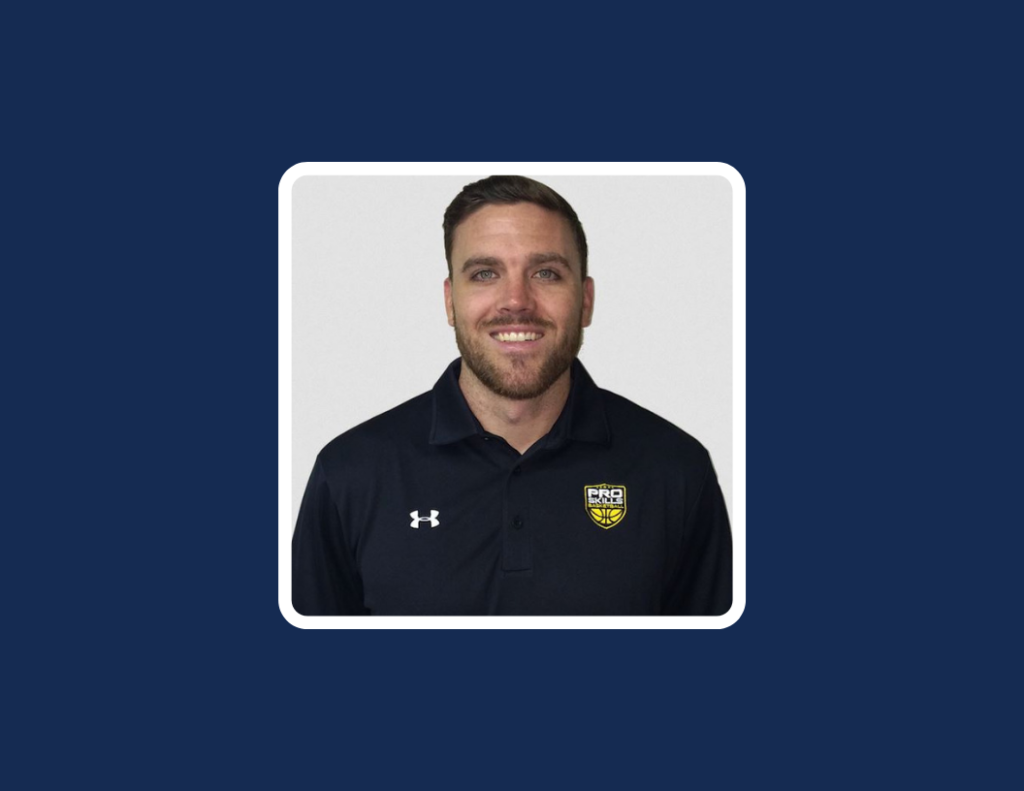
BRENDAN WINTERS – CO-FOUNDER OF PRO SKILS BASKETBALL – EPISODE 926
Website – https://proskillsbasketball.com/
Email – [email protected]
Twitter – @brendanwinters @ProSkillsBball

If you listen to and love the Hoop Heads Podcast, please consider giving us a small tip that will help in our quest to become the #1 basketball coaching podcast.
Brendan Winters is the co-founder of Pro Skills Basketball headquartered in Charlotte, North Carolina. Pro Skills Basketball is changing the model for youth basketball in three major ways.
#1 Offering a longer-term “one-club” program to maximize development.
#2 A focus on fundamentals, skill development, and practice over simply playing games.
#3 Hiring trained, certified, and positive coaches.
If you’re looking to improve your coaching please consider joining the Hoop Heads Mentorship Program. We believe that having a mentor is the best way to maximize your potential and become a transformational coach. By matching you up with one of our experienced mentors you’ll develop a one on one relationship that will help your coaching, your team, your program, and your mindset. The Hoop Heads Mentorship Program delivers mentoring services to basketball coaches at all levels through our team of experienced Head Coaches. Find out more at hoopheadspod.com or shoot me an email directly [email protected]
Be sure to follow us on Twitter and Instagram @hoopheadspod for the latest updates on episodes, guests, and events from the Hoop Heads Pod.
Make sure you’re subscribed to the Hoop Heads Pod on iTunes or wherever you get your podcasts and while you’re there please leave us a 5 star rating and review. Your ratings help your friends and coaching colleagues find the show. If you really love what you’re hearing recommend the Hoop Heads Pod to someone and get them to join you as a part of Hoop Heads Nation.
Take some notes as you listen to this episode of the Hoop Heads Podcast with Brendan Winters from Pro Skills Basketball.
What We Discuss with Brendan Winters
- The increasing number of foreign born players in the NBA and the reasons behind that change
- The year long commitment players make when participating on a Pro Skills Club Team
- “Our teams are going to be led by experienced, knowledgeable coaches. They’re also going to be positive. We’re not going to be berating our kids. We’re not going to be negative. We’re not going to be screaming. We’re not going to be cussing at them. We’re going to make this a high energy, enjoyable, fun, positive experience.”
- “It’s almost impossible not to get better with all the offerings we have on court for an entire year.”
- “Skill development over games, development over winning.”
- “It’s getting harder nowadays than ever for parents and players to stick with the process.”
- “The instability and the fragmentation of the US youth system, I think really, really hurts players.”
- “Players just go with their trainer and then they just go play five on five AAU basketball.”
- “There’s so much missing in between that one on zero training and the five on five.”
- The lack of skill development at younger ages
- The need for coach licensing and certification
- “You can pretty much just say whatever you want to a parent or a kid just to get them to play with you.”
- Having an impact and improving AAU Basketball one market at a time
- The trend in other sports of players not playing for their high schools
- Prep school basketball factories
- The need for one set of rules across all levels of basketball in the US
- The value of 3 on 3 in youth basketball
- The need for parent education in youth basketball
- Building resilience, toughness, teamwork and coachability through sports
- “You’ve got to learn to be a part of a team. You’ve got to learn to be coachable. You’ve got to learn to have some grit, some toughness, to fail and then get back up. And that’s a large part of what we do.”
- Learning life lessons through basketball
- The need for parents and coaches to zoom out and see the bigger picture
- “Hopefully we can use basketball as the vehicle to make them better human beings.”
Like this show? Please leave us a review here — even one sentence helps! Consider including your Twitter handle so we can thank you personally!

We’re excited to partner with Dr. Dish, the world’s best shooting machine! Mention the Hoop Heads Podcast when you place your order and get $300 off a brand new state of the art Dr. Dish Shooting Machine!

Prepare like the pros with the all new FastDraw and FastScout. FastDraw has been the number one play diagramming software for coaches for years, and now with it’s integrated web platform, coaches have the ability to add video to plays and share them directly to their players Android and iPhones via their mobile app. Coaches can also create customized scouting reports, upload and send game and practice film straight to the mobile app. Your players and staff have never been as prepared for games as they will after using FastDraw & FastScout. You’ll see quickly why FastModel Sports has the most compelling and intuitive basketball software out there! In addition to a great product, they also provide basketball coaching content and resources through their blog and playbank, which features over 8,000 free plays and drills from their online coaching community. For access to these plays and more information, visit fastmodelsports.com or follow them on Twitter @FastModel. Use Promo code HHP15 to save 15%

Your first impression is everything when applying for a new coaching job. A professional coaching portfolio is the tool that highlights your coaching achievements and philosophies and, most of all, helps separate you and your abilities from the other applicants.
The key to landing a new coaching job is to demonstrate to the hiring committee your attention to detail, level of preparedness, and your professionalism. Not only does a coaching portfolio allow you to exhibit these qualities, it also allows you to present your personal philosophies on coaching, leadership, and program development in an organized manner.
The Coaching Portfolio Guide is an instructional, membership-based website that helps you develop a personalized portfolio. Each section of the portfolio guide provides detailed instructions on how to organize your portfolio in a professional manner. The guide also provides sample documents for each section of your portfolio that you can copy, modify, and add to your personal portfolio.

We know you’re invested in the next generation of athletes, so why not give them the star treatment this season with GameChanger. Introducing GameChanger, a free app that provides you with data to make strategic coaching decisions and to deliver memorable moments to your team and its fans. Engage your players, empower your coaching decisions, and give parents the thrill of watching every play unfold in real time this season. Download GameChanger now on iOS or Android. GameChanger equips your team with the tools they need to succeed. Download it today and make this season one for the books. GameChanger. Stream. Score. Connect. Learn more at gc.com/hoopheads.
With GameChanger you’ll get automated highlight clips for all scoring plays as well as rebounds, steals, assists, and more. Plus free live streaming, advanced scorekeeping, and team management. No complex setups required, just easy, free streaming from your mobile device. AI powered technology will automatically pan and zoom…
Coach: the season just wrapped up and you need a break. Take your family on a much needed trip somewhere and leave the launch of your off season film review to #TeamsOfMen and our brand new #CoachsMirror product. Combining your game film & schematic goals with an experienced coach’s eye and the time saving power of AI, we will have an entire self scout of your film ready for you when you come back refreshed from your time off. Packages are available now breaking down 1, 3 or 5 games from this season.
Pro Skills Basketball is thrilled to announce that they are expanding their reach and seeking driven individuals to join them as City Directors in new cities across the country. This is an exciting opportunity to be at the forefront of revolutionizing youth basketball development and fostering a culture of excellence inspired by European-style basketball academies. Learn more now!
THANKS, BRENDAN WINTERS
If you enjoyed this episode with Brendan Winters let him know by clicking on the link below and thanking him via Twitter.
Click here to thank Brendan Winters via Twitter
Click here to let Mike & Jason know about your number one takeaway from this episode!
And if you want us to answer your questions on one of our upcoming weekly NBA episodes, drop us a line at [email protected].
TRANSCRIPT FOR BRENDAN WINTERS – CO-FOUNDER OF PRO SKILS BASKETBALL – EPISODE 926
[00:00:00] Mike Klinzing: Hello and welcome to the Hoop Heads Podcast. It’s Mike Klinzing here tonight without my co-host Jason Sunkle, but I am pleased to be joined for the third time, Brendan Winters, founder of Pro Skills Basketball, up for number three. That puts you in, I think you’re in a, at least a moderately exclusive club, I think, Brendon. So welcome back, man.
[00:00:20] Brendan Winters: Yeah. I think that’s elite, is what we call it in the youth basketball world. Yeah. We toss around elite like there’s no tomorrow, but yeah, glad to be back. Mike. Appreciate it. Love the Hoop Heads pod. Love everything you’re doing.
[00:00:35] Mike Klinzing: Well, I appreciate having you on and looking forward to diving into the topic that you and I are going to talk about tonight, which is just how can we improve youth basketball here in the United States and make it look like more of the European model, which when Adam Silver, NBA commissioner, talked during All Star Weekend, he gave a little speech and talked about the differences between European basketball style versus here in the United States. So just talk about some of your takeaways when you heard what Adam Silver talked about, I know these are things that are near and dear to your heart and what you guys are trying to do at Pro Skills. Just talk about some of your takeaways from what Adam Silver talked about.
[00:01:18] Brendan Winters: Yeah, this is something that’s been going on for a while. We recognized it when we first came back to the US. My co-founder and I on Pro skills. We started this as a basketball camp in 2009. We were playing overseas. did that for a couple years as a summer camp, but then came back and started to do it full time.
And we really noticed right away, like, man, like the model is just kind of messed up. Like the, the games, the kids are playing and the coaches that are out there. And so that’s how we ended up getting into AAU or what they call AAU. We call it our club teams. But you call it AAU, travel ball, whatever you want to call it.
We got into it because we saw these problems and decided like, Hey, we need to try to do something about it and just impact whoever we can impact that at least within our ecosystem. And it’s just kind of funny now I know the NBA has been aware of it for a few different years, but, or the last at least probably the last six or seven, they created the junior NBA flagship network I think six or seven years ago to try to kind of combat this problem which we are a member of and it’s a great group, but yeah, it’s just funny hearing Adam Silver after this past all star game, talk about it.
And basically what he said is like 30 percent of the NBA now is born outside of the U. S. That number has been increasing over the last number of years. And he thinks, or at least what he said, a lot of it is due to probably the U. S. system being a bit broken and the Europeans catching up to us because they have a better system. And I mean, there’s some stats that like, I think Mike Brey said he thinks 50 percent of the NBA will be international by like 2029 or so. So that trend is kind of increasing. And then as that increases the percentage of US players will be decreasing.
So I think we’re doing what we’re doing at the right time. The NBA is, I mean, if Adam Silver’s calling it out, it’s hitting at the highest level.
[00:03:28] Mike Klinzing: Absolutely. All right. So let’s kind of go through and talk about some of the things that you guys have put together at Pro Skills to try to make the system again, within your own ecosystem, better for the players, families, their development as basketball players.
And let’s start with the idea that it’s a club model as opposed to an AAU team, explain to people what that means.
[00:03:57] Brendan Winters: Yeah, well, now what that means for us is it’s a commitment for the whole year. Instead of having players just hop from team to team or club to club from season to season, the typical AAU model is play in the spring.
You probably play into the summer a little bit, depending on the age, you might go into July if you’re a high school player. Maybe you join another club in the fall, play a little fall season, a couple months, then in the winter if you’re elementary, middle, you might play on another team or another club and you just kind of hop around because there’s so many options these days.
But with us we ask for a commitment for basically the entire year. All of our cities, we’re in 20 cities around the U. S. More on the way. All of our cities run an eight or 11 month program just kind of depending on their state rules and our city director’s jobs, whether they’re high school coaches or their availability in the winter.
But that has just happened in the last four to five years for us where we went to that model. But from the beginning, what we said is like, Hey, we will do AAU. We kind of got begged by this group of parents. We had no intention when we first started doing AAU, we were just doing clinics, training camps, that whole kind of skill development model.
Similar Mike, I think to what you do, but we got begged by this group of parents. Hey, can you please start up teams? My co-founder went to a game, saw one of these girls that we were training, like she got berated by her coach in front of everyone just for missing a shot. And we were just like, this is ridiculous.
So we said, okay, we’re going to do it. We’re going to do it our way though. So we took some of our Davidson learnings, our European learnings. Which the big thing was the focus on skill development. Like, Hey, we are actually going to practice. We’re going to practice twice a week and our teams are going to be led by experienced, knowledgeable coaches.
They’re also going to be positive. We’re not going to be berating our kids. We’re not going to be negative. We’re not going to be screaming. We’re not going to be cussing at them. We’re going to make this a high energy, enjoyable, fun. Positive experience. And so that has been our model from the beginning.
And at the very beginning we were doing it because we didn’t know what we were doing. We agreed to do it, but we, we openly said, all right, we don’t really know what we’re doing. Like we don’t know the difference between AAU, YBOA, USBA, like any of these things. And I’ll never forget that first tryout we had when we gotind of barraged with these questions.
And we were just like, we have no idea, to be honest with you. Like, we’re just going to make some teams. We’ll figure it out as we go. And we did figure it out, but that model really took off. The parents really appreciated it. We hired our coaches. It wasn’t mom and dad coaches. It wasn’t volunteers. We paid them.
Now we didn’t pay them a lot, but it was enough for gas, food, that sort of thing for their time. Background checks, CPR training, that whole deal. So a little bit more professionalized. And then again, we said, we’re not going to play every weekend. We’ll play every other weekend, depending on the season.
We’re going to practice twice a week. We’re also going to do clinics and training. We’re going to do all that sort of stuff. And in practice, it’s not just roll the ball out. It’s hey, like, let’s say it’s an hour and a half. It’s like, all right, first 30 minutes, kind of individual skill development next 30 teamwork and then the last 30 like controlled scrimmages, essentially, maybe it’s like no dribble five on five on five or one dribble five on five that sort of stuff. And again, that model just really took off. The kids liked it. Parents liked it. Kids were all getting better. And then a few years into it, we were like, you know what, like, because like our kids kept coming back season after season.
And so we were like, why don’t we just put this together in a whole package, make it pretty much the entire year. And that way we can kind of bundle up all this stuff we’re doing and give the kids a better experience. We can work with them throughout the whole year. We can really, really get to know the players and truly make them better, get to know them as people as well.
Versus having new players come in, come out and kind of do that whole thing. So, like I said, that started about four or five years ago, but it’s going really well now. So it’s a year long commitment and we’re not saying you can’t play any other sports. Are we do have a flexible model where certain seasons are much more flexible where it’s like, Hey, if you play football, go play football, baseball, whatever, but we’re also going to have this, but these basketball offerings that you can come to as well.
And so it’s been a really good model. We’ve seen a lot of really, really good results. Players come to play with us and they absolutely get better. I mean, it’s almost impossible not to get better with all the offerings we have on court for an entire year. So that’s our model now.
We still do the hiring coaches, we background check, and we do all that stuff still skill development over games development over winning. We’re not chasing trophies in elementary, middle school, or even in high school. So it’s been a good model. It’s been exciting and yeah, we’re really happy about where we’re at right now.
[00:09:04] Mike Klinzing: So when I think about this, to me, one of the biggest benefits has to be, as you mentioned, that you, your coaches, whoever are working directly with those kids, you’re really getting to know those players, getting to know those families. And you get to understand what their strengths and weaknesses are as players.
So then you can work on it as opposed to a kid popping into a one week camp or working with a trainer for four sessions or playing three weekends of AAU with this team. And then all of a sudden I’m on this other AAU team with a whole new coach and a whole new set of teammates. Instead, you’re developing the continuity, which again, when I think about what is done in European basketball, right?
You have a kid who gets identified in whatever way and ends up at a club where there’s 12 and under team, and then there’s a 13 and under team, then there’s a 14 and under team. And there’s a progression where all those coaches are of the same mindset, the same philosophy. And there’s this progression up through the program where those kids are being taught the fundamentals.
They’re being taught the way that that club plays the game offensively and defensively. And it’s not, I’m not jumping from this to that, to this system, to this coach’s philosophy, to that coach’s philosophy, where again, if I’m a 12 or 13 year old kid, how do I even piece all that together to really develop as a player?
And I think that when we start talking about European basketball, to me, that’s where there’s a huge advantage. And you guys are starting to put that together with, I’m sure. As you see kids that have progressed that start with you at age nine or 10 and they’re going through and all of a sudden now they’re high school players.
Yeah, the development track that they’re on, I’m sure coming through a consistent. program is huge for their development. I just don’t see how it doesn’t work.
[00:10:59] Brendan Winters: Yeah. No, I mean, instability is the whole key. But it’s the players and the parents, I mean, it’s getting harder nowadays than ever is for them to stick with the process.
It’s a marathon, not a sprint, but the problem is these days. And I feel like I sound like an old guy and I kind of am now at this point these days, blah, blah, blah. But it started probably, I think with my generation when I think AAU kind of got popular when I was in high school or right after.
So it is my generation and it’s kind of the grass is always greener mentality, but. If you hop from team to team, from coach to coach it takes a while for that coach and who knows if that coach is even a good coach or bad coach, but it takes a little while for a coach to figure out what kind of player you are, what your weaknesses are, what your strengths are, mentally physically, just skill wise on the basketball court. And if you’re hopping from team to team, it’s like, you’re never able to just continuously take those steps forward. You probably go back two steps when you go to another team and then that coach has to figure it out. Or maybe you go to a team, probably a lot of times go to a team with a coach who’s not very good.
So. Yeah, the instability and the fragmentation of the US youth system, I think really, really hurts players. And it’s one of the things Adam Silver said is like, the players today are incredibly skilled. They’re probably more skilled than they’ve ever been, because they all work with trainers, right?
So the typical US player has a trainer, And then plays a lot of games. So it’s like there’s a lot of one versus zero, one versus the cone with the trainer. And then they go, they play on an AAU team that a lot of times they don’t practice, or if they do practice, it is just a roll the ball out and go play and just kind of like run around with no teaching.
Or they don’t practice and they just play games. And so what’s missing is everything in between. Like, what about between the one on zero and the five on five, what about the two on two, the three on three, the three versus four and everything in between there. That’s what we do a lot in our practices.
I think players today are missing that they’re skilled because they work with trainers, but those skills don’t necessarily translate to the game because they haven’t learned how to play in some of these game situations. They either just go with the trainer and then they just go play five on five AAU basketball.
Frankly, a lot of it is just run and gun. You know, press full court, lot of layups. And so we see a ton of kids that are really good. They’re really good athletes when they’re young and everyone thinks they’re this great player. They play on these teams that are really good because they just press full court.
They get steals and then they get layups, but then they get to high school. Kids catch up with them physically. They haven’t developed their skills. They can’t shoot. All they can do really is play defense and make layups, but at that level, everyone for the most part can do that. And what you’re missing is the kids that actually know how to play, the kids that can shoot, that can actually play in a team system.
And that’s kind of what Adam Silver was talking about is their skill, but they just, I think Antawn Jameson, I saw a video of he came out I don’t know when it was, but in this past year was like in the NBA, we are teaching players how to set proper picks. You know, and it’s like, gosh, if you’re getting to the highest level and you’ve never been taught how to set proper screens, that’s a problem.
[00:14:32] Mike Klinzing: So, all right. A bunch of things came to mind as you were talking. So let’s first talk a little bit about that trainer. And five on five and then kids being super skilled. I think when I look back and again, I’m a lot older than you, but so in the late eighties, when I’m playing high school basketball, every high school team, every high school team had the six, two football kid who had no discernible basketball skills at all, but just was a brute going out there and banging into people and rebounding and setting screens.
And every team had one of those guys. And, I look at players 9, 10, 11, 12 on a lot of high school rosters back 15, 20, 25 years ago. And the skill level of those players was nowhere near the skill level of player. You look at the back end of a high school bench today, and if you just put those kids out on the floor and gave them a ball and gave them some cones, or you’re watching them during warmups, like those kids are banging home threes and doing every dribble move you could ever want.
Now, the question then becomes, right, can those kids actually play the game of basketball? And where are we in terms of basketball IQ? And like, I go back and forth with it because there’s certainly kids have so much more access today to good coaching if they want it. Now there’s a lot of bad coaching out there as you well know, but there’s also a lot of really good coaching at the lower levels that kids have access to that I know I didn’t have access to when I was a kid.
And then they also have access to. technology. If you’re a kid and you want to watch film of college guys or NBA guys or high school players, like the opportunity to sit down and watch film and really learn the game is there for anybody who wants it. So I think there are avenues for kids to be able to improve their IQ.
And yet I still think that, and again, this is the old guy’s syndrome. I still love the fact that I grew up playing pick up basketball and I didn’t always have to play with my mom and dad in the stands watching me with a coach coaching me every single second I ever played the game with a ref out there calling fouls I had to decide call my own fouls and figure that out I know like when I was in high school in college I used to go to pick up games and I just never called fouls like I’d get bludgeoned to death.
And I just because I want to get better and guys on my team would get mad and be like, game point. I’d get clobbered. I wouldn’t call it. I’m like, look, I’m not calling the fouls. I’m not here to win this pickup game. Not that I don’t want to win, but I’m trying to develop my skills.
And that’s something that I just, I have a hard time thinking that that doesn’t have an impact on players today, that that element of the game is missing.
[00:17:18] Brendan Winters: Yeah, no, I think it is. That’s what I’m saying. I think kids today more often than not, they do the trainer thing, which is fine, you got to work on your skills one on one or one on zero, whatever, or in a small group and you do have to play five on five, but that in between that you’re talking about, where I remember I played a ton of 3 at the Y with my buddies who were also serious players because, hey, maybe we didn’t have 10 that day or whatever.
We only had 4 guys, 6 guys, whatever. So we just played two on two, three on three, and that helped so much, but I think that is pretty non existent these days, where it’s like, hey, if you’re not working with a trainer or not playing on the weekend in some five on five games, like, with a ref and a team and a coach, like, then you’re not doing the two on two, the three on three, and that sort of stuff, and that’s, the three on three piece, I think that it’s something that I took away from Europe where I was really taught and really saw that, man, like basketball is really like essentially a three man game with two other people just out there.
Exactly. Yeah, like I mean, you go back to the Bulls the triangle offense and all that. I mean, that’s the best basketball and that’s what the Europeans understand. All you do is play in threes and play in these triangles and try to find that on the court. And I didn’t really realize that until I got to Europe and they emphasize it.
And we did a ton of that in practice situational three on three, starting this pick on pick and roll with the corner guy coming up after you take it. And then the other two guys are just on the weak side and kind of hanging out for the most part. But yeah, there’s so much missing in between that one on zero training and the five on five.
There’s so much in between there that’s missing these days.
[00:19:08] Mike Klinzing: And then the other thing that struck me when you were talking before is just the stability piece of it. And so I’ll speak to my experience as a parent with my son who, he just finished his senior year of high school basketball. So he played two years of AAU.
We got very fortunate, lucky that we got hooked up with the team that he ended up playing on. And we had basically the same team for two years in a row. We had one kid left and we added one new kid, but it was basically the same eight or nine guys for two seasons. So going into his junior year and going into his senior year, same team, excellent coach who coached the team, coached it like it was a high school team, like a college team, demanded that in practice, demanded effort, demanded unselfishness, demanded that you play defense, and did that in practice, did that in games, and held kids accountable, and made them better.
And my son would come home from practice and he’d just say to me, I love coach Izzy because he holds me accountable. And if something happens and I do something wrong, he points it out and he says, Hey, this is what you have to do next time to be better. And like most kids, and again, there’s a fine line where, again, you’re talking about how do you correct kids?
You can do it in a positive manner. And obviously there’s differences when you’re coaching a kid who’s nine versus you’re coaching a high school senior. But I think ultimately like kids want somebody that’s going to help make them better. I mean, I think that’s universal from kids who were in third grade all the way up to pro players, right?
I’ve talked to so many guys who work in the NBA and they all say NBA players don’t care at all about who you are, what your resume is, where you played at this or that. The only thing they care about is can you make me a better player. And I think that’s what players want at all levels. And too often, we just, when guys are jumping around to different teams and to your point, if you’re playing on one team for half the spring, and then you’re on another team, and then now suddenly you’re in a fall league over here, you’re with your high school coach at this time, and then you’re with this trainer, and then now that trainer is not doing what I want or isn’t telling me what I want to hear.
And now another trainer, it’s just, how does the kid ever hear a consistent message and be able to get better? And that’s where I think here in the U. S. Europeans, they’re hearing the same message from their club from the time they’re whatever, 12, 11. And how can that not be better for player development?
It’s just, to me, a no brainer.
[00:21:40] Brendan Winters: Yeah. And that’s a big problem with the U. S. system is there’s no licenses, certifications, like mandatory, at least. I mean, USAB license, which is great. Like that’s a good first step. And I know the junior NBA worked with them on that, but it’s not a mandatory thing.
You don’t have to have, like in Europe, you have in most countries, you have to have certain licenses and certifications. And not to say that’s going to make you a great coach, but at least it’s an education and it’s a start. And it does create some consistency like you just talked about, Mike.
Because here in the States, anyone and their brother can become a coach, anyone and their brother can start a club and that is what’s happening is, for whatever reason, it’s just become so fragmented and there is so many options out there. And there are a lot of great, great options.
Like you said, there are some really good AAU coaches. There are really good high school coaches. But there’s a whole lot of bad ones, I think as well, because there’s no barrier to entry, there’s no license certification. You don’t need anything. You can pretty much just say whatever you want to a parent or a kid just to get them to play with you.
And a lot of times, and that’s what a lot of these folks do is they will say whatever they need to say to get a player on their team. And a lot of times it doesn’t work out. And then the player is like, okay, well now I need to go find a new team because this one isn’t what this guy said. And so now they hop to the next one and who knows if that’s good or bad, but I mean, there is a million options out there right now.
And there’s no oversight.
[00:23:19] Mike Klinzing: I feel like AAU basketball and individual training has almost become a commodity where people just look at it and they make choices on. Well, what time are the practices or what time is this trainer available or where is the trainer’s location and how close is it to my house?
And there was a time before, now I’m going back a little bit, before I was doing the podcast and I was doing more training, I’d have kids that I’d be working with and maybe there was a week or two where I couldn’t fit or meet their schedule and whatever. And then three weeks later, I’d see them with Trainer X.
I’m like, this guy’s eating a sandwich, sitting in a chair while he’s working with your kid and you’re paying him. And I got to the point where it was super frustrating because I felt like, man, I’m putting all this time and effort to plan what I’m going to do and try to help the kid get better.
And I’m trying to analyze their strengths and weaknesses and figure it out and all those kinds of things. And then somebody goes somewhere else just because one or two weeks I couldn’t meet their time. And it just got super frustrating. I think that’s the same thing that we see from the AAU side of it is that there’s so many people now that have, all right, I’ve got a four team club or I’ve got a six team club, or I’m starting with this.
And you look at the quality of the teams. And again, like you’re not going back to it. Whatever you want to call AAU basketball, watered down, however you want to say it, it’s just that cat has been out of the bag and you’re not going to put it back. So the question becomes, and I think this is the question that you guys are trying to answer, right, is how do we provide the best environment for the kids who are participating in our program?
And I think that the model that you guys are putting forth where it’s all year round and they’re being exposed repeatedly to the same coaches, to the same philosophy, that’s how you get better. You don’t get better hopping from this to that, to this, to that. And again, when you have no idea what the quality is.
[00:25:29] Brendan Winters: Yeah. I mean, there’s a lot of places we can kind of take that, but with our model, we say, Hey, look like this might not be, this is not a fit for everyone. We are not trying to serve everyone. There might be other better options for you out there. But like you said, there’s a lot of bad options out there and a lot of kind of charlatans out there.
And again, today grass is always greener for players and parents. And so it’s getting harder and harder to keep kids, to develop them for a year, two years, three years, and without them leaving, because they think there’s a better option out there. And with no barriers to entry again, I hear a lot that, youth sports are becoming more expensive or kids are getting priced out or whatever it is.
Like, I actually don’t really agree with that. I think there’s more options than ever. I mean, in my local area, there’s like five rec leagues that my kids could play in if they wanted for very, very cheap and there’s 10 clubs around the area, all at different price points and stuff.
There’s just so many options out there. But I think one for the US, like you said, the cat’s kind of out of the bag and I don’t think we’ll ever really have be able to get to a true European system. But what we try to do is just impact the kids and parents that we have in our little area.
And not all of our cities are that big. Some of them just started this year, last year. And we have two teams, four teams, six teams, whatever it is. Some of our cities are a little bit bigger, 20 teams, 25, 30, whatever. And we can have a little bit larger impact, but what we are seeing in some of our bigger cities is other clubs taking pieces of what we do.
For instance, in Charlotte, we see a lot of the better clubs are now paying their coaches. And so it makes it harder for us certainly, because even some of our coaches have left to go to other clubs because maybe they’re getting offered to be paid more or whatever. And so I do think in Charlotte, for instance, the coaching quality, I think on the AAU side has gotten really, really good since we started and that’s fine, it makes it harder for us, but we just kind of have to step our game up. So like we all just keep leveling up and getting better.
I think there’s some really good stuff coming out of Charlotte for instance. But yeah, it’s just for us, it’s just about, Hey, let’s focus on what we can control. Let’s coach the kids that we have. Let’s make an impact. Let’s coach the coaches too, and help them get better. And then hopefully the idea is like five years down the line, 10 years down the line, we have impacted the youth basketball in the cities that we’re in, whether it’s Pro Skills or these other organizations that, Hey, maybe we created our own competition in some cases.
I mean, that does happen. A coach leaves, starts his own organization. Well, hopefully he takes the positives of what we’re doing and implement some, maybe not, but hopefully, and in doing that we think that we’re making a positive impact in our cities.
[00:28:34] Mike Klinzing: Here in the U. S. youth basketball and basketball in general is tied to schools.
So kids play for their middle school, they play for their high school. Whereas in Europe, you’re playing for your club, which is not connected to your school. And therefore you can play with that club year round. Whereas here in the U. S. our high school athletic associations all have rules depending upon which state you’re in.
Some states are a complete free for all, you can practice basically year round with your high school team if you want. Other states you’re very, very limited in what you can do in your off season. But What I’ve seen, and I’m sure you’ve seen the same thing, that there are sports, like for example, girls soccer, where there are a number of girls that are playing Division I college soccer that never set foot on a high school soccer field.
They stayed with their club team all throughout their career.
[00:29:34] Brendan Winters: We are not proponents of like, Hey, kids should not play for their high schools just to be clear, their schools. Like we think that is a positive thing. There’s a lot of great school coaches. It’s fun to play for your school, right? Represent your school and have the fans there.
I had a great high school experience, great college experience. And yet, like when we first heard that was happening on the soccer side, we were it honestly made us sad. Like, dang, like these clubs, they’re not allowing their kids go through that whole thing to play for these schools.
Yeah. And so we are definitely not proponents of that. I do kind of think we have over the last four to five years especially what you’re seeing is AAU directors or AAU clubs or guys involved in AAU, they basically start their own, we call them basketball factories like the prep schools that everyone knows the prep school is, was built for basketball.
And the academics is sometimes like an online course or maybe they attend a different school academically, but then play for this prep school. I mean, that’s essentially the U. S. version of playing for your club team. It’s happening everywhere as you’ve seen where the academics are, they’re basically non existent or very low level.
And everyone knows it’s just like, Hey, this school exists for basketball. So I think that’s kind of where it’s gone in the US. Yeah. And at the college level, I mean, you see everything happening now with the NIL and now people are saying like, Hey, should those sports, like especially football and basketball be detached from the academic piece.
And I don’t know how I feel about that in particular. I had a great college experience and NCAA tournaments coming up. Like what a awesome event and time and piece of entertainment for everyone, but man, I don’t know what’s going to happen at the college level, especially with football and basketball.
And I think kind of whatever happens there is going to trickle down probably to the high school level eventually. I mean, it’s already sort of starting, like I said, with the basketball schools.
[00:31:54] Mike Klinzing: Yeah. I mean, five or 10 years from now, you think about what the college basketball landscape, college football landscape is going to look like.
I can’t really even wrap my head around it. When you think about how fast Brendon, how fast NIL came in and just sort of, took over is maybe too strong of a term. But I mean, the fact that you go back 10, 15 years ago and the things that were like unbelievably giant scandals, right? That this kid got $1,500 or we paid for this kid’s mom to come home for the grandfather’s funeral. And now it’s just like, these kids are signing these deals for huge amounts of money. And look, don’t get me wrong. I’ve always said and maintained that when you think about what was always unfair to me was that a kid could sign with a school.
The coach could leave with no repercussions at all and break their contract and go triple their salary at another school. And here’s all the kids that that coach recruited. Again, that coach is an adult. The kids are 18, 19, 20 years old. And here they’re kind of left just, what do I do? I came to this school because this guy recruited me.
I wanted to play for him. And now suddenly he’s gone. And so it always felt like the scales were tipped way in favor of the coaches instead of the athletes. And yet at the same time, I’m kind of like you, I’m not sure that the way that we’ve gone to this kind of wild west system of NIL is the best way to do it, but I don’t know what the answer is by the same token.
[00:33:34] Brendan Winters: Yeah, I have no idea on the college piece there. I mean, I’ve listened to ideas and normally I end up hearing what Jay Bilas says And I think that usually makes a lot of sense. And I’m like, yeah, just do it that way, but we’ll see where we end up. But all I do know is that, I mean, that trickle down effect is real from the NBA down to college down to, I mean, again, in like Adam Silver said, they’re going to have to reassess the Ignite team, right? The G League Ignite team and see if that makes sense anymore, just because of all the changes, but whatever happens there is going to trickle down to youth basketball. And so I’m not sure what’s going to happen, but I tell you what, we mentioned it just before.
I do know one thing, like one way youth basketball could improve quite a bit is if every state would have the same dang rules on the court and shot clock, all that sort of stuff. Because that’s one thing Europe has, is it’s the same rules everywhere, and at every age group, whether you’re in France, Germany, wherever they have the same rules, FIBA, right?
And so in the NBA, you got different rules, and in college, that has different rules and high school, and then state by state is different in high school. And so, if we could get to some system where at least at the high school and below level that those rules are all the same statewide across the U S that would make things a whole lot better.
And that seems like, gosh, that seems like it’s a natural first place to start. It shouldn’t be that hard.
[00:35:10] Mike Klinzing: Yeah, that doesn’t seem like it’s that hard. Like we have the, whatever the national federation of high schools that kind of generally oversees everything. It feels like that would be a pretty simple change to institute. But again, what it comes down to is kind of like what we see all the time in youth basketball here in the United States is everybody has their little piece of the pie and they’re squeezing onto that piece of the pie. as tight as they possibly can. And they just don’t want to give up that power, prestige, whatever it is.
And I think it’s sort of the same thing when you talk about those rules across, across States and everything. And if we could get it all the same, one of the things that I’d like to see, honestly, Brendan, I know that it’s something that, that you’re a believer in, but I’ve, I’ve espoused the idea that if, You had kids not play five on five basketball until, and you can throw a grade level at me and I’d be okay with it, but let’s just say through sixth grade, if you did nothing but play three on three, if everything youth basketball sixth grade and under was three on three leagues and playing three on three, I think that the outcome of the quality of basketball player that we would produce would be so much higher than what we produce today. So I’ll give you a good example. So I had a guy this year who he took over the recreation department in our city and he came to me after he got the job and he said that he wanted to revamp the kindergarten and first grade basketball league. And he said, would you be willing to, to kind of take that on and make it more of an academy style of program as opposed to, so what it was in the past was you’d have four teams in one gym.
It’s the loudest gym with the worst possible acoustics that you could ever imagine, Brendan. I mean, you can’t really hear anything. So you have all these kindergarten and first graders, you have four teams practicing on four baskets in this gym. And then of course, when you have kindergarten and first grade, not only do you have all the kids, but you have everybody has a parent there the whole time.
And so the parents are talking, whatever. So it’s just really a difficult environment, but these teams would come in and they’d practice for whenever, maybe a week or two, they’d have practice. And then by week three, they’re playing five on five full court games. kindergarten and first grade. And he’s like, I don’t want to, and my kids participated in that.
It’s chaos as you well, as you well know and can imagine.
[00:37:50] Brendan Winters: I’m with you. I got a five year old and a seven year old and they both played rec league and especially the five year old that was like half football, half basketball. Like it was just crazy. And I made that same comment, During, I was like, they would be way better off if they just played three on three and full court in quotations.
Cause it’s like that’s like a very short court. It’s essentially the width of. Like just play three on three where there’s more space. You get the ball more often. I’m totally with you there. And then on my, my daughter’s team, who’s seven, we played in a 10 year league. And I was coaching and lucky. And we only had eight or nine players on our team and every practice one or two would not be there.
So I only had six. And so all we did was play three on three full court and they got so much better because they just touched the ball so much. They, and like, not that we cared about winning, but like they got so much better. We didn’t play five on five, the entire in practice, the entire season. Cause we never had enough.
We didn’t even play four on four. We played three on three, every single practice. And then we got into the games and like, we were totally fine. We were probably better than fine in, in, in those games. So it was kind of a. unintentional experiment a little bit, but like to your point, three on three was amazing for them.
And it would have been amazing for my son’s group, like you just talked about. Yeah. So, so did your guy end up doing that?
[00:39:15] Mike Klinzing: Yeah. So we ended up doing it. I ended up coming on board. And so what we did was we still had all the teams still had coaches. So they still had the volunteer coaches, mostly parents.
And we still had four teams in the gym at the same time. But what we did was. I came to every, whatever, I was there for every session. So there was like three separate hours of practice where each hour had four teams. So it was like ended up being that I think there was 12 and then we did an extra one extra session because there was four.
So I did like four hours of practices on a Saturday. But basically what would happen is I would plan out what those teams were going to do for practice. I would demonstrate whatever the drill, or we’d be doing ball handling and I would do it and then all the teams would be all the kids would have their ball and they’d be doing their ball handling.
And then I’d say, okay, here’s the next drill we’re going to do. And then you’d have, And the coaches help out and copy…
[00:40:11] Brendan Winters: Right, and watch you.
[00:40:14] Mike Klinzing: Exactly. So they’d watch me and then they would go and kind of facilitate the drill. So from the coach’s perspective, like they didn’t have to plan anything. So they could just show up and here’s Mike, he’s going to tell us exactly what we’re going to do.
And then they would help to implement it. And then we spent probably, I think it was an eight week total program and we spent the first three weeks we did nothing but again, skill work and drills and that kind of thing. And then by week four, we added like 10 or 15 minutes of three on three at the end.
And we did a couple of weeks of that. And what was interesting is that the guy who ran the recreation department who brought me on, he was getting calls from people saying you advertise this as a league and they’re not playing any games. Now he only got a couple you always tend to over exaggerate.
There’s like 150 kids in the program and he probably got three calls, but those are the calls that you worry about. You’re like, Oh my God, do we have to? And so he came to me, he’s like, what do you think? You know, should we play some five on five? I’m like, look, when we get to the last week, if we want to play a 15 minute five on five game just to keep everybody happy.
I’m like, we can do that. If you want me to do that, I’m happy to do it. And we ended up doing it. What’s funny, Brendan, I’m sure you’ll appreciate this is we’re doing all the drills and the skill work and we’re playing three on three or whatever. And obviously that’s where the value is in what we’re doing.
But then you get to the five on five and suddenly like, Everybody’s no longer on their phone. Grandma’s all of a sudden paying attention. Everybody’s got the phone out, they’re taking pictures, they’re taking videos, they’re cheering and all it’s just, but the whole time while you’re doing any kind of skill work, like no, but people could be, they couldn’t be less interested.
So it’s just, it goes back to, I think what’s, there’s so much benefit in three on three, but there’s also a piece that I think I’m sure you guys run into this and that this is one of the parts of what you’re trying to do is there’s a parent education piece. That is so critical to help people to understand because people just don’t, they don’t understand it.
And I know even for myself, and you’re probably going through this to some degree as a parent, as knowledgeable as you are, and as knowledgeable as I was coming up with my own kids, like there’s still so much to navigate as far as like, who do I want their coach to be? Now you have an organization, so obviously you have sort of some things in place that your kids will be able to participate in.
But as I’m going through, I’m like, okay, like I know this guy, I know this organization, or I want to coach so I can control the environment, but how do I make sure I get the right players around my kid? And there’s so many pieces to navigate and I know what I’m doing. And even then I felt like at times I’m like, am I doing the right thing?
So I can only imagine for somebody with no basketball background or experience to be able to educate them is so critical and yet it’s so hard to do.
[00:43:05] Brendan Winters: It’s so hard. And again, because the grass is always greener that applies to parents too, especially parents. We run into the same thing. So we run in some of our cities, we will forego the five on five winter league or fall league.
And instead we will do our own three on three. We did it this year with high school kids. We did it this year and we’ll get the same thing. Like. Like, I want to play five on five and like in these tournaments and you know, at whatever, XYZ with the refs and all that sort of stuff.
And we try to educate them. I’m like, no, no, this is why we’re playing three on three. This is why it’s better. It’s a more productive use of use of your time. Also, it’s cheaper because now you’re not going to pay a hundred dollars for the tournament entry or league entry or whatever it is on the weekends.
But yeah, it’s, I mean, Educating the parents is really difficult. And I think one thing that basketball has we’re swimming upstream a little bit is like, it seems like more parents think they know basketball than other sports. I was at my daughter’s soccer practice today.
She just plays rec league and I actually said to my wife, I was like, I didn’t think it was like a very, this was her second practice, but it was just very slow and girls were standing around and I was like first of all, this is not a very good practice. But at the same time, I have no idea how I would make this a better practice.
Like, I don’t know any soccer drills. I have no idea what I would do here. Whereas, like, I feel like on the basketball side, like, people watch or used to watch Coach K or whoever, and then they’re like, oh, I know how to coach because I watch basketball. I watch the NBA or watch college or whatever.
And it’s like a more popular sport, I guess, in terms of the entertainment side than some of these other ones. And so more people, more parents think they know basketball when actually it’s like you really don’t. You just watch it on TV. Exactly. And I’m not sure soccer in the U. S. for instance, or volleyball, right run into some of those challenges because maybe people don’t feel as educated about them. So I think that is part of the issue with parents and basketball.
[00:45:16] Mike Klinzing: Yeah. It’s tough. I mean, it’s a hard thing where you never, like you mentioned it earlier, where you have to. the nine year old team that has all the great athletes.
And then you have the guy who thinks he’s a guru that is coaching that team that he’s got his diamond press and he’s got this and that, and he thinks he knows everything. And you’re like, dude, you might be a really good recruiter and you got really good talent, but it’s not really that you’re this great coach.
But I think so oftentimes, again, parents get caught up and they’ll see that and be like, okay, so look at that team. And then what club is that? And even though they’re not really learning anything, and even though they’re not really developing those kids, a lot of times clubs that have that kind of success, then they end up getting more kids to be able to sign up and parents, because they see the parents kind of see the bling for lack of a better way of saying it.
I think what’s interesting, Brendan, too, is, so my oldest daughter now is, or my youngest daughter is now in eighth grade, so she’s going to be in high school next year, so we’re kind of, I don’t want to say past completely the youth basketball side of it, but what’s funny is to me, we’ll be up at the gym sometime shooting and the gym where we go to, there’s an area where there’s shooting machines and then there’s an area where games are being played.
So sometimes we’ll be up there shooting and there’ll be games going on, whether it’s local, like travel basketball or an AAU tournament or whatever. And I’ll see like these third graders. Boys and girls playing and the coaches are going crazy on the sideline or yelling and jumping up and down.
And the parents are going nuts and screaming and yelling at each other and cheering. It gets totally crazy. And part of me, I guess whenever I see that, I’m always like, God, it’s such a long game and like, just relax, like just relax as a parent and try to enjoy it. And I know it’s hard in the moment to feel that and especially feel it with your own kids. So much of it has nothing to do with you as a parent. It’s again, do you put your kid in the right environment? And then ultimately it’s up to them. And I just wish I could tell parents to just relax and kind of enjoy the journey and try to get educated about what’s the best place for your kid to develop as a player and as a person.
[00:47:44] Brendan Winters: Yeah. No, I’m with you again tonight at my daughter’s soccer practice. I was about 30 seconds away from telling the dad next to me to chill out because he was yelling at his daughter and I was like, it’s just practice and they’re seven years old. Like who cares? But yeah, it’s pretty crazy. And I know we’ve talked about a lot about the kind of just the basketball skill development piece in this conversation, but a big part of what we do is just like try to teach life lessons through basketball because if kids aren’t getting some of this through sports, I’m not sure where they’re getting it.
Like the building resilience or toughness or teamwork and coachability, like if they’re not playing sports and it comes out in competitive sports, especially AAU basketball in this case or high school basketball, whatever. Like. You’ve got to learn to be a part of a team.
You’ve got to learn to be coachable. You’ve got to learn to have some grit, some toughness to fail and then get back up. And that’s a large part of what we do. And so we’re not afraid to lose and talk, but again, it’s hard because like, you’ve got to recognize that it’s a marathon, not a sprint. And with social media and everything else these days, we’ve talked about the amount of teams and other options that are out there.
It’s easy to jump ship at the first sign of trouble when, to your point, if parents would just zoom out and coaches would zoom out and take a longer term view and more holistic view, not just basketball just life in general. Like most of these kids are not going to play in college.
Most of them are not going pro, like, but you can help build employable adults, gracious young adults and kids with young adults with a little bit more resilience because they had some years under their belt playing AAU basketball or school sports or volleyball, soccer, whatever it might be.
And I think a lot of that is missing these days where people are so focused on the trophies, on the wins, on that sort of stuff, on developing now and being the best player now versus Like, Hey, let’s step back. Don’t ruin this for you, for your kids right now.
[00:49:59] Mike Klinzing: Well, when I was coaching my kids teams, I put together like a notebook that we would do these little lessons for like 10 or 15 minutes at the start of practice sometimes or the end of practice and I’d whatever I’d run off the copies of it and put it in a three ring binder.
So every kid had their binder with like the little either team photo or everybody would sign the team goals and put that on the front or whatever. And there were some people that parents love that stuff. And like, I even had a parent that my son’s a senior and I had another parent of another kid say, Hey, my kid still has.
The notebook that you guys worked on in fifth grade, and he still looks at some of the stuff that is in there, reminds him of whatever. And then I had in the moment, I had some people saying, Hey, why are you wasting 15 minutes of our practice time going over and talking about being a good teammate or talking about how to develop resilience or how to, Make sure that you’re working hard, not just in basketball, but in school and are you being the best family member you can be and all this stuff.
And it’s just, I mean, there’s so many opportunities, like you said, to be able to, to pour into kids in such a way that it’s not just about basketball. And I don’t know how you think about it, but obviously in your family, basketball for you has always been a huge and important part of your life.
And it’s always been a huge and important part of my life too. And I think back to how important the game was to me and it still is, but how important it was to me as a player, both as a high school player, as a college player, how critical it was and how into it I was at the time. And then I look back and I’m like, for me I never played professionally after I got done playing in college.
So basically my competitive career ended when I was 22 and I was, I continued to keep playing, but you look back on it and you’re like, like, what do I want? When you become a parent, you’re like, what do I want for my own kids? Like, what’s important about. the game of basketball, that eventually the ball is going to stop bouncing.
So what do I want out of the game for them? And obviously you want them to have a great basketball experience, but you also want them, as you said, to learn to become the type of young adult that is going to be a productive member of society. And it’s a hard balance to strike as a parent. I think so often, and again, it goes back to what we’ve been talking about the whole time, right?
You want to put your kid in a place where they’re going to be coached, they’re going to be cared for, and they’re going to have a positive experience. And I think that’s what you guys are really doing. And that’s how you’re really having an impact is being able to touch kids in such a way that you’re providing them with a great basketball experience, which I think Looking back, sometimes parents can’t see that in the moment because.
They only see, we got to win this game and they see, Hey, my kids got to do this or that, or they didn’t do this or that, but ultimately, like I said, it’s a long game and I think you guys are in it for the right reasons.
[00:53:06] Brendan Winters: Yeah, no, I mean, we’re just using basketball as a vehicle. I mean, basketball is important to us.
We want to get kids better. We want to increase their fundamentals and their understanding of how to play the team game and to become better players. But at the end of the day, it is a vehicle, like I said, to teach these other life lessons to be coachable, to have resilience and grit be able to overcome failure to be able to experience success and failure with your teammates and with your coach and to learn that like, hey, if you want to get good at something, you need to work at it.
And ultimately, exactly that is why we’re doing it. Because we know that 0.01 percent might go on to playing college or pro or whatever, but the other 99 percent are going to have a normal job as an adult and a family and all that, and hopefully we can use basketball as the vehicle to make them better human beings.
And so, yeah, I mean, that’s ultimately why we’re doing this and just using basketball as a vehicle and hopefully we can positively influence basketball at the same time.
[00:54:13] Mike Klinzing: And talk a little bit about what you guys are looking for in terms of expansion and city directors. I know that we’re trying to help you get the word out about people want to join the Pro Skills basketball coaching family.
So talk a little bit about that and what you’re looking for in somebody that could potentially be a great city director for you guys.
[00:54:32] Brendan Winters: Yeah. And the reason I love this podcast is because I know there’s a lot of really good coaches. I mean, if you’re listening to this podcast, you’re a coach that wants to get better and wants to improve, whether it’s X’s and O’s or relationships or whatever it is. And so we’re looking for passionate basketball coaches, basketball leaders. B, we’re also looking for one thing we’ve kind of discovered that this was not the goal at the start, but we discovered like, hey, we actually have a model that can create more employment opportunities for basketball, great basketball people.
Some people really do not like their nine to five job in basketball is they’re doing basketball on the side, whether it’s coaching in school or coaching club, whatever. And then, and they love that and they would die to be able to work in basketball either more in a full time capacity or, or even just do more of it part time.
And so our model actually we’ve discovered allows for that. And that’s part of the reason we were like, Oh, let’s, well, let’s expand then. And because we have something here, we can create more employment opportunities. So yeah, we’re in 20 cities now we’re looking to add 10 to 20 more over the coming year.
So we’re looking to get into all major cities and it’s just about finding the right director. So great basketball leader, great basketball coach, but also someone with a little bit of entrepreneurial spirit too, a little bit of a willingness to grind and sell and market and get out there and into the community and talk about it.
And those folks, like I just said, that want to do youth basketball full time. I think those are the key pieces that we’re looking for.
[00:56:15] Mike Klinzing: All right. If somebody is interested, how do they reach out to you? How do they find out more?
[00:56:20] Brendan Winters: Yeah, pretty easy. Just go to our website, proskillsbasketball.com/jobs, and you’ll see the city director posting there. So it’s just proskillsbasketball.com/jobs. You can read the job description, you can apply there. And we have a dedicated team member that is the one responsible for this and he will reach out and we’ll just go from there.
[00:56:44] Mike Klinzing: Anything we didn’t hit on, any final point you want to make before we wrap up?
[00:56:48] Brendan Winters: No, no, final point. Really enjoyed this conversation. Love what you’re doing. Keep doing it. Thank you to all the folks out there who listened. No, like I said, you have a lot of good basketball people who listen to this podcast.
So just excited to hear any, any feedback.
[00:57:06] Mike Klinzing: Brendan, I can’t thank you enough for taking the time out of your schedule tonight to join us. I’ve said it numerous times, both to you and to people in general, that what you guys are doing in trying to make an impact on what admittedly is a very goofy system of youth basketball that we have here in the United States, that you guys and your organization, what you’re trying to bring to it and the best face forward for youth basketball development.
You guys at Pro Skills are doing that. So kudos to you. Keep up the good work. I really appreciate everything you do. Again, I appreciate the relationship that you and I have been able to build here over a couple of years. And again, I have a lot of respect for what you and Logan have put together and what you’ve been able to do on the business side of it and the impact that you’re having on the basketball community.
So again, keep that up. Thanks to everyone for listening. Really appreciate it. If you’re at all interested in getting involved with Brendan and Pro Skills, please reach out to them, go check out the website, take a look at what that job entails. And I know there’s somebody out there that’s listening that would make a great fit for Pro Skills and Brendan’s organization.
So please go ahead and check that out. And to everyone out there, thanks for listening tonight and we will catch you on our next episode. Thanks.