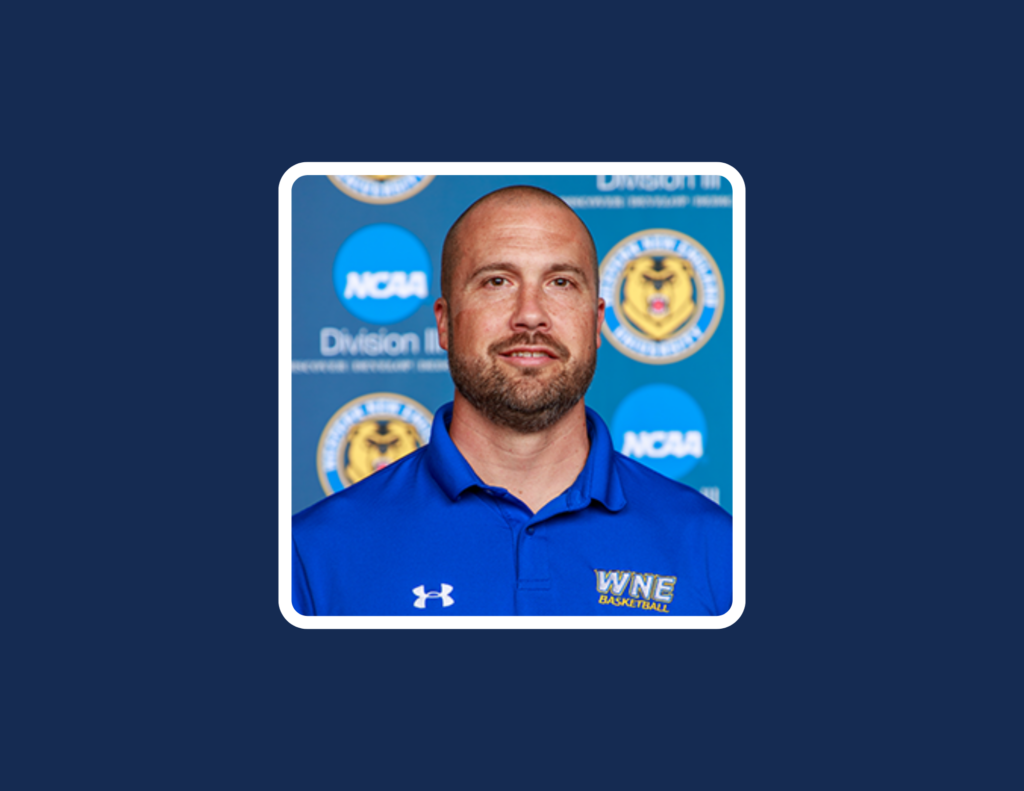
COLIN TABB – WESTERN NEW ENGLAND UNIVERSITY MEN’S BASKETBALL HEAD COACH – EPISODE 917
Website – https://wnegoldenbears.com/sports/mens-basketball
Email – [email protected]
Twitter – @Ctabb44

If you listen to and love the Hoop Heads Podcast, please consider giving us a small tip that will help in our quest to become the #1 basketball coaching podcast.
Colin Tabb just completed his 9th season as the Men’s Basketball Head Coach at Western New England University. Tabb guided the Golden Bears to their first ever Commonwealth Coast Conference Championship game appearance in 2022-2023 and a second place regular season finish in 23-24.
Tabb came to Western New England from the business world where he served as the president and owner of BasketBull, LLC, since 2003. BasketBull is a basketball event-management company, an official licensee of the Naismith Memorial Basketball Hall of Fame, that develops, promotes, organizes and operates grassroots events, camps, tournaments, clinics and skills academies throughout the Northeast.
Tabb previously served as an assistant on the men’s basketball coaching staffs at Brandeis University (2005-08) and Rhode Island College (2003-04) for four seasons.
As a player Tabb starred for Trinity College from 1999-2002, leading the program to a 51-20 overall record, a 2002 NCAA Division III Men’s Basketball Championship appearance and a pair of New England Small School Athletic Conference tournament runner-up finishes. His best season came during his senior campaign when he poured in a school record 619 points on the way to becoming the program’s first player selected to the National Association of Basketball Coaches All-America First Team. After he graduated from Trinity in 2002 he played two years of professional basketball in Ireland and Germany.
Tabb was inducted into the New England Basketball Hall of Fame in August 2015.
If you’re looking to improve your coaching please consider joining the Hoop Heads Mentorship Program. We believe that having a mentor is the best way to maximize your potential and become a transformational coach. By matching you up with one of our experienced mentors you’ll develop a one on one relationship that will help your coaching, your team, your program, and your mindset. The Hoop Heads Mentorship Program delivers mentoring services to basketball coaches at all levels through our team of experienced Head Coaches. Find out more at hoopheadspod.com or shoot me an email directly [email protected]
Be sure to follow us on Twitter and Instagram @hoopheadspod for the latest updates on episodes, guests, and events from the Hoop Heads Pod.
Make sure you’re subscribed to the Hoop Heads Pod on iTunes or wherever you get your podcasts and while you’re there please leave us a 5 star rating and review. Your ratings help your friends and coaching colleagues find the show. If you really love what you’re hearing recommend the Hoop Heads Pod to someone and get them to join you as a part of Hoop Heads Nation.
It’s time to take some notes as you listen to this episode with Colin Tabb, Men’s Basketball Head Coach at Western New England University.
What We Discuss with Colin Tabb
- Growing up in a family where “Basketball just was something that was hard to avoid and hard to not love.”
- Pick up basketball culture and what today’s game is missing
- “Finding a way to win as a player is much different than being able to take six, seven, eight dribbles and break somebody down and take a shot that’s not a great team shot.”
- The many challenges of being a basketball parent
- His college playing days starting at D1 Quinnipiac and finishing at D3 Trinity College
- His experience playing overseas in Germany, England, and Ireland.
- His first two coaching stints at Rhode Island College and Brandeis
- Leaving coaching to run BasketBull, a grassroots basketball events company that was affiliated with the Naismith Basketball Hall of Fame in Springfield
- How the connections he built while running BasketBull helped him when he returned to coaching
- Coaching a year of Prep School before taking the Western New England job
- Missing out on the first recruiting cycle after being hired in late July
- “You have to be very flexible, adaptable and willing to change as a coach.”
- “We want to get guys that we really want to be around every day for four years because it’s a long time and you spend a lot of days, a lot of hours together.”
- “We’re adamant as a staff about seeing kids play in high school before we make a decision on them.”
- “I’m paying attention to mom and dad and stands, is that a family that we want to have around and be with for the next four years?”
- “It’s much easier to recruit culture than it is to try to mold culture.”
- D3 recruiting challenges
- “To be really successful at the division three level, you got to get some steals. You got to get some guys that are, that are probably scholarship level players and they fall through the cracks for whatever reason it may be.”
- Developing your team and program to beat the best teams in your conference and in the country
- Getting players to buy into being part of something bigger than themselves
- “You have to leave your ego at the door. And everything that we do now is about the program.”
- “Team success will lead to individual success.”
- “It’s not just maintaining, it’s continually getting better.”
Like this show? Please leave us a review here — even one sentence helps! Consider including your Twitter handle so we can thank you personally!

We’re excited to partner with Dr. Dish, the world’s best shooting machine! Mention the Hoop Heads Podcast when you place your order and get $300 off a brand new state of the art Dr. Dish Shooting Machine!

Prepare like the pros with the all new FastDraw and FastScout. FastDraw has been the number one play diagramming software for coaches for years, and now with it’s integrated web platform, coaches have the ability to add video to plays and share them directly to their players Android and iPhones via their mobile app. Coaches can also create customized scouting reports, upload and send game and practice film straight to the mobile app. Your players and staff have never been as prepared for games as they will after using FastDraw & FastScout. You’ll see quickly why FastModel Sports has the most compelling and intuitive basketball software out there! In addition to a great product, they also provide basketball coaching content and resources through their blog and playbank, which features over 8,000 free plays and drills from their online coaching community. For access to these plays and more information, visit fastmodelsports.com or follow them on Twitter @FastModel. Use Promo code HHP15 to save 15%
Your first impression is everything when applying for a new coaching job. A professional coaching portfolio is the tool that highlights your coaching achievements and philosophies and, most of all, helps separate you and your abilities from the other applicants.
The key to landing a new coaching job is to demonstrate to the hiring committee your attention to detail, level of preparedness, and your professionalism. Not only does a coaching portfolio allow you to exhibit these qualities, it also allows you to present your personal philosophies on coaching, leadership, and program development in an organized manner.
The Coaching Portfolio Guide is an instructional, membership-based website that helps you develop a personalized portfolio. Each section of the portfolio guide provides detailed instructions on how to organize your portfolio in a professional manner. The guide also provides sample documents for each section of your portfolio that you can copy, modify, and add to your personal portfolio.

We know you’re invested in the next generation of athletes, so why not give them the star treatment this season with GameChanger. Introducing GameChanger, a free app that provides you with data to make strategic coaching decisions and to deliver memorable moments to your team and its fans. Engage your players, empower your coaching decisions, and give parents the thrill of watching every play unfold in real time this season. Download GameChanger now on iOS or Android. GameChanger equips your team with the tools they need to succeed. Download it today and make this season one for the books. GameChanger. Stream. Score. Connect. Learn more at gc.com/hoopheads.
With GameChanger you’ll get automated highlight clips for all scoring plays as well as rebounds, steals, assists, and more. Plus free live streaming, advanced scorekeeping, and team management. No complex setups required, just easy, free streaming from your mobile device. AI powered technology will automatically pan and zoom…
Coach: the season just wrapped up and you need a break. Take your family on a much needed trip somewhere and leave the launch of your off season film review to #TeamsOfMen and our brand new #CoachsMirror product. Combining your game film & schematic goals with an experienced coach’s eye and the time saving power of AI, we will have an entire self scout of your film ready for you when you come back refreshed from your time off. Packages are available now breaking down 1, 3 or 5 games from this season.
Pro Skills Basketball is thrilled to announce that they are expanding their reach and seeking driven individuals to join them as City Directors in new cities across the country. This is an exciting opportunity to be at the forefront of revolutionizing youth basketball development and fostering a culture of excellence inspired by European-style basketball academies. Learn more now!
THANKS, COLIN TABB
If you enjoyed this episode with Colin Tabb let him know by clicking on the link below and thanking her via Twitter.
Click here to thank Colin Tabb via Twitter
Click here to let Mike & Jason know about your number one takeaway from this episode!
And if you want us to answer your questions on one of our upcoming weekly NBA episodes, drop us a line at [email protected].
TRANSCRIPT FOR COLIN TABB – WESTERN NEW ENGLAND UNIVERSITY MEN’S BASKETBALL HEAD COACH – EPISODE 917
[00:00:00] Mike Klinzing: Hello and welcome to the Hoop Heads Podcast. It’s Mike Klinzing here with my co-host Jason Sunkle tonight. And we are pleased to welcome in from Western New England University, the men’s head basketball coach, Colin Tabb. Colin, welcome to the Hoop Heads Pod.
[00:00:12] Colin Tabb: Thanks, Mike. I appreciate you guys having me on.
[00:00:17] Mike Klinzing: Thrilled to have you on, looking forward to diving into all the things that you’ve been able to do in your career. Let’s start by going back in time, Colin, to when you were a kid, tell us a little bit about some of your first experiences with the game, what you remember and what made you fall in love with it.
[00:00:30] Colin Tabb: Geez. I mean, basketball’s been a huge part of my life for as long as I can remember. And it all starts with our family. My brother and then the two of us, and then we have a bunch of cousins as well, but all of their fathers who are my uncles had all there’s about five uncles on my mom’s side that all had some type of roots in basketball. Some are a little bit more football heavy. But, but all of them are involved in basketball as well. Quite a few played at the college level. One played at Dartmouth. One played at Division III school outside of Springfield. North Adams State. And then they, a bunch of them got into coaching at various levels, some really successful high school coaches some prep school coaches.
So that kind of growing up in that family just had me around basketball from such an early age. And then my brother’s three years older. And his our cousin who is a very similar age to him, I grew up just idolizing those guys and trying to compete with them, trying to follow them around wherever I could.
I would do anything to be around my brother and around my brother playing. So if that meant I was rebounding for him, that’s what I was doing. In our backyard at the bottom of our hill. We had a, my dad kind of converted some space in the in the grass and made a paved court.
So we had a nice private hoop to work out in all the time. And, but I remember at such a young age, just rebounding for him. I think that’s when I really started to love the game, is like, I would any missed shot that he had, I would go up and grab the ball, like as aggressively as I could, jump as high as I could you know, shot fake to put it back up, and try to make try to get something out of it while I was missing any of the shots that he missed, which wasn’t many at all, because he could really, really shoot.
So, just being around him, and kind of falling in love with the game that way, and then we had other cousins that were very, very good basketball players as well. I think there’s five or six of us that all played at the college level in our family. So we had some battles growing up.
Certainly my brother and I, but then our cousins extended as well. So yeah, just, just kind of just being around it in our family. It just was something that was hard to avoid and hard to not love.
[00:02:45] Mike Klinzing: Because you had so many people in your family that played the game and coached the game, was coaching on your radar from a young age or was that something that you really didn’t think about until your playing career was over?
[00:02:57] Colin Tabb: You know, it’s hard to say. A lot of people have asked me that. I don’t think there’s a part of me that ever thought I wouldn’t be involved in basketball. I certainly had other interests. But I think those interests were, I don’t want to say fleeting, but I just never, I never took them as seriously as I did basketball.
I don’t know that I ever, at a young age, envisioned myself as a coach, but There were certainly aspects of how I viewed the game that was probably different than some of my teammates and peers and that kind of stuff, like the system aspect of it, kind of dissecting the game, the scouting and then when my brother got into coaching, like, just the recruiting aspect and he was really, he’s my brother’s been a college coach for a long time.
He’s actually coaching in prep school now, but kind of like that recruiting aspect of things like building the relationships with players and all that stuff, started to feel really natural to me. So it’s hard to say at a young age, if I was thinking about being a coach, I think I wanted to pursue playing as much as I could and to see where that took me.
But definitely really didn’t see myself not being involved in basketball some way, somehow.
[00:04:06] Mike Klinzing: You got older and you kept competing with your brother and your cousins and everybody in your family. When you got to high school and you think back to that time, how’d you go about getting better and improving your game.
What were some of the things that you did? How’d you go about getting better to be the kind of player that you wanted to be?
[00:04:21] Colin Tabb: Yeah, I was pretty driven. I think I made a lot of sacrifices. Obviously AAU was, was just starting to get really popular, it certainly wasn’t like it is now.
It wasn’t as you know, if watered down is the right word, but like, it wasn’t as prevalent like where every.
[00:04:42] Mike Klinzing: Every single, every single kid who plays basketball plays AAU, right?
[00:04:48] Colin Tabb: When my brother was really getting into it, there was probably four or five teams in Massachusetts at the time.
And every single one of them had multiple division one players on their team, you know? And even when I three years later for me, when I was kind of getting into that high school circuit, It was very similar. I played more in Connecticut where we live is we’re in Connecticut, but we’re literally right on the Massachusetts state line.
So like we crossed over between Springfield, Mass or like kind of the Hartford, Connecticut area quite a bit with, with how we played and who we played with. So I played more in Connecticut. But that being said, like similar thing, like four or five, six teams at the most, and all those teams were just really, really good multiple college Division I players on the roster.
So, AAU for me was part of like getting into it, but like, I definitely held myself to like I was very, very obsessive, anytime I wasn’t feeling good about myself as a player, I’m outside of my hoop and I was very diligent about making sure that I felt better about how I was performing.
And the only way to correct that was to go back out and work. We were with a lot of my high school teammates, we organized runs all the time at our town park. And we had a good group of guys that would consistently play. Like we, I couldn’t just think of like hours at the park in the summer just spending entire days there.
Mom and dad dropping us off early in the morning and like we would literally bring lunch with us and just spend all day there. We hunted games too. Like we would drive into cities to find places to play. We would drive into Hartford, we would drive to New Britain, we’d go into Springfield and all those places are like 30, 35 minutes away.
We would go seek out higher level competition and kind of walk in like, who the hell are these dudes and then knowing that we have something to prove and like, and then a game later, they’re like, okay, these dudes can play and we would spend hours there and there was something to that.
Like there was. That kind of gave you like a little bit of confidence, a little bit of a just like motivation to go out there and kind of prove that you belong. So I think there was just like, there was just that aspect of just being driven to like, get better, to challenge myself, to find the best competition I could find.
There was also that self motivation, like I talked about, I was constantly scrutinizing myself and probably being my own toughest critic.
[00:07:10] Mike Klinzing: So. How does the pickup basketball scene that you grew up with and the way you described it, that’s the way I grew up too.
And I talked to so many coaches and just seeing it with my own two eyes that. That pickup basketball culture that you described just doesn’t exist anymore. And so when you think about how your players that you’re coaching today, how they get better, what they do with their off season, just compare and contrast what you did versus what they’re doing now.
[00:07:37] Colin Tabb: It’s definitely different now. My guys at Western New England in the off season, like they are playing pickup, like they organize probably four to five days a week they’re in the gym playing pickup with each other. But I think it’s easy and it’s convenient in a certain way because you have probably 12 to 14 guys that are probably returning or guys that still want to play even some of the graduates that still want to play.
But you’re not going to the park down the road or drive into a park and trying to find some run like where. I just don’t think that exists much anymore. And it’s kind of like, to me, that’s where you earn your stripes a little bit doing that.
You figure things out doing that. You’re challenged in a way, you’re competing against all sorts of different types of talent. So a lot of guys older than you, a lot of guys way bigger and more physical than you. Guys that are quicker, more athletic, like.
And you have to improvise. You have to figure out how to compete at that level. You have to sometimes be smarter. You have to sometimes be stronger. You have to be tougher. You got to stay on, you got to find a way to stay on the court, you know? So I don’t know. So many kids nowadays, especially at like a high school level they have a personal trainer or they only want to work out with somebody that’s putting them through a workout and telling them what to do.
You lose some of that creativity and some of that, like. I don’t know, just like that pureness of the game when you’re doing that. And I don’t know how well all of that stuff translates. I mean, you definitely improve as a player. You’re improving your skill set. But like how much of that is like game applicable, you know?
Because when you’re playing at the park, you’re finding ways to win, you want to stay on the court, you’re finding ways to win. Those are two different things, like finding a way to win as a player is much different than being able to take six, seven, eight dribbles and break somebody down and take a shot that’s not a great team shot.
I don’t know, it’s just a different generation with some of that stuff. And I wish high school kids and college kids would go seek that stuff and just play ball and like get beat up, get some cuts, get some blood.
Like that’s what it’s all about, you know? And yeah, I just think some of that stuff’s missing nowadays.
[00:10:02] Mike Klinzing: I can sense your exasperation and, I feel the exact same way. And this is a conversation that we’ve had. I don’t even know how many times on the podcast that I always lament the disappearance of pickup basketball.
And my son’s a senior in high school this year and he just didn’t grow up in the game the same way that I did. And I tell people all the time that I played high school basketball. I played division one college basketball and some of my best memories. of the game are not from those organized team experiences.
They’re just from playing at the park with different dudes, like you described that, Hey, this guy’s here. I drove to this court or we played in this gym. And I remember when we took this five and showed up and nobody thought we were going to be any good and boom, all of a sudden we’re winning. And then you got gather guys, respect.
And I don’t know how you can measure Colin, the difference in player development, because when you look at isolated skill level of players, I think there’s no doubt that shooting today is better than it’s ever been. The number of kids that can handle the ball is better than it’s ever been. But I think you made a great point of, it’s one thing to be able to shoot the ball or be able to handle the ball, but how do you figure out how to win?
And I don’t know if that’s basketball IQ, I don’t know if that’s competitiveness. I’m not sure what exactly it is. And I know there’s no good way for us to be able to measure like, Hey, put this kid in this environment and then put that same exact kid in this other environment and let those two kids develop simultaneously and see which one comes out better.
I know we can’t do that. I just know. And again, I think you feel the same way. And somebody who grows up in today’s world probably thinks that. their way is superior. And certainly I’ll go to my grave thinking that the way that I grew up in the game is superior. I just think that we have to accept that it’s different, but I do oftentimes wonder what have we gained versus what have we lost?
And I think one of the big things for me is just pick up basketball. More than anything else just was so much fun. And I think that’s what fostered my love for the game And it sounds like you were exactly the same way.
[00:12:03] Colin Tabb: Yeah, no question. No, I mean, I loved it and I miss those days. I don’t play a whole lot anymore at all really And my body just can’t handle it but like I miss those days and I think that’s how people truly Love the game like that competitiveness and that just finding a way to win and a lot of times you’re doing it with some of your boys and it’s nothing like it, man.
No, you’re building that camaraderie and stuff. And it’s funny. I have three girls and I brought my middle daughter out, I don’t know, it was probably like six months ago. I brought her just outside in our driveway and we’re working out and I started like getting a little more physical with her than she’s used to.
And she’s like are you doing that? I’m like, you have to be able to play through contact. You have to be able to play through physicality. And I could tell she was very apprehensive. Like she was nervous, you know?
This is how you need to adjust now. Like this I’m giving you a bump. I’m giving you a check. You have to be the one that initiates the contact. Like don’t, don’t respond to the defender. Initiating contact, like you as the offensive player, you need to be the one to initiate.
So anyhow, we kind of went through like a 20 minute workout of that side of it, like her driving and getting into me and creating the contact and all that stuff. And then the very next day she sent me a text on her way home from school and she’s like, dad, can we do that workout again?
And I was like, this is awesome. She started thinking about it and there was a little bit something that got the juices flowing.
Just kind of like just got her thinking and got her wanting more. Like she got the bug a little bit, that’s the word I was looking for. She got the bug and the fact that she wanted more of that was awesome. So we’ve done that a bunch since, and she’s become a tougher player because of it.
And it’s kind of cool to see some of that, but again, you can do one or two things. You can just put her through drills and rebound for her and talk to her, talk about her skills. But what’s going to translate more and she’s got to get stronger and tougher and be able to play through contact.
And like you said, there’s all elements of the game that’s hard to measure, like what’s more beneficial and what’s not. But it’s all about being as well rounded as you can be and, and having as many different experiences as you can.
[00:14:28] Mike Klinzing: Absolutely. All right. What’s your biggest challenge as a basketball parent?
[00:14:30] Colin Tabb: Oof, that’s a tough one. You know, there’s a lot of times where they don’t want to hear it, right? So I’m not that father that’s in the stands barking at them. I let them play.
I want them to ask me to go work out like, I don’t say like, Hey, you like, let’s go get a workout in. Cause you haven’t done anything yet today. Yeah. But it’s a fine line, right? Because technology is just constantly at their fingertips and they always have distractions.
They always have reasons why they shouldn’t or why they don’t want to go out and do something or work on their game or whatever. So I think it’s knowing how much to push them, knowing how much that they understand how hard they should be working in order to be a good player whether it’s and I have when my oldest one’s more like lacrosse and then my two younger ones are soccer, basketball right now.
And so and they’re at the age now where, especially my middle one, where it’s time for her to like figure out if she’s serious about it and really be committed to it if she wants to be and, and put more time into getting better. But I think the biggest challenge is knowing how much kind of constructive criticism to give them, and when they want to hear it, when they don’t, I try not to say a ton right after the game. I try to like give it some time, get back in the house. We’ll talk a little bit. We’ll hang out and they’re like, Hey like, do you remember this play or try to bring it up a little bit later.
I think they’re usually a little less emotional at that point. And they’re a little more receptive to hearing what I have to say, but there’s definitely like. Okay. They like to roll their eyes at me and, and say, Oh, geez, here goes dad again, like dad’s a coach. He wants to talk to me about it.
So I got to try to pick and choose when it’s appropriate. When it’s not. It’s funny because that’s a fine line to walk. Yeah. It’s funny because today I actually went over to my fourth grader. They have a playoff game on Saturday. So the coach said something to me about stopping in and we’re going to see his own this weekend. Like, do you think you could stop in and give us some tidbits? So I didn’t tell her I was coming. So I got there with like 45 minutes left in practice and I walked in and I see her look at me and she’s like kind of rolling her eyes, like, what are you doing here?
And then the coach is like we have a special guest Coach Tabb’s going to talk to us about some stuff that we can do and look for against his own. So like all the other girls were like, Oh, like a college coach is here. This is great. Like we can, we’re going to learn something different.
And, and then she’s just like, kind of, she’s more embarrassed, you know? So it was good. She settled in.
[00:16:54] Mike Klinzing: That’s funny. That’s the life of a parent right there. That is. A very apt description of the life of a parent, no doubt. Walking that line is tough. How much do you push versus how much do you make sure it’s on them?
And there’s a fine line there where you can, you can tread on one side of the line a little too far and you can certainly tread on the other side a little bit too far. And that’s, I think, one of the biggest challenges, especially if you’re somebody who, again, had such a good experience in the game and you’re competitive and you kind of know what it takes and you want to be able to share that knowledge with them.
And yet, To your point, there are times where they just want to roll their eyes in that era. They just are like, Hey, I don’t want to do it today. And sometimes I guess I found for me that even though it was really, really hard, I had to step back and just say, Hey, it’s got to come to them. And for me, that’s been, that’s been successful because I think eventually the kids came around to the game and Then I also didn’t damage my, damage my relationship with him, which ultimately is the most important thing that 20 years from now, they still, still want to talk to their dad.
They were not like dad was an overbearing ogre who just made me practice basketball at the time. It’s not easy to do.
[00:17:57] Colin Tabb: It’s definitely not easy to do. And when you’re living in the moment, you feel like time’s ticking like you got, you got to start working, you got to start working.
But I look back and I know when I really like dove into like just being fully committed to basketball, it was probably like eighth grade going into freshman year. And then and it, and it was pretty consistent, but like there was other times where I was just like super, super committed to like being the best I could be.
And then there was other times where it kind of ebbed and flowed a little bit.
[00:18:30] Mike Klinzing: Plus our memory’s probably a little clouded,
[00:18:31] Colin Tabb: Mine is for sure to some degree, but mine is for sure.
[00:18:38] Mike Klinzing: Alright, so tell me a little bit about your college decision.
[00:18:39] Colin Tabb: Yeah, so I actually started at Quinnipiac. I was at Quinnipiac for two years. My freshman year, I had knee surgery. I played for Joe DeSantis there. I’m not sure if you guys know Joe at all. Really good player at Fairfield. And then he had been in college coaching for a while, I think at like St. John’s and Pitt, and then he got the Quinnipiac job and we had just gone to Division I. So I visited there and I loved it. I had knee surgery my freshman year, so I did not play at all. And then my second year, redshirt freshman year, I played quite a bit as a redshirt freshman played well.
I won’t get into all the details, but let’s just say there was a very stubborn side of me that coach and I had like a little exchange and I don’t think either side of us were really happy with the exchange, but there’s a part of me that said, okay, I’m going to look somewhere else and transfer.
And then he was kind of shocked by that decision. So long story short, I ended up, I did end up transferring. And there’s always like a side of me that has a little bit of regret for that decision. But that being said, like my experience at Trinity was, was just awesome. And I’ll never have regret for going to Trinity.
You kind of always wonder about like, had I stayed at Quinnipiac, what would have happened? Cause I did feel like I was playing well and I was getting good minutes. But when I transferred to Trinity, I just really fell back in love with the game. And I was amazed at, at how competitive it was, like going from division one to division three, I thought it was going to be a lot easier, you know?
I’d walk in and it was going to be a cakewalk, like division one player going down. And I was just blown away at how good it was like maybe they’re not as big and as athletic, but these dudes could play like the skill set was there, like they knew how to play the game the right way.
And it was actually I was looking at a couple of schools when I was transferring, but I had known Coach Ogranik a little bit during my high school days. He recruited me a tiny bit, but it didn’t really translate to much. And then I had a buddy of mine that was at Trinity from high school.
And then my previous assistant coach from high school was now an assistant coach at Trinity, kinda like a volunteer assistant. So he’s the one that like, kind of connected me with, with Coach Ogranik and kind of opened up that door. And then you know, it was, it was Trinity’s a really good academic school and I, I was doing well at Quinnipiac, but second semester I knew I like needed to get my GPA up to a certain, whatever that number was. I think I had like a low 3.2, 3.3. And I needed to get over a three five to be able to be considered at Trinity. So like I had to really bust my butt second semester at Quinnipiac to get my GPA a little bit higher to get over three, to get it over a three five, and then fortunate enough to get in there and then, yeah.
So then three years at Trinity and had an awesome experience.
[00:21:20] Mike Klinzing: So what were you thinking career wise at that point?
[00:21:22] Colin Tabb: Yeah. At that point, there was a side of me that was like my grandfather was in law enforcement. He was chief of police in Springfield for a number of years.
And his nickname, so we’ll probably talk about it later, but the company that I started that has a partnership with the hall of fame is called BasketBull. My grandfather’s nickname was the bull. So like tough, tough dude, he actually played at Providence college played basketball and everyone called him the bull.
So. When I was at Trinity, I was doing a bunch of stuff like legal studies. I was doing political science as my major and legal studies as my minor. And I was really thinking about like maybe doing something in law, whether it was law enforcement or maybe something maybe potentially go to law school.
So that’s where my area of study was, but like again, I was loving every aspect of basketball there too. So there was a side of me that was like, okay, this is what I’m going to get my degree in and maybe pursue this career path. But I was still obviously really basketball. I knew I wanted to kind of try to continue to play and see where that led to.
[00:22:27] Mike Klinzing: So when you graduate, you get an opportunity to play overseas and you go to Ireland and to Germany. Tell me a little bit about those two experiences, what it was like as a young guy going overseas and playing and kind of being on your own.
[00:22:41] Colin Tabb: It was eye opening. It was in some aspects very professional, some aspects a little unorganized and kind of got the full gamut of the, of the international plane overseas experience. So I started in Germany very blue collar town.
Not a lot of English spoken there. That was an adjustment. The league was extremely, extremely competitive. I mean, multiple, like, Division I Big East, ACC level guys. There’s I mean, there were like, I Brian Brown played at Ohio State. Terrence Rencher played at Texas. I mean, there was a lot of very, very good players that were in the league.
And then a ton of really good international players. And we’re going we’re going from arenas that had 2, 000 people to 10, 15, 000 people. So just like the, the basketball was high level it was professional and the experience like it was tough, but I kind of settled in and I was playing well early on and I was starting and getting good minutes and then I had a really bad ankle injury.
I dislocated my ankle, bone chips. You know, just, it was, it was bad, probably tore like three ligaments in it. So I was out for like three months and, and they were great. The club is awesome. They continued to honor my contract but they ended up bringing in another player. I think he played at, I want to say Mississippi State.
Can’t remember his name is Chuck something, but anyhow, so when I did finally get healthy, which was like in December, and I said, I think I tore it in like early October. Got healthy in December and then like a lot of my minutes were kind of gone at that point. So I kind of played some sporadic minutes here and there.
And then the season finished up, came back and I re injured the ankle again. So then I ended up coaching at Rhode Island College for a year just cause I was like, the ankle was not feeling great and I wasn’t sure if I was going to be able to make it back over, over season time to try to play another year for like that August.
So we ended up coaching at Rick for a year. And then throughout that year, I was kind of like getting a bug to try to get back overseas. So started training again, started working out again. And that’s when I went to Ireland. And I was, I actually went to England first. When I got to England, everything that was promised for me, it was, so it was a team in the BBC BBL, excuse me, everything that was promised for me, car, apartment, all that stuff.
None of it was given. None of it was provided. So and I’m, I’m like waiting at the airport for like four hours waiting for somebody to pick me up when I first arrived. You know, and then I get there and I’m leveled like five other guys and it’s like, it’s, it’s all, it’s almost like a dorm, a dorm suite.
It’s like there’s, there’s one little kitchen area and then everyone’s got their own bedroom off of it. And actually everybody had roommates too. Like it was just, it was, it was bizarre. But they had promised me my own apartment, my own car. I didn’t have a car. So that lasted about two weeks.
I could tell it was just like a shady situation. So then I ended up going right from England to Ireland. And so then I played there that year and that was a cool experience, but it was just so much less professional. We only practiced three days a week. The pay was nowhere near the same.
My wife now, but my, she was my girlfriend at the time. Like she came over and spent a lot of time with me over there and she’s like, do you really want to keep doing this? And I’m part of me, part of me did, but then at the same time I’m like, look, I understand. Yeah. I’m not going to keep playing for the rest of my life.
So I think at some point, it was kind of at the, towards the end of that situation that I was like, all right, maybe I’ll, maybe I’ll stop playing. And then came back and got a job for a little bit and the Brandeis job opened up so I was able to get a coaching job which was a really good coaching job at that time because it was a full time position paid pretty well and then, and obviously in a great, great league.
So that was my first step into coaching for that 05 year. So that was the next year after playing in Ireland.
[00:26:21] Mike Klinzing: So in those two experiences at Rhode Island College and then at Brandeis, how, what did you know immediately that you liked about coaching? What was it that said, Hey, this is something that I can see myself doing?
[00:26:32] Colin Tabb: I mean, I think there’s a lot of aspects of it that I, that I just, that I really enjoyed, especially, especially back then. Like there were two very different situations. You know, at Rhode Island College, I was learning a ton working for a guy that was, that was very demanding and of the staff, of the players, just, he ran it like a Division I program.
I enjoyed the competitiveness of it. I enjoyed the preparation of it. And scouting opponents and the recruiting aspect of things and trying to find those, those next guys that can get the program to the, to the level that you want it to be at.
And then when I was at Brandeis, the head coach there gave me a ton of autonomy to kind of just give my ideas and provide my feedback and take leads on scouts and take leads on recruiting. And he was a really smart coach and he did a great job of closing with recruits and kind of big picture stuff.
But he gave his assistants a lot of autonomy to learn and grow and kind of take ownership and aspects of the program that he thought they could handle. So I love that aspect of it too. And it’s just gave me a lot of just pride and passion to to build up the Brandeis program as good as we could.
And we had some really successful years there. The league was, was super competitive. And that’s when I really fell in love with like the coaching aspect and I think at that time I was starting to think like I’d love to have my own job one day too be a, be a head coach one day.
So how do you go from that to Basketbull? Yeah, so the Basketbull thing kind of popped up like we, so it kind of goes full circle now back to a lot of my uncles that were very involved in coaching and playing when they were younger and then coaching when they got older. And so they had a really good relationship with people at the hall of fame and the hall of fame was, was very interested in trying to start up youth basketball events in hopes of bringing people to visit the museum.
Kind of build their brand in that market, in that landscape. And so they approached my uncles about, Hey, like, would you guys have any, any interest in possibly starting up some a tournament series with the Hall of Fame brand and logo and we’ll have a partnership. So we were doing it for probably like the whole time I was at Brandeis.
I think we had started up, because I think we started in about 2004, 2005. So. I took a liking to that too, like there was a side of me that like really I think it’s probably just the competitive side, like just trying to build up these tournaments and make them as successful as they could be and get some of the better teams there.
And I thought it was, there was a lot of synergy between the recruiting aspect of things and, and building relationships with the AAU guys that could help with recruiting. And so, so we were doing it for a few years and then we had an investor that wanted to build a multi court facility. And he kind of had like the same vision and model as the Cooperstown Field of Dreams for baseball.
He wanted to have all these basketball courts in the city and be able to run all these tournaments and have the Hall of Fame connection. And so it made a lot of sense to me and he offered to make my position a full time position. And it was a significant salary increase for me.
It got me back into the Springfield area where my family’s from. And so at that time, like. It was hard for me, but I guess I just felt like I had to take the opportunity when it was there. And just, I think from a financial standpoint and there was a side of me that really enjoyed putting the events on.
So that’s when I left coaching and I think probably a month later I was like, geez, I’m going to miss coaching. I could tell right away. But this was also kind of cool and it kept me in the game and it kept me in the game in a way that I thought maybe I could use it and leverage it down the road to potentially you know, get back into college coaching and whether that was an assistant job or a head job because that was the one thing that I wanted to do.
That I did was like, I had a lot of relationships and contacts with a lot of people in the AAU world and the prep school world. And you had to talk to these guys all the time. And I was able to make a lot of good friendships and good connections and people that I really like and trust.
And truthfully, still stay in touch with to this day. You know, whether it’s recruiting or we’re still running basketball, obviously not to the same degree. But I still run those events on the side during the spring and summer. So I did that full time for about five or six years.
And the business grew, we went from probably four or five events a year up to like over 20 events in probably like 2012, 13, 14, something in those years. And we had some of the best recruiting exposure events like in the country, like we were competing with all the top event operators, the hoop group and, and big shots and big foot and all the guys that are running some of these best some of these premier events that are not shoe company events.
And the shoe company circuit kind of changed the landscape when they really started to push that stuff. Because they kind of gobbled up all of those live weekends where you can run events. So I think there was kind of like a gradual decrease in the quality of our, our Hall of Fame branded events.
Kind of like in the late 2015, 16, 17 in those years. But we had some really good years where our, where our events were like very, very high level. And we had, I mean, there was a couple of years where we probably had 200 college coaches that came to some of our top events.
I took a lot of pride into it and I wanted those things to be really well run, wanted them to be competitive. And I wanted to get some of the best clubs and players that we can get there. So I think it was just that competitive side of me that wanted to put a product out there that was, that was really successful.
[00:32:18] Mike Klinzing: From a business standpoint, in between events, did you try to fill that building and how challenging was that?
[00:32:21] Colin Tabb: was that? So the building never ended up happening. I didn’t say that as part of the story. So the investor we probably had over a year to a year and a half where he was very involved and wanted to build it and eventually he got to the point where he just didn’t think it made financial sense.
So whether that was a year, year and a half, whatever it was. But at that point, like we were running a pretty, pretty solid business like we had good revenue. We were smart about our expenses and we had some other full time people with me as well, we were making a profit and doing pretty well and we didn’t have the facility at the time.
So like, so one of my uncles said, you know what, like, why don’t we buy it? Cause he, when he invested into myself and the company, he bought ownership in the company. So. When we were trying to get it back, we decided to offer him, to basically purchase the company back from him.
And we were able to do that. And then then kind of just run it as our own business and we had full ownership.
[00:33:31] Mike Klinzing: So probably it was a good move not to buy a building based on my experience of talking to people. I think the build, the building, the building business is a tough business. I will say that you can probably make it work, but if I had money to invest, I think there are other places that I would put my money that would have a better return. Now, if I had lots and lots and lots of money, and I just wanted to do it for fun, maybe. But if I was looking at it as a, as an investment that was going to make money, man, owning a building is, that’s a lot of hustle to be able to keep that thing full, which is kind of why I asked you that question, because I know that people that I’ve talked to and been around that, You got to be hustling all the time to keep that thing full.
[00:34:11] Colin Tabb: No question. I’ve talked to a lot of people whether it was during those years when we were really thinking about that idea and that concept or since then, the underlining theme is that you don’t own the building, the building owns you, and you’re constantly trying to figure out ways to bring people in to provide revenue, to cover your monthly expenses. And it’s almost impossible.
[00:34:40] Mike Klinzing: It never stops.
[00:34:40] Colin Tabb: You can’t relax. You can never relax. I was adamant about like, I’ll never, I’d never want to be somebody that owns it. I never want to be somebody that runs the building. I will run all of my events out of the building, but you’re going to have to get somebody else to manage it.
You’re going to have to get somebody else to just oversee that thing day to day.
[00:35:02] Mike Klinzing: All right. Talk about getting back into coaching. You jump back in and you get into coaching at the boarding school at Loomis Chaffee in Connecticut, and then that’ll going to kind of jump you over to, to Western New England.
So just give me the rundown of how that happens and how you end up at Western New England. And then we’ll dive into building your program there.
[00:35:20] Colin Tabb: Yeah. So the Loomis thing was kind of a cool story. I had, I had known the AD through, through basketball and running those events. And we had, we had I think we ran one or two events there, but we had been in contact a bunch.
And he reached out to me and it was like, probably me. Late October, early November of 2014 and they had, they had literally just started practice and they were like a week into practice. So whatever that timeframe was and he goes, Hey, we just had a situation where our coach decided to leave.
He’s like, I’m not going to get into the details of why, but we’re looking to find somebody to fill his spot. Would you know anybody? And I’m like let me think about it. Like I can ask around, like obviously short notice, the timing isn’t great, but, and we’re talking for like 10 minutes or so, and then we’re about to hang up and I say to him, I’m like, Hey Bob, like, I’m just throwing this out there, but I know you’re looking for somebody for the job, like I might have an interest in it.
And he’s like let’s grab coffee tomorrow. So I know exactly what it was because my wife and I were on our way to my in laws or her family for Thanksgiving in Rhode Island. So we stopped, it must’ve been like, probably that like Wednesday morning or whatever it was.
So it was probably Thanksgiving week. So we stopped and I had coffee with the AD from Loomis at a Denny’s on our way. And I think probably 30 minutes in, he was like, all right, we’re good. We’re like, if you can be here Sunday night or whatever it was like we’re all set.
We’re going to get you rolling. So that just kind of, just kind of fell on my lap and I was, I was in a kind of right place, right time situation. And so that was that was an interesting year. It got me back into coaching and it was probably a really good thing because like I hadn’t thought basketball in that way in a little bit.
So it challenged me to, to start thinking as a coach again, how to run a team. What do we want to run? What fits for these guys? When I started like we probably had a week before we were going to be playing a game like they had practice for a week and then they’re off for like four or five days for Thanksgiving.
And then we had another week and then we’re playing games. So like there was no time to really plan, prepare or figure out, figure out the roster or any of that stuff. So it was it was it was a somewhat challenging year, but it was a good learning year for me. I enjoyed it. And I was planning on coming back.
They actually offered me a spot in their admissions department. It was going to be like a part time, like two to three day a week position where I would help out with, with admissions responsibilities. And then I could continue to coach. But I could also continue to run basketball. You know, cause I just, that was the one thing it was like, I, my wife and I didn’t really want to move onto a campus cause they did offer me a full time spot in admissions there too.
But we just didn’t want to like, we had a good situation where we’re living. We didn’t want to move onto the campus. So we decided just to do the part time thing for the next year, excuse me. And then it was probably like June, late June, early July when Western New England opened up.
And again, very similar, like I knew all the administration at Western New England and Western New England for me. Like, it’s a really special place. My dad went to Western New England. My uncle was a football coach at Western New England for probably 14, 15 years. So like, I grew up on that campus. I would do a ton of workouts there.
He would let me in the weight room. So like, I had a lot of history and fond memories there. But also I got to know all the administration, the athletic director, the assistant AD the facilities manager, because I was running a ton of events at Western New So when that job opened up, I was like, geez, I really believe this is a great job.
I think this is a gold mine. Like it’s, it’s something that hasn’t been super successful. So the previous coach was also the AD. And he was just wearing too many hats. He was trying to run an athletic department plus coaching a men’s college basketball team.
And I think it just became too much for him. So, That’s when he stepped down from coaching and he was just going to focus on being the AD. And then I, then crazy situation for him. He had some medical issues. So when I ended up starting there, he was like on disability. And I think my first year there, he was probably only in like probably two or three months out of that time because he had some, just had some medical issues.
And then he ended up stepping away from Western Illinois as the AD and he ended up getting healthy and then taking another AD job somewhere else. So anyhow, I got a little sidetracked, but so yeah, when the, when the Western New England job opened up, I just knew it was a great opportunity.
And like I said, I had every intention of going back to Loomis. But you know, ultimately I loved the idea of being at the college level coaching and trying to build that program up because I thought it was a really good opportunity.
[00:40:03] Mike Klinzing: So what’s the biggest adjustment as A first time collegiate head coach?
I’m sure there’s a bunch of things that were a challenge right off the bat. But when you think back to that time, what are some things that you knew you had to take care of? Some things that were important that you had to get off to a good start as a first time head coach?
[00:40:23] Colin Tabb: Yeah. I mean the timing was obviously not great because the recruiting cycle had kind of came and went so by the time I started, it was almost the end of July. So you’re walking into a job where the students are going to be arriving in about three weeks. Your roster is your roster. I was able to get one player who happened to be a really good player for us.
I was able to get one player in August. So I think Looking back on it, like I’m sure, I know my head was spinning. I know my head was spinning at the time but looking back on it, I think the, the biggest challenge and the biggest surprise for me, like sliding into that position as a, as a, as a division three head college coach is just how many hats you have to wear.
Like, you’re not, you’re, you’re not coaching just basketball, like the, the, the academic side of things getting, getting the guys organized for study halls. The fundraising aspect of things connecting with alumni, alumni days. A lot of the things that were being done already on campus with other sports, I’m like, Oh yeah, you guys are doing that and you guys are doing that.
So you have to learn the community there and like kind of what’s the norm, what’s not. You know, there’s just, there’s just so many things like we, our budget was just nothing like I was used to when I was at Brandeis. You know, so we had to be creative with how we got things done and what we could offer our student athletes.
Yeah. Yeah. Learning the academic standards and how the financial aid process worked was much different like Brandeis was basically a full need school. So if you qualified for full need, they would meet a hundred percent of it. Our situation at Western New England is like we got financial aid, we’re not going to meet full need.
We’ll give a portion of it so there was just, there’s just a lot of different what, what are the academic requirements and, and what kind of kids you can get in and what kind of kids you can’t, where you got to recruit from, you know? So it just takes time, right?
It just takes time to figure out like how to build a program and what’s going to be more beneficial with the time that you spend just being very focused and intentional. With how you try to run your program, that took, it really took a couple of years to try to figure out the best ways.
And that’s why I feel awful for like when there’s division one coaches who are high pressure jobs and you get three years and guys are people are calling for your head, I think it takes three years to really figure out like the type of kid that you can recruit and the type of kid that might be successful at your school because every school is unique.
[00:43:03] Mike Klinzing: And all the things that you’re talking about, right, are things that are off the floor. I mean, you’re not even talking about at this point, we haven’t mentioned anything about what it takes to be successful on the basketball court.
We’re just talking about you and your adjustment to being able to, as you said, wear all those different hats and figure out all those different pieces and how they fit together and how they make sure they do what they’re supposed to do to help your program, to get. Where you want it to go. So, I mean, if that process is taking three years and then you’re talking about, Hey, I’m also a first time head coach.
I got to figure this thing out on the basketball court too. Obviously, I think the first place where you start up to me, there’s always two things. When I think about how do you start a program? One, the first part is how do you build a culture? And then two at the college level recruit. So let’s touch on those two things.
Maybe let’s start with the. recruiting piece of it. Obviously that first year, you didn’t have much of an opportunity to go out and recruit, but just talk about over the course of your tenure, how have you gone about and approached your recruiting? What kind of kid are you looking for? Obviously there’s a certain level of talent and skill that a kid has to have, but from maybe an intangible standpoint or some things that really fit into your program, what kind of kid, what kind of player are you looking for on the recruiting trail?
[00:44:11] Colin Tabb: Yeah that’s kind of like a moving target. It’s a revolving door in a sense that like, I think it changes and it kind of changes based on your current roster or changes based on kind of your own experiences. What has it been like lately for you?
And it’s not, it’s Western New England is not a place where you can identify the kid that you want and know that you’re going to like maybe you identify four or five kids that kind of have similar character traits and skill sets and all that stuff. And you’re like, okay, we’re going to get one of these four or five guys.
It’s not that cut and dry because you know, you have the financial piece, you have the academic side of things. I think you have to cast a little bit of a wider net and you have to be very flexible, adaptable and willing to change as a coach. We’ve been small, we’ve been big, we’ve been physical, we’ve been quick, we’ve been like we’ve had kind of like the full gamut of different types of players.
Yeah. And my thought process is like, well, right away it was we got to get better talent. Okay. So my first year, I think we brought in 10 guys and no, I think six of them ended up making it all the way through graduate and there’s always a little bit of attrition at the division three level, there’s going to be guys that for whatever reason decide not to play anymore, whether they kind of fall out of the love of the game or they can’t afford it anymore. They struggle academically. I just think there’s always a little bit of turnover that occurs. So the first year we brought in 10 guys and then I think we increased our talent level, but when we took some of those guys or there might’ve been alittle bit more risk than we would like because maybe they came with some question marks or some baggage there. I think that first year though, it was just like, okay, we got to get better players. We got to get better talent. Once we do that, then we can start to really kind of prioritize the type of kid that we really want to try to get here.
When you recruit a kid and they’re playing for you, they’re playing for you for four years. And that’s a long time and when you go when you start, when you, when you realize that you’re like, okay, that’s going to change the type of kid that we want to get. You know, like we want to get guys that.
We really want to be around every day for four years because it’s a long time and you spend a lot of days, a lot of hours together. There’s going to be good days. There’s going to be bad days. There’s going to be good moods. There’s going to be bad moods. So you really are taking the good with the bad with a player and a lot of it was a learning process for me. So as I got to start to like really get comfortable with how I’m building my program and kind of go through a year and two years of those experiences you start to, you did try to start focusing more on kids that have high character.
We’re adamant as a staff about seeing kids play in high school before we make a decision on them. Because I’ve, I think I’ve learned the hard way a little bit, that like, you see a kid play in aau and you see one side of ’em. But when you see a kid play in a high school game there’s a lot more adversity that can come up.
There’s a lot more pressure. How do kids respond to that? How do they respond to their coaches getting on them? How do they respond to a team scouting them a certain way? You know, I think, and unfortunately it can be later in the recruiting process for us. You’re kind of putting yourself at risk of potentially not getting a kid that you might think is talented enough.
But I think it helps to answer a lot of the questions that, that you might end up ultimately finding out about later on. Like, if you have a kid for four years and you only take them after watching a showcase in an AAU tournament or something like that you know, really hard, man. It’s hard. It’s hard. It is the timing.
The timing is not great especially for the division three level, because for the most part, like right now, right, we’re still trying to solidify our senior class for next year’s freshmen, so we’re still recruiting 24s and we’ve seen, for the most part, we’ve seen all the guys that were on pretty heavy in person now.
So we have a really good feel for the guys that we want to get. But I’m paying attention to mom and dad and stands, is that a family that we want to have around and be with for the next four years? You have to look at all aspects of that stuff now. We’ve had some kids that have been difficult to coach and it, again, it kind of comes back to that same point of like four years is a long time and it affects your culture.
It affects your team. And I think it’s much easier to recruit culture than it is to try to mold culture. But again, it’s just not, it’s not something that is so cut and dry at our level. Like, we, sometimes we, we strike out on the kids that are for the top four or five on our board and in a certain position or a certain need.
So then do we take a kid that might be a little bit more of a risk to try to fill that spot that we have a void in or a need in? Or do we wait? It’s a tough thing. It’s a really tough thing, especially with not having scholarships.
[00:49:07] Mike Klinzing: Absolutely. Yeah. I can completely understand.
You get to that point where, as you said, everybody’s waiting and this year it’s even doubly difficult because the FAFSA is so delayed. So everybody doesn’t even know what kind of package you’re going to be able to offer them. in any way, shape or form. So then everybody’s kind of in a waiting game.
Schools and coaches are in a waiting game and, and players are in a waiting game. And I know that my son’s sort of in that same position. We’re just sitting around and he’s going to be a division three player. And there’s a bunch of schools that are interested in a bunch of schools that he’s interested in, but it’s hard to compare.
apples to apples when you have no idea what the final cost of the tuition is going to be at any of the places. So it’s, it makes it, it makes it challenging on both sides. Cause obviously the schools are waiting to hear what his decision is going to be. And clearly he wants to make a decision and figure it out.
[00:49:55] Colin Tabb:. I know the timing aspect of division three recruiting is really, really challenging. Cause we have a couple of kids right now that I can tell are, are very close to saying that they want to come. And I’m like, is he the top guy that we want right now or, or if he calls me tomorrow and says, coach, I’m ready, it says, yes.
Right. If he says yes. Yeah. I know Johnny is better and fits us better and is the right fit for us, but he’s probably a month away, you know? So if I say, Hey, I appreciate the call, something’s changed or whatever story I were to give them, what then you risk not getting either one so it’s hard.
The time and comes at you quick it’s this time of year where you’re and some of the guys that we’re going after, like they’re hoping to get scholarships still. I think to be really successful at the division three level, you got to get some steals.
You got to get some guys that are, that are probably scholarship level players and they fall through the cracks for whatever reason it may be. And certainly now, I think with the, with the current recruiting landscape, that’s probably happening a lot more now than it ever has you know, division two level guys dropping our level.
I tell my staff this, I tell my players just when we practice every day and, and like, if, if we’re having a maybe a rough day, like everything that, that we’re trying to do is to be able to play and beat the top teams that we play starting the year.
And like in our conference, Nichols has, outside of this year, Nichols has won the conference tournament and been in the NCAAs, I think the last seven years. And this was a very unique year where us and Nichols both got upset in the semi finals. We were the one and the two, they were the one, we were the two.
And but like, that’s like, we’re constantly saying, can this type of player beat Nichols? You know, that’s, that’s, that’s the measuring stick and they’re for sure. And he does a great job. Like he has some really good young talent, but he also hits the transfer portal and he’s got division one players transferring in.
I was looking at their lineup and we’re scouting for them. They got basically five division one guys on the floor right now. That’s ultimately what you’re competing against. So
[00:52:11] Mike Klinzing: Absolutely. And I mean, I think that’s true when you look at any level, right? You want to be able to, if you’re going to compete, you got to be able to have players on your roster who are probably capable of playing a level above where they are. And that’s a tough needle to thread when you start talking about recruiting and figuring it out.
The timing, as you said, where, okay, do I say yes to this kid while I’m waiting on this one who might be a little bit better and a little bit better fit? And then, as you said, do I lose both of them? It’s a, Man, that is, again, it’s not an enviable position. And just like when, when you call for our pre podcast call and you’re like, I’m in the gym recruiting, I’m out on the road.
And obviously, obviously from a division three standpoint you have a lot more freedom than, than guys at the higher levels to be out and be able to watch games, which I’m sure in some ways is a blessing in some ways is a curse, right? You have that access, but you also can’t you also can’t say, well, can’t get out today because it’s illegal for me to be out there. You can kind of be out there whenever you, whenever you want to be. So you know, obviously there’s, there’s good and bad to, to that part of it. So once you get these guys on campus and you’ve got them on your team, what do you think are the keys to the success that you’ve been able to have on the basketball floor?
What have you done in terms of building your program, the key, one or two things that you think have led to the success that you’ve had?
[00:53:27] Colin Tabb: Yeah, I mean, I think the biggest thing and it’s hard, but I think the biggest thing is for guys to walk in and understand that they’re a part of something that’s much bigger than themselves right now.
So it’s kind of like, and I talk about during our recruiting process but it’s an element of like, okay, now, now you have to leave your ego at the door. And everything that we do now is about the program. Every decision we make, every shot we take, every time we’re either jogging or sprinting back on defense, ultimately you’re affecting the other 14, 15 guys in the roster.
So we really try to hammer home like that aspect of the we above me and leaving your ego at the door. And you could go down the line and probably say 12 of our 16 or 17 guys, whatever it was were the best players on their high school team. But now it’s a collection of that you’re no different than your teammate that’s sitting right next to you in terms of where you’re coming from and what you’ve experienced up to this point. But now it’s about making those sacrifices that are going to be ultimately going to help our program and our team have more success.
So we really try to stress that a lot. We talk about a lot. We talk about team success will lead to individual success like. It’s funny this year. You know, last year we had four guys, make all conference, second place finish in the conference and this year we dealt with just a boatload of injuries and just guys kind of confidence fluctuating from up and down because they’re dealing with some of these injuries.
So. We didn’t have the year that that I knew we were capable of, but we still finished in second place and we still had three guys that made all conference in and I was worried this year because I stress it all the time. Like team success is going to lead to individual success.
And I felt like this year, I’m like, we’re going to be splitting our votes this year because we were very, very balanced. We had a bunch of guys that averaged between like 10 and 14 points a game. So I was kind of worried that like, they were all going to kind of take each other’s votes.
And like, that was going to fly in the wind of my message that I give my guys all the time, you know. But it ended up working out okay from that award standpoint or whatever you want to say but I do think there’s a lot of truth to that stuff and they have to be willing to sacrifice their own personal goals for what we’re trying to build as a team.
We really buy in on the defensive end. I think our guys have, especially this current group has, have really grasped how, how our system works on the defensive end and what we’re trying to do and what we’re trying to force the ball and opportunities that are going to exist. The last two years, I think we’ve been either first or second place for points allowed and field goal percentage and some of those key stats within our conference and even ranked nationally in some of them last year. So I think there’s the guys are doing a good job of buying in on the things that we stress.
We do a lot of work culturally. We have kind of like our standards that we set and we try to mold those from year to year. We try to remind our guys of those standards and kind of everything that we do. You know, there’s certainly times of the year where we’ll have some lapses, but for the most part, the guys do a really good job of buying in and holding each other accountable for that stuff and kind of walking the walk with it.
So. Yeah, so I think we and I’m really trying to get to the point now and I think we’re in a good spot where the guys, the guys coach themselves, right? They hold, they hold each other to the standards where the coaches have to be the ones enforcing it.
You know, like, I think the guys are doing a good job of being the ones that are holding each other to those standards now because they know what the expectations are and they know what the coaching staff wants. And they also know some of the things that they stressed as really important to them early in the year.
And we’ve got some experienced guys now that have been with us for two, three years and some going on forward with a COVID year next year or so. You know, I think we’re from that standpoint, we’re in a pretty good spot too.
[00:57:31] Mike Klinzing: Absolutely. I want to wrap up with one final two part question.
So part one is when you look ahead over the next year or two, what do you see as being your biggest challenge? And then second part of the question is when you think about what you get to do every day, what’s your biggest joy? So your biggest challenge and then your biggest joy.
[00:57:48] Colin Tabb: So I think as a coach, it’s probably natural like where you’re never content in your current state.
You’re always worried about the future. We’re going to have a good core of our guys back next year. I feel good about our talent level and I feel good about the potential for next year’s team, but like, I’m already worried and concerned about two years from now, three years from now, four years from now so that’s really what keeps me up at night is like making sure that like, I want to want to continue to compete at this high level and, and be fighting for a conference championship every year and, and potentially making the NCAA tournament.
Like, I really hope our guys get a chance to experience that. I know how challenging it is and how competitive it is, but like, I just really hope that our guys get a chance to experience that in the coming years. And so it’s just kind of maintaining and even getting better, like it’s not just maintaining, it’s continually getting better.
And so I think the recruiting aspect of things is a constant challenge that never goes away. So that’s probably what I would say for the challenge. Biggest joy is, is I’m doing something I love to do. I love being around the guys. I love the locker room. I love the preparation and, and the recruiting aspect of things.
I have a job that it’s a very special job. It’s a very unique job and there’s a lot of demands. There’s a lot of time away. There’s a lot of sacrifices, but ultimately it’s something that I absolutely love doing. I’m at a great place where our administration is super supportive. And so I think from all of that stuff, like they provides me with a ton of joy and I’m super passionate about it. I’m just as motivated today as I was nine years ago when I started. So those are the two things. And I’d be remiss if I didn’t say the tough thing with all of this is, is the family aspect of it, like three young daughters that’s always kind of in the back of my mind that you’re missing aspects of your girl’s childhood and sporting events and certain things like that.
So that’s something that’s always challenging in this profession. You try to find as much balance as you can and be there as much as you can. But there’s obviously going to be things that you miss. So that can be difficult at times.
[01:00:06] Mike Klinzing: That is definitely one of the biggest challenges and definitely something that’s.
Not easy to do, but hey, you’re getting your girl some good workouts in and bumping her and trying to get her some pickup basketball experience. So you’re doing something right over there, Colin.
[01:00:20] Colin Tabb: Trying what I can.
[01:00:22] Mike Klinzing: All right. Before we get out, I want to give you a chance to share how people can connect with you, whether you want to share email, social media, website, whatever you feel comfortable with.
And then after you do that, I will jump back in and wrap things up.
[01:00:32] Colin Tabb: Yeah, all my info is on the Western Athletics website. So you can find my email and office number there. I am also on Twitter I think it’s @ctab44 So feel free to give a follow there but feel free to reach out as well if you’d like to.
And I appreciate the opportunity, Mike. This is great.
[01:00:54] Mike Klinzing: Colin, cannot thank you enough for taking the time out of your schedule tonight to jump on with us. Truly appreciative. And to everyone out there, thanks for listening and we will catch you on our next episode. Thanks.