
ERIK OLSON – HO CHI MINH CITY WINGS HEAD COACH – EPISODE 900
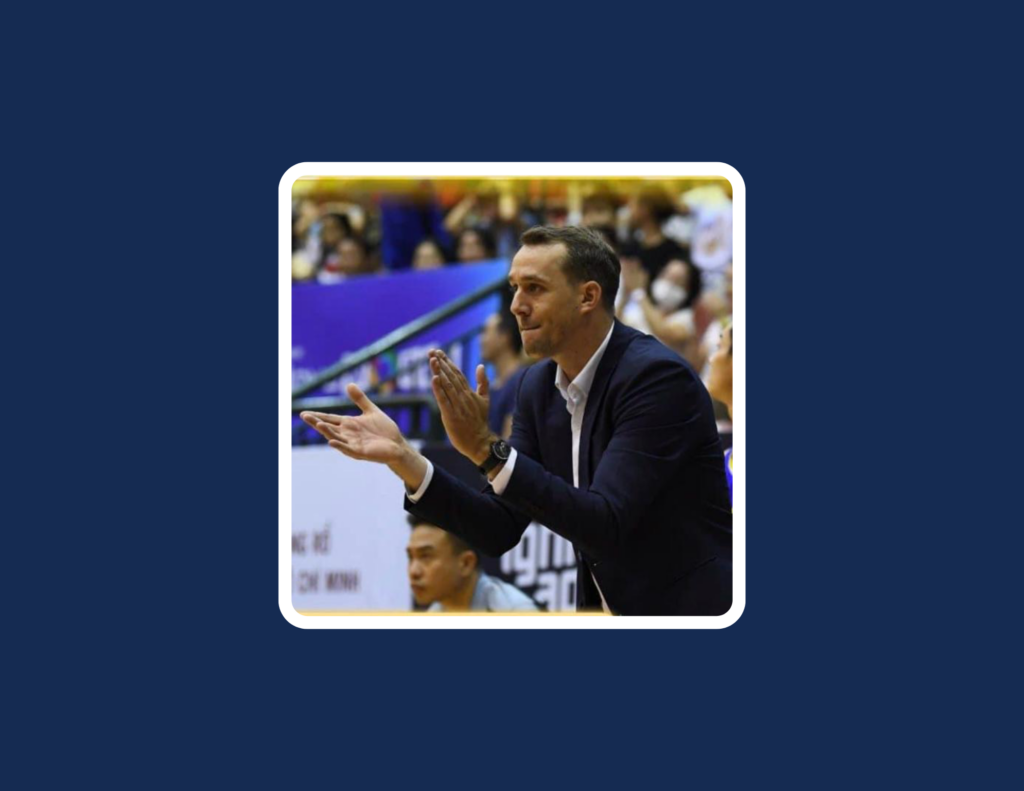
Website – http://linkedin.com/in/erik-olson-55bb2319
Email – [email protected]
Twitter – @_OlsonErik

If you listen to and love the Hoop Heads Podcast, please consider giving us a small tip that will help in our quest to become the #1 basketball coaching podcast.
Erik Olson is the Head Coach of the Ho Chi Minh City Wings in the Vietnam Basketball Association. He has traveled the globe coaching in Denmark, Sweden, Scotland, Iceland, and Australia.
After finishing his collegiate playing career at D3 Linfield University Erik played professionally in the UK, Germany, and Australia. He began his coaching career as a player/coach in Australia before moving on to Iceland where he eventually became involved with their national team. He moved to Scotland as their national team coach at age 29 before his stops in Denmark, Sweden, and finally Vietnam.
If you’re looking to improve your coaching please consider joining the Hoop Heads Mentorship Program. We believe that having a mentor is the best way to maximize your potential and become a transformational coach. By matching you up with one of our experienced mentors you’ll develop a one on one relationship that will help your coaching, your team, your program, and your mindset. The Hoop Heads Mentorship Program delivers mentoring services to basketball coaches at all levels through our team of experienced Head Coaches. Find out more at hoopheadspod.com or shoot me an email directly [email protected]
Be sure to follow us on Twitter and Instagram @hoopheadspod for the latest updates on episodes, guests, and events from the Hoop Heads Pod.
Grab your notebook as you listen to this episode with Erik Olson, Head Coach of the Ho Chi Minh City Wings in the Vietnam Basketball Association.
What We Discuss with Erik Olson
- Growing up in the gym with his Dad who coached at Black Hills State University
- Seeing the game as a coach from an early age
- The influence of his dad, his dad’s staff, and his dad’s players on his development as a player
- Playing against Khris Humphries as a high school player in Minnesota
- Playing D3 Basketball at Linfield University
- His first overseas opportunity in Scotland
- “Seeing something new and getting outside the U. S., outside of your comfort zone, outside of your bubble, for me, it was life changing.”
- His short stint playing in Germany followed getting a high school head coaching job in Idaho
- Playing overseas in Australia between season coaching in Idaho
- His experience as a player/coach in Australia
- “I learned a lot about the game actually trying to teach guys that couldn’t dribble, pass, or shoot.”
- The one endorsement that convinced him to take a coaching job in Iceland
- “You have this idea of how you want to play, what style you would like to play. And then you look at your roster and you think, can they do that? or are we capable of winning if we do this?”
- “Take care of the basketball, rebound the basketball and take open shots.”
- Why player recruitment is so important in the lower levels of the Euro League
- The pride of working with the Icelandic National Team
- “The players have to know wherever you’re at that it’s about them.”
- “You have to work with an unbelievable level of energy and then you have to be selfless and be about the team and their development and their goals.”
- “You’re not going to have a good culture without good relationships.”
- “One of the great challenges of moving around and coaching at different levels in different countries is how do you build common ground with someone that doesn’t speak great English?”
- Dealing with language barriers on and off the court
- “If we’re going to add something, we probably might need to subtract something on the other end of that to simplify.”
- “A lot of teams will beat themselves before somebody else will beat them.”
- “You want to take away their plan A and force them to play into their plan B and plan C within their offense.”
- “You’ve got to be able to take those two timeouts that you get and change the rhythm of the game.”
- “I love the FIBA game. I love the way it goes up and down. It’s a faster game. There’s less stoppages of play.”
- “I’m an obsessive type of coach, I want to know everything. I want to feel like I know everything about my opponent.”
- “You want your players to be out there playing very hard, playing very together and not overthinking.”
- How COVID led him from coaching in Sweden to an opportunity in Vietnam.
- The crazy and dangerous bus rides in overseas basketball
- “We get to do it all for the round ball. We get to be around the game of basketball and make it a part of your life.”
Like this show? Please leave us a review here — even one sentence helps! Consider including your Twitter handle so we can thank you personally!

We’re excited to partner with Dr. Dish, the world’s best shooting machine! Mention the Hoop Heads Podcast when you place your order and get $300 off a brand new state of the art Dr. Dish Shooting Machine!

Prepare like the pros with the all new FastDraw and FastScout. FastDraw has been the number one play diagramming software for coaches for years, and now with it’s integrated web platform, coaches have the ability to add video to plays and share them directly to their players Android and iPhones via their mobile app. Coaches can also create customized scouting reports, upload and send game and practice film straight to the mobile app. Your players and staff have never been as prepared for games as they will after using FastDraw & FastScout. You’ll see quickly why FastModel Sports has the most compelling and intuitive basketball software out there! In addition to a great product, they also provide basketball coaching content and resources through their blog and playbank, which features over 8,000 free plays and drills from their online coaching community. For access to these plays and more information, visit fastmodelsports.com or follow them on Twitter @FastModel. Use Promo code HHP15 to save 15%

Your first impression is everything when applying for a new coaching job. A professional coaching portfolio is the tool that highlights your coaching achievements and philosophies and, most of all, helps separate you and your abilities from the other applicants.
The key to landing a new coaching job is to demonstrate to the hiring committee your attention to detail, level of preparedness, and your professionalism. Not only does a coaching portfolio allow you to exhibit these qualities, it also allows you to present your personal philosophies on coaching, leadership, and program development in an organized manner.
The Coaching Portfolio Guide is an instructional, membership-based website that helps you develop a personalized portfolio. Each section of the portfolio guide provides detailed instructions on how to organize your portfolio in a professional manner. The guide also provides sample documents for each section of your portfolio that you can copy, modify, and add to your personal portfolio.

We know you’re invested in the next generation of athletes, so why not give them the star treatment this season with GameChanger. Introducing GameChanger, a free app that provides you with data to make strategic coaching decisions and to deliver memorable moments to your team and its fans. Engage your players, empower your coaching decisions, and give parents the thrill of watching every play unfold in real time this season. Download GameChanger now on iOS or Android. GameChanger equips your team with the tools they need to succeed. Download it today and make this season one for the books. GameChanger. Stream. Score. Connect. Learn more at gc.com/hoopheads.
With GameChanger you’ll get automated highlight clips for all scoring plays as well as rebounds, steals, assists, and more. Plus free live streaming, advanced scorekeeping, and team management. No complex setups required, just easy, free streaming from your mobile device. AI powered technology will automatically pan and zoom…
THANKS, ERIK OLSON
If you enjoyed this episode with Erik Olson let him know by clicking on the link below and thanking him on Twitter:
Click here to thank Erik Olson on Twitter
Click here to let Mike & Jason know about your number one takeaway from this episode!
And if you want us to answer your questions on one of our upcoming weekly NBA episodes, drop us a line at [email protected].
TRANSCRIPT FOR ERIK OLSON – HO CHI MINH CITY WINGS HEAD COACH – EPISODE 900
[00:00:00] Mike Klinzing: Hello and welcome to the Hoop Heads Podcast. It’s Mike Klinzing here with my co-host Jason Sunkle tonight and we are pleased to welcome in International Basketball Coach, currently coaching in Vietnam, Erik Olson. Erik, welcome to the Hoop Heads Pod.
[00:00:15] Erik Olson: Thank you so much for having me guys. It’s a pleasure to be on with you.
[00:00:22] Mike Klinzing: We are excited to have you on and get an opportunity to learn about all the various stops that you’ve had in your coaching career, what you’ve learned coaching all over the globe and some of the lessons that I’m sure you’ll be able to share with our audience here as we go through the podcast tonight.
I want to start by going back in time to when you were a kid. Tell me how you fell in love with the game of basketball. What are some of your earliest memories?
[00:00:47] Erik Olson: Well, that goes far back. My father was a NAIA head basketball coach in the Midwest school that is now Division II, Black Hills State University.
So I grew up being that kid that was four or five, six years old. Standing in the corner of the gym holding the ball when the coaches were talking and watching practice and kind of being around things. So from a very young age, I had the pleasure of being around teams seeing how everything operated, seeing how the coaching meetings would go, the film meetings, the trainings and just being fully immersed from a young age around the game. And obviously when that’s the situation, you’re going to fall in love with it. And since then play in high school, play in college and play overseas and then have an opportunity to make the jump into coaching myself.
And I guess it’s been a great ride thus far, but it all comes back to the to the round ball. And then the thing that we all love which is the game of basketball.
[00:01:51] Mike Klinzing: As a kid, with your dad coaching, did you, as a player, I’m always curious because I think different people have different responses and different ways they thought about the game when they were playing it.
Since your dad was a coach, did you, as a player, do you feel like you saw the game or were you already starting to maybe look at the game through a coaching lens just because of the influence of your dad when you were playing, let’s say, as a middle school or high school player?
[00:02:18] Erik Olson: Yeah, I think for sure I would see the game as a coach.
Even if I didn’t quite realize it, drawing plays on a napkin, maybe as a kid, which not really a normal, yeah. Normal activity for a kid to be drawing the X’s and O’s on a napkin cause you see your old man doing it, or you see the coaching staff doing it. So I definitely think the coaching influence was there from a young age and then you’re the captain of your high school team or a captain of your college team. And you are going to act more strategically like a coach maybe at certain times. So that influence was certainly pretty profound on my career seeing the game from a different lens, right?
[00:03:03] Mike Klinzing: How much influence did your dad have over your development as a player? So as you started to take the game more seriously, as you got a little bit older, how did your dad help you to improve? Was he hands on, hands off? What was that relationship like between the two of you in terms of not just father son, but also kind of player coach?
[00:03:25] Erik Olson: Of course coach’s kids are usually going to be pushed a little bit more, you’re getting coached at a younger age versus just involving in the game. So I certainly remember my father the American dream.
You’re outside in the driveway shoot shooting hoops playing one on one, that type of stuff. And then as you get older. I was very fortunate to have really good coaches that would put me through workouts or give me feedback or try to support my development.
So I really had a good mix of my father, of course being hands on and wanting his son to succeed and wanting to help and wanting to be a good father. I also had his staff, his assistants, even his players sometimes they’d want to put you through a workout or come watch a game and give you feedback.
I was fortunate as a player to really have that to have that access, obviously, and those things stick with you. So some of my good friends now even at this this point in life are still the guys that 20, 20 years ago, 25 years ago were rebounding for you and trying to get your follow through right and your footwork right.
[00:04:45] Mike Klinzing: Absolutely. All right. So as a high school player, give me your favorite memory. What’s something that sticks out? Could be a game, could be a moment, could be just the general experience of teammates. Just what sticks out for you when you think about your high school career?
[00:05:02] Erik Olson: Yeah, for me, there’s, of course, like everybody, there’s a lot of memories.
I particularly remember being a very young skinny shooting guard that was a sophomore. In Minnesota playing in the state tournament. And we were, our team was the Moorhead Spuds. We were in the Northern part of Minnesota at the moment. And we were playing against Khris Humphries’ high school team from Hopkins high school in Minnesota.
And he was the player of the year in the state of Minnesota at the time. And we were the kids from the sticks up there outside of the city and I vividly remember just the level of that game myself not being ready to compete at that level as a sophomore and watching Khris Humphries go out there and really just dominate the game from, from A to Z for 32 minutes, it’s something that stuck with me going into junior, senior year and into college, just watching elite players even from a young age and seeing the noticeable difference in the effect they can have on a game and how comfortable they are playing the game and can still remember Khris Humphries getting the ball 14 feet from the basket and it was just a bucket every single time.
That sticks into my memory bank as one of those while you’re sitting here as a kid trying to get on the court and you’re watching Khris Humphries drop 40 on you and you’re 15, 16 years old and that one sticks with me.
[00:06:36] Mike Klinzing: It’s kind of amazing when you think about guys like that who eventually obviously make it to the NBA. And clearly there are some guys that are late bloomers. And then there are some guys who, when you see them as a high school player and you just see the level of physical tools that they have to say nothing of their basketball skills, but just from a body standpoint, how differently those guys are built.
I mean, I had two experiences, one, actually I had three. So one was Jerome Lane way back in the day, and Jerome Lane was just like, dude was built, his legs were like tree trunks. I remember being on the floor with him at one point. And then obviously I never played with LeBron, but saw LeBron as a high school player and clearly a man among boys.
And then the other guy I saw back when he was in high school, and this was Even pre internet, I watched him play. I wasn’t on the court with him, but heard about this guy here in Ohio, Jimmy Jackson, who played for Toledo Montgomery High School. And I saw him when he was a sophomore. My dad and I drove to a game and we had never seen a picture of him, never knew anything about him. Had heard about this kid and we show up and like wonder if we’re going to be able to tell who he is. And sure enough, he comes out right instantly. You’re like, that one’s Jimmy Jackson. Clearly was built exactly like he was built when he was a rookie with the Dallas Mavericks.
He looked exactly the same as when he was in 10th grade. And those guys are just, they’re just built differently.
[00:08:00] Erik Olson: That’s the Khris Humphries story. Same thing. Man amongst boys at the time his body didn’t really change in those years after, but like you said, it’s sure noticeable when you step when you watch a game and some of these elite guys it stands out to you.
Now it’s a different game. Obviously, there’s so many high level players and the game has really developed and grown and the gap is much smaller. So maybe it’s a little bit different now, but it’s certainly noticeable still when you see these those elite guys, like you just mentioned.
[00:08:35] Mike Klinzing: Absolutely. All right. Tell me a little bit about your college decision, how you ended up going to Linfield, what the recruiting process was like for you. And when did college basketball start to get on your radar?
[00:08:49] Erik Olson: I mean, I was a small school guy, right. As we’re transitioning there from talking about LeBron and Khris Humphries, and I was a division three basketball player, right.
My recruitment was much different. I would try to get myself seen. I would go to exposure camps the five star invitational anywhere you could go where you were going to be around good players and college coaches. And like you mentioned earlier, late Bloomer early Bloomer, myself being a Division III basketball player, I was a late Bloomer.
I kind of made the decision to go to Linfield just for a great education in a sports environment with a pretty strong basketball program. Now Linfield is a small school, but it’s known for having an unbelievably powerful football program at the Division III level, being a national competitor every year.
And I think they’ve got the longest winning streak of all football programs in America. So yeah. far as it’s like 50 seasons in a row with a winning record. I mean, it’s a strong program. So basketball wasn’t really on the map. And me being a, me being a late bloomer, my career didn’t really take off until I was a junior and then senior year I had a couple of good games towards the end of my career.
And that opened up just enough doors to be able to transition into playing overseas.
[00:10:19] Mike Klinzing: Tell me a little bit about how did that, how does that, how does that happen for you? Because again, I think it’s far more common today for players at the NAIA or division three level to be able to get an opportunity to play overseas, but it feels like something that in the past it wasn’t quite as easy to do.
So what was that process like for you? How did that become a reality?
[00:10:42] Erik Olson: You’re 100 percent accurate on that. It’s different, it’s a little more accessible now, again, with the technology, with the access that coaches have to diving into a player’s career back, yeah, back then, there weren’t a lot of guys that were able to go overseas and have the opportunity and it was on my bucket list. My dream, my goal was to at least experience the different cultures one way or the other, whether it be to travel and teach English or I wanted to get outside and experience some new things.
So, on my radar right away was maybe I got to do some things here to have the opportunity to go to a foreign country and play basketball. And the process with that nowadays maybe you’re going to tryouts and maybe you’re going to invitationals with other players.
None of that stuff existed. existed 15, 16 years ago, really. It was more, you better hustle a little bit. You better put a highlight tape together and I didn’t have an agent. You’re sending the stuff out to teams, you’re cold calling coaches or GMs and trying to get your resume on a couple people’s desks that it might be the right fit.
So that was kind of my process at that time. I had a really strong second half of my senior season and I would just take those games, full games, highlight, highlight tapes and send it via email or a phone call to as many people as I could and one day the phone rings and you get an opportunity to actually go somewhere and sometimes it takes one opportunity and the rest is kind of history in some ways. Well, the first opportunity I had was to go to Scotland, actually, in the United Kingdom. And it was a small level. Coach John Bunyan, who is a very storied coach in the United Kingdom, an older gentleman, been coaching 20 years and kind of built the program from the ground up.
They picked up the phone and then wanted me to come for a three month stint for not a lot of money and to stay with a Scottish family inside their house as a homestay. So again, if you want to have the opportunity to jump overseas and maybe start something, ideally you might have some things you think you might need a salary a decent amount of money and I didn’t have any of that.
It was like a $500 a month type of gig and stay with a family.
[00:13:33] Mike Klinzing: What was it like for you going
overseas as a young guy, obviously. In the UK, you don’t maybe have quite the same language barrier that you might initially in another country, which I know you played in Germany and we could talk a little about that.
But just what was the adjustment like for you no longer living in your home country? Forget about the basketball side of it.
[00:13:52] Erik Olson: And that’s one thing that I would recommend to everybody graduating from university or a younger student athlete or student in general that’s about to start their career.
For me, seeing something new and getting outside the U. S., outside of your comfort zone, outside of your bubble for me, it was life changing, obviously. just to experience new things, meet new people and be pushed to adapt. So moving outside the U.S., I, as a young kid, to be honest with you to be fully honest, I didn’t really think about it. It was more just here’s this opportunity. I’d like to give it a go like to take a chance and really see what could happen. obviously basketball wise, you want to keep playing, you want to have an opportunity to keep doing what you love.
But other times you just have to jump into an opportunity and make it work. And that’s really what it was for me at that age. You got a guy that you don’t know, you’ve never met he’s going to, he’s telling you you’re going to stay with this really nice family in Scotland. You don’t really know what you’re getting into.
But there you go one week later you’re on a plane you just get your passport, you never used it. You’re looking at this thing and what am I getting into? And it was kind of just he was right. It was a great family. It was a really good situation.
It was a small town in Scotland. We ended up going three months and winning the Scottish cup their first time for the club I was MVP of the Scottish league that season. so things could have gone much different. If you go out there and don’t win or you don’t put the pieces together, that could have been my one and only opportunity.
But it turned out the other way where it works for both sides. And you’re able to kind of build off that and take it to the next opportunity.
[00:15:43] Mike Klinzing: Did you stay in the UK after that or did you immediately move? I know you eventually ended up in Germany next. Was that an immediate move or, or did you stay in Scotland for a little bit of time?
[00:15:52] Erik Olson: Right from that season, again, being a guy that didn’t have an agent, didn’t have anybody representing me at that time. I took that, again, that film and those stats and those connections. I went right to Germany and tried to find a team that would that would consider employing me for the following season.
So went to Germany, traveled around Nuremberg and Berlin. South of Germany, the north of Germany. And just again, try to get in the gym, try to meet some coaches try to play in some open runs be a part of a couple teams in their off season and make a good impression.
So it was really, it went immediately right into I better find the next opportunity because I don’t want to go home and start a real job so I went right out and got out there and tried to find the next gig. And it worked enough. I was able to jump in with a Pro B team at the time.
They’re now Pro A. And this was this was a team called Ehingen in the south of Germany, and they were a strong team and I was only able to spend two months with them before statistically not being good enough, right? So, I went there, I had a good opportunity to continue to play.
You’re trying to get better. And then the coach brings you in and says you’re not the right fit for the group. We need a bigger guard. They brought in a division one guy and just like that just like that, my German experience was over.
So now you’re back to the drawing board now, again, if you don’t have an agent and you’re, you’re not a high power D one guy or a division two, all American or whatever it might be. I had to go back to the drawing board. And then from there, the next couple of years got really interesting.
With the opportunities I had to take and, and try to make work. And so I ended up taking a high school job. I took a high school job in Idaho that was immediately open. Like two weeks later, it was open after getting cut. And now I’m a 23 year old head basketball coach in Idaho in the middle of nowhere.
Okay, so, so now I’m a basketball coach in Sun Valley, Idaho, a great little town, a skiing town with a population that didn’t give a lick about basketball. But I did that for four months and built that program up and then again, the phone rings and now I have a chance to go to Australia and play.
So I finished a season as a coach and 23 years old, and I immediately flew to Australia to spend the next six months playing in the in the Waratah league of, of Australia. Okay. And that was like a year round coach in Idaho, go to Idaho go to Australia.
And now, now I’ve added a third country kind of to the resume and yeah, I did that for two years. So I went back to Idaho after I played in Australia and then I went back to Australia again a second time. as a player coach which was also kind of common back in the day. There was player coaches.
So that’s really how my coaching career started was going to Idaho and taking a chance at a high school program and then going to play again and turning that pro job in Australia into a player coaching job.
[00:19:23] Mike Klinzing: All right. So let me dive into your mentality at that point. Where you’re back in Australia to play. You’re also coaching this team in Idaho. Was there any thought when you were in Idaho that that was the place you wanted to be, and maybe you were looking for a more settled life or were you still, Hey, I want to be in Australia.
[00:19:49] Erik Olson: At that point, I really still wanted to be a player, which is what it was.
I was still, I was 23, 24 years old in that period. I really wanted to see if I could continue to play. So when I was in Idaho I was coaching 16 year old kids. It was a, it was really a good learning experience. I learned a lot about the game actually trying to teach guys that couldn’t dribble pass or shoot like I learned a lot I learned a lot about the game of basketball from being in that type of situation.
So I was hungry as a mentality. You asked, I was hungry to just keep building whatever it was going to be to try to keep building experiences and a network of contacts and that’s so when the phone rang the second time in Australia to come back as a player coach, it was kind of like a no brainer, what a cool experience to be playing professionally in Australia and they’re going to give you the reins of the team to be the coach as well.
I mean, it was a really unique opportunity at that time. And those player coaching jobs are gone now. You don’t really see that anymore anywhere, but to be doing that at 24 years old, a player coach in Australia. I mean, it was a once in a lifetime opportunity and we had a lot of fun doing it.
We had some success doing it. And that’s where my early career early life of being around coaches and being drawing plays on the napkin and now you have to mesh being a good player and being the right coach for what the team needs. so for me, those were just kind of like unbelievable experiences to go from Idaho guys that can’t dribble, pass, or shoot to the small high school level in a ski town to going to Australia to being a professional player coach.
I mean, those are two opposite ends of the, of the spectrum.
[00:21:48] Mike Klinzing: Right. So this is a first on the pod, a player coach. So what I want to know is how do you balance. What you’re doing as a player with what you’re doing as a coach. Did you lean more one way or the other? Obviously at this point, you’re young. You went back to Australia because as you said, you still wanted to play.
So I’m just curious where, what the mentality was, maybe how you split your thoughts in terms of how much were you focused on your performance as a player versus what you had to do as a coach?
[00:22:22] Erik Olson: Yeah, that’s a great question. I mean, I often think back about what my mentality was at that, at that point in my career.
And I mean, you had to be a good player to keep your job first, that was ultimately they needed to win. They wanted their import player as they would as they would call it in Australia, they wanted their import player to produce. So you had to be aggressive and you had to maybe shoot the ball a couple more times than you normally would want as a coach, right?
You had to force some of the actions sometimes. But I was fortunate because we had a very talented team, so we were able to And they were an experienced team. So we were really able to like you can say, let’s go four out with one low post, let’s go five or let’s run flex.
So we were able to kind of do some things like basic just with having a smart group that was pretty talented. So we were able to kind of play good team basketball score a lot of points, we brought a lot of fans into the club and really built it up.
And by the end of the season we were, I got coach of the year, player of the year award in Australia and our team won we were in the finals that year. So, I mean, it ended up, we ended up hitting on everything. Sometimes you hit, sometimes you miss, that group really dialed in and hit but me being our coach’s kid, again, I was always thinking about coaching what we got to do defensively what’s not working pick and roll wise what’s our change of pace defense that we can go to. So, player coach, 24 years old, I was still thinking about we got to play winning basketball and that’s if you want to do that, then your equations get simpler if you just want to play good basketball.
[00:24:15] Mike Klinzing: Yeah, that makes sense. I mean, I think from the standpoint of, right, you’re, you’re trying to put together, no matter whether you’re on the player side or you’re the coaching side, you’re trying to put together a winning team. You’re trying to put together a good combination. You’re trying to do things that are going to help your team to be successful.
You’re just kind of looking at it from dual perspectives at the same time, which is really interesting.
[00:24:37] Erik Olson: I mean, it was tough because you got to keep guys you got to keep guys motivated and you don’t want to be, you can’t be the guy that’s it’s all about you taking the shots and getting your own you can’t have that.
So you had to show that you were about the team. So we made it an emphasis to be the best defensive team in the in the league. So we were on each other. We had a good atmosphere of toughness we were just kind of like united on the defensive side of the ball and that really kind of built up our core and our mentality to where everybody trusted each other.
Everybody knew that coach isn’t here to get his own that type of mentality cause when you’re in a foreign country and you’re the new guy, right? Or you’re the outsider, maybe not the new guy, but you’re the outsider to the culture you really got to get people on board with you.
And they got to know that you really have their best interests at heart and you have to mean it. And some of those guys in Australia are still great friends of mine. A long time later I talked to my assistant coach yesterday.
We talking about technology and the access we get you can pick up the phone and call people around the world. So Australia these were really like development jobs early in my career that gave me a great foundation forward and a lot of tough situations to be in that you can that you can build off at this point.
[00:26:07] Mike Klinzing: So you’ve got a couple seasons of experience in Idaho. You got this player coach experience under your belt in Australia at this point, what are you thinking about in terms of a longer term plan for. Your career. Are you thinking, Hey, I really am enjoying this professional basketball experience.
This is kind of the direction that I want to go with it. Was there ever a thought to come back to the States and be, okay, I’m going to get a teaching job and be a high school coach, or maybe I want to get in and coach at the college level. What were you thinking about? Or was it, did you have a plan or was it more just, Hey, whatever the next opportunity is?
I’m going to take a look at it. What were you thinking at that point?
[00:26:47] Erik Olson: At that point, I was definitely thinking about how to, how to get into the highest level of basketball I could at that point. If that meant, being an NCAA assistant that was on the table and those were things that I would consider the Development League and G League, it was a different thing. It was a different thing back then. So for me, it was kind of like the route was probably going to be NCAA high school, obviously, but you have to factor in, I didn’t want to be a teacher at that point. I wanted to stay in basketball at a high level.
So I just kind of just buckled down. And I remember interviewing for assistant jobs at the NCAA level. But at that time I’m 25 years old and then I was a player coach in Australia. I didn’t have a great resume at that point. plus all the connections that later I would add for recruitment around Scandinavia and Europe.
I didn’t have that stuff at that point. So I wasn’t that attractive as a 25 year old guy trying to get into an assistant situation at the NCAA level. So once I realized that, the challenge became how can I build off this this into something bigger and then again, the phone rings one day.
Maybe two weeks after going through this process and you’re stuck a little bit into what you want to do the phone rings and I get an opportunity to go to Iceland and I didn’t even know where Iceland was on the map at that point. I’m in Australia and I get a call to go to Iceland, again, other side of the world and you start Googling it and you realize that there’s not a lot of sunshine.
It’s a cold place and there’s not a lot of people that live there. So it wasn’t that attractive on the surface, obviously. But I knew they had really good basketball. And I had known an American coach Jeff Kotilla was his name, who he was this is, he was a very connected guy in Scandinavia.
And he was a college coach for a long time. And he made the jump into being a professional coach after he met his wife. And he loved Iceland and that’s all it took for me. It was one guy saying you’re going to like it no matter what you think, you’re going to like it. So sure enough, you’re on a plane and touchdown in the land of Northern Lights there in Northern Europe and now you’re a young coach that is in Europe and we were a bad team.
We were in the second division. of, of the Icelandic pro league. And it was it was a tough, tough job. But I had to take it. And now I was done playing, I was not a player coach. I was not a guy trying to play. I knew my career was over at that point. But here I was trying to build now a team and a program and a culture in the Icelandic pro system.
[00:29:46] Mike Klinzing: How did you go about putting together sort of your philosophy of how you wanted to play? Who were your influences in terms of from an X’s and O’s offensive and defensive philosophy? How did you kind of build that as a head coach?
[00:30:00] Erik Olson: Well, I think that’s a great question. I think this a little bit.
I think being a young guy, I was a young coach. Most of the players, many of the players I had were older than me at that age, a lot of the guys were older than me were veteran guys. I mean, you have this idea of how you want to play what style you would like to play.
And then you look at your roster and you think, can they do that? or are we capable of winning if we do this? So at that age, my philosophy was really. Like, what can we do with this group to give us the best the best chance to win regardless of, like, how I want to play what kind of Princeton action we want I would like to run, or flashy defensive set flashy defensive look at that time, whatever it might be I was really concerned with taking over a bad team And then that was kind of the only opportunity I was going to get to be a pro coach.
So when I was that age, my philosophy was we just got to take care of the basketball, rebound the basketball and take open shots. That was my philosophy at that at that point in my career, just to give us a chance to improve our record from being an eighth ninth place team before I got there.
To just make enough improvement to where you’re going to get a second season and a second chance to recruit, bring in another new American maybe add some young guys, develop the guys you have. For me, it was like a two year season, that first job in Iceland.
Kind of a two year season where you’re trying to get to year two, trying to improve your record and build some momentum. So my philosophy really was, was quite simple at that stage in my career. David Blatt was the guy that everybody in Europe that was foreign an American guy, everybody would look up to this American coach that was at a high level.
David Blatt, he was rolling in Europe at that time. he was well respected. So like, these are the guys. You would, you would watch and you’d say like, wow how’d he get to his level in Europe? being an outsider, being the only foreigner in that country the four years I was in Iceland, I was the only American there for four years.
There weren’t a lot of American guys trying to get into the European system yet. And that’s changed over the last five, six, seven years. There’s a lot more Americans now. But back then there just weren’t that many guys that were trying to break into the European system, right?
It’s a completely different thing. So I was one of the only the young coach from America and Iceland. And first year we were just trying to go from ninth to seventh and that’s exactly what we did. We went from ninth to seventh place and we got the contract for year two and now we’re trying to go back to the drawing board and see how we can how we can be more successful again.
[00:33:08] Mike Klinzing: You described the process for, let’s just go with Iceland, bringing players onto your team. What did that process look like? How involved were you in helping to select the players as the head coach? And just kind of how that club system worked in Iceland.
[00:33:23] Erik Olson: Sure. That’s how coaches will fail or you’ll succeed with your recruitment, that’s such an important part of the job and it’s different at a high level EuroLeague, sometimes the scout might have more power than, than anybody in the club but at those levels lower end of, of pro basketball in Europe, I mean, the coaches bringing in the guys.
Yeah. And the coach better bring in good guys or it’s not going to work. So I went, when I was signing my first Americans, I was looking at guys like myself division two, division three guys. that I knew could adapt that I knew would really be about the program and the culture.
So I signed one of Don Meyer’s one of Don Meyer’s players when he was at Northern States Colin Pryor. He was an All American at Northern States. He played for Don Meyer late in his career. and Don Meyer and my dad used to coach against each other in the Midwest.
So once I saw his name and saw he was a Division II All American coming out of Don Meyer’s program I thought that was the guy that I needed to bring in. And we only got one import, for example, in Iceland back then. It’s changed now. You get multiple in some leagues, you get five, six.
I’ve had that as well, but it’s a tough, it’s a tough thing signing players nowadays it’s agents and it’s scouts and I had to have watched a lot of games on my own and make a lot of calls and I went with someone I trusted and that was one of Don Meyer’s players.
Trust your gut, right? Trust your gut. It worked out. He was a great guy. He was all about the team. He stayed with me for two years in Iceland and we ended up my third season winning the winning the league and moving up into the top division and he was as much a part of that as, as anybody.
So, sometimes again, he hits, sometimes he misses. He was the perfect fit at the perfect time for that group. And he’s actually still in Iceland. He’s married an Icelandic girl, he’s played for the national team. He’s really had a good career from that first signing kind of same story as me, maybe take an opportunity and run with it.
And he he’s certainly on that boat as well. What is the level of
[00:35:45] Mike Klinzing: What is the level of Pro basketball in Iceland, what does it compare to here in the U. S. in terms of level of play?
[00:35:52] Erik Olson: That’s I would, yeah, it’s a good question. At the top league in Iceland now, now it’s and even then it was open for, you’d have a handful of foreigners.
We had a couple Division I players. We had sent a couple young kids to play Division II basketball in America later. I mean, I think it was like average To pretty good a division two level of, of basketball, right? I mean, you’ve got some guys that are major conference players that are there as the foreigners.
You’ll have some really decent European guys that have played in America at the division one level. And then your seventh, eighth, ninth man are division three level players. So it averaged out into being like a division two or competitive NAIA level of basketball.
In the Icelandic league and then then that’s the bottom tier of European basketball would be like Iceland and Luxembourg, these, these countries are on the smaller end of European basketball.
[00:36:56] Mike Klinzing: Talk about being involved with the Icelandic national team and what that process looks like for getting involved in it and then how you go about putting together a national team and just what that experience was like.
[00:37:07] Erik Olson: National teams are just an incredible experience. I mean, to be a part of someone else’s national team program obviously you’re not, it’s not the USA it’s not the country you were born in. It’s not the country you watch on TV. So I just felt an incredible sense of pride to be a part of the Iceland national team.
I took pride in it the players, it was their life. It was there was a lot of national pride in Iceland being a small country. They’re very good at sports. The football team has been in the world cup the basketball team has been in the European Championships, and there’s only 300,000 people that live in Iceland, like it’s not a big population, so to be really good at football and basketball at a global level they do a lot right in their development and how they take a small group of kids in these smaller towns and develop that talent into high level players that stay together and stay with it.
And stay committed to the programs. And so I took pride in that. And being a part of a national team just a great experience. I did it again after that in Scotland. But being that first one and it was, it was the U 20 team. It wasn’t the men’s team. I was with the U 20 Iceland National teams as we were trying to qualify for the for the FIBA European Championships.
Those players were young and a lot of them have continued their careers at a high level. We had a young seven footer that’s played in Valencia, Spain in EuroLeague level and was an NBA prospect for a short period of time. And there was some really good guards that are still playing in EuroLeague top league Greece really good careers.
And those kids were, they were just young kids at the time. But any coach out there, any player that’s been a part of a national team will tell you, I mean, it’s a great experience, you feel pride when you’re a part of it and there’s definitely a different element there from trying to win at the pro level to being a part of a national team program.
It’s a cool experience. And there’s a little bit more, it’s just a little bit more on the table, when you’re wearing a country’s name across your chest, no matter what that level is, it’s a cool experience to be a part of.
[00:39:35] Mike Klinzing: What’s it like working within that structure with people from those other countries? How do they look at you as an American who’s again, outsider maybe is the wrong word, but just obviously, as you said, it’s not the country where you’re born. How does that work just from a, a cultural standpoint in terms of, and I know it’s fairly common to have an American coach be involved in a national program in other countries, but just how did that work for you?
How did you feel as an American? Did you feel like you were just as much a part of it as anybody else who was kind of in the administration coaching ranks or what was that like?
[00:40:16] Erik Olson: This has been a theme in every place that I’ve gone. I mean, you, the players have to know wherever you’re at that it’s about them. That you’re invested in them, in their development, in the team’s goals. That’s been a theme that I didn’t quite didn’t quite realize when you’re, again, when you’re 21 and jumping on a plane to go to your first overseas job you don’t really know what you’re getting into.
But one of the things I’ve learned in all these stops and all these different countries here and there and different levels with sometimes you have six Americans, sometimes you have one but it’s always been the theme where if the players, if they really know that you’re invested in them and you’re trying to develop their game and develop the game of basketball it’s easy to find common ground with players, with other coaches, with administration, with fans. You have to work with like an unbelievable level of energy and then you have to be selfless and be about the team and their development and their goals. I’ve always been able to have some success bridging those gaps and bridging cultures together.
But it is a unique challenge in every job. And it is something that needs to be at the absolute top of the list as far as if you’re going to succeed, that’s what it’s going to take to have a chance to do that.
[00:41:50] Mike Klinzing: Now, let’s build on that thought just in general as a coach, because what I hear you saying is that you’ve kind of got to get the players to buy in and get them to believe that.
You’re on their side. You’re there to help them to grow and improve and do what you can to make their experience the best one possible and help them to get better as a player. So over the course of your career, what did you, what have you learned about building the kind of relationship with players that’s necessary?
In order for them to develop that trust in you so that you can help them individually to get better, but also collectively to be able to build the kind of team that can win out on the floor. What have you learned about building relationships with players over the course of your career?
[00:42:31] Erik Olson: Oh, I can tell you, you’re not going to win without good ones. You’re not going to have a good culture without good relationships. And I think my youth situation has been unique in the sense that I was younger than a lot of in the early jobs in my career, I was younger than some of the players I was coaching.
That was the theme in Denmark, even with five Americans, six Americans we had some vets, veteran guys on that team. And when you’re the younger guy you’re coming in and they have experience, they play the high levels, whatever that situation might be, finding the common ground is essential to building a partnership together and that’s what it comes down to, is being on the same boat, paddling in the same direction the generic, kind of generic talk there, but of course you want to get the right guys on the bus and the right guys off the bus, but sometimes you don’t have a choice.
I’ve walked into teams where everybody’s signed and everybody’s under contract and they’re struggling to win and you got to figure it out how to turn it around and that’s a challenge, right? If you can’t send guys out and bring guys in or whatever that might be.
Well, you got to figure out a different way than at that point. And it will always come back to having strong relationships going in the same direction together. And then again, the players knowing that you want them to succeed and you’re going to do anything you can to help those guys succeed and maybe that means being role specific for certain guys, of course, like you’re going to have to accept a role, but we’re going to have success together if we all do it and do what is necessary to win.
And those relationships, I mean, I’ve kept great relationships in every country I’ve been, but that’s been one of the pleasures of the job. One of the great challenges of moving around and coaching at different levels in different countries is how do you build common ground with someone that doesn’t speak great English?
As an American coach, how do you build common ground with a 38 year old veteran player that’s the leading scorer in the history of the league that hasn’t won? How do you build common ground around these types of situations? And every situation’s different, of course but I think I think the, the ultimate takeaway there is, as far as how you’re going to build a relationship is commitment to each other and the players and the management and everybody knowing that you’re a selfless person that is trying to is trying to is trying to do the right thing at the right time for the team. And I think if you do those things, you’ll have a chance to succeed no matter where you’re at or what level you’re doing what you do.
[00:45:30] Mike Klinzing: In places where you’ve been, where there is a language barrier, how much of the language in terms of just Maybe picking up phrases and tidbits of the language. How much do you pick up in the time while you’re coaching? How comfortable do you get with maybe understanding some basic, basic things or being able to say a few basic things in the language? What does that look like?
[00:45:53] Erik Olson: It’s tough, that’s a tough task. I mean, Iceland was a great example there.
That’s one of the most difficult oldest languages in the world, you’re trying to pick up what you can to bridge these gaps. Sometimes you just hope the players will have a basic understanding of English and I’ve had teams that are fluent in English, like Iceland, most players spoke really proper English and there was no need to work too hard to communicate.
But on the other end of the world, I mean, in Vietnam the amount of our players that speak English is very small, so I work for the last three years, I’ve worked predominantly through having a good translator and you’re in timeouts and you’re on the floor and your translator is an extension of you as the coach.
I’ve seen a couple different scenarios where it’s a challenge and again, how are you going to find that common ground in those situations? But I’ve tried to take a little bit of the language and everywhere I’ve gone. So I can still go back to Iceland and hopefully I could navigate a little bit if I got into a jam with the language there and Sweden and Denmark, where there’s some similarities there between the languages, so you were able to feel a little bit more comfortable if you would leave the apartment and you could half read a sign or half get things done in the community it’s a unique challenge that’s something that not everybody thinks about when they think about living overseas, obviously coaching overseas, not everybody speaks English, and sometimes if they do, it’s a lot different than what you’re used to it sounding. sometimes you have to put a smile on your face in Vietnam, and shake a hand and bow the head, and we’re in this together type of thing. Sometimes it works, and I’ve got great support here, I’ve had great support in everywhere I’ve been, but that language barrier, it can be a tough situation sometimes, and I’m thankful to have good people around me that have really supported me along the way in each of these jobs.
And if you don’t have that, if you’re on your own it’s a tough thing. I’ve seen some Americans that didn’t have great support and didn’t hit when it was close and then those, every job’s tough and every job’s unique.
[00:48:26] Mike Klinzing: How about off the court? So I mean, on the practice floor, obviously you’re communicating, you kind of have the same mission, but off the court, you still have to. Live your life during the time when you’re not coaching. So what’s that like when you’re in a place where you don’t speak the language? Just how do you go about navigating through your daily life while you’re coaching in a place where you don’t speak the language?
[00:48:49] Erik Olson: Yeah. Again, I’ve had jobs where you have some free time and I’ve also Iceland is a great example. I spent four years there. I coached the U16 team. I coached the U18 team. I coached the U20 team. I coached the men’s pro team and I ran the basketball academy, which was the only academy in Iceland at that time.
So for three of those four years, I was coaching all day. I was in the gym and that was why I went there was to be in the lab to learn as much as I could and work with as many players as I could and try to develop a style and a methodology to how you build players.
So that was my Iceland experience was coaching 16s, 18s, U20. Academy and being involved with the national team. So that, that was a lot of basketball. So to be honest, I didn’t do too much outside of the gym in a town of 6,000 people in Iceland, right? It was not a big population.
There wasn’t a whole lot to do and it was dark all, all day. So. I just took that and ran with it. That was a basketball decision. I was there to learn as much as I could. And Denmark was much the same. I mean, it was a morning practice every single day. And then it was an evening practice every single night.
And a lot of games mixed in between that. So I guess basketball, you better love what you do, right? And I think for me, I love coaching and I love working with players. I love watching our opponents and putting the game plan together and I just enjoy the process of what a season looks like and what a development model looks like in the game of basketball. So I’m thankful that basketball is and has been my life up to this point. So to answer your question, I guess not a whole lot outside of the gym, right? It’s you better love what you do and then basketball better be it.
If you’re going to live in a foreign country and, you know what I mean? And try to build a basketball career.
[00:50:59] Mike Klinzing: All right. Talk to me a little bit about, and again, we’re just talking generalities here, because obviously I know that each situation, each team, each country has, is a little bit different.
But just in terms of generally, how do you put together a practice plan? What’s your process for, okay, the previous day’s practice ends or the previous night’s game is over? And we’re going to practice the next day. Just walk me through how you put together that practice plan and then what you’re trying to make sure that you incorporate in that plan on a daily basis.
[00:51:32] Erik Olson: Sure. I’ll take that from my Vietnamese experience out here but universally and now through my career, one of the things I learned from being around coaches and career coaches and young assistants, and my father, older Coach and watching Don Meyer on the other sideline.
Being around the game I’ve been a believer that it’s what my team needs this week as far as in season what do we need this week as far as what do we have to do to get better? What’s the short term vision this week of what we have to do to be successful.
And I’ve got my core belief in fundamentals, you got to shoot, you got to ball handle, you got to finish, you got to do footwork stuff, you have these core these core things that you have to do that you want to change and you want to keep challenging of course, and that’s off season, in season you need to have a vision for what are the core fundamentals that these players need. like, this guy needs it, that guy needs it, and then our whole group, what do we need? You have to have that, of course, but basketball wise X’s and O’s and strategy of a team.
I’ve always been, what do we need in the short term? And if we’re going to add something, we probably might need to subtract something on the other end of that to simplify and not letting your playbook get too long or your scouting report become too complicated.
I believe in keeping things simple. And keeping the game what it is, which is sometimes it’s a simple game and a lot of teams will beat themselves before somebody else will beat you. So I believe in fundamentals and I I believe in, in, in daily process of, of, of improvement.
And then as a bigger picture, I believe in what our team needs in the short term that’s how I would approach every day with how I’m going to build my practice for that day, for that week. And a lot of times you’re going to play a game on a Monday and you’re going to play another game on a Friday.
So whatever that might be, you’ll have a couple days in between, of course. And it needs to be it needs to be, get better, but rest and then recover and then and then we better be tighter as a group the next game. So these are all factors within your processing.
But that’s what I love about it. I think that’s what most coaches love about it is the day to day and the process and the improvement and then the challenges that it brings.
[00:54:21] Mike Klinzing: Talk to me a little bit about the scouting process when you’re looking at.
What are some of the things that you look for that, A, you can attack offensively or B, that you feel like you need to defend defensively? And obviously, I know there’s a ton of things that What are some things that when you’re watching a team on film, you want to know for sure heading into that next game? What are some of the key things that you’re looking for when you watch film and you scout a team?
[00:54:53] Erik Olson: Early in my career, I was off. I liked to watch movies. I like to consider myself an offensive coach early. I really cared about the offensive side of the ball and running good stuff and what system you want to play and sometimes your team doesn’t have those capabilities, doesn’t match that vision so you have to adapt, but I’ve fallen in love over the last seven, eight years with D having defensive minded teams having really tough teams that are dive on the ground and we’re going to talk and we’re going to we’re going to get back and work together and move together and talk together and rebound together.
I mean, I’ve always just taken pride in being a good defensive team. And in Europe that you see both, right? You see, Teams that are going to run and press and just like America, you’re going to get a little bit of that and you’re going to get teams, Serbian teams, and different, different countries that are going to run offense for 20 seconds and only shoot in the last four seconds of a shot clock.
I mean, so, yeah, you’re not going to be able to cover everything within a game. You have to take away the primary option. that is obviously what the first thing we’re trying to do is take away their primary bread and butter either score or bread and butter set you want to take away their comfort level with their go to whatever it is the percentage of times that the other team is going to run an action or isolate this player or look for this.
I mean, I think first has got to come back to you want to take away their plan A and force them to play into their plan B and plan C within their offense. And every team again on a short turnaround sometimes or a long turnaround, whatever it’s going to be.
You got to focus first on taking away their primary option and having your, your core defensive philosophies got to stay in place. I like to switch I like to pressure up and front the post when we can and rotate and scramble and run teams off the three point line.
I mean, with a 24 second shot clock it’s the game in Europe is, you It becomes much less manageable from an NCAA game where you get you get four media timeouts. you get you get timeouts, you can call on the fly if you don’t like what you’re seeing, you can call a timeout as a coach being in Europe and being in the FIBA game you have to do your work before the game and then you have to adjust in the timeouts that you do get, which is not that many.
Right. So you’ve got your core philosophies, and you’ve got what we’re trying to take away, plan A and plan B, what we need to take away. And then you’re in a game and you’ve got to adjust. You’ve got to be able to take those two timeouts that you get and change the rhythm of the game.
Within those timeouts because you’re just going to have less time to talk, to manage. The media timeouts are gone, you’re just going to get less time in the game and FIBA and it just kind of goes up and down and flows a little bit differently. So I love the FIBA game.
I love the way it goes up and down. It’s a faster game. There’s less stoppages of play. So now I’m completely used to it. I’ll still debate with my, my friends that are college coaches and we’ll still debate what’s the better style of basketball, better and it’s truly a different game.
FIBA is truly a different game to what an NCAA game looks like. It’s just, it’s almost, not a different sport, but it feels differently when you’re watching it. Just because of the tempo is different and the less stoppages of play kind of make it an up and down event, right?
Less stoppages of play
[00:58:55] Mike Klinzing: Less stoppages of play is definitely a plus. Whenever I watch international basketball, I think that’s one of the things that truly sticks out. When you watch a college game or you watch an NBA game and You’re talking about the last four minutes of that game seemed to take forever. Even a high school game, my son’s a senior in high school right now, teams that get five timeouts and they’re saving them all for the last four minutes of the fourth quarter. And it just feels like, man, those things just drag on. And a lot of times it’s that old saying, right? That a lot of times there’s a lot of overcoaching. Where if you just kind of let the players go and figure it out and play through things that they’d learn to adapt and probably end up making better decisions in some cases than what the coach could make from the sidelines in those last second plays.
But definitely from a flow standpoint, the international game is, is much, is a much more fun product to watch in the last three, four minutes where you’re not having to sit through multiple timeouts and stoppages and all the other things that, that go on here. In the States, when you start talking about games like that, it’s just, again, a completely different feel.
Talking about film and scouting and preparing for an opponent, putting together practice plans. How much of the scouting report that you put together on a team or how much of the film breakdown that you do, how much of that gets shared directly with your players, how much are your players involved in?
And again, I know it probably varies again, country to country, team to team, but just in general, your philosophy as a coach of how much of the scouting report that you put together as a coach, how much of that gets shared with your players?
[01:00:36] Erik Olson: Right. That’s great. Great. You love talking about that, that type of stuff.
I’m an obsessive type of coach, right? I want to know everything. I want to feel like I know everything about my opponent. I don’t expect my team to know everything. Right. But me, I want to feel like I know what they’re thinking, what they might go to late in the game what their end of game sideline play has been in the past, what they go to if they need a bucket, they haven’t scored a couple possessions in a row. I want to feel like I know everything that that could be thrown at you now, it’s not that’s not conceivably possible to know everything, but you want to work like you’re completely and utterly prepared for the opponent. But I’ve played for coaches that you’d spend hours in the meeting rooms, right.
And hours watching film. And getting seven pages or eight pages of a scouting report. I’ve played for those coaches and I’ve played for more of the type of guys that less is more and so I guess I’ve seen both sides of that. But I take a little bit of both, we’re going to watch film.
We’re going to watch a lot of their sets. We’re going to watch a lot of personnel, we’re going to keep our core philosophies pretty consistent from week to week. maybe change, one guy, take one guy out of the pack or whatever, whatever it might be to keep it simple, but take away what they want to do.
But I definitely believe sometimes that less is more and you want your players to be out there playing very hard, playing very together and not overthinking. So I’ve taken more of that approach where I don’t want to be in the film room for hours with our team.
I don’t want to hand out 15 pages of a scouting report and expect there to be a hundred percent understanding of what we’re trying to get done. Right. So I want to know everything, but I want my players to execute and play as hard as they can and play as confidently as they can.
I’m more the type to spend 20 minutes in the video room, right. And maybe more time individually with players showing individual clips and this I’m definitely a big believer in individual development within a team concept.
So less is more I’ve met other coaches that are successful that’ll be like me and then some Serbian coaches, Bosnian coaches. I mean, they’ll spend hours in the video room and they’ll win and they’ll feel successful with it.
So I guess I’ve seen both succeed both have their successes, but for me it’s the individual development in the team concepts and that has worked with most of the groups I’ve had as far as End of season, playing better basketball and being more united at the end than you are at the beginning and evolving all through the process.
And multiple ways to win, right? I mean, there’s lots of different ways. Correct. Multiple ways to win and not that many ways to lose. It is a a simple game. At the end of the day, it does get, sometimes it gets over complicated and the NBA is its own thing.
We’re not talking about the NBA. We’re not talking about a star studded league or superstars or big contracts. When, when you take that stuff away and you’re just you’re, you’re coaching for Denmark is a good example. I had two guys from Texas tech had a player from Baylor, had two other like mid division one players on that, on that team. And no one was a millionaire and no one was making six figures, but everybody was a really talented player and everybody really wanted to win and so you get a different brand of basketball.
You definitely get a different style of play, but that that was a pretty talented group I had there, when you’re talking about three Big 12 level of players in your starting five type of deal. So yeah, it’s, it, that, that scouting side and, and game planning, I mean, that’s the beauty of the details.
That’s where the fun is. And if you’ve got guys that are bought into each other, everything becomes easier at the end of the day, everything becomes easier.
[01:05:14] Mike Klinzing: Absolutely. All right. Talk to me about making the jump from Europe to Asia. You’re now currently coaching in Vietnam.
Give me some of the similarities, differences, just kind of the general overview, lay of the land, Vietnamese basketball, what it looks like in your eyes.
[01:05:27] Erik Olson: Sure. Sure. And even, even how I got to Vietnam is a story I was coaching in Sweden and, and it was we were two thirds of the way through the season and COVID, COVID pandemic Just the way the world was that the league shut down in Europe.
Sweden was one of those leagues that that canceled the remainder of the year. so I’m sitting there without it without a job. The season had just been canceled. We were you, you go there to win. We were in second place we were trying to move up to the top division in Sweden.
It was a good situation. It was a good stable club with money behind it. So it was a good situation to be in if it was going to continue. And then one day it \ wasn’t there anymore. It wasn’t going to continue and everything was shut down and it was going to be like that for a while.
So. That’s how I came to Vietnam. Vietnam was going to run a bubble. They were going to be in a hotel. They were going to play games in the convention center. Everybody was going to stay isolated and, and you were going to still have a league to play in. So that to me was very attractive.
I wanted to coach, I wanted to be around the game. And so that’s how I came to Vietnam was through a COVID shutdown in Europe and then having the opportunity to come out here to Asia and being in an entirely different basketball landscape, cultural landscape, other side of the world and Vietnam is it’s a story within itself for American guys like my grandfather was in the Vietnam war, right?
So I had some ties to this country that maybe not the best ties to have. But I had some ties to Vietnam and it seemed like a place where I could be comfortable and be involved in the game of basketball here. And it’s a growing game in Vietnam.
This is a league that’s been in place for seven or eight years. So basketball is much newer it’s much, much different style of play. You don’t have, we don’t have a lot of six, eight, six, nine inside Vietnamese players. We have a faster group of guards smaller, quicker players that, so the style of play becomes different.
Everything just kind of changes and that goes back to that goes back to earlier in the conversation speaking about like what style of play do I want to wait? Do I want to play, what system do I want to implement? And then looking at your roster.
Well, what kind of system do we need to play to have the best have the best chance to succeed? That’s how I entered the Vietnam market three years ago. Taking a bad job, the last place team the year before and trying to trying to turn that into a winning situation.
And you know. Sidebar. I mean, there’s been seven coaches for this, six coaches for our club that were all fired after one season. So mostly Americans, always foreigners come for four or five months don’t like it, don’t get it done, get fired, whatever the story might be there.
I’ve actually been the only coach now to stay with our club beyond one season even. So it’s been three seasons in Vietnam. It’s a growing market, Asia, the market is huge. The viewership is very big. like there’s a lot of engagement behind the sport, so it’s been a great experience.
As far as seeing the game again through a different lens but subjectively not as high of a level of play as what was happening in Europe with the five, six Americans. So again, different ends of the spectrum but part of the game. grassroots a little bit more hands on with, with the club as a whole so it’s been a really good experience to be out here.
Which one of the countries has the best food?
I would say Vietnam does have the best food. I guess I’m a little biased now. I’ve been out here a couple years, but I, it’s that’s been another thing there. You get to experience different things in every place. Iceland was a lot of fish a lot of fish and potatoes. That was the thing in Iceland. And Scandinavia a lot of meat and potatoes Germany the bratwurst you get different stuff every, everywhere. But if you’re open minded, I feel like people can, you’ll find what you, what you need and what you want and you’ll experience new things.
So I think Vietnam’s got a lot of pluses there on the food side and basketball. It’s a big growing market. There’s a lot going on as far as like the development of the sport in Asia. It’s definitely there’s a lot of money behind the development of the game and the business venture with things.
I mean, I’ve definitely seen things from a different perspective now coming out here and I would imagine most people don’t know that Vietnam has a professional basketball team. I mean, I did not know that until I needed to know it’s not like Sweden or Germany where oh, it’s a pretty good league so it’s been different in many respects and I’ll have to take this opportunity and you’ll have to turn it into a different one, whether, wherever that might be.
I think that’s always the challenge of taking these jobs and I’m still one of the younger coaches around Asia I’m 36 years old. I’ve had a lot of experience as a head coach in different countries. So I can always look back and then look forward again and just kind of be excited about, What that next opportunity might be when it, when it does come.
[01:11:22] Mike Klinzing: All right. This is my standard question for anybody who has experience in any way, shape or form for, with overseas basketball. What is your craziest story? PG 13 version, your craziest story could be on the court, could be off the court. Just the funniest, craziest story that when somebody kind of asks you to tell them what the experience is like, give me that story.
[01:11:43] Erik Olson: Well, I can’t tell you anything about Vietnam because I’m scared. Still currently in Vietnam. So we’ll leave that off the table. I always go, I always go back to being in Iceland or Australia, but we’ll pick Iceland for this one. And the life threatening bus trips that you would have to takethrough some of these countries that you’re not flying there’s not a big budget for, for a coach bus, you know so some of these trips some of these trips where you’re going to drive 10 hours I remember a 10 hour trip in Iceland. Okay. On a, on a minivan.
Through a dark winter storm next to, through the cliffs and along the ocean roads and the glaciers and it just, I will always tell this these stories to people and you’re, you’re holding on for dear life on some of these trips where you’re, you don’t know if you’re going to make it you’re, you’ve been on a bus for nine hours and you can’t see anything and then you got to play a game and then again, you got to play a game.
You got to win the game. You got to execute. You got to get off the bus with the right mentality and get the job done. And then you got to drive back. I mean, I’ve had multiple situations like that early in my career where you’re talking about an 8, 9, 10 hour bus ride to play a game and you’re right back on the bus driving, driving back home.
I think that’s the stuff that people will see the basketball and people will see the journey. But the experience has come from the day to day the people you’re working with the players you’re working with and the things that you ultimately go through together and, and that’s always been the highlight of, of my time over overseas is the different people I’ve gotten to work with and meet different players that have played for Bobby Knight or played for Don Meyer.
And now you’re coaching them and these are the highlights of doing what I’ve done over my career. But craziest story would have to be those the 20 hour trips to play a game in a town of 5,000 people and not knowing if you’re going to get back safely to your home.
There’s been a handful of those where you’re just closing your eyes and. And praying for praying for good luck and then safety along the way.
[01:14:12] Mike Klinzing: Absolutely. I can completely picture that would be like, all right, Eric, I want to wrap it up with one final two part question.
So part one, when you look ahead over the next year or two, what do you see as being your biggest challenge? And then part two, when you think about what you get to do day in and day out, what brings you the most joy? So your biggest challenge and then your biggest joy.
[01:14:37] Erik Olson: Biggest challenge for a guy like me, a coach a young, younger coach still trying to get to a higher level.
The biggest challenge is the influx of American coaches and foreign coaches that have with the development of the game and the international growth of the game. I, for example, in Iceland was the only foreign coach in Denmark. I was the only foreign coach American coach in Sweden.
I was the only American coach in the league. And then now I’ve come to Vietnam and there’s a handful of American coaches these years later, there’s a handful of foreign guys. So I think the challenge in the coaching business is, I’m not coaching in the NCAA level. So you don’t have, you might not have stability, right? You might not have a three year plan to build your program. I’ve been two and four at times in my career. And if you lose the next game, you feel like you’re probably getting fired that’s happened that’s happened in my career. So the biggest challenge would be taking what you’re currently tasked with and doing a great job, but the challenge is always going to be you’re going to need that. You’re going to have to be building towards the next thing. But you still have to be fully involved in what you’re currently doing, because if you’re not, then you’re not going to succeed. So that’s the biggest challenge is keeping that balance of A to Z, being a worker, outworking everybody that you can and taking the most with what you have.
But then at the same time, building your career and building what could be next and networking what could be next. So that’s a daily process. And that’s something that I’ve done my whole career early on, not having an agent trying to turn opportunity A to opportunity B, C, while being fully invested every single day and every single practice in every single second trying to succeed within that moment. So that’s a daily challenge. That’s an every season challenge. But the greatest joy is always going to be that you’re doing what you love. You get to work with players, you get to coach the game.
You had pros. I’ve had high level guys. I’ve had guys that can’t dribble past or shoot I’ve had everything I’ve had everything along the way. Right. But the greatest joy is that we get to do something we love. We get to do it all for the round ball. We get to be around a game of basketball and make it a part of your life.
So I just love working with players. I love helping players get to the next level. Whether that be a 16 year old or a 38 year old that went to a Final Four with Bobby Knight. You have both ends of the spectrum at all times. But the greatest joy is going to be getting on the floor.
And working with people and being a part of something that’s bigger than yourself within a group dynamic and thankful to have had these experiences and thankful to be able to share them with you guys and talk a little bit about them.
So it’s been a pleasure really appreciate you guys.
[01:17:49] Mike Klinzing: Absolutely. Before we get out, I want to give you a chance to share how people can get in touch with you. So if you want to share email, social media, whatever you got. And then after you do that, I’ll jump back in and wrap things up.
[01:17:59] Erik Olson: Absolutely. I feel like you have to be someone that’s approachable and contactable and willing to share your story and help people. of all the jobs I’ve ever gotten, it’s always been a first or a second connection that, taking it to those opportunities. Someone going to bat for you sometimes can just go can go miles so yeah, I would love for any coach out there or any player that wants to talk about how to get into their first job be in the game in some different capacity. I’m always, always reachable and being the country that I’m in at the current moment the best way for people to approach me would, start with just an email and a note to introduce themselves [email protected] and I will immediately respond and keep an open line of communication with anybody that wants to talk the game or talk about life or the sport and what it can do for people.
[01:19:05] Mike Klinzing: I cannot thank you enough for taking the time out of your schedule tonight. Truly appreciative. So glad we were able to connect from, halfway across the world, all the way across the world, however we want to define it. But again, time difference. We figured it out. Thank you for joining us tonight. And we appreciate everyone out there in our audience listening, and we will catch you on our next episode. Thanks.