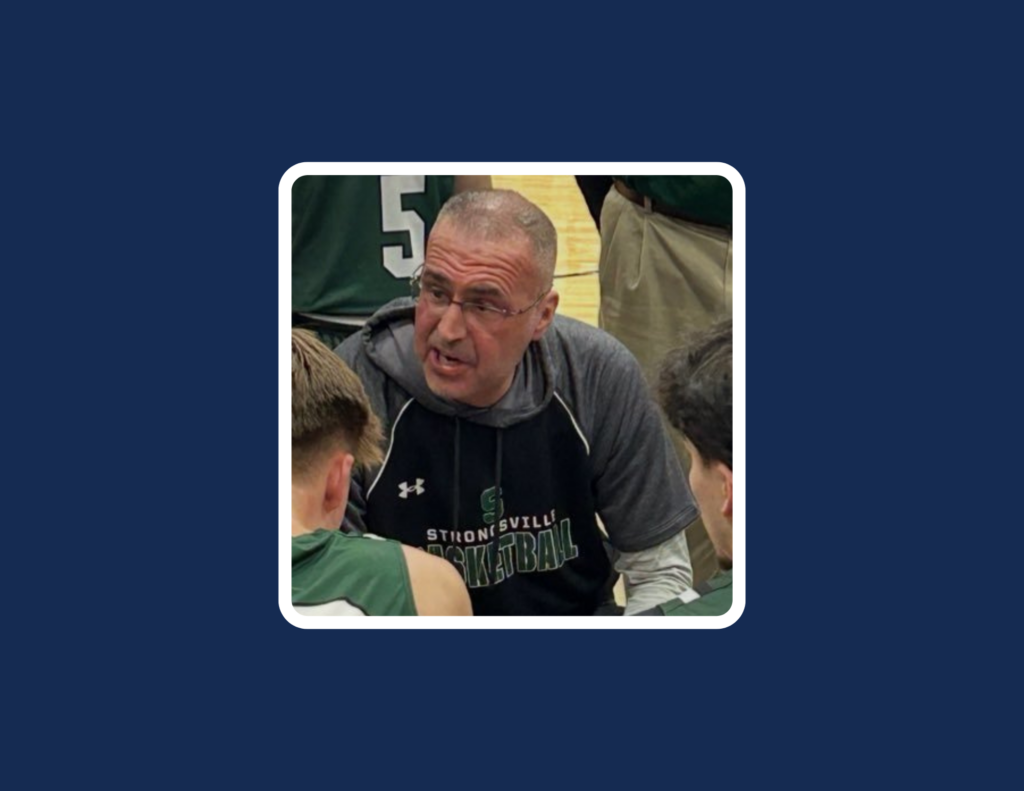
RYAN KILBANE – STRONGSVILLE (OH) HIGH SCHOOL BOYS’ BASKETBALL HEAD COACH – EPISODE 1228

Website – https://www.strongsvillemustangs.org/sport/basketball/boys/
Email – rpk44133@yahoo.com
Twitter/X – @RKilbane32
If you listen to and love the Hoop Heads Podcast, please consider giving us a small tip that will help in our quest to become the #1 basketball coaching podcast.
Ryan Kilbane just completed his first season as the Boys’ Basketball Head Coach at Strongsville High School in the state of Ohio.
Prior to Strongsville Kilbane spent the previous seven seasons at Brunswick High School as the junior varsity head basketball coach (117-35 overall record) and an assistant coach on the varsity staff for Coach Joe Mackey. He also held those same positions at Strongsville High School for five seasons prior to his coaching experience at Brunswick.
On this episode Mike & Ryan discuss why the foundation of a successful team lies in the connections formed among players, which ultimately enhances their performance on the court. Kilbane reflects on his experiences from his first season, highlighting how the camaraderie developed during daily practices translated into improved team cohesion during games. The discussion delves into the necessity of fostering an environment where players feel valued and understood, thereby encouraging them to invest in the team’s growth. Furthermore, Kilbane addresses the challenges ahead, including the need to replace key players while maintaining the established culture of effort, enthusiasm, and execution that he aims to cultivate in his program at Strongsville.
Follow us on Twitter and Instagram @hoopheadspod for the latest updates on episodes, guests, and events from the Hoop Heads Pod.
Make sure you’re subscribed to the Hoop Heads Pod on Spotify or wherever you get your podcasts and while you’re there please leave us a 5 star rating and review. Your ratings help your friends and coaching colleagues find the show. If you really love what you’re hearing recommend the Hoop Heads Pod to someone and get them to join you as a part of Hoop Heads Nation.
Grab pen and paper before you listen to this episode with Ryan Kilbane, Boys’ Basketball Head Coach at Strongsville High School in the state of Ohio.
What We Discuss with Ryan Kilbane
- Keys to cultivating a strong and cohesive team culture
- Why understanding and implementing effective strategies for your youth basketball program is essential to developing a sustainable public high school basketball program
- Building an experienced coaching staff is vital for any head coach, particularly one facing the challenges of rebuilding a program
- Establishing an environment of accountability and effort
- Coaching strategies must adapt to the unique needs of each team
- Engaging with the community and youth programs fosters a stronger connection to the sport and enhances team spirit
- Ways to incorporate younger players into the program
- Learning from coaching mentors
Like this show? Please leave us a review here — even one sentence helps! Consider including your Twitter handle so we can thank you personally!

Give With Hoops is a groundbreaking initiative that fuses basketball analytics with modern sponsorship. Built for teams who see data as opportunity, from AAU programs to college powerhouses.
By tying on-court performance directly to community and sponsor engagement, Give With Hoops help programs raise more while deepening support from those who believe in the game.
Traditional fundraising disconnects donors from the action. Sell candy bars, wash cars, beg for donations, it’s exhausting and ineffective. Players perform better when their stats matter beyond the scoreboard. That’s why Give With Hoops was created.
Give With Hoops connects game performance to community support. Every basket, rebound, and assist becomes a chance to raise funds. Transparent, exciting, and proven to raise 3x more than traditional methods.
Aiming to go D3? The D3 Recruiting Playbook gives you a clear, step-by-step roadmap to the recruiting process – what coaches value, key milestones from early high school through application season, and how to build a target list of schools that fit your needs.
We’ll demystify researching D3 programs and how to stand out without chasing every camp or showcase.
The modules cover things like writing emails to coaches, building an effective highlight tape, using social media well, planning ID camps and visits, and navigating application strategy.
You’ll get templates, checklists, and an outreach plan to communicate confidently, learn how to compare financial packages, and avoid common missteps. By the end, you’ll have a prioritized school list and a decision framework you can use to land your best-fit opportunity.
Your first impression is everything when applying for a new coaching job. A professional coaching portfolio is the tool that highlights your coaching achievements and philosophies and, most of all, helps separate you and your abilities from the other applicants.
The key to landing a new coaching job is to demonstrate to the hiring committee your attention to detail, level of preparedness, and your professionalism. Not only does a coaching portfolio allow you to exhibit these qualities, it also allows you to present your personal philosophies on coaching, leadership, and program development in an organized manner.
The Coaching Portfolio Guide is an instructional, membership-based website that helps you develop a personalized portfolio. Each section of the portfolio guide provides detailed instructions on how to organize your portfolio in a professional manner. The guide also provides sample documents for each section of your portfolio that you can copy, modify, and add to your personal portfolio.

Hey coaches — you’ve got a game plan for your team… but do you have one for your money?
That’s where Wealth4Coaches comes in.
Each week, they deliver simple, no-fluff financial tips made just for coaches. Whether you’re getting paid for camps, training sessions, or a full season—Wealth4Coaches helps you track it, save it, and grow it.
It’s time to stop guessing and start building.
Subscribe now at wealth4coaches.beehiiv.com/subscribe
And follow them on Twitter @Wealth4Coaches for daily money wins.
Your money needs a coach.
Start with Wealth4Coaches.
THANKS, RYAN KILBANE
If you enjoyed this episode with Ryan Kilbane to let him know by clicking on the link below and thanking him via Twitter.
Click here to thank Ryan Kilbane via Twitter
Click here to let Mike & Jason know about your number one takeaway from this episode!
And if you want us to answer your questions on one of our upcoming weekly NBA episodes, drop us a line at mike@hoopheadspod.com.
TRANSCRIPT FOR RYAN KILBANE – STRONGSVILLE (OH) HIGH SCHOOL BOYS’ BASKETBALL HEAD COACH – EPISODE 1228
[00:00:00] Narrator: The Hoop Heads Podcast is brought to you by Head Start Basketball.
[00:00:20] Ryan Kilbane: Close teams win close games. You don’t have to be best friends, but you have to be close. And I think organically over the year, our guys became closer. Not that they’re going to hang out all the time, but I think for those two hours every day, they became close. And I think by the way we played, I think you could tell that.
And so there’s all these things that you have to do and manage throughout a season. I think relationship building is probably the most important.
[00:00:49] Mike Klinzing: Ryan Kilbane just completed his first season as the boys’ basketball head coach at Strongsville High School in the state of Ohio. Prior to Strongsville Kil, Bain spent the previous seven seasons at Brunswick High School as the junior varsity head basketball coach, where he compiled a 117 and 35 overall record.
He was also an assistant coach on the varsity staff for Coach Joe Mackey. He held those same positions at Strongsville High School for five seasons prior to his coaching experience at Brunswick.
Coaches, you’ve got a game plan for your team, but do you have one for your money? That’s where Wealth4Coaches comes in. Each week we’ll deliver simple, no fluff financial tips made just for coaches. Whether you’re getting paid for camps, training sessions, or a full season, Wealth4Coaches helps you track it, save it, and grow it.
It’s time to stop guessing and start building. Subscribe now at Wealth4Coaches.beehive.com/subscribe and follow us on Twitter at Wealth4Coaches for daily money wins. Your money needs a coach. Start with Wealth4Coaches.
[00:01:56] Cory Baldwin: Yo. This is Coach Baldwin men’s basketball coach at South Georgia State College, and you are listening to the Hoop Heads Podcast.
[00:02:10] Mike Klinzing: Give With Hoops is the first platform turning basketball analytics into fundraising impact. Every stat tells a story, and now every story drives sponsorship engagement and team growth programs nationwide are transforming basketball stats into funding power. Learn to use performance data to attract sponsors and engage fans and raise more with every play.
Give with Hoops will help you raise three times more money for your program as their stat based pledges consistently outperform traditional fundraisers. Visit give with hoops.com/hoop-heads-podcast to learn more and take your fundraising to the next level. Give with Hoops.
Grab pen and paper before you listen to this episode with Ryan Kilbane Boys basketball head coach at Strongsville High School in the state of Ohio.
Hello and welcome to the Hoop Heads podcast. It’s Mike Klinzing here without my co-host Jason Sunkle tonight. But I am pleased to be joined by Ryan Kilbane, head boys basketball coach at Strongsville High School here, my hometown.
Ryan, welcome to the Hoop Heads Pod.
[00:03:19] Ryan Kilbane: Mike, thanks for the invite. Always good to see you.
[00:03:23] Mike Klinzing: Excited to have you on. Looking forward to diving into how you’re planning to build the program after your first year recently completed, and we’re going to get into all that. Let’s start by going back in time to when you were a kid.
Tell me a little bit about your first experiences with the game of basketball growing up in Strongsville. What it was like.
[00:03:41] Ryan Kilbane: Actually it’s funny you’re actually in one of the memories, I was I’m a little bit younger than you, but I still remember going to the Strongsville games.
You were on some great teams. You, Tucker Neil, Joe Mackey coach Casey was the coach. And so I remember sitting in the stands the cheerleaders would throw out the little mini basketballs. And I just, I got hooked. You guys were really good. And, I always thought someday I’d love to be out there playing.
I was at the game where you hit the half court shot to win it. I believe it was against Bruns, I believe, against Brunswick. It was. And and so I just got hooked from there. I’ve always loved the game. I was a huge Cavs fan. Still am I was a huge Cavs fan when I was younger. And I loved college basketball.
Growing up seventh, eighth grade into high school. I think younger kids don’t remember college basketball. You do Mike, but college basketball is much different. The UNLV teams, the Duke teams, the Kentucky teams were, these guys with say, for three or four years.
And the Larry Johnsons and the Christian Laers, and the Bobby Hurleys and the Stacey Monds, and it’s not like that anymore. And I still remember hanging out with my friends, all guys that played at Strongsville, and we would go watch the tournament and so I just, high school basketball, watching you guys growing up in that the Cavs in the late eighties and early nineties, and then obviously college basketball.
I just have, I’ve been obsessed with it my whole life. And then obviously playing it as well. So it’s where I got started. So I guess I have. You to thank for that and all your former teammates.
[00:05:12] Mike Klinzing: What I’ll say to that is that it is certainly interesting to hear you say that looking ahead, right?
As a kid growing up in the community, looking above you at the people who were, when you’re in elementary school and junior high, watching those guys play and feeling like, someday I want to be out there. Because I tell people all the time that when I was a kid and I moved to Strongsville in second grade, but when I was a kid in elementary school in junior high, I remember going to the games and my memory is of guys coming out for warmups and hearing the fight song.
And watching people go through the layup line and smack the backboard. And me thinking that was like the greatest thing Yes. That I could ever imagine somebody being able to do. And just from the time I started going to games with my dad, always feeling like. That was something that I wanted to do in my life from the time I was, whatever, eight years old, I knew that I always wanted to play for the high school and in my case, coach Connors was there first, and then Coach Casey obviously took over and coached me when I was there.
But just looking up to those guys and I think about the Bill Vaughn and Kent Wilsons and then a little bit older, Mike Mazzio and Andy Palmer and Mike Petris and Dave Cri, and just, I could go on and on with the guys that I used to watch when I was younger and just watch them out on the floor and the things that they did and want to be that someday for myself.
And so to hear you say that same thing again, I think from our era from you go back to the time when we were growing up and it felt I’m sure you and I are not the only two people who grew up in our era who felt the way that you and I just talked about. And I feel like in. Our community.
That’s one of the things that has been missing. And now granted it’s a different time. Sure. It’s more difficult because there’s so many other things going on with people. But I do think that over the last, whatever, let’s say 15, 20 years, that’s been something that has been missing is that aspirational idea of, Hey, I’m in fourth grade here.
Someday I’d like to play for Coach Kilbane and be on the high school team. And it’s just, I feel like that’s something that’s not been here for a long time. And I know we’ll get into it talking about some of the things that you’ve done. Yeah. With the youth program or whatever. But it’s really cool just in terms of thinking about the history of what this program has been and what, and what it’s potentially going to become.
[00:07:47] Ryan Kilbane: I said this and It’s a great point, Mike, that you made. I’ve said this to a number of people I said this I was talking to a group of people earlier in the season and I said, Strongsville. High school might be a football school, but the Strongsville community is a basketball town, and that’s not a knock on football.
The football program’s in really good hands with Coach Resnick, he’s doing a great job and it’s not a knock on anyone that plays football, but I’m like you, I’ve always felt that. I’ve always felt like it was a basketball town. And there is a connection, and I know we’ll talk about it later in the interview about how we’re trying to reconnect with the youth and how important the youth is to really, to any public school program.
One of the things I will tell you and what I told our seniors on senior night, and then when we got in the playoffs, I said, listen you, you are playing for the guys that played before you and you’re playing for the guys that are going to come after you. And I don’t know if the guys, and this could be any community, right?
I don’t know if they realize. How good of a basketball program traditionally Strongsville High School is. I think it’s one of the best in the area. Every program has ups and downs, but if you want to go back and look at the players and coaches who have gone through this program and compare that to other schools, I’d be glad to have that conversation with anyone a any day.
And so I think it’s important for our guys to understand that, and it’s, we can talk about this a little bit later, but it’s one of the things that I’ve talked about with within our program, our athletic department, and they’re on board with it is there has to be a connection to our past. And I think, and I don’t think it has primarily to do with our school.
I think, like you said, people get busy, they do a million other things and that gets lost. And so I think we have to get that recon reconnected. I think the other thing too, and I’ve said this all the time, there’s nothing like playing for your hometown school. It, there just is nothing better than that.
There’s nothing better than playing on a Friday night against your rivals at home representing your hometown. And, I have three or four really good friends and we all played basketball together at Strongsville, and we’re still very close to this day. And and that is, if there is a magic to high school sports I know we’re talking about basketball, but high school sports, that there is that lifelong connection that you always have both as a player and a coach.
And especially in our program, we’re both alumni from it. And like I said, it’s, it historically has been really good.
[00:10:17] Mike Klinzing: I think that speaks to, again, you look back and you can go to, I graduated in 1988, you graduated in 1995. You can even go back in late seventies, mid seventies, where the program really started to take off.
And then obviously Coach Lynch for a long time after my coach Casey retired and the success that Coach Lynch had. And it just, yeah, again, from a public school perspective here in the Cleveland area, when you think about the success of the team itself and then obviously the players that it’s produced, but then to your point, if you look around at the people who are involved still in the game, either as coaches or yeah I’ve never been a basketball varsity basketball coach, but I’ve done a lot of things in the community with basketball and around and then you think about what Tucker has been able to do with his a U organization and just, there’s just so many people that have come through the program that are still having an impact on the basketball world.
And to your point, I don’t think that. Necessarily everybody realizes the history going back, whatever, 50 years of what this program has been. I
[00:11:20] Ryan Kilbane: no I agree with you. If you look at the bas, and I’m certainly not going to put myself in the conversation with yourself or Tucker, but if you even coach Mackey, look at what he’s done at Brunswick.
Absolutely. I think he’s the best coach in the area and one of the best in the state. Coach Bratton just got his 300th win as a coach. And so if you look at the landscape, coach Kriz was at Menner for a long time as an assistant coach. Coach Eker still one of my assistants at Strongsville.
There’s former players Bo Walinski is our JV coach. He was a really good player at Strongsville. So if you look at former Strongsville players. Coaches, they’re scattered all over the landscape in northeast Ohio and still making an impact. And for me, that’s exciting to be in that group.
I am nowhere near as accomplished as you guys, but but being a part of that club it’s sometimes it’s actually, it’s very humbling. And it, there’s a lot of resources that I can use. But it’s that his history of the program, which I think is sometimes lost but really good.
[00:12:25] Mike Klinzing: Yeah, absolutely. Another guy that you worked for, coach Collins, who was my teammate and then Dwayne Sheldon, who’s been, yeah, a head college coach and Dwayne’s now an ad down at Dublin Kaufman in the Columbus area. Yeah, so again, two more guys who’ve just had a tremendous amount of success in the game.
And yeah, it really is amazing when you look at not just again. The product that was on the floor from a playing and a team standpoint, but just again, the basketball minds, yeah. That were created that have gone into basketball in their future careers going forward. So it’s just, again, a very unique program and one that I think sometimes, as you said, it’s lost with people, that they don’t necessarily always understand the tradition from a public school standpoint here in the Cleveland area.
How good it really is. So let’s talk a little bit about your journey
[00:13:11] Narrator: Sure.
[00:13:11] Mike Klinzing: To coaching. At what point did you think that coaching was something that you wanted to do, that it was something that you felt like, Hey, I can make an impact and use my knowledge of the game to be able to have an impact on young people.
Was that something that you always thought about growing up or was it something that came to you a little bit later?
[00:13:29] Ryan Kilbane: No, actually, it always was. I, we were talking just a minute ago about college basketball back when we were growing up and the players I loved the players, but I was always.
Really interested in the coaches as well and, Mike Chesky and Dean Smith and Roy Williams and guys like that. And watching how they would produce year after Rick Patino and Calipari and those guys, how they produced year after year and watching their interviews and reading their books and so I always thought.
I could do something like that. And, once I got playing I quickly realized that my career was only going to go so far. I was not, the biggest I didn’t have the athletic qualities, although I could hold my own. But what I did have is I had a mental toughness and a IQ for the game.
And so I always thought when basketball playing ended for me I always thought I could be a good coach. And yeah, early on and I would pay attention what coaches do in certain situations and things like that. And then being on the floor in games, thinking, if I was a coach, would we do it this way or that way?
And just learning from all of them. And I realized like something I wanted to do and, you could have that in your mind, but until you get that opportunity, and so I always was hoping for an opportunity. I was very fortunate that I got one. But yeah I would say from far back I was always focused on doing it someday.
I just love being around it and what I didn’t realize is everything else that went into it when you’re younger you don’t realize that but it’s just a fulfilling part of my life and it’s something I always wanted to do and I’m very blessed that I get to do it.
[00:15:10] Mike Klinzing: It’s interesting, Ryan, because whenever I do an interview with somebody, this is a line of questioning that almost always comes up in terms of when did you know you want to be a coach? And there’s usually two ways that people look at it. You have one, which is what you described, where somebody. Is playing and they feel like they’re looking at it not only from a player perspective, but they’re also looking at it from a coaching perspective and trying to figure out strategy.
Or they’re thinking about, Hey, how’s the coach approaching this? Or they’re the person drawing up the plays on the napkin or in the dirt or whatever and trying to be the coach of their teammates. So yeah, that route, and then they get done playing and then they figure out a way into coaching. Then you have other people that they’re just focused on playing and they’re not really even thinking at all about the coaching piece of it.
And then their career ends and they’re like, oh, basketball’s done. Like how can I stay involved in the game? And that’s how I was like when I was playing, I did not think at all. I never had a person talk to me about, Hey, do you want to be a coach? Do you, are you thinking about coaching? I never thought about being a coach.
Never crossed my mind. I tell people all the time when I was at Kent and we had a bunch of different student managers that all were guys that I befriended and got to know really well while I was there. And clearly a lot of them were in being a manager because they wanted to eventually get into coaching.
That never once Ryan dawned on me that was a pathway into coaching. I was like, ah, they, they just like hanging out with the players and I get to go on some road trips and whatever. I never once thought about that as a pathway into coaching because it just wasn’t on my radar. So it’s interesting, again, to always hear the perspectives of coaches who come on the show to hear which one were you?
Were you the guy that has always thought about being a coach? Or were you the guy that just all of a sudden you’re like, I have to stay in basketball. What am I going to do? And then that’s how you get into coaching. So tell me about the first time you became a coach, the first time on the sideline, your first time at a practice.
What do you remember about those very first experiences where you actually got to do it instead of just think about it?
[00:17:13] Ryan Kilbane: Yeah. Boy, I’ll go back to when I was, I think I was 19 years old, and so when I was done playing at Strongsville. I had a couple opportunities to go play division three. And I made the decision.
And then a lot of kids, I know you, you with your son as well, it’s, I was burned out when I was done. I just, I was like, I don’t know if I want to keep playing and I give a lot of credit to kids that go play. And I, yeah, I know we can have a separate conversation on this.
I don’t think people also realize how competitive and really good basketball division three basketball is. That’s a conversation for another day. because I think it gets overlooked quite a bit. But I made a decision. I didn’t want to play. I just was going to go to school and I went away to school for a year and then I came back home and decided to go to Tri-C.
And the funny part was I was actually going to go to school to be a teacher. I wanted to be a teacher just so I could coach. I thought that’s the only way that I’m ever going to be able to coach is if I want to be a teacher. The problem though, Mike, is I hated school. I was a terrible student and I just hated school and luckily my three kids don’t take after me.
But that was an issue that I had. And really I have to thank Coach Mackey, who has been a huge influence in my life. And I had met Joe, I was still at Strongsville and if you remember, he used to do basketball camps at Omni because that’s, his dad ran the Omni and he was at BW and he was looking for some, from some Strongsville players to come help at camp.
And I volunteered and I got to know him really well. He ended up getting the the Brunswick job very young. And he asked if I wanted to come help. And I was 19, a 19-year-old kid. And I said, yeah. And I just came and volunteered and I just hung around and. I watched how we built the program from the ground up.
I was there for a couple years and then and then I went and went to work for my family. But that being around him for a couple years at the beginning, I became obsessed with being a coach. I got to watch a young guy not much older than me, come and take over a program. And the nice thing was he kinda let me help and do some things.
I got to sit on the bench for the varsity and JV games. I took stats. He showed me the importance of what to talk to the teams about at halftime and what stats to look at. Even at an early age, learning about planning and practicing and putting things together like that. So it was like an internship really.
And so I did that for a few years and then I went and worked for my family. And then a position opened up on the Strongsville staff. They were actually looking for a freshman coach. And one of the guys I was working with knew Coach Lynch, who was the head coach at the time. Now, when I played at Strongsville, coach Lynch was the athletic director.
So I got to know him as a player and he was an administrator. And I went and met with him and he said, Hey, you want to be my freshman coach? And I had never been a head coach of anything, and I thought it was, I thought I just got hired by Duke. I thought it was the greatest thing ever to be a freshman coach at Strongsville.
And so I went for a year and coached there. And if you think about it, how fortunate I am for my first two coaching experiences to be with Coach Mackey when he first starts at Brunswick, and then be with Coach Lynch toward the last couple years before he retired. Those guys have almost a thousand wins combined.
And so being a young guy and first in the business to be able to learn from those two I was really fortunate. So I coached freshmen for a year and then I moved up to jv the JV coach went on to be his assistant the next year. And so I stayed as the JV coach for four years. He retired and then Coach Collins came in and kept me.
I’ve known Darren, Darren was my assistant coach, or Darren was the assistant coach. I played CYO. So I’ve known Darren since I was in sixth grade maybe. And and so Darren got the job and asked if I wanted to stay on as a JV coach, and I did for the next three years. And then he moved on and I was at a bit of a crossroads, to be honest with you, Mike.
I was like, they’re going to bring in a new coach. And I knew I wasn’t ready yet. I had asked to apply for the job, but I wasn’t a teacher. And it went back to the whole thing. I thought I had to be a teacher, and so they gave me a courtesy interview, which was nice.
I got to go through that process and see what it was like, but I wasn’t ready to be a varsity coach at all. And so I was wondering, what am I going to do? Strongs was going to bring a new coach. I think all coaches should bring in their own staff, what are the, what am I going to do? So I reached out to Coach Mackey just on a whim, and I said Hey, if you’re ever looking for a coach let me know.
And it’s it’s weird how life works. I just I believe that things happen for a reason. And he texted me back about 15 minutes later. And said, it’s funny, you reached out to me. I now need a JV coach. I don’t have one. My JV coach left to go work in the private sector, in the business world, and I need a JV coach.
And I jumped on the opportunity and I was there for seven years and it was the best experience that I’ve ever had. I’m a Strongsville guy and I love where I’m at. I would not be where I’m at if it wasn’t for the Brunswick community and the Brunswick basketball family and Coach Mackey.
It was, I, during my interviews at Strongsville, I said, working for Coach Mackey for seven years is like a coaching bootcamp. You learn everything about how to run a program and what goes on behind the scenes and how to build a program and how to deal with the youth and how to develop relationships.
None of this stuff I knew about. And I got a front row seat to it every day. And so when the Strongsville job opened last spring, I knew I was ready because I was with him. And that’s again, it’s just, it’s the people you meet it know. And I was, like I said, I don’t know how many coaches have both Coach Mackey and Coach Lynch as people that they worked with.
I, like I said, I’m very blessed and very fortunate. And I still think of the things that Coach Lynch taught me when I was on his staff. And Coach Mackey is a resource for me all the time. That’s how I ended up where I ended up
[00:23:24] Mike Klinzing: one of the best coaches probably in the history of the state of Ohio in terms of high school basketball.
When you talk about Joe, both Joe’s. Joe Mackey and Joe Lynch, and the fact that you had an opportunity to work with them and to be able to pick their brain and to be able to see them work day to day, again, can’t help but improve you as a coach, right as you’re trying to grow in your craft. So before we dive into the Strongs Strongsville job, tell me a little bit about if you had to boil down one thing for each of them that you took from them that you feel like is the most influential on who you are today and what you’re about as a coach.
What’s the one thing from Coach Mackey? The one thing from Coach Lynch that I’m sure there’s a million, but if you can boil it down to one for each of them that you think is the most important lesson you learned from each one of them.
[00:24:25] Ryan Kilbane: Wow. That’s a great question. I’ll start with Coach Lynch.
I think the way that he carried himself with a belief in his system and a belief of what the things that, that he wanted to do in the program, he had a very strong belief on it and never second guessed himself. Maybe he didn’t private, I don’t know. I think coaches probably do. But outwardly he never did.
And he had a very strong belief in what he did and he was a really good teacher at it. And so that’s one of the things that I learned of how to break down certain things. And that’s what I watched him do for the two years I was with him. As far as Joe Mackey. Boy we would probably go into your next interview for all the things that that I learned.
And the funny thing is too, Mike this I still pick his brain even now, and now we coach against each other. I’ll give you a quick example. We got, unfortunately, we, we lost in the first round of the tournament. Played good in the second half, didn’t start the game very well but leading into that week I reached out to him and I said, what advice do you have to get a team ready to play in a tournament game?
I’ve never been a coach. I’ve been his assistant. We got to the elite eight a couple years ago, but when you move one chair over it’s a lot different. And he sent me a one page text on everything that he has done in the past to get his teams ready to go. And I. Followed it word for word.
Now we didn’t the ultimately the result didn’t go our way. But my team, I believe my team was prepared. And so I think from Joe, I think there’s a few things. Joe Mackey, the the way he communicates, the relationships he builds with his players. Everyone sees him on the sidelines and they see the strategy and, but they don’t see what goes on behind the scenes, the relationships that he builds the things he expects out of his players, what he expects out of his coaches.
He coaches his coaches. He coaches his players. The way he puts practice together. I learned how to watch film and certain things to look for that I still do now. When I sit and watch film with my coaches and my players there’s things that I point out that I learned from him. Preparation.
Is a huge thing there. There isn’t anyone more prepared than Coach Mackey, I don’t think. And so all those things and more, I just think that the re the way he relates to players he always said that the day that he wakes up and doesn’t relate to the players anymore, he knows he’s done. And I agree with that.
At some point, hopefully far down the road the moment I realized I don’t relate to the players anymore I don’t, I’m not going to want to do it anymore. Unfortunately I was only with Coach Lynch for a few years but he would come around before he got sick and watch when I was at Brunswick and when we played Strongs only come over and say some kind words.
But Joe Mackey, my relationship with him. Like I said, I’ve used the word blessing. It’s truly a blessing. He’s been great to me in the coaching profession personally. We’re really good friends. And even though we coach against each other now I get advice from him all the time.
Probably more than people, probably more than people think. But there, there’s so many things I learned from him and I’m a huge fan of him and his program.
[00:27:37] Mike Klinzing: There’s so much value in having a mentor, right? And especially somebody that you work closely with, that you have a relationship with, that you can reach out to, again, as a first time head coach, to be able to have somebody that you can go to and say, Hey, here’s something that I’m going through.
Here’s something that our team’s trying to figure out. Here’s something that, Hey, can you gimme some advice? Just like you talked about with the postseason, the thing that I’ll go back to with Joe. I tell people all the time, and I’m obviously not in his practices, I’m not seeing all the things that you were seeing when you’re coaching with him on his staff.
But when people ask me about Joe, what I always say is, at a public school, you know that you have a good coach and you know you have a great program where in years where you have really good talent, you go 18 and four, you go 19 and three, you go 20 and two, you win a district championship in your really good years, and then in the years where you’re down, you’re not four and 18.
Yeah. You’re still winning 14, 15 games even in a year where maybe the talent isn’t as great because you’ve built. A program you’ve built those relationships that you talked about. So yeah, maybe you don’t have the top shelf talent that you have in other years, but because you’ve gotten to know those younger players, because you’ve built them up, because they’ve been involved in your program and they’ve been coached in the same way as they’ve come up, that even though maybe the ceiling’s not as high, the floor is very high because you’ve built a program, anybody can have a great year or a great two years.
If you get a nice run of talent that maybe you didn’t really have anything to do with developing, and sometimes it just works out. And then in year three or year four, the talent goes away and then all of a sudden you’re back down at the bottom of the league conference standings. Whereas if you have a really good program, even in your down years, you’re going to be a couple games above 500.
Nobody’s going to want to play you. And that’s what I tell people about Joe, is you can look at his record. He just wins year after year. And some years he wins 20 games. Some years he wins 14. But I can guarantee you that it’s going to be a winning record. His teams, every year, every well coached and they’re going to be difficult to beat.
And so again, like I said, I don’t know all the details, the particulars, the way you do in terms of what he does on a day-to-day basis to make that happen. But I know that the results speak for themselves. Over the course of his career. There’s, again, he’s the winningest coach in Medina County history, and he’s just done a tremendous job with that program.
For you to be able to have him on the hotline, to be able to call him up anytime you need them is tremendously valuable. Without question. So I want to lead into the Strongsville job with a question. Yeah. Based on something that you said a minute ago. Yeah. When you talk about that first time when the job came open and you got that interview and you said, I knew I wasn’t ready.
And then this time, obviously when you go after the job, you feel like you are prepared, you are ready. So tell me a little bit about the difference between Ryan Kilbane then and Ryan Kilbane last spring, when you get the opportunity to interview for the job and eventually get it.
[00:30:57] Ryan Kilbane: I think the first time number one, your personal life is a little bit different, right?
You have kids, they’re young, you know this they’re younger and Yep. And coaching and even what you do, Mike, everything you do with camps and the podcast and all the basketball things that you’re involved with, it’s like a full-time job. Being a high school coach, it’s a full-time job.
Our season ended last Friday and we start up after Easter again with open gyms and it just goes all the way through. Then you’re off in August for a month, and then you’re right back at it when school starts. I was not ready. I think back then, I think you have. There’s a competitiveness, which I think is important, which, that’s one thing I learned from Coach Mackey. One thing I’ve tried to instill in our program is you have to have a competitiveness that not only on the floor, but I think also in life. You’re always competing for something. And sometimes you get it and sometimes you don’t.
And so back then, yeah, I wanted to get it, but I, stepping back and looking back, I wasn’t ready. I didn’t know how to run a program. I didn’t know how to build a program or sustain a program. I didn’t understand the connection with the youth building a youth program, none of that stuff. I really wasn’t taught that.
And I’m not blaming anyone for that. It just wasn’t part of the culture that I was in. The first time that, that I was at Strongsville when I got to Brunswick and worked with Coach Mackey. And I also want to point out the staff. He’s had Coach Mattis, coach Garmin. Has been there. Trevor Mackey, his son, has been a part of it.
And so you’re in it and you get a front, like I said, a front row seat to how a program is built. And you just said it, Mike, on the down years, there’s still over 500. And how do you do that? You have a youth program that is a mirror image of your varsity in high school program.
Coach Mackey always says you want to try to get four players per grade. If you can end up with four players per grade, your program will always sustain itself. I didn’t know that. I had no idea. And so how you build that and what goes on behind the scenes and then the nuts and bolts of how you plan a practice and how do you scout an opponent?
How do you build a schedule? There’s things like that. I had no idea about any of that. And I think the good thing is Coach Mackey let us coach and I remember one of the things he said. He said, I hired you to coach. And so if we’re in a game and it’s a varsity game and I ask for your opinion, I want you to gimme your opinion, even if I disagree with it.
Which there’s some separate stories on that. And sometimes he agreed and sometimes he didn’t. One of the things I’ll tell you, Mike, you’ll like is, he’d always ask, should we go zone? Should we go, man? And it was in the middle of the game and no one would say anything. And then he would say, but I’m asking you, what do you, and so we would just say, alright, let’s go two, which is two, three.
And then we would, he’d call it, and then you’re on the hot seat. Then you have to pray that the opponent doesn’t hit a three, because if he does, he’ll say, we’re never going to call that again. But it’s, and I’ve done that now as a coach. And then you realize after the game you can laugh about it.
But, so I didn’t know any of the stuff that went, I had no idea. And being with him for seven years and the success that I got to watch. The tournament runs and the fighting for conferences and the players that came through there, how to deal with parents and administrators and teachers. I didn’t know any of that, but I got to see it.
And he let me do that. And he knew I wanted to be a coach someday. He knew I wanted to be a head coach. And so he allowed me to learn. And when I was his JV coach, I was a JV coach for all seven years. I will tell you this he never interfered. Not one time he let me be successful. He let me fail.
If I had to fail, we would talk about it after. But he never stepped in. And that’s how I learned and that made me ready to take on strong school’s a huge program. It’s a huge school. It’s a big district. It’s a large community. And for a first time coach, that’s a big thing to walk into.
But I knew I was ready after being with him for that amount of time.
[00:35:07] Mike Klinzing: Are you or an athlete you know planning to go D three? Check out the D three recruiting playbook from D three Direct. Their playbook gives you a clear step-by-step roadmap to the recruiting process. What coaches value key milestones from early high school through application season and how to build a targeted list of schools that fit your needs?
The playbook demystifies researching D three programs and how to stand out without chasing every camp or showcase the modules cover things like writing emails to coaches, building an effective highlight tape using social media, planning camps and visits and navigating application strategy. You’ll get templates, checklists, and an outreach plan to communicate confidently.
Learn how to compare financial packages and avoid common missteps. By the end, you’ll have a prioritized school list and a decision framework you can use to land your best fit opportunity. Click on the link in the show notes to get your D three recruiting playbook from D three Direct.
How did you catalog the things that you learned? Were you a notebook guy? Are you a Google Drive guy? Are you just putting things away in your mental file cabinet? How did you prepare for the idea that someday I might be able to take over my own program? What did your process for putting all those things down and remembering them and getting your plan for your program?
What did that look like for you?
[00:36:28] Ryan Kilbane: Yeah I would say all of the above. And my iPhone I would use too. And the notes. I still have old practice plans. From, because when I was the JV coach and the varsity assistant under Joe, we always practiced together, I’d say 95% of the time, which I’ve carried over now at Strongsville, the JV and varsity practice together.
I think it’s, I think it’s the right thing. I, some coaches do their own thing and I don’t know if anyone has a right or wrong, it’s just what’s comfortable for us. But I still have it’s funny, I was actually going through my phone the other day and I had a note in my iPhone of different sets versus different defenses versus different opponents that came from him.
And I’ve actually implemented some of that stuff. I have old practice plans. I have old scouting reports saved, and I use all of that and then just a lot for memory. And then I can, I, like I said, he, I can call him up or shoot him a text. And so I have all those things. And actually, during my interview.
I actually broke some of it out and talked about some of the things that I would use and we still do a lot of the way that he formatted practices, the drills, the way we watch film, the way we scout. Now, every coach has their own philosophy and their own style, but the foundation of those things came from him.
That’s what I use. I do, I put my own spin on it. But all those things, I didn’t have any of that stuff when I interviewed the first time. It probably would’ve been a train wreck, Mike, to be honest with you. I would’ve been passionate about it, but I don’t know if I would’ve done a very good job.
I was very confident and still am from being with him as long as I was and having that background that I could step in and over time do a good job. So a lot of that, and if you watch, obviously his teams are way more advanced than us right now, but if you watch, you’ll see some similar things that we have very similar terminology.
Actually it’s funny the second time we played them this year, which ended up being a pretty good game. We played really well. In the second half. He called a a pressure, and I knew right away what it was, and we ended up getting a layup and he looked down at me and just laughed and then went and sat back down.
And he knew better because I knew what it was. But a lot of the, a lot of the terminology, a lot of the things you hear, a lot of the things that we want to run a lot of the things offensively and defensively want to do. But that’s any coach if you look at basketball or football, they, they hire an offensive coordinator.
He brings his system along with them. And so I think it’s a successful system. And so all those things that you asked about, Mike, I use them all as reference points and still do.
[00:39:06] Mike Klinzing: Yeah, I think the ability to, and I always say this that when you become a head coach and when you take over your own program, part of what you do is you bring with you the things that.
You take from the coaches that you work for. And some coaches have worked for a lot of coaches before they get their first head coaching job. Some coaches have only worked for one or two coaches. But ultimately what you do is you steal the things that you like and you implement them into your own philosophy.
And then there may be other things that don’t fit your personality or maybe something you’re like, Hey, in that situation I do something different. So then you go a different direction in that area. But I think we All right. Nobody is inventing this coaching thing. Most of us are just borrowing and stealing from Yeah, the people that we had the good fortune to work for.
And I think about Ryan my first time, I remember when I started coaching, and I’ve told this story before on the podcast, but my first, I volunteered at Strongsville actually with Coach Eker for a year. And I was just there sometimes and not all the time when I was trying to figure out when I was, if I was going to go back to school or whatever, but my first real job for myself as a coach was a JV coach at Bay Village.
And I got that job and sat down, wrote my first practice pland I had played for Coach Casey in high school, and I had played for Coach McDonald at Kent. So I had two coaches. That was really all I knew, and I was not nearly as humble as I needed to be back at that time. I thought, I’m a good player, I’m going to be a good coach, and that was all I needed.
And so only thing I knew, drills, offense, defense, how to play culture, every, everything that I knew was from those two people and those two people only. And so when somebody would’ve asked me if I would’ve sat down for an interview like this, and somebody would’ve said why do you do this? Or How do you do that?
It’s just all, this is what Coach Casey did, this is what Coach McDonald did. That’s all that’s all I knew. And then gradually as you go along, you figure out, hey, what those guys are doing in this situation really works and maybe there’s something else that I want to tweak. And so I think we’re all a product of that part of it.
And then I think for you, and this is something that I think sometimes gets overlooked, but I think for you, one of the things that to me is super valuable is, let’s say instead of being the JV coach at Brunswick for seven years, you had been the varsity assistant for seven years as the JV coach, you got so many more reps.
Yeah, as a coach, making decisions in game and substituting and all that stuff because like I was a varsity assistant at Richmond for whatever, 13 or 14 years. I never made a sub, I never called the defense. I never did anything. And then one year, our JV coach left right before the season, so I ended up being the varsity assistant and the JV coach.
It took me like 10 games Ryan to remember oh, I got a bench, I got a sub guys. Yeah. Because I was there by myself. I had no assistant. And so to be able to have those reps as a JV coach, I’m sure was very valuable to you as you went into your first year as the varsity.
[00:41:53] Ryan Kilbane: Yeah,
[00:41:53] Mike Klinzing: As the varsity coach for sure.
[00:41:55] Ryan Kilbane: Yeah, absolutely. It’s a great point, Mike. It’s a minor league pitcher or someone who plays in the G League. It gives you a chance to make mistakes and the stage is not so bright in your own little world. It is like when you’re a JV head coach, the only people that really care are you, your players and their parents.
But you make it out to be, the funniest thing is I always, for seven years we had really good team, really good JV teams. We had really good talent that went through there. And I was very blessed with that. And really good kids, and I always knew what our record was and how well we played.
And now being a varsity coach, I’d always have to ask our JV coach, what’s your record? I, you don’t even think about it. And but you’re right. Being in, in that position, having the subs, when do use timeouts there was a game we played, oh, three years ago, a JV game. We played St.
Ed’s, we lost by one. It was a great game. But the game, I had no timeouts left. We had scored and I had no timeouts left. And it was a JV only game on a Wednesday night. And I remember after the game, I sat in the office with Coach Mackey for half hour, and we talked about. And one of the things I learned is he told me he is always have at least one time out in your back pocket.
I know sometimes you’re in the course of a game and there’s 30 seconds left. You make a layup and the crowd’s into it, and you want to call a time out real fast, but always keep one. And you know what? I’ve never finished a game this year and I always had one, at least one left. And I learned that from him.
And that goes back to three years ago when we played Sainted. But I never would’ve learned that being just a varsity only assistant. And because you can yell out whatever you want, at the end of the day, he makes the decision, right? And they look at him. And so those are the things that I learned how to sub in certain situations, offense and defensive substitutions.
How to run a set for a player that’s hot. How to draw something up in a 32nd timeout. I never would’ve known that, 32nd timeouts. I think they’re faster than 30 seconds. They seem a lot faster than 30 seconds. But all those things you get to learn and then win or lose. You get to talk to a guy that’s had so much success, and then we talk about it and in a way that, that you can learn from it.
And everybody still makes mistakes but those things that you learn that I can apply now to what I do, I never would’ve learned that not having that for seven years. Yeah, like I said, it was the greatest internship a coach could ever have.
[00:44:18] Mike Klinzing: Absolutely. There’s no question that, just to be able to get those reps and to be able to work under Joe and to be able to see behind the scenes and what he does and how he does it, and like I said earlier, the success that he’s had obviously speaks for itself.
So let’s transition now into getting the Strongsville job. And you have the job, you’re in your first couple days. What’s the thought process? What are you thinking about? What’s the. Number one or two things in your mind that you’re like, okay, here’s what we have to do if we’re going to get to where we want to go, if I’m going to mold this program into what I want it to be.
What were your main priorities? The first or second thing that you thought, these are the things we have to do, my non-negotiables, if we’re going to get, have success.
[00:45:03] Ryan Kilbane: The very first thing is I had to get to know the kids. I only knew them on a scouting report and most of them had graduated. So these were guys that were on the end of the rotation.
But I knew through a scouting report being at Brunswick. So it was getting to know them and developing a relationship with them, and then look, there, there are certain things that we’re going to do defensively and often offensively, but there’s other things, right? For example I implemented it, and this might be a small thing, but.
A 15 minute rule. So if something starts at noon, you are ready to go at 1145. They didn’t have that prior, and I’m not saying it’s right or wrong, it’s just, again, another thing that I learned I was at Brunswick and it took a little bit for them to get used to it, but it didn’t take long. because we stressed it.
And so I think the offensive and defensive philosophies, but I think kids now, and I think you know this Mike, when they’re open to new ideas, but they want to know how does it benefit them? How does it help them? And I think once they started to see what we were doing, they started to feel really comfortable.
I got hired in late May and as June is really an open month. It’s treated like a regular season, so it was a rush to get everything in. And so we were a little bit behind the eight ball, but. I think our standard of toughness we were going to defend first we wanted to play with really good pace.
I think those were the things. And then we used the three E’s that, that I’m big on. We wanted to play with great effort, great enthusiasm and execute when we had to execute. So those three E’s and I said that the last e the execution part is going to take some time. The first two tho those are non-negotiables.
You you show up and we have great effort and you have, I don’t think you can the middle E the enthusiasm. I don’t think you can play this for and not have that. And that doesn’t mean running around. And some kids are like that. Some kids are very quiet. But there’s got to be an enthusiasm, a fire, a competitiveness that you have to play with.
And so those were the things that we spent the summer really laying the foundation for that. And then getting the kids. Look we graduated 90 and this is not an over overstatement, because your son was one of them. We graduated 98% of our scoring. I don’t know if any other school, big time school has done that.
And now this year we’re graduating 90% more. I don’t know if any school has had that back to back years. It is what it is, right? And so we had kids that had not played in the positions, meaning the rotational spots that we were asked. They had never been in those spots before. And so one of the things, Mike, is I sat down with some of our guys and I told them flat out one day, you have no idea.
What it takes to be a starter at this level. And it wasn’t their fault. They’d never been one. They had no idea. They didn’t know how to prepare, they didn’t know how to use open gym. They didn’t know how to get shots up. They didn’t know how to get their fundamental they just didn’t know. They just thought, I’m just going to show up and play at open gym.
And I said, no, look, there’s a way that you have to prepare yourself for the season. And that took a while and that wasn’t their fault. They don’t know. And like you said until you go through something, you have no idea how to do it. And to be honest with you, the first part of the summer and really into the fall and into the early part of the season was getting these kids who were probably guy 7, 8, 9, and 10 are now guy 1, 3, 4, and five.
To understand that you have to prepare yourself. And you know what, Mike, it wasn’t a physical thing. It was a mental thing. It was a mental part that they had to prepare themselves for that. Once we did. Boy, they got a lot better. But it takes time. And listen, the conference we’re in the schedule, we play.
You don’t get eased into it, and I give our kids a lot of credit. They learned a lot. They had very good individual years, and we finished the year very strong. We won more games. I think a lot of people thought we were going to win, and that’s no knock on the people that were making predictions.
I heard from a lot of people that I respect didn’t think we win a ton of games, and that’s okay. But there was a mental aspect that these kids had to learn. And then once they did we started to get better from it. And guess what? We have to do the same thing now this off season, except this off season.
We already have the foundation laid. They know our system they know what our expectations are. So now it’s reinforcing it and teaching it. And we can go into the off season, not as rush as we were last year.
[00:50:00] Mike Klinzing: Speak a little bit about the relationship piece of it, which you mentioned in terms of that was the number one priority, right?
When you get the job is getting to know the kids and then clearly if you’re going to hold them to those standards of the three ees and trying to get them to do the things that you guys ended up doing at the end of the season, where in the second round of conference play you won. Beat four teams that beat you in the first round of conference play.
And in some cases, you got waxed in the first time the first time around. Yeah. And then came back and were able to bounce back. But in order for that to happen, you have to have some relationships. So just tell me a little bit about how, over the course of, from the day you get the job until where you are now, would you do formally, informally to try to build those relationships with the kids?
[00:50:45] Ryan Kilbane: I think just having conversation with them, I think getting to know them, there’s always an awkwardness. I know who, I knew who they were from being a coach at a rival school, and they knew who I was. So they, at least we knew each other. I wasn’t just some guy they’d never seen before, but I’d never been around them.
And so having conversations I’ll tell you what was great, just having one-on-one, just non-formal interactions with them. And then once I got to see them play we could talk about their game and how we could help them get better. And then Mike, I think, and you know this because you’ve been around basketball for so long, they have to develop, they have to trust you.
And so the things I was telling them, I kept saying, look, at some point it’s going to click for you. You might not see it now, but it will. And I think once it started to, there was a trust factor and I think they began to buy into what we were telling them. Anyone can come in as a new coach and make all these promises and use the three E’s and all that stuff, but if they don’t buy into it, what good is it?
And so the things you have to tell them, the more we reinforced it. It started to click, they started to buy in, and then you develop a relationship that way. I think the other thing, and I learned this from Coach Mackey too. I am very blunt and honest with our guys, and not mean or anything like that, but I think kids might appreciate when you just are straight to the point.
I think. I think they do. I, and I think, listen, a player comes in, asks what they can do to get better. You tell them. This is where I see where they’re at. And then the most important thing is you follow up what you say by then what you do. And when you do that there’s another, there’s a part of that trust factor as well.
And I think the, and finally, I think, look, to be honest with you, I used it a lot and it was true, like no one expected us to win at all. And I constantly reminded them of that, and I think within the locker room. Know, we started to win and upset a couple teams. We ended up with nine wins, which was more than I think anyone thought.
Seven of those nine came against the final top 25 cleveland.com ranking. That’s pretty good with a team that, and you’re right, the second time, and I kept telling them guys, the second time we play teams, we either are right there or win the game. And that is on them. That is the improvement they made.
And the other thing is we didn’t, our open gyms weren’t very good at the beginning. We didn’t practice really well at the beginning. And so there was a certain way that we said, look, our open gyms are going to be this. Here’s what I expect in our open gyms. Here’s what I expect to practice. And as the year went on, I didn’t have to say that anymore.
They just, we practiced really good all the time. So I just think, coach Kovich at North Royalton is another really good coach. And a good friend of mine as well who played under Joe at Brunswick we would play each other in the fall and open gyms. He would come over, we would go over there which was great.
And again, very similar systems to what we have. And he said, it takes about a year to two years when you’re a new coach and you’re implementing something. And so we’re a little bit behind, but you could start to see, and he said it, he was right. You’ll start to have a little success and they’ll start to feel more comfortable and more comfortable.
And so that’s what we got. And then we did some other things. We had team dinners, which I thought were important. Another thing I learned at Brunswick all the parents got involved, which was great every week, both the freshmen, JV and varsity, which was outstanding. And I think for a group of kids, Mike, that you’ve been on teams your whole life, like you’re not best friends with everyone on the team, but I think they really didn’t know each other.
I think those things, getting pizza after practice having things we had a fall league with the youth. Having them come up and be a, we’d have 20 players every Sunday come up and ref and coach being a part of the summer camp. I would bring donuts and pizza and for all the, and just from the sit around the locker room and things like that.
I’ve got an Xbox in the, I never had, think about when we play, what was it, Sega or whatever it was, I got a, an Xbox for the locker room, and I walked in early in the season and they were all in there playing Madden and just like laughing at like those things.
Again, I learned that at Brunswick that we did so many of those things and I just think. I think the best teams, the CLO coach Mac used to say, close teams win close games. You don’t have to be best friends, but you have to be close. And I think organically over the year, Mike, our guys became closer. Not that they’re going to hang out all the time, but I think for those two hours every day they became close.
And I think by the way we played, I think you could tell that. And so there’s all these things that you have to do and manage throughout a season. I think relationship building is probably the most important. And you know what, we’ll go through it again this year because we’re going to have a lot of younger guys.
because we have five seniors that are graduating. Four started for us and so we have to find four new starters and so we’ll probably do it all over again.
[00:55:52] Mike Klinzing: That connectedness I think is really important. And as you were talking, you kept referencing, we, a lot of times we, in relation to you and your players, but also I know you and your staff.
And so Yeah. As a new coach, I think one of the things that’s always a challenge is where’s my staff come from? How do I figure out who’s going to be a part of that? So talk a little bit about your process back when you got the job of just putting together a staff and how you went about that.
[00:56:21] Ryan Kilbane: Yeah.
Again, I’ll go back to Coach Mackey. When I got the job I said, okay, what’s, what do I do first? And he said, you have to find a really good staff. He goes, I’ve been blessed with a really good staff. That’s one a get your staff put together and you need guys that you can trust.
You need guys that will push back on you. That are just yes men all the time. And guys that are as passionate about the game and the program that you are. And so that’s what you have to find. And so right out of the gate, obviously, coach Eker, he’s the best. He was the assistant coach in JV coach when I was at Strongsville.
I’ve known him since I was 16, and he was the first one I reached out to. And I said, listen, I need you to be my lead assistant. And it took him two seconds to say yes, and he knew I was going through the the interview process. And then, we looked at, hey freshman and JV coach other assistants Ryan Byers is a kid who played there young man who goes to bw, had a really good career at Strongsville.
And Coach Riker’s Hey, listen, he did a really good job and do you want to talk to him? And I talked to Ryan and. And Ryan I’ve known the buyer’s family for a while. His mom his mom and dad, Eric and Lori I went to Strongsville with, so I’ve known them for a long time and I only took me two minutes to talk to Ryan that we were very similar in our thoughts.
And so kept him. Lenny Kunz, who, Lenny Big Lenny’s, been around for a million years. He was the freshman coach when I got the job. And I called him up and I said, listen I don’t want you to coach the freshmen. And he was like, oh. And I said, I want you to be with me full-time. I just I need guys that I can rely on.
I’ve known you for a long time. You’re a straight shooter. And he jumped at the opportunity. And so I had my staff put together, and then you had to try to find your freshman and JV coach. Doug Taylor was a guy that he works at the Rec he played football and basketball at Elyria Catholic.
Ended up playing Division one football. He played at Toledo for a year, then went to Walsh the all time leading assist for a season at Elyria Catholic. Younger guy, but was really good for that role. A as our freshman coach and our varsity guys. Older guys liked him. He was younger, he could relate to them.
He’s a multi-sport guy, which I really liked. I’m big on guys playing multi-sport. Everyone, coaches say they are, but they really aren’t a lot of the times. I think it’s great. I think players should play as many sports as possible. And then for my JV coach Bo Wenski was a graduate of Strongsville, was on the 2006 regional final team as the point guard.
He had a little bit of coaching background. I’ve known Bo for a long time. He grew up with my brother. They were friends, so I’ve known him for a long time. And when I got the job, he actually reached out to me and was real excited. And I said, Hey, do you want to coach? And he’s alright.
And so we, we sat and talked and he did a really good job this year. A as, as the JV coach. And I think his background, and if you look they’re people that have outside of Doug, but he works in Strongsville. These are guys that have been a part of Strongsville basketball at different times, right?
Lenny goes all the way back. His son’s played, we’re very good players at Strongsville. Lenny’s been around for a long time. Coach Ike’s been around for a long time. Ryan was a really good player. His family, his brothers have come through. Brandon’s our point guard right now. Bo had success and then Doug had success.
And so if you look at the guys that we had, and not only were they great, but. They didn’t agree with me all the time, which I loved. We’d sit and meet and they would say, let’s try this, let’s do this. And sometimes I took their opinion, sometimes I didn’t. But they were great.
And there’s no way, as a first year coach. Everything you have to deal with. You go through losing streaks, it was bumpy at the beginning of the year but I wouldn’t have been able to get through it without them. So my advice for any coach, especially one that’s their first time, is you’ve got to get the coaching staff that you can rely on and trust and in moments, because it’s a lonely job When things aren’t going well, heck, even when things are going well, it’s a lonely job.
And you have to have a staff that you can trust and rely on because at times that’s all you have. It really is. And I was very fortunate and they’re all planning on being back. That’s one of the first things I asked after the we lost in the tournament. I said, is everyone coming back?
And they all said yes. And so that for me, that’s exciting. And there, then there’s some consistency, Mike. Now we can hit the ground in April and there’s no learning curve. And that’s what I want. because we’re going to have a lot of young guys coming in. So
[01:01:05] Mike Klinzing: connectedness as a staff and as a staff with your players, I think is key, right?
When you start talking about the kind of consistency that you want to build in your program, if you have consistency in your staff, if you have consistency in those relationships between you and the players, I think all those things kind of work hand in hand to be able to get you to the point where you can build that type of consistent program that we’re talking about.
And then I want to ask you a little bit about some of the things that you did outside of the varsity team, but things that you did that had not been done here before to connect and to involve the younger players in the school district with the high school program. So you talked about. You had the fall league, you had the clinic, you had the little, just tell me about all those little initiatives that you did to try to connect your players to the younger players that would hopefully allow them to have the experience that you and I talked about right at the beginning of the show, right?
Yeah. That there was this connection between Hey, there’s random buyers in a uniform man, someday I want to be like him. I want to play on the team just like he does. Here I am as a third grader, and now he’s coaching me at this little clinic. So just talk about some of those things that you instituted.
[01:02:23] Ryan Kilbane: So that’s exactly right. And again, it’s a lot that I learned what the Brunswick program did. And so I think you have to have a connection to the youth and especially, third really through eighth grade, right? And so we did a lot of things. We put a fall lead together, number one.
Back up a little bit. We had a summer camp which we’ll have in June. Last year was in July, only because I was hired late this year, it’ll be in June. We had a couple hundred kids, kind of a. It was, we just threw it together and said, let’s do one. And we had a ton of kids, but one of the and they’ve had that here before.
And so that, that wasn’t anything new. A couple of the new things is we had a fall league, which we did at Brunswick, and we had over 200 kids. Sign up. Third, third, fourth, fifth, sixth, seventh, and eighth. And it was twofold. One, it was to get all the youth into our building once a week. So it was on Sundays, right?
And so you get to meet the parents and the players and their siblings, and they all get to come, right? So that’s the first thing. The second thing is the players run the league. Our players the high school players, right? So they coach it, they run the scoreboard, they’re the officials. And myself and our coaching staff, we’re the commissioners.
We just walk around and make sure everything, and. I think one for our older guys, it brought it, brought them together. because every Sunday they were together and we brought donuts and they hung out in the locker room before the kids got there and played Xbox. Then they get to like you just said, Hey Brandon Byers gets to coach me.
I’m in fifth grade, right? Matt Hef, you had a really good year. Gets to coach my seventh grade team. And so they were there, we were there every Sunday from nine to noon and we used all the courts and it was great. Like I said, we had over 200 kids. I’ve gotten emails already, when are we doing that again?
Which we will in September. And I think it was great and all those kids got to be there. And then we had some of those kids then be ball boys for us this year during our regular season games. And we allowed them to get into games for free with their Fall league shirt on. So we had a, I would look up sometimes and see, oh, there’s the purple team and the red team, and some of those kids showed up.
Same with camp, if they wore their camp shirt, they got in for free. I remember the last day of camp, we gave out basketballs and all these kids stayed and stood in line to get autographs from these high school kids. And it’s like we talked about at the beginning, you would’ve thought these guys were the calves.
The way they wanted everyone’s autograph. And I think the players thought it was cool and so did the younger players. And so we did that. And then we teamed up with the girls program, who I’m a big fan of Coach Maddie and the girls at Strongsville. We have a really good relationship.
We’re going to try to do more things together as I think it’s important. We did a mini mustang skill clinic on a Saturday morning where we had kindergartners, first grade and second graders, boys and girls. We had almost 40 kids. For that. And for an hour and a half they got to mingle with the girls players and the boys players.
And you had girls and boys and it was great. And then we did a lot of outreach to our seventh and eighth graders, and we need to keep our players in Strongsville. We do. And I’ll tell you that our seventh and eighth grade, we have two really good classes coming, which is exciting for a coach.
And so they got into the games for free. And then the other thing we did is we had them come in our locker room for pregame. One time we had 25 kids in our locker room just standing in the back while I gave the pregame. So they got to see what it was like. I could only imagine when I was a kid, if I was able to go in your locker room, I would’ve been, oh my God.
Hey, this is where I want to be. And so I think it connects and it, it hooks the players, right? And we had players come I, we had. Probably 10 to 15 middle school players every game. And then we created a section behind our bench and that’s where they sat. And I think they felt part of the program.
I think the fourth graders felt part of the program. The other thing we did is, and this being on the board with the travel program we did a coaches clinic, which they had never done before. And we talked about some of the things that we expect. And I got out and watched some of our teams, which was cool, and the coaches were appreciative.
And listen, I don’t think you can be a successful coach of varsity coach unless you are involved in every aspect of the program from the youth all the way to the varsity program. And what I mean by that is not that you make all the decisions, or not that you have the answers to everything, but you’ve have to be involved.
And you have to be involved. I went to some of the middle school games. It was hard. I went to a few, sometimes they played the same night. We would practice. And so we tried. I have a good relationship with our middle school coaches. I would, I do want to add, we talked about our coaching staff. I’m blessed.
We have four really good middle school coaches in Strongsville that do a great job. And that’s really where it starts. So a again I’ve said this before and again I keep talking about Brunswick, but I learned it from there. You can’t be successful in a program unless you’re involved in every aspect of that program.
And that program begins in third grade when they start playing travel. And if you’re not invested in that, then it’s not going to work. And it’s going to talk about, you, you can have some good seasons and but if you’re going to sustain it, and that’s my goal is sustain it. You’ve got to be involved with it and you’ve got to do all these things.
So we’ll have a fall league again, we’ll have another summer camp. We’ll do more mini mustangs. We’ll be involved with the middle school. We’ll do another coaches clinic. And there’s other things that we talked about doing along with the girls program as well. And so I just, I think it’s important.
You can’t be in a silo. It can’t just be all about the high school. Your basketball, I said this during my interview, the Strongsville basketball program is not just contained in the walls of Strongsville High School. It’s the entire community. And that’s how you get a team. Like you, you said even a downer, you win 12 or 13 games, right?
Because you just keep, filtering guys in. And that’s where we want to get to.
[01:08:24] Mike Klinzing: And I’ll go back to again what we talked about at the very beginning of this conversation, that connection between the varsity program, as you said, inside the walls of the high school, and filtering that out to connect with the younger players in the program, with their families.
Doing that in different ways. And I know for me that when I was a kid, one of the things that I loved was we as high school players used to coach the teams. There were no parent coaches back in then. Now a completely different era. Yeah. Completely different time. Completely different time.
I don’t think you could fully probably get away with that at this point, but I say all the time that there were guys that coached me when I was in fourth, fifth, sixth grade, that. I still have contact with today.
[01:09:17] Ryan Kilbane: Yeah.
[01:09:17] Mike Klinzing: And then conversely, there are guys that I coached in that program that I still have connection to today.
And that’s something that, again, when you start talking about ultimately what participating in high school basketball is, and I’ve started to, I think, have this type of conversation with parents, with other coaches, with anybody that will listen to me that in the moment, right? The most important thing in the moment when you’re coaching or when you’re playing is your performance in that game that night.
How’d we do? Did we win? How did I play? Did I co, did I make the right call? Did I choose the right out of all that stuff is what in the moment ends up being super important, right? But then five years from now. 10 years from now, what really matters is what kind of experience did I have as a player?
What kind of experience did I create for my players as a coach? Because like I played four years of college basketball, so I played a hundred and some games in college. I could maybe give you some details on five or six of them maybe.
[01:10:33] Ryan Kilbane: Yeah.
[01:10:34] Mike Klinzing: I could maybe look at a score and it might jog my memory, but if you just ask me something off the top of my head, there’s very few, but I can tell you what my experience was like.
I can tell you about the guys that I played with and the same thing at Strongs. There’s some play games and things that I remember, but I remember the atmosphere. I remember every day just loving going in and being a part of practice and Coach Casey, and Coach Connors, and Coach Thompson, and the atmosphere that they created and my teammates and all that stuff.
And so I think what you’re talking about in terms of connecting those high school kids with the younger kids. All creates the kind of experience that makes somebody want to be a part of it. Whether that’s somebody is you and your coaching staff, whether that’s somebody is the players who are a part of your high school program, or whether those somebodies are the younger kids and their families, and feeling like they’re a part of it.
And to me, I just think that’s what ultimately a basketball program should do. And if you do all those things, I think you win as a byproduct of that because there’s that connectedness and all those things. I think it just goes together.
[01:11:37] Ryan Kilbane: Yeah. I just to piggyback on that it’s great that you said that.
One of the things I said after we lost our tournament game and the kids were upset, especially the seniors, I said almost the exact same thing. I said, listen, 10 years from now and I have a group chat with all my buddies. From high school, we all played basketball. And you’re right. And I told him, you probably won’t remember the details of this game.
Maybe you will. And maybe there’s a few, but you’ll remember the relationships and the stories and the laughs and the bus rides and the team dinners and all the stuff that and that’s what my buddies and I talk about the funny stories and the interactions we had with each other. And that is what’s so great about high school sports.
And you’re right. We’re so focused on, on winning and winning is important and competitiveness, but creating an environment that they want to be a part of. And that is something that I strive to do every day, even in the off season. Things that we are going to plan or put into a play in place.
I totally agree. It’s I’m so glad you said that, and that’s why. I’m a big proponent on kids playing as many sports as possible. I know it’s hard for them every sport’s year round. I’m one of those coaches that are fine with it. I know some aren’t and that’s fine. But I’ve always been good with it because every sport has a little different experience.
But if you can create a good experience, I think the wins come from that. And I think your program becomes better and more successful when they have better experiences. And so that’s just another thing that we’re trying to create here. And I think we’re off to a pretty good start.
[01:13:17] Mike Klinzing: All right.
Before we wrap up, I want to ask you a final two part question. So part one, when you look ahead over the next year or two heading into the second year of your job, what do you see as being your biggest challenge? And then the second part of the question, when you think about what you get to do every day as the head coach at Strongsville, what brings you the most joy?
So your biggest challenge first and then your biggest joy.
[01:13:42] Ryan Kilbane: I would say our biggest challenge is the same challenge that we had last year, except I have a little bit more time, is, we have to replace our leading score, our third leading score, and our fourth leading score. And we have to replace four starters.
Right now, as we sit here today, I have one for sure. Starter and buyers. I don’t have four, sorry. There’s guys that could and so that is what we’re going to do this summer is really put guys in different situations to me though, Mike, that’s also exciting because you can experiment a little bit with it.
I think we’ve got guys that, that can be pretty good. They’re younger and again, it’s going to be the same thing they’ve ever been in these roles before. And so we’ve got to see how that plays out, but at least we go into it with a foundation and they know what we’re, what our expectations are. So we’re already ahead of the game a little bit.
But that’s going to be a challenge. And I’ve said to our coaches, and I said to our players. I’ll put the best 15 players, best, 15 varsity players together. I don’t care if they’re freshmen, sophomores, juniors, seniors, they move into Strongsville, they transfer to Strongsville or they fall from the sky.
I don’t care where they come from. They’re, and one of the other things I said is it’s not always the best players. It’s the right players. We have to find the right players and that meet the expectations we have. So the challenge is, again it’s building up the program but beginning to now sus sustain some of the success that we had.
So that’s the first thing. The joy, geez there’s a lot. It’s humbling to be the head coach at Strongsville. It is. Especially a kid that grew up in Strongsville, played at Strongsville, graduated from Strongsville. It’s a great job and it’s very humbling. And so I wake up every day. Very blessed because I’ll just think back to a year ago, I didn’t have any idea this was going to happen.
They had a coach at the time, and Coach Sapar did a great job, and then he ended up resigning and it happened to open up. And that’s a tough, Kevin did such a great job here that, to follow him he’s writing the long line of the good coaches that we’ve had at Strongsville.
And again I just I’m humbled by it. I’m very blessed by it. But every day I wake up with a, I’m excited. And my thought is, how do we become a better program today? How do we do that? I love trying to solve problems and come up with strategies and things like that. And so even now tomorrow will be a week since we lost in the tournament.
I wish we were practicing still. So there are things that I’m thinking about. How do we get better in the off season? What are some things that we have to implement? And so it’s just a constant strategy and work toward becoming better, but excited and enthusiastic about it every day.
And the moment that I wake up, coach Mackey talked about the moment he doesn’t relate to players anymore. And I agree with that. The moment I wake up and I’m not excited about being the head coach at Strongsville, that will be the day that I resign because you can’t, I don’t think you can do the job, and I don’t think you can play without an enthusiasm.
And that’s what I have every day for getting better. And I’m ultra competitive, probably to a fault sometimes. Just trying to figure out every day how to get better. But I’m humbled by it because it is a, there’s only so many of these jobs and to have one, especially. In this conference.
Look at the coaches that we have in this conference. I, earlier I talked about the former Strongsville alumni who have gone on to do great things like yourself and Coach Mackey and Coach Sheldon and Coach Bratton. We had talked about that. Coach Collins, I’m not in that group.
I’m in it because I’m a coach, but I haven’t had the success that they’ve had clearly. But then you look at the coaches that I get to coach against in this conference and I’m clearly not in, in that club, just probably by name. And so there’s an enthusiasm I have for, I love what I do and my grandfather once told me that if you love what you do, you’ll never work.
It’s not work. And it’s a lot that goes into it, but it’s not work. because I love every second of it, so I wouldn’t trade it for the world.
[01:17:42] Mike Klinzing: It’s well said. And I think there’s a special little extra when you’re coaching at your alma mater whatever. Whatever, a hundred percent you can give to another job.
I think when it’s your alma mater, there’s just I don’t know if it’s quantifiable or not, but there’s just something a little bit extra that makes it even more special when you get an opportunity to coach at your alma mater. Before we wrap up, I want you to share how can people get in touch with you, connect with you, share email, social media, whatever you feel comfortable with, and then after you do that, I’ll jump back in and wrap things up.
[01:18:18] Ryan Kilbane: Yeah my email is r kba@sscsmustangs.org, so feel free to, to email. I’m also on Twitter as well. R KBA 32 is my handle. I got a really nice picture of myself, so you’ll know it’s me. I think it’s a nice picture. I don’t know if you guys think it’s a nice picture, but and listen, I love the game and I love, the high school, the connection, the relationships. And I love talking to coaches. I listen to your podcast, the coaches that you have. I think it’s great. And so yeah, if anyone ever wants to reach out, feel free and reach out. And we might need some scrimmages actually in the fall. So if anyone’s listening and wants the scrimmage, we’ll start putting those together as well.
But Mike you do a great, I’m going to say this Mike, before I wrap up. I’ve known you for a long time. You do a great job. And both with your camps and all the other things that you do that the podcasts and all the ways that you’re part of it I’ve gotten to know your two kids as well and their reflection of you and your wife.
You guys are a great family and so I appreciate all you do. And it was, I this was awesome. Anytime you want me to come on, I’ll do it. because I, outside of basketball, I really have no life. If you’re ever looking, I’ll come back on and do it.
[01:19:28] Mike Klinzing: There we go. There we go. Hey, first of all, thank you for the kind words.
I really appreciate that. Basketball obviously has been a huge part of my life. I always say I can never give back to the game what it’s given me. So whatever meager contribution this podcast is or whatever else I do it can, I can never give back what the game has given to me. So I appreciate you saying those nice things about me and the kids and my family.
Certainly we’ve tried to. Do the best job we can with that. So thank you for that. And again, obviously being a hometown guy here, I wish you nothing but the best and hope that the program gets to the level that we all would love to see it, where we’re consistently winning year after year.
Those up, years and down years are all winning years. And again, I wish you nothing but the best and trying to accomplish that. And I’ll be right there following along rooting for you as we go through this as we go through this journey. So again, thank you for your time tonight, Ryan.
Really appreciate it. And to everyone out there, thanks for listening and we’ll catch you on our next episode. Thanks.
Your first impression is everything when applying for a new coaching job. A professional coaching portfolio is the tool that highlights your coaching achievements and philosophies, and most of all helps separate you and your abilities from the other applicants. The Coaching Portfolio Guide is an instructional membership based website that helps you develop a personalized portfolio.
Each section of the portfolio guide provides detailed instructions on how to organize your portfolio in a professional manner. The guide also provides sample documents for each section of your portfolio that you can copy, modify, and add to your personal portfolio. As a Hoop Heads Pod listener, you can get your coaching portfolio guide for just $25.
Visit coaching portfolio guide.com/hoopheads to learn more.
[01:21:21] Narrator: Thanks for listening to the Hoop Heads podcast presented by Head Start Basketball.