
ROUND TABLE 78 – WHAT’S YOUR PROCESS FOR SETTING GOALS WITH YOUR TEAM AT THE BEGINNING OF THE SEASON? – EPISODE 1115
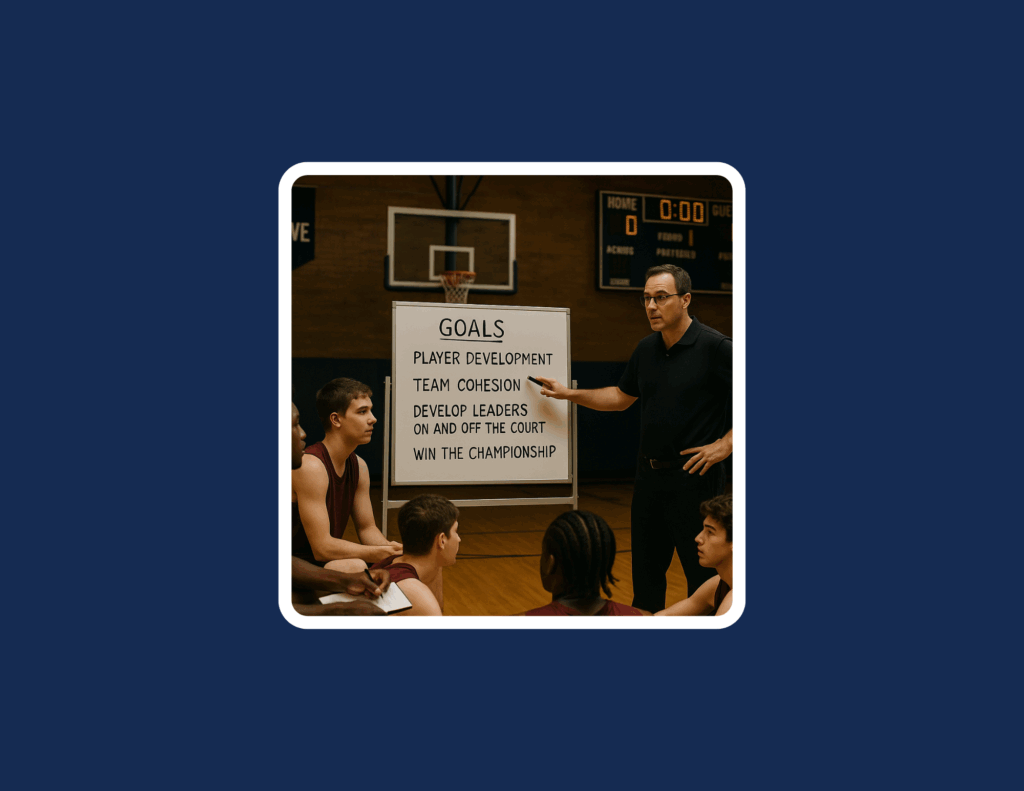

Welcome to the 78th edition of the Coach’s Corner Round Table on the Hoop Heads Podcast. Each episode of the Coach’s Corner Round Table will feature our All-Star lineup of guests answering a single basketball question. A new Coach’s Corner Round Table will drop around the 15th of each month.
June’s Round Table question is: What’s your process for setting goals with your team at the beginning of the season?
Our Coaching Lineup this month:
- Jerry Buckley – Bishop Kenny (FL) High School
- Sean Glaze – Great Results Team Building
- Stephen Halstead – Grace College
- Joe Harris – Lake Chelan (WA) High School
- Bob Krizancic – Mentor (OH) High School
- Tom McKeown – Author of This is Panther Country
- Cooper Neimand – Performance Coach for College Basketball Coaches
- Raul Placeres – Maryville College
- Michael Rejniak – We are D3 & NCSA
- Don Showalter – USA Basketball
- John Shulman – University of Central Arkansas
Please enjoy this Round Table episode of the Hoop Heads Podcast and once you’re finished listening please give the show a five star rating and review after you subscribe on your favorite podcast app.
Be sure to follow us on twitter and Instagram @hoopheadspod for the latest updates on episodes, guests, and events from the Hoop Heads Pod.
If you listen to and love the Hoop Heads Podcast, please consider giving us a small tip that will help in our quest to become the #1 basketball coaching podcast.
THANKS COACHES!
If you enjoyed this episode let our coaches know by clicking on the links below and sending them a quick shout out on Twitter:
Click here to thank Jerry Buckley on Twitter!
Click here to thank Sean Glaze on Twitter!
Click here to thank Stephen Halstead on Twitter!
Click here to thank Joe Harris on Twitter!
Click here to thank Bob Krizancic on Twitter!
Click here to thank Tom McKeown on Twitter!
Click here to thank Cooper Neimand on Twitter!
Click here to thank Raul Placeres on Twitter!
Click here to thank Michael Rejniak on Twitter!
Click here to thank Don Showalter on Twitter!
Click here to thank John Shulman on Twitter!
Like this show? Please leave us a review here — even one sentence helps! Consider including your Twitter handle so we can thank you personally!
And if you want us to answer your questions on one of our upcoming weekly NBA episodes, drop us a line at mike@hoopheadspod.com.

We’re excited to partner with Dr. Dish, the world’s best shooting machine! Mention the Hoop Heads Podcast when you place your order and get $300 off a brand new state of the art Dr. Dish Shooting Machine!
Your first impression is everything when applying for a new coaching job. A professional coaching portfolio is the tool that highlights your coaching achievements and philosophies and, most of all, helps separate you and your abilities from the other applicants.
The key to landing a new coaching job is to demonstrate to the hiring committee your attention to detail, level of preparedness, and your professionalism. Not only does a coaching portfolio allow you to exhibit these qualities, it also allows you to present your personal philosophies on coaching, leadership, and program development in an organized manner.
The Coaching Portfolio Guide is an instructional, membership-based website that helps you develop a personalized portfolio. Each section of the portfolio guide provides detailed instructions on how to organize your portfolio in a professional manner. The guide also provides sample documents for each section of your portfolio that you can copy, modify, and add to your personal portfolio.
TRANSCRIPT FOR ROUND TABLE 78 – WHAT ARE THE KEY PRINCIPLES YOU TEACH TO ENSURE SPACING AND TIMING ON OFFENSE? – EPISODE 1114
[00:00:00] Narrator: The Hoop Heads Podcast is brought to you by Head Start Basketball.
[00:00:20] Mike Klinzing: Hello and welcome to the 78th edition of the Coach’s Corner Round Table on the Hoop Heads Podcast. Each episode of the Coach’s Corner round table will feature our all-star lineup of guests answering a single basketball question. A new Coach’s Corner Round Table will drop around the 15th of each month.
June’s Round Table question is, “What’s your process for setting goals with your team at the beginning of the season?”
Our coaching lineup this month includes:
- Jerry Buckley – Bishop Kenny (FL) High School
- Sean Glaze – Great Results Team Building
- Stephen Halstead – Grace College
- Joe Harris – Lake Chelan (WA) High School
- Bob Krizancic – Mentor (OH) High School
- Tom McKeown – Author of This is Panther Country
- Cooper Neimand – Performance Coach for College Basketball Coaches
- Raul Placeres – Maryville College
- Michael Rejniak – We are D3 & NCSA
- Don Showalter – USA Basketball
- John Shulman – University of Central Arkansas
Please enjoy this Round Table episode of the Hoop Heads Podcast.
And once you’re finished listening, please give the show a five star rating and review after you subscribe on your favorite podcast app. Be sure to follow us on Twitter and Instagram @HoopHeadsPod for the latest updates on episodes, guests and events from the Hoop Heads pod.
Hey hoop heads. This month only our friends at Dr. Dish Basketball are giving you an exclusive $2,000 off plus free shipping on your purchase of a Dr. Dish. CT Plus, All Star Plus, or Rebel Plus. Hurry to secure your savings before June 30th or while supplies last. Learn more at drdishbasketball.com and follow their incredible content @drdishbball on Twitter, Instagram, Facebook, and YouTube. Mention the Hoop Heads podcast and save an extra $300 on a Doctor Dish Rebel Plus. All Star Plus, and CT Plus Models. Those are some great deals Hoop Heads. Get your Dr. Dish shooting machine today.
[00:02:23] Eric Horstman: Hi there. This is Eric Horstman from the Beacon Orthopedics Flying to the Hoop Basketball Tournament and you’re listening to the Hoop Heads Podcast.
[00:02:35] Mike Klinzing: Your first impression is everything when applying for a new coaching job. A professional coaching portfolio is the tool that highlights your coaching achievements and philosophies, and most of all helps separate you and your abilities from the other applicants. The Coaching Portfolio Guide is an instructional membership based website that helps you develop a personalized portfolio.
Each section of the portfolio guide provides detailed instructions on how to organize your portfolio in a professional manner. The guide also provides sample documents for each section of your portfolio that you can copy, modify, and add to your personal portfolio. As a Hoop Heads Pod listener, you can get your coaching portfolio guide for just $25.
Visit coachingportfolioguide.com/hoopheads to learn more,
Let’s hear from our panel about their process for setting goals with their team at the beginning of the season.
Jerry Buckley, Bishop Kenny High School, Jacksonville, Florida.
[00:03:38] Jerry Buckley: This is Jerry Buckley from Bishop Kenny talking about our process for setting goals each season. For us it’s pretty consistent with how we go about things. Really, we just obviously want to improve each and every day throughout the season and improve each month and see that improvement.
We want to come together as a team and play our best basketball at the right time of year. In Florida, we have districts. So, which is usually four to six teams, and we always want to put ourselves in position to compete for a district championship. And that’s always hopefully a realistic goal for us each year.
And then again, like I said, playing our best basketball at the end of the season is always a goal, so we want to peak at the right time. It’s a gradual process starting with the summer, the fall, regular season, and obviously playoffs. So again, that’s always going to be a big goal for us to be playing our best basketball and be our most together as a group.
As we can at the end of the season.
[00:04:35] Mike Klinzing: Sean Glaze from Great Results Team Building.
[00:04:40] Sean Glaze: Thanks to Mike for sharing the question. What’s your process for setting goals with your team at the beginning of the season? I think that a team’s goal is always to win a conference championship. That’s every year. Our job as coaches is to figure out how our talent will be able to do that. My name’s Sean Glaze and I coached for nearly 30 years at a high school and college level, and I now work with organizations as a speaker and facilitator to help them build more successful team cultures.
I think it’s important. To have a big team mission or a team goal, but that goal is worthless unless you build support underneath it. See, as a coach, we need to support that big goal by identifying smaller game goals that help us to accomplish the larger goal. Maybe it’s rebounding goal, maybe it’s a shot selection goal or a free throw goal.
Maybe it’s a turnovers or pace or number of shots goal. Maybe it’s a defensive field goal percentage goal. But you want to choose three that you’re going to be able to track in games and emphasize and practice all year long. That helps to create priorities and habits. But the most important thing that you’re going to establish are not those smaller goals, but the standards that you’re going to set that based upon core values.
You want to have three to five core values in your program, and then clarify and share specific examples of what they look like in the locker room on the core, and even outside the gym. That’s going to give you nine to 15 standards of behavior. And culture is the behaviors that are allowed and repeated in any organization.
But people don’t learn by hearing something once or by seeing it on a wall. They learn by doing it and hearing it multiple times. So every day, your job as a leader is to emphasize and teach and remind and share the importance of one of those team standards. Then once you’ve gone through the list of nine to 15 that your team agreed upon in the early season standards meeting, you continue to invest five minutes every day by teaching or reviewing or sharing a positive example or a standard in what it looks like each day and why that’s important.
And after you’ve done that, you can invite assistant or players to take over that team standards, teaching opportunities. The season continues to allow them to share their perspective, and you roll through that list of behavioral standards all year long. And they become ingrained in your team so they know what’s going to be celebrated in your culture.
Those standards need to support smaller goals and smaller goals, create the opportunity to achieve a larger goal. I just wrote a new book has a number of tools that are actually going to be helpful to you. To create a culture and be the leader that you’re going to be proud to be. I hope you grab a copy and let me know if I can help you and your team with resources or experiences to help you build a championship culture.
[00:07:22] Mike Klinzing: Stephen Halstead from Grace College.
[00:07:27] Stephen Halstead: Hey there. This is Stephen Halstead, assistant coach at Grace College. Tuning into the hoop heads round table number 78. And the question this month is, what’s your process for setting goals with your team at the beginning of the season? And I really like this question because this is one thing our staff spends a lot of time talking about of we try not to put just numerical goals for our group, like win 20 games this year, achieve win the league.
Obviously those are goals and things that we want to accomplish. But rather than just setting that baseline goal, we try to necessarily mark out how we’re going to be able to go and accomplish those things and what we need to accomplish day to day and how we’re just interacting, how we’re practicing and the process that goes into it.
So we’re very much a process driven team. If we feel like we are doing everything in our power to set ourselves up for a position to win, or we’ve had a great week of practice and we’re able to do all the things, but then we just fall short in the game we, we aren’t going to be one that’s going to be super upset.
Like, we’re going to go back and look at the process throughout, not necessarily just the game. So I would say that is a, a long way of answering it, but that’s kind of the process for setting goals, is we try to figure out the how of what we’re going to be doing each day and what really sets us apart from maybe other programs.
[00:08:49] Mike Klinzing: Joe Harris, Lake Chelan High School, Lake Chelan, Washington.
[00:08:56] Joe Harris: Hello, Hoop Heads. This is Joe Harris at Lake Chelan. Jumping back in with this month’s round table question, what’s your process for setting goals with your team? At the beginning of the season, we wanted our coaches and players to really take ownership in our program, so we started each year with developing standards for our team.
We did this by asking these six simple questions. What would you like our team to stand for? What would you like to stand for? What do you want our team culture to be? What would you like to be able to guarantee about our team? What are our for sures about our team, and what are our shared values? After we gathered some of this feedback, we would then sit down to build our standards as a group and asking follow up questions about what we want to stand for.
We’d then dive into some outcome related goals, like holding our opponents to 12 points or less per quarter. A number of rebound offensive and defensive rebounds per quarter in game, a number of insists per game, those types of things. We felt like this really helped us build. A tradition-based culture and it all starts with what we wanted our team to stand for.
Hope everybody is getting to enjoy some summer sun, and best of luck to you in whatever you’re doing. Thanks again.
[00:10:18] Mike Klinzing: Bob Krizancic, Mentor High School, Mentor, Ohio
[00:10:25] Bob Krizancic: Coach K Mentor High School. Setting goals with our team. Absolutely a huge component. I believe in our success. We tell our players, set the goals high individually and team wise, since we won a state title and been to state four times, naturally the state title is one of those leading the country and scoring is another one, leading the state in scoring.
But more importantly than setting the goals is I want to see their plan, their system. On how they’re going to get there. And we meet once a month on just where they’re at. And do we have to tweak anything? Best of luck.
[00:11:07] Mike Klinzing: Tom McKeown, the author of This is Panther Country.
[00:11:13] Tom McKeown: Hello, this is Tom McKeown, author of the book. This is Panther Country, a book that chronicles a historic run of the 1975 Babylon Panther High School basketball team. In goal setting, what we used to do was very basic. We would have everyone pick a team and an individual goal at the beginning of the season and go through them together After the first practice,
[00:11:40] Mike Klinzing: High school and middle school basketball program directors, listen closely. Coaches are expected to do far more than just coach. You know this. It doesn’t matter if you’re doing the coaching yourself or you have a full staff of coaches with you. You know very well that coaches handle scheduling, academic issues, parent communication, leadership development.
Even mental health concerns for athletes. A lot to deal with, and when coaches are stretched too thin, it impacts the development of athletes, team morale, and the overall success of the program. There are several ways to prevent you or your coaches from feeling overwhelmed. However, I’ll tell you one of our favorite ways to keep coaches firing on all cylinders.
That’s athlete driven accountability and organization. Instead of coaches constantly reminding players about assignments, grades, and practice schedules, the program at Playmaker Planner puts the responsibility back on the athletes by tracking their own academics goals and commitments. Student athletes become more self-sufficient, which of course allows the coach to focus on what they love doing most, Coaching. Let’s find out if the programs from Playmaker Planner can be a compliment to what you’re already doing. Visit playmaker planner.com/stop-is-this-for-you to find out more?
Cooper Neimand – Performance Coach for college basketball coaches,
[00:13:02] Cooper Neimand: It always starts with the coach. You need to be super clear on your job and your goal. Be able to articulate with that with the team right away. You know, my job is to help each one of you guys get better and to help us win. And every decision I make will be With that in mind, I think you also as a coach, have to have a good feel about what the individuals want, even if it’s a little bit selfish.
You know, on jv, the guys want to be on varsity, on varsity, they all want to play in college and get a scholarship. In college, it’s all about going pro or getting more money. You know, understanding these underlining motives lets you tie in their personal goals and into the bigger picture. I. And that gives you, that gives players ownership.
And honestly, it takes a lot of weight off of your shoulders and you can use that as a reference point all year. You know, if you have a college player who wants to go pro but is complaining about weights and really wants to skip weight or not go to the training room you don’t take it personal.
Just ask, what would a pro do? You know? And it brings them back to what they said they wanted. I think at the start of every year after you explain what you need to do and understand the overall motives, you have to sit down with every player. What are your goals? Who do you need to be to accomplish them?
What might get in your way? How might you get in your way? And if I notice you sabotaging yourself, how, how should I help? And then the key message that you always come back to throughout the year and you have to preach over and over again is that whatever you want, varsity, getting a scholarship going pro, you can’t get there alone.
To reach your goals, you need everybody. And so we have to commit to a team as a team to get better every single day, and everybody’s individual goals will take care of themselves.
[00:15:05] Mike Klinzing: Raul Placeres from Maryville College.
[00:15:11] Raul Placeres: Our process for setting goals with our team at the beginning of the season. This is Coach Placeres head basketball coach at Maryville College. I think setting goals with a basketball team at the beginning of the season especially process oriented goals, is about creating a shared vision, building habits, and establishing a culture that leads to success over time.
I think number one, you have to establish a clear identity, but who do you want to become? I think it’s great to have player input, so it becomes your identity, our identity not just a coach’s vision. I think educating players on process versus outcome goals make it clear that process goals are controllable and sustainable.
I. But that they often lead to outcomes. I think creating individual and team habits. What behaviors lead to improvement? I think for creating standards and not rules, turn standards into accountability tools and peers holding each other accountable to them. Break the season into segments.
Preseason early games non-conference to conference. It’s a conference tournament. I think something simple as let’s average under 10 turnovers a game and let’s assist on 50% or more of our made field goals are, are our goals that our program uses to, to dictate and to establish that we are playing the type of brand of basketball that we want to play.
I think tracking and reflecting weekly is really important. Using films, stat breakdowns. To reflect how well the team is executing the process of what we’re trying to become. You know, make reflection a team habit. I think using feedback to tweak focus areas throughout the year is really important and celebrating progress.
I think that is really essential and important. And overall team growth. You know, recognizing players who consistently. Live the process as a coach and as a staff, reward, growth, effort and leadership, and man, build confidence through acknowledgement of small wins. I think that is things that we do here in our program and I think can serve any sport or any team of any level.
Thanks again for the opportunity.
[00:17:27] Mike Klinzing: Michael Rejniak, Coach Rej from NCSA and We are D Three TBT.
[00:17:35] Michael Rejniak: Hey, hoop heads. This is Coach Rej gm, head coach of We are D Three, and this month’s question, what’s your process for setting goals with your team at the beginning of the season? I think first things first, you really need to take stock of what happened the previous season and where you’re at currently and really have a good assessment of where we’re at from a roster viewpoint schedule.
All the things. And then furthermore, then we need to look at okay, where you currently are with all of that and versus where you want to be. I think it’s very important when we’re setting goals you want to be able to stretch yourself. So that when you accomplish them it means something, but also you don’t want to make sure that they’re like totally unachievable.
Like for instance, a oh and 20 team saying, Hey, we’re going to win a national title. That’s probably unrealistic. So you want to, when you’re, you have your big goals, right? But you want to make sure that we’re setting small, measurable goals for the team along the way so that they experience both success.
When they achieve those goals and, but also a little bit of failure along the way to challenge themselves to get to that end goal. Definitely want to make sure constant dialogue is happening to the team with that. And furthermore, letting the players have input to what the team’s goal is. That’s only going to further create buy-in.
Hope everybody is having a great summer. See you guys in July. In the TBT,
[00:19:22] Mike Klinzing: Don Showalter, USA Basketball.
[00:19:28] Don Showalter: Hi Don Showalter here from USA basketball. Question is, what is the process for setting goals at the beginning of the season? I think this can take a lot of different forms. And I’ve changed my. I guess tune an idea about this over the years? I think it really needs to be guided by the coach because some goals will be, first of all, unattainable, such as a maybe a conference championship, state championship or undefeated season that the kids put down.
The players put down. So I think it’s have to be. Really as guided by the coach in helping them dictate what kind of goals really can they achieve during the year, but with also under consideration is not make it the goal’s too low. So goal setting is something I think that is really more difficult than just saying, here, write down your goals for the season.
So as a coach, I guide them through some of the things, ask them some questions such as what, what is your personal goal? You know, you have different kinds of goals, so what is your personal goal? What, what what goals do you think we can achieve as a team based on what we see coming back or what other teams have as well?
So that, that’s a thought process that throughout the years, I’ve kind of changed. And put more thought and energy and time into. Thanks.
[00:21:00] Mike Klinzing: John Shulman from the University of Central Arkansas.
[00:21:06] John Shulman: This is John Shulman, head basketball coach at the University of Central Arkansas. And the question of the months is, what is our process of setting goals at the beginning of the season? Gosh, I’m the wrong person to ask for this. Individual goals really don’t do those.
And team goals don’t do a whole lot of that. We have one goal in mind when the season starts and we’re coming off the season where we finished in 10th place, but we had one goal and that was the win the league. I know that’s probably not right. I know you’re supposed to have a goal on the team reaching its fullest potential or.
Let’s see if we can win this many games or percentage wise, our goal is to hold people under 42% or 32% from the three point line. Or the goal is to those are kind team goals on I do, I guess this would be a goal at the end of the season. I do want to make more free throws than our opponents shoot.
I do want to have a, a positive. Rebound margin compared to our teams. And so I want a positive rebound margin and I want to make more free throws than our opponent shoots. So I guess those are team goals, but tho those aren’t goals that I will make with our team. That’s just goals that I think are very important to winning.
The one goal that we’ll talk about before the season starts is to win the league that we want to cut down the nets and we want to be the last one standing. Whether that’s right or wrong, I guess that’s why we’re doing this podcast and dealing with that. So you can have dumb people like me making, making these comments.
But that’s just my beliefs. And we were picked 10th, no, I’m sorry. We were picked 11th in the league last year, our first year here at Central Arkansas. And our goal was still to win the league. It wasn’t to finish in the top five but we did have a realistic goal. When things kind of started to unravel with with our injuries, our goal was to make the tournament.
And if we got in the tournament, we thought we had a chance to win the league. ’cause you can’t win the league if you’re not in the tournament. So we did attain one small goal by playing in the eighth Sun tournament. But I, I’m, especially as I’m getting a little older. I don’t have those small goals. My goals for next year very simple, is to win the Aun regular season so we can be the number one seed and to win the tournament and go to the NCAA tournament and then we will figure out some different goals at that time.
I have a great summer. Don’t forget to enjoy your family and don’t forget to take some time off for you during this time. Because it’s hard. It’s now a year round job what we all do. But you better take some time to take care of you and take care of your health. As, as someone told me one time had a good buddy of mine, high school basketball coach pass away.
It wasn’t during the season, but he passed away during the off season and on a Thursday. And by Monday they had a replacement. So we’re all very replaceable, so enjoy your family, enjoy your life, take care of you, and hopefully this helps. Take care.
[00:24:30] Mike Klinzing: Thanks for checking out this month’s Hoop Heads Podcast Round Table.
We’ll be back next month with another question for our all-star lineup of coaches.
[00:24:38] Narrator: Thanks for listening to the Hoop Heads Podcast presented by Head Start Basketball.