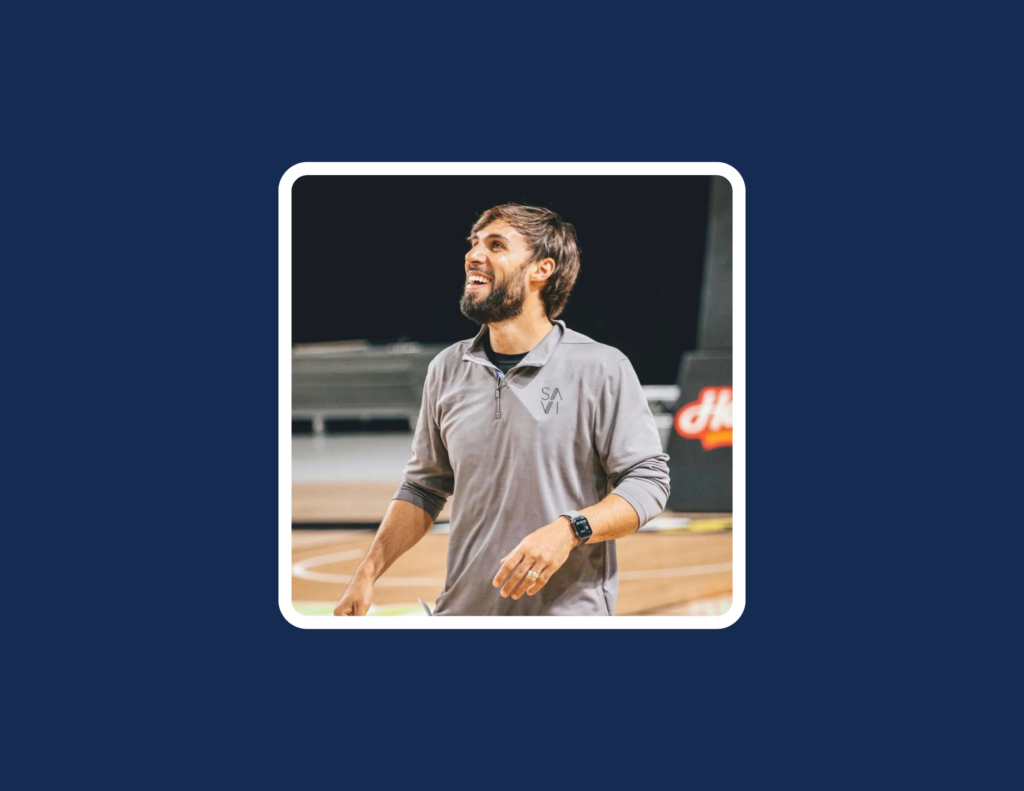
MARK CASCIO – DIRECTOR OF COACH DEVELOPMENT AT SAVI COACHING – EPISODE 1234

Website – https://savicoach.com/
Email – mark@savicoach.com
Twitter/X – @coachcascio
If you listen to and love the Hoop Heads Podcast, please consider giving us a small tip that will help in our quest to become the #1 basketball coaching podcast.
Mark Cascio is the Director of Coach Development at SAVI Coaching where he has partnered up with Founder Tyler Coston to provide community, courses, and consulting to coaches across the world.
Mark is a championship basketball coach with eighteen years of coaching experience at the both the high school and college level. During this time, his teams have won eight district titles, appeared in five Final Fours, and won a State Title in 2012. He was a head coach at the age of 21 and was the youngest coach to win a state championship in Louisiana at the age of 26. Mark’s tireless work ethic and quest to be a lifelong learner has provided him with resources he is eager to share. He is passionate about helping build better programs, coaches, and players through innovative concepts on the court and implementing championship systems off the court.
On this episode Mike and Mark discuss the transformative approach to coaching that emphasizes the integration of conceptual offense with player development. Central to our conversation is the assertion that effective coaching transcends mere technical skills, advocating instead for a holistic philosophy that prioritizes relationships and cultural alignment within a team. We explore the significance of simplifying complex strategies into digestible concepts, thereby enabling players to make instinctive decisions on the court. Additionally, we delve into the importance of creating an engaging environment where players can thrive, emphasizing that the essence of coaching lies in fostering growth and resilience, rather than solely focusing on winning. This episode helps coaches to reflect on their methodologies and to embrace practices that cultivate both skill and camaraderie among their players.
Follow us on Twitter and Instagram @hoopheadspod for the latest updates on episodes, guests, and events from the Hoop Heads Pod.
Make sure you’re subscribed to the Hoop Heads Pod on Spotify or wherever you get your podcasts and while you’re there please leave us a 5 star rating and review. Your ratings help your friends and coaching colleagues find the show. If you really love what you’re hearing recommend the Hoop Heads Pod to someone and get them to join you as a part of Hoop Heads Nation.
You’ll want to make note of all the great takeaways on this episode with Mark Cascio, Director of Coach Development at SAVI Coaching.
What We Discuss with Mark Cascio
- The importance of establishing a clear coaching culture that prioritizes relationships and systems
- Why coaches should focus on simplicity in their offensive strategies
- Teaching players how to make decisions during games
- The concept of “Dominoes” emphasizes creating multiple options for players to enhance decision-making on the court
- Incorporating player feedback and allowing them to name plays can foster a sense of ownership and enhance team culture
- The importance of creating a supportive coaching community through shared experiences and resources
- Implementing practical actions and triggers into your offensive strategies
- Simplicity in practice not only enhances player understanding but also leads to better performance on the court
- Understanding players’ individual strengths and weaknesses to effectively coach them
- Establishing clear objectives and standards
- Building strong connections with players leads to a better team environment
- Why simplifying your strategies improve clarity and execution on the court during games
- How to integrate feedback loops within coaching to ensure continuous improvement among players
Like this show? Please leave us a review here — even one sentence helps! Consider including your Twitter handle so we can thank you personally!

Give With Hoops is a groundbreaking initiative that fuses basketball analytics with modern sponsorship. Built for teams who see data as opportunity, from AAU programs to college powerhouses.
By tying on-court performance directly to community and sponsor engagement, Give With Hoops help programs raise more while deepening support from those who believe in the game.
Traditional fundraising disconnects donors from the action. Sell candy bars, wash cars, beg for donations, it’s exhausting and ineffective. Players perform better when their stats matter beyond the scoreboard. That’s why Give With Hoops was created.
Give With Hoops connects game performance to community support. Every basket, rebound, and assist becomes a chance to raise funds. Transparent, exciting, and proven to raise 3x more than traditional methods.
Aiming to go D3? The D3 Recruiting Playbook gives you a clear, step-by-step roadmap to the recruiting process – what coaches value, key milestones from early high school through application season, and how to build a target list of schools that fit your needs.
We’ll demystify researching D3 programs and how to stand out without chasing every camp or showcase.
The modules cover things like writing emails to coaches, building an effective highlight tape, using social media well, planning ID camps and visits, and navigating application strategy.
You’ll get templates, checklists, and an outreach plan to communicate confidently, learn how to compare financial packages, and avoid common missteps. By the end, you’ll have a prioritized school list and a decision framework you can use to land your best-fit opportunity.
Your first impression is everything when applying for a new coaching job. A professional coaching portfolio is the tool that highlights your coaching achievements and philosophies and, most of all, helps separate you and your abilities from the other applicants.
The key to landing a new coaching job is to demonstrate to the hiring committee your attention to detail, level of preparedness, and your professionalism. Not only does a coaching portfolio allow you to exhibit these qualities, it also allows you to present your personal philosophies on coaching, leadership, and program development in an organized manner.
The Coaching Portfolio Guide is an instructional, membership-based website that helps you develop a personalized portfolio. Each section of the portfolio guide provides detailed instructions on how to organize your portfolio in a professional manner. The guide also provides sample documents for each section of your portfolio that you can copy, modify, and add to your personal portfolio.

Hey coaches — you’ve got a game plan for your team… but do you have one for your money?
That’s where Wealth4Coaches comes in.
Each week, they deliver simple, no-fluff financial tips made just for coaches. Whether you’re getting paid for camps, training sessions, or a full season—Wealth4Coaches helps you track it, save it, and grow it.
It’s time to stop guessing and start building.
Subscribe now at wealth4coaches.beehiiv.com/subscribe
And follow them on Twitter @Wealth4Coaches for daily money wins.
Your money needs a coach.
Start with Wealth4Coaches.
THANKS, MARK CASCIO
If you enjoyed this episode with Mark Cascio to let him know by clicking on the link below and thanking him via Twitter.
Click here to thank Mark Cascio via Twitter
Click here to let Mike & Jason know about your number one takeaway from this episode!
And if you want us to answer your questions on one of our upcoming weekly NBA episodes, drop us a line at mike@hoopheadspod.com.
TRANSCRIPT FOR MARK CASCIO – DIRECTOR OF COACH DEVELOPMENT AT SAVI COACHING – EPISODE 1234
[00:00:00] Narrator: The Hoop Heads Podcast is brought to you by Head Start Basketball.
[00:00:20] Mark Cascio: Mike has the ball here. We can do A or B. Mike is the decision maker. He’s got the ball. When he swings it, I just know he is going to do A or B, and that’s going to unlock a few different other options, which could unlock a few different other options, which is the fun part about conceptual offense. So now that we have actions and we have triggers, then you group actions into a menu of actions, which is just called a series. So a series would share a shape and a trigger.
[00:00:47] Mike Klinzing: Mark Cascio is the Director of Coach Development at Savi Coaching, where he is partnered up with Founder Tyler Coston to provide community courses and consulting to coaches across the world. Mark is a championship basketball coach with 18 years of coaching experience at both the high school and college levels.
During this time, his teams have won eight district titles, appeared in five final fours, and won a state title in 2012. He was a head coach at the age of 21 and was the youngest coach to win a state championship in Louisiana at the age of 26. Mark’s tireless work ethic and Quest to be a lifelong learner has provided him with resources he’s eager to share.
He’s passionate about helping build better programs, coaches and players through innovative concepts on the court and implementing championship systems off the court.
Give with Hoops is the first platform turning basketball analytics into fundraising impact. Every stat tells a story and now every story drives sponsorship engagement and team growth programs nationwide are transforming basketball stats into funding power. Learn to use performance data to attract sponsors, engage fans, and raise more with every play.
Give With Hoops will help you raise three times more money for your program as their stat based pledges consistently outperform traditional fundraisers. Visit Give with hoops.com/hoop-heads-podcast to learn more and take your fundraising to the next level. Give with Hoops.
[00:02:18] Dan Krikorian and Patrick Carney: Hi, I’m Dan Krikorian. And I’m Patrick Carney. And we’re Slappin Glass and you’re listening to the Hoop Heads Podcast.
[00:02:29] Mike Klinzing: Are you or an athlete you know planning to go D3? Check out the D3 recruiting playbook from D3 Direct. Their playbook gives you a clear step-by-step roadmap to the recruiting process. What coaches value key milestones from early high school through application season and how to build a targeted list of schools that fit your needs?
The playbook demystifies researching D3 programs and how to stand out without chasing every camp or showcase the modules cover things like writing emails to coaches, building an effective highlight tape using social media, planning camps and visits and navigating application strategy. You’ll get templates, checklists, and an outreach plan to communicate confidently.
Learn how to compare financial packages and avoid common missteps. By the end, you’ll have a prioritized school list and a decision framework you can use to land your best fit opportunity. Click on the link in the show notes to get your D3 recruiting playbook from D3 Direct.
You’ll want to make note of all the great takeaways on this episode with Mark Casio, director of Coach Development at Savi Coaching.
Hello and welcome to the Hoop Heads podcast. It’s Mike Klinzing here without my co-host Jason Sunkle this morning. But I am pleased to welcome back to the Hoop Heads Pod, Mark Cascio from Savi Coaching. Mark, welcome back in man.
[00:03:49] Mark Cascio: Honored to be here. Excited to talk some whos with you. And I know we, we spoke on the phone last week. I do want to say just how much I appreciate what you do and respect the longevity of this podcast. It’s amazing.
[00:04:00] Mike Klinzing: Appreciate that. And again, like I’ve told everybody who has anything to compliment me on in that area, it’s been a labor of love.
It’s been a passion, and I can never give back to the game of basketball what it’s given me. So it’s a joy to be able to talk to people who are of a, like mindset and love the game, and it’s been such a huge part of their life as well. And to be able to give them an opportunity to share their stories and share what they know to make the basketball world a better place for all of us.
So again, thanks for those kind words. Really appreciate it. And we’re going to dig in here with you and where you’re at since the last time we talked. So you were coaching at the high school level the last time we talked and working with your company, courtside Consulting. Then you had an opportunity to go and coach on the women’s side, the college level at Appalachian State, and then you hooked up with Tyler at Savi.
So just give us the quick the quick bio here since you were last there, and the journey of how you ended up where you’re at right now.
[00:04:53] Mark Cascio: Yeah. Yeah, so last time I was on, like you said, I was coaching at the high school level on the boys’ side, five A in Louisiana, and it was my alma mater.
And it was just really rewarding experience. I loved it. And we, I got to the point where how I just felt like my job was done there in a lot of ways. It was a great place to work, great kids, great program and still follow it and miss it. But I was consulting for colleges, app state being one of them.
Opportunity came available and right fit for me, right fit for my family. So we did that and everybody asked Hey, what do you, what level did you like better? And really there’s things to love about high school. There’s things to love about college. So my decision to get out was really, I guess there’s a lot of factors in there. Family flexibility, time, fulfillment. And I found when I was doing my court side consulting stuff on the side, I just really felt fulfilled helping other coaches. And so I felt like that was my long-term calling. I never thought at maybe 38 whenever I got out of coaching that would be, it would be that early.
So I just wanted to dive in and go all in on helping coaches. And I did that for about five months solo and then reconnected with Tyler Coston, who was at PGC, started Savi Coaching. And as we continued to build a relationship and talk, we just figured we could make more impact together. It’s like we were doing the same exact thing.
So we ended up combining. And so the kind of, the story of how I met Tyler I knew of him just because his presence and role in, in PGC basketball. And we spoke at a clinic in 2021 at the Hosier Clinic. So in the gym that, that the movie Hoosiers was filmed in. And he came in, I think, in the middle of my presentation.
So I saw him come in and did my clinic presentation. I think I was talking about Dominoes, which is disadvantaged basketball and how to teach through small-sided games. And I think that was the last presenter of the night. So we all just hung out, went and saw the locker room where the movie was filmed.
And so we, it was just really cool to connect with all the coaches and he came up and was just very complimentary. He said, look, I think I learned more in half of your clinic presentation than I have in all the other coaching clinics I’ve been to. And I was like, wow, like that’s amazing that somebody would say that and had the value.
And we exchanged numbers. Never spoke to each other. We, neither one of us reached out until two years later. We spoke at a clinic in South Carolina, and this time we were, we both had multiple sessions. So Tyler went, I went and we had a break where another speaker was presenting. Then Tyler went, then I went and we just kept building off each other’s presentations.
So Tyler would present on something and I would take what Tyler was doing and add a little something to it. So right away we knew that our philosophy was aligned. Our vision for how we wanted to serve coaches was aligned. And then it just had to make business sense. Three things that were really important to Tyler and I whenever we connected is we wanted to combine coaching culture and systems.
We think there’s a lot of, there’s not enough coach development out there, but the coach development that is out there is really good. And where we just thought we could position ourselves is. Let’s just not be about X’s and O’s. Let’s not just be about like courses or skill development. Let’s have everything where we really teach or, and share with coaches how we would lead a program with culture coaching and systems.
So that’s one. We want to be highly relational. I think the best thing that we do at Savi Coaching is we have a community that combines our information, our courses and what we teach with constant support and feedback. So we build relationships. There’s a lot of q and a and back and forth where we could say, Mike, giving your situation, this is actually how I would do it.
So we build really deep relationships with our coaches, and then we’re focused more on application. because that’s where the transformation that we have seen really occur is when you combine. Information with the community and consulting side. Long way to say was in coaching, got out, partnered with Tyler and now we do Savi coaching and it’s just been an amazing experience for for me personally and professionally.
[00:09:05] Mike Klinzing: So as you two are getting together and again combining, obviously you knew you had this connection right in just your thought process of how you think the game and what you think is important in building a program and coaching a team. As you guys get into this process and you’re having those conversations, what do you talk about in terms of, okay, we have this general idea, right?
You were doing one thing, he was doing another thing. How do you figure out what is the, I dunno if products, maybe not the right word, but what are the services, the products, the way you want to connect? What do those conversations look like between the two of you so that when you go to put it in front of the coaching market.
You know that you’re going to have value that you can provide to those coaches that are engaging with you guys.
[00:09:55] Mark Cascio: Yeah, that’s a really great question. One thing I’ve loved about working with Tyler, and it’s probably true with if a coach is listening now of like other coaches that you’ve worked with, is that they have strong beliefs, but loosely held meaning like, Hey, we’re convicted and we think this is the right way to go.
But if there’s a better way, if there’s a new idea or something that we could do something that could help us do it better, let’s do it. So that was, that’s the first thing is we were just very open and, Hey, this has been my approach. This is what I’m really strongly about.
And these are some things that. Our podcast is called The Hours because we want to spend hours with our listeners and our members. But it was also a great way for Tyler and I just to align. So we would just say, Hey man, let’s talk about Advantage basketball. And we wouldn’t do a lot of prep because we really wanted it to be organic in real conversations.
I remember just one, that one episode, he was talking about Advantage Basketball, and I said, oh yeah, I call that Dominoes. because the idea is that once you get the first domino to fall and the next one to fall, your advantage is bigger and bigger. He was like, I like that. Let’s use that. And I’m like.
Sure. And he is yeah, let’s just change everything from Advantage Basketball to Dominoes. So a good example of like philosophically we teach Advantage basketball, but just very loosely held on what we’re going to call that in a line on it. But I think one thing, and it’s probably the, honestly, the best thing that we do in Savi Coaching is teaching the Savi method.
I got the shirt on, you can see it, Mike. It’s SavIs spelled SAVI, and it’s an acronym for Simplicity, adversity, victory and Identity. And those are the core values that we run our business on. It’s the core values that we run our basketball programs on. So it’s really the lens that we view coaching, and I would say most coaches come in for our offensive system or like our lock left system or our player development stuff.
But I think what they find quickly is it’s more about how you do what you do, not just what you do. And I think a lot of coaches start with what. And then they try to figure out how I would actually go with, like, why we’re going to play this way, how are we going to do it? And then what do we actually do to get our teams to play that way?
I think that sometimes that flow is backwards for coaches and why they may lack clarity, but so the Savi method is like, we think that simplicity wins. As a coach, when we start, we know what we know. So the game feels really simple. And then as we learn new things, it’s oh, we could do this and that, and I don’t really know much about a matchup zone, or I’ve never run a diamond press before.
Then you start to think wait, I don’t know a whole lot of stuff. And then when you can decide Hey, this is the level, this is what we want to play, this is what I teach really well, then you get on the other side of complexity and that simplicity. We believe in like really clear terminology.
Clear standards. The simpler things are, the more you can scale them the A is adversity strengthen. Something that we really help coaches embrace themselves, but also in their program. Adversity’s a good thing, and we should lean into it because when adversity hits, it just means that you’re learning and getting better.
If there was no adversity, then there’s no growth. And we all know that as coaches, but it’s really hard to be in a practice that’s going poorly and saying Hey, this is really good. We want practice to be clean and so yeah, we just, we help them lean into adversity, how to embrace adversity, but also how to dial in the right amount of adversity for your team.
I think the best coaches, and you see it in, in March Madness now of like the coaches that really hold the line, whether it’s holding the line with standards and behavior or how can we just create optimal amount of struggle for our players inside of practice is, if skill exceeds challenge, so players can do whatever you’re doing easily, they’re going to get bored and they’re going to lose engagement.
If it’s the same, you’re just testing, but you might not be growing. It’s just a measurement of where we are. Check for understanding. But if you can get challenged, a slightly exceed skill, that’s where you’re going to push them to the next level. So that’s adversity strengthens. Next one is, victory is defined.
We just believe in defining your own victories for your program instead of just wins is the scoreboard. It’s all, all of what you hear coaches talk about embracing the process and not being results driven. That’s victory defined. And then last is identity commits. Like we just believe in going all in on what you do.
So I am a former poker player or poker lover. And when you go all in, your decision’s already made, right? You can’t pull your chips back, you don’t know what cards are coming out. So we believe we should coach like that. If we really feel like this is the best way to develop our athletes as people and as basketball players in the best style of play that gives us a chance to win, then let’s go all in on that approach.
because half measures do not work. We don’t want to straddle and ah, we’re going to play some zone, but we like this man stuff and we’re going to play fast, but we’re going to slow it down too. So that’s the identity commits part. And really that has the been the best way that we serve coaches. It’s to help them embrace those principles, but also adopt and adapt them for their program.
Man, I’m giving you some long answers. I apologize.
[00:14:53] Mike Klinzing: No, it’s perfect. There’s a ton of things obviously then that we can talk about Off of all those four principles that you just talked about. The first one that came to mind as you’re talking is when you say simplicity over complexity. When you say having a clear identity of what you want to do understanding that it’s the process, it’s not the outcome.
To me, all that comes back to. Preparation and being intentional with what you do. What I think about is coaches today that I know, and not even necessarily high school coaches who I think this is the case, and college coaches probably not so much, but I know for grassroots basketball, right? There’s a ton of people I know that are coaching AAU teams or coaching a travel team, whatever.
And the vast majority of those coaches, the way they coach is I’m on Twitter or I’m on YouTube and I see, Hey, I really love this Spain pick and roll action. Or, Hey, I really love this 1 3 1 matchup zone. Or, Hey, I really love this horn set and it’s just, there’s no. System to your point, it’s just I’m plucking things that, okay, this action, yeah, I like it.
It could work for my team, but how does that fit into the bigger picture? And so I think, and this is just again, me projecting onto what you and Tyler do that the value of having the conversations that coaches have with you guys is let’s figure out who you are, what you stand for, both Xs and O’s y, and as a human being and how you want your culture to be and start there and then we can build out the other stuff as opposed to, as you’re saying, a lot of people are just grabbing, picking and choosing this stuff and it’s not cohesive, if that makes sense.
[00:16:43] Mark Cascio: Absolutely. Yeah. And I think we’ve all been there as coaches too, right? Is I think. Even if you’re an experienced coach, I think you go through these like arcs of coaching where a lot of times we’re just, we’re grasping and it’s hey, we lost this game, or last season wasn’t as successful as we thought.
So I saw this cool thing on Twitter. Maybe that’s the answer, right? And there is some value in that. I think that gives you a good education on other systems, but I do think the simplicity part is does this fit us and can we be really good at it? Like we would rather be really good or great at two to three things than to try to do everything.
And same thing with practice like. Let’s talk about simplicity at practice. One thing that I have actually gotten better at in just the last couple years of my coaching is can we pick one thing that we want to be better at practice? Because I have tra like been so guilty of, we have to be better at breaking the press.
We have to be, we have to get some shots up, we have to install this, we have to work on this. And then you leave practice and you’re like, did we like really move the needle? And in maybe we got 1% better in some of these things. So yeah we help coaches make the system there. As I tell coaches, I don’t try to convince you the way to play.
What I want to do is take what you do and put it on steroids for you. And a lot of that is making it more like simplifying everything and the easiest way. To simplify, but also the easiest way to get better at anything is actually to eliminate things. If we’re going to let’s say we’re working with a player and we want to make them a better shooter, which every coach does, right?
Every coach listening to this is yeah, I wish my team shot better. It might take six months to develop a better shooter, but we could probably get them to eliminate something in six minutes that’s going to make them a better shooter. Or think of your team. We could make them better decision makers over the course of a season.
Or we could just eliminate a read for a player instantly and just say, Hey, when you get the ball, I want you thinking shoot it or move it. Instead of shoot it, drive it or move it. If most of their turnovers come off the dribble, you’ve just eliminated a lot of their decision making and a lot of their turnovers.
With very little practice. Now, it doesn’t mean that we don’t care about that player’s ability to drive, but we’re going to shrink that menu and allow them to grow into their game. So one part of identity I’ll go back to the identity commits part is what we stress to coaches and players is your identity is not who you are today.
We believe your identity should be who you’re becoming. So if a coach is listening to this in the off season and you want to shrink the menu for some players, or even your team is identify a strength and a stretch, this is what we do. Or you do really well. Now this is your stretch, so you shoot it really well.
If you don’t have a shot, move the ball. But your stretch is going to be able to attack closeouts, play off the balance, make those defi decisions be a better finisher. Whatever it is, it doesn’t mean we’re not willing and actively working with you on that. But until you’re there, we’re going to shrink the menu.
One more thought, man I’m being long-winded today. I apologize. Is just comes to mind is sandbox and war games. So how do we differentiate these things in practice? Sandbox is, hey, explore the edges this, shoot it or move it player. Put it on the floor as much as you possibly can. We’re, this is where we’re growing, we’re going to have some adversity, we’re embracing that.
But when we go five on five or we’re doing this like four minute time scrimmage, that’s war games. You fill your role and you do your role the best you can.
[00:20:07] Mike Klinzing: A great way of looking at it, right? It’s clear and it gives somebody, okay, which one of those two modes am In? And I know when I’m in this mode, I have to do X and I’m in this mode.
Now I can move out of that and do something different. And so I think that’s a really good way to look at it when you’re talking with, whether it’s a coach or a player and you’re asking them to eliminate things. And I know that just like you, right? In our journey, we’re all trying to grow as coaches, and I try to be as self-aware as I possibly can, and I know one of the things that I am guilty of all the time is the.
I want to fix a million problems. I’ve always told this story on the podcast, mark, my very first coaching job, I was a JV basketball coach, and I walked in and I had played for one high school coach. I had played for one college coach. I knew nothing about coaching besides what those two guys had done for me as a player.
And so I walked in and I had my first drill, and I got 12 kids that are standing at, they’re staring at me. And we go through and we do the first drill five minutes. And I remember just standing there watching it going, there was like 500 things wrong that I just watched. How am I possibly going to fix all of this?
And so I still, in my coaching today, I still find myself. Being a fixer, like we’re doing a drill on pick and roll, whatever, and instead I’m talking about, Hey, did you box out on this defensive arena? Instead of looking at what the focus is of what I’m doing, I’m looking at all these other things. And again, we know that as you said, it’s impossible to be able to focus on a hundred things in a practice and really make anything better.
So what I’m curious about is when you’re having a conversation with a coach about, Hey, let’s pare down what you want your team to be really good at. Let’s make it three things this season that your identity is going to be built around, that your practices are going to try to help your team improve on. What does that give and take look like in a conversation as you’re working through helping a coach to understand why two or three things is important and why maybe letting something else go that they might normally correct or stop practice why they need to do that.
[00:22:19] Mark Cascio: Yeah, that’s a really good question. So much comes to mind. In fact I’ve, I actually, I’m going to tell, I would tell a quick story about your you’re doing this drill with your JV team and like seeing all these things to correct. I just got roped in the coaching and a u team. My daughter switched a u programs and practice one.
Our coach there was miscommunication didn’t show up. They were going to combine with a lower age group team and practice. And some of the players that knew me were like, C come coach, come run practice. So I was like no. I’m a parent. In fact, I was going to just drop off and leave.
So anyway, I coached the practice and after practice the parents were like, you have to coach this team. Got roped into it and I was recruiting an assistant coach, and he said, just, hey, very open and honest. I’m a bad assistant coach. I’ve been a head coach almost every, season of my career.
And so we had that conversation, which like just. And if you’re a coach listening, like one thing that I have grown in a lot is having honest, hard conversations, whether that’s with players, coaches, parents. So I just said, awesome, man, I’m glad you said that. Let’s chop it up. Let’s talk about everything that could damage our relationship or cause us to not like each other or feel good about this in three months.
And said, so awesome. I’m glad you acknowledged that. Let’s talk about it. And one of the things that I said was, dude, my practices are going to be really messy and you might watch us play and say there’s 10 things that we need to fix. And he’s not even fixing nine of them. We’re taking bad shots, we’re traveling, we’re, not communicating.
And I told him, I said, man, like I see it, but I also know we can’t fix it all at the same time. So what we do is, and what I would do with a coach is let’s pick the highest leverage thing that we can fix. So let’s say we are watching our team play three on three or five on five, and. 10 things are wrong, but our spacing is poor.
Why usually start with spacing? Spacing is offense, offensive spacing. And if we fix spacing, that probably is going to impact our decision making because there’s going to be more players to pass to. It’s going to impact our shot selection. We’re going to turn the ball over less, we’re going to run better actions because we’re in spots that we practice from.
So like all of those things, I’m identifying the highest leverage thing. So I just asked him, Hey, have some trust that we’re going to get to it. But there might be, we might be able to collapse a timeline and fix some of those things, but also know if we are traveling and like you said, we’re worried we’re working on, something defensively.
I might not even talk about us traveling, so that would be one thing. And honestly, the way we do it with our members is they can submit film every week of their team and we watch the film, we break it down, kinda like scribble over the screen, pause and we just say, look. This is what I saw in your next practice, I would work on this.
And a lot of that too is why we’re there for feedback in sport. We have weekly consulting calls with all of our members as well, where we can talk through these things. But one thing I would ask a coach is as you’re going through this lens of what does my team look like next year? What can we work on today?
Is think about this from like a zoomed out perspective for next year’s team. What’s the most important thing you can teach your team offensively? And then what’s the most important thing you can teach your team defensively? If you can zoom out to that? I think all the other steps below that are going to work themselves out.
[00:25:46] Mike Klinzing: Makes sense, right? I think you have to have a vision that goes back to again, what we talked about earlier, being intentional, being prepared, knowing in advance what you want your team to look like, what you believe in, and then you can start to build out. Those details. It’s when you come in with this hodgepodge of, I got all these ideas, but they’re all one’s here, and there’s no cohesive plan.
And so to be able to put together that cohesive plan now if you have that original vision, now you can build out, scaffold, all those other things underneath it that support that main idea. Again, whether that’s Xs and Os, whether it’s culture, whatever it might be. And that’s going to end up having you in a better place than again, just picking and choosing of, Hey, I’m going to do this, I’m going to do that, I’m going to try to fix all these things.
And again, we all fall into it. I think that’s the key is so often writing, coaching, and it’s interesting when you talk about having that conversation with your assistant coach. Coaching to me is always one of the loneliest professions, right? Because especially as a head coach assistants, if you have on a, if you’re on a big staff, like the assistants can get together and talk.
Honestly, sometimes there’s. That disconnect between a head coach and an assistant coach, the head coach, oftentimes you feel like you’re completely on an island you feel like, Hey, nobody else in the world has ever gone through this thing that I’m facing. And the reality is there are lots of people that have gone through the experience that you’re having.
And so to be able to have somebody that you can bounce ideas off of, sometimes you just need confirmation. Sometimes maybe you see something, but you just don’t want to pull the trigger because I’m not sure. And to have somebody back you up sometimes just a new set of eyes gives you something else to look at.
So here’s what I want to ask you. When you engage with a coach, so when they come, a coach comes to you guys and says, Hey, I want to work with you. What does that, what does it look like? What is the coach getting from it? How do you, what’s the process you guys use to work with a coach? What does that look like?
[00:27:46] Mark Cascio: Yeah, there’s really, there’s three ways that, that we could work with you is the first, is like entry level, buy a course, right? And that’s going to give you some information. And if you want to go deeper than that, then I would say become a member. And that is, like you said, you can go through the course and then we have more of the how in there because the application, although like you’re saying as a head coach, it’s lonely, you want to talk, bounce some ideas.
because from no one’s looking at it from your lens on your staff, right? It’s always going to be more important to you. You could ask us like me or Tyler or any of the other coaches on our staff, but you could also, in our community, there’s coaches that have either are going through the same thing or have gone through it and they can share their experience.
For instance, a coach yesterday in our community asked has anybody ever sent a survey to parents after the season? We have a survey that we share with our members to give to players to give with coaching staff and to give to parents. He did the player one. He did the coach one. The response was so good.
He is man, I’m really tempted to do this parent one. But he’s I keep getting cold feet. And there’s a coach that I consult with privately in San Diego, and I just tagged them in that post and said, Hey, I know you sent this out. Share your experience with it. So that’s really valuable and that, that brings you to like the, okay, let me go in the membership a little bit more.
So you have access to Tyler and I through the community, but also a community of like-minded coaches all over the world. And that gets you the film breakdowns, that gets you the weekly consulting calls where a lot of coaches just love to come on once a week with Tyler and I hang out, ask questions, get some live support feedback.
And then the highest level would be private consulting where we meet with you individually, we watch more of your film, everything. It’s kinda like we become an assistant coach for you when you’re a member. It’s Tyler and I are the head coaches. This is what we’re doing currently with our teams, or this is what we would do.
You get to feed into that when we’re privately consulting is you’re the head coach, we’re on the staff. And then the last way is clinics. Or yeah, we call program clinics. We come to you and do two, three days of installing or working with your team on whatever you want. So definitely different levels of entry.
To that. The membership is by far the best value. because you get the film breakdowns, you get live support, you get q and a, you get all of our courses and systems for as little as $97.
[00:30:11] Mike Klinzing: From a content creation standpoint, what does that look like?
[00:30:15] Mark Cascio: Yeah, that’s a great question. Member driven, to be honest with you, we have our courses, like we have our lock left course, we have a conceptual offense course.
We have our player development course a culture course, like how we would build culture and incorporate in all those things. Practices all. So we’ve got like content for everything. But really what we have stopped doing is guessing on what content our coaches want. We develop content for our members.
So if a coach says, Hey, I want to install, I want to run ball screens next year, but I’ve never taught them, or we’ve never really run them we want to level up our ball screens, we’ll direct them to the content. But if we don’t have it, it’s oh, let me hop on my computer today and give you exactly the way I would do it, or exactly the way we would do it.
And then that becomes content for a course, but it’s also directly for the members. It’s all on brand. It’s all what we believe in, but it’s all member driven as well. So if a lot of questions are coming up in the community about something specific or a question where we don’t have a resource for, we just build it for you.
[00:31:18] Mike Klinzing: Gotcha. Makes sense. What are some trends, ideas, questions? What’s hot right now? What do you see people wanting to know more about in the conversations that you’re having? Or what are some things that you and Tyler are seeing that you’re looking at, whether it’s watching film, whether it’s whatever that you guys are starting to notice that you think are important developments in the game and coaching?
[00:31:44] Mark Cascio: Yeah. First one that comes to mind, I’ve been guilty of being labeled an offensive coach. Offense to mind first. I actually, I love offensive defense really. If I had to put myself in a bucket of what type of coach I am. I just love systems. And there’s an argument that like I know Mike SA friend of mine, we actually had him on our podcast recently, and he believes in playing with Pace offensively, but he also believes in making the other team work and grind him out defensively.
You can definitely win like that. Mike is a great coach and he’s won a lot of games more than I have. I just think if your systems match, it’s easier to build a mentality or an identity, like you talked about like vision earlier. If you’re going to cast a vision to be like one fun win that we’ve used is Hey, we’re the boogeyman.
Like we don’t go to bed like searching for the boogeyman, like the boogieman looks for us before he goes to bed. And it just is like a mantra of we’re not worried about anybody on our schedule. They’re worried about us. We’re planning our systems to be the best team, not to beat the best team on our schedule.
That’s the kind of coach I would label myself as. But a lot of people call me offense, so I’m going to talk offense first. I think the, what has been coming up a lot in our membership is coaches want to incorporate more actions and concepts, I guess into their offense, but they don’t want it to be clunky.
Like exactly what you’ve said a couple times is yeah, okay, we can incorporate ball screens, but do I just call for a ball screen or does that become a set? It’s no, the, what I like to do is think about all the actions that I want to run and see if we can organically get those in our core offense.
And the way we did that, and we laid it out in our new offensive course, is actions, triggers, and series. So if a coach wants to run a ball of screen, a zoom a flare screen, it’s like those are all your actions. Now, what’s going to trigger those actions? Some people, some coaches call triggers actions.
I, I differentiate those, like a trigger’s going to tell me. What action menu I have. So when Mike has the ball here, we can do A or B. Mike is the decision maker. He’s got the ball. When he swings it, I just know he is going to do A or B, and that’s going to unlock a few different other options, which could unlock a few different other options, which is the fun part about conceptual offense.
So now that we have actions and we have triggers, then you group actions into a menu of actions, which is just called a series. So a series would share a shape and a trigger. So hopefully I said that clearly enough. So for instance, rose Series is something that I have iterated over the years and it’s just a series of actions that we run.
When the ball goes across the top, I call them the action spots, but it’s just, what’s the slots or the guard spots. So when we pass across, we could go fingers, fan or follow, but it’s my choice. Whenever I pass the ball across, all the other four players on the court know how to react and play out of those.
There might be a different series, like we run what’s called pro series, which blends zooms and ball screens. I don’t have to call one of those things. We flow in and out of those like a pitcher would, pitching from the mound fastball, change up, curve ball. It’s just we’re going to do that until we get ourselves in a big advantage situation where we get the shots that we’re hunting.
So that that’s one offensively there that a lot of coaches are reaching out about this time of year.
[00:34:58] Mike Klinzing: How do you react to or counter argue a coach who says, and again, I’m thinking about the coach who traditionally has run and based what they do on set plays, right? We’ve all seen that coach at every level of the game, where each time down the floor the coach is controlling what play is being run and what you’re describing, obviously.
Takes the control within the game, right? Obviously in practice, you’ve given kids lots of opportunity to be able to practice and make decisions and make mistakes and have a messy situation that helps them to learn. But there are a lot of coaches who are resistant to putting that much control with their players because they want to be able to call the play, run the set, do that action, and not allow the player to, Hey, if I pass here, I’ve got three choices.
It’s no, you pass here and then we go there and it’s a pattern. So when you run into a coach who’s coming to you that maybe wants to get out of the set plays and modernize the way that they play, how do you help them to understand what that looks like and what do they have to accept in order to gain the benefit of that offense?
[00:36:18] Mark Cascio: Yeah, great question. There’s probably five things that come to mind here and I’ll see if I can articulate these clearly. First I would say if you’re set, play driven, you’re for, you’re probably forfeiting some transition. Even if you’re like, oh no, we’re going to run. And then if we don’t, get something in transition, then we’re going to go to our set plays.
I would just argue to have a menu of set plays, it’s probably going to dominate your practice time. And the trade, like you said, is we’re not going to spend as much time in transition. And if you’re going to play against a better team, a lot of coaches will say we should slow it down and have less possessions.
I would say yes, that can be a way to win. But if you gave me a choice, I would rather beat that team in transition. because it’s the easiest way to create an advantage. Once we get in the half court and we’re 5 1 5 and those dudes are duets are bigger, faster, and stronger, it’s going to be really tough.
We got less space. They’re set, they’re neutral, they’re varsity too. They get to, to disrupt or to cover whatever we’re doing. So I would rather play 4 1 2 than 5, 1 5 against a better team. So I think you forfeit transition. Number two, I think you should teach players how to play instead of teach them how to run plays.
Because when your play is disrupted, they’re going to have to play basketball anyway. All offenses become conceptual. If we run like America’s play is what I always call, called, like cross screen, double down for the shooter. Let’s say we run that and I’m the shooter and I come at the top of the key and I’m not open, but we have to flow in the something, right?
So now we’ve become conceptual. So I would argue let’s just get there faster. The third thing is when we run a set, it’s five players doing what the coach told them to do to get a shot. And oftentimes it’s not the shot that you want. And I think that’s the lens. You can just tell coaches backgrounds because they don’t value shot selection.
And we talk about like offense, eliminating things. If you want your offense to be better next year, eliminate bad shots. All of a sudden your players are better shooters because they’re taking shots that they can make. I tell this all the time. I’m a capable shooter. I’m not a great shooter, but if I’m stationary and I’m open, I’m a good, I’m a good shooter.
If I’m moving, if I’m coming off screens, if I’m slightly contested, I’m a below average shooter. And I’m, I can easily admit that. So every one of your shooters will be better if you’re focused on shot selection. So I would say, can we focus our attention on running actions that create an advantage instead of a play that creates a shot?
because sometimes it’s, yeah, Mike came off that stagger screen and let one go, but he wasn’t balanced. He was contested. There was somebody else that was more open where we’ve lost some opportunity there. And then, what you’re going to have to give up is some control. But if you think about the game’s messy anyway, you might as well embrace it.
And 30% of the game is from a whistle or a dead ball. That’s when you call your plays. Just have a rough touch constraint that you put on yourself is when the referee touches the ball. You can, get in all your plays that you want or even time and score late game. I want Mike getting this shot from there.
At least that first domino look. Call it. I think really good offenses have a balance between we have our core offense, we’ve got, some counters that we’re, we run, we’ve got some sets that we really love. Like I’ve got three sets that I love that I know can give us a shot. I’m just not going to call them unless we need them.
because I’ve trained my team to play conceptually and that’s the way I would rather play. And then maybe lastly. I would challenge the coach to coach the way they would want to play in. I would say most players are playing basketball because they want to play basketball, not because they want to run plays.
So there’s oftentimes coaches will complain or one of the challenges they’re trying to navigate is a lack of buy-in or instantly I think you lose some buy-in. If I’m coming and I want to hoop and have fun and you want me to run a lot of plays, there’s going to be a gap there that we’re going to have to shrink.
College coaches like Hurley can recruit to that. But at the high school level, especially like you’re getting the players you’re getting and when you try to, I wouldn’t say put a limit on them, you can win a lot of games running sets. I don’t want to, I don’t want to, I don’t mean to demean or cut down coaches that run a lot of sets.
I just think, when you go play pickup you don’t want to run a lot of sets so your players don’t want to either.
[00:40:48] Mike Klinzing: Coaches, you’ve got a game plan for your team, but do you have one for your money? That’s where Wealth4Coaches comes in. Each week, we’ll deliver simple, no fluff financial tips made just for coaches. Whether you’re getting paid for camps, training sessions, or a full season, Wealth4Coaches helps you track it, save it, and grow it.
It’s time to stop guessing and start building. Subscribe now at Wealth. For coaches.beehive.com/subscribe and follow us on Twitter at Wealth4Coaches for daily money wins your money Needs a coach, start with Wealth4Coaches.
Yeah, and I think the other thing too, when it comes down to it is if you’re running a lot of sets, and you mentioned it just briefly there, that it’s been, you have to take a lot of time out of your practices to understand. Those patterns and to run them over and over again. And let’s face it, depending upon what level you’re coaching, even at the high school varsity level, and then certainly any levels below that, the odds that you’re going to have five players that are going to execute your set perfectly at any given time under pressure that’s asking a lot.
Mark. I, there, there are certainly teams that can do that, but there are a lot that can’t.
[00:42:05] Mark Cascio: Yeah. That It brings up a great point too, and I forgot where I heard this, but I saw this somewhere I guess probably a year ago, but it’s really stuck with me is like when you, it might have been Noah, LA Roche, when you run a play or a set, you’re assuming, the way the defense is going to cover it.
Like you’re always designing it with like defense being, and oh no, no defense is going to be there when we set the screen. Like, how often are your players exactly where you want them to be defensively, right?
That’s where you have to teach players how to play. I think as a head coach.
You should make yourself increasingly unnecessary. If you go into your gym for practice and you don’t show up and your players don’t know what to do, I think there’s an opportunity there. If you walk the ball up across half court and your players are conditioned to look at you to like, Hey, what do we do?
There’s an opportunity there. Not to say those things are wrong. I just think there’s a, what we just believe is there’s this like way that you can play basketball. The, our mission at SavIs to revolutionize the way the game is taught and played. And a lot of what I’ve shared, a lot of what you’ve talked about, that’s the vision.
That’s the revolution, is like, can we focus on actions instead of sets? Can we develop better players? Can we score more points? Can we have more fun? Can we bring joy into coaching? Because so much of our experience. Has not been filled with joy or there’s coaches in our past that were like, I didn’t really like to play for her.
I didn’t really like to play for him. It’s can we equip coaches with the tools where they can get the most out of their team, but they can have a really joyful experience and their players can as well.
[00:43:39] Mike Klinzing: And I think part of what players want right, is to get better and improve. And if you’re spending whatever, you have an hour and a half practice and you’re spending 45 minutes or an hour of that practice running through 10 set plays or 15 set plays.
Yeah, your kids are learning that play or those plays, but they’re not learning how to play the game. So when they go to their next coach or their next opportunity or the next level, they haven’t developed some of the individual skills that will allow them to adapt to the next coach and the next system that they end up playing in.
I think that’s a big part of it. When I think about, again, everybody defines fun differently, right? And fun might be defined differently for a third grade player versus a college player. But I do think that every player, even if they can’t articulate it or don’t want to articulate it, working hard and getting better and seeing yourself improve as a player, it’s not fun in the rah, we’re having a party fun.
But if at the end of the season I can look back and say, wow, at the beginning I couldn’t really do this, and now at the end I see myself being able to do these things at this level, like that’s fun. And it’s hard to do that when you’re. Just constantly running everything at the coach’s direction instead of putting kids in position to be able to make decisions and do that.
And I’m sure that’s what you, obviously you found that in your own coaching, but I’m sure that you see that with coaches that you work with as you’re helping someone maybe to transition from that quote, old school method to, to this new school. School.
[00:45:15] Mark Cascio: Yeah. You talk about fun and everybody has their own definition.
The way I would define fun is just high energy. Like I, you think about times that you’ve had fun, it’s probably just been a high energy environment, whether it was a camp or a practice or a party with your friends, or, a road trip, whatever. Just high energy. And that’s a, thing.
Hey, start with standards. If you’re a coach listening and you want to maybe incorporate some of the things that we’ve shared, or there’s some things that you’re seeing on Twitter or wherever that you want to incorporate. It’s just man, start with an inner a standard of high energy. No matter what we do.
We can run sets all day every day, but we’re going to do them with a whole lot of energy.
[00:45:53] Mike Klinzing: Yeah.
[00:45:53] Mark Cascio: Yeah. You automatically, you’ll get that guy or girl that like your job is to screen there and then screen there. If the energy or the environment is high energy, then at least you’re on your way to, to plant the seed for having more fun.
[00:46:07] Mike Klinzing: Yeah. It’s so true. And I think it, so much of it comes from the coach, right? So much of it comes from the coaching staff, from the head coach, and what kind of tone do you set every single day? And it goes back to what I said earlier. I think that’s something that you have to be intentional about because we all have days like when you’re coaching at the high school level, if you’re a high school teacher and you’re going through your class schedule all day and maybe X happened or maybe you just had a rough day and now you get to practice, it’s easy to.
Kind of hang your head and come in there a little mopey. Guess what? Your team is going to very quickly latch onto that energy that you have. And so you have to get to that end of your day and shift gears, whatever the mental, there’s all the mental tricks of take 30 seconds and shift from mopey teacher mode to high energy coach mode.
Or when you’re going from one part of your life to another, you have to just be able to shift so that you’re bringing that energy every time. And I do think you’re right. Here’s an example, and this isn’t even coaching a team, but I can speak to when I’m running basketball camp, right? And there’s times where if I have a camp that has 75 or 80 kids in it, usually the energy level is there just because of the number of kids.
But there’s times where I might be at a camp where there’s 30 kids and. Then the energy level is a little bit different. It’s a little lower. And so then it needs me as the director to come in with a little bit of the rah and a little bit of the spirit, and even to pick up not just the players, but the coaches.
And so much of that energy comes from the head coach and how you step on the floor every single day. And you’re a hundred percent right that when you’re in an environment, I don’t care if it’s basketball or sports or what, go anywhere. If there’s high energy, it’s going to be a much better experience than if everybody is sitting at a table with their head down.
Even like a meeting, you think about just running a staff meeting as whatever in a business. If you come in and it’s monotone and it’s this and it’s that. Guess what everybody who’s sitting there listening to you talk feels the same way. And so I think that’s a huge point is you’ve have to bring, you’ve have to bring energy in order to be able to get people to where they want to go.
And it’s not always easy, right? That’s not easy all the
[00:48:31] Mark Cascio: time. Yeah. I would actually argue it’s probably the most challenging part of being a head coach is that you set the tone. Like we talk about our captains or leaders set the tone, and they do, but it’s always the head coach.
I remember telling my staff, it was one of those times where you’re just tired, you’re beat down. We probably lost a few games in a row and I was just like, Hey guys, it’d be great if one of y’all would set the tone one day, but in reality it’s not their job. Yeah. It’s you now if you have assistant coaches that have high energy, it sure makes it easier because energy’s contagious.
So like something you said that, that’s really great and I want to make sure we double click on it, is when you got less people in the gym. It’s hard to have that energy. Like 80 kids, there’s going to be, because it’s contagious. You feel it, right? Yep. It’s exciting. It’s loud by nature because 80 kids are talking, but but yeah, every day in practice.
If you want to have a great practice, it starts with energy. One thing that, that I would share with coaches that we do in all of our Savi, like business meetings, we do it in all of our live trainings that we do with our coaches but we also do with our teams that we coach, is we just, we celebrate each other.
So I referenced the AAU practice where after the practice, the parents were like, you have to coach. It’s not because I’m a good basketball coach, it’s because I prioritize kids celebrating each other. If somebody made a mistake, we celebrated it. Mike, I’m so glad. So for instance, this is a real example.
At practice, we we were playing three on three really high pace. It’s a game that we call flow game where you you flow from possession to possession, like feba, but it’s a little bit different where there’s not a lot of breaks and you have to really communicate and match up quickly.
We didn’t match up quickly and one girl tried to switch, but we communicated it late and I just said, Hey, Millie. I’m so glad that we missed that switch because I just realized we haven’t talked about switching. Let’s spend 90 seconds and let me teach you how to switch. There’s three steps to switching.
We have to talk, touch and take. So let’s break up 90 seconds. Let’s work on talk, touching, taking we, I, I use a four step process to teach anything. Teach it, script it, read it, play it. So just teach. This is what switching is. We talk, we touch, we take, this is what talk means. This is what touch means.
This is what take means. And then script it. All right, Mike, you go dribble, handoff to Mark, John and Jimmy. Y’all are going to talk, touch and take. We’re not looking to score, we’re scripting and then we’re going to read it, right? And then we just play it live and see if that transfers. If it doesn’t transfer, go backwards a step.
Go back to read it. If that’s not right, go back to script it. If that’s not right, reteach it. So anyway it’s like how do we embrace. Like how do we make people feel good, whether they’re doing well or there, there’s a learning opportunity. Hey Millie, I love that we missed that switch. Let’s talk about switching.
And then after practice, we always, so beginning of practice, we start with celebrations. What’s something that we did well? Who do we want to celebrate? And that is, it’s really good for obviously morale, but it’s also it’s great to bring up just points, like tomorrow’s practice. They might say.
We switched a lot. I celebrate our switching in last practice. Oh, Mike, remind me, where did the three Ts of switching? And Mike says, talk touch. Okay I know we have to work on taking today, right? So just, it’s like a good conversation starter. It’s a great way to relate and just get them talking early in practice.
And then after we spotlight people that you know, for their effort, if they were above standard. And all of that is it’s just a culture of celebrating each other. We create high energy, we have fun, but it’s also a way to bring our standards onto the floor. So many coaches, okay, so what’s coming up in our community?
What are coaches reach out about is I want to build a better culture. I just don’t really know how to do that within practice or games or meetings. I would just argue start with standards and everything. Part of the victory is measuring things. We believe in just establishing success criteria for everything.
So if you’re a head coach and you’re struggling with the energy today, what you’re going to measure is how many high fives you can give in practice. At the end of practice. Count them. I gave 37 high fives today. I guarantee your energy’s going to be better than if you gave seven. If you don’t measure something, it’s not going to improve.
So whatever’s important to you, measure it. So we say measurement is magic. Quick story. So there’s something called the Hawthorne Effect. There was. A consulting firm that was hired to increase productivity in a factory. So they were playing with all these variables like the temperature the size of the room, the number of workers in the room, and the lighting in the room.
Do workers work better? And bright light or low light or medium? And what they found is no matter what variable they changed, productivity was up from the baseline because the workers knew they were being measured. Fantastic. So just saying, Hey, we’re going to play 5 1 5, and the only thing we’re worried about is shot selection.
Instantly. We’ve directed our team’s focus to shot selection. So without a drill, without any kind of coaching, they’re going to take better shots, right? Because they know that’s going to be the measuring, that’s going to be the debrief. Now, if we try to coach 10 things, going back to our conversation earlier. Then they don’t know what to focus on.
Mike’s worried about shot selection. I’m worried about jumping to the ball. Somebody else is worried about running this action. Somebody else is worried about their girlfriend, then we’re not going to get the results that we want.
[00:54:00] Mike Klinzing: And that goes back to simple, right? It’s simple in that, okay, in this drill, here’s what we want to focus on.
Here’s what we’re measuring. There’s obviously all these other things that are going on, but the one thing that we want to do is we’re going to measure this. And then to your point, that allows players to dial in. And you’re going to get more of that. The one that I always think about when it comes to this kind of constraint.
I always think about offensive rebounding being a great way. If you want to focus on something in a drill, because so often, right in a practice drill, what I find is oftentimes you have offense going against defense. And even if you’re going to transition, a lot of times we as coaches will say. One shot and then just get back and then we’re going to transition.
And so when you say that, obviously nobody’s going to the offensive boards because everybody knows that you can’t get one because that’s just the way the drill is run. And so what you’re doing there is you’re building the habit of when our shot goes up for our team, nobody’s crashing the offensive boards.
And so I always think when you do put one in, it’s amazing the difference that you see in how many offensive rebounds are snagged. When you just put that simple direction of, hey, what we’re measuring in this drill, whatever the other stuff is, that leads into it When we get the shot up, if you get an offensive rebound that gets you three points or four points or whatever it is in the scoring system.
And it’s amazing how many offensive rebounds a team is able to get when that’s the focus. And then you also see, obviously the defense starts looking around going we better box our people out in order to be able to get the rebound. And it’s something that, it goes back to the intentionality of it.
That, and again, I think of myself, in these situations, I’m trying to be self-aware that. I don’t always remember that I should do that. You know what I mean? If I don’t consciously think, oh man, we haven’t done this, or We need to work on our offensive rebounding, then it’s easy for that to slip away from me for a week or two weeks, or even for a season because I just haven’t gone back and thought about what are my core principles, what’s important to me?
And again, maybe offensive rebounding isn’t what is important to me, but I have to pick, like you said earlier, I have to pick those two or three things that are going to be critical. And I’ve have to keep going back to those and figuring out how can I get my team to work on those without a lot of times explicitly saying, okay, this is an offensive rebounding drill.
Let’s line up three on three and you guys are on the inside. You guys are on the outside, and then let’s just kill each other to go get the rebound. Okay, but if you could do it in the context of a practice, it’s so much more valuable.
[00:56:32] Mark Cascio: Yeah. That’s so good. Okay. So many things come to mind. Here we go.
First, even if offensive rebounding is aren’t important, I bet defensive rebounding iss important to you. So Correct. If you get your players to crash more, your defensive rebounding will get better. Rising tide raises all boats. Another one would be, like you, you said it like very well. Yeah, we can do a drill where we’re all just like crashing into each other and banging heads.
But then we go play a game on Tuesday night and it’s like we worked on it at practice, and now we’re not doing the game. It’s because drills very rarely translate to games. Games translate to games. So like you said, how do we design the environment where the environment is the teacher that just by participating in this game, our rebounding iss going to get better.
I’m going to be a better rebounder. You’ll be a better rebounder. And that could be like you said, measuring it. It could be adding a constraint where. We have, we play a game that’s called Koko, like a knockout punch where we could say, Hey, we’re playing 5 1 5 to 12 by twos anD3s, but an offensive rebound putback is the knockout punch games over.
You win. Just by doing that. Again, we’re directing players focus to offensive rebounding, which is going to direct the other team’s focus to defensive rebounding, and that’s going to translate to a game because they’re actually executing those in a game. Which brings me to my next point. If you’re a coach listening, I would encourage you to start with reads first in, in technique second.
And it’s not that we’re anti set plays. It’s not that we’re anti technique, it’s just not where we would start. Where if you start to teach defensive rebounding by teaching your players how to block out, how to block out, I would say you’re doing it wrong. And I say wrong, not to insult people, but just I think there’s a better way.
What I would do is just say, when our shot goes up, check, just go make eye contact with the player that you’re guarding. And if he goes, if he makes an attempt, just go hit him. Just go make contact. And if we get our team to do that, then I can teach you technique, which is going to shorten the path to mastery.
I can make you a better boxer router with some technique, but if you never block out in a game, it has no value. So get them blocking out. Another one would be offensive rebounds. Get them going on the rise of the shot and then we can teach them the swim or rip or spin or whatever or where to go to the offensive rebound.
Get to the weak side of the floor wherever you want your players to go. If they’re not going first, all the other stuff doesn’t really matter. It has very little value. Yeah. Very well said. As far as rebounding, because that’s a common, when we get. Usually our members will reach out and say, Hey, somebody give me a good rebounding drill.
And that’s where we have to go into this whole thing of a drill could help like this much, but here’s nine other things that we could do that would be better than an actual drill.
[00:59:25] Mike Klinzing: Here’s a funny story for you, and it’s only tangentially related to what we’re talking about, but it was just an interesting comment that my daughter made to me.
So she’s a sophomore in high school and there are many times where I go with her and I’m, she’s shooting and I’m rebounding and doing different things. And this is two weeks ago. She’s shooting threes and I’m chasing rebounds for her. And at one point she stops and she says, dad. How do you, it seems like you usually know where the ball’s going to go when I miss, she’s like, how do you know that?
And I think about my life as a player and as a coach. And I think about back when I was a kid and the number of times that I spent shooting with somebody else, and again, we weren’t obviously nearly as sophisticated in terms of what players are doing today. It was just, okay, my partner’s sliding around the arc and I’m just passing the ball and I’m getting rebounds.
And, but what you learned in that, and this is what I told her, I said, I have spent so many hours standing underneath the basket watching someone shoot and watching the trajectory of the ball that I know when the ball’s halfway there. I got a pretty good guess when the ball’s halfway to the basket of where that rebounds going to go.
And today with either trainers or a shooting machine. Kids never do that. Like when does a, when does an actual high school basketball player rebound for someone else? And I never really thought about it in the way that my daughter asked the question, but again, it’s one of those things that when you look at the way that we do whatever it is that we do, there’s things that intuitively you learn.
Like the purpose of me rebounding for one of my friends when I was 16 years old was not for me to become a rebounder, but that was the result because of the design of it. And it wasn’t designed for me to learn that. But this is the same thing, right? You can des, you can now intentionally design things to help your team be a better rebounding team or to have better shot selection or to focus on, hey, we’re not going to turn the ball over.
Or whatever it is that you want to, desi, whatever it is you want to design. It’s just so interesting how the human mind learns. And that’s what we’re all trying to do is figure out what’s the best way in practice or in a workout, or as a coach and as I’m thinking about designing this, what’s the best way to take what I’m doing and have it actually translate to a game?
That’s the secret sauce that we’re all trying to figure out. And there’s lots of ways to, there’s lots of ways to do it. And we’re continuously evolving, which is what makes this fun.
[01:02:07] Mark Cascio: Yeah. That is what I call the art of coaching, is knowing when to do what. How do we get our teams to be able to track the ball?
So yeah. What you’re saying is it’s great. Like one thing I love that you said is hey, learning to track the ball was an indirect skill that I learned. So it’s a great example of hey, just being in that environment, just asking you to rebound for your partner. You’re automatically going to be a better rebounder because you don’t want to run to every rebound.
You want to anticipate where it’s going, so you shorten your steps, especially as we get older and rebounding for our daughters.
[01:02:37] Dan Krikorian and Patrick Carney: Absolutely.
[01:02:39] Mark Cascio: Yeah. And yeah that’s a great example of teaching res first you could have all the great offensive rebounding technique, but if you’re in the wrong spot, you’re still going to get very few offensive rebounds.
Okay, so here’s one example, or one way that I’ve worked in offensive rebounding into my individual skill workouts or small group workouts. If I’m working out a player, I like to to get reps in what we call burst, where they’re just getting multiple reps after another, instead of a rep, a pause, a rep, a pause so we would often start a burst with an offensive rebound.
So I would have a player pass to me, I shoot. So then they start to build the anticipation of like, all right. Coach is getting into his shot. So what’s my next action? Am I getting back? Am I crashing? So now they start to, to crash, but they’re, they track the ball, they get an offensive rebound.
Again, I’m not a good shooter, so it’s going to be a miss. So they get offensive, rebound, they put it back, and then they reshape the floor and now we’re into what we’re actually working on. Like maybe it’s shots to live or shots to a read. Maybe you get a couple shots and we get a ball screen read in. Then you get a couple more shots.
We’re just going to hide the vegetables in the spaghetti sauce, right? It’s let’s just start it with an offensive rebound and over the course of a season, we can work in other things like that. But that’s just like one way where if a coach is listening and you want to incorporate what Mike is really good at into your team, just start with it.
[01:04:03] Mike Klinzing: Yeah. That layering piece I think is really important. Just another simple one that I always think about right, is so often in drills. A coach ends up being the passer, right? We have a drill that’s set up and okay, we’re going to make this cut, or we’re going to have this screen, and then the coach is making the pass.
Well, a simple way to do, just add one more layer is just have the player be the passer, and now you have one more kid who’s having to, and again, some drills you maybe have to make a read off of that. Some drills, maybe you have to put the ball on the floor once to get the better angle, whatever. Sometimes coaches I know are hesitant to do that, right?
Because especially if you’re working with younger kids, then maybe the pass isn’t hitting the kid right where they want it to. So then the kid who’s getting the shot maybe isn’t getting as much out of it. But again, how many times do you get a perfect pass in a game? And so there’s so many different ways that you can think about this and look at it, but just to me, that layering piece when you’re talking about your drills, which is what you’re saying there, is start it with an offensive rebound, even though that’s not the focus that takes two seconds to start the drill and now you’ve added a whole nother skill to the process of what you’re doing.
[01:05:04] Mark Cascio: Yeah. Usually coaches are the pastors. Exactly why you said is oh, that pass isn’t one time or on target or it’s not the way I would do it. But that’s actually a good, again, adversity strengthens, right? If we’re not doing it right or if something is not going right, it means there’s an opportunity to learn.
So I would say if you’re hesitant to do that or you’re, you do that and your players are, not making the right pass, whatever it means they don’t really understand what you’re doing, that’s the opportunity, right? Like Mike, I’ve noticed that every time Johnny comes off that ghost screen, he’s having to wait on your pass.
We want to hit him as he breaks open, right? Because that’s the value of starting with Reeds too, right? He is put a defender out there. So then you’re not asking him to picture where the defense is. It’s hey, when he’s open, hit him. So that ball’s have to come out a little earlier and then it might be not great for a week or so, but after that you have to a higher IQ team that’s going to be better in your actions.
All those things. And then one, one term that you use that I love, I’m glad you use it, is layering. That’s something that comes up a lot in our membership is just practice execution, practice design. One thing that I am it’s a hill I will die on, is don’t give your players everything.
I’ll give you two strategies to be a better layered pr practice coach. Number one is rule of three, 10 and 30. So don’t give them more than three things. They’re going to forget, whatever you said. If you give them more than three get them going in 30 seconds or less. That’s a challenging one.
But I’m going to come back to how you do that in 30 seconds or less. And then last is, let’s not go longer than 10 minutes with one thing. Then it just gets stale. You lose that steam. So that’s the rule of three 10 and 30, but here’s how to get them going in 30 seconds or less. It’s my second point in a layered approach is first just start with organization.
Then we’re going to add an objective, and then we’re going to observe. So if I was going, I’m going to say shell drill, although I’m not a believer in shell drill, is there a place for it? Maybe, right? I just wouldn’t start there. I would start with a read. Shell is mostly technique. There is no read, it’s offense.
Pass the ball around. Defense jumps to the ball. There’s no res there. But I’m going to do shell drill because every coach has run. Shell drill me included. All right, we’re going to have four players on offense. The light team, you’re going to be on defense offense. You’re going to pass the ball around. Defense, you’re going to jump to the ball.
Let’s make sure we’re calling for the ball. Let’s make sure that we’re one. Pass away. Let’s make sure we’re two passes away. Let’s make sure we close out. We’re closing out with high hands and offense. Make sure you’re catching and holding for a second. So then it’s whoa, one, you’re talking way too long.
Two, they don’t remember any of that. So just start with the organization. If I was setting up shell drill, I would say dark team, y’all’s ball, light team. You’re on defense. Four on four. That’s the second thing. So whose ball it is number one, number of players, number two, number three, offense. Pass the ball around.
Go. Don’t teach anything and just see what happens, right? That’s the observation part. Are we jumping to the ball? Are we communicating? Are we in a good stance offensively? Whatever it is, right? If you’re doing those things well then what aren’t you doing? That’s what you should coach, right? They’re going to show you what you need to coach.
But even still, how would I get them going in 30 seconds or less? Blue, your ball white on D four on four blue. Pass the ball around. Go. I can get you going in 10 seconds or less. Then add an objective. Okay? Once we do that, everybody knows what we’re doing. We’ve answered a couple questions. Maybe if somebody was unsure, all right, now this is why we’re doing Shel drill, we’re doing it because we want to move as the ball moves, or we want to make sure we’re in a stance when whatever it is, right?
Add the objective after they’ve already started. And that’s how you layer your objectives on top and you don’t give them everything at once.
[01:08:55] Mike Klinzing: Yeah. Which makes sense, right? Because again, as you said, they’re going to forget everything. And I’ll add one other thing that you talked about at the beginning, right?
Is terminology, and I’m terrible at this. I am terrible at this mark, which is naming your drills, right? If you have something, a situation that you’re going to come back to, something that you like to run, and again, maybe you don’t do it every day, but it’s something that you keep coming back to. If that thing has a name, now I can just say, Hey, let’s run Duke.
Everybody get into it and then boom. I’m terrible at that. I’m the guy who is doing exactly what you just described, right? I’m like, okay, we need a line here. We need a line here. The ball’s have to be here. This is what we’re trying to like. I’m terrible at that naming drills. I’ve been terrible at that from when I started, and I’m still terrible at it because for whatever reason, I just always, when I go to put a name to something, I’m always like, that name sounds stupid.
I don’t want to name the drill that, and, but you’re so right that the terminology, if you can make sure that your terminology is standard again, with the things you’re teaching, but also I’ve found that when I do name a drill, it allows me to be much more efficient as opposed to taking a minute to set up a drill that we’ve already done.
But I still feel the need to walk through and explain it and get everybody in the right spots instead of just being like, Hey, let’s go to UCLA. And everybody jumps into it. Knows what, knows where they are. Now, it’s harder to do if you’re coaching an a U team and you have. Two days for an hour. If you’re a high school coach or a college coach, obviously you’ve probably solved that problem for the most part.
But I think a lot of recreation, a u grassroots coaches struggle with that same thing that I’m talking about where they know what they want to do and maybe they do it week one, and then they want to come back to it in week four, and they have to re-explain it. Whereas if you just have a name, it makes it a little bit simpler.
[01:10:41] Mark Cascio: Yeah, that’s really good. I was fortunate to work with a coach that had a name for everything. So I just it became natural to me and a lot of stuff I stole from him. And then it, anytime I added something like this needs a name. I usually just give homage to where I got it from, so for instance, one of the one of the few kind of, this is like a modified drill, which I would call a game is. One of the few that I like, have come up with originally on my own is one of the most popular ones. It’s called Gulf Coast. And the reason why I call it Gulf Coast is because when Andy Infield was coaching at Florida Gulf Coast, he spoke at a clinic and he did a drill.
I diagrammed it. I went home three days later. I was like, I can’t read any of this. And I don’t remember exactly how he did it. But I think this was the objective, right? This is what he wanted his team to get out. It was like a drive and kick drill that I turned into a game. So we call it Gulf Coast, so I could just say Gulf Coast now.
There’s infinite number of things that we can work in Gulf Coast. One of them being burn cuts. If I’m getting my team to do it, I’m just going to say Gulf Coast. If they just get in their lines and start going one, I think that’s a sign of a really good team that doesn’t need their coach to say ready.
Go. In fact, a you practiced the other day. I had to say Ready go. And I was like, girls, that’s the last time I’m going to do that. When you’re ready, you go. because you might get five extra reps in before this group over here is going right. Messy wins. But anyway, I can say Gulf Coast, they might do it for 30 seconds and then just say hold, okay, now we’re working on burn cutting from the corner in Gulf Coast.
Go. So that’d be a way to layer that terminology really important. I have a name for everything. The way Tyler does it, which actually might serve you. Or maybe a coach that wants to take a different approach, whatever the emphasis is, he just calls that the game. So instead of calling it Gulf Coast, he would probably say four on two burn cuts.
To me, that’s confusing, but it works for Tyler.
[01:12:34] Mike Klinzing: Yeah. It is interesting that there are things that work for some teams, some coaches. So my daughter’s a U team last year. They wanted to call their out of bounds plays and this came from the players, right? Which again, is something that. Is much more new school than back in the day where there were very few coaches that would go to the players and be like, Hey, what do you want to name this play?
But my daughter’s team wanted to name their plays after fruits. So we’d be on that to out of bounds plays and be like, all right, we’re going to run Banana, or we’re going to run Mango, or whatever. And as a coach, you’re like, oh my God. Like we’re really going to call this out from this. We’re going to be yelling Mango, mango from the sidelines.
But again, part of what you’re there as a coach is to serve your players and to make their environment. And so what we’ve talked about in this whole pod, right? Yeah. Is you’re making the experience for them a good one. You’re helping to create a culture. What’s the difference if the place called Mango, or it’s called two.
It doesn’t make any, it doesn’t make any difference.
[01:13:32] Mark Cascio: Yeah. What you’re saying is something It’s so good. We would just call that co-creating. Can we just help, can we take this from a coach led experience and just move it more towards a player led experience? because the player that decided on Mango just loves when we run Mango, right?
And they’re probably going to remember Mango because they named it and they feel important and they feel like this is their program and not Mark’s program or Mike’s program. It’s all of our program. So we’re all owners in this thing. We’re not renting this experience. If you’re coaching a kid for four years, it’s like you’re not renting these four years, like you’re owning this experience.
This is your experience. We make it what we want it to be. So yeah. That’s so good. I love that.
[01:14:13] Mike Klinzing: Yeah, that’s a great point. And I think that to maybe put a bow on what we’ve been talking about, and I, this has been a theme that’s come up, mark in the last, I don’t know, month or so, a lot just.
Personally, my conversations outside of the podcast, but also with a couple of guests that I’ve had that, and I think it speaks to what you and Tyler are trying to do with Savi, is that the experience that we as coaches create for our players and the environment that we put them in, and we’ve talked about all different ways to try to make that better, both from an improving them in a, from a skill standpoint, but also improving just the culture, the morale, the fun, the energy.
All those things go together. And what I’ve been thinking about and talking about recently is the fact that when you think about the day to day as a coach or as a player, what is very important to you in the moment is your performance as a player or how does your team play as a coach?
And then obviously depending on the level, the winning and the losing is important, the higher the level you go up if you want to keep your job. But all those things. When you look five years out or 10 years out or 15 years out, like all those things, the performance day to day melts away. And what you’re left with is what was my experience like both as a coach.
We all have teams as coaches, right? That we’re like, I love that team. And it’s not always your team that went 25 and oh, not that it could be, but it’s not always. Sometimes it’s just, I just love those kids because, not because we won a ton of games, but because it was just a fun group every day. They brought the energy and all the things that we were talking about.
And so I keep coming back to this idea that all the technical things that we’ve talked about contribute to this greater culture environment that we’ve created that allows a kid five years from now, 10 years from now, allows us as a coach, as we look back on our experiences, to think that a positive. Was created.
because that’s what I remember. Like I played a hundred and whatever college games. And I could honestly tell you details maybe about 5, 6, 7 of them maybe, if I’m lucky. And the rest of what I remember is the culture, the environment around the teammates the relation, all that’s that. That’s what I remember.
And yet in the moment, I didn’t care about any of that stuff. I only cared about how I played and how I contributed to us winning or losing. And so there’s this like balance. And I think what we’re trying to do, and what you and Tyler are for sure trying to do is to bridge the gap of let’s make the experience in the moment as good as it can be.
Let’s get everybody, let’s make our team as good as it can be. Let’s make players individually as good as they can be. And at the same time, while we’re doing that, we’re also creating this bigger environment culture, which 10 years from now we’re going to look back on it and be like, wow. I was so lucky to be a part of Mark’s team where I was so lucky to be coached by Tyler because.
They created this situation where not only did Improve as a basketball player, Improved as a human being, and Improved in connecting with the people that were a part of that experience. And I just think that to me, that when I think about coaching that’s the ball that I’m starting to roll into a, this big picture thing.
If that make, if that makes any sense to you or resonates in any way
[01:17:36] Mark Cascio: it does man. And it’s you said it very well and it’s, I say that because it’s hard to say, right? It’s hard to like encompass that of the importance of the basketball, but basketball’s really not important. There’s more to basketball than basketball, right?
There’s so many other things that we can teach through the game. And, what comes to mind for me is like what makes the best coaches are ones that can have really high standards while also building really good relationships with their players in the same skills that you use to teach your teams how to run a play or how to execute an action.
How to operate in a drill or play defense are the same skills that you’re going to use to build that culture piece that you’re talking about, right? How do we communicate? How do we hold standards? How do we cast a vision? How do we communicate that vision? How do we relate to people? Like, all those things will make you a better culture builder.
It’ll make you a better coach on the floor. It’ll make you a better connector of those things. It’ll make you a better husband, wife, dad, sister, brother, whatever. So that’s what it’s all about. And yeah, so that, that’s really good. I had man, I had one more thing I wanted to say on that. It was you said so many really good things.
Oh, play to a purpose higher than winning. Like, how do we prioritize you, you talk about, you remember moments of your career, not games as a coach, the hard thing and one that I’ve had to live with is we don’t get to pick the moments they remember. So when you jump on a player and make them feel.
Small or make them feel wrong, or you have to make them feel bad before they do something good. That might be the moment they remember, so be really intentional about what experiences and what moments you’re creating for your players, because they’re going to remember the ones that they’re going to remember.
Play to a purpose higher than winning. If you’re only judging if I ask you, Hey, did you have how was your season? Oh, we were 10 and 14. You’re looking at it wrong. I didn’t ask you what your record was like. My nephew plays basketball, he’s a sophomore, and I’ll say, Hey, how’d the game go?
Oh, we lost. I say, I didn’t ask who won the game. I asked how the game went. So yeah, it’s a, and that’s defining your own victory, play into a purpose higher than winning. So as a coach, if you haven’t clearly articulated the purpose that’s higher than winning, you have a great off-season project.
Like what is your vision? What is your mission that you’re bringing every single day? It’s going to take the pressure of wins and losses off, but it’s also going to make it easier to create that environment that you want to coach in.
[01:20:00] Mike Klinzing: Yeah. And it takes time to get there. I think you have to really, again, it goes back to that word that I love to use.
You have to be intentional about making that a priority. because I don’t think it comes naturally because most of us who are in sports or are in coaching we started out as really competitive people. And when you start out as really competitive, when you’re 6, 7, 8 years old and you want to win the race or you want to win the backyard football game, or you have to be the fastest person in the game of tag, you get to this point where hey, winning and losing is the end all be all.
And you have to figure out that there’s more to it than just winning and losing. And I think that’s part of the mission of what you’re trying to do. What I’m trying to do is let’s figure out. And again I think there’s also a misconception, right? That some of the things with culture and whatever, that like that stuff contributes to winning.
It’s not separate from, it’s not, sometimes I think coaches who are resistant to it feel like, oh, that’s, I can’t take 10 minutes out of my practice, five at the beginning and five at the end to have these conversations. because I need every second to be able to work on whatever. And there’s such a connection between the people and believing in one another and connecting and that leads to and helps winning.
And I think if we can get that message across to people we’re really doing something. I feel like Mark, we could go for another four hours here without question. But I want to be respectful of your time. So before we get out, give us an idea of what you guys. Have coming next with Savi, how people can connect with you and Tyler, get involved in what you’re doing, become a member, find the courses, gimme everything that people need to reach out to you and find out more about what you guys are doing.
[01:21:44] Mark Cascio: Yeah, we’re both on social. You can go to Savicoach.com and find our free community where you can just hop in and interact with other coaches if you want to interact with Tyler and I, that’s inside of our membership, which is Savi Basketball. So that’s the great, that’s the best place.
Great way to, to entry level stuff. As a member, we give you courses, community consulting, all of which I shared today. It’s if you have questions of how that relates to your program, that’s why we’re there. So that’s how to be involved. What we have going on now is Tyler’s actually running a, what we call a challenge inside of our membership.
It just means you have a daily task or there’s daily content that’s coming out, and he’s sharing how he would, he runs his youth program over the month of April. I’m doing a maybe a higher level coaching challenge where we’re going to dive into your team’s film and analytics. I’m just going to give you like a five minute task to do every single day.
It’s going to build out an off season resource for you that’s going to help you plan for next year. And that is, again, the separator. What we think is unique to Savi Basketball is we want to look at your numbers and give you a clear plan based on where your program’s at. So that’s what we’re doing. If you reach out, I’d be happy to hop on the phone with you and talk.
About your program, what you have going on. And if you’re curious on membership, we can go there too. But this whole thing started with me connecting with coaches like you and just enjoying the heck out of it. This is the fastest 90 minutes I’ve ever had. So I enjoy this so much. If you’re a coach that’s listening and you just want to hop on the phone and talk basketball, let’s do it.
[01:23:15] Mike Klinzing: Mark, I cannot thank you enough for taking the time today. I feel like this was maybe the most actionable podcast that I’ve ever done in terms of things that if there’s a quick hitter of a ten second snippet, that a coach can grab something and immediately be able to implement it into their practice. I honestly feel like we accomplished a ton in this hour and whatever, 20 minutes that we’ve been on in terms of just giving coaches quick little things that they can incorporate right away, listen to it and be like, oh, yeah, I could do that.
Or, oh yeah, I could think about that. And so again, for that, I thank you. It’s been a lot of fun. Number two, we’ll have to make a number three coming up pretty soon. But nonetheless, thank you and thanks to everyone out there for listening, and we’ll catch you on our next episode. Thanks.
Your first impression is everything when applying for a new coaching job. A professional coaching portfolio is the tool that highlights your coaching achievements and philosophies, and most of all helps separate you and your abilities from the other applicants. The Coaching Portfolio Guide is an instructional membership based website that helps you develop a personalized portfolio.
Each section of the portfolio guide provides detailed instructions on how to organize your portfolio in a professional manner. The guide also provides sample documents for each section of your portfolio that you can copy, modify, and add to your personal portfolio. As a Hoop Heads Pod listener, you can get your coaching portfolio guide for just $25.
Visit coaching portfolio guide.com/hoopheads to learn more.
[01:24:53] Narrator: Thanks for listening to the Hoop Heads Podcast presented by Head Start Basketball.