
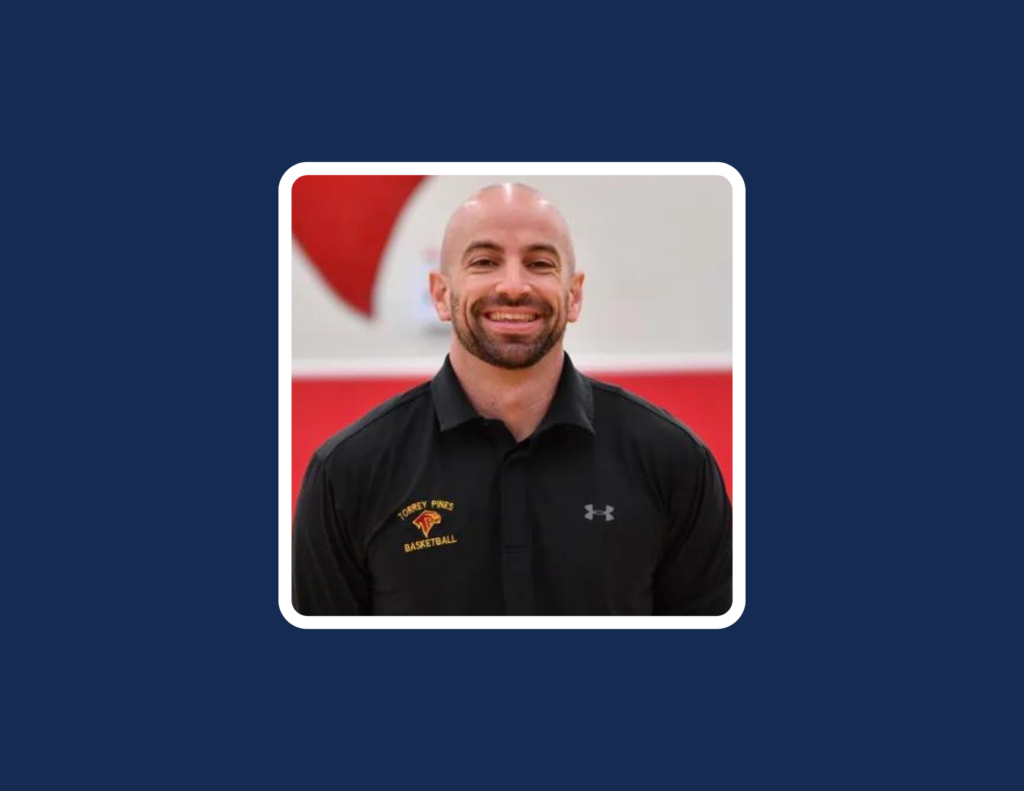
NICK DIAZ – TORREY PINES (CA) HIGH SCHOOL BOYS’ BASKETBALL ASSISTANT COACH – EPISODE 943

Website – https://torreypinesbasketball.com/coaches
Email – nicksd3@gmail.com
Twitter/X – @NickSDiaz
If you listen to and love the Hoop Heads Podcast, please consider giving us a small tip that will help in our quest to become the #1 basketball coaching podcast.
Nick Diaz just completed his 10th year as a Boys’ Basketball Assistant Coach for Torrey Pines High School in San Diego, California, working with Falcons at all three levels of the program. He is a Torrey Pines alum who graduated in 2010 after playing two years for Coach John Olive. While in high school, Diaz was part of two league championship teams and a CIF San Diego Section Runner-Up. After attending Torrey Pines, he graduated with a degree in sociology from the University of Oregon in 2014. Nick is a full-time Special Education Teacher at Canyon Crest Academy.
If you’re looking to improve your coaching please consider joining the Hoop Heads Mentorship Program. We believe that having a mentor is the best way to maximize your potential and become a transformational coach. By matching you up with one of our experienced mentors you’ll develop a one on one relationship that will help your coaching, your team, your program, and your mindset. The Hoop Heads Mentorship Program delivers mentoring services to basketball coaches at all levels through our team of experienced Head Coaches. Find out more at hoopheadspod.com or shoot me an email directly mike@hoopheadspod.com
Be sure to follow us on Twitter and Instagram @hoopheadspod for the latest updates on episodes, guests, and events from the Hoop Heads Pod.
Make sure you’re subscribed to the Hoop Heads Pod on iTunes or wherever you get your podcasts and while you’re there please leave us a 5 star rating and review. Your ratings help your friends and coaching colleagues find the show. If you really love what you’re hearing recommend the Hoop Heads Pod to someone and get them to join you as a part of Hoop Heads Nation.
Get ready to jot down some notes as you listen to this episode with Nick Diaz, Boys’ Basketball Assistant Coach for Torrey Pines High School in San Diego, California.
What We Discuss with Nick Diaz
- His early days learning the game in San Diego
- A high school buzzer beater that he’ll never forget
- His first experience coaching a friend’s (Scott Kaplan) son’s rec league team
- Working for his high school coach during the summers when he was at the University of Oregon
- The competitive nature of coaching
- “I think you’ve got to foster the kid’s love of the game.”
- “All the research out there is that sports are valuable for kids it helps them academically, socially, emotionally, everything.”
- The characteristics of a great youth basketball coach
- Keys to communicating with parents
- “If you sign up to coach, I just think that the parent piece is kind of part of the deal.”
- Why zone defenses are bad for youth basketball
- Teaching positionless basketball
- The financial challenges that AAU presents to many families
- Kids playing too many games without enough practice time
- Eliminating the ranking of youth players
- Graduating from college and finding his way back to coach at Torrey Pines HS with Coach Olive
- Navigating the changing relationship with Coach Olive after joining his staff
- Designating roles and responsibilities on a coaching staff
- “We all collectively do a good job of working with college coaches to help get our guys recruited whether that’s getting them recruited out of high school or once they’re in college and if for some reason they’re in the transfer portal talking to different coaches as well.”
- Creating competitive practices
- “We want players to want to win.”
- “I really think it’s valuable to have your best guys go against each other because that’s just going to help prepare them for tough games but at the same time, you need to have your starters and rotation guys play together because that’s who’s going to play together during the games and they need to help build that chemistry and that timing on things so we do both.”
- “If you talk through it with the staff and you trust your guys, eventually you’re going to come up to a resolution of, okay, this is what we think is our best chance to win.”
- “I think an important aspect of high school coaching, in my opinion, is you have to make the game as simple for these kids as possible.”
- Improving his ability to evaluate players and teams
- The role of a high school coach in college recruiting
- “I just think the relationship piece and being able to really, truly assess what level of play that kid can play at in college and be communicative with the kids, with the parents, with college coaches.”
- “It’s super important, I think, for the high school coaches and the AAU coaches to co exist together.”
- “If you’re producing college players you’re going to have more kids wanting to be a part of your high school program. The same for an AAU team.”
- “We love the game, we love winning, and we love competing, but helping kids is equally as important, if not more important, than all that.”
- As an assistant coach, “Do whatever is needed, and there’s no job too small, no job too big, do whatever is needed.”
- The importance of loyalty in an assistant coach
- “At the end of the day, we get to live in San Diego and coach basketball and make a living out of doing that and teaching.”
Like this show? Please leave us a review here — even one sentence helps! Consider including your Twitter handle so we can thank you personally!

We’re excited to partner with Dr. Dish, the world’s best shooting machine! Mention the Hoop Heads Podcast when you place your order and get $300 off a brand new state of the art Dr. Dish Shooting Machine!

Prepare like the pros with the all new FastDraw and FastScout. FastDraw has been the number one play diagramming software for coaches for years, and now with it’s integrated web platform, coaches have the ability to add video to plays and share them directly to their players Android and iPhones via their mobile app. Coaches can also create customized scouting reports, upload and send game and practice film straight to the mobile app. Your players and staff have never been as prepared for games as they will after using FastDraw & FastScout. You’ll see quickly why FastModel Sports has the most compelling and intuitive basketball software out there! In addition to a great product, they also provide basketball coaching content and resources through their blog and playbank, which features over 8,000 free plays and drills from their online coaching community. For access to these plays and more information, visit fastmodelsports.com or follow them on Twitter @FastModel. Use Promo code HHP15 to save 15%
Your first impression is everything when applying for a new coaching job. A professional coaching portfolio is the tool that highlights your coaching achievements and philosophies and, most of all, helps separate you and your abilities from the other applicants.
The key to landing a new coaching job is to demonstrate to the hiring committee your attention to detail, level of preparedness, and your professionalism. Not only does a coaching portfolio allow you to exhibit these qualities, it also allows you to present your personal philosophies on coaching, leadership, and program development in an organized manner.
The Coaching Portfolio Guide is an instructional, membership-based website that helps you develop a personalized portfolio. Each section of the portfolio guide provides detailed instructions on how to organize your portfolio in a professional manner. The guide also provides sample documents for each section of your portfolio that you can copy, modify, and add to your personal portfolio.
Hey, coach! Want to take your team to the next level this season? Introducing GameChanger, the ultimate game-day assistant with tools to give you a winning advantage. With GameChanger, you can track stats, keep score, and even live stream games, all for free! Get the stats and crucial game video you need to lead your team to victory, all from the palm of your hand. Coach smarter this season with GameChanger. Download GameChanger today on iOS or Android and make this season one to remember. GameChanger. Stream. Score. Connect. Learn more at GC.com/HoopHeads
“Integrity Insight” is a transformative mini-course designed for coaches, focused on examining and improving team conduct in alignment with core values and ethical standards. This course encourages coaches to engage in a reflective and analytical journey, examining past behaviors and incidents to foster a culture of integrity and accountability in their teams.
THANKS, NICK DIAZ
If you enjoyed this episode with Nick Diaz let him know by clicking on the link below and thanking him via Twitter.
Click here to thank Nick Diaz via Twitter
Click here to let Mike & Jason know about your number one takeaway from this episode!
And if you want us to answer your questions on one of our upcoming weekly NBA episodes, drop us a line at mike@hoopheadspod.com.
TRANSCRIPT FOR NICK DIAZ – TORREY PINES (CA) HIGH SCHOOL BOYS’ BASKETBALL ASSISTANT COACH – EPISODE 943
[00:00:00] Mike Klinzing: Hello and welcome to the Hoop Heads Podcast. It’s Mike Klinzing here with my co-host Jason Sunkle tonight and we are pleased to welcome in Nick Diaz, boys basketball assistant coach at Torrey Pines High School in San Diego, California. Nick, welcome in.
[00:00:16] NIck Diaz: Thanks for having me guys. I’m excited to be here. Shout out to Tim Gallagher for hooking this up. Tim knows everyone who is anyone in basketball. So I’m very glad that he was able to connect here with you guys. So yeah, I mean, love the game. So I’m looking forward to talking with you guys about it.
[00:00:31] Mike Klinzing: There is no doubt that. I would say Tim probably is the leader in podcast recommended guests here on the Hoop Heads Pod.
So Tim’s going to keep our guys coming without question. Everybody who sent us has been great and we are definitely looking forward to this conversation. Nick, before we even talk basketball though, Nick, I got to ask you a question. So this is a San Diego related question and Yeah. I’ve been on vacation in San Diego probably four times, I would guess, maybe five even.
And every time I’m there, I always ask myself, how does anybody here ever go to work? So how do you answer that question when it comes to just the beautiful weather and climate in San Diego? How do you go to work every day?
[00:01:13] NIck Diaz: Well, we look at the bills and how much it costs to live here. And I said, man, if I want to keep living here, I guess I got to go to work. So that’s probably that. And you just stay motivated to want to keep your lifestyle here. So yeah, but there’s stuff for some days you’re like, man, nice that like we, we could go do anything, but hopefully I don’t take it for granted too much, but I’d say just to keep the lights on.
[00:01:37] Mike Klinzing: There you go. Understood. Understood. But man, I just love San Diego, love everything about it. From the weather to the city itself to the beaches and it’s just, man, every, every time I’m there, I’m like, this is, if I could go live somewhere again, cost, cost prohibitive in some cases, but definitely a place that is a beautiful place to live and work.
So go back in time, Nick, to when you were a kid, tell me a little bit about how you fell in love with the game of basketball. What were some of your first experiences with the game?
[00:02:05] NIck Diaz: I just remember early memory was basically shooting outside my dad and a couple other dads on the cul de sac, they built a hoop, they got a tire, and they found a hole a hoop, and they put cement into the tire and put it at the end of the cul de sac, and I basically just found my way out there every day.
And loved doing it. I used to shoot granny style when I wasn’t strong enough to shoot overhead. And so then the day I was able to do that, I felt like I’d hit the powerball. So just always got excited to go out and play, whether it’s with my brothers or the other kids in the block and just loved it.
And from there, I remember going to a YMCA all sports camp we did basketball, flag football. Soccer, whatever. And I remember, I only wanted to do the basketball part. I didn’t want to go do the other sports. When it was time to transition, I had like put up a fight, like, no, I’m going to stay.
You guys can go play soccer. I’m going to stay here by myself and keep shooting. So I think that’s probably around the times that’s might have been eight or nine, I’m guessing. Is when I would say I fell in love with it. And the first time I ever played on an organized team, sounds late these days, but it was probably the summer going into fifth grade nowadays kids are playing in like kindergarten or first grade five years behind at this point.
I know I was five years behind. It probably came back to haunt me later in my career. And yeah, I just remember joining a local rec league. And I wasn’t any good because I’d never played before, but obviously I loved it, and just the camaraderie and just the game itself, and I would say those are my earliest memories shooting on the block, camp, and playing in that first rec league back then.
[00:03:55] Mike Klinzing: As you get up into high school and you’re working to become a better player, what was your process for developing yourself as a basketball player? How did you go about doing that? Was it working out by yourself? Was it pickup games? Was it going against a friend? How did you go about getting better? What was the plan?
[00:04:17] NIck Diaz: Just I wouldn’t say there was much of a plan it was, a lot of it was my dad just dropped me off at the local rec center after school or on weekends and said, just go play pickup. That’s probably what his dad did to him back when he was a kid. So I loved it. I would just go play pickup, whether it was against guys my own age you know, when I was in elementary school.
Every now and then you’d play against some other kids that are older than you and bigger than you and rough you up a bit. So I did a lot of that. And then a lot of it was just being outside, being in the driveway, being on the street, just dribbling and shooting until the sun went down.
And so that was pretty much it. That was probably, definitely before the time when everyone had a skills trainer like they do now. Back then that wasn’t really a thing on this obviously pre social media. So there wasn’t a way to go like just go on Twitter and find a trainer and kind of we’re just on your own and how to figure it out, you know?
So I do think pickup is a lost art of today, but I would say just a lot of pickup, a lot of shooting outside. And yeah.
I never actually started playing competitive AAU until I was in 7th grade. And that was a huge shock, right, going from a rec league to a competitive AAU. Our first year, my 7th grade year, we lost every game. And it was demoralizing. And then eventually we got some better players. 8th grade, turned it around and went like 11-1 or whatever it was.
Won our league title in the like a local AAU league. So just kind of that was the progression of playing in the rec league. Making that jump up to AAU in 7th grade, and I played on my school team. I went to a small Catholic school, so we had a team. For each year you were there.
First grade through 8th grade. And then playing old fashioned pick up at the rec center and shooting in the driveway. Kind of like a lot of kids back in the day, I would imagine.
[00:06:13] Mike Klinzing: Yeah, absolutely. I mean, I think about the amount of time that I spent on my driveway in elementary school and what for me was probably junior high.
And then as I was able to drive, then I could kind of spread my wings and get other places and go and find games and that kind of thing. But definitely, I think when you look at the way that Kids grow up in the game today, certainly different from the way you grew up in the game. And certainly I’m a lot older than you.
So I, when I go back and think about how I grew up in the game, much, much, much, much different, there was no such thing as a trainer. There was just me and my imagination and a ball and a hoop and working on my game. And then eventually trying to find when I was young, finding neighbors that. Come and play on the driveway or ride my bike over to their house.
And then as you get a little bit older, you’re riding up to the park and playing there. And then eventually I’m getting in the car and able to search out and find some games. And it was just a lot different. And as you said, you couldn’t go on social media or YouTube and find, Hey, let me figure out some drills that can help me with this or that.
It was kind of like you were limited to what you could come up with. And I know for me, at least I had basically two workouts that I did all the way through high school. and college that when I was by myself, I did one workout. And if I was lucky enough to have somebody that wanted to shoot with me and do something, then I had another workout that I do in that case.
And so I wasn’t super creative and I probably got really good at those drills, but yeah, I think if I was around today, I would have been a lot more creative with what I do. And it’s interesting to think about how the game has changed and how it’s impacted the way that players play and the way that we as coaches kind of interact with our players and the way that they.
Interact with the game themselves, but let’s think back to you as a high school player. Do you have a favorite memory from playing in high school? And obviously now you’re coaching at the school where you put me, you played and working with your coach and you played four. So do you have a favorite memory from your time as a player?
[00:08:09] NIck Diaz: Absolutely, yeah. So, first starter of this is, I was not a very good high school player. I mean, I made the team all four years. I played freshman, played JV, played varsity, and was not a rotation guy, but loved being around it, loved my teammates. But I would say a favorite memory, my junior year, we were in the CIF seven finals for our section, which is kind of like the equivalent to like state playoffs in most other states.
California’s so big, so we start off with section. Yeah. In our junior year, we were semifinal game at home. We’re playing against our hated rival, LaCosta Canyon High School. I mean, this is a bitter rivalry. This is Michigan, Ohio State. This is Yankees Red Sox. And so they had beaten us. That was the fourth time we had played them.
They’d beaten us twice. The first, they won the first two. We won the third winner of this goes to the championship game. I mean, sold out crowd, standing room only. You know, not letting anyone else in the gym after a while was so crazy. And it was a, we’re down one with about eight seconds, I would say.
Point guard dribbles down. I can’t even remember who shot. Oh, we threw it to our big man. He threw up a hook shot, air balled it, and I remember being on the fence, and I yelled, Ramsey, go get it! And our, our foreman just comes out of nowhere, grabs the offensive rebound, and just tosses it up in the air as time expires, and it goes right through the net, and the place just erupts.
And you know, stormed the court. It was, I mean, just, it was so loud that it went quiet. You know what I mean? Like, you know how sometimes it gets so loud, you can’t even hear anything. Yeah. So, I mean, just to win a game of that magnitude against that opponent in that fashion, like at the buzzer and to.
Just the euphoria. I mean I can like feel almost coming back to my veins right now. Like it was unbelievable. There’s clips, this is like pre YouTube, so it’s hard to find clips on it. There’s a couple on the internet that are pretty grainy, but I would definitely say winning against them on a buzzer beater was something that I will never forget for sure.
[00:10:27] Mike Klinzing: Yeah. Buzzer beaters, especially at the high school level. I mean, not everybody gets to experience that, but if you do, that’s a special moment, especially when you get to do it against your rival and there’s a big crowd and all the things that go along with that. There’s nothing more exciting than a high school buzzer beater just because of the emotion and everything that goes into the rivalries.
It’s really, really, a great scene when you get the chance to be a, be a part of that. Were you thinking at all while you’re in high school that at some point, maybe you’d want to coach basketball or was that not on your radar at all when you’re a high school student?
[00:11:05] NIck Diaz: You know, it was, but it wasn’t. So I never thought about it seriously until I got to college. However, I did start my journey coaching when I was in high school. And it was just a rec league team and I’ll never forget it. There’s a local radio guy here. He’s actually a national radio guy. His name is Scott Kaplan. He’s the San Diego guy.
He’s worked in a bunch of networks. Anyways, it was the summer before my senior year and I coached his son in our youth camp that our head coach had, John Olive Basketball Camps. My son was on my team, kid was a good kid he had fun. And I would see Scott around town, we got to know each other, good dude.
And I’m 17 about to turn 18 and my dad’s just hounding me, you have to get a job, you have to get a job, you’re not just going to be some lazy bum all summer doing nothing. And so one day I’m at the gym lifting some weights and Scott Kaplan comes up to me and he goes, Hey man you know, my son was on your team at camp and he had a really fun time.
I’m starting a team. I want to pay you to coach it. And I was like, I couldn’t say yes fast enough. And so I remember going home and I said, dad, I found a job today. He said, Oh yeah, what’s your job? I go, this guy’s going to pay me to coach a youth basketball team. So that is literally how it started all because of Scott Kaplan.
And then I think just doing that. You know, we had a really good team. We made it to the championship of our little rec league. And we, that was the only game we lost. We were undefeated up to that point before we lost. And, I just had a great time. I kind of kept in the back of my mind like, okay, this is something I want to do later on.
Like maybe if I go work a regular nine to five office job, I can coach a little rec team or a club team on the side. I never really thought about spending more time than that. And then it just kind of evolved when I got to college.
[00:12:56] Mike Klinzing: So tell me a little bit about your college experience.
You go to Oregon, what’s the thought process there in terms of what you want to do and what you study and just give us an idea of what your college experience was like.
[00:13:06] NIck Diaz: Yeah just wanted to go be a regular student, went to Oregon and wanted to enjoy that the big time sports atmosphere as long as a good academic school, wanted to get out of state and see To see different scenery, see what life is like somewhere else after having lived here my whole life.
Everyone thought I was crazy, going from San Diego to rainy Oregon. There’s probably some truth to that. But I wasn’t thinking too much about basketball when I got there. I was just worried about, okay, pass my classes, go to football games, enjoy life have a fun experience.
And then kind of later on, towards the end of my freshman year, I remember thinking like, okay I miss the game. I miss being around the team. This is the first time in my life I hadn’t been around a team since I was like 8 years old maybe. And so I just really had that itch. And then when I came back in the summer, Coach Olive asked me to work his camp again.
I did that. He asked me to help out with their summer teams with the incoming freshmen to help them get acclimated, and I did that, and then kind of just going through that, I was like, alright, like, this is what I’m going to do. I want to, I want to coach, like, I want to coach at a high school and really dedicate as much time as I can to it, so.
That’s kind of how that happened. I tried to be a manager at Oregon. You know, it was I didn’t do it the right way. If you’re going to be a manager, especially a big time college program, you’ve got to try and set that up well before you get on campus. And I wasn’t thinking. I wasn’t planning ahead.
And so, I tried. It didn’t work out. It’s all good. No hard feelings. I still love my school. There’s a lot of kids who apply for those jobs. They don’t have a lot of them to begin with. So it’s fine. I coach a rec league team. In Oregon, a little bit of some like fourth and fifth graders just to keep myself in the coaching world while I was at school.
And then every summer that I came home, I would coach my coach’s camp, I would coach with our freshman and JV teams and then I would coach a local club team to keep my foot in the door.
[00:15:09] Mike Klinzing: Funny when you talk about the potential of being a manager and when I played division one basketball, so that was from 88 to 92 at Kent State and we had guys who were managers. And I can honestly tell you, Nick, that during the time while I was playing, I never once ever looked at Our managers and thought, Oh, these guys are managers because they want to get into coaching.
I always look at them and man, they must really like the guys in the team and they want to be around us. Division one basketball players and be around the program. And they think it’s cool to be able to be a part of it. I never once looked at it as a route into coaching. And now you see that there’s so many guys that do take.
That particular path to becoming a college coach. But yet when I was involved in the program, I never saw it. And yet, when you look back, I’m like, how did I not see that, that these guys are spending so much time with the coaching staff. Like preparing for practice, during practice, on road trips. Right. The exposure that you get to a coaching staff as a manager A college program, I mean, is, is invaluable in the relationships that you build with that coaching staff, which obviously if you want to get into, especially college coaching, those relationships are really important.
And so I think, like I said, I never even looked at it that way. And obviously that wasn’t the path that you ended up taking, because as you said, it takes a lot more prep to be able to sort of get in there. And there’s lots of people that want to get those jobs for various reasons, but your path is you just, Kind of stumbled into hey, I’m going to coach this youth team and now all of a sudden you’re hooked and you’re into it You’re getting some more opportunities to do that and somebody said hey you want to pay you to come coach this team So when you think about some of those first opportunities, what was it?
Specifically about coaching that hooked you that made you say hey This is something that I want to make sure it continues to be a part of my life as I move forward Was there one, two, three particular things that just grabbed you and said, Hey, I got to keep doing this?
[00:17:15] NIck Diaz: Yeah. I would say the first thing I think of is just the competitive nature of it.
I’m wired to be a competitor. I’m one of five kids. I have older brothers who played football and they were wrestlers. So we rough housed a lot. We fought over everything. We’re just wired to be competitors. And so I just, I love the competitive aspect of like, okay, let’s go try to beat, we got to win this game.
Let’s go beat them. It’s us versus them. I love that the brotherhood aspect too of you get a group of guys and you’re just trying to accomplish a goal. Yeah. I also love seeing kids get better. I grew up loving the game, obviously still do, so when you see kids who also love the game, and they have a passion for it, and they want to eventually be good high school players, go play in college and beyond if they’re lucky enough to help them on their journey to do that what’s, there’s, you can’t even put a value on that.
I would say seeing the kids succeed at the higher level, is equally or greater than any of those wins that we’ve had. So I’d say the competitive aspect for sure, to help the kids get better. And it just sounds so fun to me. There’s a lot of work that goes into it, obviously, but I would say the brotherhood, the camaraderie you know, a lot of people have a bad face and mouth about parents.
I’ve had mostly good experiences with parents. So I’m pretty fortunate, knock on wood. So I think like. Early on, like, having good experiences and relationships with different families made it be like, okay, this is fun, like, I’m getting the competitive juice, I’m helping these kids get better, and I’m enjoying hanging out with the kids and their families that it just made the environment, it was really conducive to wanting to keep me around it, you know what I mean?
[00:19:04] Mike Klinzing: Yeah, absolutely. No, it makes complete sense. I mean, I think that when you start talking about that camaraderie, you start talking about what it means to be a part of a team. It’s something that I think that people who aren’t involved in sports, I think they have a hard time kind of visualizing what that looks and feels like when you talk about being in a locker room or just competing together.
It’s such a an intense experience. And I don’t care whether you’re talking about fifth grade AAU basketball, or you’re talking about college basketball or whatever level, there’s just this sort of intimacy that you develop with your teammates because you’re the only group of people that are going through that particular game, that particular practice, that particular season.
And let’s face it, that outside of very few things in our lives do we compete at the same level of intensity that we do in sports, and it’s rare to do it together in that same way where everybody’s kind of working towards that same goal. So I can completely relate and understand exactly what you’re saying when it comes to just wanting to be a part of that and be a part of a team, especially if it’s something that you grew up with.
I think that’s one of the things that really is attractive to coaches. I can tell you, Nick, that we’ve talked to a ton of people on the podcast that said, Hey, I got done playing and I was no longer part of a team. And all of a sudden I thought to myself, Man, I miss, I miss just being a part of something bigger than myself and being a part of a team.
And I think that’s kind of the feeling that you’re getting at, if I’m not mistaken. Is that right?
[00:20:45] NIck Diaz: Yeah, it is. For sure. For sure. I couldn’t imagine not being part of a team or not having something competitive in my life, not being something where I’m helping kids and families. I just can’t even grasp what that would look like.
You know what I mean?
[00:21:03] Mike Klinzing: Yeah, absolutely. I mean, I think that again, when you talk about giving back, right, that you’re using the game of basketball as a vehicle to be able to give back and pour into kids and to be able to have an impact on their lives. And what better way to do that than to do it through a game that.
You love that’s been an important part of your life and that you can use to be able to have an impact on kids. And let me piggyback on that with a question about youth basketball coaching. When you think about what makes a good youth basketball coach, what are some of the characteristics that you would say you’ve seen in good youth coaches that have that kind of positive impact that we were just talking about?
[00:21:47] NIck Diaz: I think you’ve got to foster the kid’s love of the game. I think you always hear those unfortunate stories of kids who get turned off on certain sports because of certain coaches. I think you’ve got to really keep kids engaged and make it fun and make them look forward to come to practice.
And challenge him appropriately, make it hard at times, but you have to make it enjoyable, because sports are hard, and, and you want kids to continue on playing sports, and all the research out there is that sports are valuable for kids it helps them academically, socially, emotionally, everything.
So I think number one, do whatever you can to help kids fall in love with the game, or they should really like the game, and grow from there. And I think development. Development is really, really big. If you’re a youth coach, so I imagine that means before high school, your goal should be, ok I want to help you, whatever high school you go to.
I want, when you show up to those high school tryouts, that you’re going to make the team. You’re going to give yourself the best chance to make the team. And for every kid that’s different, you know. For some kids, it’s just make the freshman team. For some kids, it’s hey, be a starter. Other kids, it’s hey, you’re a freshman, go make JV.
Or go make varsity. You know what I mean? So I think just relative to each kid’s situation, I think the development piece is really, really big. Obviously, we always talk about in basketball, too many coaches play zone at the young levels because most good high school programs are going to play man.
Obviously, most college programs are going to play man to man. So I really think that the development piece of teaching kids man to man defense, teaching offensively. Just because the kid’s the biggest kid now. Don’t just pigeonhole him. He’s a five man. He’s playing back to the basket.
He may not be the biggest kid in a few years, you know. I think teach kids to play as positionless basketball, as much positionless basketball as possible. You know. Good spacing, cutting, and screening, and ball handling, and shooting, and be able to do different things on the court, and not just, oh, that kid’s a point guard, and that kid’s just a three or a four or a five I think at a young age, just look at them as hoopers.
Just go learn to play. You know what I mean? So I think those are the things that jump out of my mind for sure with a good youth coach. And building a good relationship with parents I think is key, because parents are a big part of the equation. At any moment they can put their kid on a different team.
You are going to hear from parents good, bad, ugly it’s just, it’s going to happen. So I think knowing how to build a good relationship with them, how to good communication, making sure they’re kept in the loop on what’s going on, and when you inevitably have to deal with some conflict.
You can, you’re best prepared to handle it. Don’t let it get confrontational. Make sure everything is above board and you handle things properly. So those are the things that definitely come to mind right away.
[00:24:42] Mike Klinzing: Yeah. I think when you talk about that proactive communication piece, to me, I don’t care what level of basketball that you’re coaching, when you can reach out to parents and keep them in the loop and keep them informed about what’s going on and make them feel like they’re a part of the program.
Then if there’s a situation that arises where it’s not maybe positive and maybe there’s a discussion about playing time or maybe there’s something else that you have to talk with a parent about that maybe is uncomfortable for both you and the parent. If you’ve already established that relationship and you’ve communicated and you’ve built some positive rapport with that family, then when you have to have a difficult conversation, that is much more likely to go well and be better received when there’s a prior relationship as opposed to, Hey, this is the first time I’m ever talking to you. Kind of like being a teacher, right, Nick? I mean, you have to communicate with parents in advance so that if there is something that you need to have a difficult conversation with them at some point, it becomes much easier when you’ve already established a positive relationship.
They know you’re coming to them in a positive way with the best interest of their child at heart, which ultimately is what I think every parent is looking for, regardless of whether you’re talking about basketball or you’re talking about school or whatever it may be. Parents obviously want the best for their kids and they’re not always going to see completely eye to eye with you as a coach or as a teacher.
But if you’ve established a good relationship, it makes it a lot easier to have those more difficult conversations. Has that been your experience?
[00:26:15] NIck Diaz: Yeah, for sure. And I heard a quote, I can’t remember who told it to me. I think it was one of my buddies who coached football. We were talking about how to handle parents and all these types of situations.
And he said, and I don’t have any kids. And he does, and he said, look, to that parent, that kid is the most important thing in the world to them. And it’s the truth to the parent, it is that important to them. So I think coming from having that lens of like maybe this is why they feel a certain way about a playing time, a role.
Overall I’ve had positive experiences. I think, like you said, being proactive, building a relationship early. Building a relationship with the kid first becoming tight with the kid and getting to know mom and dad as well. I think it makes it The bond’s stronger and it makes communication easier, I think it mitigates problems, I think that when conflict does arise, it’s, it’s not as intense it can be more direct, obviously there’s going to be outliers, there’s going to be people who are going to be upset, there’s going to be people who are going to really lose it over certain things, you can’t really prevent that, some people are going to do what they’re going to do, no matter what, but if you can prevent as much as possible and make it not as intense and uncomfortable as it can be.
I think that the proactive piece is super valuable and I think more coaches should do it. I understand why some coaches probably don’t. They’re probably thinking, well, I spent enough time coaching and breaking down film and game planning, which is a fair point and coaches have jobs, lives to worry about. So I get it. But to me it’s like if you sign up to coach, I just think that the parent piece is kind of part of the deal. Especially in today’s day where there’s technology, there’s so much access to information, there’s so many different forms of communication that, to me, it’s almost in our best interest, even more so now, to be proactive with that communication piece of the parents, I think.
[00:28:20] Mike Klinzing: Yeah, I agree with you. I mean, I think that if you’re not interacting with parents in a positive way and in a proactive way, I think you’re doing yourself a disservice because ultimately you’re going to have to interact with parents in some way, shape or form. And especially if you’re at the high school level or the youth level, there’s just no way that you’re going to be able to completely avoid that.
And so you’re much better off. setting a positive tone with your communication and making it proactive and getting ahead of it and keeping people informed and making sure they know when practices, when they know when the games are, when they know what’s going on within the team. And then when you do that, you just make things much, much easier.
And you get people who then advocate for you and your program, and they have good things to say like, Hey, this guy communicates, or this girl communicates. And they really allow me to be a part of it. And they keep me informed and they make me feel like I’m a part of. what this program is all about. And I think that when we talk about whether it’s at the youth level or the high school level, I think that having parents as advocates, as opposed to adversaries is really a critical piece in being able to have success.
Let’s talk generalities when it comes to youth basketball, before we get into your experience at the high school level. If you were looking at the youth basketball landscape and you could make one or two changes to the things that you see out there in youth basketball today, what are one or two changes that you’d like to see that you think would make the game better for whether you want to pick one particular constituency or, or all of them?
But when I think about parents, players, and coaches, what are some things that we could do to improve youth basketball here in the United States today?
[00:30:09] NIck Diaz: Man, I think, I’m sure that I’m sure there’s a few that all of us would think of. It’s easy for me to just say, Hey, let’s cut this zone nonsense out.
Let’s all play man to man. I think I’ve heard some countries they actually do that. I think somewhere in Europe, and I think I, maybe Australia, someone told me they like have people walk around and if you’re in a zone defense, you get a technical power has so think Canada has that,
[00:30:32] Mike Klinzing: I think Canada knows that they have. I’m trying to think. They, oh, I’m trying to think who told me that. It might have been, I
[00:30:38] NIck Diaz: Sorry. I know I’m not making it up. I know it’s somewhere.
[00:30:40] Mike Klinzing: No, it’s somewhere. They, they call them like they have like, they even have like a name, but it’s like, it’s like zone monitor or court monitor or something that basically people go around during tournaments.
[00:30:51] NIck Diaz: Yeah, they were like a certain color t shirt probably. Yeah, no, I think something like that would, would be cool. I think if just cause you get, you see so many kids, unfortunately, I feel like when they get to high school, they don’t understand help defense or different ways to guard a ball you know rotations just on and on and how that impacts the rest of the game, how that impacts the box out, the rebounds, and transition to offense.
It affects everything. It’s such a domino effect. So I’d love if we could find a way for kids to play man to man, even if it’s not exclusively, how about mostly? Let’s start with that. I think There you go. You know, too many coaches I mentioned earlier, like, oh, he’s the biggest kid, so they have to make him a 5 man.
We don’t know how big that kid’s going to be one day. He could’ve just matured early. You know, don’t stunt his growth as a player by saying he’s a back to the baskets. I wish more people would understand that and think like, hey, let’s teach a lot of like 5Ls. Or let’s have like, Everyone learned post up moves and everyone learned ball handling and shooting and everyone’s allowed to kind of do different things, so making kids more well rounded and less pigeon holed in their game, so that development piece, I think for sure, as well as like good spacing and cutting and screening, not just standing.
And, but also on the other side, not like teaching kids 50 plays. Kids don’t need to know that many plays. Maybe teach them a few basic concepts. I’ve always thought it’s more important to teach kids how to play than it is to teach them a bunch of plays. You know, read, react, different concepts like that.
I think the financial piece is tricky. You know, to play on an elite level club team, AAU, it’s expensive. Obviously, I’m sure a lot of the top kids, they get scholarships financial aid, because they’re good players and the programs want them. So the other kids end up paying more to cover their costs. I’m not saying I’m against that, but I think that there’s probably a good amount of families who are priced out.
I don’t know. Of playing higher level basketball, and I think that it’s good for kids to start in rec league but eventually if a kid is progressing or showing an interest in wanting more, I wish there were more ways for the kid that weren’t the elite players when they were young to get those opportunities, because not everyone’s going to get those same chances, obviously.
So, if there is some way, I don’t know how you do it, you can’t really tell AAU coaches what they can and can’t charge. So, I have no idea how, what that would even look like, but I think it would be, it would be great if there were more opportunities for kids who get priced out of the market. I think that would be helpful.
I mean what else is there? Those things come to mind for sure. Oh, too many games. How did I forget? Too many games. Kids don’t need to be playing three games in a day. Four, five, six in a weekend. That’s too much. Kids need to be practicing more than they play. So I don’t know if it has to be 50 50.
You know, for every game you get one practice, you know. But just, I think the discrepancy, it’s too big right now, you know. I just, I don’t think it’s healthy for kids to be playing that many games. You hear about the overuse of muscles leads to injuries and fatigue. And also, when you play that many games, it kind of devalues some of the games, I feel like.
You lost a game, eh, it’s okay, we got another one in an hour. So I just, yeah, I don’t know how you do that, right? Put a cap on the number of games a kid can play in a weekend or you have to tell the tournaments how to run it. But those are the things that jump out of my mind for sure.
[00:34:32] Mike Klinzing: I think that all those points that you hit on are really important. really good ones. And I think that they’re ones that are, as you said, they’re difficult to solve. And part of that is because youth sports has become big business and it supports a lot of adults making a living, which again, there’s nothing wrong with that.
I run basketball camps and I make money from doing that. There’s nothing wrong with it. I do think though, that sometimes we let it get, A little bit skewed in terms of what we’re trying to do. And my thing is that I always kind of go back to, and I think you can take almost every point that you made and kind of put it around this central idea.
And that is that what we do in youth basketball, to me, should always be centered around the kid and should be for the good of the kids who are playing the game. And I think sometimes we make decisions that are good for the adults that are involved and not so good for the kids. So you think about five, six games in a weekend.
Is that good for the kids and their bodies and their development? Probably not. Is it good for tournament operators? Probably. You look at development and trying to get players to become better and talking about having more practices where kids can work on their game and get better. Is that kid centric?
If we have less practices, probably not. Cause again, you’re going to get better from having an opportunity to practice and work on your skills and be able to develop. And so I think that there’s, There’s so many things that if we just kind of frame it through the lens of, hey, what’s good for the kids that are playing the game?
If we always kind of think about that, I think we’re going to try to end up in a pretty good place, but it’s a real challenge. And I think one of the things, Nick, and I don’t know if you guys speak to this, experience this at all in California. But one of the things that we’re seeing, at least here in Ohio, and my daughter’s in eighth grade, and we were at a tournament like two weekends ago.
And there was so many tournaments here in the Cleveland area and so many teams that are playing in all these tournaments that to be able to find officials, you end up with People who are certified officials and then they’re not really doing the things that they should be doing. So they’re not getting into position to make calls and they’re doing this and that they’re supposed to be underneath the basket at one end and they barely move.
And then you end up getting, yeah, getting physical where again, because the referee isn’t calling it or isn’t in position or doesn’t know what they’re doing. And then you’ve got these tournament directors that like, you’re not really putting. a good product out there when you have people officiating who aren’t fully officials.
And it just puts the whole thing kind of in danger. So I think it’s, it’s a combination. All the things that you and I have sort of talked about here in the last 10 or 15 minutes are all things that they’re not easy to solve, but I don’t know that they’re completely impossible to solve, or at least make possible.
And I think it’s when you frame it through that idea of what’s good for kids. Is it good for kids to be playing in a tournament where there aren’t officials that have been certified and are ready to do a good job. Are they on their 10th? Are they on their, yeah, are they on their 10th game of the day and they can barely move?
Again, as, as a tournament operator, if I can’t find enough qualified officials, then I can’t really run a tournament. Now, I know that’s probably not likely to happen because there’s a lot of money at stake, but it just seems like there’s better ways that we could do it. So I don’t know if we solved anything, but at least we got some ideas and some thoughts out there.
[00:38:25] NIck Diaz: I don’t know if you have any reaction. Sure. I got one more problem. Can we stop ranking kids? Yep. For sure. For sure. You know, what, what are we doing? Like, Oh, I’m okay with high school ranking. That’s fine. Cause there’s, there’s, that’s a different deal. But like under high school, like let’s stop saying, Oh, that’s eighth grade in the country.
Fifth, sixth grader. What like, what are we doing? Like we don’t need websites. We don’t need that’s ranking these kids. I’m not even really in love with young kids getting highlight tapes. I think if gives some kids some false hope and Self inflated egos, whatever, but I’ll let that go, but like, let’s stop doing all this nonsense. You know what I mean?
[00:39:09] Mike Klinzing: So true. I mean, I think that it’s just some of the things that, that we do are, are really, I mean, it’s sometimes hard to wrap your head around like the why, like, how did this, how did this start? Like, why did we start doing it this particular way? And man, there’s a lot to unpack there.
We could probably do five, six, seven, eight. We could probably do a whole series of podcasts on each one of the issues that we’ve raised, but I think there are people that want to make the game better. And 98 percent of the people who are in youth basketball are in it for the right reasons. And we just have to kind of figure out a way to, to make sure that those are the people whose voices and who we’re allowing to be able to make policy and to be able to get things organized. And it’s tough because again, there’s all different states across the United States where rules are different in terms of high school access to players. And then you have just, again, the number of different tournament operators and AAU clubs and all that go about doing things differently.
But for me, it just still comes back to, can we do it in such a way that it’s best for kids? And if you frame it that way, I think ultimately then we’re going to end up in a. And so it’s a challenge, but hopefully at some point we’ll continue to be able to make inroads and make the youth basketball landscape a better place for everybody involved.
Let’s jump to your high school experience. Tell me how. The opportunity comes for you to go back to your high school, to be able to work with your own high school coach and just start with just the process of getting the job.
[00:40:55] NIck Diaz: Graduation from college was coming up. Didn’t really have a plan. I had a summer job working at the San Antonio Spurs youth camps. And I was like, okay, I’m going to go do that. And then I’ll go back to San Diego and kind of just figure things out. Go out to San Antonio, have a good experience, put the summer with them right after they had beat the heat in the championship.
And then Did that for the summer, came home, and Coach Olive had heard that I was back in town. We had texted and gone back and forth a little bit, and we had kind of loosely talked about coaching and helping out. And then one day he just said, hey, come by practice tomorrow. And it was during a basketball P.E. It was in the fall. And I just showed up one day and We talked for a few minutes, and he was just like, hey one of our other coaches had left, he had taken a different job, and so there was an opening, and he was like, you want to help out you can help out the freshman at JV in varsity, you can kind of come to all three and do as much as you can I know you’re going to be busy with other stuff, but just come as much as you can, help out with all three teams, and Let’s just get started.
And I was like, all right, let’s do it. And it kind of was as simple as that. Just luckily having played for him and worked his camps so that pre existing relationship and knowledge of the program and some of my teammates were still involved with the program, and I had coached a lot of the kids in the program already when they were younger coming up.
So, it just kind of was a natural fit, it felt like, and so. It just kind of came about that way. And here I am 10 years later, never left.
[00:42:39] Mike Klinzing: What was it like going from Hey, you had sort of the player coach relationship to now you’re actually colleagues with somebody that you used to play for? I think that dynamic is always interesting.
And I love kind of hearing how different coaches have handled that particular aspect of it. So how did you handle the relationship piece of sort of switching from, Hey, it’s a player. This guy was my coach to all of a sudden now we’re colleagues on the same staff.
[00:43:07] NIck Diaz: Yeah, for sure. It definitely like, it, I feel like it just takes like a lot of time to really get that cause like I was still in the mold of like, Oh, this is my coach.
Like, you know what I mean? I still looked at him, even still to this day a little bit cause regardless he still is the boss. And so when he it gives us an instruction, we just do it. Cause that’s just what I’ve been doing with them since I was 14 years old. And so it definitely took time.
To be like, alright, yeah, he is our coach, and he was my coach, but now, like I work with him and working for him is different than playing for him. And so I think just being privy to more conversations that are just only coaches around when we’re talking about certain kids or families or game planning and stuff like that, I think, like when we’re bouncing ideas off each other for different ideas, I think that you just kind of naturally start to feel like, okay this is a different kind of relationship than we used to have.
When I was a high school kid you weren’t asking the kids input on game plan. We weren’t Giving you updates on what other kids what was going on with them or scouting other schools. So I think just because of the nature of the interaction and the time spent together, it just kind of evolved into a colleague relationship.
And our coach is he’s a fearless leader for sure. He’s been coaching since 1985 college and high school. And so we’ve always looked at him like he’s just, he’s the wise man. He knows so much about basketball. He’s probably forgotten more about basketball, than I know.
And so it just, I never like changed how I viewed him in a basketball sense, but in terms of relationally it definitely was a process to evolve to that.
[00:45:02] Mike Klinzing: It’s a really good answer and I think it’s a really healthy way to look at it, that you still have the reverence for him, that you had. as a player, that his coaching acumen and his basketball knowledge.
And at the same time, as you said, that relationship part of it changes because now you have access to all those conversations and you’re a part of those as well, which you obviously want as a player. So you can still have a tremendous amount of Respect and reverence for him as a basketball mind and as a coach and what you think of him in that realm.
And yet at the same time, you kind of have to bring yourself along that, hey, he’s no longer, it’s no longer a superior and an underling. It’s, it’s two people who are on at least relatively equal footing in terms of being part of a coaching staff. How do you guys, how does Coach Olive put together the roles that all of you guys on staff.
And I know that you have a staff that’s been together for a long time, so it may be that as guys come on that he kind of gives them a role and talks about what they’re going to do, but how do you guys think about and define roles within your coaching staff?
[00:46:15] NIck Diaz: Right. No, very good question. That’s not something I really think about because I feel like I’ve just been doing it for so long it’s like riding a bike, like you just do it and it’s just like second nature, but I feel like he we have a freshman coach, we have a JV coach, we have guys who are assistants and they help out with all three teams.
I we have one guy who does stats. You know, we have a guy that does official book. So I think this really, he does a really good job of communicating of like, Hey, this is kind of what I’m expecting of you. You know, for example, like me, I help out a lot with like player development and practice.
Helping out with running a practice in terms of like being a passer or rebounder in a drill getting the pad out and beating the hell out of guys when they get to the post, stuff like that. During the game, identifying, alright, who’s our offensive rebounder crash guys, who are the guys that are getting back that’s kind of my thing.
Letting coach know, hey, two timeouts left, or hey, such and such kid has two fouls, let’s go at him. We’ll I feel like he’s pretty good about like, hey, this, I want you to tell me these things during the game, I’m looking for this, like give suggestions if we’re trying to run a play, speak your mind if you have an idea for a sub, speak your mind, so, obviously you don’t give a hundred suggestions a game you have to be judicial about it, but, Just him really just letting people know, this is kind of what your role is.
We have another coach, he runs the scout. He runs the film exchange. We have another guy, he runs he, he handles all of our staff. All the uploading of that to MaxPreps and all that. And so I think just, If you identify the different things the gameplay, the scouting, the player development and a lot of what we do collectively, it’s not like, oh, only he does scouting and I can’t.
It’s kind of just like, this is what needs to be done, I know it’s going to get done, I’ll assign certain tasks to each of you, but you guys can help each other out, complete those tasks. We all collectively do a good job of working with college coaches to help get our guys recruited whether that’s getting them recruited out of high school or once they’re in college and if for some reason they’re in the transfer portal talking to different coaches as well.
I’ve spent probably the past couple weeks working with transfer portal staff. So I would say he does a good job from the start of really just kind of laying it out like, hey, this is kind of what we need done, these are the tasks that are assigned, you’re in charge of this, you’re in charge of that, and help each other out and let’s get it all done. And we just get it done, you know?
[00:49:01] Mike Klinzing: What does that look like in practice in terms of whose voice are the players hearing and are you guys dividing up one coach is watching a particular aspect of the game that you guys might talk about kind of in the practice planning process or is it more a case of everybody’s kind of coaching everything and jumping in where you see fit or how does that work within the dynamics of your staff during practice?
[00:49:28] NIck Diaz: A little bit of both. I think everyone is definitely jumping in. Obviously you don’t step on anyone’s toes. And when someone’s coaching up it’s their time to coach them up. Definitely from my go back to the offensive rebounding, that’s like a big part of it. Part of our program and so that’s kind of my unit of, alright, you’re going to identify the three guys that are going to crash the glass, you identify the two guys that are getting back, every time there’s a sub, it’s on you to figure that out, and so I’m watching for that, I’m making sure our guys are crashing the glass, making sure the other guys are busted back and so, then there’s other coaches who we have a coach who’s a really good coach, Jake Gilliam.
He he’s really good at all, both ends of the floor, but looking at defense and making sure the matchups are right, he, he kind of spends a lot of focus on that making sure how we’re going to defend ball screens and then we kind of just collectively do it all, but obviously yeah.
First and last voice is Coach Olive. He’s going to have final say on what happens. We give him our suggestions. But yeah, during practice to your question, I would say it’s a very much collective. All of us are coaching.
[00:50:41] Mike Klinzing: What does it look like in practice? When you’re trying to develop competitiveness within your team, and specifically I’m thinking about, I know a lot of coaches like to have drills where they have winners and losers, or they chart winners and losers throughout the practice.
And obviously at the high school level, sometimes it’s difficult when you start talking about some of the tracking that college programs can do, but What do you guys do from a practice standpoint to make sure that you’re getting the most benefit out of your practice each day and making sure that it’s competitive and that guys are pushing each other to be their best?
[00:51:18] NIck Diaz: Yeah, we do a lot of competitive drills. We don’t chart winners and losers by writing it down, but we do a lot of drills where there are winners and losers. Losers you have to do push ups, you have to do some running, whatever. And so, yeah, we do a lot of different drills.
And it can be your classic shell drill, just old school, 5 on 5 half court, let’s play. Each team’s going to get five possessions most points win. Sometimes it’s, Most points wins, sometimes it’s most stops wins. We do a lot of rebounding drills, where it’s you get it’s minus a point for a miss boxed out, it’s offense gets two points for an offensive rebound, defense gets one point for a defensive rebound, and it’s first team to eleven.
And the only way you get on defense is if you get an offensive rebound. So we do a lot of drills like that where we’re constantly just, we want there to be a win or loser. We want you to have to compete. We’ll do shooting drills where this basket versus fast basket, that basket. We’re going to put the timer out, who can make what team can make the most.
And whether it’s jumpers or free throws or what have you. So. Coach does a really good job of making, not 100 percent of the drills competitive, but I would say probably the majority of them. There is a winner and a loser, and it gets kids fired up, you know? They want to win, and so we want them to win.
We want them to want to win. So some kids It can get it can get chippy, you know these kids, they have pride they’re teenage boys, and so we, we’ve seen a lot of trash talk, it’s, it’s never gotten out of line, it doesn’t get too physical but it’s, it’s spirited, I’ll say and so, and it makes it fun, you know what I mean, it just it can be easy to go through the motions of a practice through the grind of a long season, and so definitely just making.
As competitive as much as you can. I think it’s so valuable and just. There’s going to be a winner and a loser. Okay, you two teams, you’re going to fight it out. Let’s see what happens.
[00:53:23] Mike Klinzing: How do you guys, this is I think a question that I always find interesting, especially at the high school level, when you guys are putting together your groups for practice, how do you organize those groups?
In other words, do you always have your starting five going against your second five? Do you mix guys up so that maybe your best player is going against your second best player if they play a similar position or their similar size? How do you guys think about the groupings in practice?
[00:53:51] NIck Diaz: We definitely mix it up for sure. I think you need a healthy dose of both. I know there’s a lot of, there’s different schools of thought out there. Some coaches are going to say, well, I want the chemistry, I want our guys to learn to play together. The starters, the rotation guys, you know. And then the other coaches on the other side are going to say, well, they’re just going to probably end up beating the second team more often than not, and that doesn’t help prepare them.
And the second team, they get kind of demoralized after always losing, or losing mostly. So we try to do both. I’m a big believer in both. I probably lean towards me personally. Wanting to have, I call it ones versus ones just split up your rotation, let’s say you have eight, okay, get four evenly on both sides and then find two other guys to go fives I really think it’s valuable to have your best guys go against each other because that’s just going to help prepare them for tough games but at the same time, you need to have your starters and rotation guys play together because that’s who’s going to play together during the games and they need to help build that chemistry and that timing on things so we do both.
I would say, I think it depends on time of the year, right? You know, I think if it’s in the preseason, like in the fall during PE, and if it’s early on the season, we’re probably doing more of our best guys against each other, and then I think as the season goes on depending on maybe upcoming opponent, and just the grind of the season, maybe then we’re probably doing more of our mid season.
Bye. Our rotation guys going against the second unit just because it’s a different part of the year, right? You’re trying to save your legs, you’re trying to focus on chemistry, you’re focusing maybe more on game planning and specific stuff to certain matchups, so I think we do a healthy dose of both for sure.
[00:55:45] Mike Klinzing: Speaking of that, when you get into that portion of the season where you’re preparing for a particular opponent, how do you guys break out your scouting responsibilities?
[00:55:56] NIck Diaz: In terms of the coaching staff, you mean?
[00:55:58] Mike Klinzing: Yes, sir.
[00:55:59] NIck Diaz: Yeah, so we watch film as a staff. We will meet if practice is, let’s say it’s a Saturday, for example practice is at 10.
Staff will get in around 8 and we’ll watch film together and then we’ll just collectively we’ll just talk through, okay, this is what we think we need to do against this opponent. You know, this is, we’ve identified these are their best players, so these, this is who we need to have guard those guys.
They kind of run this action a lot, how we’re going to guard that. So it’s pretty much a collective unit. Coach will go, okay, how do we want to guard this? And we’ll give our input and he’ll say, okay, I like that. I don’t know about that or this might work. So it’s very much a team effort.
We’re all just kind of in the same room it’s kind of like the war room and we’re just in sync, really just working together to figure out what we’re going to do. We all just give different suggestions and we talk through the different options. Are we icing the ball screens? Are we going to switch them? Are we hedging? Are we going to trap in certain situations? And then do we want this kid on that best player? And if you talk through it with the staff and you trust your guys, it’s Eventually you’re going to come up to a resolution of, okay, this is what we think is our best chance to win. So that’s kind of our method that we do.
[00:57:26] Mike Klinzing: Makes sense. I mean, I think, again, everybody has it. A little bit different in terms of their set up and how they get their team prepared, and how they use that scouting report and how much they share with the players. When you think about the amount of work that you guys do on scouting, and then what do you actually end up sharing with your players because I know there’s a thought, and again, this even goes up to the college level in terms of how much information is actually valuable to the players.
Obviously as a coaching staff, It’s important for you to know some of the things that you know after scouting a team, but how much of that can you pass on to your team and how much of it is actually useful to them when it comes to game prep?
[00:58:07] NIck Diaz: We give them a lot less than we actually talk about in the room.
That’s for sure. We’ve so many times we’ll be in a scouting We talk, and we’ll be going over stuff, and we’ll be like, okay, we’re going to do this, we’re going to do this, and coach goes, we can’t tell our kids because this is going to make their head spin. They won’t know what that means. And so these are high school kids, he goes, if I was coaching back in Villanova, I could tell those guys this.
And he goes, I can’t tell these kids this. And so we definitely have to dumb it down and just kind of give them the meat. So we take out a lot, trim the fat off of it and give them, I don’t know if I can give a percentage, but it’s a whole lot less than what we go over and I think it comes down to, if you give kids too much, it just gives them way too much to think about and they can be more prone to mistakes, so I think an important aspect of high school coaching, in my opinion, is you have to make the game as simple for these kids as possible.
Because basketball can be a very complex game, but I think you have to simplify it as much as possible. So, I think that just giving them like a few key areas. Okay, these are the shooters. These are the non shooters. These are the main plays that they run. When they do this action, they’re going to do this every single time.
This is their habits. This is what they want to do out of bounds. This is how they defend. And if we do X, Y, and Z things, That’s going to give us the best chance to win. If we can avoid doing X, Y, and Z things, we should have a really good chance. I think you just have to make it as cut and dry as possible.
So they’re getting a very watered down version. It’s probably like version 4 after we’ve gone through like several iterations of it in the scouting meeting. And we may have met for two hours and then we can give it to them in under a half hour, you know what I mean?
[01:00:00] Mike Klinzing: Absolutely. Yeah. I mean, I think that again, you as a coaching staff want to have as much knowledge as you possibly can about those other teams. And yet, at the same time, you want to be able to convey. What absolutely necessary for your players and not anymore, because again, my experience and it sounds like your experience is pretty similar that high school players, there’s a limit to how much a they can consume and actually understand and then be able to apply where it’s actually helpful versus in some cases harmful that you’re just stuff.
And then I always found that when I was coaching at the high school level, that a lot of times our guys had difficulty just remembering what we did and what we were supposed to do, let alone trying to figure out what the opponent was trying to do. And so I always felt like, especially at the high school level, I think the college level is maybe a little bit different, but at the high school level, I feel like if you can kind of focus in on what you do and do it well, especially from a player standpoint, I think there’s a limit to how valuable.
A huge in detailed scout is for a player. I think it’s helpful for the coaching staff to be ready and be prepared. And there are things that a coaching staff can do, but I think oftentimes. Again, high school kids, they have enough, hard enough time just remembering what they’re supposed to do with their own stuff, let alone be worried about what the opponent is doing.
[01:01:22] NIck Diaz: Yeah, exactly. Learn your own plays first.
[01:01:25] Mike Klinzing: There you go. There’s no doubt about that. All right. Let me ask you about your own development as a coach. When you think about sort of your lifespan, In coaching, what’s something that you feel like when you first started was maybe a weakness that you’ve improved over the course of your career?
It could be a specific aspect of the game. It could be something related to coaching and developing culture or relationships. You can take that question anywhere you want, but just something that you’ve improved upon since you started your career.
[01:01:59] NIck Diaz: I think I have gained a lot more confidence in my Evaluation of both players and teams, and really getting a feel for what level of player they are, and what level of college, if any, they can play at.
That’s growing up and when you’re early on in college, early on in coaching, like, I’m just trying to figure out, like, who’s good, who’s not good. I didn’t really have, like, a basis to go off of, and after doing it for 10 years, and coaching a lot of really good players.
Coached against some really good players. Scouted a lot. Watched a lot of games. You know, I feel a lot more confident in my ability to be like, okay, this kid can play at that level. Or this kid is really good. This kid’s a lot better than people think he is. Or people say that that kid’s really good.
I’m not buying it. I don’t see it. And here’s X, Y, and Z. And just from sitting and watching a kid, whether it’s in the gym, he’s really good. Which is preferred, or watch film, I, I feel like I’ve gotten a lot better at knowing how good a kid is, or at least having a gut feel, you, no one bats a thousand right, no one knows for sure, but just going with my gut of, I think this kid can play, I think this kid can do this, or I, I think this kid is not quite as, as, as ready as people may think so, I say player and team evaluation for sure is something I’ve gotten a lot more confident on.
[01:03:31] Mike Klinzing: All right. So to go along with that, one of the things that I always think that is underrated in terms of a role that a high school coach can play, and obviously you’re an assistant coach, so you’re kind of playing, maybe taking a backseat in this particular area, but when you think about what a high school coach can do or should do to help their players in the recruiting process, one of the things that’s really changed in the basketball landscape over the last 10 or 15 years is the flip from the importance of high school basketball in terms of recruiting versus the importance of AAU basketball when it comes to recruiting.
And I think when I started the podcast, Jason and I back in 2018, I would have come to you with the idea that to me, high school basketball was way more important when it came to being recruited to play college basketball. And now after having done this podcast and talked to coaches for six years and also having had my son kind of go through the process this year as a graduating senior.
I feel like my position on that has kind of flipped where I almost feel like AAU basketball is much more important when it comes to at least getting on the radar of coaches and that high school basketball is kind of taking a back seat. But I still do believe that high school coaches and high school basketball are still critically important in terms of being able to identify Who’s a player that can succeed at what level of college basketball?
I think that piggybacks off what you were just talking about in your last answer. So what do you see as being the role for a high school coach in the recruitment of their players? And what have you guys experienced there at Torrey Pines?
[01:05:18] NIck Diaz: Yeah, I think relationships are key. That’s a big common theme in basketball.
Not just with kids and parents, but with college coaches. You have to build relationships and that’s can be done in a wide variety of ways. Going to college games, college practices, clinics you know. There’s different ways you can do it. So I think, and just reaching out too. You can reach out, all their contacts are on their website.
A lot of them, you can find them on Twitter. So, I think building relationships is key. And promoting your guys. And getting their Hudl out to people. Sending emails, making phone calls, reaching out to coaches and saying, Hey, I got a kid that I think you should at least take a look at. And promoting it in the right way.
If you have a kid who you think is a borderline D1, you’re not calling UCLA about that kid. You’re calling the schools that you think that kid can play at, so whatever level you consider to be borderline D1, whether that’s higher level D2, lower, low major D1, I think, like, really having an understanding of what level you think that kid is going to play at and being realistic and maybe even understudying it could be, could be an understanding I think just reaching out to coaches, sending out film building relationships, really working hard to get them like, Hey, come to practice.
I want you to come see this kid. I just think that’s such an important piece. We’re fortunate because we’ve had a very good track record. I was just looking at it. In the 10 years that I’ve been there, we’ve had 24 college players, and that’s D1, D2, D3, NAIA, JUCO. Some kids are full scholarships, some kids are walk-ons and there’s going to be some more coming.
So, we’ve kind of seen across all levels and so I think that the track record helps fortunately enough, if I call a college coach and I say, hey, I have a kid I think you should take a look at, We’re lucky that that coach is probably going to go, Oh, Torrey Pines, they’ve had a bunch of kids come out over the years.
You know, if this guy thinks he’s good, I must take a look at him. So, that’s definitely to our advantage success breeds success. And when we’ve produced this number of college players, that means more kids want to come to our program that have college aspirations because they see that we have a good system and blueprint to help kids get recruited.
But as far as the role, back to your point, I just think the relationship piece and being able to really, truly assess what level of play that kid can play at in college and be communicative with the kids, with the parents, with college coaches. And, oh, getting their transcript. Hey, make sure you send your transcript to this school, they’re interested.
I also think, like, finding out about colleges, colleges have those elite camps. I know, still. There’s different showcase camps where different scouts are put on events. So, like, being in the loop on those events I think is key. And as well, you mentioned AAU becoming more important and you’re absolutely right.
It’s super important, I think, for the high school coaches and the AAU coaches to co exist together. You know, we can, we can definitely both work together in this ecosystem of trying to help the kids and, and help them get recruited and do what’s best for them. So I think that talking about placing the kid on the right AAU team not every situation is the best for each kid.
Based on the kid’s position and circumstances. So helping kids find the right AAU team when they’re on an AAU team, working with their AAU coaches and figure out, okay, who are you hearing from for college for this kid? Like, let’s work together. You call that school, I’ll call this school.
Can you have this school call me back? So it just comes back to working together. That’s just my whole thing. You know what I mean?
[01:09:14] Mike Klinzing: It’s kid centric again, right? Kind of goes back to what we’re talking about before, where If you’re the high school coach or you’re the AAU coach, and I think one of the things that you see a lot of times is people kind of dig in and they say, Hey, this is my player or this is my little, my little niche of what I deal with.
And we don’t necessarily want to deal with people that are outside our niche or trying to infringe upon our niche. But yet ultimately, I think if, if you’re a player’s high school coach or you’re a player’s AAU coach, your, your motivation, your objective should be to do what’s best for the team. That player, that kid to be able to help them again, to your point, that if there is a level of college basketball that they can play at, to be able to get that player in front of the coaches at the right level where they can play.
And to me, it seems like a no brainer that. The high school coach and the AAU coach would kind of work hand in hand to make that happen. But yet I know in practice that that often is not what happens. And in a lot of ways, it’s really hard to understand because again, you would hope that anybody who’s in either one of those roles would, would want to do it because they have the best interest of their player of that kid at heart.
And like you said, I think 98 percent of people Who are involved in the coaching profession at any one of those levels. That’s exactly how they, how they are, but it, but it does happen where that’s not always the case. And I think you make a great point that if, if you are either a high school coach or an AAU coach in a particular area, that the better job you can do of being able to build relationships across AAU to high school and high school to AAU, I think the better off everybody’s going to be.
It’s going to make for a better high school program. It’s going to make for a better AAU program. And ultimately it’s going to make for a better experience for the kids who are involved in both.
[01:11:09] NIck Diaz: I agree. And it’s going to help your program in the long run too. I mean, if you’re producing college players you’re going to have more kids wanting to be a part of your program. The same for an AAU team. It generates itself. And so, it’s in your best interest to, let’s not let egos get in the way. And so, you can work together. And so, again, we got in this to help kids.
Yeah, we love the game, we love winning, and we love competing, but helping kids is equally as important, if not more important, than all that. So, let’s just, let’s just make it work. This isn’t rocket science.
[01:11:47] Mike Klinzing: That is true. It definitely is not. It definitely is not. It does take time and it takes caring and the people who do it well are the people who put the time in to become the best at it that they can be.
What do you think, you’ve been an assistant coach for 10 years, so if you had to boil it down to let’s say two, the two most important characteristics in your mind of what makes for a good assistant coach, what would those two characteristics be?
[01:12:18] NIck Diaz: Do whatever is needed, and there’s no job too small, no job too big, do whatever is needed.
You know, it’s sweep the floor, pick up the donuts or the coffee, work a kid out, give a kid a ride home, feed a kid, call a college coach, send film, go scout a game, just do whatever is needed, and just, you’re not above anything, you’re there for the kids, you’re there for the game. It’s a team effort, so just do whatever is needed and be okay with it and then I think the other thing, that’s a tough one, there’s so many that are important, but I just think, being loyal is a big one, I know, probably a lot of head coaches would say that that’s what they look for in assistants, I think just, I’m a big loyalty guy and I think that just.
Be loyal to the coaching staff. Be loyal to those kids. If you’re at a good program and you’re happy, write it out. Obviously if you want to, if you get a head coaching job, great. That means you’ve progressed enough to go there. But I don’t think you want to be the assistant coach who just hops around different assistant coaching spots.
That’s probably not a great look, in my opinion. But I think just, yeah, do what’s needed and be loyal and, and, and you’re there for the kids, you’re not there for you. I don’t make, I tell the kids all the time, I don’t make any more money if we go 30 and 0, or 0 and 30, if you go play at Duke, or if you go play at whatever Juco that no one’s ever heard of, or you quit the game.
Like, it changes my salary not one bit. But, I do have an emotional investment in your success and in the team’s success. So, if we’re going to spend all this time together for no real money, let’s try to win and get you to college, huh?
[01:14:10] Mike Klinzing: Absolutely. I mean, that’s really a good way to look at it. And I think that those two characteristics that you just mentioned to me are, are really key when it comes to being an assistant coach.
And I think it’s being an assistant coach at any level. I’ve heard so many guys talk about what you mentioned where I’d say, just do whatever you’re asked and be there to even do the things that aren’t being asked, be aware of what’s going on and try to make your head coach’s job easier. Yeah. and then to me like I said, that’s something that all assistant coaches should kind of put that at the very top of their list.
And then the loyalty piece of it. Being loyal to your head coach, being loyal to your program, being loyal to the players that are on your team, that are underneath your tutelage. To me, if you can do those two things, then you’re 98 percent of the way to being a successful assistant basketball coach. And I think that it’s telling that you didn’t talk at all about, Hey, you have to know this phase of X’s and O’s, or you have to know this or that.
And really, I think what it comes down to is Again, you’re trying to serve the people that you’re working with. You’re trying to serve your head coach. You’re trying to serve the players that are a part of your team. And if you do those two things, then I think you’re well on your way to being a great assistant coach.
All right, Nick, we are coming up towards an hour and 20 minutes. I want to ask you one final two part question. So one, when you think about The next year or two, what do you see as being your biggest challenge? And then part two, when you think about what you get to do every day, what brings you the most joy?
So your biggest challenge followed by your biggest joy.
[01:15:51] NIck Diaz: And when you say biggest challenge, you’re talking about like for the team?
[01:15:55] Mike Klinzing: I’m talking about when you professionally as a coach, so it could be with your specific team that you have coming back for next year. What’s a challenge? Maybe it’s a challenge in your career, something that you’re working on trying to get better at. You can kind of take that in whatever direction you want to take it.
[01:16:10] NIck Diaz: Yeah. I think Challenge luckily I have a pretty good life, pretty good job, so I can’t really complain about anything like that. I think with regards to our team we lose four starters, so only returning one.
We have two kids who missed all of last year, the injuries, who would have been in our rotation, so now hopefully they’re healthy, because we desperately need them, so trying to mix in a lot of new pieces is, I think that’s going to be a challenge so just try to figure that out, that’s something that we got to find a way to get these kids up to speed and to make sure that the pieces of the puzzle work together so that we can have success and reach the goal that we’re looking for.
And then Joy. Man I’m very fortunate. I get to teach and coach in the same school district that I went to. And I get to live in the neighborhood right around where I grew up. And it’s one of the best places, I think, in America, maybe even the world to live. And so, I get to go coach at my school.
And I get to help kids that are just like me. Grew up in my neighborhood. Love the game. And at the end of the day, we get to live in San Diego and coach basketball and make a living out of doing that and teaching. So I think just like having that reality. It’s something I don’t ever want to forget, because I know how many people don’t have the best reality, and I know how much work I put in to make this a reality, and so just really understanding that it’s special.
Not everyone gets to experience it and to really make the most of it and enjoy it as much as possible. I hope it lasts as long as I can.
[01:17:59] Mike Klinzing: Makes sense. And I think that’s well said. And it kind of encapsulates the entire conversation pretty well. We talked right off the top about living in San Diego and having an opportunity to coach basketball and doing it at your alma mater.
And there’s so many things that I think from what we’ve talked about tonight that you kind of wrapped up there. And that final answer in terms of what being a coach for you is all about. Before we wrap up, I want to give you a chance to share how people can get in touch with you, Nick. How can they reach out?
Whether you want to share email, social media, website, whatever you feel comfortable with. And then after you do that, I’ll jump back in and wrap things up.
[01:18:43] NIck Diaz: Yeah, so I would say our program Twitter is, you can just, on Twitter you can type in Torrey Pines Basketball and it’s @tphs_basketball.
My personal Twitter account is, is real simple, it’s just @Nick Diaz, you can find me on Twitter. I’m easy to get a hold of. My email is nicksd3@gmail.com. So, by all means, anyone who wants to reach out, I’m more than happy to talk to help, and help anyone. So. Yeah, people can reach out to me.
I really appreciate you guys having me on. I know we did an hour 20. I feel like we could do another two hours. I wouldn’t even blink at it. You know what I mean?
[01:19:28] Mike Klinzing: I know exactly what you mean. It’s funny that you say that because I tell people all the time that I’ll be sitting here and having a conversation.
And all of a sudden I’ll look up at the time and it’ll be like an hour and 10 minutes. And I’m like, man, we didn’t even get to this guy’s current job yet. We’ve been through all these different stops along the way. And here, this guy’s a head coach at such and such a high school or such and such a college.
And we haven’t even gotten to their current job. So I agree with you a hundred percent. It always feels like when you’re having a great conversation, there’s so much more that, you’re leaving on the table. And so who knows, maybe that’s an invite to come back for a second one, Nick.
I really appreciate your time tonight. Again, I thank Tim for connecting us and putting this thing together so that you and I could get out here and talk some basketball and learn more about you and your career and all the things that you’ve been able to do. And I’m really appreciative to Tim as always for hooking us up with another great guest.
So again, Nick, thank you. And to everyone out there, thanks for listening. And we will catch you on our next. Episode. Thanks.