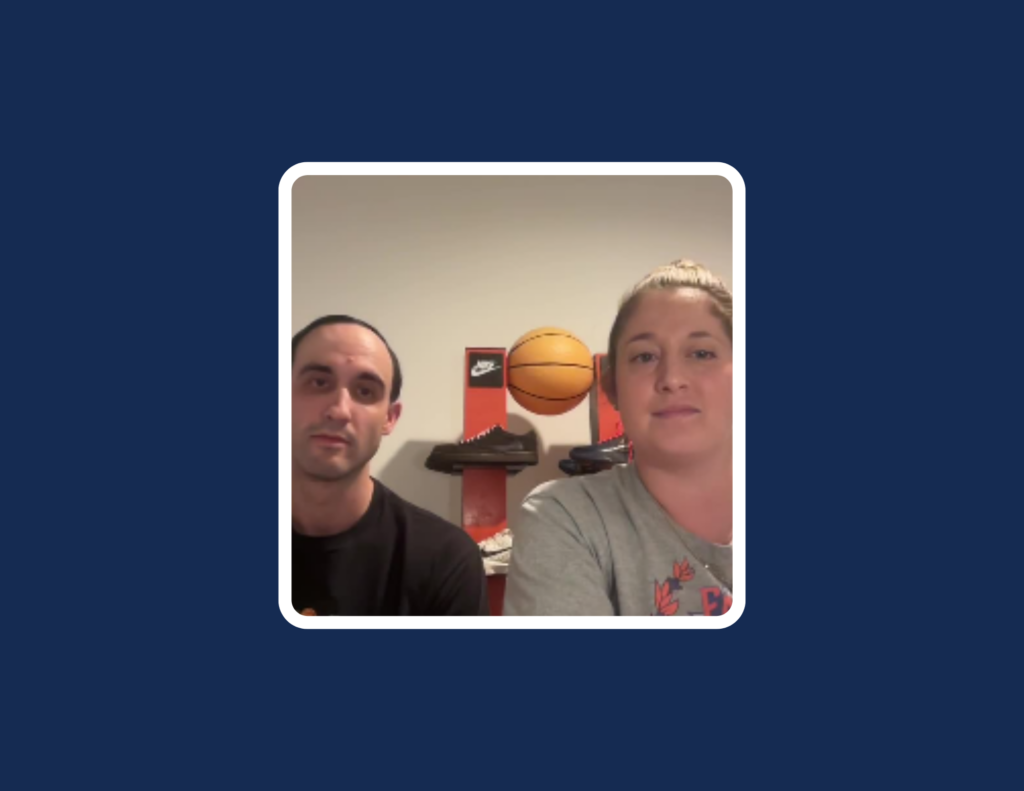
JORDAN STASYSZYN & ALEXA BARBUSH – UNLEASHED POTENTIAL – EPISODE 1213

Website – https://www.unleashed717.com/
Email – stasyszynj14@gmail.com
Twitter/X – @unleashed717 @jstas717 @abarbush5
If you listen to and love the Hoop Heads Podcast, please consider giving us a small tip that will help in our quest to become the #1 basketball coaching podcast.
Jordan Stasyszyn & Alexa Barbush run Unleashed Potential, a skill development program based in Carlisle, Pennsylvania.
Jordan is Carlisle High Schools fourth all-time leading scorer with over 1,600 points and a Big 15 Selection. He played Division 1 basketball at Fairleigh Dickinson before transferring to play at Shippensburg University, where he graduated from with a Bachelors in Communications and Public Relations. He furthered his education by completing his Masters from LaSalle University in Professional and Business Communication.
Alexa was an All-State and Big 15 Selection at Trinity High School. She played at Franklin & Marshall College where she compiled an impressive list of achievements. She was named a 2x D3 All-American, 2x Preseason All-American, Centennial Conference Player of the year, and scored 1,486 points. She graduated with a bachelors in Psychology. She also coached at Dickinson College for a year as an assistant coach.
On this episode Mike, Jordan, & Alexa discuss their unique approach to basketball training, which emphasizes adaptability and personalized instruction tailored to each athlete’s needs. Jordan and Alexa detail their backgrounds in basketball, highlighting their extensive experience and commitment to fostering skill development at all levels. They discuss the importance of creating a supportive environment for young players, where both beginners and advanced athletes can thrive. Listeners will gain insights into the operational aspects of running a successful training program while ensuring that every player receives the attention and guidance necessary to enhance their game.
Follow us on Twitter and Instagram @hoopheadspod for the latest updates on episodes, guests, and events from the Hoop Heads Pod.
Make sure you’re subscribed to the Hoop Heads Pod on Spotify or wherever you get your podcasts and while you’re there please leave us a 5 star rating and review. Your ratings help your friends and coaching colleagues find the show. If you really love what you’re hearing recommend the Hoop Heads Pod to someone and get them to join you as a part of Hoop Heads Nation.
You’ll want to take some notes as you listen to this episode with Jordan Stasyszyn & Alexa Barbush from Unleashed Potential in Carlisle, Pennsylvania.
What We Discuss with Jordan Stasyszyn & Alexa Barbush
- The importance of adapting training programs to suit individual needs and why a one-size-fits-all approach is ineffective
- Consistent practice outside of training sessions is crucial for improvement
- Their commitment to honesty in coaching
- Delivering constructive feedback to players, even when it may be uncomfortable for parents
- Growth for all players, regardless of their skill levels or backgrounds
- Building relationships with both athletes and their families as a cornerstone of effective coaching and training practices
- Creating a structured yet flexible framework for every training session
- Best methods for sharing areas for improvement
- The necessity of maintaining a player’s basketball skill set while also encouraging athletes to engage in multiple sports for overall athletic development
- Fostering trust and setting realistic expectations regarding skill progression
- Group vs individual training sessions
Like this show? Please leave us a review here — even one sentence helps! Consider including your Twitter handle so we can thank you personally!
Give With Hoops is a groundbreaking initiative that fuses basketball analytics with modern sponsorship. Built for teams who see data as opportunity, from AAU programs to college powerhouses.
By tying on-court performance directly to community and sponsor engagement, Give With Hoops help programs raise more while deepening support from those who believe in the game.
Traditional fundraising disconnects donors from the action. Sell candy bars, wash cars, beg for donations, it’s exhausting and ineffective. Players perform better when their stats matter beyond the scoreboard. That’s why Give With Hoops was created.
Give With Hoops connects game performance to community support. Every basket, rebound, and assist becomes a chance to raise funds. Transparent, exciting, and proven to raise 3x more than traditional methods.
Aiming to go D3? The D3 Recruiting Playbook gives you a clear, step-by-step roadmap to the recruiting process – what coaches value, key milestones from early high school through application season, and how to build a target list of schools that fit your needs.
We’ll demystify researching D3 programs and how to stand out without chasing every camp or showcase.
The modules cover things like writing emails to coaches, building an effective highlight tape, using social media well, planning ID camps and visits, and navigating application strategy.
You’ll get templates, checklists, and an outreach plan to communicate confidently, learn how to compare financial packages, and avoid common missteps. By the end, you’ll have a prioritized school list and a decision framework you can use to land your best-fit opportunity.
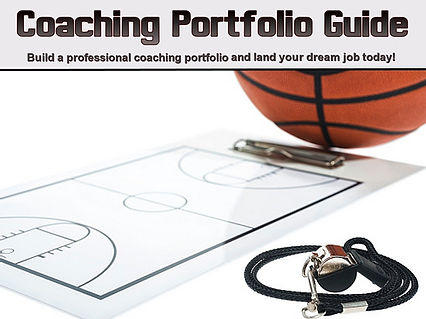
Your first impression is everything when applying for a new coaching job. A professional coaching portfolio is the tool that highlights your coaching achievements and philosophies and, most of all, helps separate you and your abilities from the other applicants.
The key to landing a new coaching job is to demonstrate to the hiring committee your attention to detail, level of preparedness, and your professionalism. Not only does a coaching portfolio allow you to exhibit these qualities, it also allows you to present your personal philosophies on coaching, leadership, and program development in an organized manner.
The Coaching Portfolio Guide is an instructional, membership-based website that helps you develop a personalized portfolio. Each section of the portfolio guide provides detailed instructions on how to organize your portfolio in a professional manner. The guide also provides sample documents for each section of your portfolio that you can copy, modify, and add to your personal portfolio.

Hey coaches — you’ve got a game plan for your team… but do you have one for your money?
That’s where Wealth4Coaches comes in.
Each week, they deliver simple, no-fluff financial tips made just for coaches. Whether you’re getting paid for camps, training sessions, or a full season—Wealth4Coaches helps you track it, save it, and grow it.
It’s time to stop guessing and start building.
Subscribe now at wealth4coaches.beehiiv.com/subscribe
And follow them on Twitter @Wealth4Coaches for daily money wins.
Your money needs a coach.
Start with Wealth4Coaches.
THANKS, JORDAN STASYSZYN & ALEXA BARBUSH
If you enjoyed this episode with Jordan Stasyszyn & Alexa Barbush to let them know by clicking on the link below and thanking them via Twitter.
Click here to thank Jordan Stasyszyn & Alexa Barbush via Twiter
Click here to let Mike & Jason know about your number one takeaway from this episode!
And if you want us to answer your questions on one of our upcoming weekly NBA episodes, drop us a line at mike@hoopheadspod.com.
TRANSCRIPT FOR JORDAN STASYSZYN & ALEXA BARBUSH – UNLEASHED POTENTIAL – EPISODE 1213
[00:00:00] Narrator: The Hoop Heads Podcast is brought to you by Headstart basketball.
[00:00:20] Jordan Stasyszyn: We will make sure that we’re always adapting plan by plan, month by month, whatever it may be, so that it’s not a one size fits all. We have a program that we run, that’s our program, but we are constantly tweaking, fine tuning for any specific group on any given night.
[00:01:35] Mike Klinzing: Jordan and Alexa Barbush Run Unleashed Potential, a skill development program based in Carlisle, Pennsylvania.
Jordan is Carlisle High School’s fourth, all time leading score with over a thousand points and a big 15 selection. He played division one basketball at Fairleigh Dickinson before transferring to play at Shippensburg University where he graduated with a bachelor’s in communications and public relations.
He furthered his education by completing his master’s from LaSalle University in Professional and Business Communication. Alexa was an Allstate in Big 15 selection at Trinity High School. She played at Franklin and Marshall College where she compiled an impressive list of achievements. She was named a two time division, three All American, two time preseason, all American Centennial Conference Player of the year, and scored 1,486 points.
She graduated with a bachelor’s in psychology. She also coached at Dickinson College for a year as an assistant coach.
[00:01:35] Mike Klinzing: Hey hoop heads. I wanted to take a minute to shout out our partners and friends at Dr. Dish Basketball.
Their Dr. Dish shooting machines are undoubtedly the most advanced and user-friendly machines on the market. Learn more@drdishbasketball.com and follow their incredible content at Dr. Dish B Ball on Twitter, Instagram, Facebook and YouTube.
Mention the Hoop Heads podcast and save an extra $300 on the Dr. Dish Rebel Allstar and CT models. Visit dr dish basketball.com for details. That’s a great deal. Hoop heads, get your Dr. Dish shooting machine today.
[00:02:14] Cat Lutz: Hi, this is Cat Lutz, head of Mental Performance at IMG Academy, and you’re listening to the Hoop Heads Podcast.
[00:02:24] Mike Klinzing: Give with hoops is the first platform turning basketball analytics into fundraising impact. Every stat tells a story and now every story drives sponsorship engagement and team growth programs nationwide are transforming basketball stats into funding power. Learn to use performance data to attract sponsors, engage fans, and raise more with every play.
Give with Hoops will help you raise three times more money for your program as their stat based pledges consistently outperform traditional fundraisers. Visit Give with hoops.com/hoop-heads-podcast to learn more and take your fundraising to the next level. Give with hoops.
You’ll want to take some notes as you listen to this episode with Jordan and Alexa. Decision from Unleashed Potential in Carlisle, Pennsylvania. Hello and welcome to the Hoop Heads podcast. It’s Mike Klinzing here tonight without my cohost Jason Sun. But I am pleased to be joined by two members of the decision family, not Joe, who we normally have on, but Jordan and Alexa, welcome to the Hoop Heads Pod from Unleashed Potential in Carlisle, Pennsylvania.
Guys, welcome.
[00:03:39] Mike Klinzing: Cool. Appreciate you having us, Mike. My dad’s been on a few times. Love the podcast. Obviously heard nothing but great things and appreciate the opportunity.
[00:03:47] Alexa Barbush: Super excited. Can’t wait.
[00:03:50] Mike Klinzing: We are thrilled to have you guys on. Wanted to dive a little bit more into the training business that you guys have been able to build through Unleashed.
But before we dive into all of the details there, I want to go back and just learn a little bit about you guys as people and sort of get an idea of where you came from in terms of your basketball background. So. Jordan, why don’t we start with you. Obviously we know your dad had a lot of conversations with him.
Anybody who’s listening to the podcast has probably heard him, but just kind of walk us through again, your introduction to the game, growing up with your dad as a coach, and the influence that he had on you and just kind of walk us through your basketball background.
[00:04:29] Jordan Stasyszyn: Yeah, so born and raised here in Carlisle, Pennsylvania.
It’s actually where we have our training business unleashed potential now. Really as far back as I can remember. And pictures, take it even further back with the basketball and the crib. I was born into the game and from really early age my early earliest memories of it are shooting around in the driveway with dad.
Also when he was the head coach of Carlisle attending all his practices and being on the sideline, shooting and or watching and learning as well as when he was an assistant at Dickinson College in Carlisle, Pennsylvania. They used to call me little s his mini me pretty much if he was in the gym, I was besides him watching, growing and learning.
My passion for the game though, in terms of developing as a player and really being committed, I would say came when I was in like fifth or sixth grade. My dad, as you guys know, has spent a lot of time at Duke University and it was his first year. As a a camp counselor there. He was working Coach K’s camp, and I went down there for my first camping experience and they used to work out the, the Duke players during the afternoons in front of the camp.
And that was my first real peak outside of what my dad had put in front of me at what high level players are doing and what real work looks like. So, and I remember the car ride home as a fifth grader from that camp. My dad and I had a conversation and I said I love the game. I want to reach this level or the highest level I can.
I was like, that’s what it really looks like will you help me on that journey? And he already had been teaching me and helping me, but that’s when we really locked in. Him and I, father and son, coach and player. And I really found the love for true skill development from my fifth or sixth grade year on that took me up through my playing days at Carlisle, where I’m now currently the fourth leading scorer 1600 career high school points, but behind two future pros and Billy or.
Former pros and Billy Owens and Jeff Libo and a player actually had the privilege of coaching when I was a JB coach there. I went on to play basketball at Fairleigh Dickinson University, a smaller division one just upset Purdue a couple years ago, their program did. So we played the likes of Mount St.
Mary’s, Robert Morris, and actually finished my career division two at Shippensburg University in Pennsylvania, PSAC School. Really good division two conference. So now in hindsight, looking back on my playing career, a lot of my experience playing at both division one and division two level really helped shaped my views and understanding of how not only it works from a player perspective, but also the business side of that level.
And it’s grown even more from that perspective now. With the NIL and all these different rules or lack thereof with the ncaa. So one thing that’s just reigned supreme for me and my whole career is the love of skill development at every single level. I love putting in work and getting better.
And now that’s transferred over the last decade plus. To me being on the coaching side of that, you always know you wanted to be a coach. And
[00:07:22] Mike Klinzing: Alexa, did you always know you wanted to be a coach? Was that something because your dad was coaching, did you always know that coaching was where you wanted to end up, or, or what was your thought process as you graduated?
[00:07:36] Jordan Stasyszyn: Yeah. So, yeah, I always just internally as a young, as a young boy and then into a young man thought that when I was done playing, I would want to be an actual head coach or head assistant at the college level. And long story short, when I graduated from Shippensburg I had got offered the grad assistant position at Villanova.
One of their two grad assistant positions when Jay Wright was there, head assistant was Billy Lang, who we had a nice family relationship with the both of them. And I did a three day sort of crash course there to see what that would entail and if I liked it. And after my three days, and they’re a first class program, I mean, they treated me like gold and everything they did was everything you would want.
I walked away from that. I was like, man, I played at the division one level. I know the time and commitment that it took, and I’m just not sure at this point that coaching’s actually for me. And just the carousel of college coaching getting in that rat race to get job security one day and be a head college coach.
That’s sort of how we, in a roundabout way came to the skill development side of things. And I always tell people now when they leave our gym we’re the saviors. Everyone gets better in our gym, and if anything we get you playing time, we don’t control taking it away. So I thought I wanted to be a coach.
And now being a in skill development and quote unquote trainer I’m very happy that I ended up where we are.
Makes sense, especially when you have a family. There’s no question that being a college coach and a fa having a family is, is definitely a challenge. So Alexa, why don’t you share your backstory and then we will get to the point where you guys come together.
[00:09:10] Alexa Barbush: Absolutely. So similar background to Jordan. I’m a coach’s kid through and through. My dad didn’t coach basketball but he, he played football in college. He coached football from the time I was little, all the way through my, my high school career. So I always was a very active kid. I played every sport imaginable.
Basketball was hands down the, the first sport that I started to play, so I naturally fell in love with it. I literally thought I was Alan Iverson. I had the sweatbands on, on the forehead, on the arms, on the legs. Like you could see more sweatband than you could body. I just. I had such a love and passion for the game, and I played other sports as I grew up.
I mean, we’re, we’re pretty big on telling kids don’t just specialize on one sport too young, too early. That, that’s a whole nother conversation. But I went to Trinity High School and had a really successful career there. Competed for a bunch of districts and state titles. I was Allstate, I was Big 15, which is like our local recognition.
And then I actually went to Franklin and Marshall College, which is a, a smaller D three school where I had a, a good career. I was a two time all American a thousand points score. And had some really, really good times there. So for me. Same thing with Jordan. I really gained a, a deep respect for skill development, more so when I met him.
But there was always something about like, the grind for me, just a lonely gym by yourself if you were lucky, a, a, a friend and a rebounder. So I just fell in love with the, the work ethic and just seeing that progress in myself, getting better, my team getting better. So I think that’s definitely something that myself and and us as a company have carried over and tried to instill in our athletes.
[00:10:55] Mike Klinzing: Did you think when you were in school that you wanted to end up coaching or in the game in some way? Or what was your thought process as you were going through school?
[00:11:10] Alexa Barbush: So I actually coached at a a school that was in my, my college conference Dickinson College for a year. And I really enjoyed my time.
I was I had the privilege of being under a coach who took me under her wing and taught me a lot, showed me a lot. She ended up leaving after that year and I just really realized same thing as Jordan. I just wasn’t into it. And by that point, we had actually both started to train kind of independently when we were in, in our college years, just trying to earn extra money for food and whatever, whatever else, when we were in school.
And by the time I was a senior and decided to take that job, we had a, a decent bit of clients at that point. So for me, when I kind of came to that crossroads of, okay, do I look for another coaching job or do we continue to do the training, which we have more flexibility, freedom in and quite honestly, we just both enjoyed more.
It kind of was a no brainer and an easy decision for, for both of us.
[00:12:12] Mike Klinzing: Alright. Tell me the story of how you guys met.
[00:12:17] Alexa Barbush: So. I’m going to give a big shout out to Jordan’s sister Kelsey. She she introduced us, she transferred into my high school and she kept saying, Hey, you, you have to meet my brother.
You just have to meet him. You two would get along so well. And at the time I was only in high school and he was in college. I was like, oh man, he is an old man. I’m still in high school. I’m not, I’m not interested in that. And long story short we ended up connecting not right away, but
[00:12:45] Jordan Stasyszyn: when I transferred out of my first school outside New York City back to Shippensburg, which was local, that’s when we ended up connected again, that today’s social media.
I Slender dm. There
you go.
[00:12:57] Alexa Barbush: Been together ever since.
[00:12:58] Mike Klinzing: There you go. There you go. A love story around the game of basketball and there’s nothing, nothing better than that. So, alright, let’s, let’s talk now about the, about the training business and how you guys go from. Sort of being independently working, doing your thing with your own individual clients.
Obviously Jordan, your dad ran again a, a national training business and oversaw all of that and that piece of it. So just kind of give the inner workings of how it went from sort of the beginnings to what you guys have built now with Unleashed.
[00:13:40] Jordan Stasyszyn: Yeah, really what happened was, and like I said, I grew up doing this in home with my dad and he was doing that with our program and everything else.
And when he did that across the country as national experience, we were looking and there was a group that did it back home. And this isn’t throwing shade to anybody, but there was a major void in this area of like, there is no training and development. Not saying people aren’t out playing or working on their game.
And you get back 13 years ago with that. Nowadays everybody thinks you’re a trainer. Or whatever they want to call themselves, but there was a major void there. So all we did was, and we said it’s, it’s been organic growth. We’ve never spent a single set on advertising. we’ve never messaged a kid and asked them to train with us.
We just made, posted on social media, Hey, we’re starting this training. If you want to work out, shoot us a message. And there’s a, a church I grew up in, in Carlisle that we started an air gym pretty much in hours that were available. And what started with one or two clients and some preexisting ones turned into four and five, and then five turned to 10, 10 turned to 1520, and it just started snowball a little bit.
Next thing it, a team brought us in, another team brought us in the AAU group we’re partnered with now brought us in. And really from day one, we’ve just been really focused on forming real relationships, telling the truth. Just doing things the quote unquote right way. And providing a high level service.
that when you come into our gym, we’re results driven, you get better. And since then, I would say the first four or five years was a steady growth and then the last six to seven and we’ve hired a staff now that’s in the gym a lot. we do all that we can to keep up with demand, which is a really good problem to have.
But really just started with, I go back to my dad working do camp just be great where you’re at. Do things for the right reasons and do them the right way. No shortcuts, not looking for any handouts or anything like that. And people will flock to that. Everyone the kids, you can’t hide with kids.
They know when they’re getting better. Parents know when they feel good about investing their time and their money on their kid and they’re seeing results. So that’s been our motto from day one, is we treat every single day or every single client like it’s day one. We formed a lot of really good relationships and had the privilege to work with a lot of really good basketball players in that time.
[00:16:01] Mike Klinzing: Tell me a little bit about the process for onboarding. A kid who comes to you for the first time and says, Hey, I want to get involved, I want to get training from you guys. What does that look like? From the moment they say, Hey, I’m in. What do you guys go through in terms of evaluating, figuring out what they need, how they need it, and then designing a program for them as an individual?
[00:16:27] Alexa Barbush: basically what we do is we. Everybody comes across and acts like their kid is Steph Curry. So for us, we get a lot of inquiries where we have no idea who the parents are, the kid is, their contact, is our first introduction to them. So we correspond back and forth a little bit.
Collect as much information we, we can about them. We offer a whole host of different things. If a kid is a complete beginner. We always recommend, they, they come in and do an individual session. you could have an individual that, that just started with basketball and they’re really raw.
Not quite sure what’s going on, where the free throw line is for some of our younger kids. And then you could get another kid that’s in seventh grade and picked up a basketball and they’re really, really talented. So we typically recommend that at first, and then based off of that first session, we see where we’re at and then basically guide them towards the best fit for them and what’s going to help them the most.
There are a lot of kids who just struggle with basic skills, so we try to keep them in smaller, more private settings so we can almost catch them up to speed if they’re a little bit behind just with their peers. So when we do eventually push them to a more. Group setting that has more of like a team atmosphere to it.
They’re not completely a fish out of water. And then there are a lot of kids who they need game experience. And a lot of what we do is skill development, but we do a lot of like game development as well, where we do situational things, small sided games. We, we compete heavily in our groups and we actually run special programs that revolve around three B three or five B five.
So it just really, that, that initial starting point in meeting and then we just evaluate them based off of that and push them where they need to go. And just because a kid starts in one thing that we do. They might stay in an individual setting for months. Some other kids, you, they might come in once or twice and we say, Hey, what, you’re, you’re ready to come to our small groups, or This program would be perfect for you based off of what your weaknesses are and what we think that that, or what we see that you need to get better at.
[00:18:45] Mike Klinzing When you say is the percentage of time that you and your staff are spending in the gym, what percentage of it is with kids that you’re working with individually and what percentage of the time you’re in the gym, are you working with groups?
[00:19:01] Jordan Stasyszyn: It can vary day to day. One big thing, just to sort of piggyback on your first question too, and what she said is there’s no trial session.
There’s no you guys come in and see what it’s like and we’re going to evaluate this and that. From workout one. For everybody who say it’s a foundation of what we do, we come in and treat you because you may not come back for whatever reason. we have people that travel from out of state, so you might come in for one, we’re not see you for a year, whatever it may be.
You come in and we’re going to go put the foot on the gas right away, on energy, on effort, and on all around skill work. So after we’ve seen you a few times and you, you’re a big or a post, yeah, we’re going to tailor some things to you, obviously, but from workout one, we treat you like you’ve been in there for a lifetime and we’re going to give you a high level, high intensity workout.
Now, the skills may be dumbed down, but. The way we get after it and the expectations of what you’re going to output in that hour are the same. From a perspective of of time breakdown, we have set times for certain age groups each week where they come into a group setting. We have nights set aside for special programs.
Our individual, we call them private or semi-private, maybe there’s more than one kid, maybe two or three in a private setting, they almost fill in around them. So if we’re in the gym for five hours every single day, especially during the school year three 30 to eight 30 or so, we’re going to have two or three hours at our group or program in one or two hours that are are private.
So for us it’s probably a 60 40 ish balance and that allows everybody the options they need to get in.
[00:20:40] Mike Klinzing: Absolutely. That makes sense. So when you’re putting together your groups, and obviously now you guys have grown, but I’m thinking back, even if you go back a little bit to closer to when you guys get started.
How do you balance out? Because I think this is one of the things when I talk to trainers, and I know in my own experience that a lot of times if I’m trying to put together a group and let’s say I’m trying to do some small sided games, or I’m trying to get some three on three going or whatever, you have to have kids who are of a similar ability in order for it to be beneficial, right?
[00:21:20] Jordan Stasyszyn: If I have one kid who’s in seventh grade who’s a player who plays on a high level a a U team, and then I got another kid who, yeah, he’s in seventh grade, but he’s maybe just touched a basketball four times in his life, those two kids aren’t going to get much out of competing against one another. So how do you guys monitor, tailor it to the particular skillset or experience level to make sure that your groups are putting everybody in the right spot so they can be challenged and not be in over their head, or not be way above some of the other people that are in their group.
[00:21:40] Alexa Barbush: So we actually, how we break out our, our groups that he was talking about. We offer him a couple times a week. We go fourth through sixth grade. And then seventh through eighth. And then we have our, what we call like our high school group. We have some flexibility within that. So if we have a sixth grader that is completely dominant and just obliterates everybody and is just ready for higher level skills, we will occasionally, right?
I have to have to watch what I say. I don’t, I don’t need everybody saying, Hey, I want my fourth grader coming with the high schoolers because it has been asked before, right?
[00:22:14] Mike Klinzing: Too many times.
[00:22:15] Alexa Barbush: Yeah, way too many times. We we’re really big in those, that’s our general layout and framework age-wise. But if you need bumped up, we’re absolutely going to bump you up.
We’ve even in certain situations, have told people, Hey, like your actual age group, you’re not quite ready for this. We run a building blocks program, which is for third and fifth graders that is very, very beginner. So if we have a fourth grader, fifth grader that’s not quite ready for the fourth through sixth grade groups will recommend.
The Building Blocks program, and then we even have, we go down to first, second graders that we actually run a program on a lowered hoop. So we have a lot of different options to fit different ages and different skill levels. And we’re also really big on splitting up on opposite ends of the court.
We reserve that the gym the entire hour for just that age group that’s in. So if we have a really high level sixth grader and then some fifth and sixth graders that aren’t nearly as skilled quite yet, they’ll be on opposite sides of the floor. And we typically do a very similar plan and workout, but we have, like he said, a little bit more of a a dumbed down version for the younger, more raw skilled kids.
And then the kids that are a little bit more talented on the other end. We can throw a little bit more complex stuff at them, but it’s still the base of the same drill.
[00:23:43] Jordan Stasyszyn: And here’s the thing, Mike, we say this all the time too. Now, in any given situation, if it’s a kid’s first time, we may not know them.
you may have a kid that’s a little bit behind. A said group with maybe some better players, but we say all skills all the times or all the time, all skills for all positions. We’re not just talking about basketball. So when a parent says, well, my kid’s dominant, they shouldn’t be in the fourth and sixth, they should be a seventh and eighth.
I say, look, if they’re dominant just skill and it’s glaring difference, they’re going to come up anyways. But our criteria to really move a kid up is dominant skill. You better be the most vocal in the gym. You better be setting the pace of that workout by dominating effort. Here’s the other part too, just like in a game and on a team where you have a best player and a worst player, you better be making the other kids in that workout better.
So if you’re the dominant player and you’re standing there looking at flies on the wall because you think you’re too good to be with that group, there’s not a chance in hell that we’re going to move you up. So that’s a very realistic thing for the kids of maybe on this said day, it wasn’t the exact fit.
We will get that right for you the next time you’re in, knowing what we know now about you. But when you’re there, I don’t care who you’re with, you need to come in and get in work and put it at a high level.
[00:25:00] Mike Klinzing: So is that a conversation that you’re having with the kid? And obviously it depends on the age exactly how you can phrase that.
And is that also a conversation you’re having with their parent?
[00:25:07] Jordan Stasyszyn: Always. It’s always a, it’s always a two-way like street in our gym now, our way is going to be the end all be all. But yeah, we’re big on, you’re investing your time and your money with us. You’re trusting with your kids’ development. We will put you in the best spot for you.
We promised that. But we are, we have built ourselves on, we will go out of business before we stop telling the truth. We will tell you the truth every single time. There’s going to be times where that’s the truth you love hearing. There’s going to be times where that’s the truth. That’s a little bit uncomfortable and there’s going to be times where that’s the truth, that it may hurt your feelings a little bit.
But we’re going to tell you where you’re at and if you’re, if you can get over that. My dad always says mad, sad, and hard. Get over mad, get over sad and hard and the long run. We have proven time and time again that if you trust the process in our gym, we will make sure you’re getting what you need every single time.
[00:26:22] Mike Klinzing: That makes a hundred percent sense. And I think that’s one of the things that, when I think about the training business, right, and you think about just the business of basketball, there’s a big problem with that truth telling piece of it because it is much easier in the short run to tell people what they want to hear instead of what they need to hear.
Because when I tell you that, Hey, little Johnny’s great and he’s going to be a high school star, and that’s not the case, well, hey, I’m going to come back to you because you said my kid is my kid. My kid’s a great player, even though I might know that they’re not. Mm-hmm. And unfortunately, again, I’ve seen that many times where you’re looking around and here’s the kid that doesn’t have the requisite skill level.
And you hear what they’re being told by somebody that’s working with them. You’re like that’s, that’s clearly, that’s clearly not the case. And again, in the short term, that might get you that person for a month, three months, six months, until their next season rolls around and a coach actually has to coach them, right?
And then what, what you’ve, what you’ve been telling them doesn’t end up being the truth. And that’s what it all goes south versus what you guys are talking about is right. You might lose somebody because maybe their a a U coach or somebody else told them, Hey, you’re this, you’re that. And then they come to you guys and you’re like, well, yeah, they’re not telling you the truth.
And maybe then they take their business elsewhere. And so in the short run, maybe you lose a client or two because of that. But in the long run, the track record that you guys are building is what keeps people coming back.
[00:27:36] Alexa Barbush: Well, it’s actually funny you say that too. We, we’ve been at this for a while now.
We’re actually sitting here trying to put a number of years to how long we’ve been at it. And most people that we do lose, not everybody, but mad at a truth that, that we told them and us being a hundred percent transparent they usually show back up and a lot of the times, a lot worse of a position.
Touch too late. Then we last saw them. Right. So, and sometimes they’re, they’re free to go wherever they want and do whatever they want and we’ll, we’ll be here for them if and when they do come back. At the end of the day, we just want the best from, for all of our clients.
Sometimes that means that we have to have some really hard conversations with people.
[00:28:22] Jordan Stasyszyn: Yeah. And also said all time too, and this is a, a misconception or it’s a, it’s a problem in use sports in general is just because you pay us for a service doesn’t mean we own the rights to you. so it’s not, you can’t train somewhere else.
Now what gets at us and it’s just caring about what we do is if you’re going somewhere else and you’re not receiving what you’re paying for it’s a bad product. Maybe they don’t do a great job. I’m not saying that there’s others that do a great job or they’re not getting what they need to hear.
They’re being told what they want to hear. that’s one thing. So there’s others out there, do a tremendous job and Mike, you might teach shooting to a certain kid and it may resonate and click with them, even though we’re teaching the same thing a way you do, it might click with that kid better.
So multiple voices are good, but a lot of times, to your point, they’re hearing too many voices that maybe aren’t qualified to be doing what they’re telling them or teaching them what they are. Or also are just that transactional relationship of, what I’m going to fib, I’m going to say what I need to say because they’re keeping the lights on at our facility or at our home.
So when you go for-profit businesses and and how big of an industry use sports is, there’s going to be a lot of that.
[00:29:42] Mike Klinzing: Yeah. I think the other thing that I found, at least here in the Cleveland area is to some degree, and I think you guys, just by the availability that you have, if you’re training from three 30 to eight 30 every day, you’re pretty available.
But I know that in my experience when I was just doing some training on my own, and then also just with guys that are still training right now, that there’s some aspect of it being almost a commodity in that I might have a kid that’s working with me and let’s say I’m available three days a week for three hours each one of those days, and the kid might love working with me, but maybe they can’t fit into my schedule.
And so I’m working with a kid, I think it’s going really well. I’m doing all the things. I’m telling the truth, they’re getting better. And then all of a sudden their availability or mine switches and you can’t not have a day. And then now I see them with Trainer X, who’s they’re working with, and the guy’s sitting in a chair and he is got a baseball hat on and he is eating lunch while he is working with the kid.
And the parent is still happily paying whatever the amount of the money is it. And you’re just looking around going like, like what are we, what are we, what are we doing here? And I’m sure you guys see some, oh my gosh, just based on your reaction, I’m sure that you guys see similar things there, but I felt like at times it becomes like, gosh, like I feel like I’m providing a tremendous amount of value and I’m doing a, I’m doing a great job.
And then just because I can’t make it work at three 30 on a Tuesday, now you’re over here. You might as well be lighting your money on fire as opposed to working with somebody who’s doing a, who’s doing a great job and really taking the time to find, so I’m assuming you guys see some of that same thing where, where you guys are
[00:31:22] Alexa Barbush: Yeah, I think.
One of the, there are, like he already said, there are trainers on every corner. The good, the bad, the ugly. And a lot of times we find kids and parents, not all of them, but a lot of people don’t love once they’ve had an individual. Being told, Hey, you would really benefit from being in a group setting, the number of kids that look like all stars in an individual setting, and then come to group and they’re just, they’re completely lost.
They can’t pay attention, they can’t follow drills. They’re just completely on another planet. And that’s one of the main reasons why they should be in a group setting. Those people tend to kind of fade away once we tell them, Hey, this is really what’s good for you. Not saying that you can’t get individuals here and there, but this is what we’re recommending and this is what’s going to benefit you the most.
So it’s almost a, a comfort thing, I think for a lot of the kids and the parents, because they’re, they’re going in with one other trainer, they’re messing up and they’re, they’re laughing, they’re giggling. In our gym you’re doing that around other kids. There’s that, I don’t want to say the embarrassment level, but
[00:32:33] Jordan Stasyszyn: we’ll kick you off the court.
[00:32:33] Alexa Barbush: Yeah. Lock in, pay attention, don’t mess around. And let’s get after it. And that that isn’t what some people are looking for. So it’s easy for them just to find somebody else and kind of move on.
[00:32:46] Jordan Stasyszyn: Yeah. And here’s the other thing too, and this is another truth we tell a lot. And like I said, we have great relationships with our families.
It’s our our email. A lot of it is, we don’t get quote unquote paid for this time, but we’re dealing with all this stuff in between. they ha confidence is down, any suggestions and whatever it may be. But this apparent issue to your point of just go somewhere else, they think they constantly need to be doing something with somebody.
Mm-hmm. And I get in Cleveland and the Northeast, all this stuff, we have weather that you can’t be out there in zero. But we have a rule in our gym, you cannot book more than one private session per week with us. Now that might be, you might fall in a group of four. You can do our normal groups.
But after you book one private session, you’re in our gym on a Monday for an individual workout, that same kid will not have another private session in our gym. If you care and want to do it that much, you find time to do that on your own. Take what we worked on and your parents paid for and you go do it like they’re paying for that service.
They’re also paying for the drills they ask all the time, what can they do at home? 90% of what we did in the private workout, I was the passer. She was the passer. Throw the ball out to yourself. So that’s another thing with us, is the parents, they’ll be like, well, they’ve a game. They can’t get there till six.
We don’t want to see them on game day. How are they that locked into their game knowing they got a workout after
coaches, you’ve got a game plan for your team, but do you have one for your money? That’s where Wealth4Coaches comes in. Each week, we’ll deliver simple, no fluff financial tips made just for coaches. Whether you’re getting paid for camps, training sessions, or a full season, Wealth4Coaches helps you track it, save it, and grow it.
It’s time to stop guessing and start building. Subscribe now at Wealth. For coaches.beehive.com/subscribe and follow us on Twitter at Wealth4Coaches for daily money wins your money needs a coach. Start with Wealth4Coaches.
[00:34:42] Mike Klinzing: Yeah, stuff like that. I think when I think about how I grew up in the game and I was obviously way before there were any trainers when I was growing up and developing as a player, but I just always tell people that, look, I can work with your kid and I can do it. X number of times in a month or X number of times in a week and whatever.
And it’s great and they’re going to get better, but if they don’t touch the ball in between the times that they’re seeing me, then you’re throwing your money away. Because ultimately, if that kid doesn’t have some drive and some desire to improve on their own outside of the confines of their team practice or their training sessions, whatever, the three of us all know that their ceiling as what they could be as a player is certainly capped when they’re just not willing to put the time in.
And I think by you guys being that clear with them, putting an emphasis on, yeah, you’re going to improve while you’re with us in the gym, but that improvement is going to be limited unless you are willing to put the time in. And that’s something that I don’t think that. A lot of parents understand, especially parents of kids on the younger side of that, because again, they just see whether it’s social media or they talk to their friends or they’re at an AAU tournament or whatever it might be, that they don’t see the connection between their kids’ love for the game and wanting to do it on their own, not just when a coach is pushing them or when mom and dad are dragging them to session X or Y.
It’s really that love for the game when you’re on your own that that’s what drive, that’s what drives success and you guys are there providing them the framework to be able to do it effectively when you’re not there.
[00:36:52] Alexa Barbush: Yeah. I just, one other thing to add to that too is I think the balance of, especially starting at younger and younger now, a a u and games being played.
Skill development. I mean, it’s co completely turned on its head. I mean, we have kids that are in third and fourth grade playing winter series as well as playing on their school teams. It, and this is, I mean, most sports these days, there’s no true season anymore. Everything is year round and a lot of these kids are playing way more games and they do skill development maybe once a week, if at all.
So I just think that balance has really gotten lopsided over the years.
[00:37:36] Jordan Stasyszyn: Yeah, you don’t need to specialize. We’re not saying that we’re big proponents of multiple sports, but that says parents all the time. There’s times where you must prioritize, so you don’t need to specialize, but you have to prioritize your time.
So if you’re getting into eighth, ninth grade and you still have aspirations of college basketball or varsity basketball, you’re a three sport athlete there’s times where. If basketball is what you’re setting your goals on in your future, you’re going to have to carve out some skill development time during soccer season without jeopardizing your body and your health and all that stuff.
because rest is equally important, but there’s some decisions and prioritization that needs to take place as a family, as a player. you, you name it. Or if not kids that love the game and are doing that, because they’re out there, the best players still do that. They will pass you by if they’re not ahead of you yet, and they will further that gap if they’re already ahead of you.
And ultimately you can’t get those years of development back, just like in the classroom. that fourth to eighth and ninth grade year, and obviously pass that too. But those are crucial years of development that you need to be prioritizing skill development or they’re very hard to give back.
[00:39:36] Mike Klinzing: There’s no doubt about that. I think when you look at the skill level of players today, it’s higher than it’s ever been. And to your point, when you look at. The opportunity and the window for when those skills can be developed if you are falling behind. Again, it’s great to be able to play multiple sports.
There’s so many benefits from an athletic standpoint and just the way your body moves and the non-repetitive injury and all that kind of stuff that, that goes along with it. But I think you make a great point when you’re talking about a sport that requires a tremendous amount of skill. Basketball, I think about like in our community here, girls soccer is a huge sport where I live, and if you are not developing those skills in fourth, fifth, sixth, seventh grade, if you’re just playing soccer during one season or you’re just playing basketball during one season, then you’re not picking up a ball or picking a, kicking the soccer ball.
Your chances of playing at the varsity level in one of those sports. Is pretty low just because, again, as you said, Jordan, there are people that are kids that are doing that, that are developing and you are going to fall behind. And there are some sports. I always think about football, right? Where if you’re a really good athlete and you get to high school and you’re a freshman and I’m the football coach, I can probably throw you out on the football field and say, Hey, you’re going to be a middle linebacker.
Mm-hmm. And you could probably make it work. But a sport that’s in as skill intensive as basketball or soccer, if you’re not continuing to at least put some time in during your off season, during the main season of another sport, it’s going to be really tough. And then to your point, if, if you want to play in advance beyond the high school level, then certainly what you’re going to need is going to go beyond just, Hey, I’m going to pick up the basketball for.
Five months during the basketball season and the rest of the time, maybe I’ll just occasionally go out and throw up some shots on my driveway. That’s just, that’s not going to work in today’s game, unfortunately, for people.
[00:40:57] Jordan Stasyszyn: No, definitely not.
[00:40:57] Mike Klinzing: Tell me a little bit about your guys’ planning process for a workout, whether that be an individual workout, whether that be a group, I know you guys talked about having specific programs where somebody could sign up for, Hey, you’re signing up for four weeks for this particular program, or maybe there’s a specific focus.
So you could take this question in whatever direction you want, whether you want to say, this is how we do it for individual, this is how we do it for group, this is how we do it for programming. But just gimme an idea of the planning that goes into the sessions that you have with a player or players in your gym.
[00:41:37] Alexa Barbush: We’re super organized on that front. We literally could have a senior that we work with now that we’ve had since fourth, fifth grade. We write every single workout down. We have books upon books in our house saved. I could go back to the year, . 2020 and find that kid a specific workout that we did.
So we’re really big on having a starting point and then building on that and growing and tailoring workouts to the kid. In terms of our programs that we run we typically run our programs in like four week stints. So Mondays are, are our program nights of the week. Every Monday for four weeks straight, they’ll come in and each workout a lot of the same focuses.
We, we cover a lot of the same topics and ideas, but they’re getting. Brand new drills and new skills layered in and week over week, we, we build into higher concepts and ideas. So we literally can go back and point to a, a program about any many years ago we’re, we’re very detailed and organized on that front, and I think it’s been huge and helpful for us kind of as we grow.
[00:42:56] Jordan Stasyszyn: Yeah, and I’ll chime into just to paint the picture a little bit. So if it’s not a specialized program four week shooting program four week dribble drive, whatever we want to call it our, any group workout on any given day is a standalone workout. So, like if you come every Tuesday to group, you’re getting a fresh general workout every time.
But if you only come one time. That stands alone itself. So if it’s a all around workout, like all of our stuff is, unless we say it’s specialized, we do everything. You will handle the ball, you’ll finish multiple ways. Obviously my dad always says the two main separators, footwork, and shooting, there will be more of that.
Whether no matter what scope is a footwork, but more footwork and shooting in our session than anything else. And here’s a really big one’s, why. One of the reasons why we advocate group, the kids will pass the ball. Now in group workouts, we may throw the ball every now and then, depending on the drill and what we want to accomplish there.
But 95% of the time, and this is such a underrated skill and skill development, the kids have to pass. That also forces then the kids have to communicate to get the ball. So we’re really big on that. As far as a staff we obviously live together so we eat, sleep, breathe it probably too much.
Sometimes she hates the NBA playoffs because I watch it every night. It’s like her basketball lot. But as a staff with our other trainers two that are teachers, one that has a full-time job if they have a kid for their first two times in our gym for a private workout, we have sort of a standard progression that we’re going to work them through.
So they become quote unquote an unleashed player here. They know our terms, the skills we’re going to work on. We compare notes. So if I’m going in on workout three with a kid that coach Matt has had twice, I will touch base with Matt. We will have a full conversation about that kid. Here’s the specific area in their shot we already discussed, they’ve improved on or are struggling with.
So when I show up. It’s a new voice, but it’s the same expectation, same workout, and they feel like I’ve been there because I have history on that kit. So we’re not just plugging and playing here. We have some standards some protocol for how we progress through stuff, but we are always sharing notes and everything is handwritten.
We take pride in that because now I can on the spot write down doesn’t appear like I’m on the phone for a parent. she’ll take my book to work out sometimes and refer to a past plan rather than being in my notes of the phone. She can actually have the entire book. So that’s a big part of our planning process is information sharing amongst our staff.
[00:45:03] Mike Klinzing: What does it look like in terms of building your bank of drills and what you guys like to do? So obviously you’re writing down the plan, but clearly you’re drawing from your knowledge, your past history. What does that look like in terms of where you’re coming up with, Hey, this is what we want to do with this group, or Hey, this is what we want to do with this kid.
And then how do you continue to build that once you have it where you’re drawing from, then you’re obviously adding to it over time, right? You’re trying to continue to innovate and learn and all that kind of stuff. So just talk to me about the creation of the drills and then pulling drills for each particular kid, group session whatever it is that you’re doing on a given day.
[00:46:15] Jordan Stasyszyn: Yeah, for me we have, I don’t even know the number of drills at this point, but standards that we’ll just make this up, we’ll throw a number out. If we had 20 finishing drills right, we’re going to work through that progression. We’re probably not going to do finishing drill number one next week.
Now, what has really helped us adapt and grow my dad to get another coach Joe saying here, hide the vegetables and the sauce. we will have a drill that we’ve maybe been doing for 12 years, 13 years, but if I have more bigs or players that play a four and five position in a drill than guards, well we might be running the same drill, but now while the guards are making this cut, someone that’s going to get to a different spot on the floor, they’re doing the same drill, but they’ll get here.
So some of our best innovation in our drills adapting and progressing. It’s almost not even looking like the original form where kids recognize it is. If we see the signups for group and there’s certain kids that need to work on certain specific parts of a drill, we’ll form our offshoots off of that.
We might even come up with an entirely new drill off of that. So while we’ve had stuff that’s been with us from the beginning and a ton of it, we’re constantly stealing from other trainers, other coaches you see, but really based off the personnel in our gym and us making sure that, . Kids aren’t getting all the same stuff when it wouldn’t apply to their position in a, in a game or what they play on a said team at the time.
We’ll make sure that we’re always adapting plan by plan month by month, whatever it may be, so that it’s not a one size fits all. We have a program that we run, that’s our program, but we are constantly tweaking, fine tuning for any specific group on any given night.
[00:47:53] Alexa Barbush: The only other thing I would add to that too is, so whether it’s group or individual, semi-private, we have a general framework and it changes.
We have kids that say, Hey coach, my shot’s been super off lately. Can we just get a straight shooting workout? And we can, we can roll on with shooting drills for days. What our general framework is, we’re going to give you a, like a warmup, a starter. Occasionally we’ll do something where they’re not scoring right away.
We’re going to hop right into some type of ball handling, finishing drill. Then we’re going to go into shot breakdown. And then we’ll get into more shot movement cuts, game-like movements. And then we might add a little bit of a movement series of ball handling. And then most of the time, especially at a season even in season with the younger kids, we will have some type of competition.
So you’re not coming into our gym unless we’re running a a five B five or a three B three specific program. We’re going to give you a small-sided competition, whether it’s 1 0 1, 1 V two something where we’re going to give a, an advantage or a disadvantage to one player over the other. So that’s like our general framework for a normal workout.
[00:49:01] Mike Klinzing: Do you find that it’s easier to innovate and adapt your drills while you’re sitting in front of your computer or at your legal pad on your desk or while you’re actually on the court and maybe you’re doing a drill and you’re like, Ooh, maybe I could just adjust or adapt this and let’s try this. Because I know for me, when I’m training or when I’m coaching a team, and I used to do this all the time when I’m practicing, like I’d have a practice plan written out and be like, okay, I want to do this drill or whatever, and then I’m out on the court and I see something that’s happening.
I’m like, oh, if we just make this tweak, I can really get this working better. Or maybe it allows me to teach it in a different way, but me sitting in front of a computer or sitting down with a legal pad, not on the court. At least for me, I’m not very good at being innovative when it comes to sitting with pen and paper or typing on the computer.
But when I’m on the floor, I feel like I can a adapt and adjust on the fly. So I don’t know if you relate to anything that I’m saying there in terms of just the adaptability from moment to moment with the drills that you already are using.
[00:50:21] Alexa Barbush: Yeah, I mean, I think most of our drills, especially the ones that we’ve been doing for years, they’ve evolved with us and they change.
We already talked about how we kind of tailor things to our personnel that are in the gym. We actually go through, and this is only something that, that him and I actually know what’s going on. We actually have to talk our trainers through some of these things. But we’ll have a, a drill and we’ll have 2.0, 3.0, 4.0.
It just kind of keeps going. And each point, whatever is a, a new wrinkle or, or caveat to the original framework or, or base drill. So yeah, we’re, we’re constantly evolving, making changes on the fly just because we saw it can be done better or it needs to be done differently based on who’s in the gym.
[00:51:10] Jordan Stasyszyn: Yeah, my best innovation has come really two ways for me personally. In our gym, we’re huge on ratio. So like we will cut a group session off at 20, 24 kids, but have three coaches in there so they’re getting a one eight ratio. Like nobody goes through Rapid is unseen ever. You might go through two or three Unspoken two and then we’ll get to you.
But like we’re big on ratio. My best innovation, because we work with a lot of organizations and travel, I’ve run so many camps for like high school programs. So I ran a local camp, had 120 kids in the camp. We were in their high school gym with four baskets that we could use at the same time. So 20 kids we’re, we will never let you stand still knowing that in my planning I got super creative with adaptations off of drills to make sure, and there’s some standing at that point, but like make sure everybody’s involved moving, we spaced it different, we gave them an extra action so they weren’t watching.
Or when I get surprised, so like going to work with a team and they say, Hey, I’m expecting 12 of our high school guys there. And then all of a sudden you show up and now we have 15 eighth graders. The whole JV and ninth grade team showed up. So on the spot, I had my plan, like, wow, I went from 12 to 28 and on the fly, but what, instead of that cone there, that’s going to be somebody flashing middle or somebody coming up for a high ball screen or whatever you have.
So it’s been both ways, but my dad always calls it a basketball classroom that’s for the players. We expect you to conduct yourself like you would in a classroom and also like a lesson plan. my parents are both teachers. Lessons, lesson plans change and evolve by the minute depending on what people need or what you’re seeing going on.
[00:52:33] Mike Klinzing: Yeah, I think that’s true. The ability to adapt is one of the things that I think, I see it all the time with the camps that I run, that there’s some coaches that I’ve hired that have a really good feel for how to take what they’re doing and adapt it depending on how many kids they have in their group.
And then you have other coaches who I’m like, Hey, that’s a great drill you’re running. Like I love it. But you have 12 kids and you have three kids that are involved in the actual action. So take that group of 12, put them in three lines, have it be more chaotic, but have kids getting more reps. Right. And maybe you can’t watch every single one of those kids’ reps, but they’re at least active as opposed to having kids standing in line.
And it’s one of those things that, and I’m sure you guys feel the same way. There’s a lot of things that I’m sure you guys do that I do, that I take for granted the ability to do what you just described, Jordan, which is to adapt on the fly and just figure something out. And there are a lot of people who maybe don’t have as much experience working with kids that they just can’t do that.
And I kind of take it for granted in myself. Sometimes I look and I’m like. Like, what are you doing? Like, I don’t understand how you don’t, I don’t understand how you don’t see that. Like if you just split this group into two lines, you could be getting way more kids involved and then you wouldn’t have the two kids slapping each other’s butts at the back end of the line, and you just eliminate all these different things.
That, to me, it just is naturally intuitive. Like I just figure that out. But there are people that sometimes struggle with that, and I think that adaptability is really key to being able to provide consistent and constant value through activity as opposed to standing.
[00:54:45] Jordan Stasyszyn: Yeah, and I’ll give you two like little hacks that we have learned from and we’ve always pri prided ourself in outstanding, but we’ve gotten even better.
Two hacks for anyone listening that runs a team by yourself or you, you’re a trainer or want tobe one. We very rarely anymore in a group setting do stationary shooting. So like we have a stationary shooting drill where, okay, we might be working on this moment and that moment, whatever.
Well, what we do now is in a group of 20, we have three lines. And instead of starting stationary at the spot, they’ll go a full speed attack down from half court. So now we’re off the attack, get to your stationary moment, work through our shooting progression. So it’s basically still a shoot, a stationary drill, but as soon as that person’s releasing the ball, the next person’s filling.
So all of a sudden right there we incorporated some conditioning some ball handling. You’re also finding balance in your shot. And the other one too, and this is a great one, is if we go three lines instead of, now if you have young kids that can’t figure it out, maybe a little bit different, but even then majority of the kids don’t go back to your line.
Everybody rotates left. So now a kid shooting in this line, you get the rebound, they rotate to the middle. Middle shoots, they rotate to the other side. So now you have constant flow too. They have to be aware of where they’re at. They have to be aware of getting outside the drill or where they’re going. It adds a whole new layer of constant movement controlled chaos.
And now instead of one kid just shooting everyone standing, you might have three kid shooting, three kids on their way to the spot their, all those kids funneling back to line. Now you got 12 kids moving at once, even though only a three are getting their actual shooting rep.
[00:56:45] Mike Klinzing: Yeah, keeping that activity level high and keeping the kids engaged is a huge piece of A, their development.
Right. But B, it also keeps kids a lot happier because nobody likes to go to a camp, a training session, whatever, and stand around. The reason why kids are there is to be active and to participate. And I always say to anybody that’s coaching. At camp with me is like, try to keep every kid as active as you possibly can and figure out that whatever activity you want to do, whatever drill you’re doing, how can you do the same thing?
How can you teach the same concept and keep as many kids engaged in what you’re doing and not standing around watching? Because again, you don’t, you don’t get better at a camp or at a training session standing around and watching. It just is. It’s just a fact. Lemme ask you about the design of your specific programs.
So as you guys are talking and trying to figure out, Hey, we want to have these different group offerings where there’s a specific theme to them, how do you go about thinking about what those are going to be and then what’s the planning process for putting them together? And then if you’re going to run them multiple times, let’s say I’m going to run a dribble drive.
Four times a year or three times a year, so whatever. So for three months I’m going to do that every, every third month or whatever it might be. How do you continue to keep that fresh so that you keep people coming back and signing up and being a part of that beyond just what we’ve already talked about, which is the improvement and all the relationships and all that kind of thing.
[00:58:11] Alexa Barbush:We try to keep things as fresh as possible for kids. I would say we have, I’d have to go through and try to count them out, but we have a bunch of different specific. Programs that we do that a lot of them we only do once a year. So that program comes and goes. If you, you missed it, you missed it.
But then we have other ones that we run on a more regular basis. Our, our building blocks program for third and fifth graders, or third through fifth. We run our shooting program multiple times a year. We run our three V three program multiple times a year. So we have our staples that we know people are interested in year round.
And then we have our other programs that we kind of sprinkle out throughout the year. And one thing that we have found to be really successful, we originally just offered a lot of four week programs where you sign up, you’re locked in for these four date, four dates, as crazy as schedules. Get for people, we found that they can’t commit to a a four week stint.
So what we do is we’ve actually started to do one day workshops where it’s a, a four week program, but you can sign up for all four or you can sign up for two, two out of the four, whatever fits your schedule. And each one of those workshops is a different focus. So we’ve found that to be really helpful to us.
[00:59:41] Jordan Stasyszyn: Yeah. And as far as like what they’re going to get, so I think we ran maybe last year a three on three. Three times. Like we run our shooting program a lot. Even if it’s just part of the one day workshops, having those notes is pure gold. I went on the a calendar the other day because one of our current workshops in season a Dribble Drive is a four week program.
We also run, so I punched into the calendar dribble drive, and I saw for like the last two, three years of dates wet in my book. And I reviewed every single plan. It was like, wow, man, I’ve been using this new, this drill a lot. In our group workouts had a lot of success. We haven’t done that in the last three dribble drives that’s going in.
And also there’s some like, like we said, some staples where like, whether it’s a stride stop playing off at two feet or every kid you say two foot finish, they jump stop, right? So we rarely jump stop, like, we’ll teach jump stop young kids, but we’re working on gathers spin off of two. So like, we’ll build in, okay, well this is a young crew.
We know most of these kids, it can all jump, stop. We’re going to introduce a gather in this program. So now they play off of one two, but still off at two feet. So having those notes is absolute gold. But there’s also ones, and I say this too, we talk about this a lot. This is one of those corny sayings skills never graduate.
Like, there’ll be times where we check ourselves and always trying to stay new, stay fresh. Like, man, these kids have been here for six, seven years. But guess what? They could still use the basic shooting drill, the same finishing drill, the stride stop they’ve been doing every year, multiple times a year with us.
Maybe we just do it in a new location this time. So if our stride stop was driving from the top of the key to the block, stepping through, turning our back to the basket, let’s introduce a stride, stop on this one, driving to the wing to make a post entry. It’s not there. And we rip through to create a new angle.
So that’s where we’re going to work and hammer those same skills, different ways but a lot of people will fine tune and this almost become like they don’t even ask questions anymore. We’ve been around long enough and built enough for the reputation where they’ll sign up for the same thing over and over.
Knowing that, and we always get, it’s the new people that ask the questions. Well, it’s only an hour long session. We’re like, what? Come in for this hour. Make sure your kid has two water bottles because there’s no time wasted. Like we’re going to really push them hard. So like, it’s sort of like a, a learned behavior there.
But yeah, we, the note taking is absolute gold because we know a kid that hasn’t come in three years. I know what they did the last workout they were in and from those programs, it does keep a fresh take on a lot of very similar stuff.
[01:02:10] Alexa Barbush: And I would just say the, as we grow and add more trainers, the notebooks are huge for us to be able to hand over, hey, here were literally the last 10 plans that we did with this kid, just to make sure it’s fresh, it’s not repetitive and they’re progressing and they’re not doing drills that they, I don’t want to say master to skill because to his point, they always can be working on the basic fundamentals.
But we want to make sure that we’re tracking this kid in the right direction for their, their goals and aspirations.
[01:03:00] Alexa Barbush: And so to go along with that. When you are onboarding a new trainer, so we talked about bringing on a new player, but when you are bringing somebody into your business, obviously again, when the two of you or your dad is doing the training, right, it’s, it’s in-house.
You guys know what the expectations are. You guys know what your reputation is, what you want to teach, how you want to teach it. You have all of that experience. It can be for a trainer who’s looking to expand, that can be a scary thing, right? To take your business and put that into somebody else’s hands and have them doing the work with clients within your business.
Again, if you haven’t done that before, if you haven’t tried to expand, to delegate, to hire someone, so what’s been the process for you guys to find good people? And then what do you do to make sure that the experience that a player gets from. Someone who is new to your program as a trainer, that it’s the same as what they would get as if they were working with you guys.
[01:03:54] Jordan Stasyszyn: You go ahead. You go ahead. So it’s been, that’s a challenge. If it was up to me, I’d still her, myself, my dad, my sister started the company with us. She moved away. She’s now back and actually helped train as well. She’s the head coach on our local high school girls program. But aside from us four that were there from the beginning, I would’ve never hired anybody.
I’d run myself into the ground. I probably have three years left on my life at this point. But for us we bring them in, they spend a lot of time with us, help run groups. They all have coaching experience. So like from day one, we know, and a lot of them are pre-exist relationships, high energy, high effort.
They know basketball. Now, just because you’re a good player doesn’t mean you’re a good trainer. Just because you’re a good coach doesn’t mean you’re a good trainer and vice versa. What we’ll do is after a bunch of group workouts, we’ll let them demonstrate a drill. We’ll let them take the lead on some stuff.
They hear our lingo. We will let them say it’s a new kid coming in, parent emails that says, Hey I have a fifth grader, sixth grader, seventh grader. They’re just learning to play. Maybe they were cut from the school team. So we’ll turn the reins over to them and say, what? And you’re going to give them a normal session.
We’re not taking anything away from the kids getting, but here’s your like, trial run. They know the plan they’re going to run. You coach it how you want with our guidelines, a little bit like what they want to learn to expect, but we let them do one or two privates on their own. Well, we’ll watch. And then the feedback, sort of like you said earlier, is typically, hey, they got a tremendous workout, but there is a way for you, you could have got them 40 more shots off.
If you just would’ve picked the pace up with your rebounding or passing or your voice. don’t coach every shot. Boom, boom, boom. Five reps and then give a little bit of feedback. Five more reps, another nugget of feedback. Five more reps. Okay, they don’t get it. Let’s stop and teach. So a really big piece of it is they come in, they can figure out our drills.
They know basketball, we’re teaching space to drills wider. Make them instead of one cut, force a second cut, get the ball out to them sooner, go more reps without teaching. So once they adapt, even though they’re high energy to the pace of our workouts, that’s when they really start to feel comfortable and we feel comfortable with them.
It’s very rarely, if ever a knowledge thing, it’s a, we are, we are always trying to figure out more efficient more ways to get them the reps and just quality, quality, quality, but also quantity in there too.
[01:06:15] Alexa Barbush: Yeah. The only other thing I would add to that is, and it took us a while to work up to this, we actually have.
Probably 75 to a hundred of our staple drills. Competitive, small-sided games filmed. So a lot of times, especially when we have newer trainers or maybe we’re not here for a weekend, it’s family vacation and they have all, all the groups for the week, we can say, Hey, go check out in the finishing folder, this drill.
And we have a very detailed voiced over video of that drill that they can look at and reference.
[01:06:55] Mike Klinzing: Do you guys create those videos?
[01:07:00] Jordan Stasyszyn: you’re looking at it
[01:07:01] Alexa Barbush: Yeah.
[01:07:04] Jordan Stasyszyn: When we were in a little bit better shape? No. We actually had a guy Matt Smith, he ran the, the clinic my dad spoke at twice now at the Hoosiers gym.
He had United Basketball, I believe was the name. Matt Smith. Yeah, it was something we had talked about and wanted to do. We just didn’t take the time and he said get me 30 videos to start. I’d like to host these on the website. So we went and filmed ourselves doing the drills. Lexi, she runs our website, does everything you see on Unleash Potential.
She’s designed it the artwork, you name it. So she would chop and edit them up. We voiced them over and then since then we did a few more. We got some of our kids that have been around for a very long time training. They’ve probably filmed about 30 or 40 of them where we’ve actually filmed them. But yeah, it’s just some good old fashioned hard work.
They’re not shorts, they’re not the or reals, they’re not 15 seconds. These are like the, I know. Two, three minute voiceover version of it. So,
[01:08:03] Alexa Barbush: well, we’re so particular and we want our drills run a certain way. We do, we give our trainers freedom because they do things a little differently and it’s good for kids to see and hear different ways of teaching, but I mean, we’re zooming in on feet to make sure they have everything down and certain drills.
So we would love to do more videos. And that’s actually on our list of, of to-dos and things we want to keep expanding and growing. I think we, we have a seven month old, so we put the brakes on that for now, but she gets a little bit more independent. We’ll, we’ll get back to the videos here.
[01:08:41] Jordan Stasyszyn: Yeah. And here’s the thing too, my, like, with the way we, we run this, and when it’s yours, you take great pride in it, obviously. I was always, and I struggled, I’ve, I’ve gotten better personally with this growth. Really thanks to her of I wanted to control every detail. What we’ve really found success in.
And now our team expanding. We have a team of three or four trainers, my sister coach Matt, coach Morgan, coach Ryan, and we have some people that like fill in and help even in, in different spots is we are never going to bend on the way we do things. So a lot of our what seems like we’re a little controlling and we’re hyperfocused on.
We are because when you come in our gym, there’s, we cannot have any disconnect in what you experience as a player or a parent. How we teach it and how we run things. Now in each session here’s some drills we’re doing. Our trainers have brought us great drills. They may not think a way that we filmed it is resonating with that kid.
So they may change the drill and they have complete freedom to do that. But where we’re hyperfocused on, and you have to be when you’re growing, is as we expand and somebody gets hurt one day or somebody else one day, the product stays the same. fourth grade girl might like her or female trainers a little bit better.
They just might be their favorite, but they love when they have me or our male trainers because they’re getting the same workout. So you might have a favorite trainer, but it’s not for a lack of, for a reason of this person does a better job or that person doesn’t. The, the different voices in different ways are great, but we are ultimately the same product.
[01:10:20] Alexa Barbush: And only other thing I’ll add to that is I think a big thing that we’ve realized over the past year or two is we’ve brought on more help and more trainers. You need to put them in situations to lead and run drills. there have been so many times where him and I just kind of take over a, a, a session from top to bottom, and it’s just easy to do that because we’re doing it how we want it to be done.
We know that we’re not misspeaking or setting things up incorrectly. Your other trainers are never going to gain the confidence to, to speak in front of the group or learn to do things how you expect them to do it, if you don’t give them opportunities to actually do it on their own. And they may mess up. I mean, we’re, we’re all human.
[01:11:06] Jordan Stasyszyn: They’re, they’re not going to follow. No one even knows the
[01:11:07] Alexa Barbush: Yeah, the parents and kids have no idea. We’re the ones like, oh my gosh, if you see where he, she put that tone and at the end of the day, it’s what it’s, and if they mess something up really bad we, we pull them aside after the session or shoot them a text or an email later and just say, Hey, like you did this and that.
Great. But in that one drill, you could tweak this a little bit differently to make it more efficient or we don’t quite word. Things the same way you did. So just little stuff like that. We, we’ve learned a lot over the past year. So
are you or an athlete planning to go D three? Check out the D three recruiting playbook from D three direct. Their playbook gives you a clear step-by-step roadmap to the recruiting process. What coaches value key milestones from early high school through application season and how to build a targeted list of schools that fit your needs.
The playbook demystifies, researching D three programs and how to stand out without chasing every camp or showcase the modules. Cover things like writing emails to coaches. Building an effective highlight tape using social media, well planning camps and visits and navigating application strategy. You’ll get templates, checklists, and an outreach plan to communicate confidently.
Learn how to compare financial packages and avoid common missteps. By the end, you’ll have a prioritized school list and a decision framework you can use to land your best fit opportunity. Click on the link in the show notes to get your D three recruiting playbook from D three direct.
Yeah, I think what I hear you guys saying is that the process of what everybody is doing is the same, and there may be some details along the way that get changed, but the expectation, regardless of who is in front of that group of kids, you are going to get the same level of energy, enthusiasm, effort.
You’re going to get the same skill work. It may be delivered slightly differently based on each coach’s. But you’re going to still walk out of the gym knowing that the workout that you just had was given to you by Unleashed Potential, regardless of whether it’s Alexa, whether it’s Jordan, whoever it is that’s, that’s providing that they’re getting, they’re getting a very similar, a very similar experience.
And I think that that, that is key. The process of being able to, again, evaluate, be there, watch somebody who’s new, take them through a workout, take them through a, a group session, and then to be able to give them feedback. And again, try to push them in the direction of, Hey, we want everything to be done in a similar fashion, again, within the confines of everybody having a slightly different coaching style and a slightly different way of of presenting things.
But ultimately a kid is going to come out of that workout with what it is that you’ve tried to design for them to be able to have. And I think that’s, again, it’s challenging because. We all know that we’ve, we’ve seen as, as we’ve said a couple times, you see the good, the bad and the ugly when it comes to training.
And so you obviously, when you’re putting your name and reputation on the line, you want to make sure that you have the best people there that are going to bring something to the table and, and make it, make it worth everybody’s while to be a, to be a part of your organization without, without a doubt.
[01:14:15] Mike Klinzing: The, yeah, the video stuff that you guys were talking about, like back in 2015, I put together this video series of stuff that I was, I had a buddy of mine and he and I filmed it and like we filmed it on his, at that point, I don’t know what iPhone six or who knows what it was back in, back in two thou, back in 2015.
But man, those videos are labor intensive when you’re trying to get them right. And mine were the same way. You guys like 2, 3, 4 minutes. And I’d try to explain the drill and then I’d have. A couple of my players out there trying to do it. And then of course you want them to execute it, right? Then a kid would miss a shot.
They’d be like, oh they’d put their head down and then they’re like a cut. We have to do it. you have to do it, you have to do it over. And it takes like pe people see the final two or three minute video and they’re like, oh, look at that. It’s super easy. And then you think, you think, yeah, that that two or three minute video took like an hour for us to shoot the thing to get it right.
[01:15:25] Jordan Stasyszyn: So should asked because I dunno if she mentioned this earlier, she was a two time all American. So like when you talk about motors and competitive, I mean. One of our first dates, we were at Ocean City of Maryland on the boardwalk mini golfing. And she’s a couple F-bombs and the putter into the, the makeshift Creek.
My family is like, they already know her. Well they knew she had that drive, but our bloopers probably would only be shown after midnight on, on TV because there’s some crazy moments from arm miss shots. But rule number one, as a trainer in a workout, never shoot the ball. Yeah. Because the kids expect every shot to go in.
That is true. That is so true. I’ve, I’ve, I’ve discovered that the older I get and the further removed I am from actually doing any real shooting that I always end up, I end up getting. All right. We’re going to shoot, I get, I get to about right here. I’m done. I cut, I cut it off. I cut it off right there.
It’s yeah, I leave that to, I leave that to my son who’s who’s 20 years old. Leeway. He wants to shoot and do stuff. Go for it. But I’m not going to be, I’m not going to be that guy anymore for that exact reason that you guys just yeah. You guys just talked about, without a doubt. Tell me a little bit about the website and the business side of it.
[01:16:31] Mike Klinzing: What do you guys like about the business side of it? What have you found that’s worked well in terms of just, again, word of mouth, the website, getting things out in front of people. Obviously the best advertisements you have is the players that you work with and the success they’ve had, but just talk about the business side.
What part of you guys enjoy and maybe what part of it you find challenging?
[01:16:58] Alexa Barbush: I would say for me, obviously the basketball. Aspect of it, like what we do in the gym. That’s hands down my favorite part. But for me I’ve always had a little bit of a, a creative side. So I took art classes when I was younger.
I even took some art classes. And college is some of my electives. I love getting to just be creative and get in. I use Adobe Illustrator. It’s awesome. It takes my mind away from everything basketball related and I just kind of get to tap into another part of my brain. And I have personally really enjoyed that.
[01:17:34] Jordan Stasyszyn: Yeah. For me especially as we grew or as we are and still growing it’s almost non-functional without the organization of a website for too long in group workouts, they weren’t even registering online. they would message us, Hey, we’re popping in, which was awesome. Great. We love those messages, but it got to a point where we can’t even keep up.
20 people are handing us cash at the door. I mean, so early on. I think there’s so many expenses with any business. Like you don’t need to, to pay someone to do your website or host this and that you can start small and organically grow, but once you and it definitely makes it more professional appearing.
Having a website being able to process, especially for groups and programs, payments online and not have to deal with that back and forth is absolutely huge. The way we do it is if you book a private session or a, like a semi-private, so anything private, you set that up like a doctor’s office visit with us.
So you’ll email us, we’ll correspond on a day and time. That schedules a line. You pay for that in person. Anything group is registered, paid for, and we don’t even communicate back and forth. It’s online. Also for us, I think something that helped us with our growth a hundred percent organic is we maybe have, I don’t even know, close to 4,000 followers on Instagram.
I know we have like 4,000 like likes or followers on Facebook, a hundred percent organic. All we have ever posted, and there might be like a handful of them, but there are still photos of like your kid Ethan from Boiling Springs. Ethan comes in, he is a senior now. After maybe four workouts, we post a picture of Ethan after the workout.
And this is not right or wrong, but here’s one thing I think is huge. Everybody is so quick to, in this day and age, because of what we have social media wise, film the workout, take the clips on video to post it and get engagement. That’s completely fine, but nothing irks me as another business owner more.
Or if I was a parent, which I am now, even kid’s not old enough. Seeing a trainer on court, coaching a kid with their phone in the hand while they’re on court giving instruction, they’re filming rebounding, you name it. That stuff’s great for advertising, but if you want to do that stuff, hi, hire a high school intern, Pam, 15 bucks an hour, have somebody else film for you.
So we’ve actually, and it’s part of our organic growth. We’ve never filmed a workout for promotional purposes. That’s what a special event, we hire a cameraman. We’ve been big on growing our social media page just through when a kid pops in they see us on social media, they follow us, we’ll post their picture, a group picture.
So that’s been a really big part of our brand is social media, but it’s really come from just organic engagement versus feeling the need to advertise ourselves through filming people all the time. I think that’s something that’s such a today thing that’s not, sometimes we’d be hurting more than it’s helping, depending on the way you’re doing it.
[01:20:41] Mike Klinzing: I think the filming thing, it’s funny that you say that because I know that like when I’m training or I’m at camp or I’m working with a group of kids, like there are times where. I feel guilty looking at my watch to see what time it is and taking my eyes off the workout. And then to your point, I mean, you’ll see, you’ll see guys that are again, eating their lunch or walking around, they’re talking to the parent for 30 minutes out of the 60 minute workout, or they’re doing, who knows what.
And again, the phone, the phone is obviously a big, a big part of it. Like I, there was times where I’m like, I should really try to keep track of like a kid’s shooting percentage. Yeah. I was on a kick for, let me, lemme see if I can track this so I can give them, Hey, look, look, they’re getting better. And every time then I found myself like I couldn’t coach and be trying to track in my head or have my phone or have my clipboard.
I’m trying to mar I’m like, I got, I just, I have to put all that stuff, I have to put all that stuff away so I can just focus on what it is that I’m trying to do, which is. Help the kid to improve and watch what they’re doing. But you do see a lot of people that are doing lots of things other than being focused on being focused on the basketball piece.
And it is interesting when you think about how pervasive the social media part of it has become in terms of just people posting about every single thing. And in all honesty, I feel like I probably don’t do that good of a job. Like there’s times where I’ll run like the last, I have a guy that took over a gym near me and so I’ve done a couple of like one day, like three, four hour clinics and I didn’t take one photo at either one of the things.
I’m like, oh, I wish I would’ve taken a picture of something. Yeah. So I would, so I would’ve had something to be able to share. Like, Hey great, great work with this group. they were whatever. I just, it’s one of those things that I’m just focused on what I’m doing and probably should focus more on at least getting a, at least getting one or two pictures that I can use to be able to for, for those promo purposes.
But I totally understand what you’re saying.
[01:22:41] Jordan Stasyszyn: Yeah. We document everything. I mean, we take pictures of any team we work with, we’re going to get, we’re going to take a picture. We don’t miss that for sure, because it’s a great freeway to advertise your business. We just, and my dad always says, you can call it old school, whatever you want, new school, whatever it may be.
We do not film the workouts. because we always say too, like, our best workouts are imperfect. So like, we’re not looking, we’re going to have great workouts with a lot of success, but we’re so huge on, you’re going to be challenged. Challenge yourself if a camera’s there, especially a kid that’s not, most kids aren’t used to being filmed, right?
So if a camera’s there, some part of them is aware of that. That’s going to affect some part of their performance. Are they scared to make the mistake? Are they playing it safe? We don’t play anything safe. So while social media’s been a great tool for us, and it’s like I said, no knock to anyone that films, you’re completely fine, dude.
It’s not saying you’re doing anything wrong, but we just don’t want any distractions in our gym that are going to take away from a kid’s like authenticity and feeling completely comfortable in their growth, whether it’s success or failure and anything to distract us. That’s why we have a trainer that does notes on his phone, but he’s not on the court with it.
it’ll be over by the wall. And when a kid’s getting a water break, he’ll, he’ll make sure he is on track. But that’s why we hand write plans because we’re undivided attention there. We have a clock that hangs on the wall, and that’s how we’re checking time in a workout. So we’ve just been really big on like, if you do a good job and do things the right way for the right reasons, your growth will come at the rate that it’s supposed to.
Without forcing that so many people are social media specialists, first, basketball trainers. It’s like, just develop the kids and the rest will follow
this stage of your business where you guys are right now, what is the one thing that is the biggest challenge that you have on a day-to-day basis? It could be a challenge that you’re in the process of overcoming.
It could be something that you want to add or try to do in the future, but when I say the biggest challenge that you guys have day to day, what, what comes to mind besides trying to manage your new family and your business?
[01:24:53] Alexa Barbush: For me, and it, it stems from us growing our family. I think the hardest thing has been managing more people, trying to coordinate schedules, making sure that we have enough help in the gym.
We have appropriate help in the gym because we can go from an individual with a fourth grade boy to two to three, back to back hours of big groups followed by a team on the back end of the evening. And at the end of the day, this is our life. This is our livelihood. So we’re always in 110%.
We can’t expect the same out of two teachers that worked all day with kids, and then they’re coming to us. They don’t want to be in the gym for, for four hours. So for us just being able to kind of puzzle piece our help together and making sure we’re not overworking our help so that when they are in the gym, they’re fresh, they’re giving us what we expect out of them and what our clients expect.
[01:25:56] Jordan Stasyszyn: Yeah. Also, I say, or ourselves my dad always calls like the hamster wheel. we train, we, we, we’ll do teams special programs. We even event this Saturday. There’s things we do, but like, we’ll take Saturday off. It’s our one day. But Monday through Friday and Sunday, like it’s all day, every day.
Especially in the summer. I mean, there’s days I’ll be in the gym 12 hours straight or traveling to a gym learning to say no, like Thanksgiving morning. No, we’re not training. New Year’s day, we’re not training. But for me, the biggest challenge to me is, and this is a great problem to have training 70 some different teams in a year, training probably 1500 different players in a year.
Now that’s the volume we get. Making sure that, to your point earlier, the right kids are in the right groups. Making sure that we’re not overfilling programs, but also not turning people away. there’s, we could sell out certain programs. We could have 60 kids in that gym in an hour, and we’re, we’re going to cut it off at 24 depending on what the program is so that the reps aren’t jeopardized.
And that one to eight, one to seven ratio maximum we want isn’t bet either. Certain programs can allow for more of that. Like a dribble dry program, everybody’s got a ball in their hands, everybody’s finishing. There’s not as much cutting or, . Passing in there so things flow quicker, so some will bend.
But that’s what the biggest thing, like in our small gym in Carlisle, Pennsylvania and we love the place, but a hole in the wall, people come for the product. just managing that crazy amount of kids that now come to us and finding spots for everybody, not just on the calendar, but also like that’s a good fit.
We do a really good job of it, but that’s the stuff that we’re constantly tweaking and maybe spending more time than you would per se, want to, to make sure the right kids are together.
[01:27:12] Alexa Barbush: That makes sense to me. That’s the key. I think in, in anything that I’ve ever done, the most challenging aspect for me is always how do I balance the levels?
How do I give the really good players what they need? And yet at the same time, how do I make sure that I find space for the kids who are just starting and make sure that those two groups are both getting served. And that’s always been. My biggest challenge in a camp setting and in training it, it happens too.
But for me it’s been a, a lot in the camp session. How do I, how do I make sure that both of those kids are getting a great experience? The kid who just is touching the ball for the first time and the kid who has multiple years of experience is and is a really good player. And I think that will always continue to be the challenge in terms of just figuring out what that looks like and how to make sure that I’m giving those players both the best possible version of myself, my camp, my training, whatever it, whatever it may be.
All right. I want to ask you guys one final question before we wrap up. So when you think about what you guys get to do every day, there aren’t many people that get to do and work full time in the game of basketball and do what you guys do. So what is it that, about what you guys do that you love the most?
[01:29:12] Alexa Barbush: I mean, for me. When we, when I was in college and I speak speaking for him because I know he felt the same way. basketball was literally your entire life up until that point. You eat, sleep, breathe basketball. I never in a million years thought that after I graduated and hung up my playing sneakers, I would still get to have a ball in my hands every day.
So I think it’s, it’s very humbling. And we’re very grateful to be able to continue to do what we love. Like he said, we could be in the gym for 12 hours and body could feel exhausted. Now that we’re getting old, we might have some, some muscles that are feeling tender and sore, I will never take for granted.
What we get to do every single day. And aside from the basketball, we are so blessed to have great families that come in and out of our lives. There are a lot of people we keep in touch with where their, their kids don’t even play basketball anymore. They’re having kids and getting married now.
So it’s been really fun and special to build this over the past decade or.
[01:30:24] Jordan Stasyszyn: Yeah, for, we both work full-time jobs. So I, we, I worked for seven years for the state. She worked for a, a marketing media company. So we did that while growing this from, we’ve never, never had the intent for this to be full-time.
We didn’t know that was possible, never thought it would be possible. So like, we were just loving what we were doing and we still do. And we’ve been so fortunate that one, like couple years ago, about six years ago, we were like, oh shoot, if one of us doesn’t quit our, the training business is going to like suffer.
And then ended up, we both ended up quitting and it’s been the best thing ever for me. Two aspects is I’ve never felt since I quit that state job. Like I’ve had to go to work. I didn’t tell people I have to go to work. It’s not work. So you’ll never hear me complain about that. But really for me it’s the relationships.
And also too, at the size we’re at baba number one player in the country. Bas coming in for a workout and then the, in the next hour, it might be a fourth grader, never picked up a basketball and the hour before is a kid that got cut from a seventh grade team later that night. Kid that plays at Penn State.
The improvement of the kids that aren’t the great players is probably the most satisfying for me. Like being able to train and develop a kid that is terrible is way more rewarding, even though they’re both as equally enjoyable. Way more rewarding than making a varsity starter comes into us even better.
Love the process like the same, but like that has been the biggest thing to me is we’ve turned more kids that have been dejected or like rejected into positive moments in their playing career. It’s a lot of times shortly after that they’ll take that with them as a young person, young player, as a life lesson more than anything basketball wise we can give them.
So that’s been a really, like big joy of ours is helping those kids as much as the ones you read about the paper.
[01:32:16] Mike Klinzing: Yeah, that’s awesome. I mean, it’s well said and I think that again, it goes back to being able to make an impact on people through the game of basketball. And you guys are very fortunate, as you said, to be able to do that full time and to be able to have that kind of impact through what you guys do day in and day out, I’m sure is tremendously satisfying.
And I always say that the game of basketball has given me so much that there’s no way I could ever, what, no matter what I do, I can never give the game back. What it’s what it’s given to me. And so whenever I get to do something with the game or, or, or utilize it to be able to have an impact on somebody I never take that for granted.
I’m always thankful for it. And I know you guys feel exactly the same way. Before we get out, I want to give you guys a chance to share how can people reach out to you, get in touch with you, find out more about what you guys are doing with unleash, share websites, social media, email, whatever you guys want so people can find out more about what you’re doing.
And then after you do that, I’ll jump back in and wrap things up.
[01:33:16] Jordan Stasyszyn: I know you’re racking your brain.
[01:33:17] Alexa Barbush: I know, I was thinking, I was like, what’s her email?
[01:33:19] Jordan Stasyszyn: Website is www.unleashed717.com. Email info is actually info@unleashed717.com. We are on social media at, on Instagram @Unleashed717, and I believe that’s the same on x.
Then on Facebook Unleashed Potential, you would see us, we have a dog with a bass on his mouth as the logo go. I know people give out our phone, their phone number a lot. I’m not doing that. We try to disconnect our phone number from people and hey, you want to talk, you’re going to email us. So info@unleashed717.com.
If you want to pick our brain, happy to share any information on stuff we talked about. We call them home and Away games. Home games based in Carlisle, Pennsylvania, where we’re at. We travel to teams within 15 to 20 minutes, up to two hours. My dad flies across the country in the world. So we’re very mobile and can really look forward to actually going to anywhere someone would be at and want to bring us in.
So we certainly appreciate you having us, Mike really humbled to get to do what you want to do and you do a great job. You’ve been really good to my family and we, we appreciate you having us on tonight.
[01:34:27] Alexa Barbush: Yeah, this has been awesome. Thank you so much.
[01:34:35] Alexa Barbush: Absolutely. Jordan. Alexa, I cannot thank you guys enough for.
Taking an hour and a half out of your schedule, getting your baby to sleep, which is always key as young parents. But I really appreciate your time again get, it’s been a pleasure getting to know the two of you after Jordan getting to know your dad over the last number of years.
Like I said, I consider him one of the one of the original hoop heads. So it’s it’s nice to keep it in the family. And again, thanks to you guys tonight for for, for taking the time. And to everyone out there, thanks for listening to the episode and we’ll catch you on the next one. Thanks.
Your first impression is everything when applying for a new coaching job. A professional coaching portfolio is
the tool that highlights your coaching achievements and philosophies, and most of all helps separate you and your abilities from the other applicants. The Coaching Portfolio Guide is an instructional membership based website that helps you develop a personalized portfolio.
Each section of the portfolio guide provides detailed instructions on how to organize your portfolio in a professional manner. The guide also provides sample documents for each section of your portfolio that you can copy, modify, and add to your personal portfolio. As a Hoop Heads Pod listener, you can get your coaching portfolio guide for just $25.
Visit coaching portfolio guide.com/hoopheads to learn more.
Thanks for listening to the Hoop Heads Podcast presented by Head Start Basketball.