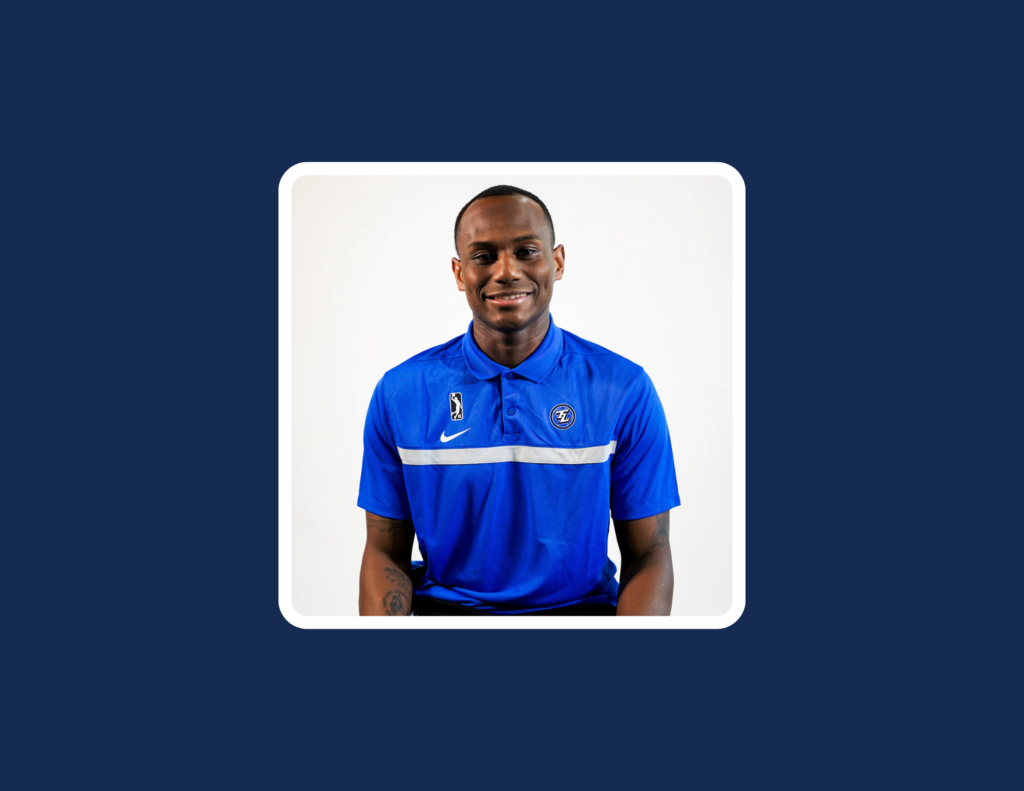
TEVIN BROWN – TEXAS LEGENDS, NBA G LEAGUE AFFILIATE OF THE DALLAS MAVERICKS, ASSISTANT COACH – EPISODE 1022
Website – https://texas.gleague.nba.com/
Email – [email protected]
Twitter/X – @_juwan

If you listen to and love the Hoop Heads Podcast, please consider giving us a small tip that will help in our quest to become the #1 basketball coaching podcast.
Tevin Brown is an assistant coach for the Texas Legends in the NBA G League. He has also served as an assistant for Coach Mike Taylor and the Winnipeg Sea Bears of the Canadian Elite Basketball League for the past two seasons.
Prior to his professional coaching opportunities Tevin worked as a pro skills trainer with Tyler Relph Basketball in Dallas, Texas. He also served as the Special Assistant to the Head Coach and Director of Player Development at the University of Texas at Tyler from 2020-2021. Tevin got his start in coaching at All Saints Episcopal High School in Tyler, Texas as a High School Girls Assistant and 7th Grade Girls Head Coach.
On this episode Mike & Tevin talk about the importance of character, consistency, and preparation at every level. Tevin discusses how his experiences as a player shaped his approach to coaching, highlighting the value of playing with older athletes and learning from mentors. Tevin believes that developing strong relationships and creating value for others are key components for success in the basketball world. As he navigates his role with the Legends, he focuses on maintaining a curious mindset and staying present in the moment, while also preparing for future opportunities. Throughout the conversation, Tevin offers insights on the challenges and joys of coaching, illustrating how the connections built through the game can lead to personal and professional growth.
Be sure to follow us on Twitter and Instagram @hoopheadspod for the latest updates on episodes, guests, and events from the Hoop Heads Pod.
Make sure you’re subscribed to the Hoop Heads Pod on iTunes or wherever you get your podcasts and while you’re there please leave us a 5 star rating and review. Your ratings help your friends and coaching colleagues find the show. If you really love what you’re hearing recommend the Hoop Heads Pod to someone and get them to join you as a part of Hoop Heads Nation.
Get out pen and paper before you listen to this episode with Tevin Brown, assistant coach for the Texas Legends in the NBA G League.
What We Discuss with Tevin Brown
- Mentorship played a crucial role in his development as a player
- Playing against older players helped develop his basketball IQ
- The importance of viewing oneself as an overall coach rather than limiting to one role
- The relationships built through basketball, whether with players or coaches, are invaluable for growth and opportunity
- Staying present in your current role while preparing for future coaching aspirations is crucial
- Successful coaches build trust with players by helping them understand their roles on the team
- Creating value for others in the coaching community can lead to future opportunities
- Building relationships with mentors and peers can significantly impact a coach’s career growth
- Consistency in preparation and performance is essential for both players and coaches alike
- Why players need to establish a defined role to gain playing time and trust
- Staying curious and open to learning
- Communication between video coordinators and coaches is essential
- Building team culture requires clear standards and expectations
- Trust is built through consistent performance and accountability
- Recovery time is vital for mental and physical health
- Aspiring coaches should prepare at a high level, regardless of their current position
Like this show? Please leave us a review here — even one sentence helps! Consider including your Twitter handle so we can thank you personally!

We’re excited to partner with Dr. Dish, the world’s best shooting machine! Mention the Hoop Heads Podcast when you place your order and get $300 off a brand new state of the art Dr. Dish Shooting Machine!

Prepare like the pros with the all new FastDraw and FastScout. FastDraw has been the number one play diagramming software for coaches for years, and now with it’s integrated web platform, coaches have the ability to add video to plays and share them directly to their players Android and iPhones via their mobile app. Coaches can also create customized scouting reports, upload and send game and practice film straight to the mobile app. Your players and staff have never been as prepared for games as they will after using FastDraw & FastScout. You’ll see quickly why FastModel Sports has the most compelling and intuitive basketball software out there! In addition to a great product, they also provide basketball coaching content and resources through their blog and playbank, which features over 8,000 free plays and drills from their online coaching community. For access to these plays and more information, visit fastmodelsports.com or follow them on Twitter @FastModel. Use Promo code HHP15 to save 15%
Your first impression is everything when applying for a new coaching job. A professional coaching portfolio is the tool that highlights your coaching achievements and philosophies and, most of all, helps separate you and your abilities from the other applicants.
The key to landing a new coaching job is to demonstrate to the hiring committee your attention to detail, level of preparedness, and your professionalism. Not only does a coaching portfolio allow you to exhibit these qualities, it also allows you to present your personal philosophies on coaching, leadership, and program development in an organized manner.
The Coaching Portfolio Guide is an instructional, membership-based website that helps you develop a personalized portfolio. Each section of the portfolio guide provides detailed instructions on how to organize your portfolio in a professional manner. The guide also provides sample documents for each section of your portfolio that you can copy, modify, and add to your personal portfolio.
Hey, coach! Want to take your team to the next level this season? Introducing GameChanger, the ultimate game-day assistant with tools to give you a winning advantage. With GameChanger, you can track stats, keep score, and even live stream games, all for free! Get the stats and crucial game video you need to lead your team to victory, all from the palm of your hand. Coach smarter this season with GameChanger. Download GameChanger today on iOS or Android and make this season one to remember. GameChanger. Stream. Score. Connect. Learn more at GC.com/HoopHeads
THANKS, TEVIN BROWN
If you enjoyed this episode with Tevin Brown let him know by clicking on the link below and thanking him via Twitter.
Click here to thank Tevin Brown via Twitter
Click here to let Mike & Jason know about your number one takeaway from this episode!
And if you want us to answer your questions on one of our upcoming weekly NBA episodes, drop us a line at [email protected].
TRANSCRIPT FOR TEVIN BROWN – TEXAS LEGENDS, NBA G LEAGUE AFFILIATE OF THE DALLAS MAVERICKS, ASSISTANT COACH – EPISODE 1022
[00:00:00] Mike Klinzing: Hello and welcome to the Hoop Heads Podcast. It’s Mike Klinzing here with my co-host Jason Sunkle tonight. And we are pleased to be joined by Tevin Brown, assistant coach of the Texas Legends of the NBA G League. Tevin, welcome to Hoop Heads Pod, man.
[00:00:20] Tevin Brown: Happy to be here. I’m glad to be here. Thank you for the invite.
[00:00:23] Mike Klinzing: Absolutely. We are thrilled to have you on. Looking forward to diving into all the things that You’ve been able to do in your career. Let’s start by going back in time to when you were a kid. Tell me a little bit about some of your first experiences with the game of basketball. What made you fall in love with it?
[00:00:35] Tevin Brown: So funny story, right? My dad, my dad actually played basketball in college as well. And he was the one that introduced me to basketball. But it’s funny because basketball wasn’t my first love. My first sport love was actually football. Cause it’s just something that came natural to me. I played football a lot more than I played basketball.
I think basketball was easy to do alone. So I kind of gravitated towards it over, over time. Just throughout my journey of basketball, especially at a younger age, I had a lot of mentors around me that was older, like high school guys guys that was in middle school. So from like the age of six to roughly 17, 18, I always played with older guys, right?
So I wouldn’t say I didn’t fall in love with basketball and the full process of basketball action to my first year. of high school. Up until then, I always mingled between football and basketball. Then throughout my younger years, from like sixth to eighth grade, most of my summers were actually spent in football practice and not actually on a basketball court.
And that’s just kind of ironic because I loved football that much, but it was a time in my life where I had got a couple concussions younger during my younger years. Then I kind of just faded towards basketball because one, I could do it by myself in a park. And two, it allowed me to be creative.
It allowed me to express myself in a way that football didn’t allow me to. Then from my ninth grade on up until now, like I’ve always loved football. I meant basketball, I’m sorry. And basketball has just been a part of my life and I love to do what I do now. When you were a
[00:02:18] Mike Klinzing: kid, Once you started gravitating towards basketball, so as a high school player, what did you do to get better?
And how does that compare to the way that you see kids coming up in the game today?
[00:02:35] Tevin Brown: Yeah, for me, for me, my growth and development as a younger player growing up, I spent a lot of time out on my own, on my own. So my grandma, I stayed with my grandma during the summers. And she, she built like a goal and some concrete.
That’s all I had for most days. And I had to roll, I wanted more space. So I had to go in concrete. So most of my summer days were spent by myself. Cause my two favorite players were Gilbert Reynos and AI. Right. So most of my days were spent in the backyard during the moves that I would see them do the night before.
Then plan wise, I would play with older kids. So I’ll play with. Kids that were older than me, but once I got to the age of 12 to 13, I was good enough to start playing with adults, right? And that added a side of toughness to me that I didn’t know I needed, the IQ, and being able to understand how to play with better players and be a leader, right?
And understand, like, you’re not gonna get the ball, right? They’re only gonna ask you to play defense. You only can shoot when they pass it to you, right? So you learn how to, I learned how to do other things at an early age. I think over time throughout my basketball career, my coaching career, that ultimately helped me become a better leader just through those small fires that I had to deal with at a younger age.
[00:03:49] Mike Klinzing: I think that one of the things that we’ve talked about a lot on here, Tevin, is just the way that the basketball landscape has changed when it comes to young players, where now so much of basketball is kids playing in their own age group with an official basketball team. with parents in the stands, with a coach on the sidelines.
And I’m kind of like you in that I grew up in an era where I played a lot of pickup basketball with a lot of guys that were older, bigger, stronger than me. And I felt like my development as a player was impacted in such a positive way by the opportunity to play against older players. And from what you just described, sounds like that’s the same thing that happened for you.
And it just feels like when you look at the way that kids grow up in the game today versus that ability to play against older players and to be able to develop your IQ, as you said, I just think that, man, it’s so valuable to be able to play pickup basketball with players who are older because it just forces you, as you said, to play a role, to be able to understand, hey, how can I impact winning in other ways besides.
Just scoring. And it’s just, to me, it’s something that I think kids today in so many ways are missing, that they just don’t get that same opportunity to play pickup basketball the way you did. Did you have one or two guys that you lucked up to, or that kind of took you under their wing in that time when you were playing with some of those older players?
Was there one or two guys that sort of served as a basketball mentor to you, for lack of a better way of saying it?
[00:05:38] Tevin Brown: Yeah, for sure. So my hometown is Pine Luff, Arkansas, which most people Probably don’t know where it is, but it’s 45 minutes south of Little Rock, the capital of Arkansas. So my cousin, Brendan Patterson, which was a standout basketball player in Arkansas at the time, he ended up going to Ole Miss 6’6 Wing.
Then he transferred to University of Arkansas Little Rock and he played there for his last two years of his basketball career. And he took me on his, he took me under his wing. Right? So he’s roughly 15 years older than me. Well, we spent, when he came home for his Christmas breaks, Thanksgiving summers, he kind of just mentored me.
He taught me the game. He loved Kobe. I love Kobe, so we always had that in common. Then obviously my dad, right? My dad was a great leader for me. And as you just mentioned about parents, right? My, my dad wasn’t like overbearing. He didn’t scream at me ever throughout my career of playing basketball from the age of three until I finished at 23.
Never once yelled at me. We had like a, a verbal, non verbal communication of eye contact during the game. Right? Like I knew what he, I knew what he expected. He had standards for me and I executed him. And we have a post game talk and that’s that. And he allowed me to develop through work ethic and just toughness and showing me tough love, being honest.
And I, so I think those two people are my two biggest mentors.
[00:07:11] Mike Klinzing: When you think back to your time as. A player in high school. What’s your favorite memory of playing high school basketball?
[00:07:20] Tevin Brown: Wow. It’s a great question. That’s an amazing question. I think just all the experiences I have with my teammates being able to just build different relationships especially my sophomore year coming in, I wasn’t playing right and going through the journey of being named starter my sophomore year and just being able to build those connections with the seniors And I think that’s like the, my favorite part, probably my sophomore year spending time with older guys, getting different experiences.
They have cars, so obviously you can do more with people who had cars in high school. So my sophomore year would probably be my greatest memory. And I think I had a breakout game my sophomore year where I had like 18 points and like 7 assists as a sophomore, first time started. So right away that’s like the memory that sticks out the most.
[00:08:08] Mike Klinzing: With college basketball always on your radar from the time you were young, or at what point did you start to think, Hey, I might be able to play a little bit beyond high school?
[00:08:17] Tevin Brown: So, it’s funny I played EYBL with the Arkansas Wings from my freshman year of high school up until my junior year. of high school.
And I could, I never thought about it in a great, great, great scheme of things. I was always just like, I’m just playing Aggie basketball. I’m playing against great players. Cause I was class of 2020, I mean 2014. So we had Devin Booker, Tyler Hughes, those guys in our class. And obviously I saw them, right?
Like I saw they had NBA talent or NBA skillsets from early on. But for me, it didn’t hit me college basketball until, until my junior year. Like, okay, I got played against this guy. He’s going to college. I played against that guy. He’s going to college now. So I believe in myself enough that I believe I can play college basketball as well.
So it worked out perfectly. My high school coach had me a ton starting my junior year and that led me ultimately led me to the schools that I ended up going to.
[00:09:14] Mike Klinzing: Tell me a little bit about the recruiting process. What was it like? Obviously you had your high school coach involved in it. Was your dad involved?
Your AAU coach? Just what was the process like for you? So my process was
[00:09:25] Tevin Brown: honestly pretty slow. Especially early on. Cause at the time my play style was a quick guard who can get in the lane, create for others. I went, I wasn’t the greatest shooter. Been 5’9 5’10 not, not being a great, the greatest shooter, definitely hurt my development a lot.
I mean, my recruitment process a lot. So my high school coach had a close friend by the name of Chris Parker at Arkansas State Mid South, which is a junior college in West Memphis, Arkansas. And that was, that was honestly my only offer. He brought me in on a visit. I played with the guys. I impressed him.
He offered me as, as we was driving back home two hours, not committed the next day, because that was the only coach that showed interest in me. He brought me in. He showed me love. The team was great. The environment was great. So I didn’t have much coming out of high school recruitment wise. And that’s why I ultimately chose the JUCO route and it worked out perfect for me.
[00:10:23] Mike Klinzing: What was it like playing at the JUCO level? I know we’ve had. several coaches on that have coached at that level and they’ve talked about obviously the positives of giving guys opportunities both academically and athletically and then they’ve also talked about some of the challenges of you may have guys in there who maybe aren’t serious about their academics or guys who have that talent d1 level but forever whatever reason they end up at the juco so what was your juco experience like
[00:10:53] Tevin Brown: it was eye opening I didn’t know, like I said, I knew zero about Juco basketball, zero about Juco basketball.
I didn’t, I didn’t understand, I didn’t have an understanding of D1, D2, D3. I, I didn’t know the difference between levels. So my Juco experience, especially my freshman year, was eye opening. Especially coming in as a three year starter in high school, and I’m coming in with 22 year old sophomores or 21 year old freshmen.
that have been injured or took other routes before coming to JUCO. So I had no real feel of what my experience would be like. So my freshman year of JUCO, I didn’t play a ton because we had a sophomore point guard and our head coach wanted him to get recruited, which and I completely understood it. I got my, I got my minutes.
I impacted winning. I not turned the ball over. Then my sophomore year, I was granted the opportunity to start. And our team, we had a really good year. That led to me getting more D2 entrance my sophomore year of junior college. And that ultimately led me to D2 UT Tyler and Tyler, Texas. So, I think my Juco experience overall was great, eye opening, and just, just made me realize that there’s much more basketball out there.
There’s really good players. We played against a ton of D1 guys. Especially the schools that were in Mississippi. The guys were high level and that kind of showed me like, okay, I kind of have still have a long way to go. And that kind of just motivated me to continue to work on my game and continue to grow as a player.
Funny
[00:12:27] Mike Klinzing: how many people have no idea, again, how good all these different levels of college basketball are. I’m sure that you’ve seen it over the course of time. And I know you’ve coached some AAU and obviously in the position that you’re in now, you talk to people all over the basketball world, but There’s so much, I don’t even know if it’s misinformation, but just lack of knowledge of people understanding how good you have to be to play at any level of college basketball.
I don’t care if you’re playing division one, I don’t care if you’re playing division three, you’re going juco, whatever. There is players everywhere. And it’s just the level of gill and talent that you have to be able to have to be able to play college basketball. I think it’s one of the most underrated things when you start going around to Watching AAU tournaments all over the country.
There’s just, there’s a huge misconception about how good you have to be to play college basketball. Absolutely.
[00:13:24] Tevin Brown: Absolutely. And that’s, and I think people don’t understand how athletic the players are at that level and how fast those gaps close when you transition from high school to JUCO and from JUCO to even a D1 level, right?
Those gaps, those decisions the standard accountability is much more higher at higher levels. And I think a lot of people. So watch more Juco Basketball, watch the NAI level, watch the D2, D3 level because there’s some phenomenal players at all at all of those levels. There’s no
[00:13:56] Mike Klinzing: question about that.
When you’re in your, during your college basketball career, what are you thinking about career wise, long term, and is coaching on your radar while you’re still playing? We always say that there’s kind of two camps of people who get to coaching, right? That one camp is Somebody who’s been drawing up plays on napkins since they were like eight years old and they’ve thought the game as a coach and they always knew they wanted to be a coach.
And then there’s another faction of people who they play the game and they play it. They’re focused on being a player. And then at some point, their playing career comes to an end and they look around and they’re like, well, what do you mean basketball’s over? Like how, how can that be? And then that’s kind of how they get to coaching.
So I don’t know if coaching was already on your radar while you, while you’re still playing in college or. What’s the process for getting to coaching?
[00:14:48] Tevin Brown: So, funny I’ll just take you back. To me, it’s like a player, right? I was the workout guy. The kid that you see on Twitter, Instagram, workout two or three times a day, got the ball handling gloves, got the ball handling outside shooting, all of those things.
So that right there allowed me to get creative with player development, right? I didn’t even know at the time what I was doing. I was more so in the moment, like you just stated. That’s it. In the moment, focused on my game just getting better as a basketball player and just doing what I love, right? I transferred to UT Tyler stress fracture early on, like my junior year early on, like in October, had a stress fracture.
And at the time, a couple years before, Paul George had just hurt his leg, right? So doctors were overly cautious of that injury. So I had to take two to three months off with nothing but pool workouts. Had pool workouts I could lift or I could just go in the gym and do form shots. So that was my workout routine for two, two and a half, three straight months.
My junior year. So I came back my junior year. I didn’t play as well. Starting point guard, we were winning. I played spot minutes. Then season ended. Our head coach at the time, Jamin Copeland, was working with a company called PGC. I saw a great opportunity to join PGC, did an interview, they hired me, that became my summer job.
Did I, was I still focused on coaching after basketball? No. I was just looking at PGC as an opportunity to do something I love. I’m helping the next generation to get better at basketball and that’s all I was looking at. Just like, okay, I’m making solid money as a college student in the summer coaching basketball.
It was fun. Then I had some adversity, right? And I might go off the rails a little with the story, but I had some adversity.
I got in like, obviously being a college student, having fun, not focused on the right things, more so focused on basketball, more so than the school part of it. Right. So we had a, the following year, I didn’t take care of my business, but second half of my junior year. So I was in, ended up in ineligible for my senior year.
That was supposed to be my senior year. So I couldn’t play, right? So I went down the dark, dark alley, dark mindset. I was like, basketball is gone? Like what? Like what? Like I can’t play basketball? So I was supposed to stay in school. I was still in a dark place, flunked out of school. So I had school gone and basketball disappeared within five months.
I had a great summer PGC. Come back August, I’m ineligible. Go all August to December wasn’t focused again cause I just wasn’t in my right head space in Ellsville again. So now I’m out of school. My mom wants me to come back home to figure it out. So I went home for Christmas for like two weeks and I was like, mom, I can’t, like, I can’t stay.
I have to figure this out. Right. So I went back I went back to Tyler, Texas to figure it out. Like didn’t have a place to stay. I had family to depend on, but I, I didn’t have a residence. I only had my things in my car in a basketball dream that I didn’t know if it was gonna ever come true again.
That’s all I had at the time. So during that time, I just got a job at Chick-fil-A got a job at Chick-fil-A was working at Chick-fil-A on my lunch breaks at three to four o’clock. I would leave I would leave. I would leave and go to the gym because I had, my friends were still on the team. And I, and they obviously, we still had a connection.
So I would just leave and go play with them for an hour, then go back to work. Then every morning at 5 AM, before I go to work at Chick fil A, I get in the gym, lift weights, shoot, go to work at 9, work from 9 to 3, go hoop, then work from 4 to 7, and that was my routine every day for almost like a year and a half until I was at UT Tollard, then Louis Wilson became the head coach.
And he’s at Laura Merrimount now. With Stan Johnson. And that was the coach that gave me my opportunity to play my senior year of basketball. Played there, injuries again, got a concussion, right? But with Lou, with Lewis Wilson we call him Lou, he, he gave me a perspective of basketball that I’ve never experienced before.
And that was, he cared about the person first. And that meant so much to me because like the dark place I was coming out of, and like, I just needed like love at the time. Right. And somebody to just show me like the way to go, like, give me a life. And he showed me that by just loving me of who I was and accepted what I had to bring.
So to get back on the team, he challenged me. I had to get a 3. 5 in my summer classes. And I got ended up getting like a 3. 8 and I was able to get on the team my senior year, got back on the team, got injured. So he kind of, long story short, he kind of mentored me. I became like a player coach my senior year.
Studied all the scouts. I was in a coaching meet sometimes, still no direction of like, oh, I’m finna coach afterwards. Then after my senior year of basketball, doing that, I helped the players, plan development, work the guys out. Then, after the season, I was sitting in his office one day, and he was like, Juwan, come file these papers for me.
And I was in there filing papers. Then the next week, he was like, yeah, I’m gonna have you as my special assistant to head coach. And that’s kinda how I fell into it. So, I’m sorry for the long story right there. I’m sorry.
[00:20:24] Mike Klinzing: No, man, it’s an awesome story. I mean, when you start talking about having the game pulled away from you because of injury and then trying to figure out, Hey, how can I come back and, and get involved with this thing that I love?
And as you said, when somebody takes the time to invest in you, not just as your worth as a basketball player, but your worth as a person, as a human being and does something like that for you. Yeah. I mean, that’s a powerful thing that anybody who, who, anybody who has a mentor like that, I mean, just, it makes all the difference, right?
It makes all the difference in your life and puts you on a path that that you’re still on today. Tell me about what it’s like to kind of go behind that curtain of the coach’s office for the first time when you’re sitting in those meetings. And I think it sounds like from your description of kind of how you were, you’re similar to.
When I was playing, I didn’t think at all about coaching. Like I kind of thought, hey, coaches, they show up at three o’clock for practice and practice ends at six o’clock and they go home and I go do my stuff and then I’ll see him tomorrow I practice at 3 but I had no idea what coaching was all about.
So how did you, when you first got that look behind the scenes were you surprised? Shocked? Did you kind of know what you were getting into or just what was your perspective when you first sort of went behind the curtain, the coaching curtain?
[00:21:52] Tevin Brown: Yeah. I was just a wide eyed kid that I had no idea. I was just excited to be there.
So anything they asked me to do, I was like, yes, I do it. Yes, I do it. Didn’t understand our workflow or exactly what they want. I was like, yes, I do it. So I was just open to any opportunity. Right. But again, Lewis Wilson, for example, he set a great example for me. Right. Cause every, every single day he reminded me, he reminded me of a simple quota, if you care enough, one day you’ll be good enough.
And that’s just something that stuck with me. And he was also me saying, if you. Work hard enough, you’re going to get exactly where you want to be. And he showed me that every single day. Challenged me with that every single day. So, behind the scenes it was more so of, this is just like me playing basketball.
Like me as a player. I have to put in time now just in a different way. Breaking down film, copying papers, typing out practice plans, working guys out, picking guys up, getting them, checking classes, right? Same exact thing I had to do for basketball as a player. That’s it. Go to the weight room, watch film pick up my teammates.
So the moments me, I had as a player, ultimately prepared me for the moment of, as a coach so I wouldn’t, I wouldn’t say it was a huge adjustment because I think those moments as me as a player is building that those characteristics allow me to adjust to coaching more smoothly.
[00:23:17] Mike Klinzing: The good
[00:23:18] Tevin Brown: thing about
[00:23:18] Mike Klinzing: that was you were making a ton of money during this, right?
Yeah,
[00:23:24] Tevin Brown: my yeah, actually Lewis Wilson, he did a great deal for me. I remember, I’ll never forget. He walked out of the office. He was like, I’ll be right back. I got a surprise for you. And I was like, so excited. Looking forward to it. Cause he, he was a great, he’s a great guy. So he always had stuff up his sleeve.
He came back in the office. I was sitting at the desk. He was like, look, I got 600 for you a month to be a student assistant. And special assistant to the head coach. And I was just so excited and I was still living at the door. I called my mom, I was like, mom, I’m, I’m getting 600. I was so excited.
I had no idea,
[00:24:03] Mike Klinzing: no idea. Yeah. It’s I mean, your story right there is one that has been repeated many times. on the podcast of somebody who gets their dream job and is making nothing or next to nothing. And then there’s always a story of the guy who’s on the staff that looks out for somebody who is not quite at the same level that they are.
And I think that it’s, it’s a very, very common story in terms of starting out. People have this glamorous vision of what coaching is and Those people are the ones that they, they watch TV and they see the coaches on the sideline that are coaching in the final four that are coaching in the NBA. And they think that those things just kind of happen and fall into people’s laps.
And the reality is that 99. 5 percent of the coaches out there in America have a story similar to yours, that it’s not just, Hey, I wake up one day and I’m on the sideline as a head coach and making a ton of money. It’s, it’s, It’s work and it’s at the same time, it’s fun, right? I mean, you talked about it, like you just, that first experience, you got to do all those different things and you got to get your hand in a bunch of different things.
And that allowed you to learn and to grow and to be around the game and around the players and around the coaching staff and around a mentor that cared about you. And again, that’s really, when you start talking about the road to the coaching profession, it’s a common one. I mean, it’s one that, that a lot of guys take and you get to that first stop and.
I think you said it really well that you, you keep working hard and you keep doing what you’re supposed to do and you keep learning, you keep growing, and then eventually you get opportunities and who knows where it eventually ends up leading you to. And let’s, if you circle back to your mentality at that time, I mean, obviously I’m guessing at that point, you’re just, man, I’m just thrilled to be able to coach college basketball and get your 600 bucks a month.
And those things that you just talked about, did you have any kind of a path, a plan, a thought in mind of, Hey, someday maybe I’d like to coach at the professional level. Someday, maybe I, maybe I want to go and coach at the high school level, which I know you did before. Did you want to stay at the college level?
Did you have any plan at all? Or was it just kind of, Hey, let’s just kind of see where this thing takes us.
[00:26:21] Tevin Brown: Yeah. When I first started, I think I just see where, see where, see where the journey takes me. Right. I, I didn’t, I, even as a player. I’m not sure if it was a good thing or a bad thing, but I didn’t have many short term, long term goals, right?
I was just trying to be the best I can be play well when the moment came, work as hard as I possibly came when the lights were off. And that was my mindset with, as with coaching as well. I mean, I think as I went throughout the year, my first year of coaching at UT Tyler Lewis Wilson and other people just spoke so much life into me as far as validating, like, Juwan, you’re doing a great job.
Continue, keep it up. So. It kept encouraging me, kept encouraging me, and that just fed the curiosity in me. Like, what more can I do, right? So immediately, I had a lot of player development responsibilities throughout my first year of coaching. And the players enjoyed the workouts. They wanted to watch film, they wanted to get in the gym more.
So my thing was, okay, this is good, this is cool, this is cool, I’m okay, I’m gaining my confidence. Season went on, and I finished my season, and then Tyler Ruff, which he’s a trainer in Dallas, Texas. I worked out with him from 2016 until whenever I finished playing in 2019 2020. He offered me a job to come be a skills trainer, right?
at the time I was 23, 24, young. I did the coaching for a year. And I was like, okay, skills training, player development. For a business full time. Sure. Let’s do it. I took the job in April. I finished at UT Tyler in June. But in between June and October of that year, I went back home to Jacksonville, Florida, and I ran my training business.
And during that time I was training pros all the way down to kindergartners, first grade. And that just allowed me to get even more experience as a coach, create my brand, create a business. Get creative with my development plans and help kids get better. So I did that. I moved to Dallas, Texas in October of 2021.
So did that for a year. So I started, we worked with like many pros, right? Tyler has a huge clientele from kindergarten all the way up to NBA players and even the top players in Dallas work with him as well. And during that time, again, people spoke life. They spoke life, encouraged me a lot. Curiosity, right?
You’re doing a good, good job. Good job. Pat on the back there. Then I met some NBA people. And I was like, okay, I love the NBA game. So start selling an NBA game. And then that just led on to me, started posting on Twitter, posted on Instagram, just putting Klinzing out there and just started to add value to other people.
Then over time, the right people saw it. The assistant coach with the Texas Legends at the time ended up recommending me for an interview and the rest was history.
[00:29:18] Mike Klinzing: All right. So tell me, let’s, let’s talk a little bit about the training part of it. And then we’ll come back to getting the job with the legends and that part.
Tell me a little bit about the training side of it, what you liked about it, what was challenging about it and sort of what your process was for how you went about training kids.
[00:29:35] Tevin Brown: Yeah, for sure. So number one process for me, what I really liked about it was the opportunity to really impact people. Again, like going back to my experience, like that feeling that I felt when Lewis stepped in my life as like a player, like he put, he always said, I’m going to put two feet in two feet in your life at all times.
I got two feet in your life. Right. So when I started working with players on my own, I dealt with the same thing I was trying to do for them. I had opportunity to be around the game I love, had opportunity to build relationships. Then ultimately I had an opportunity to just be aware of so many people, it impacts so many people.
And that’s what kept driving me every single day. And I think the challenges for me early on, especially with the training business was like, how, how would you market people to get more business? Like what separates you from the next person? And people say comparison is the enemy of joy. Great. But at the same time, I’m a young coach in a business where it’s a lot of trainers.
So I tend to compare myself, right? I’m looking at this trainer’s page, right? I’m looking at that Traders page. I’m sending coaching clinics, right? And my process of learning was, okay, I’m learning from all these different people. Right, so how, now can I, how can I put on the headphones and quiet the noise?
And build my own philosophies and build my own niche. So that’s my process of getting players better, right? So for me, especially with young players, everything started with Dribble Pass Shoot. Super simple. Then base it off your needs. Put your situations to practice. Showcase what you need to work on, but also what you’re good at.
And that’s kind of like how I process things. Then for professional players at the time, I use something called SWOT analysis with, which is strengths, weaknesses, opportunities, and threats. It’s normally like a business plan, but obviously strengths are what you do well. Weaknesses are what you’re not as good at.
Opportunities are like opportunities for growth, growth areas. Then threats would simply be what could the defense do. to take you out of the game. And that’s kind of like how I evaluated and handled my player development with my professional athletes, high school athletes. It was more, once you got to your junior year, sophomore, junior year, let’s start fine tuning, right?
If you can shoot really well, catch and shoot, how can we now get you really comfortable with making decisions off the bounce? And I’m talking about just catch and shoot, use your pump fake as your threat. Now, how can we get you to 1, 2, 3, 4 bounces to the rim? Then that’s when we get into the passing decision.
So, that was my process and how I looked at player development during that time. Did
[00:32:20] Mike Klinzing: you use a lot of film while you were doing your player development stuff, or was that something that wasn’t a part of it? Because I know there are some guys that use a lot of film while they’re training and others just don’t have access to that with, with some of their, with some of their people.
How’d you go about using or not using film?
[00:32:35] Tevin Brown: No, absolutely. I, again, I loved film, always have loved film, so film was a huge part even from the kindergarten, the, the kind kindergartners. Right. The thing about kindergartners writing younger players is they love the icons of the NBA. Right? The Kyries, the Lukas, the LeBron James, the KDs, Devin Bookers, right?
The better players, right? So if you can find a simple clip of them doing the move that they’re working on, they’re instantly bought into that, right? So that was my way of, I wouldn’t say tricking the mind for young kids to get engaged, but that was my way of grabbing their attention. It’s like, hey, look, your favorite player is doing this right now.
I believe in you enough that you can do the same. And they’re all excited. Then for the professional players, It was more synergy and number breakdowns along with the film. So with the professional players, there’s way more detail than with the younger players. It was how could I create curiosity and engagement.
[00:33:35] Mike Klinzing: I think that really when you talked about initially when you answered this question about how do you kind of try to differentiate yourself from other trainers, I think that’s always the challenge and it comes back to me to right being prepared and being able to demonstrate your value to the players, to their families.
And can you get a guy better? Can you get a player better? And if you can do that, I think there’s, there’s value. Unfortunately, a lot of times, as I’m sure out in the market, there’s trainers that are out there just kind of collecting their hourly paycheck and not necessarily getting players better.
And just like in a lot of other spaces in youth basketball, there’s people that are doing it really, really well. And there’s other people who are just kind of out there going through and sort of milking the system. And so I think when it comes to training, whether you’re from a coach’s perspective or whether you’re an athlete looking for a trainer, I just think that what you need is to look for somebody who’s prepared, who’s getting to know the player, getting to know, as you said, mentioned the SWAT piece of it, which I think is a great way.
Hey, how can we get this player better? How can we help them perform better in games, which ultimately is what it’s all about. And so the training business is just very interesting as it’s exploded, it’s just become a market that is extremely saturated and it’s always interesting to talk to people who have done it and, and the people who have done it well, like yourself, are the people who have put the time into you Study their craft and understand what it is that they’re actually trying to do to help a person get better and not somebody that’s just gone and found some videos on YouTube and throwing those out there with whatever players they’re working with.
So the training business is always an interesting one to me. Let’s jump to your experience and getting the legends job. What do you remember about the interview process of actually getting the job?
[00:35:42] Tevin Brown: Yeah, I remember it was six weeks. It was six weeks, so I was excited. I was like, okay, is this, is this working out or what’s happening?
Or is I’m, am I moving on? Did I get the job? Did they choose somebody else? So it was like, for me, I was very anxious because it was new. And I was so excited for it. Interview process was like six, seven weeks or whatever. So I had to, I had to do like some workouts in front of the coaches, obviously.
Then during the time, obviously we have the G League tryouts, right? I had two G League tryouts, and I was that was part of my interview process to come coach, right? They wanted to see how well I can coach, come in the room draw, draw plays on the board, like, kind of gauge where I was as a coach.
I did that, then the following night, well, the same night, I had to do, like, a private workout where I had to lead a station, right? Pick and roll breakdown. Like, how well can you break down a pick and roll defense, but also teach it to the players, well enough so they can execute and understand. Then along that night, I also had to coach a team, right?
Eight, eight players that were really good college basketball players that are now trying to make to the NBA or G League. So again, another opportunity to showcase my value and what I can do. I did that process end up getting the job end up going well for me. So it was, it was definitely a anxious process for me because it was new and I was just so excited and I was just so ready for a new challenge and opportunity.
[00:37:19] Mike Klinzing: What was your initial role with the Legends right after you get the job? And how has it changed to
[00:37:25] Tevin Brown: where you are now? Oh yeah, so my initial role was Head Video Coordinator, Player Development Coach, which I did the last two seasons. Then this last season. This last past summer, I got a bump up to an assistant coach role.
So overall, like I was responsible for all video, sending to front offices between Dallas and the Legends organizing every all film with the assistant coach and head coach, scout reports, providing scout videos, typing out the rim reports with the assistants obviously being on the court, working guys out, but also being a body, which is also very important at all.
being able to be a body on the court and play with the players. Then obviously I had to travel, live code, games. So that was my first initial role in the G League. This year is more so a leadership role, which is, will be new for me because I now have to guide people and manage people and help them grow, but also continue to grow as a coach as well.
[00:38:29] Mike Klinzing: How does that leadership look like on a day to day basis when you say taking over more of a leadership role Explain to us what that looks like.
[00:38:37] Tevin Brown: Yeah. So just like, right, you have a coaching staff, right? As a video coordinator or assistant coach that I’m still responsible for all the video, but now I’m teaching others how to organize, manage, and operate the video as an NBA video coordinator, right?
So day to day is either early morning meetings teaching players, teaching people how to start the cameras. How to code games, how we play call calls, how we read coverages in video, how we organize like our scout schedule, three to five out. But also knowing how to like helping them grow as coaches on the court as well.
I think the video part is very important. I think if you can just look at yourself as an overall coach and not just put yourself in a box as a video coordinator, it helps your growth the most.
[00:39:31] Mike Klinzing: When you were in the video rooms, obviously we’ve had an opportunity to talk to. Several guys who have spent time as video coordinators, whether at the college level, the G league level, the NBA level.
And one of the things that they always say is that the amount of time that you’re spending breaking down tape, both of your team, your opponents, that the level of learning from an X’s and O’s standpoint, that you get an opportunity to do just by virtue of being exposed to the amount of film. That you have to watch and break down and code and do all those things.
Talk to me a little bit about how you feel like your time in the video room improve your ability to see, recognize, understand the X’s and O’s part of the game compared to when you first step into that role. Yeah, I
[00:40:25] Tevin Brown: big time, right. I go back to, again, everything for me kind of goes back to UT Tyler and Lewis Wilson.
Right. He was the one that kinda introduced me to how to break down film, right? So going back to them, my, the process of film was every game we played, I had to watch the last a hundred, 150 offensive clips, last 150 defensive clips, right? And provide him a report of what do I see as far as the Xs and Os, where they doing Atos, what’s the coverages?
Right? And at that time, I didn’t understand that was preparing me for the NBA video room, right? Because. I didn’t understand the difference between college and NBA basketball game at the time. So I think during that time, my first year in the G League, it was strictly studying the NBA, right? I had a great coach that I worked for that built urgency and gave me great projects to study and just watch the game as much as possible, right?
Because ultimately, We all want to coach, right? So for me, the process was watch film, but within watching film, also take 15 to 20 minutes out of your day to just work on your board game, right? Which like I, we tell players all the time, work on your game. Same thing for coaches, right? Work on your game. So, right.
So breaking down the film watching games pulling ATOs, X and O’s within that, just also drawing out what I will do in certain situations, 15 to 20 minutes every day. Then get right back to it. Then you can just rotate that, right? So that was my kind of my process of learning the X’s and O’s and growing as a young video coordinator.
[00:42:07] Mike Klinzing: Would you say that your knowledge of offense or defense, which one did more about from an X’s and O’s standpoint? Do you feel like going into it and tell me a little bit about the differences in learning? G League offense, G League defense, which one was easier to figure out, to navigate? Maybe neither one was, maybe there wasn’t one versus the other, but just the difference in looking at offense and defense on tape, which one maybe do you prefer?
Just talk about the differences between looking at offense and defense.
[00:42:44] Tevin Brown: Yeah, I think for early on, it was the terminology defensively and offensively. And that, and that’s a huge thing in the NBA, right? Speaking the same language I wouldn’t say either was, was easier, easier for me because both were pretty tough offensively the thing is like the personnel and style of play in the G League is super fast, right, so it ranges from, you can have anywhere between 100 to 115 possessions every single game, right, so understanding teams running habits, what they’re trying to do early offense and flow, also their sets.
How they end, how they end possessions. Whether it’s a pick and roll, a iso, it’s an angle. Pick and roll. A middle pick and roll, and how do they space, right? Or they’re a flat team. They three out, one in, I mean four out, one in, five out, right? Then defensively, again, same thing is offense. Everything starts in transition, right?
So how, how they crash ’em, how you, how they’re crashing, what’s their crash rules, how they sprint back defensive coverages. Shell rotation on their heavy, heavy, heavy nail team or their heavy low man team, right? Do they switch ball screens at the level? So all of those things were pretty difficult for me starting out early on.
But again, repetitions of watching film and watching games kind of helped me a ton to speed up that process.
[00:44:13] Mike Klinzing: What’s the interaction like between you as a video coordinator and the assistant coaches and head coaches? When you’re in that role and then obviously you’re going to sort of experience that on the flip side now when you’re dealing with somebody else in the video room, but just what’s that communication like between the video room and, and the coaching staff?
[00:44:39] Tevin Brown: Yeah, it’s huge. Similar best, best ability is availability, right? So the thought is, as long as the assistant coaches and head coaches are there, I’m there. Phone is always open. You make, you’re going to make their job as easy as possible. Right? If that’s cutting some clips for the scout, if that’s providing extra ideas to the offensive coach, hey, I saw this EuroLeague team do a 77 this way.
Hey, maybe this could be good for our shooter coming off, going to his right, his right hand. Right? That’s providing feeling for our head coach, right? Always being open for our head coach, always asking what he needs, and almost kind of predicting the next thing he’s going to ask for. Kind of working ahead as a video coordinator, right?
You start thinking like a head coach, right? And that’s also something Lewis Woodson taught me when I was a young special assistant for him. It’s like thinking like a head coach, right? If we’re prepared for a game that they’re playing, they’re going to blitz a lot of ball screens, right? Okay, perfect.
Let’s go to the college team that was the best versus blitz. Hey, coach, here we go. There’s 15 clips of Let’s go Gonzaga killing blitz covers last night. Here you go. Right. So just creating value always being available and just always being open, being an open ear.
[00:46:02] Mike Klinzing: I would think that that communication is critical, as you said, to be able to think like a head coach and try to anticipate what that coach is going to need and be able to provide that as quickly as possible and keep those lines of communication open so that you can make sure that. Everybody’s on the same page as you prepare for your next opponent or you’re helping your own team to be able to improve what, what they do.
The role that you have now as an assistant and being able to get out on the floor a little bit more. What’s your favorite part of kind of taking on that role compared to what you were doing before?
[00:46:41] Tevin Brown: Oh, that’s a great, great question. I, most of this responsibility just taking ownership of your work.
That’s the biggest thing in like the ownership of now you’re in a bigger role of, again, to lead people and help people grow. Again, and that’s ultimately what matters most to me. I had the past two summers, not to get off track, but the past two summers, I went to Canada Winnipeg Seabears in the CBL.
And I had an opportunity to be an assistant coach there as well the last two summers, right? So, again, different because the season is shorter. Two, two and a half, roughly three months seasons. So it kind of prepared me for the moment that I’m in now. So I think, again, I think it just goes back to me now having a great opportunity to help people and lead them and help them become better coaches.
[00:47:29] Mike Klinzing: Day to day challenges of being in the G League in that you have the players that you’re working with, right? Their ultimate goal is to be able to get to the NBA. And so by nature of that. Goal. Mm-Hmm. there. There tends to be, or at least in my mind, those players, right? That’s an individual goal. We know how important basketball is a team sport when it’s played at its best and when guys share the ball and there’s comradery and all those things, right?
And yet each individual player on your team has the individual goal from proving of attracting it, the attention of the NBA club to be able to. Get a call up or get an opportunity with a different NBA team. And so how do you guys, as a coaching staff, how do you build the type of culture comradery within your team so that you can play team basketball and yet also know that and have your players know that you guys are also helping them to develop, to reach their ultimate goal?
How do you balance out those two sort of, they’re not competing goals, but sometimes they can be. at odds, for lack of a better way
[00:48:47] Tevin Brown: of saying it. Absolutely. I think again, communication, right? Set the standard early, right? And that, when I say set the standard early is obviously meeting, right? This is, this is what we need from you, right?
And this is also what the big club needs from you. So identifying the standard and setting the standard for the players early on. Also communication individually, having those one on one conversations, right? And letting players know, like, this is where you’ve been, this is where you are. And this is where you need to be to get to where you want to go.
Right? So, we’re all on the same page. And, and, and we’re, and this is a long season, right? Every, every moment isn’t going to be perfect, right? But as long as we communicate continue to push our vision, also continue to push the vision for yourself. Hold yourself to a higher standard. The G League is a tough league due to the season, long season, obviously, and smaller staffs.
But I think if all, everybody’s on the same page, right, constantly giving players the reminder. If you do these things, right, you’re fitting in a role now, just buy into it. Humility. Just be humble enough to accept your role. Don’t lose your confidence, right? But if you want to play, you have to do these two or three things.
And that ultimately within development, as you continue to develop people and their game, the winner, the product, the by product is winning, right? And everybody loves winners. And that brings even more attention to your team at any level, not only, not only the G League, right? Same thing for us, right?
Byproduct of buying into the team, but also having your own goals of playing the right way, getting to where you want to go to the NBA, but also combine those things and everybody’s on the same page, at least to win it, which equals most times, sometimes more NBA eyes on you, which is going to help you ultimately get to your NBA
[00:50:44] Mike Klinzing: dream.
I mean, that makes sense when you start talking about, right, obviously winning attracts attention and when guys buy into their roles on a team, that allows the team to function more efficiently, which should eventually lead to more wins. I want to ask you a question that it’s one that talked with other guys that coach at various levels in the professional basketball and it’s, it’s a concept that I always find to be.
Sort of fascinating. And let me kind of lay it out for you and then I’ll get your take on it. So when players are young and they’re at the lower levels of basketball, we try to teach our players to be well rounded. We want them to be good kind of at everything, right? We teach the kid to handle the ball.
We teach the kid to rebound. We want the kid to be able to play defense. We don’t want to lock them into one position. We want them to be good at everything. Right. And then Every step of the way, as you go up the basketball ladder, your role becomes more and more defined. Like there are guys in high school who get a chance, the coach kind of gives them the ball and says, Hey, go do your thing.
And they’re the best player on the team. They’re the star. And they get to do that. And then those players move on to college basketball. And there’s not that many college basketball players who the coach just hands them the ball and says, okay, go ahead and do what you want. And then obviously you get to the pro level.
And what there’s. 15 guys, 20 guys in the NBA that maybe have that freedom to just kind of do what they want with the ball in their hands and everybody else. And you said it in your previous answer, there’s two or three things that you have to do really well in order to be able to maintain or keep your job or to be able to get a job in the NBA.
And to me it always feels counterintuitive. And I remember when Mike Procopio, who was with the Mavericks at one time. As their player development, he was one of Kobe’s player development guys that he’s the one who first said this to me. He’s like, yeah, you get to this level and like, we don’t need you to be able to do everything.
Like you have to be able to do your role. If you can shoot 45 percent on wide open corner threes and play good defense, guess what? Man, you’re going to make a lot of money in the NBA. You don’t need to have to do all these other things. So how do you have, what are those conversations sound like when you’re trying to I don’t know if convince is the right word, but when you’re talking to a player about like, Hey, this is the archetype of player that you are.
And if you’re going to get an opportunity to the NBA, it’s going to be because you need to do these two or three things well. And I just wonder, because obviously all the players that are playing at your level are unbelievable players, right? They’re super talented. They’ve been the best player probably at every level they’ve ever been at.
And now suddenly you’re asking them to, I don’t know if it’s take a step back, but just to sort of zero in on what are the most important things that they can do. So what are those conversations like for you and your staff, if you’ve had a chance to sit down on any conversations that kind of follow along those lines?
[00:53:57] Tevin Brown: Yeah. So I would say conversations are, especially with players, right? What can you do to get on the floor? Right. Identify what do we need from you to get on the floor? We’re not going to take away the things you want to do. But what can you do to get on the floor right now? What is your team asking you to do?
What are your coaches asking you to do? You do those two or three things consistently, that builds trust. And ultimately, with all coaches, we play the players we trust. That’s on every level. If we trust you enough, we don’t have any problem putting you in the game. Then once you get in the game, and you get those minutes, and it builds up over time, then you can start showcasing even more.
But right now, like, just get on the floor. We have to get on the floor, right? Get on the floor. You played 30 minutes. Now you get more opportunity to showcase what you truly can do. And again, you continue to do that over time. Consistency is the biggest thing, especially with younger guys. Just be consistent every single day.
Carry the water, chop wood every single day, every single day. Small things. I don’t think I need to do is get on the floor, right? Once I get on the floor, now I can start showcasing my ability to shoot, Drive, play, make or whatever, but you still have to do it within the confinement of our team system. And that’s how most times the conversations go, right?
It’s an honest conversation of this is what the team needs. Do you want to play? Yes or no? Yes. Okay, perfect. Right now, that’s all we need from you right now. If you, once you get your 20, 30 minute stretch and you showcase that you have the ability to do more skills, then perfect. You, you gained that trust because now you’re ready to play it.
But now I trust even grows more into in you because now you’ve showcased us more.
[00:55:47] Mike Klinzing: It makes sense. I mean, as you said, the first thing you have to do, and I think any basketball player can relate to this is right. You first, you first need an opportunity and you need an opportunity to be able to get on the floor.
And once you’re on the floor, then now, Hey, can I do the things that my coaching staff has asked me? Can they trust me to do those things? And now you can take it to that next step. and maybe be able to expand your role, expand your game a little bit. But as you said, the first thing is you got to get on the floor.
I just always think it’s really interesting when you start talking about, again, guys who have been the player with the ball in their hands, the one, they’ve been the star, they’ve been able to do kind of all these different things, and now suddenly they get to the pro level and they’re being asked to scale back, for lack of a better way of saying it, to, hey, make sure you do these, These things.
And if you do these things, that’s what’s going to get you on the floor and give you a chance to win. And then you can expand your role from there. I just always think that that’s a sort of a fascinating back and forth between what seems like, Hey, once you get to that pro level, everybody’s kind of doing everything.
And you realize, yeah, no, that’s not the way it is. Cause there aren’t, there just aren’t very many guys at that level that get to just take the ball and Hey, couldn’t vote to what you want. There are very few, very few. Yeah. They’re very few and far between.
[00:57:10] Tevin Brown: No, I mean, absolutely, I agree. And I think, just, also, taking a step back and being honest with yourself and your development.
Are you doing every single thing you need to do to get minutes? Are you, are you spending extra time on your film? Are you eating right? Are you going to the gym late night to get extra shots? To put in the work for your moment? Right, so, especially for young guys, right? It’s easy to get discouraged. Coach is taking my confidence.
Coach isn’t letting me play my game, right? Take a step back and take ownership. Appreciate it. Like on your development, right? Am I doing every single day? Am I doing what I need to do to play and get better, right? If I’m not shooting the ball well, maybe, okay, I’m not shooting the ball. Well, I need to change my shooting routine.
I need to come back at night and shoot even more, right? And that could be a quick and easy fix is you just taking that accountability. And sometimes for young players, especially, they need failure, right? They need that failure to look in the mirror and be like, okay, this is new, right? So now we can start building those routines and overcome and just continue to get better as a basketball player.
[00:58:22] Mike Klinzing: What sets apart in the time that you’ve been with the legends, what sets apart the best guys that have come through and played for you and your coaching staff in terms of not their basketball skill, but their intangibles, the things that they do off the floor, their preparation. What are the things that stand out about the guys who have been the best players that have passed through and that you’ve had an opportunity to coach this to this point with the legends?
[00:58:51] Tevin Brown: I think number one right away is character, right? In character, just who you are as a person. Like, who are you as a person, right? Rather it’s, if you walk in a room, super simple, smile. Even if you’re having a bad day, shake hands, speak.
The simple things, right? Showing up on time, showing up early, having a routine, right? Especially young guys, sometimes, like we say, have a routine, but most times, like, young guys need guidance, right? Helping them build out a routine to help them grow as a player, right? Then like, like I said, routine.
Then the last thing is consistency. With everything they do, right? It’s purpose. Everything is done with purpose. Everything is done with consistency. It’s okay, I want to get here, right? This is, these are the things I have to do every single day to get here. If it doesn’t work out, I can live with the result because I’ve done every single thing to get to that moment.
It just didn’t work out. Now the thing is about the G League is that you get a, like, you get a call up, right? It didn’t go well. Okay, perfect. I got my opportunity to get into the room. I get my feedback from the team that let me go. Now I have to come back and do the same thing over and over again. Again, the consistency and endurance and adaptability.
And no, I think those things are like the biggest things that stand out for me with the players that we’ve coached that have been the best for us.
[01:00:21] Mike Klinzing: Let’s throw that question back at you as a coach. What do you have to do to be at your best? What are some things from an intangible standpoint? Obviously, there’s the X’s and O’s and you got to know your stuff and you got to be prepared and all that. But what are some things that you do as part of your routine to help you be at your best as a coach?
[01:00:41] Tevin Brown: No, absolutely. I got to get in the weight room every morning. I have to do something physical every morning. Rather walking, taking a walk early in the morning, or I have to lift early in the morning, right? So I’m a morning person, get up in the morning, read or listen to a podcast, something outside of basketball that’s not with basketball, anything to do with basketball, something with musical performance, something with teaching, something about how players learn or how students learn in the classroom.
Right. And then I spend the time with, cause I have a daughter, spend the time with my daughter. Being away from the game helps me kind of settle back in. It’s like, okay, everything is not as bad as it may seem, right? So just staying grounded and spend the time with family and people who care, care about me.
So those are like the things that helped me be my best. Obviously we got, we have a great staff here, which with the legends that is family oriented. And just being around the people that show love and speak life and full of energy. So those are like the things that I do every single day is workout, read spend the time with my daughter, just falling off being present in the moment.
Then that allows me to be refreshed and being able to invest in others.
[01:01:54] Mike Klinzing: That’s so important, right? To be able to have that routine, that ability to step away. We all know that coaching is all consuming, right? I mean, there’s, there’s very few moments in the day where you can. Just put it aside and not be thinking about what it is that you’re trying to do day to day for your team, for your players.
And it’s just coaching is one of those jobs that you just, it just doesn’t go away. So you have to have some of those things like you just described to be able to have a routine. And I think it’s always interesting to hear what different guys do to be able to, I don’t know if relax is the right word, but just, as you said, to be able to step away and get your mind right so that you can come back with the, with the proper framework of mind to.
Be able to give your best to your players, your team, your coaching staff and all that part of it. I think it’s really, really critically important.
[01:02:47] Tevin Brown: Tell me a little bit about,
[01:02:48] Mike Klinzing: go ahead.
[01:02:49] Tevin Brown: No, absolutely. I think especially early on in my coaching career, I didn’t understand that. Right. I was the young kid. Oh yeah, sure.
Like I’m never going to get tired. Like I’m fine. Like I’m fine. Like work, work, work. Work, work, work. Like I’m fine. But no, like as I’ve gotten older, those things are so important. Just being able to just close the laptop sometime and just sit back and watch something that has nothing to do with basketball is always refreshing and always good for me.
[01:03:17] Mike Klinzing: It’s hard to do though, man. I, it’s really hard to do when you have something that you’re passionate about, it’s difficult to put it down. It’s difficult to just say, Hey, I got to step away. And sometimes I read a great thing today that I thought was super interesting. It’s not something that. is new, but it just made me think.
And I saw it on Twitter and I don’t even remember exactly the context of it, but it was something to the effect of that coaches need to remember that the gains that you make don’t come from the training. They come from the recovery time between the trainings. And the whole concept was you have to be able to give your body time to be able to sort of solidify The gains that you make when you’re training.
And I think that goes to this exact point that we’re talking about, right? If you’re going 24, seven, that there’s never a time for your mind to be able to slow down and sort of process the growth that you made or, or the progress that you were going to make from your last training session. Coaching session or your last film or whatever it is, you’ve got to be able to take some time to be able to take that deep breath, step away, as you said.
And then that’s when, Hey, now you’re kind of just bringing all that. Knowledge, everything together. And then the next time you step back out, now you’re fresh and you could bring it to the best of your ability. I just think that that’s something that is super underrated. I know it’s underrated in life and I’ve heard plenty of stories about professional sports and obviously how difficult it is.
And I think you would probably attest to that same thing, but that ability to step away, even if it’s just like you said, get in the weight room for 30 minutes or taking a 15 minute walk and Do wonders for your outlook as coach, but more importantly, just as a human being, right?
[01:05:05] Tevin Brown: No, absolutely. No, absolutely.
I think it’s very important. Cause I, I feel like I’ve, in my past, I’ve dealt with mental health just anxiety issues or whatever it may be. And I, at the time, like, I didn’t know what it was. I didn’t know what to do. I didn’t know the proper steps to take as a young coach, but now as I’ve been around more people talk to more people.
You start to hear and learn more about reading and obviously being mentored by others. You start seeing the real value in that. And I mean, I think it’s one of the most important things for coaches and players to just reset at times.
[01:05:44] Mike Klinzing: I couldn’t agree more. I mean, I think it’s really a huge part of making sure that you can be at your best when you are where you’re at.
You got to work as hard as you can, but you also have to be able to take a step back and ask questions. and get that moment to be able to relax and refocus and refresh and then come back so you can be at your best. Tell me a little bit about the relationship that you guys have with the parent NBA team and how much communication is there between G League and NBA?
How much do you talk to their coaching staff? How much do they talk to you? Is there much communication at all? Just tell me about that relationship between The two coaching staffs, the two organizations.
[01:06:30] Tevin Brown: Oh yeah, it’s been phenomenal with the Mavs and Legends, right? We spend we had the opportunity to spend the playoffs with them.
Going through playoff preparation, being a part of the coaching staff was phenomenal. First time going through a finals run amazing feeling, right? Obviously now we have the two ways, which we have three two ways, and you have like E 10s, they have three, three E 10s, and obviously you have the rookies.
Right? So. The G League coaches are around because ultimately, throughout the year, you’re going to be coaching those guys because they’re going to be getting sent to the G League, right? So you’re there in extension of the Dallas Mavericks coaching staff. And you’re building those relationships with the players every single day ultimately because you want to start to know them before you have to demand things from them throughout the year.
Then throughout the pre draft process, we spent time with them running the pre draft workouts. Then the last two years, we’ve had the blessing and opportunity to be a part of the training camp, the entire training camp, up until our season start. We are part of Dallas Mavericks coaching staff. Then throughout the year, once our season start, we’ll go down to games.
If we’re off, we’ll practice or we’ll go to the practice. Then like two or three times a month, our G League team actually practices in the NBA facility. So the front office eyes, their coaching staff eyes are on our players. Also on us as coaches, because they’re evaluating everyone, right? And see how everyone’s developing and growing.
Then with the, as far as with the coaching staff, we have the direct communication, right? We talk every week or every day based off the things we need from each other. But they’re open, open line for us to grow, ask questions and we ask them questions, they ask us questions. So ultimately like we, we’re a big team.
extension of their coaching staff here in Frisco.
[01:08:16] Mike Klinzing: Who’s been the coach, whether it’s one of the coaches with the Legends or somebody with the Mavs organization that you feel like has been your closest confidant or somebody who’s really looked out for you or kind of showed you the way? Is there anybody that fits that description?
[01:08:33] Tevin Brown: Oh, it’s a good, it’s a couple people. Head coach Jordan Sears, he’s also a young guy as well. He’s 28, right? He was, I believe he was the youngest G League head coach at 27. And Jordan Sears was the head video coordinator in Dallas at the time when I first got hired with the Legends. So we had a prior relationship and he, he, he invested so much time into me in helping me become a very video video coordinator when I first started.
Then I would say Max Hooper, which he played at Oakland University as one of the, one of the greatest shooters in Oakland history. Then also Riley Crean, which he’s in the video room, all video guys. So those are the guys like I’m closest with those three off the top. Then obviously Jared Dudley.
Jared Dudley has been phenomenal for me. Just answering any text messages and questions I have. But also again, the person dynamic, just being a, being a normal human being and just building their relationship through laughs, over food. Sitting in the video room, spending time with us. So I think those four off the top of my head, are like the biggest impact people that I’ve had in my life, as I’ve been with the Legends.
[01:09:42] Mike Klinzing: I asked you earlier about when you first started on your coaching journey, sort of what was the plan, and whether you had kind of put together a road map of kind of where you wanted to see your career go. And at that time you kind of said, yeah, no, at that point I didn’t really know where I was going.
But now You’re obviously a lot farther along in your career. What’s the pathway, again, if you could draw it up ideally, what’s the pathway that you see yourself continuing to go down here as your career continues to develop? Obviously, you’re doing the best job in the moment where you’re at, and that’s how you’re going to get an opportunity to advance.
But just what are your career goals? What do you see in the future
[01:10:26] Tevin Brown: moving forward? Yeah, I believe at some level, whether it’s the NBA, college, high school ultimately I want to become a head coach right? Just continue to grow, continue to learn, but I think that’s just like another step I’m gonna keep growing to as far as like leadership, right?
That was something that was kind of like natural for me because I was a natural like point guard, leader, use my voice a lot So I think ultimately at some point throughout my career, like my overall goal is to become a head coach one day. I, I would love to be a head coach, lead people. Whether it’s at the NBA, college, high school, I don’t really know where to take me.
But ultimately being a head coach is my ultimate goal with my coaching journey.
[01:11:10] Mike Klinzing: Okay, so let me ask you this. This is a question that I asked to a lot of people who have been assistant coaches and are either looking for their first head coaching job at some point in the future or getting head coaches to kind of think back to when they were an assistant.
As you are preparing for that eventual opportunity, are you collecting? Again, it used to be the three ring binder. Right? But that’s obviously long since gone Now it’s, no, no, it’s still live. It’s, it’s a Google Live. It’s a, it’s still a alive so, or it’s a Google drive or it’s what, whatever it may be. Maybe you’re still old school in the three ring binder, but tell me a little bit about just how you are sort of curating the things that you want to collect that eventually may become part of who you are as the head coach.
How are you collecting whether it’s. Video, whether it’s leadership things, whether it’s just, you’re grabbing something that you like and saying, Hey, I don’t want to forget about this. Or maybe you’re just your own notes of, Hey, I like that word. I like this. I don’t like that. How are you collecting that material to kind of continue to, to build your portfolio that you’re going to kind of look through when it becomes time for you to be able to run your own program at whatever level that ends up being.
[01:12:31] Tevin Brown: Absolutely, Mike. Just like you said, the three ring binder and pen and pad. Alright,
[01:12:35] Mike Klinzing: there you go. Good work, man. I love it.
[01:12:38] Tevin Brown: Again, like Louis Woodson, like that’s what I learned was the pen and pad, old yellow pad, legal pad, white paper, yellow paper, and the binder. So any ideas that I have, I have them either in a binder or in vanilla folders.
Whether it’s drills, notes that I pick up from podcasts. Stuff I pick up off Twitter, even I have to bookmark it and send it to my computer to print off to put in my binder. Ours is just like simply keeping things in my computer, on my notes. So I kind of have everything organized between where there’s player development, team defense, defense breakdowns, team office, officer breakdowns.
Everything is kind of organized in its own section, but everything is pretty much pen and pad and vanilla folders and binders still for me.
[01:13:31] Mike Klinzing: Old school, man. I love it.
[01:13:33] Tevin Brown: That’s good stuff. It’s tough to get away from.
[01:13:36] Mike Klinzing: Yep. All right. So if you had one piece of advice to give to a young coach out there who wants to get an opportunity in the G League, what would that piece of advice be for somebody who is maybe their high school coach?
Maybe they’re currently a college player. Maybe they’re a college coach who wants to make a leap to the professional ranks. What advice would you give
[01:14:01] Tevin Brown: them? Don’t undervalue your opportunities, right? Where you are right now is where you want, where you need to be, right? Continue to just, whether it’s high school, middle school, prepare like you’re in the NBA already, right?
Prepare like where your feet are already, like where you’re trying to go, right? Like I’m present in my moment, but my preparation is at an NBA level. Even if you don’t have the resource to see that, reach out to people and ask questions. I think secondly is constantly creating value, always find ways to create value for people, right?
We talk about relationships and networking, right? You build a relationship with someone, but now you have to bring something to the relationship, right? Whether it’s sending edits to coaches that reaching out to people after they win a championship, right? The thing about that is everybody sends texts the first two or three days after something happens, right?
Accomplishment happens, everybody’s blowing up that person. But send that text sometimes like a week later when everything slows down. And now it’s, Hey coach, great, great season. I loved how you all killed so and so with the pick a side, pick a role, right? I’m looking forward to meeting you. I’ll be in your city.
Can’t wait to catch practice next year. So something as simple as that, then also just continue to nurture relationships, right? water plants every single day. Just to be authentic in your approach because people, I don’t want, I don’t want to want to say like use, you don’t want to use people at all.
Like, like I just said, bring some civil relationship. That, and that’s what I know because that’s what worked for me was just being available for other people and just helping them. Maybe I didn’t get a job. Maybe they didn’t give me a job, right? But now like I’m in the back of their mind. And that’s just like the small thing that I could think of the three or four small things I could think of.
Yeah, that’s great
[01:15:58] Mike Klinzing: advice. I love that when you start talking about building relationships and building relationships in a genuine way that it’s not just about, Hey man, I’m building a relationship because maybe one day you can get me a job. It’s building the relationship of, Hey, what can I do to. Help you.
And I think when you come at that from a genuine perspective, I think that’s when you really end up with a friendship and a true person that you can count on and trust, and they can trust and count on you. And then that’s what opportunities come, right? Cause somebody hears about this and somebody hears about that for if there’s an opening and then somebody says, well, I know that guy and he did right by me before.
And that’s, that’s really how the business works. And I think that’s a, that’s a really good piece of advice. I want to ask you one final two part question here, Devin, before we wrap up. So the first part of the question is when you think ahead for the next year or two, what do you see as being your biggest challenge?
And then the second part of the question is when you think about what you get to do every single day, what brings you the most joy? So your biggest challenge and then your biggest joy.
[01:17:07] Tevin Brown: Oh, that’s a great question. I think for me, the biggest challenge that I’ll probably see going forward is. Not trying, not being in the mindset of always looking for what’s next.
Cause like, especially as a young coach, right? You get the assistant coach experience at the G League level. But then you start getting in the mindset of not being grateful for what you have. Because now it’s like, oh yeah, I did this already. Now let’s, I need to hurry up and get to the NBA. Right? So I think the challenge is Literally staying present, keeping that same mindset and curiosity as you had when you was a six year old kid, just starting to play basketball.
You’re curious, right? You got to try to find that curiosity over the next few years. And I think that would probably be the biggest thing is staying curious, right? Keep reaching out to people, keep learning and keep growing as a coach. Don’t try not to get stagnant. Then joy. I live by a simple quote of being light.
Right? Be a light in people’s lives, be a light in, when you, when you’re in people’s presence. That’s my, I love being around people. I love smiling and spending time with people I love. So, I think that’s like the biggest blessing and joy that brings over the next few years. It’s just like the people you get to meet.
You get to meet so many unique people. Even through Twitter, right? I’ve met so many, People through Twitter, even like, even with you, Mike, like just simple Twitter. Yeah, exactly. I know, it’s crazy. I think the, the relationships you build in this business through just a round ball is a joy. You, I don’t think you can get anywhere else outside of sports.
It’s like so simple that it can connect people from millions and thousands of miles away, a thousand miles away. So I think over the, over the next few years, that’s the joy is just the relationships I’ll build over the next few years. It’s really well said and I
[01:18:58] Mike Klinzing: think it’s. Very descriptive of kind of what this podcast has been.
I mean, I say this all the time, but we’ve built so many genuine friendships as a result of this thing that if you’d have told me when we started six years ago that that would have been possible, I would have told you you were crazy. And so I think to cite the relationships that basketball can create and it’s just, it’s amazing.
I mean, the game, I’ll never be able to give back to the game anywhere near what, It’s given me both in terms of just who I am as a person and the people that I’ve been fortunate enough to be able to interact with through the game of basketball. I mean, it’s just is, I mean, it’s unbelievable. And I think it’s very well said in terms of, of what brings what brings me joy from the game of basketball and a similar thing for you.
Before we wrap up, I want to give you a chance to share how people can get in touch with you, connect with you, whether you want to share email, social media, Whatever you feel comfortable with. And then after you do that, I will jump back in and wrap things up.
[01:20:00] Tevin Brown: Yeah. My Twitter handle is @_juwan or you can find me on Instagram, _JuwanBrown11
I’m pretty big on social media. I spend time on social media. So I’m very responsive. So if anyone has any questions or wants to talk hoops, or if I have any questions for anybody, you can always reach out and I always do my best to respond as quick as possible.
[01:20:36] Mike Klinzing: Tevin, I cannot thank you enough for taking the time out of your schedule tonight to join us? Really appreciate it. And to everyone out there, thanks for listening and we will catch you on our next episode. Thanks.