JAKE DIEBLER – THE OHIO STATE UNIVERSITY MEN’S BASKETBALL HEAD COACH – EPISODE 995
Website – https://ohiostatebuckeyes.com/sports/mens-basketball
Email – [email protected]
Twitter/X – @JakeDiebler

If you listen to and love the Hoop Heads Podcast, please consider giving us a small tip that will help in our quest to become the #1 basketball coaching podcast.
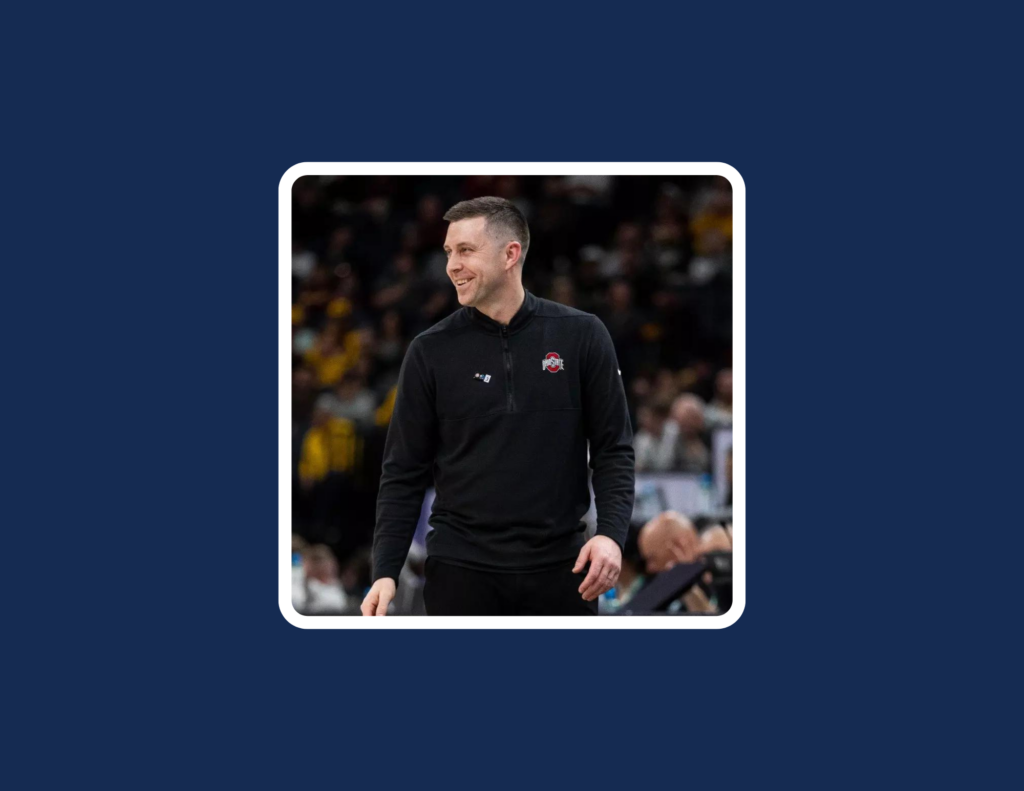
Jake Diebler is the Head Men’s Basketball at the Ohio State University. He has been with the Buckeyes for a total of eight seasons. He was a video coordinator with the program from 2014-16 and then returned as an assistant coach prior to the 2019-20 season. He was promoted to associate head coach before the 2021-22 season and then was named interim head coach on Feb. 14, 2024. The first Ohioan to be Ohio State’s head coach in 35 years, Diebler led the Buckeyes to a 6-2 record in his time as the interim head coach.
Following the Big Ten Tournament, Diebler was named the full time head coach and led the Buckeyes to the quarterfinals of the NIT. Overall, Diebler amassed an 8-3 record as head coach at the end of the 2023-24 season.
Jake began his coaching career at Valparaiso with Bryce Drew from 2009-2013. He also worked for Drew at Vanderbilt from 2016-2019.
As a player Jake holds the all-time Ohio high school career records in both assists (835) and steals (578). At Valparaiso, Diebler finished his Crusader career 10th with 130 career steals and 16th all-time at Valpo with 229 career assists.
If you’re looking to improve your coaching please consider joining the Hoop Heads Mentorship Program. We believe that having a mentor is the best way to maximize your potential and become a transformational coach. By matching you up with one of our experienced mentors you’ll develop a one on one relationship that will help your coaching, your team, your program, and your mindset. The Hoop Heads Mentorship Program delivers mentoring services to basketball coaches at all levels through our team of experienced Head Coaches. Find out more at hoopheadspod.com or shoot me an email directly [email protected]
Be sure to follow us on Twitter and Instagram @hoopheadspod for the latest updates on episodes, guests, and events from the Hoop Heads Pod.
Make sure you’re subscribed to the Hoop Heads Pod on iTunes or wherever you get your podcasts and while you’re there please leave us a 5 star rating and review. Your ratings help your friends and coaching colleagues find the show. If you really love what you’re hearing recommend the Hoop Heads Pod to someone and get them to join you as a part of Hoop Heads Nation.
Take down some notes as you listen to this episode with Jake Diebler, Head Men’s Basketball Coach at The Ohio State University.
What We Discuss with Jake Diebler
- Growing up in the Diebler house – “It was all ball all the time. A lot of the time we spent together as a family was in the gym.”
- The prevalence of guys working out individually today versus playing more pickup in the past
- The depth of skill in today’s players regardless of size or position which allows coaches to be more flexible and creative
- The traits he looks for in a competitive player
- The influence of his father on both his playing and coaching career
- Getting his start in coaching at Valparaiso after injuries prevented him from playing overseas
- “There’s that void when you stop playing and I was just wired to compete at everything.”
- Coaching with passion and enthusiasm in varied circumstances
- “I’ve seen firsthand when you’re willing to spend time with people and you do it from a genuine place of helping them, wanting to help them grow. I’ve seen how impactful it can be.”
- The influence of Homer Drew, Bryce Drew, Thad Matta, and Chris Holtman
- “Your best job interview is the one you’re at.”
- Don’t look ahead in your career, focus on where you are right now
- The value of time and making a commitment to help players grow and develop
- The challenges and emotions of taking over from Chris Holtman as the interim head coach last season
- The mission of growth and development that is shared by the entire staff
- “There’s a tradition in this basketball program and a standard of competing for championships and advancing in the NCAA tournament. And we got to get back to that.”
- “It’s hard to win at a high level consistently in college basketball. We want to get there. That’s where this program belongs.”
Like this show? Please leave us a review here — even one sentence helps! Consider including your Twitter handle so we can thank you personally!

We’re excited to partner with Dr. Dish, the world’s best shooting machine! Mention the Hoop Heads Podcast when you place your order and get $300 off a brand new state of the art Dr. Dish Shooting Machine!

Prepare like the pros with the all new FastDraw and FastScout. FastDraw has been the number one play diagramming software for coaches for years, and now with it’s integrated web platform, coaches have the ability to add video to plays and share them directly to their players Android and iPhones via their mobile app. Coaches can also create customized scouting reports, upload and send game and practice film straight to the mobile app. Your players and staff have never been as prepared for games as they will after using FastDraw & FastScout. You’ll see quickly why FastModel Sports has the most compelling and intuitive basketball software out there! In addition to a great product, they also provide basketball coaching content and resources through their blog and playbank, which features over 8,000 free plays and drills from their online coaching community. For access to these plays and more information, visit fastmodelsports.com or follow them on Twitter @FastModel. Use Promo code HHP15 to save 15%
Your first impression is everything when applying for a new coaching job. A professional coaching portfolio is the tool that highlights your coaching achievements and philosophies and, most of all, helps separate you and your abilities from the other applicants.
The key to landing a new coaching job is to demonstrate to the hiring committee your attention to detail, level of preparedness, and your professionalism. Not only does a coaching portfolio allow you to exhibit these qualities, it also allows you to present your personal philosophies on coaching, leadership, and program development in an organized manner.
The Coaching Portfolio Guide is an instructional, membership-based website that helps you develop a personalized portfolio. Each section of the portfolio guide provides detailed instructions on how to organize your portfolio in a professional manner. The guide also provides sample documents for each section of your portfolio that you can copy, modify, and add to your personal portfolio.

Hey, coach! Want to take your team to the next level this season? Introducing GameChanger, the ultimate game-day assistant with tools to give you a winning advantage. With GameChanger, you can track stats, keep score, and even live stream games, all for free! Get the stats and crucial game video you need to lead your team to victory, all from the palm of your hand. Coach smarter this season with GameChanger. Download GameChanger today on iOS or Android and make this season one to remember. GameChanger. Stream. Score. Connect. Learn more at GC.com/HoopHeads
THANKS, JAKE DIEBLER
If you enjoyed this episode with Jake Diebler let him know by clicking on the link below and thanking him via Twitter.
Click here to thank Jake Diebler via Twitter
Click here to let Mike & Jason know about your number one takeaway from this episode!
And if you want us to answer your questions on one of our upcoming weekly NBA episodes, drop us a line at [email protected].
TRANSCRIPT FOR JAKE DIEBLER – THE OHIO STATE UNIVERSITY MEN’S BASKETBALL HEAD COACH – EPISODE 995
[00:00:00] Mike Klinzing: Hello and welcome to the Hoop Heads Podcast. It’s Mike Klinzing here without my co-host Jason Sunkle this morning. But I am pleased to be joined by the head men’s basketball coach at The Ohio State University, Jake Diebler. Jake, welcome.
[00:00:13] Jake Diebler: Happy to be here, Mike. Thanks for having me on.
[00:00:15] Mike Klinzing: Thrilled to have you on. Looking forward to diving into all the things that you’ve been able to do in your career. Let’s start by going back in time to when you were a kid. You grew up in a basketball family. What’s it like growing up in the Diebler household when it comes to basketball?
[00:00:29] Jake Diebler: It was all ball all the time. A lot of the time we spent together as a family was in the gym.
And my dad being a coach, us having gym access, and we always seemed to live really, really close to the gym. So that certainly helped. But even my mom coming in and being a part of it, we spent a lot of our family time together in the gym.
[00:00:51] Mike Klinzing: How much of your time as a player is spent working on your game in the gym with your dad or with your brother by yourself versus Playing pickup games, playing AAU, how did you balance that out as a young player?
[00:01:08] Jake Diebler: Yeah, all of it was important. From the time I was about 11 or 12 years old, my dad had us going up to the gym and, and starting our workout by 5:30, really five days a week. From the time I, whatever that was, fifth, sixth grade, all the way through my senior year before I went off to college.
So there was certainly a lot of individual skill development, but we traveled nationally, both John and I played for an AAU program called All Ohio Red here based out of Columbus. So we traveled nationally with that. And back then you played pickup all the time. Whether it was open gym two on two, three on three, playing outside, playing at parks you were always playing. So, it was all three of those kind of different avenues of time were important for us.
[00:02:00] Mike Klinzing: How does that compare to the guys that you’re recruiting and that you have on your team in terms of the way that they come up in the game. Do you think it’s similar, dissimilar? Just how do you approach that or how do you look at that?
[00:02:13] Jake Diebler: I think you’re seeing there’s a travel element that’s different now. Back when I played AAU, you played a lot more regional tournaments and played only a handful or a few national ones, but you traveled to Indiana to play a tournament or teams from the Midwest would come to Ohio, you travel more regionally.
So there’s a travel component I think that’s different. I think guys now spend more time with individual trainers than when I was coming up and we played more, even when I was in college, after practice, we would play two on two, three on three or we would get on a weekend, we would get guys together, go in, play twos or threes versus now, I think you’re seeing guys more often are coming in and working on their own individual game.
[00:03:04] Mike Klinzing: How does that impact you from a coaching standpoint in terms of strength and weaknesses that the players may bring to your team? I know one of the things that I’ll talk to coaches about is that sort of the demise of pickup games has Maybe hurt the competitiveness in some way and guys hate to lose because there’s always another game coming around or maybe the, the basketball IQ because they’re just not playing as many games and they’re working more on the individual skill, which clearly I think there’s no doubt that the individual skill level of players is higher today than it’s ever been.
But when you think about, again, your experience and just, as you said, playing more pickup and playing more twos and threes versus just. Working out by yourself on your individual skills. How does that impact how you coach?
[00:03:52] Jake Diebler: You know, I think you’re absolutely right. There’s the increased skill level and the depth of skill regardless of position or size that you have within a team is probably the highest it’s ever been.
Which as a coach, it gives you a lot of flexibility and an avenue to be creative when designing sets and things like that. So that’s all positive. I don’t know necessarily that it’s, I think you have to be more intentional than ever, I guess, when it comes to recruiting and identifying who is competitive in recruiting, because I think there are varying levels and competitiveness and guys coming up in at the age we’re starting to recruit.
And we certainly want here to identify who has that competitive edge and who plays with that. But I don’t think it’s like this epidemic where there’s no competitiveness in new sports. People are still competing, but I do think you have to be a little more, just aware and evaluate better maybe than you had to 10, 15 years ago at the level of competitiveness each individual has.
[00:05:09] Mike Klinzing: What do you look for when you’re trying to figure out, hey, does this kid have the competitive nature that we need in our program? What are some signs or things that you try to look for or conversations that you have with their high school coach, their AAU coach? What are the things that you’re looking for as far as competitiveness goes?
[00:05:29] Jake Diebler: I think you’re looking at motor, you’re looking at time commitment, what kind of time they spend in the game. You’re looking at guys who, and I’m trying to identify, do they understand the time and the score at the end of the game? Are they putting the team first with the decisions they make?
There is competitiveness when they have the ball in the hands or in their hands or is there competitiveness on both ends of the floor. I think you’re trying to look at all that and how physical they may play. There’s different elements certainly to competitiveness, but some of it is a coach’s feel.
I think too, you’re watching out there and you can sense an energy. Communication I think good leaders typically are really, really competitive, right? So you can see that communication element to it. And yeah, it’s something we’re certainly mindful of.
[00:06:26] Mike Klinzing: Thinking back to your time as a player and obviously the influence of your dad, did you always know that you wanted to be a coach or was that something that came on your radar as your playing career is coming to an end and you start looking around and saying, Hey, I gotta figure out a way to stay in this game.
I don’t know if one of those avenues, either one of them sort of defines the way you came to coaching.
[00:06:50] Jake Diebler: Yeah. I did not go to college thinking, hey, I want to become a college coach. I went to college, had a pretty good indication after my freshman year of college that I probably wasn’t going to go play in the NBA, but it didn’t stop me from investing all the time and energy I could into being a good player because I just loved being a part of a team.
I wanted to compete to win a championship, but I just, in my mind, I went to college thinking, Hey, I want to go own my own business and make a lot of money. I was motivated by that. Both my parents were educators, lifelong educators. And so I thought the pathway to happiness was making tons of money and owning my own business was going to be the way I was going to do it.
That all changed when I went to college and I actually got saved in college, became a Christian and the people who influenced me most in that were my college coaches. And in that moment, when that life change happened for me, I wanted to coach. I think certainly I always had it in my DNA. I was voted a captain my sophomore year of college after not playing hardly at all as a freshman.
I certainly was around it with my father. I saw the influence he had on people and coaching and I was always relationship driven, was blessed to have an understanding early on in my career of the game and that certainly grew as my experience grew. But what I’m doing right now, I view as a calling.
I think this is more of a calling. This is, God has put me in this profession because I’m passionate about impacting young people like I was impacted when I was in college.
[00:08:36] Mike Klinzing: What are those conversations like with your coaching staff at Valpo when you start thinking about Hey, I’m going to get into the coaching profession.
Are they giving you advice as to, Hey, here’s some things that you can do? Obviously you’re well connected through your dad. Just what’s the process like as you start to shift your mindset there towards coaching?
[00:09:00] Jake Diebler: Well, it’s interesting when I said, Hey, I think I want to be a coach. They were like, well, yeah, no kidding.
Like what took you so long to figure that out, you know? But it was great. I finished my senior year playing at Valpo. I was pretty banged up. I had a real bad shoulder injury that I played through the rest of the year. And in my mind, I thought I could go play in Europe in some league worked my way up.
I did want to play professionally, but I physically wasn’t able to after my senior year was over. So I started that year as I recovered and rehab and stuff. I was a student assistant coach. And after that year, when my plan was like, Hey, I want to maybe try this professional thing.
Believe it or not, there weren’t a ton of huge lucrative offers for me to play professionally anywhere. And I knew at that time, it just was really burning in my heart that coaching is what I wanted to do. So they kept me on another year to finish my grad degree at Valpo.
And I completely put it out of my mind, this idea of playing professionally and that kind of really that second year at Valpo really jump started my coaching career.
[00:10:14] Mike Klinzing: What did you love about it right away? Because obviously you’ve been around the game, your dad’s a coach, so you’ve seen the life of a coach kind of from the inside.
But when you actually take that step and you get on the coaching staff, What is it about it that really grabs you and says, Hey, I know I’m in the right place.
[00:10:32] Jake Diebler: Well, coaching uniquely feeds the two things that I think kind of fill my bucket up. And that’s the competitiveness, right?
Cause there’s that void when you stop playing and I was just wired to compete at everything. My wife doesn’t even like, we don’t play games in our house. It gets a little ugly. So coaching fills that part. Certainly. Which I need, I needed an outlet for that. The other part that coaching does is I’m motivated. I get fulfillment. I get joy out of seeing people grow and develop and coaching is like a blank canvas when it comes to that, and so those two things, the competitive nature of being around a game that I love, that’s been so good to me, and then having this kind of vessel, this platform to really pour into people, help them grow and develop, both certainly on the court, but also off the court is just why I love it so much.
[00:11:35] Mike Klinzing: What part of your dad. As a coach, do you carry around with you that you feel like is an important part of your characteristics?
[00:11:45] Jake Diebler: I think what I learned from my dad coaching early is you can coach hard both but you have to coach with the same enthusiasm and passion that you do when mistakes are made or during accountability moments, you have to have that same enthusiasm and passion when good things happen, and it’s okay to coach with the joy and an energy if that’s who you are and that’s who I am and I got that from him, so it’s very easy for me to be comfortable coaching because I get to be who I am.
And I learned the value in that from him. And I’ve seen firsthand when you’re willing to spend time with people and you do it from a genuine place of helping them, wanting to help them grow. I’ve seen how impactful it can be, but my dad. There’s still guys who played for my dad before I was born that he, that he still talks to and has relationships with and, and, and so to see what basketball can do to connect people.
I saw that from the time I could start walking to still getting to live it out today.
[00:12:54] Mike Klinzing: Yeah, I mean, there’s no doubt about that. I think when you start talking about what ultimately is important as a coach and clearly. The higher the level you go and the level where you’re coaching at now, wins and losses are clearly important.
And yet, at the same time, when you really look at the impact of what you can do as a coach, the fact that, again, your dad has guys that, you know. Were around way before you were around that he still talks to and is connected with, like they probably don’t remember their records from some of those years, but you can bet that they remember the relationship.
And just, again, the way that your dad was able to support and help them to grow and all the things that you were just talking about that you’re doing. As a head coach, when you think about your time as an assistant, so at Valpo, at Ohio State, at Vanderbilt, and then you get an opportunity to be a head coach, what did you learn during those years as an assistant that helped you to be a better head coach and maybe help you to understand what your staff, once you’re a head coach, needs from, from you as the head coach?
[00:14:01] Jake Diebler: Well, I think first off, you gotta look at the people that I’ve had an opportunity to work for two Hall of Famers. and Homer Drew, Bryce Drew, who’s taken Grand Canyon University to new heights and has Been to the NCAA tournament in three different places and just development, like his ability to help players develop.
He was my position coach when I was at Valpo. He was working for his dad. I was playing for his dad. And then Chris Holtman who’s like, there’s a steadiness and then his track record. I’ve been really, really fortunate to work for great coaches and elite people. So not every assistant coach has that luxury.
And I don’t take that for granted for a second. So in doing that and to certain varying degrees, right. But I think all of them for the most part created a pathway for me to grow while I was working for them. So I’m grateful for that. But I can’t go out and coach and try to be Homer Drew or try to be Thad Matta I have to be myself.
But the last probably 10 years I’ve been in coaching, I’ve really tried to be intentional about watching them and seeing how they came about to decisions. What decisions did they make? Things that maybe in my mind that,if I were given an opportunity, I might do a little differently, but more just watching and listening and there was a great deal of value in that.
And so I’m grateful for the people I’ve worked for. And I feel like who I am as a person is, and as a coach and how that’s been developed. All four of those guys have played a part in that. So I’ve learned a lot.
[00:15:59] Mike Klinzing: What area of coaching do you think, when you look back to when you were a first or second year coach to where you are now, what area do you think you’ve grown the most in terms of your coaching ability or your coaching techniques or however you want to approach that question, what area do you think you’ve grown in the most over the course of your time as a coach?
[00:16:23] Jake Diebler: I’m a big believer in my ability to help players develop certainly individually, both on and off the court.
And I learned early on the value of time. It’s a commitment to do it, and you’ve got to be willing to spend the time with guys, and that’s something, and thankfully my wife is equally as passionate as I am about helping these guys develop both on and off the court, so she understands the time commitment that’s required to do that.
So that was, that was something, I think early on in my career, in full transparency, I was spending too much mental space thinking about what was next. And how to move up in the coaching profession and things like that. And, I got some advice early on, your best job interview is the one you’re at.
And that really changed my mindset. And I think even when I was interim coach here, part of the reason I was able to, I think, impact these guys is I wasn’t thinking about what was next. I wasn’t thinking about it, I was trusting God would provide for me and my family.
I didn’t know what that was going to look like. But I was just focused on serving our players and serving our program as well as I possibly could through the end of that season. And now that I’m the head coach here, I don’t think that mission hasn’t changed. That’s ultimately what I’m tasked with doing here.
Now we have to win. Absolutely. I understand that, but I think the pathway to winning is we’ve got to recruit good players. Certainly we have a great staff. All of that stuff is important, but ultimately it’s like as the head coach, I got to serve our players in this program as well as I possibly can. And then watching guys in game and having to make some decisions, whether it’s calling some plays, being able to fill in as a head coach for a couple of games before doing this, all that stuff was important.
But I think the player development. It was an area I really grew in and then, being where your feet are, like so often young coaches, we get, we fall victim to try to move up and, and, and we feel like we can move up quickly. And certainly you can, it just, the best way to do it I’ve found is being fully committed and focused on doing the absolute best you can where you are.
[00:18:42] Mike Klinzing: What was the mentality when you take over the team towards the end of the season last year? How do you sort of reset the way you’re thinking in order to Give that team the best of what you had and put them in the best position to have the success that you guys had down the stretch.
[00:19:02] Jake Diebler: You know, it was really hard because you had a friend who was going through, I mean, it was hard on all of us, right?
Whole staff, players, but obviously hardest on Coach Holtman. And that was probably one of my biggest struggles in that whole time was like trying to compartmentalize to some degree emotions and feelings because your heart feels for him and his family at that time, but at the same time you had to you couldn’t walk around with that emotion on your sleeve in front of the players and we had to move the program forward and finish the year well.
So there was a lot of mixed emotions and it was for me personally, that part was hard, but I got great advice from some people in the profession and some people who are mentors of mine or friends. And they all said, you got to be yourself and you have to create a way to be yourself.
We couldn’t make all these wholesale changes at that time. That was going to be counterproductive. We made some. We increased the pace. We changed how we practiced. We didn’t necessarily change all the drills. We did a couple, made some adjustments, but we changed how we practice, the pace we practice with, the urgency and stuff.
But the mindset behind that was it fit who I was and it created a opportunity for me to be the best I could be for our guys. Because ultimately that was the best way I was going to serve them was to be the very best I could for them, not for me, for them. So it was a hard time, but I had a great circle around me that was able to help me, I think, get through that and keep the focus on the players and the program.
[00:21:02] Mike Klinzing: Once you officially are named the head coach and you put together a staff, what are those planning meetings look like? And what are you guys talking about? What were some of the key things that you felt like were going to be drivers of your success moving forward?
[00:21:22] Jake Diebler: Well, I think it was important for me before I could communicate.
To our players I had to communicate to our staff who we were going to be as a program foundationally, the values of our program, stylistically, how we wanted at least foundationally to play in between the lines and what we wanted to be about in between the lines. And you could probably ask anybody on our staff and they’d say, what’s the most important thing to me, and they would probably respond growth and development. I think the mission has not changed for me. It’s why I got into coaching. It’s that focus was a big part of why we were able to have some success down the stretch last year. And that’s what we’re committed to as a program here is helping guys grow and develop in all areas.
So I had to make sure that message was really relayed to the staff fully, but I also hired quite honestly, that was part of the hiring process were guys that I knew that was important to them too. Certainly we were able to hire a group that had just the depth of winning and experience was I’m really excited about that.
It’s going to serve our program well, but they also had their values needed to align with mine from the standpoint of like, we are going to help our guys grow and develop in all areas because there’s a sacrifice from our staff. It’s a sacrifice we have to make and spending time with our players and things to make sure we can do that at a high level.
[00:22:59] Mike Klinzing: Now that that plan is in place, you had a full summer with your team. As you look ahead over the next year, what do you see as being the biggest challenge to having the kind of success that you want to have? And then when you sit down at the end of this coming season, how are you going to define a successful season?
[00:23:22] Jake Diebler: Well, I think the biggest challenge right now is a lot of new pieces, new head coach, new system, and everything feels great. Guys are connecting. We have a great group of guys, but we gotta figure out and build the way to respond to adversity. Because the one thing I know that’s gonna happen, we’re in the best, the deepest league in the country.
18 teams, all 18 are like deep league. We’re going to face adversity, make no mistake about it. How we handle that adversity is going to be really important. Does it linger around for a few days or a week, or does it linger around for three or four weeks? That’s something ultimately we are going to have to build up an ability to resist adversity and fight through it well.
So we got to create some of that this fall, and we got to create some in practice to where we can get used to handling that, certainly in game, but in the larger context of things. But I’m excited about our group. And as far as defining success, there’s a tradition in this basketball program and a standard of competing for championships and advancing in the NCAA tournament.
And we got to get back to that. We have to get back to that. Now, we want to get back there as quick as we absolutely can. There’s no guarantees, right? It’s hard to do. It’s hard to do. It’s hard to win at a high level consistently in college basketball. We want to get there. That’s where this program belongs.
And so, that certainly, we’ll evaluate at the end of the year how quickly we’ve been able to do that. But then at the same time we’re gonna also evaluate success based upon how our guys grew and developed as people and players. And that’s an important part. So it’s kind of twofold there, the evaluating success, but we’re not going to shy away from the tradition and the standard of excellence that this program has had for decades.
And I don’t know if we’re gonna be able to get there tomorrow or it’s gonna, I don’t know how long it’s gonna take , but I can promise you we’re fighting, we’re fighting every day to get to back to that level. And that’s ultimately I think what our fans wanna see. It’s what our former players deserve and it’s what we’re working towards.
[00:25:55] Mike Klinzing: Absolutely. Alright, Jake, before we get out, I want to give you a chance to share how can people connect with you? Find out more about your program at Ohio State, just website, email, social media, whatever you want to share. And then after you do that, I’ll jump back in and wrap things up.
[00:26:09] Jake Diebler: Yeah, we got a great social media team, certainly as a department at Ohio State, but even within Ohio State Hoops.
And I would encourage people to get connected with us through that. We need Buckeye Nation to come out and support us. There was a time where the Schott was really feared I think in the Big 10. And so we got to get back to that. This arenas. It’s one of the largest in the country.
It’s great. So that’ll be part of it too. Come see us, come see us in person. And then I love having coaches and whether it’s coaches, trainers, whoever, basketball people come in, watch practice and you can reach out to us that way. So we feel like at Ohio State, we’re kind of as our AD Ross Bjork just mentioned this, like we’re a public person.
This is a public trust, our program’s the same way. So we want people to have access to us. So we’re open to that.
[00:27:06] Mike Klinzing: Jake, cannot thank you enough for taking the time out of your schedule this afternoon to jump on and join us. Really appreciate it. And everyone out there, thanks for listening and we will catch you on our next episode.
Thanks.