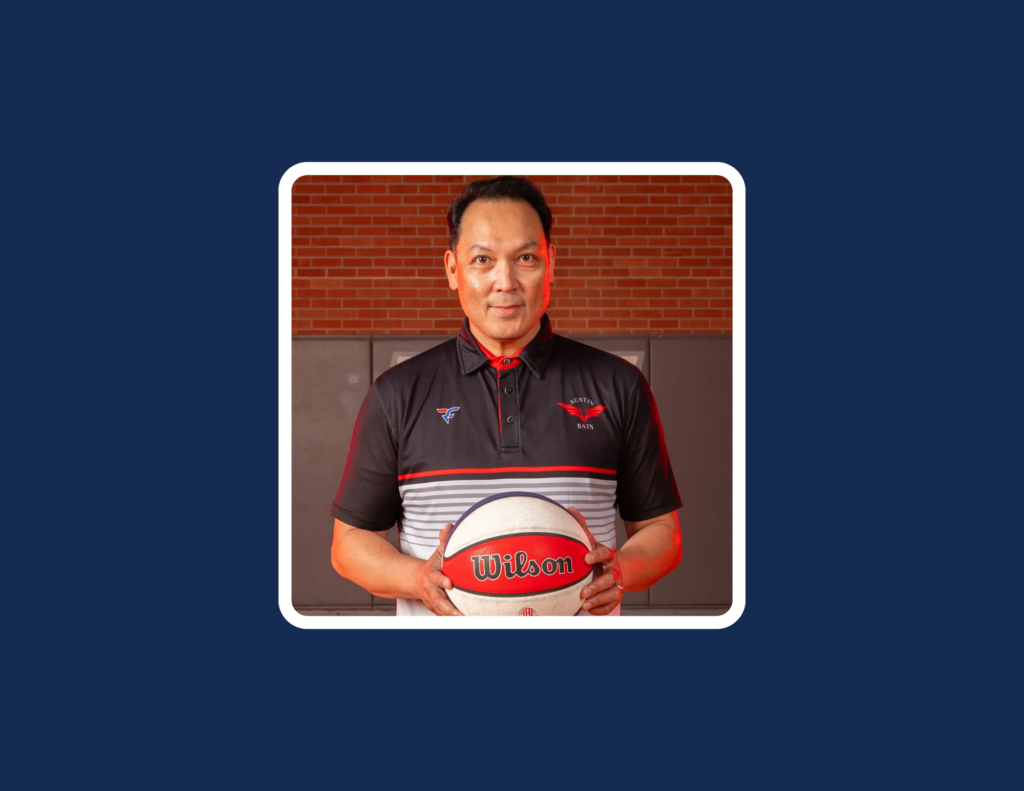
ROMMEL CORRO – HEAD COACH OF THE 2025-2026 ABA CHAMPION AUSTIN BATS – EPISODE 1291

Website – https://austinbatsbasketball.com/
Email – [email protected]
Instagram – @austinbatsbasketball
Rommel Corro is the Head Coach and General Manager of the Austin Bats of the American Basketball Association. He led the Bats to the ABA Championship in the 2025 – 2026 season. Corro was named the 4th head coach of the Austin Bats in 2018, taking over after the team reached the 2017–2018 ABA Finals.
Originally from the Philippines, Corro played high school varsity basketball in Lamar, Missouri, and is a U.S. Army veteran. Prior to joining the Bats, Corro brought eighteen-plus years of basketball coaching experience, most of it in high-level amateur competition, winning various tournaments and league championships, as well as experience organizing leagues and tournaments. In his first season coaching at the professional level with the Austin Elite Squad in the Texas Basketball Association, he guided the team to the 2018 championship along with multiple Final Four and Finals appearances. In his years coaching the Austin Bats, the team has finished with a winning season every year, three-time Division Champions, two-time Regional Champions, reaching the ABA Final Four in 2024–2025, and winning the 2025–2026 ABA Championship.
On this episode Mike & Rommel discuss his unusual path from growing up in the Philippines to becoming a basketball leader in the U.S. Rommel explains how he played multiple sports as a kid, discovered basketball later through summer practice, and deepened his connection to the game through the Filipino community and military life. Rommel then walks through his journey organizing Filipino leagues and eventually coaching the Austin Bats, including the roster-building, scouting, and mental preparation that helped fuel championship runs. He also breaks down how the ABA is structured, how the Bats fit into the Austin sports scene, and what it meant to win a title as a team. The conversation highlights perseverance, leadership, and the joy Rommel finds in building a team that keeps growing together.
Follow us on Twitter and Instagram @hoopheadspod for the latest updates on episodes, guests, and events from the Hoop Heads Pod.
Make sure you’re subscribed to the Hoop Heads Pod on iTunes or wherever you get your podcasts and while you’re there please leave us a 5 star rating and review. Your ratings help your friends and coaching colleagues find the show. If you really love what you’re hearing recommend the Hoop Heads Pod to someone and get them to join you as a part of Hoop Heads Nation.
Listen and learn on this episode with Rommel Corro, Head Coach and General Manager of the ABA Champion Austin Bats.
What We Discuss with Rommel Corro
- Identity comes after repetition, not before it
The idea – He did not become a coach because he had a clear ambition to coach. He became a coach by repeatedly showing up, organizing, adjusting, and eventually owning decisions until the role caught up with his behavior.
Why it matters – A lot of people wait to feel qualified before stepping into leadership. In reality, leadership often emerges from accumulated responsibility, not self-declaration.
In practice – He started by running Filipino tournaments, handling uniforms, managing teams, and only later realized he was already functioning as the coach and operator.
- Constraint can create better team design than talent alone
The idea – His best teams were not built by collecting the most names. They were built by assembling complementary roles under real constraints – size, injury risk, availability, and chemistry.
Why it matters – Teams fail when they assume talent is enough. Winning structures are usually about fit, not just quality.
In practice– The championship teams worked because the roster had the right mix of shooter, big, veteran, and specialist, and because he adjusted roles instead of forcing everyone into equal usage.
- Defense is really a coordination system, not an effort slogan
The idea – What separated his teams was not just hustle. It was the ability to rotate, recover, and stay connected when the first action failed.
Why it matters – Most teams think defense is individual grit. He treats it as a shared operating system that makes the team hard to break.
In practice – He went back to the film and realized they won ugly because missed shots were followed by organized backline help, rotations, and repeated stops until the other team cracked.
- Mental preparation matters more when the environment is messy
The idea – In leagues without perfect scouting, polished schedules, or stable conditions, the edge comes from clarity and repetition, not complexity.
Why it matters – When information is incomplete, teams do not need more tactics. They need more discipline around how they think, communicate, and reset.
In practice – His playoff routine focused on walkthroughs, pregame meetings, player tendencies, and keeping everyone mentally aligned because many opponents had no film and the games were decided by adjustment under pressure.
- A loss becomes useful only when it changes roster and role decisions
The idea – He does not treat losses as emotional events. He treats them as diagnostic data that should change who plays, how they are used, and what the team practices next.
Why it matters – Reflection without structural change is wasted pain. Good teams improve when defeat forces a sharper understanding of what the roster actually needs.
In practice – After a painful loss, he brought back older veterans who understood their roles, reduced overreliance on high-profile talent, and rebalanced the team around function instead of reputation.
- The best leaders create calm, not just direction
The idea – He wins partly because he stabilizes the room. When pressure rises, he does not add noise – he narrows attention and makes execution feel manageable.
Why it matters – Many coaches over-index on schemes. Real leadership is often the ability to lower panic so people can perform what they already know.
In practice – In late-game situations, he called timeouts, simplified instructions, and got players focused on the next possession rather than the size of the moment.
- A championship is often the side effect of a shared standard
The idea – The team did not just win because it wanted a title. It won because everyone internalized the same standard for preparation, defense, and accountability.
Why it matters – Culture is strongest when it becomes self-policing. Once players begin thinking and correcting like the staff, performance stops depending on the coach alone.
In practice – By the playoff run, players were contributing their own defensive ideas, arriving earlier, preparing together, and acting like the system belonged to them, not just to the staff.
Like this show? Please leave us a review here — even one sentence helps! Consider including your Twitter handle so we can thank you personally!
Your first impression is everything when applying for a new coaching job. A professional coaching portfolio is the tool that highlights your coaching achievements and philosophies and, most of all, helps separate you and your abilities from the other applicants.
The key to landing a new coaching job is to demonstrate to the hiring committee your attention to detail, level of preparedness, and your professionalism. Not only does a coaching portfolio allow you to exhibit these qualities, it also allows you to present your personal philosophies on coaching, leadership, and program development in an organized manner.
The Coaching Portfolio Guide is an instructional, membership-based website that helps you develop a personalized portfolio. Each section of the portfolio guide provides detailed instructions on how to organize your portfolio in a professional manner. The guide also provides sample documents for each section of your portfolio that you can copy, modify, and add to your personal portfolio.
Aiming to go D3? The D3 Recruiting Playbook gives you a clear, step-by-step roadmap to the recruiting process – what coaches value, key milestones from early high school through application season, and how to build a target list of schools that fit your needs.
We’ll demystify researching D3 programs and how to stand out without chasing every camp or showcase.
The modules cover things like writing emails to coaches, building an effective highlight tape, using social media well, planning ID camps and visits, and navigating application strategy.
You’ll get templates, checklists, and an outreach plan to communicate confidently, learn how to compare financial packages, and avoid common missteps. By the end, you’ll have a prioritized school list and a decision framework you can use to land your best-fit opportunity.

Give With Hoops is a groundbreaking initiative that fuses basketball analytics with modern sponsorship. Built for teams who see data as opportunity, from AAU programs to college powerhouses.
By tying on-court performance directly to community and sponsor engagement, Give With Hoops help programs raise more while deepening support from those who believe in the game.
Traditional fundraising disconnects donors from the action. Sell candy bars, wash cars, beg for donations, it’s exhausting and ineffective. Players perform better when their stats matter beyond the scoreboard. That’s why Give With Hoops was created.
Give With Hoops connects game performance to community support. Every basket, rebound, and assist becomes a chance to raise funds. Transparent, exciting, and proven to raise 3x more than traditional methods.
THANKS, ROMEL CORRO
If you enjoyed this episode with Rommel Corro let him know by clicking on the link below and thanking him via email.
Click here to thank Rommel Corro via Email
Click here to let Mike & Jason know about your number one takeaway from this episode!
And if you want us to answer your questions on one of our upcoming weekly NBA episodes, drop us a line at [email protected].
TRANSCRIPT FOR ROMMEL CORRO – HEAD COACH OF THE 2025-2026 ABA CHAMPION AUSTIN BATS – EPISODE 1291
[00:00:00] Narrator: The Hoop Heads Podcast is brought to you by Head Start Basketball
[00:00:20] Rommel Corro: It was kinda hard to put it in perspective because though we expect it to win, then when we get it, even though we were expecting it, it still feel like a surprise. Do we just do that, or how did it happen?
[00:00:38] Mike Klinzing: Rommel Corro is the head coach and general manager of the Austin Bats of the American Basketball Association.
He led the Bats to the ABA Championship in the 2025-26 season. Corro was named the fourth head coach of the Austin Bats in 2018, taking over after the team reached the 2017-2018 ABA finals. Originally from the Philippines, Corro played high school varsity basketball in Lamar, Missouri, and is a U.S. Army veteran.
Prior to joining the Bats, Corro brought 18-plus years of basketball coaching experience, most of it in high-level amateur competition, winning various tournaments and league championships, as well as experience organizing leagues and tournaments. In his first season coaching at the professional level with the Austin Elite Squad and the Texas Basketball Association, he guided the team to the 2018 championship, along with multiple Final Four and finals appearances.
In his years coaching the Austin Bats, the team has finished with a winning season every year. They are three-time division champions, two-time regional champions, reached the ABA Final Four in 2024-25, and won the 2025-2026 ABA Championship. Ever since I founded Head Start Basketball in 1993, we’ve helped young players develop their skills, confidence, and love for the game.
Now we’re partnering with coaches and athletic programs to bring the Head Start Basketball camp experience to new communities. Our camps run for five days, three hours per day, and serve boys and girls in grades one through six. You or someone on your staff directs the on-court portion of the camp, while Head Start Basketball manages registration, promotion, parent communication, T-shirts, trophies, website setup, and administration.
There are no upfront camp planning headaches, and the profits are divided 50/50 between your program and Head Start Basketball. If you want to reach more families or strengthen your youth basketball pipeline or just create additional revenue for your program, visit headstartbasketball.com to explore hosting a camp.
[00:02:32] Marcus Kahn: Hey, this is Marcus Khan, head men’s basketball coach at the University of Mary Washington, 2026 D3 National Champions, and you are listening to the Hoop Heads podcast
[00:02:43] Mike Klinzing: Listen and learn on this episode with Rommel Corro, head coach and general manager of the ABA champion Austin Bats. Hello, and welcome to the Hoop Heads podcast.
It’s Mike Klinzing here without my co-host, Jason Sunkle, tonight. But I am pleased to be joined by Rommel Corro, head coach of the ABA champion Austin Bats. Rommel, welcome to the Hoop Heads Pod.
[00:03:08] Rommel Corro: Yeah. Thank you for having this opportunity to get this I guess little interview with you guys, and looking for- I was looking forward to it in some kind of way, and I’m glad I’m here.
[00:03:19] Mike Klinzing: We are thrilled to have you on, and looking forward to learning more about your background, learning more about the ABA, learning more about the Austin Bats, and learning more about your journey, and how you got to where you are today. I know when we talked in our pre-call you told me a little bit about, just again, how interesting your path is.
So we’re going to get into that, and we’re going to start by going back in time to when you were a kid. Tell me a little bit about how you got introduced to sports, what your life was like growing up and just how you got connected to basketball eventually.
[00:03:52] Rommel Corro: My sports journey from childhood was a little unusual because I grew up in the Philippines mainly.
And I dabbled in different stuff, but I wasn’t really… Our, our family w- is not a sports-minded family in in, in a way, but we did a little bit of sports here and there. It was mainly table tennis. I also dabbled in darts. There’s also a sport called sepak takraw, which is like a volleyball with your feet.
I was Per se, I was in the varsity in that one. I kinda dabbled in soccer also, football as we call, the non-American football, but football, the soccer. And I did a little bit of basketball, but I was not very good at it ’cause nobody in my family played basketball. And just kinda… I played more of table tennis and sepak takraw, which is up to my late to the high school part and stuff.
And then I got here in the US around 16 years old or so and stuff, and that… I’m, for my… I am pretty tall for… And usually I wouldn’t say really tall, but none or for an ordinary Filipino or Asian I’m six foot tall, so I’ll– I’m pretty tall for compared to the masses and stuff. So I, I went to kinda like college in the Philippines in a way, but or high school.
They kinda “Hey, how come that you’re not playing basketball? You’re tall,” this and that, right? So I tried, but just never really got into it, there was no background in terms of training and all that. Like I said, my family is not into sports as much, so never got into it. And fast-forward to coming here in the US.
But all this time I was good in darts, I was good in sepak takraw, and I was decent in soccer and table tennis I was good. But I got here, around 16 years old and then finally got to high school here in… I went to Missouri in, in a town called Lamar, Missouri. And now it was a small town, population like 5,000 or less.
The school was 2A, so I went for my jun- my junior year I went, kinda went in there, and then during the summer I was bored, so I went to the park for like a whole summer by myself shooting basketball for three, three, four hours a day, like five days a week. And now I didn’t know noth- I don’t know what I was doing.
I was just shooting, just dribbling, shooting, dribbling for like literally for three months, four months on summer. Now my senior year I just kinda Was in the gym and then I shoot around and then this coach saw me and she said, “Hey why don’t you try out and play for, the team and stuff?”
And, it’s a small town, so they needed some kind of something different than the usual stuff. It’s a farm town, but it’s also a, a nice community and stuff, I was able to make the team, but I wasn’t really a rotation player per se, it was just like whatever.
But I was learning, but I was… Honestly, I was lost at the same time because I have no background of whatsoever in basketball. I didn’t know what training. Now, during the summer, that helped me a little bit ’cause I was shooting a lot, like shooting, just shooting, shooting, shooting at, like just from free throws to three-pointers and then I think there were some games that they leave me open, I was hitting shots, during some kind of small tournaments and you know how high school have, have tournaments.
I was able to do that. But over, over the time, like when I had to play, like they would put me in. If it’s a zone, I’m okay, right? It’s easy. But when they go man to man and we run our runs and we run our plays, I get lost. I get lost on like switches and stuff because I didn’t know nothing about that at that time.
So I get… basically I’m on the bench my whole, the whole time. I, even when I finished high school, graduated and stuff, I got, just they gave us a letter because we’re in the varsity and stuff. That was my one year in there. It’s a very small town. It was a two-way school.
So finished that. I end up joining the military US Army. And j- like at the same time I’m still… For me, I wasn’t thinking basketball no more. I’m just joining the military, trying to find my way in life and joined the joined that, and Desert Sto- Desert Storm, Desert Shield happened. So I was there for six months and then, thank God it just, it was a short, conflict and stuff.
And I got back. I got sent to I was in Kansas at that time. But even that, that route going there was also, I don’t want to go through it, but it was also kinda an odd thing, but military is military in a way. So I was there and then I was in Fort Riley, and then Fort Riley sent me to I got transferred to Fort Hood in Killeen.
I was there for three years. And then I just kinda met a lot of my native Filipinos that was also in the army, and they’re like, “Hey, you’re tall. How come… you play basketball?” I said, “Yeah, I used to play in high school.” So I end up going into it and coming back and playing, and then I kinda played, but never really…
I thought I was like, I was it because I was tall and big, but at the same time I was not really there was more skill involved to it than just being tall, so that and, I finished that, like I played a lot of b- basketball through like mini tournaments and stuff, or just group, weekend stuff with my g- with them.
And I get to, they… I get to understand a little bit of it, but at the same time, it’s still very foreign to me. So I’m learning, and then I, after three years of basketball there in the military with different kinds of like tournaments and just getting with… ‘Cause Filipinos, I don’t know if we’re crazy about basketball.
But when I was in the Philippines, I was not even connected to that culture per se, basketball culture. I got into it here after my military service. Out– I got out I went to Chicago. I kinda joined some random Filipino teams, and I played. I was decent, but not- nothing really to he’s, s- that e- that somebody would notice.
The reason they noticed me because I was tall. That was it. Other than that, then we– I continued to do that, and then I came from Chicago, stayed there for a year, and then I came back here to Austin and kinda figured out I’m not doing anything. And so I just started meeting different kind of people, mainly in the community, Filipino community, and we started playing basketball, having many…
Like every, if any of if you know at all, every tour- every city in the US have a league, Filipino league everywhere. And especially in the East Coast, West Coast, California, everything, they have tournaments they have going on. It’s a, it’s like a, for them it’s like almost like a mini religion in per se basketball.
So I get into it and just s- not really like religiously, but I’m into it because there’s… it’s it connects, it connected me to my, to the culture of the Filipino ’cause I was, when I was in Missouri, I was the only Filipino in the area and nobody else. And my friends they were not sporty.
Also, I have friends that are not into sports, but they, we were just friends, and we hang out, but they never even played sports. They never got into sports. We just in, in Missouri. So I got out and then it’s a long learning experience for me. And then I don’t know when I started really got into understanding of basketball, and I think what it was is during the ’90s.
The ’90s, I watched a lot of the Chicago Bulls basketball ’cause my cousins and my… ‘Cause I moved to Chicago after military, but during that time I was watching a lot of basketball. Michael Jordan was the main thing, main attraction. And prior to that I w- I was already hearing about Larry Bird all the time, but I never really paid attention to that.
But it was the, the Jordan Jordan b- run that I kinda noticed basketball. I keep watching, like watching. I started understanding what it is, but at the same time, I just understand everything like, “Oh, that was good,” but never really understood how everything works in terms of training and coaching and all of that.
It’s, it took a while for me to get there, like it’s a long, it’s kinda like a long story. I’m trying to shorten it, but it’s a long because after that, let’s say I, I got to here in Austin. I cr- I have our organized teams and leagues and all of that. And then at the same time We… It was just going on for like years just doing that years and years.
And then I got tired of like the same people playing and so I was like, “Okay, let’s, let me step out of that and just play.” I would go to like random gyms by myself and shoot around. I would– Sometimes I would bring my whole team, which is the Filipino group. It’s like, “Hey, let’s go play over there. Let’s play.”
And we go early in the morning and there’s nobody there, so we, like we had the gym ourselves. So we just played. Nothing really, nothing to it, just played. Now over time, I kinda get to know some people, m- met some people here in Austin and stuff. And that was like in the 98, ’99 and stuff, I, when I moved back here and I kinda started doing that.
And then I started hosting tournaments. I invited teams from… Somehow people hear stuff, so I invited teams to come here from Houston, Dallas and stuff, San Antonio. End up hosting a lot of those year on, year in, year out. They come, twice a week. And to- like sometimes we do a every two months tournament.
Over time really it kinda went on. And then 2005… it just keep going until like 2007. There was like a, a big national Filipino tournament. I never knew about it. Just somebody was just like, “Oh, we went there and we won.” They won a na- they won a national championship for like Filipino nationals, which is r- you represent like a city.
Let’s say Houston. I play… So these teams are coming, like some teams are from Canada, some teams are from the East Coast, New York, Washington D.C. Philadelphia, all the East Coast, New Jersey. All the East Coast teams that are populated with a bunch of Filipinos they got programs that the kids from eight years old all the way playing all the way through.
Like even the old folks, the veterans that still play, some of them have played college and then, and they still play right now, like 60 years old, they still play. Even like yearly they go to tournaments every year. So I got into that one, and the first time I got my own team was 2011. Put it together. I was able…
It was the, the host was in Houston, so we got, I got a few tea- I probably was able to brought in six teams with different ages and stuff, and they have a open team. My open team was, we were pretty good, but at the same time we didn’t really have time to acclimate each other and practice and stuff.
But I know everybody, and I kinda because I was organizing, I didn’t coach. I just kinda “Okay, you guys take care of that and you guys do it.” At some times I was like, “Okay, I’ll help out and…” But I never really kinda be like in charge of stuff. It’s more of “Okay, since you guys are here, I’m just going to be in the background just helping stuff here and there.”
Come to 2012
It was a Canada tournament, Filipino Nationals. It was in Vaughan, which is close to Toronto, Vaughan. I took a team, maybe took three teams. There’s an open team. I had six players in my open. I know that we are going to like very good. I know that we were going to be a very good guy. But six teams, I was worried.
Six players, I was so worried that one of them would just twist their ankle and we’ll be done. But… And because the reason that I know that we’re good, because all the players, I didn’t even realize ’cause I know they were good. I didn’t even realize that all of them have a little background. Like they went– Some of them went to college, they were varsity players, and they were like impact players on their team.
And I recruit- I was able to recruit this dude. He was 6’7″. And he was part Filipino. I never met him in person. I just talked to him. I text him. It’s like, “Hey, somebody told me that you’re interested in playing.” He’s from California, and he just finished college in Nebraska somewhere, like a small, JUCO or it’s like Division II and Division III college.
He just finished. And I told him “We’d be in– you’d be interested to go to Canada with us?” And he says… I didn’t hear from him for two days, and then in, in the third day he text me. He said, “I think I’ll be able to.” And then, and the thing, the and the thing with Dave is like, ’cause I have a partner, and he says, “You just, if you can just fly yourself over there you can just room with us and take care of the rest and stuff.
We don’t have to spend extra money.” So we’re able to do that. He, we met him, and he just gelled well with us. He was six… He was like six seven. He’s pretty tall and very athletic. So when we got there, we, it, we played against a team in Toronto that were very physical and stuff, and they basically like double team, triple team him.
But we end up still winning that one because our, the, the, the other players that we have in our team was also smart enough to, to just, take good shots and all of that. And then at that time I wasn’t coaching, so somebody was coaching that too. I was just there organizing everything. And we went to the championship with six players, and the other team had 15.
They were deep, 15, and they had their fans was all over the court. Like every time they make a shot, they would almost like rush the court. It was in, this was in in, in Toronto area, and so it, there was like the big dome over there that they have different courts. They… And we end up winning that one.
So that was my first big win in terms of kinda a big deal win, ’cause we wi- I win in locals a lot, per se. Not like a lot, but enough to where oh, we went and stuff. We, I’ve wi- I’ve win enough in the local stuff tournament. That was the big deal that we, I was able to win that and Because I selected the players, even though I didn’t coach, somebody was coaching they I was still have my hand in everything, picking every one of them.
And they were all buying what we’re trying to do for the team. And then we won the following year, the big man we have, he went pro, and he was the number one pick in the professional team in the Philippines. He was the number one pick. So I was happy for that.
And one of my players, actually, he was a guard. He’s my, our point guard. He was really our… that’s also the reason that we won because they could have been… We– I gave the ch- the MVP to my, to the big to our big, but they could have been co-MVPs. But I just give it to him because it will give him more resume ’cause the guy, my point guard, he was going to be a physical therapy doctor and stuff.
So he said, I’m not going to… I know my window of playing at my level, it’s I have a lot of competition, so it’s not going to be, I’m not going to waste my time doing that, so I’m just going to be staying here and do that.” And he stayed there, and he still plays, and he’s still pretty good. He was like, he’s really my best, one of my best point guard I have.
And so now my big that was MVP, he still plays over there since 2012. So he’s still making money over there and he’s been there for, like, all these years every time. And over that time, we keep going to that tournament now. We have some local tournaments here and there. We, I win here and there too, 2014, fif- ’13, ’14, ’15, and ’16, ’17.
So out of those time, those stuff, we, I We went to the championship maybe four times and lost every single time. Because the teams we were, I always felt we were missing something. Just not enough players. I had five or six, six, six players or seven. And we just didn’t have– We had the players sometimes, but the dynamic of everything just didn’t click, the other team was just better. So come 2018, I I I had, I think I had a team. So I was like, I had a team. I had a big, he was also about 6’5″. Then I have good role players. And then I asked one player that I’ve always wanted to come and he showed up. I asked– I had to use my, I had to use my mileage, card mileage for him to show up in, in Mon- it was in Montreal.
It happened in Montreal, Canada again, 2018. Same thing. We played really good, tough teams and stuff. But come down to The finals, the players I have, I had a really good point guard very s- D1 player, Filipino D1 player. He wasn’t big, but he’s very fast. I had co- Most of them, my starters were high-level players, but the main difference was my bench player.
Like he’s, he was actually, he pl- When he was 16, he played for the Philippine national team when he was 16 years old. So I was able to get him. He was he lives in McAllen in, in Texas, in McAllen. So I was able to get him. He showed up, and I basically, he’s coming off the bench every, every game. So but he end up being the MVP because every time I put him in, I, ’cause I have a veteran in the team, so I let him start for five, six minutes, and then when he comes in, the veteran just kinda sits down and ’cause the veteran was still good.
He was just a little bit slow. He was still smart but the guy that comes in for him was he was just a bucket getter. He was getting buckets, and he’s 6’2″ with a big body got good hops and everything and he changes the game for us. But I do have height on my like my guards. So I have my shooting guard was 6’2″, my, my big 6’5″, but he plays like a guard.
So the, that was a mismatch on the other team, on the other bigs that they have because they would guard him, and he would just ball flat. I, he can still guard the middle a little bit, but we kinda design our… I wouldn’t say we design, we just kinda talked about it, and the our defense just started clicking.
They understand rotation, and that’s when, that’s where I– When we won that, that championship, I didn’t even know how we did it. We just won, right? So I went back and looked at the film, and I looked at like it was ugly, but every time we missed a shot, we ran back defense, and we he- like even if we, they get the, the guards would get beat, the backside guys would help rotate and help the drives or kick out, whatever.
They, they kept rotating and stuff. And that was the problem that the other team was, they were not catching to that one. ‘Cause even though we missed, they would miss two times, three times, and we would miss one time and then, but we scored the other possessions every time. It was a ugly game, but we won by 10 or fif- 10 or eight, eight to 10 points stuff.
But the team that we played had some former pros in there, but they were the team from Toronto again, ’cause they were– The Toronto has a big Filipino community, and they have good stuff. So that’s how my stuff in there and then In the local scene in terms of the ABA, in 2016, ’12, something like that, they started the ABA team here.
And I know the guys that played I know the the people and stuff, but I never really got involved. And they s- they just tend me to like… ‘Cause I do sell I dabbled in doing custom uniforms since 2010. So I was doing that for AUs and stuff, and so they kinda reached out to me about that.
But n- they never got into it, and so they got their own uniforms, and I just let them be like, ’cause I was busy with other stuff. And I’m doing– I was still doing the Filipino stuff and leagues and all that. I was doing that. And over time they… It was actually called– They were called the Austin Boom.
They were called the Austin Boom. They would win tournament the division a few times. They went to the Elite Eight, and but they lost in the first round. And at that time, I was not involved at all. And then 2017, they
Austin hosted it, the final Elite Eight, the Elite Eight for the ABA. They hosted it and they won ’cause they had a good team too. They won the following y- the, they won their division and then they went to the finals against the, the Giants, the Jacksonville Giants. And Jack- Jacksonville Giants was a very good team.
They were very run very well. They were really like a run, like pro type stuff. But during that time, the, the Austin… they were already the Austin Bats. I think they were established already for since 2012. They were Austin Bats, but I think they were only Austin Bats for three or four years because they were Austin Boom before.
‘Cause the owner purchased the rights and she changed the name to Austin Bats at that time. And actually the owner, she designed that logo herself. She made that logo herself, and and got that and the reason I got close to them more ’cause they ordered uniforms from me.
The uniform they used on that, that s- that season was my uniform. And so I was just there and their GM, he’s the one that reached out he picked up the uniform and said, “Why don’t you coach us?” I said, “Nah, I’m not really ready. I don’t kn- I don’t know what the hell I’m doing in terms of that level.
I don’t know. I don’t know.” So I didn’t. He asked me for like maybe a year or two before that. But it was just like a conversation, nothing really like, “Come and, coach us.” It was just like, it was just something like friendly you know. And then over time, I went to the finals and watched them play and they lost.
The players that they have was good, but the other team just kinda have some breaks in there and they lost. Like it was a good game. They lost by I think four or six points, maybe eight maybe the most and stuff. Maybe between six or eight points. But it was a close game throughout until the last four or five minutes, maybe three minutes of the game.
That’s when everything kinda, starts doing stuff, but it’s… And then the following year when they lost that, the owner called me and “Hey, why don’t you-” come aboard and be the coach. But at that time, I didn’t say yes yet. So one of the players that used to play for them, it’s, he’s he came to me.
There was a summer league going on here in Aus- in Texas called Tex… It was a b- league called, just a local league in Texas called Texas Basketball Association. And he says, “Let’s put a team together and join this league, and I think we can win it or we can compete at, be in a top five team.”
And there were like 20 teams in the, in that. Mostly Dallas teams. There were some Houston teams, a few in San Antonio, and few in between. But majority was in Dallas. So we join and we… They… I said, “I don’t know a lot of players, but I know only you and maybe one or two guys.” And said you have to bring me players.”
So he brought me some players, and I looked at them. I was like, “Oh, I know them by face or by name, but I never really talked to them.” And they like, “Okay, we’ll play.” So we played, and we end up really… We went through the First game of the season, I… The first game I coached, and that was, it was just me and them.
So I co- going in there I was like, “What I got myself into?” ‘Cause I don’t know nothing about this. But it was just, it was a simple, it was just a game. At the same time I was able to manage enough, rotation of the game and all of that. Even though we didn’t really run a play but we… I was able to calm them down on situations and stuff, and we won the game.
And so after that, after like a, a day or two after that game I was like I think I can do this.” So we went through the season and we actually maybe, what, maybe just lost one game, and then went to the playoffs and we won. We end up winning it by… It was, the finals was a three-game series and we went…
Houston had a… We went to Houston first because they had a, higher seed in terms. We went to Houston, we played them. We were down by, we were down by two in the last, I don’t know, 10 seconds or so. Now, we didn’t really, we didn’t really we didn’t really just, we didn’t have a play for the… Ha- it was a half court inbound play.
We just managed. We talked about it. Called timeout, we talked about it and they said, “Just do this, do that screen.” And we were able to… ‘Cause our point guard was, got hurt, so we were able to… My shooting guard was able to get away from them and shot like almost a half court shot and made it, and we won by one on that one.
So we came home and for the second game, the s- for the second game of the series and we beat them. We didn’t have to go back. So we won that championship on 2018. But after 2018, that, that was the s- beginning of the 2018, 2019 ABA season and that’s when the owner kinda reached out to me again and says, “Hey you should come in and, be the head coach and that and stuff.”
So I said, “Okay, I think I can do it.” But at the same time, I was still figuring out stuff ’cause this is another level. It’s more of like it’s a better, league and it’s more like a professional run league type and so- I got in there somehow, the players, the… Now I’m starting, she’s telling me, “Oh, this player, they want– he, he wants to come back, but I don’t want them back.”
It’s “Tell them they can’t come back.” I said, “I’ve never talked to this player before.” I’ve never met them in person. I know them by face, but I never really talked to them. So I was like, “I can’t do that because I might be the coach, but you got the GM. Why don’t he tell them that?”
And I said, “Why?” She said, “I don’t want to, talk to the players too much about that stuff.” But we end up just not having that player, but then at the same time, we– I just kinda kept the players what they have, what they have. So I s- like from that year, I think we have four players, maybe five players that came back.
Majority of it are really the same players. And then it’s, it was not my s- we were winning, but then o- at the time, I start tinkering with the roster, trying to s- see where everything works out and stuff. And now it’s not just about me ’cause, like the owner also, she has… Over time, I’ve learned that she has to have, Her own eye test.
I can bring any players I want, but she has to have her eye test on the players. She has her own way of making that player stay ’cause I’ve let go a lot of players in our franchise and stuff with bringing them in. And fast-forward to just a few years, like COVID, like 2020 when COVID happened, 2019, we were going, we…
Then the, it stopped in 2019, so a lot of players cannot come, so we stopped. 2022, 1/22, like we basically kinda stopped. We– In 2023, we even stopped in ’23 ’cause it was just a lot, like not a lot. It was the owner had some kinda personal issue that she had to deal with financially that that would, that distracted the team, that she couldn’t finance it correctly.
So she said, “I’m… I’d rather that we do this rather than just trying to be limping through the season just to play.” So we… But I’ve already s- during that time, I’ve got the players. During that time too, we also had up and downs for playing. There were times that it was just bad.
It was bad. But the players that I had during that time we actually won our division the one time, and then we could never make it to the, the regionals because of circumstances. So we won our division, but we never went to the regionals for the playoffs ’cause we couldn’t just… Because we only play on weekends, and a lot of players at that time, you have to be in the regionals by Wednesday of the week, and a lot of them were working and didn’t have time to ask for the off.
So that was kinda unfortunate was we never got to do that. But then in 2024, ’25 That’s when we got back. So I got the players, I added some s- stuff here and there. That’s when I started tinkering more and stuff. So now during that time, 2022, 2023, I brought in a, a coach with me, assistant coach, that helped me because during game time, my, my mind is there, but I was– I’m also the– I’m also like the operations manager.
I’m the GM. I’m like I’m running everything in the ABA and stuff. But it’s in– it’s still a small business. It’s not like we have a lot of money, but at the same time, it’s– it was a learning experience for that. It’s still good, but now having to do that as to bring in assistant coach with me is actually…
This assistant coach actually, we used to coach each other, and he basically the team that he had, the owner just stopped doing that, and he’s– There was a– There’s always a game it, and he would show up, and I was like: “What are you doing?” He’s like: “Oh, I’m just hanging out, watching, supporting some players.”
I was like: “Okay. You– Like, why don’t you just coach with me?” He says: “Okay.” He just said like that. And oh, prior to that too, there’s some pro-am leagues here locally. A lot of local players play in the, college and all of that. We put our team together. We tinkered about that too. The third season of the pro-am league, we won a championship.
We won a championship. Now it was m- no, I, he was– It was me and him, but at the same time, I gave him the helm of kinda just talking with the players and everything. So we won the… During this, the regular season of the pro-am league, we were like five We were four, four and two or five and two. And the last game, the last three games of the season we won, ’cause we changed, like everybody…
Finally, the players saw what we’re trying to do, and we started sc- scouting every player’s stat, how they play, and how they… What’s comfortable for them. We start scouting that. And then we end up winning, ’cause the team that we play in the championship, they beat us by 20-plus during the regular season, but then we, on the on the f- on the finals, we beat them.
But like I said, to… So I have a assistant coach that helped me, but am I rambling too long? I’m just talking, man. So I don’t want to keep you, get bored. And this a long… I’m just telling, I guess-
[00:37:38] Mike Klinzing: No, you’re good …
[00:37:38] Rommel Corro: a
[00:37:39] Mike Klinzing: chronicled story. I love the story, and I love just again how you’re kinda going through your timeline.
Good. Yes. Just to ask you a question here at this point, was there a moment in the journey where you go from growing up in the Philippines, you’re kinda dabbling in basketball, you come to the US- … you get into it a little bit more, then you’re in the military, and you’re kinda organizing the Filipino leagues when you get out.
Was there a moment where you thought to yourself, “Hey, I’m actually a coach”? Do you remember a, like a light bulb moment where you were like, “Hey, I’m not just a guy who likes basketball anymore. I’m actually a coach”? Is there a moment that you could point to like that?
[00:38:23] Rommel Corro: I think there is, but I never really thought that mu- it’s…
I think it was on maybe my second year on the Bats, per se. But at the same time, during the Bats season now it was, I might have skipped some stuff in there. There was also times that we brought in other coaches in the Bats organization. So there were, like, two coaches. But somehow, they were good coaches, but just didn’t work out in terms of how that…
But yeah, I think it was the second season. It’s like, “Oh, I’m a head coach,” but at the same time, I’m not really The reason that I didn’t really clicked me as much because I was doing different stuff. I was doing scheduling, I was doing all the stuff. I wasn’t just doing the, the head coach stuff. ‘Cause when I say to me it was like if your head coach, you’d be just doing like just watching films or you’re just watching stuff.
And during that time it was hard to do because some of the teams that we were playing, we didn’t have, we don’t have no films at all. So we just kinda scout them when they, when we play. We basically just see what they do and we adjust on what they do, and we just play our game per se. And it’s difficult, but at the same time we are confident, the players are confident enough to where we know we can beat them and stuff.
We know we, if we just play our game and we play defense and take good shots, s- good shot selection and run b- basically defense we would be fine. And plus we know that we, they would miss more than we do eventually. ‘Cause I think we, I have my s- my players are good enough defensively, but they have…
And also smart. They just don’t take shots because they want to take shots. Now, I’m not saying that they don’t they don’t, they still take shots here and there, but in the length of the game they don’t, they think more per se in, in their basketball IQs a little bit better than some of the teams that we have.
Sometimes when that time comes, the other team just all of a sudden give, they give up. They give up and they’re all of a sudden they’re just dribbling the ball and shooting, just going through the motions kind of stuff. And we notice that. Over time I noticed that myself. It took me a while to do that.
It it’s still a little, it was a learning experience also at the same time. So yeah. And like I said, the, when 2024-2025 season was closer to the, this year our championship run, we had a run last not last year, the year before. We went to St. Louis. We were undefeated But I felt we were like new to, to the scene and we were confident in…
We were confident. At the same time, I think mentally we were not together in terms of that. We were k- everybody was kinda like just going there trying to okay let’s play and w- win this thing. ‘Cause when we played the Chicago, the, it was the defending champion, Chicago Fury we were up by 20 and we end up just they just grinded, the other team grinded.
Chicago they grinded and they make a bucket and we tried to we tried to extend our lead and it cost us that. And then we took some bad shots in there. That, that could cost, but at the end also we had a heartbreaking loss. It was a one-point loss. It was but that game, that cost us like, it was really like…
So after that loss, we didn’t really blame them. We– I could’ve blamed somebody, but the play- the players know what they did, so I didn’t, we didn’t have to talk about it too much. We didn’t have to like point fingers of anything what happened ’cause I could have oh, you cost us that game, this and that, whatever.
Like everybody just… ‘Cause they know what they did, and the other players know what they did. If we didn’t, if we won that game, we would’ve won the championship easily. So fast-forward to ’25, ’26 season, we came back and this time we kinda– we prepared the same way as we always do. At the same time, mentally-wise, the beginning of the season, it was– it’s still the same mentality and stuff, but we’re more prepared.
They’re more focused. Even though our scoring kinda went down a little bit, because we were the number one scoring team the year before. We were like 142 per game. But this year it went down to 130-something. But we were still in top five. And the reason for that is ’cause some of our players had some little injuries stuff here and there at the beginning of the season.
Just kinda stopped because they were playing in June this summer. And as the season progressed, we picked up some players here and there. It worked. Now, these are high-level players. It worked. They’re high-level players, and it worked for two or three games. But over– after the fourth game, we lost our game.
We lost a game to our rival. We lost big time. And the thing is, we should have n-never lost it, but I think the situation and the game style that we played just, it wasn’t us. So we lost by The game was close. The– It was like the last four or five minutes. We were up also four minutes into it, we were only down they got back up and they went by two, and all of a sudden they s- went, they went for a run. We couldn’t score. We didn’t score for four minutes, and we end up losing by 18 and basically got us stuck. We probably scored, in a four… Or the last four minutes we scored maybe two points.
So it was horrible. So we kinda, me and the coach like, she– My assistant coach is “We’ll just take this loss. We’ll take this loss and we’ll r- we’ll go back and look at everything and stuff.” And so we did. And the players we had, n- they were good.
And so we kinda just, adjusted our roster. So we brought in some old veterans that was playing in 2017, that was in the championship. We brought in a couple of them. They’re now… they’re they were a little bit older, but I know that they understood what their role was, and they didn’t demand stuff.
So we brought them in and it kinda worked because they weren’t e- they weren’t expected to be back in the team because of what we have. ‘Cause our… In paper, we were really tough. But we brought them in and they helped, and I told them like, “We’re going to use you.” I just… Shooting guard, I told her like, “I just need one or two per game from you.”
The big that we brought in I, he just come in to get some relief from our bigs and stuff here and there. No major minutes, no nothing. Just to come in. Sometimes depends on how the game goes, you can ma- you have more minutes. But over, over time, it just worked because and we started clicking.
That loss gave us the, that edge to where, okay, we can’t lose again no more. And so when the s- when the… We won our division, we went to the playoffs. Now, the playoffs came, and I made everybody show up an hour. Usually they don’t show up an hour before the game time. I made everybody show up, and they responded to that.
They showed up at the gym, get ready, stretch, kinda mentally prepared themselves and also I said, “We need to have a strategy meeting or just pre-game stuff.” Everything. We could run plays here and there and w- write some plays. We would run it on one occasion sometimes during the game, but then if the game goes, we go back to how we always play, and it becomes easy for us and stuff.
But now the teams that we played were good. They were not stopped, but we scouted every single one of them, but there’s, they were still able to do that and that was the main thing that we got is having to focus from our players. Now we, the players that we have, we have– obviously players have their own character and stuff, and so I had to deal with that.
They have to deal it themselves also within each other and stuff, but The main difference was that really stuck out with me for the team is that they were engaged on everything that we did. They were like, they were just, they were focused. When we talk about defense, when we talk about a player or from another, another team they would bring in their own something like, “Oh, we can do this, we can do that.
This is how we run our defense and stuff.” So yeah. So that I’m just… I know I’m like talking a lot, so I would like for you to ask more questions, tell
[00:47:32] Mike Klinzing: me a little bit about how you like to organize your practices, especially as you’re going into a playoff scenario. How do you organize a practice?
What does it look like? How much time you spend in offense, defense? Just do you like to do it the same every day? What’s it look like for you when you’re putting together a practice?
[00:47:50] Rommel Corro: So when we do that honestly it was hard to get everybody in, but at the same time, they’re all in shape.
So they get themselves, ’cause all the players, ’cause… So the, the dynamic of our team is a little different than most teams are. And in the ABA is kinda like that because everybody plays on the weekend, so The main thing that we did is this. When we did, When we did the run for the championship, when we went to Atlanta, ’cause everybody was there, we did a walkthrough.
So we had two hours of walkthrough, right? We talk about defensive stuff. Mainly I was just… it’s kinda a in-season walk like any teams would do is instead of having to run or doing some stuff, we did a walkthrough on defense and a walkthrough on offense, and then just basically give them some get some shots up and get them comfortable on the court was the main thing that we did.
And talk particularly about the defensive schemes that we’re going to do. We kinda do, we… The main thing about our team is we, they understood already the defensive schemes that we’re trying to do every single game. It doesn’t change. It’s just the other team, it’s hard for them to notice it because I bring in, I rotate players here and there, and they still play the same way.
They might mess up here and there, but the defense is always there. And now it do- it doesn’t work. Call timeout, we organize and we do that. And then that’s what we did on… in, in our final full run. We… The day before, before we go sleep, I told them, “We have to have the meeting. Before we go to sleep, we have a pre-game.”
We had I said, “We’re going to have here in the hotel ro- lobby. Go right here, we meet up for about an hour. We talk about it. We talk about the the the offense for the other team, individual players’ tendency, how they do.” Now that’s, now I’m telling that my assistant coach, he’s the one that’s doing all of that, and he sends it in a, a format with every player’s numbers and names and stuff and what they do, how they dribble light, dribble to the right, and then they might go cross to the left and then pull up, right?
So We picked up on that and make sure okay, that player is that, that’s their main player, that’s their main scorer. This guy’s a rebounder. He can’t shoot, stuff like that. We understood which player that we need to defend, which player we need to back off, everything, and even how they play offense and stuff.
And then we just– and then the players we had, they understood, okay, that’s how they are, and then we also understood how they run their offense. We just make sure that they, we can defend their offense and stuff. And like particularly the, The first game we play against the California team.
They’re b- they’re r- they’re shooters. They like to shoot. They just run and there’s bunch of them are shooters, majority of them are shooters. They shoot. Now, that… If you look at the film of our game against them, they went, they got a lot, a few layups early in the game because we were up in there.
And so we didn’t have, we didn’t try to help, rotate help on that one because we stayed behind on the shooters and stuff. But over time, they got out in their comfort zone of shooting, but they still made some tough shots against us. And, we won by two against them. But we still made them uncomfortable, and they didn’t just score like they always do.
They would run up the score against other teams easy. They would win by 20, 30 points because of the way their offense run. So we make them drive to the basket and make their bigs kinda take some shots outside. Their shooters were still making shots against us. So we understood that, that the practice is important, but also it’s really is the mental preparation mentally.
And that was, I think, the main difference that we have against other teams that… I’m not saying that they’re not doing it, but because we were focused on that preparation itself mentally, the difference from la- the year before to this year is that having that mental preparation and stuff to where ev- where-
[00:52:35] Mike Klinzing: Understood.
I think-
[00:52:37] Rommel Corro: Yeah, go ahead.
[00:52:37] Mike Klinzing: That mental preparation obviously is really important, right? When you’re talking about trying to win a championship and making sure all your guys are on the same page, and that they’re focused on what they need to be focused on, and clearly that makes a difference when you’re trying to go on a championship run.
Can you explain for our audience a little bit exactly how the ABA is structured, and what your schedule looks like, and how that all comes together in the playoffs and results in a championship? Just give us a little bit of the lay of the land for people- Okay … who maybe aren’t familiar with the ABA.
[00:53:08] Rommel Corro: So the ABA is the way it’s structured currently is we play, we ha- we have over…
Nationwide, there’s over like 100-plus teams. They said 150 teams, but I don’t really count. But it’s, let’s just say 100, 100 teams. In our division itself right now, last year we had 10 divi- 10, maybe nine in our division, nine teams, all spread out all Texas. Now we have 13. There’s new teams that have popped in, like there’s a team from Lubbock, Like now Lubbock and what’s the other team that’s close to Lubbock?
And then a couple of teams from the the Dallas For-Forward area popped up and just put them together. They always have the players, they just never had a team because, you still have to finance the team itself. So that, and then each region have their own group of teams. Like it’s separated by regions and stuff.
They have it by north, south, north and south, east, and central. Yeah. And then each, each one have different color. They have it color-coded each, the region. Our region is south region, and we– it consists of all the way to Georgia Florida, Louisiana, Texas, All the way, yeah, that one, the, the South region is that part.
Tennessee and all of that. That and then the Central is mainly Missouri Missouri all the way to Chicago and, Wisconsin, all of that. And then the East Coast is the East Coast, and then the West is the West and stuff. So there’s a lot. And then we play a 20-game season, 10 home, 10 away.
And then we schedule our own within the, our region and sometimes outside of the region, and we schedule each other based on our av- availability and stuff. And there’s also a team from, actually a team from Japan that would come down every year. They come down, and they bring some players from their country, maybe six or seven of them.
And then when they come in, it’s more of like a tour for those players, and they come in, and they always ask a couple of players from our local area to play with them. And we give them those players and stuff, and w- they just play and stuff. So they come around February of each year. They start basically touring around Missouri, and they drive everywhere.
So that… And then it’s very exciting because they’re basically from Japan and it’s it’s a different dy- dynamic and stuff. It’s– and they’re good players too. They’re pretty good players. And then that’s how it goes. And then the game season starts October, late October, and it ends on the end of February, which is the last day of February, what, last weekend of February.
Then after that, March, first week of March, first weekend of March is the playoffs. The playoffs for division playoffs, and then after that, division and then regional. And after regional, by the time that finish, March finishes, by third week of March, the, the region should be done, and then the Final Four comes up.
That’s the championship of the ABA. And that’s how we… That’s how the ABA work in terms of the game situation and stuff. And then the Final Four comes down from the West East, Central, and South. So th- those are the f- the top four teams that come down. So yeah, we, like last year, the year before the year we had to go to Alabama to play our regional and stuff.
And so this time, because we were the higher seed, the teams, they came to us. So teams from Alabama, Mississippi came to down, and then team from Florida came down in the finals and stuff. So it was, you know- How’s the- Yeah …
[00:57:11] Mike Klinzing: how’s the connection between the team and the city of Austin? What kind of reception do you guys get?
What kind of attendance do you get? How, what was, how was the reaction to the championship? Just talk to me about the relationship between you and your team and the city of Austin.
[00:57:25] Rommel Corro: So the s- the city of Austin is, we, the owner ha- it’s really good, but with, in Austin at the same time, with a lot of stuff going on, it, the fan base, we have the fan base, but we would like to have more of the fan base.
But with the dynamic going on, the entertainment of stuff that going on in Austin. So the fan base we have, we’ll probably have, a total of 100 to 200 people in the game per se, and we want to enjoy increase that this year because we, throughout the years we’ve the owners always instructed me, “We have to win.
We have to win the championship. We have to win the championship.” And then when they see that, the Austin, the City of Austin will start working with us more on that part. And when did happen, they, the City of Austin has been, they’ve been working with us and stuff and we’ve been working with the Chamber of Commerce also and it’s a lot of stuff happening.
But I’m just preparing my team because right now the ownership of the team, they’re working something in the background that I’m aware but not aware at the same time. So there’s a lot in the works, but I don’t know all the details with it. But we are prepping for everything. We are also the only team in the ABA, I would say currently, but from last year that have a cheerleading squad that, entertain our stuff.
But so we– our game we want to try to make it more as entertaining and stuff. We have to everybody to where they… It’s more valuable, the, the entertainment value of it is not the same as we would too, ’cause we use gym. Now we’re able to get a college gym that we can use now and stuff.
It’s ’cause ha-having to use a stadium is very, expensive ob-obviously, and we, we just can’t have, get the stadium quick. And that’s our goal is really to be able to have that opportunity down the future. But it– we’re working. It’s a work in progress and stuff. And then the players that we have, their commitment stuff all of them, some of them have become fathers now.
They have their own careers outside of basketball. And some of them are concentrating basketball, some of them are concen-conc-concentrating in other career ladder and stuff. But they still play at this level, high level ’cause, One of my best players, number one, he was the number one scoring scorer in the ABA last season averages.
But for average, he was… Now he’s a police officer. And a lot of the other guys are… One, one of them are coaching, they’re training bask- in basketball. So there’s a lot of them that are doing, s-some are still want to go to the next level of basketball and we want to give them the opportunity to do so and stuff.
And team, there’s a lot of outside players that want to… we get messages all the time that they want to try out, they want to do this, but at the same time, we’re having the same team and maybe You know, adjust it here and there down the line, but we don’t know yet. But majority of the players are coming back and trying to defend our championship.
And so that’s obviously in the works all throughout, and so we’re just trying to get ready and get ready. Our s- first game of the season is October 25th, Sunday, and we’ll try to, play and kinda start our season in a good way and, and defend our title this year also.
[01:01:10] Mike Klinzing: It’s great that you got some of your guys back from the championship team. That obviously makes it easier. When you think back to the locker room after the championship win, what did you say to your guys? ‘Cause obviously they’re all coming from different places in life, right? And then you guys come together as a group, and you’re working towards what lots of teams are working towards, right?
Trying to win a championship, and then you accomplish that. What did you talk to them about in the locker room after that win?
[01:01:40] Rommel Corro: Just basically to focus on what… But it was a lot. It was kinda hard to put it in perspective because though we expected to win, we were… Like it was…
It’s always, it’s like always there. But then when we get it the feeling of having that, even though we were expecting it, it still feel like a surprise. It feel like a surprise. Did we just do that or how did it happen? But overall, we- it did happen and players they know what they did, and so they manifested it on the way they talk and stuff.
So it was mainly to where we just… Because when we won, we had to get back right away ’cause it was, we had to get back. So their focus was like, “We won. Let’s celebrate.” Like that. But the celebration was mainly for “Okay, now we got it. Let’s go home and let’s go back to our work.” Basically their regular work and stuff. But they, we didn’t really talk too much in terms of of that, but the main thing that we kinda everybody was kinda like, they always said, “Man, we could’ve, we should’ve been the back-to-back champion already because of that, what happened the year before.” So because of what happened the year before, their focus was getting this championship this year, was manifesting what they’ve always thought, become a champion.
And that’s basically- What I think everybody was thinking, even though it wasn’t really broadcast because they… Our celebration was just short and sweet, and then we got out there and flew out like a few hours later. Some of them did, but the f- following morning we did and some, some people, but it’s at the same time some guys flew out that night and stuff.
But they, we just, they… I can’t just count them down and they… All the work, the preparation that we did throughout the season kinda culminated on the championship itself that, that we call, we can call ourselves a champion. That even though we thought, like I said, we thought about it all season, we should be a champion, and it happened.
I think themselves, they caught it a surprise also by, by making it happen because it was not easy. Some of our players were limping throughout the playoffs all the way to the championship. We just never showed it, and they just, they dig in deep. Your base– There was like four of the top players I have that were really limping a little bit.
Some of them were limping during to the season, but I think some of them got better at the playoffs and in the finals and stuff. Because there were some that they were just they had a concussion because they had a car accident. Some of them they pulled their groin, or they had their foot was just heel, their heel was hurting.
But at the end of the season, the finals, they were not feeling that no more. So it healed. But but during the time, like one of my best, I guess my, my shooting guard, he’s– he could s- if you look at the film he’s, even though he’s playing good defense, he’s still not 100%. You could still see the limp and stuff.
He’s he’s not running, he’s not jumping as high. But he was, he would play defense well and stuff, and I think that, that’s, for me, was the surprise because we talked about championship all the time. “We have to win this. We have to win this. We have to get one.” Now, we say one, but when you get one, it’s like, why you just get one?
Just get two. You have to defend it because, now we’ve always thought that we always have a target on our backs, even though we didn’t win a championship, because teams look at us differently. The teams in the ABA look at us differently because they feel like we are the model team in the ABA.
That they always… Teams come up to us like, “Hey, you guys, the Bats,” this and that. But at the same time, we didn’t even notice that We are that. They look up to us, or, and we, so because of we focus on ourselves, we never really thought about other teams. We just … That’s the thing, too.
We just focus on ourselves of what we’re trying to do. That was it. We, the outside noise, we kinda hear it here and there, but we never really let it bothers. We just kinda “Okay, they’re doing that. They’re doing it to us, but let’s just focus on who we are and what we do and how we play.” And that’s, I think that was the difference also.
[01:06:21] Mike Klinzing: Makes sense, right? You were focused all season long on trying to get that championship. Then you finally get it, and you’re like, “All right, yeah, it’s we got it,” right? “We got it.” And and you, even though you had, had been pointing towards that all year, kinda when you get there, sounds like it felt like, “Man, we really did it.
We really reached-” “… this goal that we’ve been talking about for so long.” It almost it almost sneaks up on you in a way. And then like you said, then you’re poised for trying to defend your title this year. I want to ask you one final two-part question, Ramel. So- Yes … two parts to this question.
The first part, when you look ahead over the next year or two, what do you see as being your biggest challenge? And then the second part of the question is, when you think about what you get to do every day as a basketball coach, what brings you the most joy? So first your biggest challenge, and then your biggest joy.
[01:07:13] Rommel Corro: My challenge is just keep keeping the right players to be on the top, and- And finding that gem of a player. Other, when my, my, my players, they say they s- they, they decide to now, “Okay, I’m not… I’m done playing,” I have to find those younger. And I’m doing it right now. I’m still trying to look for that.
I’m trying to bring in some players. That that’s going to be that mainly. And what was the second? Second part was the biggest joy. What brings you the most joy about what you get to do? Is it… What brings me… I enjoy it. I enjoy the… Even though it’s It, even though it is stressful, even though it’s stressful, it stresses me out, believe me.
I’m not… Or in s- I become anxious and stuff, but
It’s, that’s the joy or the feeling the journey. The journey itself is, that what gives me joy. Like even from the, from be- like just regular game, like a opening game or whatever, any game, right? From going there, let’s say we go to a, a team. We visit a team to go play against them. That going there and driving, some of players ride with me.
We go, we talk, but then we get there, it’s all business. We see all the other players drive in, we goes to business, and I see the… They’re all happy to see each other. They’re high-fiving and it becomes like, per se, I think, like everybody says, “It’s a nice family, basketball team is a family.”
But becomes a family for us we don’t really call ourselves like, “Oh, we’re family,” this and that, but I think that’s, they have, we have that, but we just don’t say it loud enough. So but that it brings me joy ’cause they like each other a lot. Now, not all the time. They’ve they, they butt heads here and there and stuff.
But I think having that journey from there, playing, and then when we win and when we leave, it gives you that sigh of relief, “Oh, man, we accomplished something.” E- especially this year, we accomplished something that we’ve always had the goal of accomplishing. And the and that’s the joy. It’s basically the journey just there.
And it’s always been a journey, ’cause… and the satisfaction of accomplishing that journey
[01:09:53] Mike Klinzing: That’s well said, and I think it goes with everything that you talked about during our conversation in terms of you had that goal, you wanted to win the championship, you came close. Eventually you get there, y- you win it, and then you kinda feel “Eh, we’ve been working on this for so long,” and now all of a sudden here we are and you’re not quite sure exactly how to feel.
There’s satisfaction, there’s joy, there’s all those things that goes into it, and you just get ready to keep working on keep working on defending your title moving forward. Before we wrap up, I want to give you a chance to share how can people connect with you, contact you, if you want to share an email, share the w- the Austin Bats website- social media, whatever you feel comfortable with- Yes we are, you know- … and then I’ll jump back in and wrap things up.
[01:10:34] Rommel Corro: Yes. We have, we are in Facebook, Austin Bats Basketball. We’re also in Instagram, Austin Bats Basketball, and our also, our website’s Austin Bats Basketball. And our email is als- basically [email protected].
You guys can ask questions in there. You can look at all the, the pictures or some videos in there, and then the, our highlights for the season or for games and also upcoming events that we’ll have, the games, the, our schedules up in there. So mainly it’s going to be all in those platforms.
And it’s easy to … So you just put Austin Bats Basketball, they’ll pop up,
[01:11:11] Mike Klinzing: perfect. Rommel, cannot thank you enough for taking the time out of your schedule tonight to join us. Really appreciate it. And to everyone out there, thanks for listening, and we will catch you on our next episode. Thanks.
[01:11:24] Narrator: Thanks for listening to the Hoop Heads Podcast, presented by Head Start Basketball