
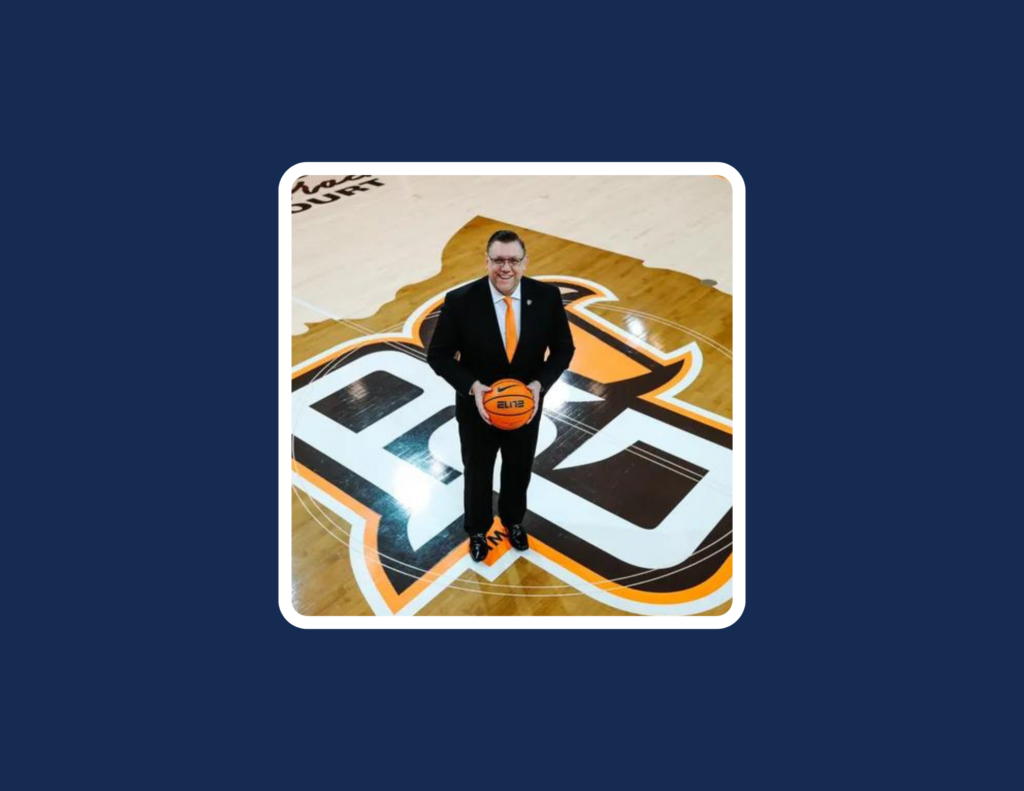
TODD SIMON – BOWLING GREEN STATE UNIVERSITY MEN’S BASKETBALL HEAD COACH – EPISODE 993
Website – https://bgsufalcons.com/sports/mens-basketball
Email – [email protected]
Twitter/X – @CoachTsimon

If you listen to and love the Hoop Heads Podcast, please consider giving us a small tip that will help in our quest to become the #1 basketball coaching podcast.
Todd Simon is entering his second season as the head coach of the Bowling Green State University’s men’s basketball program in 2024-25. In his first season with the Falcons, Coach Simon orchestrated one of the quickest turnarounds in program history. In his first season, the Falcons tallied 20 wins for just the 10th time in the program’s MAC era, becoming one of 10 teams in the nation to go from 20 losses in 2022-23 to 20 wins in 2023-24.
Simon joined the Falcons after spending seven seasons at Southern Utah as the head coach of the Thunderbirds. Under Simon’s leadership, Southern Utah went 118-96 with three straight 20 wins seasons from 2020-2023.
Prior to arriving at Southern Utah, Simon was named interim head coach of the UNLV men’s basketball program in January 2016 and was in his third year as associate head coach with UNLV.
Before his time as a Runnin’ Rebel, Simon served Findlay Prep in Henderson, Nevada for seven years in both head and assistant coaching roles. During his career Simon has helped develop and coach several players that have become top NBA draft picks, including Anthony Bennett, who was selected as the top overall pick in 2013, Rashad Vaughn, Avery Bradley, Christian Wood, Jorge Gutierrez, Cory Joseph, DeAndre Liggins, Nick Johnson and Tristan Thompson.
If you’re looking to improve your coaching please consider joining the Hoop Heads Mentorship Program. We believe that having a mentor is the best way to maximize your potential and become a transformational coach. By matching you up with one of our experienced mentors you’ll develop a one on one relationship that will help your coaching, your team, your program, and your mindset. The Hoop Heads Mentorship Program delivers mentoring services to basketball coaches at all levels through our team of experienced Head Coaches. Find out more at hoopheadspod.com or shoot me an email directly [email protected]
Be sure to follow us on Twitter and Instagram @hoopheadspod for the latest updates on episodes, guests, and events from the Hoop Heads Pod.
Make sure you’re subscribed to the Hoop Heads Pod on iTunes or wherever you get your podcasts and while you’re there please leave us a 5 star rating and review. Your ratings help your friends and coaching colleagues find the show. If you really love what you’re hearing recommend the Hoop Heads Pod to someone and get them to join you as a part of Hoop Heads Nation.
Have a notebook handy as you listen to this episode with Todd Simon, Head Men’s Basketball Coach at Bowling Green State University.
What We Discuss with Todd Simon
- Growing up in Michigan a fan of the Bad Boy Pistons and Coach Chuck Daly
- “Competitors will find a way.”
- “This guy it doesn’t care about his numbers. He’s trying to make the right basketball play because he understands the game and what it takes to win.”
- Earning an academic scholarship at Central Michigan and why people tried to talk him out of coaching for a living
- The early influences in his career including Paul Westphal & Lon Krueger
- “It was always just trying to figure out how I can help and be valuable. That was my angle.”
- “I’ve started to be a little more empathetic and understanding, and that experience really helped me grow to be more of a coach that understands relationships come first.”
- “I love high school practices and good high school coaches are solid gold, man.”
- His experience at Findlay Prep and the high number of NBA players he coached there
- “Findlay Prep was a powder keg for performance and growth.”
- The decision to leave Findlay Prep for UNLV
- Taking over as the interim head coach at UNLV in his 3rd season there
- “There was a difference between being ready and prepared. I feel like I’ve always been prepared.”
- Taking the head coaching job at Southern Utah
- “I’m a builder, I like building things. I like doing something that someone hasn’t done. I’d rather play Duke than coach Duke.”
- “Make sure everything’s measurable so that you can see the growth.”
- The need for “reprogramming the thinking from all aspects of the university, reprogramming folks’ vision of the program.”
- “Accountability. You can’t let up, you can’t have slippage.”
- “I think I promoted eight guys now to their first assistant job since 2016. I love giving guys chances, to find guys that are hungry, that fit what we are. And give them an opportunity.”
- “I’m a true believer that you hire the right people and let them grow into their positions and you help teach and educate them.”
- Teaching his coaching staff on the front end rather than being reactionary
- The moment he realized his team should reflect what he wants to do
- “We’re looking for basketball IQ. Guys understand that the easiest way to play this game is to make it a numbers game. Can I get two to guard me? And then we can play four on three.”
- “If they ain’t guarding you, you’re not a shooter.”
- “There’s all kinds of jobs in basketball. And so we’re really just trying to make sure we fill all those jobs.”
- Making quicker decisions than the other teams eventually leads to advantages
- “We just really, really hammer home doing things the right way, but very quickly.”
- “We know our terminology and our terminology is consistent as a staff. So we’re calling it the same thing so we can get in, correct, get out.”
- “I just prescribe exercises. If you need more exercises then I prescribe more, you need less and the drill looks good. I’ll just cut the drill after a minute and call it a day. Let’s keep getting on the next drill. You guys mastered this.”
- What attracted him to the job at Bowling Green
- Building connections in a new geographic area when you take over a program
- “The first thing I always do when I get a job is I interview anybody that touches the program, former the previous assistants, the previous head coach.”
- ” We’re desperate to win. And we’re going to coach that way. We’re going to coach our tails off every single day. It starts with us. If we give everything we got with great enthusiasm, it’s going to rub off on our guys.”
- “We’re professional sports, whether you like it or not.”
- “We have a new team every year. We got to develop a system that works for that and keep it moving.”
- “I want to win everything. I want to win every game. I don’t do goals. If I scheduled 31 games, I want to win all 31 games.”
- “I simply like watching small fish become big fish and that’s coaches. players, programs, whatever it is, that’s what I like to do.”
Like this show? Please leave us a review here — even one sentence helps! Consider including your Twitter handle so we can thank you personally!

We’re excited to partner with Dr. Dish, the world’s best shooting machine! Mention the Hoop Heads Podcast when you place your order and get $300 off a brand new state of the art Dr. Dish Shooting Machine!

Prepare like the pros with the all new FastDraw and FastScout. FastDraw has been the number one play diagramming software for coaches for years, and now with it’s integrated web platform, coaches have the ability to add video to plays and share them directly to their players Android and iPhones via their mobile app. Coaches can also create customized scouting reports, upload and send game and practice film straight to the mobile app. Your players and staff have never been as prepared for games as they will after using FastDraw & FastScout. You’ll see quickly why FastModel Sports has the most compelling and intuitive basketball software out there! In addition to a great product, they also provide basketball coaching content and resources through their blog and playbank, which features over 8,000 free plays and drills from their online coaching community. For access to these plays and more information, visit fastmodelsports.com or follow them on Twitter @FastModel. Use Promo code HHP15 to save 15%
Your first impression is everything when applying for a new coaching job. A professional coaching portfolio is the tool that highlights your coaching achievements and philosophies and, most of all, helps separate you and your abilities from the other applicants.
The key to landing a new coaching job is to demonstrate to the hiring committee your attention to detail, level of preparedness, and your professionalism. Not only does a coaching portfolio allow you to exhibit these qualities, it also allows you to present your personal philosophies on coaching, leadership, and program development in an organized manner.
The Coaching Portfolio Guide is an instructional, membership-based website that helps you develop a personalized portfolio. Each section of the portfolio guide provides detailed instructions on how to organize your portfolio in a professional manner. The guide also provides sample documents for each section of your portfolio that you can copy, modify, and add to your personal portfolio.

Hey, coach! Want to take your team to the next level this season? Introducing GameChanger, the ultimate game-day assistant with tools to give you a winning advantage. With GameChanger, you can track stats, keep score, and even live stream games, all for free! Get the stats and crucial game video you need to lead your team to victory, all from the palm of your hand. Coach smarter this season with GameChanger. Download GameChanger today on iOS or Android and make this season one to remember. GameChanger. Stream. Score. Connect. Learn more at GC.com/HoopHeads
THANKS, TODD SIMON
If you enjoyed this episode with Todd Simon let him know by clicking on the link below and thanking him via Twitter.
Click here to thank Todd Simon via Twitter
Click here to let Mike & Jason know about your number one takeaway from this episode!
And if you want us to answer your questions on one of our upcoming weekly NBA episodes, drop us a line at [email protected].
TRANSCRIPT FOR TODD SIMON – BOWLING GREEN STATE UNIVERSITY MEN’S BASKETBALL HEAD COACH – EPISODE 993
[00:00:00] Mike Klinzing: Hello and welcome to the Hoop Heads Podcast. It’s Mike Klinzing here with my co-host Jason Sunkle tonight. And we are pleased to be joined by Todd Simon, head men’s basketball coach at Bowling Green State University. Todd, welcome to the Hoop Heads pod.
[00:00:15] Todd Simon: Hey, thanks for having me.
[00:00:17] Mike Klinzing: Thrilled to have you on, looking forward to diving into all the varied stops that you’ve had in your coaching career.
Let’s start by going back in time to when you were a kid. Tell me a little bit about some of your first experiences with the game, what you remember, what made you fall in love with it.
[00:00:31] Todd Simon: Yeah I think I just fell in love with playing the game initially it was something, I come from a great sports town midwest middle of Michigan, thousand person country town that excelled and everyone loves sports.
And so you woke up at sunrise and you played something till sunset and just, just kind of really latched on to playing the game of basketball. And then as I became enamored with it that was kind of in the year of the bad boy Pistons when I was nine, 10 years old and they were phenomenally successful.
Magic Johnson being a Lansing legend from down the road, that was such a huge phenomenon at the time with the, he was one of the best in the NBA and, and Michigan basketball was on top. And so at a young age, you just became really, really intrigued by the game, but I was really intrigued by the coaching side of it at a very young age I just remember being so intrigued by the Chuck Daly, Pat Riley watching these guys and the strategy of the game and then all of that, it comes with it.
[00:01:44] Mike Klinzing: What did that look like from a coaching standpoint? So I think what’s interesting is almost every conversation that we have with coaches, there’s two routes kind of into the coaching profession. You have someone like yourself who says, Hey, even when I was a kid and I was playing, I still was already thinking about the game and looking at it from a coaching standpoint.
And then there’s other guys that they’re playing, they’re completely focused on being a player. And then all of a sudden they’re playing careers over and they look around, they’re like, Hey man, like how do I stay involved in the game of basketball? So when you’re a kid and you’re looking at those coaching personalities, how did you approach that in terms of just thinking about coaching?
Was that something that like, Hey, maybe someday I’d like to do that. Are you kind of drawing X’s and O’s in your notebook at school? Like what does coaching look like when you’re, when you’re a kid, middle school going into high school?
[00:02:35] Todd Simon: Yeah and it wasn’t like I had a lineage of coaching or anything like that.
It was just a curiosity. I was always a big curious learner. I enjoyed learning. I enjoyed school. I enjoyed digging into topics and I would get the G. I. Joe guys out and start running run plays five and simulate five on five games with G. I. Joe guys and that was I just was just in love with fantasizing about the game.
Like what if you had five Magic Johnsons and you’re a positionless those are things I was thinking about in six, seven years old and, And so it was just a fascinating deal. It just kind of, kind of was a first love, but it was really I enjoyed playing, but that wasn’t I really liked the other side of the game from the jump.
[00:03:32] Mike Klinzing: How did the way that you grew up in the game growing up in a small town in Michigan, how does that compare to the guys that you’ve coached and recruited over the last five, six, seven, eight years as sort of basketball has changed? And just, again, the youth basketball landscape, the high school basketball landscape, just in terms of how guys get prepared to be able to play at the college level, how does that compare to how you grew up in the games?
I know for me, and I’m a little bit older than you again, I spent a lot of time. On the playground or by myself or chasing pickup games. Whereas again, guys today spend so much time with AAU and training and that kind of stuff. So just, how do you think about the difference between your upbringing in the game and the guys that you end up coaching?
[00:04:16] Todd Simon: Yeah, I mean, it’s really evolved. I mean at that stage it was you kind of latched on to maybe a good local player that knew a thing or two. We kind of just studied the game. I had one of our high school coaches look a few doors down and try to get some information there.
And you just do little camps and all that stuff. But the reality is the majority of it everybody on the block had a basketball hoop. And it was just, where are you playing it? And everybody just gathered around or you went to the park and if you lost, you might not get on for a few games.
So you learn the game that way as true competitors do. And it’s really shaped a little bit of what we recruit to I want guys that want to compete. Competitors will find a way now, if you get tired of playing a game for 10 minutes and sitting for an hour.
You better figure out a way to win, right? And so you want to find competitors that can, that’s just going to find a way to win. So it’s really kind of shaped a little bit of what we are and finding guys with a chip on their shoulder that maybe have a non traditional anointment into the game are guys I’m drawn to.
[00:05:30] Mike Klinzing: When you’re evaluating guys, What are you looking for that gives you an idea that a guy is going to be the type of competitor that you want to have on your team? So whether you’re watching them in an AAU setting or you’re watching them with their high school team, what are some things that you kind of, you look for from a recruiting standpoint that you’re like, yeah, this kid has that chip on his shoulder, this kid has that competitive fire that I think can make him a good part of our program.
[00:05:57] Todd Simon: Yeah, I mean, guys that are willing to sacrifice their bodies, you guys that are not going to turn away from a charge or bail out on someone trying to dunk on them, or loose ball in the paint and they’re the first one on it, or there’s a crackdown that needs to be had, or a blockout small on big, and they’re willing to do what it takes to get that ball.
There’s so many different ways that you can see that and where that competitiveness manifests itself, some guys don’t handle losing well in those, then I’d rather have a guy whose cups overflowing because they’re so competitive. Then a guy whose glass is only half full and then takes the hell and keeps his day moving along that’s some, I don’t identify well with that.
So sometimes it’s kind of looking for those kind of tip off. This guy really hates to lose and it’s not about him or hey, this guy it doesn’t care about his numbers. He’s trying to make the right basketball play because he understands the game and what it takes to win.
So there’s, those are our main kind of areas. And that’s probably the top of the list of what we recruit to.
[00:07:13] Mike Klinzing: What was your thought process in terms of career wise? At that point, were you thinking coaching? Did you have something else in mind when you went to Central Michigan? What was the thought process in terms of career? What were you going to do?
[00:07:29] Todd Simon: Yeah, my situation is a little bit unique. I was a full academic scholar and, and had a ton of scholarships all over the place and Central Michigan offered a full ride with part of their Centralis program, which they award, maybe a dozen kids every year.
And it was really competitive. And so my competition was in academics. So, and that being said as you kind of get put in these groups of high academic achievers and whatnot along the way, a lot of folks try to talk me out of the sports side of it like, Hey, this guy’s maybe that doesn’t a group is, is all doctors, lawyers neurosurgeons or whatever, whatever it is.
And I was like, I like sports? And so you get talked out of it, like, Hey, like you should be going to this, that, or the other. And I considered it and considered at one point going to Harvard post graduate or doing some of those things, but then my heart really wasn’t in that side of it.
It was really into the sports, but I was also very, very, very I think realistic I didn’t have any foot in the door. I wasn’t a great player. I didn’t know anybody. It was just so. But while I was in college I utilized every credit they’re going to give me so I got a double major, one on sports studies, which was just for fun.
And one in management information systems, which it’s kind of what you were kind of pushed into because that was that was. More realistic goal, but I was also coaching high school football and high school basketball while I was in college. So I kind of got a head start on what I wanted to do and things kind of happened fast.
And so once college was done, I said there’s a, there’s a small period of time I’m going to take advantage of this and do some things. So I kind of because by then I’d already had a full time job. And managing people already kind of moved up the ranks at a tech firm.
And as a senior in college and already had these coaching jobs and I said, well, if I’m going to do it, I’m going to chase what I want to do and move to LA, clear across the country from central Michigan and started just living in gyms for fun. And that’s how I kind of got started in the business.
[00:10:10] Mike Klinzing: Who would you say was the most instrumental person in that early part of your career in terms of connecting you or giving you an opportunity?
[00:10:19] Todd Simon: Well, the first shoe and door I had an opportunity at Central Michigan after school after my four years was done to be the video guy, but I wasn’t ready to just spread the wings a little bit and try something else.
And, and so then going out west I lived near Pepperdine. And Paul Westphal was there and obviously revered Paul Westphal, his style in the Midwest you grew up at the altar of, of Gene Keady, Bob Knight, Tom Izzo, a certain brand of basketball you grew up with, with toughness being the thing of the day.
And so we get to Pepperdine and it was just, I was enamored With the brilliant basketball mind that he was very offensive oriented, not a yeller or screamer. It was just a different way of doing things that I hadn’t seen before. And so they allowed me to just keep coming to practice and keep coming to practice and, and then I borrowed these films.
Hey, you mind if I break these films down? no problem. Whatever kid, whatever you want to do. So I was really big in analytics and this is back in 2003 and this, they’re doing all kinds of analytics on stuff and just gave him some reports. And I said, well, Hey, do you want to work here? we can’t pay you, but you can work here.
And so that was kind of the first way in the door, which was a big confidence boost. But then once I got in and it was a short time, I mean, we’re talking, I don’t know, eight months, maybe not even that. But they valued what I was, in recruiting and analytics and those types of things.
And to hear that from coach Westphal is like, Hey, wait a minute. I can do this. This guy’s been at the top of the mountain and he’s saying, good job something that important, like, or, Hey, what do you think of this? Like I had follow up questions and, and I remember we were talking it Hey, there’s a lot of talent in Canada.
And next thing they’re flying to Canada and then. Recruiting kids out of Toronto at Pepperdine and, and it’s just like, all of a sudden you’re feeling valued, like, Hey, I can contribute. So that, that was very influential. Coach Kruger after that after that short period at Pepperdine, I moved over to UNLV as a video assistant did some grad work and Coach Kruger was just he’s brilliant, but he’s brilliant with people.
And I thought, I think kind of really learned how to do things with him. And I’ve been very fortunate to have some good bosses along with Michael Peck at Findlay Prep is, is a great leader of men knew how to coach talent, knew how to be a disciplinarian. and then Dave Rice, I worked for UNLV.
Guys love to play for him and he had a knack for that. So you kind of take something from all of them, really.
[00:13:25] Mike Klinzing: What would you say when you first started, what do you think was your biggest strength? Do you think it was that ability to kind of go in and look at things from a new perspective? Obviously, if you’re going in and you’re watching film and you’re bringing analytics, like you said, that’s big. 20 years ago where not a ton of people were even focused on that. But what do you think were your strengths early on in your coaching career that you, you still bring to the table today?
[00:13:41] Todd Simon: I think one of the strengths was I didn’t have a background in, I had a business background. I was doing some independent sales type work for in technology. And so you just, if you don’t work, you don’t, you don’t eat. And so you’re taking a different mindset into it.
So that work ethic and work capacity, I think it’s always been a major strength. I was willing to if it took me 30 hours, To put together some incredible scout prep, and this is pre synergy days and all that good stuff. It was going to take 30 hours to do it. I was going to sit there for 30 hours and, and make sure that it was going to blow them away and but just finding ways to add value and get closer to winning and I think that was always worked backwards from that. what does that mean to get a player better? Latch onto a guy as maybe needs it. staying in a film room, finding some different analytics. So it was always just trying to figure out how I can help be valuable. And that was my angle.
[00:14:51] Mike Klinzing: What was an area that when you look back now, you’re like, man, I was, I’ve really gotten a lot better at this particular aspect of it since, since back when you started, what was something where you really had to grow?
[00:15:05] Todd Simon: Well I think I think early on, especially early in the coaching days, I was very black and white disciplinarian and very rigid.
We were at Findlay Prep. We had 12 guys living in a five bedroom house and then many of those guys went on to the NBA and all that stuff. But if you walked in the house, I mean, it was pristine the floor shined and there’s never anything in the sink ever. And the rooms, beds are made, I mean, it was very militaristic.
I think over time, I’ve started to be a little more empathetic and understanding, and that experience really helped me grow to be more of a coach that understands. The relationships come first. I think that that was a huge piece of growth for me. And then, then obviously the basketball always evolves I think I was a pretty good coach five years ago but I think right now I’d beat myself by 20 points just from it just, Cause I’m always that, that growth mindset is very important for me that I love to learn, but it’s also a little bit of a negative because you got to filter out and see what you can apply to your own program. But I kind of love it all of it.
[00:16:28] Mike Klinzing: So where do you go when you’re trying to learn? What are the sources that you turn to? Are you going to practices or what are you watching on film? Where do you go? Are you watching Euroleague? Are you watching NBA? Are you watching other college programs? Just where do you go to learn?
[00:16:44] Todd Simon: Really everything. You used to just keep a bin of note cards next to the couch. And you see something on social media, whatever you write down now, now I do it all on phone and notes and, and snapping pictures, recording stuff, or I’ll it could be watching the WNBA game and then say, rewind it, and then does it record the screen or didn’t come back to it later or phone conversations hear something that’s intriguing.
Or, hey, here’s a topic that came up and it might call five coaches that night and say, hey, what, how do you handle this scenario and then that leads to five more conversations with five more people after well, I talked with so and so but I really try to I love high school practices and good high school coaches are solid gold, man.
I mean, cause you have to, I’ve been at that level. Right. And then, so you’ve got to be creative. You have no margin for error. I mean, most of these states without shot clocks, your minimum possession is four. I’ve lived that life. College, you get here, and you can throw the ball around, you can do this, you can waste possessions, and you can’t do that at the high school level.
And you’ve got maybe Jimmy the banker’s son over here, and you got two elite players over here, and this kid can’t do this. So you’ve got to really coach. So I never enjoyed taking notes at all that stuff. That’s why I really liked the recruiting live period. So I’d like to see good coaches.
[00:18:15] Mike Klinzing: Let’s go backwards to Findlay Prep. Tell me a little bit about just what made that such a unique situation. And then talk about some of the guys that you were able to coach while you were there.
[00:18:28] Todd Simon: Yeah, great situation so Coach Peck, who was the video coordinator at UNLV. And so he went over with this upstart prep school that we’re starting in Henderson, Nevada, outside of Vegas.
And Scott Beaton was the head coach. He was the former head coach at Albany. And then so I’d kind of slid into coach Peck’s role and coach Kruger had asked we just talked about career paths and all that stuff, and I love recruiting. And we just kind of talked about it. I mean, Coming up to the administrative route.
It was a long road back then and one thing led to another, he said, well, what do you think about going over to Findlay? You’ll get to get on the floor and coach, make a little bit more money. You get to go recruit. And I said, that was my big thing. So I want to recruit internationally. I want to do camps in Africa and wherever.
I mean, I want to go all over the place. I want to really be. Elevate and help in that area. And, and that was the deal. And so I did that instead. And year one kind of got off the ground. Year two, coach Peck was elevated to the head coach. And I was the associate head coach. And I was living with all the players with my wife, with 12 guys under one roof.
And. And you know that by we got year two, we were 32 and one year three we’re 33. And oh year four we’re 32 and two. we just, we rattled off 35 or 235 and seven, run over a few years with three national championships and another Mythical National Championship at the end of the run.
And it was a successful program, but it was really a life skills and a training program that competed in games. And so we were able to get these guys at such an impressionable age. you’re talking about Tristan Thompson as a junior Christian Wood, who’s still in the NBA.
Nigel Williams Goss, who was fantastic for all four years of high school for us. Nick Johnson Avery Bradley, Corey Joseph. I mean, you kind of go right down the line. we’re just kind of churning out NBA guys and I think when the tally was done, I think it was in the twenties that we, through our tenure and after of guys in that, in that short period of time.
And, and so it was a really fun run, but it was nice. It was like being in a lab so we could just do whatever we wanted and if it didn’t work, it didn’t work, we didn’t care. So it, we really cut our teeth coaching basketball that way.
[00:21:15] Mike Klinzing: Those guys that you coach that eventually make it to the league, is there a defining characteristic or characteristics that you feel like, obviously there’s a level of talent that you have to be able to have to eventually succeed in the NBA, but just when it comes to like their work ethic and just the way they went about their business, how do you, how do those guys, those, those super elite players, what sets them apart?
[00:21:44] Todd Simon: They’re different, they’re hyper competitive. We use up our practice slot and volleyball be coming on and they a guy like Tristan and Corey and other times, I mean, they, they take it to the park down the street to finish what the finish this game out and they just love the game, love the process.
I mean, at one point I remember. I’d get in the gym with guys in the morning and I got in with the guy at 715 while another guy down the hall said, you’re getting in at 715 before school, I want to get in at 645. Next I heard that and said, well, he’s getting 645 coach. I want 615. And that guy said, well, I can’t 545.
I mean, it was just like one of those deals. It was putting like minded. Competitors that were very, very driven and you put them in real tight guardrails and eliminated distractions. And it was a powder keg for performance and growth. It was really spectacular. it was, it was a good a time of seeing guys just blossom and, and it’d be really hard to replicate.
[00:22:58] Mike Klinzing: How did you feel like Findlay prep fit into your career track? In other words, Were you thinking, Hey, this is kind of the level of basketball. I might stay here if this run can keep going. Did you always know you wanted to get back into the college game? Just what was your thought process at that point in terms of where you wanted to go with your career?
[00:23:17] Todd Simon: It’s interesting. I’m very wired that what I’m doing now is the most important thing. And I don’t love the Looking over the fence and, or looking too far ahead and let those chips fall where they may. And even back then I stayed at that level. I mean, ton of jobs, high paying jobs, Hey, bring this player, bring Anthony Bennett, and we’ll give you this, bring this guy, we’ll give you what I mean?
So very easily could have been Findlay prep to a power five in two, three years, but that wasn’t what I was trying to do. We were building something. It mattered to me it was it’s a legacy and so I was very passionate about that. So we stayed seven years especially once I became the head coach, I really thought that I could just stick this out forever, but became calling and it was actually closer to my house than, than I actually was, it was a no at first.
I had a couple of young kids and, and I was we were king of the world. I had seven or eight NBA players coming on that roster next year, the next year, we were going to be the best high school team, probably at all time, arguably. And, and they came back again. I said, well, if I’m ever going to do it, this is the time to do it. And that’s where I kind of made the leap.
[00:24:40] Mike Klinzing: And when you make that leap, what, what’s your thought as you get in there and you make that transition from again, coaching a team of future NBA players, obviously the talent at UNL leaves really high too, but just what was that transition? Did, did you feel like initially right away, you’re like, Hey, this was, this was the right decision for me to get back in as I know, as you said, you’re kind of focused on, Hey, this is what I’m doing right now.
But as you looked ahead over the course of your career, did you think, Hey, this is probably going to allow me to, to continue to expand and grow and learn and just expand my horizons?
[00:25:16] Todd Simon: Yeah, I needed to get out of that comfort zone, but I wasn’t really worried about all that. I didn’t really worry about my role.
I knew as I was going to get there. My job was to help Dave Rice win and Heath Schroyer treated me great was so helpful Stacey Augmon was great and we enjoyed that period and so I was just kind of a young guy just trying to figure it out, but I knew I could recruit my butt off if I brought good players to the table and in a very short period of time we had seven NBA players in that window of time at UNLV, which was unmatched before and after since the tark years and for such a period of time.
And I was really proud of those recruiting classes and think we had a third rank one in, in the nation and, and just kinda latched on to whatever role I was gonna have. And then that role kind of grew became associate head coach and, and just kind of grew that. And then, and unfortunately in that last year, we weren’t able to kind of get it done enough.
And under bad circumstances, you don’t want to become, but it would kind of get thrust into the interim head coaching job in my third year there in very short order. So but it all felt natural. It felt like there was a difference between being ready and prepared.
I always felt like I’ve always been prepared. So he stayed prepared.
[00:26:39] Mike Klinzing: What’s it like taking over a program in the middle of a season like that? How difficult of a transition is that to go from assistant to head coach? And then just being able to manage all the things that I’m sure were coming at you in such a short period of time, where normally if you get hired, you got an off season to kind of figure it out.
And obviously you were already on the inside as an assistant, but just talk a little bit about that transition, what that was like and what you had to manage in order to make that work.
[00:27:10] Todd Simon: Yeah. I mean, it was a Sunday and we played Tuesday. And the pressure was really wearing on the players they care.
We all did. We all cared about coach Rice and the pressure was mounting from external, the fan base and everything was just kind of, we lost kind of six out of eight games, even though there were close games and some of those are really good teams. And it was on the road those, those, some of those things don’t matter.
It’s just the circumstances. And so it was all right. We got to play free and clear. Let’s get our minds back to enjoying basketball. Let’s just do the, let’s just be really good at the simple stuff. Let’s get back to playing hyper fast like I like to play free and clear and let’s have a little fun, a little swagger, a little smile.
And let’s see how this goes. And we were able to kind of turn it around and have some success.
[00:28:07] Mike Klinzing: When that season ended, what did the process look like in terms of you thinking about, should this job be one that I’m gonna try to take over and remove that interim tag?
Obviously then you go to Southern Utah. So just tell me about that. And kind of how you ended up making the decision to leave UNLV for Southern Utah and what that process entailed.
[00:28:34] Todd Simon: Yeah. When I was asked to take over we agreed I was not going to campaign for the job.
I wasn’t going to do any of the dog and pony show. I knew they were going to do a national search. It was well aware of all that stuff. And then I was okay with it but I used to tell officials all the time and say, Hey, we’re on edge, but we don’t, we’re all coaching with for sale signs in our yard and that’s until you’re in those positions, it’s not very fun.
Right. But you’re doing the best job because you’re serving the student athletes. You want to make sure these kids that you brought in had a good experience. And so we gave it our all and we thought, let’s just let the chips fall where they may and see where it goes. But it was really about 12 days into it that next thing I’m talking to search firms for other open jobs because we got off to a hot start.
And got some media coverage and we’re just going a hundred points and we were doing all kinds of that stuff. And so I kind of figured out kind of by a couple of weeks that, Hey, this is, there’s other folks that are really, really interested in what we’re doing. And it was going to be a decision time at some point in the near future.
And we pushed all of it to the end of the years. Look, I’m not talking to anybody until this is done. We owe it to these guys. They didn’t choose to be in this position. So let’s give it all. And as soon as that season was done, it was kind of a whirlwind from there.
[00:30:00] Mike Klinzing: What do you remember about the interview process with Southern Utah and what attracted you there?
What was it about the program, the school that you liked that made you thought, made you think that, Hey, this is the place that I can go in and win.
[00:30:12] Todd Simon: Yeah, there was there’s three or four schools that can talk to a couple of search firms and stuff like that. And then the AD, Jason Biedekofer, who is fantastic.
He’s now, I believe, number two over at UConn. He’s a wonderful AD. And he said, well, will you just meet me for a drink? Let’s just have a conversation. And I said, well, okay. Southern Utah was like 351 out of 351 real downtown. I think they averaged four and a half wins over three or four years.
And a little hubris came into play like, Hey, I like getting outside of my comfort zone and I know I’m a builder, I like building things. I like doing something that someone hasn’t done. I’d rather play Duke than coach Duke? And so, and we had played at Southern Utah on the road and I thought, well this is a couple hours away.
I love Las Vegas. I love this area. This is intriguing. If I’m going to do this, let’s start at the bottom. Let’s see if I can really do this and this is fine and really coach and so it was a little, and that was an intriguing thing.
And our conversation and so here’s what I kind of need. And he’s like, well, here’s what it is. And he’s like, if you’re not serious, tell me and we’ll just enjoy this little meeting. And I said, well, if you’re not serious about these things, and then he, we’re both straight shooters.
And then by the end of that meeting, I talked to my wife. I said, we’re going to have a crack at this. If we want it to, it’s going to be a massive. I still had two and a half years left in my deal at UNLV. That was going to have to forego as opposed to maybe going in the NBA or someplace where I wouldn’t have to forego that money?
And but I’ve never been driven by that. And so we got in the car, just drove up two and a half hours, looked around the sleepy town. And I said, yeah, we can raise our kids here. These are good people. This is a good place. We can build a winner here and they’ll get excited. And that was that.
[00:32:25] Mike Klinzing: So when you get that job, and obviously, as you just said, it’s a huge rebuilding project, what were the first building blocks that you felt like you had to put in place in order to get the Southern Utah program going and getting it moving in the direction that you wanted to go?
[00:32:47] Todd Simon: Yeah, I mean, first we need to establish the culture. We needed to make sure there’s a standard that we have there in terms of how we do anything how we do everything. And going to class and achieving in the classroom and in the weight room and pushing guys and making sure everything’s measurable so that you can see the growth.
And so that was step one. We needed to do that from day one, make sure everyone knew this is what, this is the boundaries of these are the expectations. This is how we’re going to do this. This is the process of what’s going to take. And if, and if it’s not going to match up with what you’re trying to do let’s leave friends.
It was going to take a little process and they had an APR problem they had actually been on the APR suspension a few years before that. And so that academics, we needed to kind of clean up. So it took a, maybe one thing people don’t understand is, is not always are these jobs rebuilds.
There’s a teardown phase and the teardown is, it’s really kind of something I really gauged. There was a little bit of a teardown not necessarily from a people standpoint, but just from a reprogramming the thinking from all aspects of the university, making the reprogramming folks vision of the program, what they think.
We’d have practice and they’d do the tours and they’d walk in the arena up top and you can hear the tour guys saying like here, gymnastics is here. They’re pretty good. The men’s basketball team stinks. And we’d be 20 feet down hearing it, hearing them talking about us on the floor.
And it’s like, okay, we’ve got to get this perception changed. And that’s part of the deal. And so you’ve got to attack it from all angles. And that’s why we started it.
[00:34:49] Mike Klinzing: What’s the key to building culture?
[00:34:52] Todd Simon: Every day, every day. Accountability. You can’t let up you can’t have slippage. I think you get the right people.
That’s sure. It certainly helps. You’ve got to be confident enough to say this person’s more talented. This person’s going to fit us and I think there’s a evolution to coaching when you start to understand that this is our fit. So we’ve got a very clear, Identity of who we are, and we recruit to it, and we tell people this is what it is when you get here.
Hey, you’re going to go to class check, and you’re going to do this, and you’re going to turn in every assignment you’re going to. And you don’t have to go shoot after, after practice, but guess what? There’s going to be 13 other guys that are, and if that’s not who you are, you’re not going to fit in or that’s just, so I think just make being very brutally honest and finding the right fits, I think we’ll accelerate that, but this is every day it’s every day and it’s consistent and we got to live it.
[00:36:06] Mike Klinzing: What about putting together a staff? What’s your philosophy on that? How do you think about balancing the staff with coaches that have different strength, the relationships that you may have with them in the past? What’s your methodology for putting together a great staff?
[00:36:23] Todd Simon: That’s one of our strengths. I have a firm philosophy that I hired for me, what works for me doesn’t necessarily work for someone else, but for me. I say I hire brothers and cousins brothers, someone I know directly have relationship with and because it’s kind of someone that I truly trust that that vouches for him because there’s a understanding of what this is and how we do things.
So, that’s kind of my hiring philosophy at Southern Utah as a young coach. I think I was the second youngest head coach in division one at the time. I was well aware I hired a veteran by the name of John Wardenburg, who really launched, really helped me Early throughout those Southern Utah years, I think he was as responsible for the winning there as anyone, because he’d been a head coach and he knew how to handle the office.
He knew how to handle upholding the culture. He was about all the right stuff. And but just that this took a lot of pressure off, right. And, and then So then I had a couple of veterans, I hired Chris Pompei was a veteran, great in the recruiting, had a lot of relationships that kind of get Southern Utah in the door.
And then as I grew as a coach I started really promoting within, I think I promoted eight guys now to their first assistant job since 2016. And I love giving guys chances to find guys that are hungry, that fit what we are. And give them an opportunity. And then, so that’s kind of where we are now.
We’ve got a lot of younger guys on staff. Every single assistant coach that I have on staff, all five guys. This is their first assistant coaching job in division one. So, and I’m okay with that guy, this is his first ops job, just promoted him within so, so I’m a true believer that you hire the right people and let them grow into their positions and you help teach and educate them.
[00:38:29] Mike Klinzing: Is that something that you think from your business background in terms of delegating? Because I know a lot of times we’ll talk to coaches that will say, Hey, when I was early in my career, especially I wanted to micromanage everything just because again, I think as coaches, a lot of times we tend to be perfectionists and we like the way we do things.
And so we want to have a hand, especially as a head coach and everything that goes on. And yet I talked to so many coaches that tell me as I matured. As a coach that I realized that when I did delegate and I did, as you just described, hire the right people and let them cater to their strengths and do the things that they do well and continue to pour into them, that that’s when my coaching and my program really took off.
So how do you approach that delegation piece of it? And is that something that you feel like you’ve gotten better at over the course of your career?
[00:39:19] Todd Simon: Yeah, it just takes a lot of organization and you avoid the micromanaging by training on the front end and when there are things that don’t necessarily get done and the uptake responsibility to say, Hey, was that clear in communication on this?
Or, hey, have we ever talked about how this needs to look now it’s like, hey, okay, let’s talk about this. Hey, I’ve got experience in this area. This is how I did it. We ran the scenario 8 years ago. Here’s how it is. And using those experiences to teach on the front end, rather than be reactionary.
I think micromanagement is a reaction. As opposed to anticipating needs and being a teacher on the front end and so that we just try to talk through things and say, Hey, this is how this you’re in charge of recruiting. Here’s how we want to organize it. Let’s talk about it. Okay. This is great.
Okay. Well, this is how we’re going to run these camps and this is how we’re going to do that. We just try to talk through it.
[00:40:29] Mike Klinzing: When did you know at Southern Utah that you had turned the corner and that you had things going in the right direction that you were going to end up having the success that you had?
Obviously, you were confident going in and felt like you were going to be able to get it done, but was there a specific light bulb moment where you’re like, Oh, we got it. Or was it more of just a gradual build of, Hey, we just got to keep putting these building blocks in place, like you talked about in terms of accountability and just day after day,
[00:40:58] Todd Simon: Those are tough jobs. You’re playing four or five games, crisscrossing the country and all that sort of thing. It means they’re tough because you’re starting out the year 0 and five and, and I think the one year, I think we went like 58 days between home games and you’re doing some tricky stuff, but we knew that second year we were a little bit better.
And then we really kind of took off at that point. And I wasn’t handling it great. The first year we weren’t very successful. I wasn’t having any fun. Yeah. I said, there’s a difference between hugging something. And choking something and I was choking the life on the program because I was trying so hard and everyone felt the tension, the whole thing.
And there was a important moment, we walked out of our offices and then you walk down the, the arena was a bowl and you walk down the practice and it was probably January, somewhere in there in that season. And I remember sitting at the top of the stairs and said, look, you’re not having any fun.
So I’m either going to get in my car and this is it. This is a wrap. I’m not doing anyone or I’m not doing anybody a good service here, by the way, I’m doing this or I’m going to go walk down there and do it how I want to do it. And we did, we just said, look, this is, we’re going to play free and clear.
We’re going to do things differently. I don’t care about what socks you’re wearing. I don’t care about the shoes. I don’t care about the minutiae, we’re getting so wrapped up and, and trying to make this thing look perfect that we’re just choking life out of the program. And then we did turn the music on and get this thing going a little bit.
And honestly, we never stopped losing any we won every all the time after that. And then really in 2019, I had a conversation with a coaching friend in the NBA and he was, we talked X and O’s. We were the number one defense in the big sky. We were big, long, athletic. And it was just such a simple observation, but he’s like, you love X and O’s.
We talk X and O’s. We do this, we do that. And then your team doesn’t reflect what you want to do. You don’t have any shooting. You just play defense and you’re playing fast, but it’s not a skillful game. And he said, he’s right. And then next year so we changed the roster and that very next year we went 20 and four, we had third in the nation in scoring.
And we’ve had nothing but 20 win seasons, the last four seasons since that moment of kind of changing philosophy and saying it’s okay just to be really, really good offensively. And. And maybe we ain’t gonna have five Marcus Smarts out there. That’s okay, too.
[00:43:59] Mike Klinzing: You don’t have to worry about what Bob Knight and Gene Keady are thinking about it, right?
[00:44:03] Todd Simon: Yeah.
[00:44:03] Mike Klinzing: Yep. So, from an offensive standpoint, when you want to play that way, and let’s go back to the recruiting question again, how do you identify guys, because obviously there’s players playing all different types of styles at the high school level, and now through the portal allows you a completely different way to be able to recruit, but when you’re looking at guys To fit into the way you want to play when you’re going up and down and you’re shooting the ball and you’re playing at that kind of pace.
What are some of the basketball skills slash IQ stuff that you look for in a kid that is going to allow him to fit in? I know we talked a little bit about the intangible before and just the competitiveness, but just from a basketball IQ standpoint and just basketball skill set, what are you looking for in a player that’s going to fit into what you’re trying to do offensively?
[00:44:51] Todd Simon: Yeah, we’re looking for basketball IQ. that the guys understand that the easiest way to play this game is to make it a numbers game. Can I get two to guard me? And then we can play four on three, the rest of the, all of the plays and make the right plays. You know the ones that they have a basketball, a cue to understand that, hey, if I play fast and can make fast decisions.
The defense can’t make those same fast decisions or make the right decisions and enough times. And if I do it enough times, the percentage is going my favor. Cause I’m used to making these quick decisions. They’re not. So we look for that basketball IQ. I think you have to have there’s a baseline level of athleticism that requires, there’s a baseline level of shooting I think you need to have at least three on the floor at a time that the defense and the defense gets to decide who’s shooters and who’s not, not the offense, because if they ain’t guarding you, you’re not a shooter so that’s, that’s an important part of it.
And then we’re just kind of looking for, what is the piece, are you an elite cutter? Are you an elite post up guy? Can you flip the post and get us something here? Can you create possession of the glass? There’s all kinds of jobs in basketball. And so we’re really just trying to make sure we fill all those jobs with guys that can do something at a high level we have shooting bigs, we have rim run bigs so we’re just trying to play a variety of different ways and see guys that kind of fit each one of those roles.
[00:46:30] Mike Klinzing: How do you design your practices to. Put the players in position to be able to make those kinds of quick decisions in a practice setting so that then it translates into their performance in games. What does that look like in practice for you?
[00:46:45] Todd Simon: Yeah, everything’s, we do the same, almost the same skill work for everybody. So our 6’11” kid, our 300 pound kid are doing the same ball handling that my point guards are doing. Cause I just want pass, dribble, shoot skill guys. They’re doing the same shooting drills that the guards are doing.
And so, because it fits what we do. And so we’re working on those things. But then we’ll do the breakouts to get those other pieces. But we do it, everything is fast. And it’s not a part of our culture. If we finished one drill, there ain’t no walk into the next drill. There ain’t no water break.
There ain’t none. No, it’s a sprint to the next drill. They know what the next drill is by name and we’re in it in a few seconds, because that’s so it’s in everything that we do, but we’ll do a drill, let’s say three trips, we’ll get a half court set, 12 second transition, 12 second transition back and we’ll say, Hey, we got to get two sides of the floor in that 12 seconds with a trigger and so we’re, we’re, we’re working on doing things with pace so there’s no waste of time guys start holding the ball, just blow it dead, turn over and, or a guy takes too long and you take it out of bounds, blow it dead, turn over the guy’s not, guy catches a shot in the corner.
He’s not shot ready because he didn’t get there in time, turn over. So we just really, really hammer home doing things the right way, but very quickly
[00:48:14] Mike Klinzing: When you’re moving things at that pace, how do you balance? keeping the pace of practice high with making coaching points, if that makes any sense.
How do you correct? How do you question? How do you look at talking with your players and trying to get them to see things that you or your staff is seeing without slowing down the pace of practice? I think that’s something that a lot of young coaches sometimes struggle with is, hey, I want to stop this because I saw something that I want to correct, but then They end up giving a two minute soliloquy about, Hey, this happens.
And meanwhile, the whole pace of practice dies out. So how do you balance that in your coaching style?
[00:48:57] Todd Simon: Yeah. So we, we talk about it. And so in action our assistants spread out around the court and they’re coaching during the action, correct it during the action while it’s happening?
And so they all have their different areas that they’re coaching. One guy we have an assistant in charge of get backs and rebounding. So they’re coaching it live. We have another guy that’s making sure the guys are being where they’re supposed to be on offense and in stance that so we’re coaching it live.
And then what I try to do, I think there’s periods to it. I think early on when they want to start getting up and down. We’ll stop it on purpose and just frustrate the process toward the point where it’s like, Hey, they’ll start coaching them each other when it starts getting chopped up all the time and, and so some of it’s by design and other times it’ll be, okay, this is five possessions, but we’re coaching after the fifth possession.
And we, I try to preach get in and get out, but we’re going to teach something, make sure we know our terminology and our terminology is consistent as a staff. So we’re calling it the same thing so we can get in, correct, get out. And then I think I think that that attentiveness and part of our culture is like, Hey, coach is talking, everyone’s got eyeballs on it’s not a, we’re not having sidebars and all that sort of stuff. So I think it’s become, helps us be efficient that way.
[00:50:31] Mike Klinzing: Has the length of your practices changed since when you first started coaching?
[00:50:36] Todd Simon: Without question. When I was early in my first year at Southern Utah and we were trying to change the culture and we were trying to just figure out how we were going to out tough somebody to win a game.
I mean, we were taping on game day and going an hour and a half for shoot around live and we’re going to wheel this thing into something now, as I got older, I realized a lot of that stuff was stupid in my opinion. And so we’ve really toned it down and found a lot of the injuries were happening in that third hour so we’ll watch more film.
We’ll be more efficient with our drills, more tactical and how we design it. And we try to try to be early season to two and a half at most. As we get closer, it’s 90 minutes. And then during the season, there’s times where 45 minutes to hour 15, if we’re, if we’re humming along and handling our business, and I just tell the players and say, this is up to you.
I just prescribe exercises. If you need more exercises that prescribe more, you need less. And the drill looks good. I’ll just cut the drill after a minute and call it a day. Let’s keep getting on the next drill. You guys mastered this. So it gives them incentive to master what it is and so we can get along quicker.
[00:51:58] Mike Klinzing: Tell me about the opportunity of Bowling Green. Obviously you build Southern Utah into a program that wins 20 games. And you had a tremendous amount of success there. Is this another case of, I’m trying to get out of my comfort zone. I’m looking for the next challenge or was the opportunity at BG just that good?
Just tell me a little bit about the, the why behind the decision to go to Bowling Green.
[00:52:23] Todd Simon: Yeah I think there’s shelf life I said, I want to make maybe one move while, while my kids were in school. Some of the changes now, kids are resilient, they’re willing to move around and all that stuff is a little different than we grew up, but I didn’t want to be one of those that was just kind of hopping around and all that stuff.
So it’s being kind of very tactical. I don’t know what the next move was going to be over these years, but we just moved the WAC, so we kind of mastered the big sky and won a championship and kind of figured that out. And then we went to the WAC, which was at like, I think the 11th ranked league out of 32 that year with Grand Canyon, Stephen F Austin and New Mexico state and Arlington and Sam Houston.
I mean, it was just a loaded league. And I think we finished second or third, won 23, 24 games, something like that. And lost in the finals to a very talented Grand Canyon team, but you kind of see on the writing on the wall. It was going to be a transition process at WAC under that format.
And now since the WAC has kind of lost a lot of those teams that were a huge challenge, but at the time you’re staring up there and saying like, man, you’re looking at their spread outside their locker room and all these things. And you’re like, man, this is something to compete with here. And, and I think there was a shelf life we were on our, our, including interims, I think we had a 580 changes in seven years.
It was some turmoil and it was just turnover. I love the place. Love Southern Utah. that’s a place you could you hold dear to our heart. We absolutely loved it there. And but it was one of those things where it’s like we talked about getting to the Midwest where we’re all, both of our family, my wife and my family’s from you know no one’s getting, getting younger.
So there’s an opportunity to be two hours from home, get some family in the stands. And so it was that was a factor in the decision we knew was, it was going to take a chore they haven’t been to a tournament now, 66 years something like that, 50, maybe 56 years. And it hasn’t last four coaches here have been let go.
It’s a challenge. We knew that. We’re going to restoke the flames a little bit. Hey, let’s put your back against the wall and let’s fight out of another situation. And we think we can do it here. And there’s a lot of special stuff going on.
[00:55:08] Mike Klinzing: When you get a new job and especially when you’re moving to a new area geographically, how do you go about quickly building slash rebuilding connections with high school coaches, AAU coaches and sort of. Reconnecting and building that network that obviously when you’re at Southern Utah, you get to know the people in the area.
You get to know who are the important people that you need to talk to in terms of recruiting. How do you do that when you get to a new area geographically?
[00:55:39] Todd Simon: Yeah, luckily we did heavy Midwest recruiting, both at UNLV, Findlay Prep and Southern Utah. So a lot of those relationships were really strong. We had to kind of unique models at all those places we’re wide net at all three spots and it’s kind of unique. This is my fourth conference to be a head coach and already 10th year as a head coach. So we’ve been in the South when the WAC was primarily Texas based and whatnot.
We’ve been out West. The Mountain West and Up in the big sky country with the big sky and now we’re in the Midwest. So you come along with, you meet a lot of people. And so we’ve got a wide net. And, and but the first thing’s first is get out and beat the pavement. Let’s just get to know everybody and be very intentional about it.
So we’ve tried to connect with as many high school coaches as humanly possible. We instituted all the camps elite camps, high school camp, kids camp. We’re going out go get in the gyms regionally, everything that we can drive to and invite people to campus?
So we just try to be Super intentional on making sure everyone we shake hands with everybody we could possibly shake hands with.
[00:57:03] Mike Klinzing: When you take over the job and you’ve got an existing roster, what are the conversations like with the guys who are coming back? What do you sit down and talk to them about?
Obviously each conversation goes its own direction depending on the kid, but what are you trying to accomplish in those initial meetings when you’re first meeting with the kids when you take a job?
[00:57:24] Todd Simon: It’s a set of expectations. We had a lot of guys that were already in the portal when we got the job and it was, hadn’t had success for a couple of years.
And just being very honest, here’s what the expectation is. Here’s what the fit is. just being very honest, but the first thing I always do when I get a job is I interview anybody that touches the program, former the previous assistants, previous head coach Michael Huger is a great man.
I call him a friend and he’s an alum and the whole thing. And all of these jobs are hard. So he was very candid on what things that he thought certain the circumstances sometimes they’re tough. and so he was very helpful but I interviewed everybody, like, let’s just talk to everybody from radio guy to average fans to donors to let me interview about 50 people and take real close notes, organize them and say, hey, here’s where problem areas are that seem to be a consistency.
We’ve got to fix this, this, and this. I’ve got a great AD and a great president Derek Vandermeer and president Rodney Rogers, and they want basketball to be successful. And so that’s a great starting point.
[00:58:43] Mike Klinzing: What’s the key or the keys to you take a program that loses 20 games before the season before you get there last year, you win 20.
What was the key to it? How did you do that in a year? How do you, how do you change a program’s direction that drastically in a year? What do you think were the keys to the success?
[00:59:04] Todd Simon: Well, you start in kind of the same way, this culture from day one, it’s toughness. We established that we’re going to, there’s going to be a baseline of defensive expectation to get on the floor.
Here’s the expectation if you’re going to contribute and we’re a better, and I’m personally better at what I do now. Then it wasn’t a pass we, we’re going to stay in games we might not have been the most talented team. We had some good players, but we were going to stay in games and then we figure out how to win in the end and, and we if we’re making shots,we weren’t a great shooting team at all and to win 20 games.
I need to be 342 in the country and shooting and win games it was really difficult, but we were able to move the chess pieces enough to be able to create transition possessions. We became a steals team defensively. We had to change who we were in order to get the most out of them. And we were pretty proud of that. We got pretty close to our ceiling.
[01:00:11] Mike Klinzing: When you look ahead to what is going to happen this season and what you were able to do looking back at last year. What are some things that you feel like are going to make the difference in sustaining that success? Because I think once you get to a certain point, okay, now we got here, we made this quick turnaround.
How do we sustain it? What are the keys to that?
[01:00:39] Todd Simon: I mean, we’re hungrier than ever. We talk about other stats. We had a coach, like we’re on a five game losing streak and we haven’t drank water. We’re in the desert and we’re desperate to win. And we’re going to coach that way.
We’re going to coach our tails off every single day. And it starts with us. And if we give everything we got with great enthusiasm, it’s going to rub off on our guys. I think that’s kind of our MO. And so that’s how we can sustain success. We don’t get satisfied with anything else. We’ve got to push ahead.
[01:01:18] Mike Klinzing: How has NIL transformed your role as. a head college basketball coach, clearly something that 10 years ago, if we just said to anybody in the college basketball world, hey, this is what it’s going to look like 10 years from now. I think everybody would have looked around and said, I can’t really believe that this is what it’s going to look like.
So how has that impacted what you do day to day as a head coach and how are you approaching the NIL situation at Bowling Green?
[01:01:50] Todd Simon: Yeah. I mean, it’s completely changed the sports. I mean, we’re professional sports, whether you like it or not. We’re so relationship based and the fear is you’re going to lose the transformational relationships and it’s all going to become transactional.
That’s always been my biggest fear. So we try to still gravitate to those. Yeah, maybe there’s an NIL. involved, but it still wants something more and I think there’s enough there and it’s kind of like in recruiting.
You got to have an identity of who we are. We’ve got a distinct system. We’re not going to hold big people for XYZ, we’re very well aware that production is going to get paid and all those type of things, especially from the MAC. There’s, I think, 11 or 12 guys that went Power 5 out of the MAC this year and 60 percent of the league that could come back has left.
So we just know exactly where we are and it’s like prep school again. It’s okay. we had a new team every year. We got to develop a system that works for that and keep it moving.
[01:03:09] Mike Klinzing: All right. Final two part question. Part one, what do you see when you look ahead as being the biggest challenge over the next year or two, and then part two, when you think about what you get to do every day, what brings you the most joy?
So first your biggest challenge and then your biggest joy.
[01:03:54] Todd Simon: Yeah, I think the challenge, I mean, obviously the changing landscape is a challenge. You’re spending time that you used to spend with the players or having individual meetings or in the gym while those hours are being replaced by fundraising and Managing NIL stuff the recruiting processes is speed dating now as opposed to so those, those challenges that are certainly different but then I’d say part of the, at the end of it, though, we’re still blessed and this is a great gig I always said when I first got into it, I said, I want to win more championships than John Wooden would, like, that was just how I was wired.
I want to win everything. I want to win every game. I don’t do goals. If I scheduled 31 games, I want to win all 31 games. Like just how I’m wired. But then something happened, especially when we won all those championships at Findlay and all that sort of stuff. Like, I I don’t, I’m not quite really even sure where any of those championship rings are.
I’m sure I got them on display somewhere, but you realize it’s about the relationships. I sum it up like this. I simply like watching small fish become big fish and that’s coaches. players, programs, whatever it is, that’s all, that’s what I like to do. Let me help this fish become a big fish.
Let it swim away. Cheer it on and give me the next one. Let’s do it again. And I get joy out of that.
[01:04:44] Mike Klinzing: Makes, I mean, again, I think when you start looking at what What coaching is all about, right? It’s that transactional versus transformational piece that you just talked about. And when, when you’re talking about turning a small fish into a big fish, that that’s a transformation and that’s not a transaction, it’s a transformation.
And I think ultimately as coaches, I know that from talking to so many guys at the college level, that it’s a challenge when you start talking about the portal. And as you said, Putting a new team together and NIL and all these different things. And you kind of just have to adjust your mentality and still look at how can I build those relationships that really are sort of the bedrock of what, we’re doing.
Again, what coaching is all about is, is being able to help the people who are in your charge, whether that be your staff, whether that be your players, whether that be the people surrounding your program. And ultimately, if you can do that, that’s where you kind of, again, not that you don’t want to win games, because obviously you want to win games, but it’s also, again, being able to have that kind of impact.
So I think that’s. That’s really well said. Before we get outside, I want to give you a chance to share, how can people reach out to you, find out more about you, your program, whether you want to share social media, email, website, whatever you feel comfortable with. And then after you do that, I’ll jump back in and wrap things up.
[01:05:57] Todd Simon: Yeah, sounds good. Yeah. I mean, the best way to reach out to me is via email, which is either through BGSU, [email protected] or direct message on Twitter is always a great way. It’s @CoachTsimon and I love interacting with coaches and anybody really that loves to talk hoops and it’s a great tool.
[01:06:26] Mike Klinzing: I cannot thank you enough for taking the time out of your schedule tonight. Really appreciate it. And to everyone out there, thanks for listening and we will catch you on our next episode. Thanks.
[01:06:40] Mike Klinzing: Nah, man, thanks. Thank you. And thanks for putting up with