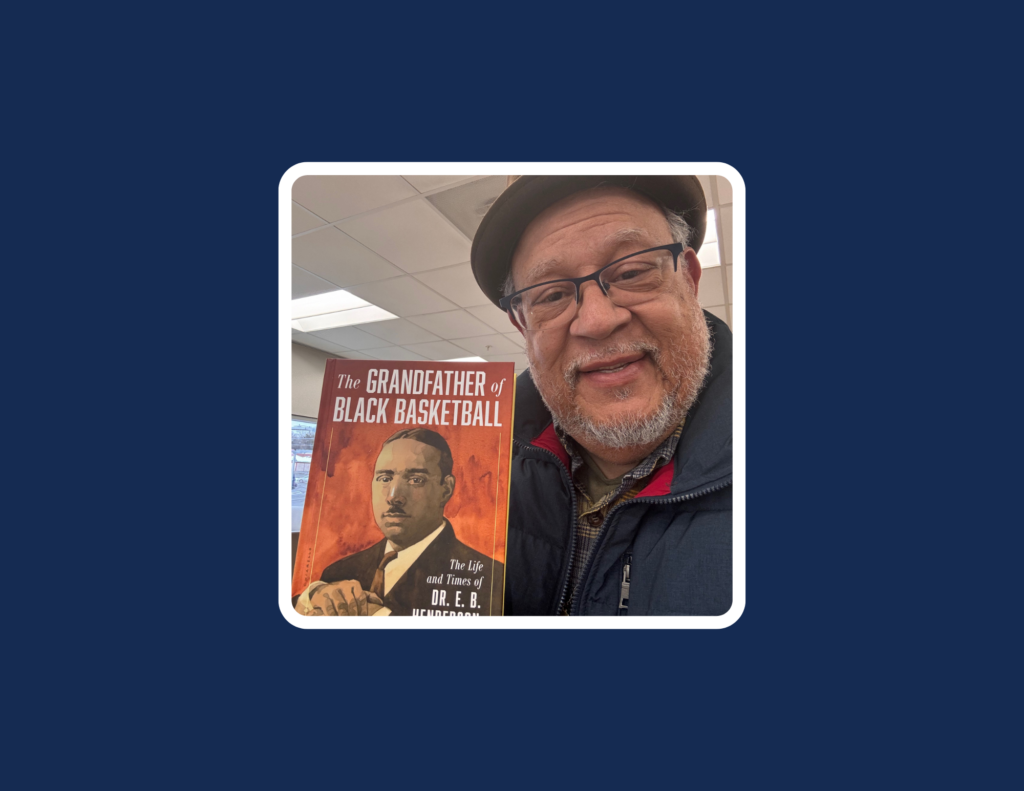
EDWIN B. HENDERSON II – AUTHOR OF THE BOOK, “THE GRANDFATHER OF BLACK BASKETBALL: THE LIFE AND TIMES OF DR. E.B. HENDERSON” – EPISODE 1225

Website – https://www.grandfatherblackbasketball.com/
Email – ebhenderson22@gmail.com
Twitter/X – @blklegassn1636
If you listen to and love the Hoop Heads Podcast, please consider giving us a small tip that will help in our quest to become the #1 basketball coaching podcast.
Edwin B. Henderson II is the author of the book, The Grandfather of Black Basketball: The Life and Times of Dr. E. B. Henderson. Henderson is the grandson and namesake of Dr. E. B. Henderson who organized the first athletic league for Blacks, introduced basketball to Black people on a wide-scale, organized basis, and founded associations to train and organize Black officials and referees. He also wrote and co-edited the first Spalding publication that highlighted the exploits of African American participation in sports and authored The Negro in Sports. Outside of athletics, Henderson was instrumental in founding the first rural branch of the NAACP, advocated for school desegregation, and held executive board positions with multiple NAACP branches.
Overlooked for decades, Henderson and his wife, Nikki, began nominating Dr. E. B. Hender[1]son to be inducted into the Naismith Memorial Basketball Hall of Fame in 2005, and after eight years, EB was finally enshrined in 2013as a contributor. The Grandfather of Black Basketball gives long-overdue recognition to a sports pioneer, civil rights activist, author, educator, and pragmatic humanitarian who fought his entire life to improve opportunities for youth through athletics.
On this episode Mike & Ed discuss the extraordinary contributions of Dr. E.B. Henderson, a pioneering figure in the realm of basketball and a dedicated civil rights activist. We delve into the historical significance of his establishment of the first sanctioned athletic league for African Americans, which enabled equitable access to sports when existing white leagues refused participation. Through the lens of his grandson, Edwin B. Henderson II, we explore the impact of Dr. Henderson’s initiatives, including the formation of the Eastern Board of Officials, which facilitated organized sports within the African American community. The discussion further highlights the long-overdue recognition of Dr. Henderson’s legacy, culminating in his induction into the Naismith Memorial Basketball Hall of Fame, an accolade that underscores his pivotal role in shaping the sport. Join us as we recount the life and times of a man whose relentless pursuit of equity and advancement in athletics has left an indelible mark on both sports and society at large.
Follow us on Twitter and Instagram @hoopheadspod for the latest updates on episodes, guests, and events from the Hoop Heads Pod.
Make sure you’re subscribed to the Hoop Heads Pod on Spotify or wherever you get your podcasts and while you’re there please leave us a 5 star rating and review. Your ratings help your friends and coaching colleagues find the show. If you really love what you’re hearing recommend the Hoop Heads Pod to someone and get them to join you as a part of Hoop Heads Nation.
Get ready to listen and learn on this episode with Edwin B. Henderson II, author of the book, The Grandfather of Black Basketball: The Life and Times of Dr. E. B. Henderson.
What We Discuss with Edwin B. Henderson II
- The significant contributions of Dr. Edwin B. Henderson II in establishing organized sports for African Americans
- The historical context of segregation in sports, particularly in Washington D.C., where Henderson fought for equal opportunities in athletics
- The challenges faced by early African American athletes and how Henderson’s initiatives paved the way for future generations in organized sports.
- How E.B. created the first athletic league for Black players, thus fostering opportunities previously unattainable due to segregation
- E.B. Henderson’s rightful place in the annals of sports history as a pioneering figure
- Why Henderson’s legacy extends beyond sports, as he played a crucial role in founding the first rural branch of the NAACP, advocating for educational rights and desegregation
- Why E.B. started the Eastern Board of Officials to enhance the quality of officiating in basketball games
- The early, overlooked contributions of African Americans in the history of basketball
- The efforts to enshrine Dr. Henderson in the Basketball Hall of Fame
Like this show? Please leave us a review here — even one sentence helps! Consider including your Twitter handle so we can thank you personally!

Give With Hoops is a groundbreaking initiative that fuses basketball analytics with modern sponsorship. Built for teams who see data as opportunity, from AAU programs to college powerhouses.
By tying on-court performance directly to community and sponsor engagement, Give With Hoops help programs raise more while deepening support from those who believe in the game.
Traditional fundraising disconnects donors from the action. Sell candy bars, wash cars, beg for donations, it’s exhausting and ineffective. Players perform better when their stats matter beyond the scoreboard. That’s why Give With Hoops was created.
Give With Hoops connects game performance to community support. Every basket, rebound, and assist becomes a chance to raise funds. Transparent, exciting, and proven to raise 3x more than traditional methods.
Aiming to go D3? The D3 Recruiting Playbook gives you a clear, step-by-step roadmap to the recruiting process – what coaches value, key milestones from early high school through application season, and how to build a target list of schools that fit your needs.
We’ll demystify researching D3 programs and how to stand out without chasing every camp or showcase.
The modules cover things like writing emails to coaches, building an effective highlight tape, using social media well, planning ID camps and visits, and navigating application strategy.
You’ll get templates, checklists, and an outreach plan to communicate confidently, learn how to compare financial packages, and avoid common missteps. By the end, you’ll have a prioritized school list and a decision framework you can use to land your best-fit opportunity.

Your first impression is everything when applying for a new coaching job. A professional coaching portfolio is the tool that highlights your coaching achievements and philosophies and, most of all, helps separate you and your abilities from the other applicants.
The key to landing a new coaching job is to demonstrate to the hiring committee your attention to detail, level of preparedness, and your professionalism. Not only does a coaching portfolio allow you to exhibit these qualities, it also allows you to present your personal philosophies on coaching, leadership, and program development in an organized manner.
The Coaching Portfolio Guide is an instructional, membership-based website that helps you develop a personalized portfolio. Each section of the portfolio guide provides detailed instructions on how to organize your portfolio in a professional manner. The guide also provides sample documents for each section of your portfolio that you can copy, modify, and add to your personal portfolio.

Hey coaches — you’ve got a game plan for your team… but do you have one for your money?
That’s where Wealth4Coaches comes in.
Each week, they deliver simple, no-fluff financial tips made just for coaches. Whether you’re getting paid for camps, training sessions, or a full season—Wealth4Coaches helps you track it, save it, and grow it.
It’s time to stop guessing and start building.
Subscribe now at wealth4coaches.beehiiv.com/subscribe
And follow them on Twitter @Wealth4Coaches for daily money wins.
Your money needs a coach.
Start with Wealth4Coaches.
THANKS, EDWIN B. HENDERSON II
If you enjoyed this episode with Edwin B. Henderson II let him know by clicking on the link below and thanking him via Twitter.
Click here to thank Edwin B. Hendersonn II via Twitter
Click here to let Mike & Jason know about your number one takeaway from this episode!
And if you want us to answer your questions on one of our upcoming weekly NBA episodes, drop us a line at mike@hoopheadspod.com.
TRANSCRIPT FOR EDWIN B. HENDERSON II – AUTHOR OF THE BOOK, “THE GRANDFATHER OF BLACK BASKETBALL: THE LIFE AND TIMES OF DR. E.B. HENDERSON” – EPISODE 1225
[00:00:00] Narrator: The Hoop Heads Podcast is brought to you by Head Start Basketball.
[00:00:21] Edwin B. Henderson II: He started the first athletic league so the African Americans could have a sanction league that they could play in because the white leagues were not going to allow them to play in theirs. They told him to go start his league, and that’s exactly what he did. But he also started an officiating league, the Eastern Board of Officials.
So the games would’ve referees, timekeeper, statisticians, and those things ushering in an era of organized sports in the African American community.
[00:00:50] Mike Klinzing: Edwin B. Henderson II is the author of the book, the Grandfather of Black Basketball, A Life and Times of Dr. E.B. Henderson. Ed is the grandson and namesake of Dr. E.B. Henderson, who organized the first athletic league for blacks, introduced basketball to black people on a wide scale, organized basis, and founded associations to train and organize black officials and referees. He also wrote and co-edited the first Spalding publication that highlighted the exploits of American participation in sports and authored the Negro in sports outside of athletics.
Henderson was instrumental in founding the first rural branch of the naacp, advocated for school desegregation and held executive board positions with multiple NAACP branches overlooked for decades. Henderson and his wife Nikki began nominating Dr. E.B. Henderson to be inducted into the Naysmith Memorial Basketball Hall of Fame in 2005 and after eight years, EEB was finally enshrined in 2013 as a contributor.
The Grandfather of Black Basketball gives long overdue recognition to a sports pioneer, civil rights activist, author, educator, and pragmatic humanitarian who fought his entire life to improve opportunities for youth through athletics.
Alright, you or an athlete planning to go D3, check out the D3 recruiting playbook from D3 Direct. Their playbook gives you a clear step-by-step roadmap to the recruiting process. What coaches value key milestones from early high school through application season and how to build a targeted list of schools that fit your needs?
The playbook demystifies, researching D3 programs and how to stand out without chasing every camp or showcase the modules. Cover things like writing emails to coaches. Building an effective highlight tape using social media, well planning camps and visits and navigating application strategy. You’ll get templates, checklists, and an outreach plan to communicate confidently.
Learn how to compare financial packages and avoid common missteps. By the end, you’ll have a prioritized school list and a decision framework you can use to land your best fit opportunity. Click on the link in the show notes to get your D3 recruiting playbook from D3 Direct.
[00:03:04] Chris Sullivan: Hi, this is Chris Sullivan head men’s basketball coach at Denison University, and you’re listening to the Hoop Heads podcast.
[00:03:15] Mike Klinzing: Give with Hoops is the first platform turning basketball analytics into fundraising impact. Every stat tells a story and now every story drives sponsorship engagement and team growth programs nationwide are transforming basketball stats into funding power. Learn to use performance data to attract sponsors, engage fans, and raise more with every play.
Give with Hoops will help you raise three times more money for your program as their stat based pledges consistently outperform traditional fundraisers. Visit give with hoops.com/hoop-heads-podcast to learn more and take your fundraising to the next level. Give with Hoops.
Get ready to listen and learn on this episode with Edwin B. Henderson II. Author of the book, the Grandfather of Black Basketball, the Life and Times of Dr. E.B. Henderson.
Hello and welcome to the Hoop Heads podcast. It’s Mike Klinzing here tonight without my co-host Jason Sunk. But I am pleased to welcome in Ed Henderson, author of the book, the Grandfather of Black Basketball. Can’t wait to dive into the book with you. Ed, welcome.
[00:04:27] Edwin B. Henderson II: Thanks for having me. Appreciate it.
[00:04:29] Mike Klinzing: Thrilled to have you on and really enjoyed getting an opportunity this week to read your book and become more educated on a chapter of basketball that, in all honesty, I can say that I didn’t know hardly anything about.
And so the opportunity to read your book, learn more about, for people out there who maybe haven’t read the show notes yet, but Ed is the grandson of E.B. Henderson, the protagonist in our book, the Grandfather of Black Basketball. And so Ed, we’re going to start out by just allowing you to give people a quick overview of the book, tell them what it’s all about and where they can get it, and then we’ll dive into Some of the specifics.
[00:05:14] Edwin B. Henderson II: A biography about the man who introduced the game of basketball to the African American community for the first time on a wide scale organized basis. After learning the game at a summer session at Harvard University where he went to earn his certification to teach the new subject of physical education.
And upon learning the fundamentals of basketball, he brought it back to the segregated public schools of Washington DC and he started small teams within the school. He started intramural and extramural. Pro teams to play each other, and that helped a couple of things. Okay. For one, it was a it was a public health initiative because the crowded inner cities, unsanitary inner cities where a lot of black people were living in alleys and all kinds of other problems from people moving up from the south during the great migration to tuberculosis and other sedentary diseases were wreaking havoc on the African American population.
so he felt that getting people moving, getting people, and actually his teacher at at Harvard Dr. Dudley Sergeant, his motto was movement, exercise, it’s medicine. Okay. And so that’s that was his, he had to go three summers in order to get full certification, but after going one summer, he was able to come back and become the physical, the first African American male physical education teacher, not only in Washington, but in the whole United States.
And he introduced the sport. He advocated the sport. He started the first athletic league so the African Americans could have a sanctioned league that they could play in because the white leagues were not going to allow them to play in theirs. They told him to go start his league, and that’s exactly what he did.
But he also started a an officiating league, the Eastern Board of Officials. So the games would’ve referees, timekeeper, statisticians, and those things ushering in an era of organized sports in the African American community.
[00:07:30] Mike Klinzing: It’s an excellent synopsis of the book. Yes. And there is obviously a ton more detail that we’re going to dive into here as we go through and talk a little bit about the book.
But I want to start with a story that you include in your book about how this project sort of came to be and the moment when you, and I believe your sister discovered a box of records memorabilia, just documents, things in your grandfather’s attic that inspired you to learn a little bit more about him and his life and kind of took you down this path of, of what eventually became this book.
So tell me a little bit about that discovery and how that then led you into this passion project of writing this book about your grandfather
[00:08:24] Edwin B. Henderson II: inherited my grandfather’s house and Falls Church, Virginia. In 1993, upon moving in we were in the attic and we were looking around, we saw a box, and upon further inspection, this box was the contents of his file cabinet.
And the light went on. It was like in the, in the like in the the movie The Blues Brothers that we’re on a mission from God here. it was my roadmap for and my, my inspiration to dig deep dig deep in, dig deep, much further, going to the National Archives, the Howard University archives, the Library of Virginia the courthouse here in Fairfax, all these different places, because my background, I have a degree in history, and now it, it had purpose it.
I’d say probably between things in life and procrastination took about 20 years to get down, down, down, dirty and do it. But it, when I decided to do it, you know made the commitment to do it, put it that way. Looking at a book holistically, I think is, can be overwhelming, but what I did was I broke it up into smaller chunks, chapters and wrote the chapters.
And then at the end like one chapter, one turned into four chapters and a couple of chapters got mixed all together and then back and forth with the editors and the publishers and stuff like that. And within a couple years the book was out.
[00:10:09] Mike Klinzing: How much time would you estimate that you spent.
Doing the research in those various places that you mentioned, if you had to ballpark it, obviously you don’t have the exact numbers down to the minute, but if you had to ballpark how much time you spent on the research portion of the book, what, what would you say?
[00:10:24] Edwin B. Henderson II: Well, story course is 20 years, but I’d have to say that a lot of life went into that as well.
Probably a good year’s worth of research. And not only that, but also the effort to nominate and get him into the basketball Hall of fame when starting in like 2005 getting the package together for the 2006 effort, you know we spent a good eight years promoting and pushing the envelope.
Trying to something happen. And after that was done, you know certain other people picked up on it, like the UD University District of Columbia, which built a statue of him. That’s a miniature of it right there. And by that time though, I was already into writing the book. But it’s always been about promoting my grandfather and what I’d like to say is that all of this is really about him.
It’s not about me. And my wife told me that on my gravestone, they’re going to, they’re going to put the son of Eby Henderson, and that’s going to be about it but it’s it’s, it’s, it’s taken, it’s, it’s taken a, a good portion of my life to try to get him. I think what he is, what he’s due, what he is due and his rightful place in the history of sports and basketball.
[00:11:54] Mike Klinzing: How do you equate the book with the quest to get him enshrined in the Naysmith Basketball Hall of Fame? How are those two intertwined and what was the timeline between the idea for the book, the research that you did that made you realize, hey, he should be recognized for his contributions to the game?
Well, how did those two pieces fit together?
[00:12:19] Edwin B. Henderson II: I, I’d have to say that they both work hand in hand. The book I think was a natural progression because even though he was in the Naysmith Basketball Hall of Fame little attention is given to the early history of basketball. Everyone is more interested in the day-to-day season to season celebrities that are on the court and rightfully so.
And it’s, it’s a special fraternity of athletes where respect is given for the talents that one possesses and one rarely looks back at where it all began. But I think in any story, the beginning is important and you know last during the playoff last year something that caught my eye was that the the NBA was promoting the pioneers of the sport, but really, they were highlighting the pioneers of the black pioneers of the NBA people like Earl Lloyd Sweetwater Clifton, Chuck Cooper, and saying that they were the, the pioneers. But yet there’s a whole almost 50 year history before that eventuality. And if the NBA is the vanguard of the sport, they need to recognize the pioneers of the whole sport, which includes Eeb Henderson.
I’d like to read something from Arthur Ashe’s book a Hard Road to Glory Basketball version where he says this, I look back, the game has come a long way since 1891 when James nailed two peach baskets to the wall. Black players have weathered many difficulties since 1908 when E Henderson began the first serious inner city competitions between New York City and Washington dc.
Much credit is due to those pioneering teams, Monticello, Leon D big Five, the Savoy Big Five, the New York Grins, the Philadelphia Tribune Girls Team, the Harlem Globetrotters, Tennessee State, Winston-Salem state College, and all. Corner A and m Henderson himself cannot be thanked enough for his contributions.
In addition, coaches and officials like Cumberland Posey, Bob Douglas, Abe Saperstein, Rucker, Holcomb Holcomb Holcomb Rucker rather big House Gaines, Johnny. B McClendon, Vivian Stringer, Dave Whitney, bill Russell, John Thompson, Lenny Wilkins, and Casey Jones have been outstanding. Okay? But it starts with Eeb Henderson.
when you look at blacks in basketball and when you look at the time period there were only sparsely one or two players here or there. When Eby Henderson, when my grandfather started to teach the sport, start teams, leagues, and organize the, the infrastructure for blacks to participate in the sport the basketball was basically played in the YMCAs and at PWIs White, predominantly white institutions of which African-Americans were not present.
So if you look at it, African Americans will be excluded from the sport where today they dominate the sport.
[00:16:13] Mike Klinzing: Talk to me a little bit about the way that the school system was set up in Washington DC at the time. It’s one of the things that, as I was reading through the book and gaining an understanding of the difference between, again, you had what at that time was called the, the colored schools, and then you had the white schools within Washington DC and then later you get into, and we could talk about this too, when he came back to Falls Church and you had just, again, where there was not funding for.
The African American schools in Falls Church and there was for the whites and there was some percentages in there where 97% of the budget in Falls Church was going to the, the white schools versus the African American schools. But it felt like, at least from the book, and tell me if I’m interpreting this correctly, that despite the fact that the DC schools were segregated at the time, that those schools were pretty well taken care of in terms of funding and providing a quality education for the African American students who were attending those schools and henceforth your grandfather, it sounds strange now to say that he was the first.
Male physical education teacher. because oftentimes, right. First thing that pops into your head, when you think about a physical education teacher today, oftentimes we think of males Yes. In that role, but clearly a different time when there were more females in teaching. But just talk to me a little bit about the setup of the setup of the DC schools and how that in some ways facilitated your grandfather’s ability to be able to, to do what he did and introduce the game to a a whole generation of, of African American students
[00:17:59] Edwin B. Henderson II: after the Civil War.
There was a senator from Massachusetts, Charles Sumner, who was beaten down on the floor of the Senate. But he was a abolitionist. He advocated for. Actually he advocated for fully integrated schools, but they weren’t ready for that. But he was able to get the funding to start segregated and fully funded schools, building of schools for black students in in the nation’s capital.
And it started out, you know very very well where buildings were built. However, the issue of with basketball was auditoriums gymnasiums and the school system at the time the EB was there. they weren’t really that forthcoming with building gymnasiums. African American schools eb, he actually went to the central YMCA, the white YMCA and was kicked out.
He just went to watch a game after he had come back from Harvard. I don’t know if he had forgotten where he was, and went in there thinking he was going to be treated and he was rudely, you know dismissed and thrown out. At that point he decided that he was going to retrofit and a lot of gymnasiums back in those days, particularly in the African, African-American community, African, were retrofitted from ballrooms and well ballrooms basically.
I think the first real gymnasium in, in the DC colored schools was Armstrong High School, which was a a vocational school next to the famous Dunbar High School in Washington, dc. But the thing about education in in Washington was that there were the teachers, the people that were teaching these students were tops in their field that could not find jobs in industry or science and other places.
So what they came here and they taught many of the teachers had PhDs and a lot of the students were so well trained, educated that they were accepted into Ivy League. Schools now I’m talking about at the turn of the 20th century, 19 hundreds. My, one of my great grandfathers, he graduated from University of Michigan Medical School.
so education for blacks here in Washington, DC was really a strong point that encouraged a lot of people to come to Washington, dc. Between the Civil War and the 1880s or nineties, maybe even 2000 1900 Washington, DC was like a mecca. There was schools, there was work, there was there was a hospital, Freedman’s hospital.
in a lot of places in the countries, blacks did not have medical care, or if they did, they had substandard medical care. So Washington was a good place to live. A lot of people associate Harlem with being the, the mecca, but Harlem really didn’t open up for many blacks until around 1900, 19 0 4, to be exact.
When there was rumor that the the subway was going to go uptown and then it didn’t, and speculators had built all of these homes and these buildings, and then they were sitting there empty and they started to rent them. The blacks and many of the brownstones up in, in Harlem are just magnificent homes.
But I’d say that the the row houses here in Washington DC are pretty fabulous too.
[00:22:12] Mike Klinzing: Absolutely. There’s no doubt about that. Anybody who’s been to DC and seen those and seen the architecture for sure, they were special places without question. So. What do you, so here’s something else that I learned in reading your book, and I’ve actually gotten a chance to reaD3 different books that are all related to this era of basketball from the Times the time Dr.
James Na Smith invents the game up until, again, let’s just talk, talk to the the NBA era of the game. Yes. And one is the author who connected us, Chris Boucher, who wrote about Harry Bucky Lou. And then today I talked to two authors who wrote a book about AJ Desta, who’s currently playing at Brigham Young University.
And they wrote about his journey to Brigham Young, but also they wrote about the connection between the Mormon church and the game of basketball. Going again all the way back to Dr. James Naismith. And one of the phrases that was in all three books. Which I had
[00:23:22] Edwin B. Henderson II: Yeah.
[00:23:22] Mike Klinzing: Never heard before was the phrase muscular Christianity.
And prior to reading Chris’s book, I had never heard that phrase. And then you shared that in your book. And then the authors of the book about a AJ Bansta shared in their book the same, that same concept. So talk a little bit about the, the muscular Christianity. I don’t know if you call it a movement idea, where that came from and how that played into the role that
[00:23:56] Edwin B. Henderson II: basketball that played for your grandfather and helping his students out.
The YMCA movement. Okay. It was one of the models of the YMCA and, you know here in Washington DC the 12th street, YMCA was the first. While it was segregated, of course, blacks could use some of the YMCAs up north, but the, the YMCA here in Washington, the 12th street, YMCA was the first full service YMCA for African Americans.
And it was in funded by two giants. It was funded initially by John d Rockefeller gave $25,000. And actually my grandfather’s team their play helped to raise money to help build the YMCA. And, but even at the end they got a grant from another $25,000 grant from Julius Rosenwald. The rose schools, he also helped to build colored YMCAs throughout the country as well.
A lot of people dunno about that part of, of Julius Rosenwald legacy. But the other thing that the 12th street YMCA was the cornerstone was laid by Teddy Roosevelt in 1908, and my grandfather’s team was started around 19 0 8 2. It wasn’t finished until 1912, but yet the team that my grandfather started, won the colored basketball championship of 19 0 9, 19 10.
The building wasn’t even finished yet, but they, they were, they were playing under thees of the 12th Street YMCA and so and that just goes to show you the character. these individuals that were playing at that time because they felt that they really boohooed professionalism.
They felt that professionalism and money would destroy the the importance of sportsmanship and so pay for play as they used to call it, didn’t really take hold until around the 1920s. Yeah.
[00:26:26] Mike Klinzing: Even today, right. When we look at the way that the game has changed, it’s interesting to kind of compare and contrast.
And that was the conversation that I had with with the authors today about BYU and talking about the, the compare and contrast with. Sort of the mission of the church to use basketball in the way that you just described. It’s an amateur sport. It’s to build up a person’s moral character and these kinds of things.
And yet now we look at the way that college basketball, which used to be a, a theoretical bastion of amateurism, and now the way that it’s sort of becoming more and more professionalized as we move into this NIL era of, of college basketball. It’s certainly just interesting to think back and read these stories of how the game started, what maybe the original purpose of it was, how people looked at it and the impact that it had on society and the impact that the people who got it started and were trying to help it to spread the influence that they hoped it had.
On the people that they introduced the game to. So it’s certainly a, a period of history that even if you have followed basketball, even if you’re a basketball fan, it’s, it’s certainly something that I don’t think a lot of people are aware of. As you said this. Piece, piece of history this 50 years from the introduction of the game and the, the invention of it from Dr.
James Naismith into the modern into the more modern era. If we can call it 1950, the 1950s modern at this point. But it’s, it’s certainly is interesting just to, to follow the arc of, of the game and your grandfather’s contributions to, to being able to contribute that to his students.
And and like I said, I, I learned a ton about just the history of Washington DC and how that was set up and the school system and all the things that, the details that you include there. So, I dunno if want you want to pick up anything from that before I move on, the next
[00:28:34] Edwin B. Henderson II: the
[00:28:34] Mike Klinzing: next piece,
[00:28:35] Edwin B. Henderson II: the next topic just about basketball, it’s the biography.
Okay. And so it talks about,
[00:28:40] Mike Klinzing: mm-hmm.
[00:28:41] Edwin B. Henderson II: In rural Virginia as well as in Washington dc it talks about the day-to-day struggles of African Americans between the war and civil rights. And then his his sunset years in Tuskegee, Alabama where I grew up. His wife, my grandmother, her sister, married Booker t Washington’s son, but my father was the director of the George Washington Carver Research Foundation.
And so moving to Tuskegee was was a way to move to a slower pace environment in their older years. And, being around and dotting on their grand, on their grandchildren and I remember when my, when I was born, I don’t remember, but the story goes,
when I was born, my grandparents drove down from. Washington to Tuskegee. And when they got there they told my grandfather they were going to name me Dave Merriweather Henderson. Upon hearing that he went upstairs, it was a long drive. I’m sure he was tired, but the next day he lingered in bed and the next day after that also, and they got worried, they called the doctor to come to the house.
Back then they used to have doctors used to make house calls. And they said, we don’t know what’s wrong with him, but he seems to be quite ill. And so my parents got together and they, my mother told my father, Jimmy, maybe we should name him for your grant, for your father. And so they went up and they told him that and he threw back the covers, came down and got something and he was perfectly fine.
So I’m his namesake and I knew him. For 21 years, you know. And when he passed I was, he was in the hospital in Tuskegee, and for three weeks he had been having a constant yoing sound. He isn’t, it was, he was trying, like he was trying to say something, but it was illegible, you know. And a voice came to me.
I was hanging out with friends and voice came to me and said, you need to go see your grandfather. And so I went to the hospital and when I got into the room shortly after that, he took his last breath and passed away. And there very, very few people I cried for when I was at their funeral, but he was definitely one of them.
[00:31:31] Mike Klinzing: Coaches, you’ve got a game plan for your team, but do you have one for your money? That’s where Wealth4Coaches comes in. Each week, we’ll deliver simple, no fluff financial tips made just for coaches. Whether you’re getting paid for camps, training sessions, or a full season, Wealth4Coaches helps you track it, save it, and grow it.
It’s time to stop guessing and start building. Subscribe now at Wealth. For coaches.beehive.com/subscribe and follow us on Twitter at Wealth4Coaches for Daily Money wins Your money Needs a coach, start with Wealth4Coaches.
How many of the stories from the book, how close was your relationship with him in terms of him talking about. Past, was it something that he would sit down and talk with you about at all, or was all of the information that you gathered about sort of your family history that is woven through this story, was most of that attained through research or how much of it was attained through your firsthand conversations with
[00:32:38] Edwin B. Henderson II: I didn’t, your
[00:32:39] Mike Klinzing: grandparents, I didn’t know
[00:32:39] Edwin B. Henderson II: about his role
[00:32:40] Mike Klinzing: and your parents
[00:32:41] Edwin B. Henderson II: in in basketball.
I really didn’t. He showed me once or twice a little gold basketball that he had gotten for winning the championship and most of his writings. And in most of his talks, he always said that if he’s remembered for anything, it would be writing the Negro in sports. And that’s the the first scholarly book on black athletes.
But he also wrote, four volumes of the official handbook for the Interscholastic Athletic Association of Middle Atlantic States is League. And that’s in the Spalding Athletic Library between 1910 and 1913. And technically among many historians they credit that with being the first chronicling of African American participation in athletics, period.
Okay. There were and back in those days they didn’t have sports sections. They used to have a sports page and he used to write for those sports pages. And most of them like were, were a part of in the Negro press, things like the Afro-American the Pittsburgh Courier, he was a stringer.
He was, he would write and put articles in those newspapers. He was also a writer. He had a regular column in a Philip Randolph’s magazine, the Messenger, which was a Vanguard of the Harlem Renaissance. And he had a, a, a article on sports and athletics. He also wrote a article in Crisis Magazine in 1911, the second year of the magazine of the crisis entitled The Colored College Athlete.
So he was a very prolific writer. He wrote over 3000 letters to the editor here in Washington, DC to post the Evening Star and the the Washington Afro-American. So, and the Wizards have a essay contest that honors him every year as well. That gives away $30,000 to high school seniors towards their college education.
[00:35:13] Mike Klinzing: And at that time, I’m sure it wasn’t easy to be able to get those works published. And the other thing that he wrote I know a lot, and you mentioned it several times in the book, is in his role as an advocate for civil rights, that he wrote numerous, numerous letters to the editor of various publications to advocate for.
Lots of different things, but talk a little bit about those letters to the editor that he wrote and kind of how that played a role in his life.
[00:35:47] Edwin B. Henderson II: He was instrumental in starting the first rural branch of the NAACP right here in Falls Church, Virginia. But he didn’t stop there. He started a branch in Leesburg.
He started a branch in Arlington. He started a branch in Alexandria and he would write about those things. One of the model, he was also president of the state NAACP right after he retired in 1954. He was a state president of the state. He’s president of the state naacp, and he was tasked with the job of, making sure that Brown versus Board of Education was implemented. And here in Virginia, that was a hard task. The governor and the senators had swore something called massive resistance to desegregating the public schools. And my grandfather worked with spots was Robinson and a number of other Oliver Hill, and of course the big guy.
Hmm. The the Supreme Court Justice how can I forget his name? He lived just a few miles away once he was he became a judge advocate for the United States, Thurgood Marshall. Okay. He worked with all of these people and he knew a lot of these people in the naacp, he, he, he had letters between he and James Weldon Johnson, who was the executive secretary.
He had have a letter of from Mary White Irvington, one of the founders. Founders. And of course he wrote for and had conversations with WB Du Bois. So he knew a lot of people and he was so well respected while he was alive. But when he died in 1977 and when I tried to get him into the basketball Hall of fame, the public memory is only so long.
If there’s nothing out there that’s visible that people can latch onto. And so it was a hard sell and we had to do a reeducation of my grandfather’s contributions in order to get him into the basketball Hall of fame. But the one thing that we did was first year we did 138 page booklet.
And after talking with the curator at the Hall of Fame, nobody knew who he was. I don’t think anybody opened the booklet at all. So my wife and I, we thought outside the box, we made a seven minute video burned 28 DVDs and set that up as our nomination packet. And then the year after that, we bought some footage from the Today Show when Arthur Ash was talking about, my grandfather included that in there, along with a segment and interview with Sheila Johnson in order to get him into the basketball hall of fame.
[00:38:56] Mike Klinzing: When you first reach out to the Hall of Fame, who do you reach out to? Who is the contact or who’s the committee? What, what’s the process for even getting that started? How did you know who to send all that stuff to, to sort of get the process started and educate the Hall of Fame?
[00:39:15] Edwin B. Henderson II: Well my wife is a museum professional, and so she knew the person to contact would be the curator.
Okay. But there’s a process, there’s a process by which you go about nominating a person to the Hall of Fame. Usually they’re done by a sponsor that’s usually a a professional player, but somebody has to do the work and put it forth. Process. And after meeting John, who is the president, the Hall of Fame was, was a good
advocate. I have to say that, say another person who I give a lot of credit to who helped push the needle forward is the person who wrote the forward to my book, David Aldridge. David Aldridge has been a, a, a real ally and a good friend, and I appreciate everything that he is done for me. But we also met along the way.
People like Dave Bing Earl Lloyd and so many others, very good people that upon hearing the story, were willing to help. The other person who I need to thank immensely is Manny Jackson, who was the owner of the Harlem Globetrotters. He revamped it after ape Stein. He bought the team and redid it, and he was the chairman of the Board of the Hall of Fame at one time.
And he put forth an effort to create a African American Pioneers special that category. And it was under that category that EB Henderson became enshrined, but the first year that they did it, somebody that really shouldn’t have needed to be get in under that category was Goose Tatum. Now, goose Tatum.
People knew around the world, knew Goose Tatum better than they knew Bill Russell.
[00:41:33] Mike Klinzing: Yeah,
[00:41:33] Edwin B. Henderson II: absolutely. Because of the Harlem Globetrot.
[00:41:35] Mike Klinzing: Absolutely.
[00:41:36] Edwin B. Henderson II: But yet, and still for some reason, it wasn’t until this special ed category came along that he was inducted. It’s a very selective process. It can be very political.
But as my friend David Alard says like the real success came about because my wife and I, we wouldn’t give up. We were persistent, tenacious and continued to believe that he belonged and therefore we kept, kept pushing.
[00:42:12] Mike Klinzing: How did you get the news? How did you get the news that when it finally happened, how did that news come to you?
[00:42:20] Edwin B. Henderson II: Well, it wasn’t from the Hall of Fame. I got it through a text message from David Aldridge congratulating the Henderson family on the induction of Eeb Henderson. That’s how I found out. Okay. And then eventually it was, it was news and I got a, I got a notice from the Hall of Fame but I appreciated it from David.
Probably much more
[00:42:50] Mike Klinzing: when you then get an opportunity to represent your grandfather. And I know in the book there’s a picture at the, at the induction ceremony that took place where he was able to, to be enshrined. What was that experience like for you and your family?
[00:43:10] Edwin B. Henderson II: Oh man. I mean, you know walking amongst, amongst the trees, you know I got a picture with with Larry Bird and all of these great people and they were very gracious.
it was a first class event. I don’t know that I was as ready for it then as I would be now if I had to do it all over again. You know I look back and say, oh, I should have said this. I should have done that. But it was done and I appreciate the hall of fame and everything that they’ve done for me since that time.
[00:43:47] Mike Klinzing: It’s really cool to be able to, I’m sure, walk into the Hall of Fame and be able to see. Your grandfather’s name and just his accomplishments be a part of the history of the game, where for so long those contributions were forgotten. And in all likelihood, had you not stumbled upon that box of file cabinet material way back when and and turned this into, as you said, a passion project.
Highly, highly likely that his contributions could have at some point been lost forever. And now that, again, being in the Hall of Fame, obviously enables him to be remembered in his rightful place in the history of the game. And I’m sure that whenever you. How many times have you walked into the Hall of Fame since the induction ceremony?
Have you been back just to walk through it as a, as a regular guy, just going to the Hall of Fame and seeing your seeing your grandfather’s name in there or, oh, a couple
[00:44:51] Edwin B. Henderson II: of times.
[00:44:52] Mike Klinzing: Okay.
[00:44:52] Edwin B. Henderson II: And, and they invited me up for a book signing at one point as well. And they’ve totally revamped the Hall of Fame.
It’s much more electronic, much more interactive now. But it’s still like a great place to take a kid and learn about the game. Yeah,
[00:45:13] Mike Klinzing: it definitely is. I’ve been there, I was there in I think 19, maybe 97, and then I was back, I don’t know, probably five, six years ago. And certainly it looked a lot different in the time from 97 to whatever, 2017 or 18 when I was, when I was last there.
And yeah, it’s, it’s definitely much more, much more of an interactive experience the second time than it was the first time that I went. Mm-hmm. But it, it is, when you think about the history of the game and going back to that era, that again, I think was underrepresented right from, from Dr. James Naismith until you talked about just the, the, the start of the NBA as a, a couple of pro leagues kind of merged together and figured out what that was going to look like and which teams were going to be a part of it.
And I know at some point that we, you mentioned the New York res a little earlier, that again, when you think about the history of African American basketball, it’s hard to. It’s hard to write that without the res, and yet they kind of disappeared right as the leagues merged together and figured out which franchises were going to continue on.
What, what struck me about the Rens from your book? The fact that really jumped out at me, and I don’t have it directly in front of me, but I know that the, the franchise record for the Rens was something like 2,700 wins and 500 losses in the history of, of the franchise. And that was a statistic from your book that really jumped out at me like, oh, holy cow.
I mean, I had heard of the New York Rens and knew probably Yeah, a, a little tiny bit that you could fit maybe on my finger or in my palm. I certainly didn’t know a whole lot about them, but that was something that Yeah. Struck me about. about that
[00:47:02] Edwin B. Henderson II: statistic, they, they got a raw deal when they created the NBA.
they were asked to leave the room and then they were told that they weren’t going to be chosen as one of the teams. They were given a team in a place where they really were not welcomed. And their what was it? The Detroit Vagabond Kings, I think was the name of the team. And they placed them in somewhere in Indiana.
And at that time black people weren’t really that welcome for certain parts of Indiana. And so their crowd was dismal and but, you know the RINs were a barnstorming team. They realized Bob, Bob Douglas realized that he could make more money traveling around the country.
Games than being stuck in the Renaissance ballroom in Harlem. And he had a, a EO steam wagon wagon big bus, the blue Goose. But in 1942 when they were rationing gas for the war, he could not get gasoline for the bus so he could not play, pay his, his players. So they all jumped ship and came here to Washington, DC for a team that was started by Hal Jackson, radio personality the Washington Bears, and they went 42 and oh undefeated, claiming the professional basketball championship out of Chicago that year.
So there’s a lot of little stories like that in the book as well, you know. But one thing I’d like to also share is this new book here by Kir Nelson, a great illustrator. And I don’t know if you’ll notice, but this is Eeb Henderson on the cover holding the ball above his head. This is a great honor.
I really, I know that this is going to be a best I learned about it, the New York Times book review. So I’m sure it’s going to be a number one bestseller. But I’d also like to talk about this new series on Prime. That’s right now about the A BA.
[00:49:41] Mike Klinzing: Absolutely.
[00:49:42] Edwin B. Henderson II: Man, it is so well done.
And you have to understand they’re talking about some serious history there where basketball was, was stale, it was dying, and they revived it and brought in the three point shot. The All Star game had the, the slam dunk contest. Spencer Haywood came in as I mean, you, before him you had to have graduated four, four years in college before you could be considered for the NBA.
And the owners were very serious about that restriction but and Spencer Haywood would change all that, you know the A BA really. Keep basketball alive and I forget the name of it soul of the Game or something like that. I know it, but interviews with Dr. And a number of other people riveting.
So if you haven’t seen it yet, I suggest if you have Prime, check it out.
[00:50:51] Mike Klinzing: I have to say that my first love as a basketball player was, was Dr. Jay. And whenever I hear stories about the a b, I don’t know, have you ever read the book Loose Balls by Terry Pluto? He’s a sports writer from here in the Cleveland area.
Yeah, that book probably was written. Whew. It’s probably 25 or 30 years old now. But it has all the sort of crazy stories from the a, b, A about players and about. Team owners and travel and just again, all the, all, all the shenanigans that went on with the, with, with the a BA back in the day. And I’m definitely, I have not started watching the documentary, but is it is on my short list of things that I want to watch.
I believe it’s called Soul Power, if I’m not mistaken. I think that’s, oh
[00:51:40] Edwin B. Henderson II: yeah, yeah.
[00:51:41] Mike Klinzing: I believe that’s what it’s called. And and so definitely something that I want to watch and again, to, to speak to your book I think some of the stories that you tell and the way that you share them, it always, as I’m reading the history of the game, and I think I do this with history outside of basketball too, but when, when you read about history, I always try to imagine what it would be like to go back and watch a game from 1911 or.
Watch a New York Rens game from somewhere as they’re traveling around in their bus and show up in a town and play a game. And to feel what that would have been like, and obviously how different the game would’ve looked and felt. And then clearly when you talk about the history of history, African American basketball, and you throw in all the civil rights and the segregation and all the challenges to put it lightly that someone like your grandfather had to face just in his ordinary everyday life to, to go about and raise a family and do all the things that he had to do, just to, to be sort of a fly on the wall and see what those experiences were like.
And I think that one of the things that I really loved about your book is it brought a lot of those stories to life and sparked my imagination to. I try to again, get those pictures in my head of what that would’ve looked and sounded and felt like to be around the game during that time. And I think that’s a credit to you as an author to be able to bring that bring all that to life.
And again, it’s when you think about just the fact that your grandfather’s story was one that very, very, very few people knew the story of his life and for you to be able to bring that out so that people can understand better about who he was, what his contributions to the game were, and again, just the legacy that it left, that he left behind, not only with basketball, but just with his family and all the other stories that you weave into the book.
I just think it was extremely well done in painting a picture of who your grandfather was.
[00:54:05] Edwin B. Henderson II: As a historian or as a, an educator, I a US history teacher. Mind you. I know, or I believe that context is important and anytime that you talk about something without drawing the picture of the environment in which it took place, then you, you really leave something out.
And there was enough there, there for me to make it interesting, I think. At least I hope.
[00:54:42] Mike Klinzing: Oh, so to go along with that, who was the most interesting or surprising person that you talked to? Researched. Somebody maybe that you didn’t know a lot about or somebody that you talked to that relayed stories, who was the most interesting person that you got a chance to interact with as a result of you doing the research to write this book?
[00:55:10] Edwin B. Henderson II: Wow. Well, one I would have to say is Earl Lloyd. Earl Lloyd is from Virginia and he’s from Alexandria. And my wife and I, we, we tracked him down. He was the grand marshal of a George Washington President’s Day parade in Alexandria. And we talked our way into this African American gentleman’s club, and he was the most gracious guy.
He broke away, he gave us some time, and he. He helped us to, to navigate some of the pitfalls as far as the Hall of Fame. And so I really appreciate it. And then he came here, we did a program with the Smithsonian at Howard University and he came and he brought Dave being with him and a few others.
And so he was a great ally. I miss him. He’s no longer with us, but there were so many people that we came along the way. And the thing about something I realize is that if you believe in something the universe will send people to help you to do what you want, what you’re trying to do. You’re not alone. If you believe and you do the work it’ll happen. And there were times when I thought it wouldn’t, but, you know you can feel down for a little while, but then put your feelings aside and get back to work.
[00:56:59] Mike Klinzing: What did the work look like to write the book? Did you sit down? Did you have a specific time of day that you would write?
Did you try to do the, I’m going to write for an hour a day, I’m going to try to write 500 words, or a thousand words, or, what was your process for, because obviously you had a ton of raw information through your research and the stories that you were able to figure out and learn about. But how did, what was the actual process for sitting down and putting pen to paper or putting fingers to fingers, to keyboard as you, as you actually wrote the book?
[00:57:35] Edwin B. Henderson II: something I had to work, you know but I was able to choose my own schedule. So I had this schedule where I was on a day off a day, and there were times when inspiration hit and I would I mean like 12 o’clock at night, and I would get up and go to my computer and just start writing because one thing about inspiration is that when it hits you, you, you have to run with it because it may not come back.
a thought, a thought pattern if you if it comes to you, you deal with it then. And the other thing was that, a day on, a day off. And a lot of times in the midst of writing, I would realize that I needed to do more research and I would have to spend the day doing that research and hopefully by the end of the day, get it on paper.
But getting it done and then getting it to the editors and having them telling me you need to change this and need things to change that, I said, give it back to me. Lemme redo the whole thing, you know? And so it took longer than they may have wanted it to be, but, and then even when I was finished, I.
An author never thinks that their book is finished. I said, okay, let’s let, let’s go. And then they gave me the task of indexing, which is a tedious thing, but they, they made it easy for me. So that was my process. That was my process. And the otherwise the thing was write the chapters, then put it together.
[00:59:36] Mike Klinzing: Was there a coherent story right from the beginning in terms of the organization? Did you have a good idea of how it was going to flow right from the beginning? Or did you have kind of just a, a hodgepodge of, I got this, I got this, I got this, I figure out the thread that weaves it all together? Or did you kind of have that from the beginning?
[00:59:55] Edwin B. Henderson II: No, there was some of that as well. I had an idea, when it was all said and done, though, I think it didn’t quite look like I had imagined in the beginning, but it made sense, you know? So you have an idea, but you start with that. You work with it, and then at the end you put it all together and hopefully it works.
[01:00:22] Mike Klinzing: Alright. Before we finish up, I just want to ask you if there’s anything that I missed in terms of a major point, an idea, something that you want to say to kind of summarize what we talked about today about the book, something that you want our audience to know about this book and about your grandfather.
Anything that we missed or anything that you want to kind of come up with as a, as a summary statement for, for what we talked about.
[01:00:51] Edwin B. Henderson II: Yeah, I think, I think I kind of nailed it all. A lot of it in the very beginning but I’d just like to say that my grandfather deserves a place in the conversation and I’m just, the messenger is trying to change the narrative to have him included.
[01:01:11] Mike Klinzing: One more time before we wrap up. Share how people can find out more about the book. Yeah. Get in touch with you whatever you want to share. Email, a website whatever Yeah. You feel comfortable with. And then after you do that, I’ll jump back in and wrap things up.
[01:01:31] Edwin B. Henderson II: I have a website grandfatherblackbasketball.com And what I’ve done there is that I have several galleries of photographs letters, documents and other things that may be of interest. I can be reached at ebhenderson@gmail com and if anyone would like for me to come somewhere and do a book signing or some kind of a presentation, I’m always pretty much available.
When family allows and you know I’m busier now than I’ve ever been in my life and I’m loving every minute.
[01:02:32] Mike Klinzing: That’s fantastic. Ed. I cannot thank you enough for a, writing the book and bringing your grandfather’s story to light and b, for being willing to take the time out of your schedule to jump on and talk with us about your grandfather, about the book.
It was so much fun to read it. I feel like I came away from it more educated about the history of basketball, but also the history of Washington DC and the history of Falls Church, Virginia, and a lot of different things that you relay through the stories in the book. It is extremely well done. I enjoyed it.
For anyone out there who loves the game of basketball, who loves history. The intersection of those two in this book is extremely well done. You will love the book. You’ll educate yourself on a chapter of the history of basketball that not many people are aware of. I’m sure I’m not the only person out there who considers themself to be a basketball fan and someone who knows at least a halfway decent amount about the game that did not know about the contributions of Eeb Henderson.
So please run out and pick up a copy. Check out Ed’s website, look at all the things that he has there, and if you do, I know you will enjoy the book. So again, ed, thank you for your time tonight. Really appreciate it. And to everyone out there, thanks for listening and we’ll catch you on our next episode.
Thanks.
Your first impression is everything when applying for a new coaching job. A professional coaching portfolio is the tool that highlights your coaching achievements and philosophies, and most of all helps separate you and your abilities from the other applicants. The Coaching Portfolio Guide is an instructional membership based website that helps you develop a personalized portfolio.
Each section of the portfolio guide provides detailed instructions on how to organize your portfolio in a professional manner. The guide also provides sample documents for each section of your portfolio that you can copy, modify, and add to your personal portfolio. As a Hoop Heads Pod listener, you can get your coaching portfolio guide for just $25.
Visit coaching portfolio guide.com/hoop heads to learn more.
[01:04:56] Narrator: Thanks for listening to the Hoop Heads podcast presented by Head Start Basketball.