
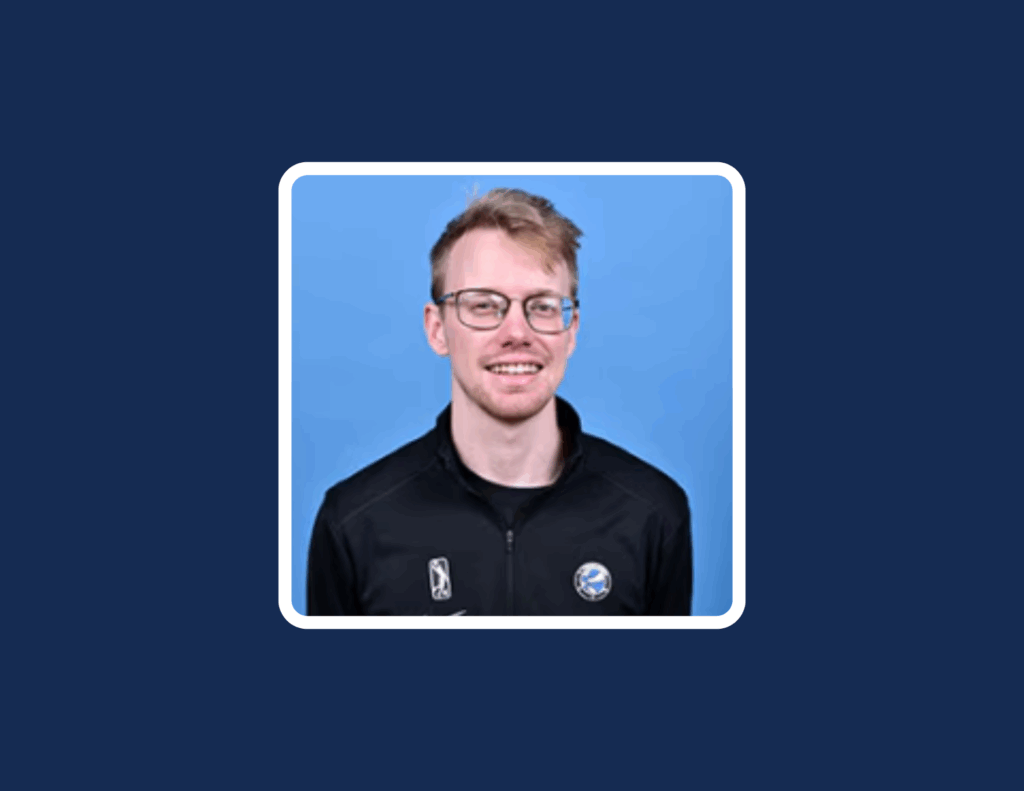
CONNOR HARR – OSCEOLA MAGIC, NBA G LEAGUE AFFILIATE OF THE ORLANDO MAGIC, VIDEO COORDINATOR – EPISODE 1110

Website – https://substack.com/@connorharr
Email – connorharr1999@gmail.com
Twitter/X – @harrconnor
If you listen to and love the Hoop Heads Podcast, please consider giving us a small tip that will help in our quest to become the #1 basketball coaching podcast.
Connor Harr is the Video Coordinator for the Osceola Magic, managing all film-related tasks and supporting player development, coaching, and team strategy. Harr previously spent five years at NCAA Division II West Liberty University, where he served as both Assistant and Head Assistant Coach.
Known for its uptempo style, West Liberty boasts the highest winning percentage in NCAA men’s basketball since 2009. Harr also served as Head Assistant Coach at Great Lakes Christian College. Harr contributed to multiple #1 nationally ranked teams, five Regular Season Conference Titles, three Conference Championships, six National Tournament Appearances, and one National Championship Runner-Up.
Connor has also developed a basketball strategy channel on Twitter and YouTube, aiding thousands of coaches in improving their craft.
On this episode Mike & Connor discuss the crucial importance of understanding one’s role within a basketball team, emphasizing that not every decision made on the court will be perfect, but rather, it is the collective effort and commitment to the team’s overarching goals that are paramount. We delve into Connor’s journey through various coaching positions, highlighting his experiences at Columbus State and West Liberty University, where the emphasis on teamwork and accountability shaped his coaching philosophy. He articulates the significance of building connections with players, fostering an environment where they not only learn the game but also enjoy the camaraderie that basketball fosters. As we explore the intricacies of coaching at the G League level, Connor shares insights on navigating challenges and the continuous pursuit of excellence in player development.
Follow us on Twitter and Instagram @hoopheadspod for the latest updates on episodes, guests, and events from the Hoop Heads Pod.
Make sure you’re subscribed to the Hoop Heads Pod on iTunes or wherever you get your podcasts and while you’re there please leave us a 5 star rating and review. Your ratings help your friends and coaching colleagues find the show. If you really love what you’re hearing recommend the Hoop Heads Pod to someone and get them to join you as a part of Hoop Heads Nation.
Grab your notebook before you listen to this episode with Connor Harr, Video Coordinator for the Osceola Magic of the NBA G League.
What We Discuss with Connor Harr
- The influence of his father when it came to his work ethic and his mother when to came to teaching
- The importance of understanding your role within a basketball team, particularly for players at the G League level
- How creating videos helped Connor understand player roles
- Why coaching is a teaching profession and effective communication is vital for player development
- Focusing on player accountability and teamwork, rather than individual accolades
- Winning is the only statistic that truly matters in basketball
- The significance of networking and building genuine relationships
- A successful team requires not only a collection of talented players but also a cohesive unit that embraces collective effort
- Mastering the ‘gray area’ in basketball strategy allows for flexibility and creativity in player decision-making
- Allowing creative freedom for players to thrive within the game
- Navigating your coaching career involves careful planning, reflection, and a clear understanding of personal strengths
- Self-reflection is an essential tool for coaches
- the importance of viewing basketball as a team effort where every player contributes to the common goal of winning
- The significance of a professional coaching portfolio for aspiring coaches, showcasing achievements and philosophies to distinguish oneself in a competitive field
- Embrace opportunities for growth because every experience contributes to your development as a coach
Like this show? Please leave us a review here — even one sentence helps! Consider including your Twitter handle so we can thank you personally!

We’re excited to partner with Dr. Dish, the world’s best shooting machine! Mention the Hoop Heads Podcast when you place your order and get $300 off a brand new state of the art Dr. Dish Shooting Machine!
Your first impression is everything when applying for a new coaching job. A professional coaching portfolio is the tool that highlights your coaching achievements and philosophies and, most of all, helps separate you and your abilities from the other applicants.
The key to landing a new coaching job is to demonstrate to the hiring committee your attention to detail, level of preparedness, and your professionalism. Not only does a coaching portfolio allow you to exhibit these qualities, it also allows you to present your personal philosophies on coaching, leadership, and program development in an organized manner.
The Coaching Portfolio Guide is an instructional, membership-based website that helps you develop a personalized portfolio. Each section of the portfolio guide provides detailed instructions on how to organize your portfolio in a professional manner. The guide also provides sample documents for each section of your portfolio that you can copy, modify, and add to your personal portfolio.

High school and middle school basketball program directors, listen closely. Coaches are expected to do far more than just coach. You know this. It doesn’t matter if you’re doing the coaching yourself, or you have a full staff of coaches with you. You know very well that coaches handle scheduling, academic issues, parent communication, leadership development, and even mental health concerns for athletes. A lot to deal with, and they haven’t even gone home yet to balance those responsibilities.
No matter the passion for the game, and burning desire to help athletes develop, this level of responsibility can lead to burnout, inefficiency, and less time spent on actual coaching. You know it’s true.
When coaches are stretched too thin, it impacts the development of athletes, team morale, and the overall success of the program. Now here comes the outsiders throwing their two cents in about what’s happening. Then come the parents complaining about how you’re running things, as if they know what they’re talking about. When’s the last time you went to their place of work chiming in from outside their window?
Before you let that fire fizzle out, know that it doesn’t have to be that complicated. There are several ways to prevent you or your coaches from feeling overwhelmed. However, I’ll tell you one of our favorite ways to keep coaches firing on all cylinders, and that’s athlete-driven accountability and organization.
Instead of coaches constantly reminding players about assignments, grades, and practice schedules, our programs at Playmaker Planner puts the responsibility back on the athletes. By tracking their own academics, goals, and commitments, student-athletes become more self-sufficient, which of course allows the coach to put their babysitter hat in the closet, and put their coaching hat back on, allowing them to focus on what they love doing.
Are we offering planners that you can get at the dollar store as a solution? Of course not, but we are starting a conversation with you to see if our programs can be a compliment to what you’re already doing. Let’s find out. To learn more visit https://playmakerplanner.com/stop-is-this-for-you
THANKS, CONNOR HARR
If you enjoyed this episode with Connor Harr let him know by clicking on the link below and thanking him via Twitter.
Click here to thank Connor Harr via Twitter
Click here to let Mike & Jason know about your number one takeaway from this episode!
And if you want us to answer your questions on one of our upcoming weekly NBA episodes, drop us a line at mike@hoopheadspod.com.
TRANSCRIPT FOR CONNOR HARR – OSCEOLA MAGIC, NBA G LEAGUE AFFILIATE OF THE ORLANDO MAGIC, VIDEO COORDINATOR – EPISODE 1110
[00:00:00] Narrator: The Hoop Heads Podcast is brought to you by Head Start Basketball.
[00:00:16] Connor Harr: I’m just trying to teach them how to be better basketball players. I’m not teaching them how to make every single decision, right? It’s impossible to get every decision, right? It’s about trying to see the bigger picture and trying to see the common goal.
[00:00:35] Mike Klinzing: Connor Harr is the video coordinator for the Osceola Magic of the NBA’s G League, managing all film related tasks and supporting player development, coaching and team strategy.
Harr previously spent five years at NCAA Division two West Liberty University, where he served as both assistant and head assistant coach, known for its uptempo style, West Liberty boast the highest winning percentage in NCAA men’s basketball since 2009. Har also served as the head assistant coach at Great Lakes Christian College.
Harr contributed to multiple number one nationally ranked teams. Five regular season conference titles, three conference championships, six national tournament appearances, and one national championship runner up. Connor has also developed a basketball strategy channel on Twitter and YouTube, aiding thousands of coaches in improving their craft.
Hey Hoop Heads. This month only our friends at Doctor Dish Basketball are giving you an exclusive $2,000 off plus free shipping on your purchase of a doctor Dish. CT Plus All Star Plus or Rebel Plus. Hurry to secure your savings before June 30th or while supplies last. Learn more@drdishbasketball.com and follow their incredible content @drdishbball on Twitter, Instagram, Facebook and YouTube. Mention the Hoop Heads podcast and save an extra $300 on a Dr. Dish Rebel Plus, all Star Plus and CT Plus models. Those are some great deals. Hoop heads. Get your Doctor Dish shooting machine today.
[00:02:07] Dre Baldwin: This is Dre Baldwin from Work On Your Game Incorporated and you are listening to the Hoop Heads Podcast. Work on your game.
[00:02:17] Mike Klinzing: Your first impression is everything when applying for a new coaching job. A professional coaching portfolio is the tool that highlights your coaching achievements and philosophies, and most of all helps separate you and your abilities from the other applicants. The Coaching Portfolio Guide is an instructional membership based website that helps you develop a personalized portfolio.
Each section of the portfolio guide provides detailed instructions on how to organize your portfolio in a professional manner. The guide also provides sample documents for each section of your portfolio that you can copy, modify, and add to your personal portfolio. As a Hoop Heads Pod listener, you can get your coaching portfolio guide for just $25.
Visit coaching portfolio guide.com/hoop heads to learn more.
Grab your notebook before you listen to this episode with Connor Harr, video coordinator for the Osceola Magic of the NBAG League.
Hello and welcome to the Hoop Heads podcast. It’s Mike Klinzing here without my co-host Jason Sun tonight. But I am pleased to be joined by Connor Harr, video coordinator for the NBA’s G League, Osceola Magic.
Connor, welcome to the Hoop Heads Pod.
[00:03:28] Connor Harr: Happy to be on here. Thanks for having me, Mike.
[00:03:32] Mike Klinzing: Absolutely thrilled to have you on Connor. Looking forward to diving into the interesting things that you’ve been able to do in your young career thus far. Let’s start by going back in time to when you were a kid. Tell me a little bit about some of your first experiences with the game. What made you fall in love with it?
[00:03:46] Connor Harr: Yeah so basketball has always been a big part of who I am. I grew up in Youngstown, Ohio which is a predominantly football dominated area. So it was kind of unique being somebody that really, truly enjoyed the game of basketball and loved the game of basketball when most of your friends were playing football all the time.
But it was. It was really enjoyable for me because it was something that my family had a love for as well. So my dad grew up playing he was a really good player at Watkins Memorial High School in Pataskala, Ohio, near Columbus. Ended up playing a year at Walsh University when they were NAIA.
So it was always something that we could kind of bond over and he ended up, he was a long time ref as well in Ohio High School. So he’s always loved the game of basketball. And then I had uncles, cousins, other people in my family that were all avid basketball players and all big hoops fans.
So it was something that I could really connect with my family with as well. And kind of got me into the game of basketball at a young age.
[00:04:53] Mike Klinzing: So talk to me about the influence of your dad, both in terms of what you were like as a player and then sort of when you think about that influence today.
A coach, what are some pieces of your dad that you’re still carrying with you even today as a coach?
[00:05:10] Connor Harr: Yeah. Honestly, like my dad me and him worked a lot. Playing basketball together. And like, I think that honestly outta anything like the hard work that he put in with me has kind of allowed me to do the same in coaching.
On top of that, like I wasn’t very good. So I think his patience with me and probably not getting not getting too upset with me because I wasn’t as good as he was probably as a kid. But he allowed me, he showed me kind of what it meant to work hard.
And I improved a lot as a player. I didn’t end up playing that long. Like I didn’t play in high school or anything like that. So I was actually a much better track and cross country athlete. So I did that in high school instead. A big part of my coaching though, I think comes from my mother.
So my mother’s a second grade teacher in the Austintown school district around Youngstown, and she. Through and through an educator. Like she loves everything about education. She loves everything about teaching, she loves everything about her students. She’s one of those teachers that like all the kids come back and see and all the kids love, like they all want to hang out with her and all that stuff.
So I think a lot of my parallels and coaching, I like to think of coaching as teaching and a lot of those came from watching my mom teach. ‘Cause when I was younger, like I would go in a room every single day after school. And as I got older, like I would start doing work in the class too, like helping out the kids with their reading and helping out the kids with their spelling and their math and all that stuff.
So that was really where I think my love for coaching started. And it began with the, my love of teaching and my mom’s love for teaching.
[00:06:52] Mike Klinzing: Did you start thinking about coaching as an actual career and a path that you could go down? Your life as opposed to, Hey, I like basketball. I like working with the kids in my mom’s class.
It’s kind of fun. When did it sort of dawn on you that, Hey, maybe I can really do this for a living? Was there a specific light bulb moment or was it more of kind of a slow burn?
[00:07:14] Connor Harr: I think it was a slow burn. I originally knew that I wanted to work in basketball. I didn’t know at what capacity that would be in.
When I graduated high school, I moved to Columbus with my dad. And I started thinking about what I wanted to do for a career. ’cause I hadn’t really given it much thought, truthfully up until that point. And I went to Columbus State Community College. I took classes there. And that first year I was at Columbus State.
I just really sat down and I thought about what I wanted for myself, what it was that I enjoyed, and the one constant that I kept coming to was how much I loved the game of basketball. So, originally I started out and I wanted to be a scout, like whether it was high school NBA, anything really like, so I started putting out NBA draft articles online.
And I got my first paid job, the. Winter of my freshman year of college writing NBA draft articles. And then after that, during like the NBA draft cycle, and once the season ended in like March and April, I got approached by an agent that I was writing about one of his clients, the client’s name is William McDowell White.
So he came outta the NBA draft in like 2019. I want to say. He was draft eligible, an Australian point guard, and I was writing about him. So the agent invited me to. Williams Pro Day out in Vegas, and there were a ton of really, really high level players there. There was a ton of really high level NBA personnel there.
Like I remember seeing Adrian Wojnowski and Greg Popovich and DeMarcus Cousins was working out on one of the courts next to us, and I was just like, man, this is crazy. Like I see all these people that like, I’ve grown up watching on TV and seeing, and I think at that point that was when it really hit me that like I have a chance at this.
Like this is something that I can do and I can do for a living. And then as I started to get more into the draft space, I started working with a lot of different agents. And what I would do is I would make either statistical presentations or videos to help their clients either obtain new contracts.
If they were already in the NBA or to try to boost their draft stock if they were coming into the draft. And they’d pay me a little bit of money for that, in my opinion. They paid me way more than they ever should for a five minute video. And I was just like, I was willing to do it for free. And they’re like, no I need to pay you.
And I was like, okay. And I look at it and I get a Venmo for 500 bucks for a five minute video, and I’m like, whoa, this doesn’t seem like it’s worth it. But yeah, so that’s when I kind of decided like, I thought I could really do this. And then as I got a little bit more into the scouting space, that was kind where the teaching part came in.
And like the influence of my mom is, I felt like the scouting profession as a whole was just kind of lonely. you just sit and you watch film, and I love watching film. I take pride in watching more film than almost anybody else. But it lacked the, the human interaction part. And that was when I started to turn my focus towards coaching.
So when I did that, I emailed the head coach at Columbus State Community College at the time when I was a freshman. They already had their manager spot filled for the season and everything. So I had to wait until next year. And that’s kinda where my feet got wet, was at Columbus State being a manager for their basketball team.
And it was basic manager stuff. Like all I did was really like, run the scoreboard, mop the floors, do the laundry forget a couple jerseys a couple times, and just kind of figure out the lay of the land and try to understand what college basketball was all about.
[00:11:21] Mike Klinzing: I want to go backwards before I jump to some questions about that first coaching experience. So the video piece of it. When you’re putting that together for the first time, what’s your process? What are you thinking about? How are you trying to make what you’re doing unique? Just what was the angle that you took as you were preparing those five minute videos for people that they felt like they were worth paying you for?
What was your process for figuring out what you needed to include in those, and just how did you kind of map out that scouting path, for lack of a better way of saying it?
[00:11:55] Connor Harr: Yeah. I think the important thing that I highlighted really was I tried to show how. Players would fit into a particular role. So it wasn’t just a highlight tape.
it was, and these guys I like, it wasn’t guys that were established NBA players, it was guys that were barely in the league, might’ve been in the G League at one point in time, were overseas trying to get in the league. So it was more about understanding what type of role they could play and how they could support an NBA roster.
So for some guys it would be maybe I’m highlighting their ability to pass the ball. I’m highlighting their ability to make correct rotations every single time on defense. I’m highlighting how many charges they take, like whatever the thing is, whatever the ancillary skill is that they need in order to compliment the other guys on the roster.
I tried to be able to highlight that as much as possible. And then I think the other thing I did a really good job of as well is like. I never tried to blindly make statements. So everything that I put in the video there would be like subtitles in the video, text in the video as well. And everything that I tried to put in the video would be supported statistically.
So it wasn’t just like I was saying, oh, this guy’s a really good passer and they go and look up his stats and he has a negative assisted turnover ratio, you know?
[00:13:26] Mike Klinzing: So it’s interesting that you describe the videos in that way because I remember I had a conversation with Mike Opio, who at the time was with the Dallas Mavericks as their Director of Player Development, and he talked to me a lot about the fact that guys at the back end of NBA rosters or guys who were trying to make it to the league, which are the guys that you’re describing, right, that you did the videos for, he said, so many of those guys don’t always have an understanding of the fact that.
You have to be able to, as you said, play a role and fit a role on a given team. And for so long in their careers, they’ve probably been the best player on their teams for a long time from the time they were a kid. And we all know that when you’re the best player on the team, right, you get the ball and you kind of get to do stuff, and you get to shoot, and you get to have the ball in your hands.
And maybe defense is a little bit secondary if you’re the star of your team. And so there’s all these factors that go into it, and then all of a sudden they get to a level where they’re no longer the best player, right? And they have to then figure out what is it that I can do? What are my one or maybe two skills at the most that I can bring to the table that will make me valuable?
As the 10th guy, the 11th guy now as a two-way guy on a roster. And he was really the first person on the podcast that I ever talked to about that particular concept. So I think it’s. Pretty cool that you had that insight as you were kind of getting started to create videos that were highlighting the things that Yeah, when you’re at the back end of a roster, no one wants to see you play like LeBron with the ball in your hands for the entire highlight tape.
’cause you’re just not going to, you’re not going to do that if you’re going to be the 11th guy on a roster. You’re never ever going to get an opportunity to do that. But you might, as you said, you might have an opportunity to play six minutes as the backup point guard and get the ball to the next guy. Or you might have an opportunity to be a great defender and knock down corner threes or whatever it is, whatever that role might be.
And like I said, Mike was the first guy that kind of talked to me a little bit about that and almost we got into a discussion about how it’s almost flipped in terms of when you think about how we teach kids to play basketball when they’re young, right? You want the kids to develop every skill and then the higher level you go, it’s almost like a lot of those skills, not that they completely drop off, but.
The utilization of those by role players certainly is diminished compared to what they were previously, if that makes any sense. So I think, I think it’s pretty cool that you had that insight when you started out.
[00:16:01] Connor Harr: Yeah, it’s it’s very funny too. I was actually just on the phone with another coach on my way here about this.
His name’s Ryan Streets. He coached at a Potomac State JUCO in West Virginia, a good friend of mine. And we were talking about that even with coaching where you’re talking about your progression as a young coach. And the one thing that I always tried to do was I tried to be very self-reflective and hone in on my strengths and really work on those strengths and make those strengths even greater.
And then when I had time in my free time, whatever it is, kind of fill in the weaknesses. But even as a player, like I think it’s huge ’cause you kind of have to. You have to come to that moment of self-realization. You have to look at yourself in the mirror and just accept the fact that this is where I’m at.
And it might not be where I end up, but this is where I am right now. And it’s kind of, it’s about checking your ego at the door basically. And you have the skills that you need and it’s just a matter of honing in on the strengths that you have as a basketball player and kind of shying away from your weaknesses until you know it’s time for the off season or whatever.
And you can still work on your strengths as much as you can, but now you can spend a little bit more time on your weaknesses as well.
[00:17:23] Mike Klinzing: And it’s just, to me, it always seems, when you think about it, like I said, counterintuitive of here you are at the highest level with these guys who are ultra, incredibly talented, and yet they still have to be able to understand, and as you said, be self-aware that, hey, that’s not my role.
If I’m going to stick. In the league, I have to be able to do X and Y tremendously well, and I have to put A, B and C off to the side right now. And yeah, I can work on that in the off season and maybe I can try to increase my role, but if I’m going to stick on a roster or I’m going to actually get some minutes, I’ve have to be able to be really good at the things that I do.
And I think it’s also a good point that you just talked about, right? As a coach that I, I can think of a ton of coaches that we’ve interviewed on the podcast, Connor, who have talked about, Hey, I started out and I was an offensive guy, and that became sort of my niche. And then eventually I got a head coaching position and I had to shore up what I was doing defensively, or I had to figure out what my philosophy was on the defensive side of the ball because I had just always sort of focused on offense as an assistant coach.
And so it is interesting how there’s parallels between the playing and the coaching when it comes to that. In terms of your ability to sort of rise up the ladder in the coaching ranks. Tell me about that first year as a manager. At Columbus State, did you get an opportunity to kind of sit in on anything and, and see anything behind the scenes coaching wise or just what were your impressions of, of the coaching profession in that first year where you ki you were kind of at least in the door, so to speak?
[00:18:54] Connor Harr: I loved it. I loved every second of it. I loved being in the gym. I loved watching the guys compete. We had a really good group of guys. I think if anything, what I learned from that experience, ’cause we had a really, really good team and we had a ton of talented players and that was when I always talk about, when I talk about like building a roster and roster construction with certain people and coaches, like I always talk about how I have a firm belief that there’s a baseline level of talent required to compete.
And then a lot of that from there, there’s a lot of other external factors that play into how good of a team you are. And I think that was like. My first realization of like, Hey, I’m in college basketball now, and there’s tons of good teams with tons of good players and talent alone isn’t just going to equate where you want to get to as a team.
So I think that was huge. And then the Columbus State people, they were great to me. They they allowed me to do some recruiting on the backend of of my time there. And it kind of went hand in hand as well because I, at the time when I was in Columbus, I started working for my, one of my best friends, Zach Flir at two 70 hoops.
And that was, at the time they’ve kind of shifted to more of just like regular media now sports media in Columbus, but that at that time they were doing a lot of Columbus scouting. So. I would go to high school games every night when I could, and I would write scouting reports about players and that allowed me to make a lot of connections with coaches as well.
’cause I’d write some scouting reports and people would like ’em or they’d be interested in a guy that they don’t know a lot about. And they’d reach out to me and we’d have a conversation. And a lot of those people I still have relationships with to this day. And a lot of them have done really, really well.
Like Jared Calhoun, like he is somebody that I would consider a friend and somebody that’s helped me along the way. And I met him at a Bishop partly game when he was recruiting a kid from there when he was at Youngstown State. So it was just things like that where it helped me out tremendously in that time, just kind of getting my feet wet and also allowing me to start getting involved in recruiting a little bit and evaluating players.
[00:21:19] Mike Klinzing: Long did it take you to feel like you had a pretty good sense or feel for how good a kid was at the high school level and what level they could play at in the college game? How long did that take you before you felt pretty confident? Then when you’re watching a kid, you’re like, yeah, this kid’s a D two kid, or this kid can play mid-major division one.
How long did that take for you? A
[00:21:41] Connor Harr: long time ho honestly, like it took a long time. I, here’s, here’s the thing with that, I, I think the, the biggest thing with it is there’s a lot of scouts out there and not a lot of ’em are watching division three basketball or watching NAIA basketball or watching JUCO basketball.
So I think it’s tough when you’re not like fully immersed in it. Like everybody watches division one basketball and everybody knows what’s going on in division one basketball. But for me, like. It was not, probably not until I got to West Lib where I really figured out like, okay, this is a division two player.
And before, when I was at West Lib, I was at Great Lakes. And so like I got to see NAI players and D three players and until then it was, it was tough. Like, and a lot of times, like I just try to focus on the player’s game rather than just penciling them in to a level. And with a lot of coaches, like they know, like they know who they like, they know if they think a kid’s good enough or not.
And more or less, for me, I felt like it was my job. When I was doing that, just to kind of give them a synopsis of the player’s game and what they’re good at and what they’re not good at. And I tried to use that same method and that same strategy that I used in, in the NBA with the scouting that I did there with high school as well.
So like, I tried to focus a lot more on guys passing ability, guys iq different reads that they’re making, things like that where I felt like at that time, at least from the people that I was working with, like I was kind of at the forefront of that where I was talking a lot more technically about a player’s game than just saying like, oh, this kid’s explosive and he can shoot.
[00:23:42] Mike Klinzing: Right? So you’re dialing in on what skills they actually have that they’re demonstrating on the floor. Instead of making a grand projection about, Hey, this kid is this or this, kid’s at this level, instead, you’re kind of being more granular and breaking it down in terms of their skill, which makes a lot of sense again, as you’re evaluating a kid.
And it probably helped you to be able to sort of dial in on those things too, to be able to, instead of trying to make a grand proclamation about every kid of, Hey, this kid’s a division three kid, or this kid’s a division two kid, or this kid should be this. Instead you’re just looking at the skills and saying, Hey, this kid can do this when I see him play, this kid maybe struggles in this particular area.
And I could see the value in that, both for you as developing yourself as a scout, but then also for the people who are reading what you’re putting together on, on different players. Talk about the opportunity at Great Lakes after you get done at Columbus State. Just tell me how that opportunity comes to you.
[00:24:37] Connor Harr: Great Lakes was awesome. Probably some of the most fun and the best time I’ve had in my coaching career, probably the most beneficial as well, so. The way I got connected at Great Lakes, it’s really random. I was up late at night. I didn’t really know what I was going to do. I think at one point in time I was going to go try to do like a student manager, student assistant at Urbana.
And that was a school in Western Ohio that ended up shutting down. So the coach that was there at the time, Nick Dials, he ended up leaving. And so when he left, I, I was just going there for him. So I was like I’m, I’m not going to Urbana for when I don’t know the, the coaching staff for the people that I’m going to be working with every day.
And so it was like really late at night. I was laying in my bed. I didn’t know what I was going to do, and I randomly came across a tweet from a guy named William Payne who has a pretty big Twitter following. He promotes players. He is a big advocate of small college basketball and just all around like a really, really good guy.
He actually was a college coach in Ohio for a brief time at Miami Hamilton, I believe. And so he tweeted something saying there was this school in Michigan and they were looking for a student assistant or basically just somebody that could work for free. So I messaged him, he gave me Richard Westland’s contact information, who was the head coach at Great Lakes Christian at the time, that’s now the head coach at University of Northwestern Ohio up in Lima.
And he, I got connected with with Rich. Rich, actually knew my boss at two 70. Zach Flir really well, so called Zach about me. Zach gave me a really strong recommendation. I went to go visit campus and Lansing, which is where Great Lakes was at, and after that it was. Pretty much history. And the cool thing about Great Lakes is they didn’t have any staff.
Like it was, it was just rich and he needed somebody to help him coach the team, obviously. So he gave me a lot of responsibility and I had no idea what I was doing, but I was on the court every day acting like I knew what I was doing. So with that, I learned from a lot of trial and error and each day was such a fantastic learning experience for me.
Where I failed, I messed up, I did things wrong. Not that I always did things wrong, like sometimes I got things right. But it was just that period where I had all that responsibility with none of it being earned or afforded any type of way that Rich gave me, really allowed me. I. To grow, grow as a basketball coach.
So when I was there, I was the assistant and I was the head JV coach. So I had my own JV team as well. Because of gym availability, we practice at six in the morning every single day. So it was JV college, JV basketball practices at six in the morning. Usually don’t go over too well. But it was, it was fantastic.
It was probably the best time I’ve ever had as a coach the most learning that I’ve ever done as a coach. And I said a big part of that was just trial and error and getting out there and figuring out what it is that works for you, what it is that doesn’t work for you. And I know all young coaches talk about all the time, like trying to find your voice as a coach and trying to find out who you are as a coach.
To me, that whole period was just me figuring out. Who I was as a coach, what I wanted to be, how I wanted to operate, how I wanted to communicate with players, and a lot of those philosophies and a lot of those things that I have like I always try to self-assess myself and reevaluate myself, but at the same time, a lot of those like core beliefs still kind of hold true today.
[00:28:35] Mike Klinzing: You almost have the best of both worlds there in that you have the assistant piece of it where you’re learning from a guy that you’re working underneath, and then you also have the ability to get those reps as the head JV coach, where you’re doing the substituting, you’re making the decisions end game.
And a lot of times, guys who start out, obviously as an assistant, you’re not getting those. Head coaching game rep. So you kind of had the both best of both worlds in that situation where you could learn underneath somebody and also get the head coaching reps that not a lot of guys get early in their career.
[00:29:05] Connor Harr: Yeah, it was awesome. I, I loved it. I really enjoyed it. It was the only time I’ve got to be a head coach in my career, so it’s was a pretty unique experience and I don’t take that for granted at all. And kind of the cool thing about Great Lakes too. So Great Lakes is like a legitimate Bible college.
So there’s about 350 kids on campus. Most of them go there for fellow Christian fellowship work, missionary work, whatever it is to be pastors. And when you go to Great Lakes, you double major with a degree in theology. So it was a very unique school from that perspective and the program before Rich took it over.
So it was, I. I got their richest second year, his first year when he took it over they were really, really bad and he turned them around in one year and took ’em to the national Championship game of N-C-C-A-A which is remarkable. And kind of what we did was we had to get really good players.
And the only way we could do that was. Kind of taking guys that needed a chance. So what we would do is we’d call up all the, ’cause they had different eligibility standards. Like we’d call up all the nais, all the jucos, all those schools and just say who do you got that’s not eligible?
And we ended up getting some really, really good players. So guys that had division one offers, guys that are still currently playing overseas guys that played D two, D one NAI at all high levels. So it was a com pretty competitive team as well which I thought was great, being able to have that much experience, especially when you’re working with a a high level player as well.
So being able to do that was awesome. And we got, like I said, exposed to. A lot of different levels of college basketball, N-A-I-A-D three NCCA, we played all those teams. So I got really familiar with the Crossroads League in Indiana. Like those teams like Grace and Taylor and got a feel for how good basketball is there.
And just how good basketball is, even at the division three level where you got schools in Michigan and schools in Ohio that all compete at a really, really high level. So that really opened my eyes from a basketball perspective and broadened my horizons of just how good college basketball is as a whole,
[00:31:27] Mike Klinzing: a pure basketball perspective.
What area in that year do you feel like you grew the most? And I don’t want, I don’t know if you want to take it, Xs and o’s or culture or just what, what did you learn in that year that you really feel like accelerated your growth, maybe from where you were when you came in at the beginning of that season?
[00:31:48] Connor Harr: I would say probably just overall presentation. So my, like I said, my voice on the court, my ability to recruit players, my ability to I would’ve to do athletic visits. So carry out athletic visits with recruits and their families. Like I was, I turned 21 during the season. So being able to do all that and being able to be incredibly vocal is something that I think I.
A lot of coaches come in and they really, really struggle with, no matter how much they know or what their playing background is or whatever it is. Like that’s usually the hardest leap. So once I got really good at that, and Coach Rich, like he’s, he’s got such a way with words. We always joke around with him and say he could sell ice to an Eskimo.
Like he’s just a very smooth talker. He knows how to relate to people. He is one of those people that, like, he comes in and he just captivates a room. And because of that, I learned a lot of his qualities from him and just kind of his outlook and mindset on life. he’s somebody that’s been through a lot of challenges and a lot of trials and a lot of tribulations and he.
Just thankful for what he does and he’s thankful for his job every day. there’s a lot of people that just constantly want more and more and more and are upset about their situation ’cause they feel like they’re deserving of more. And he’s somebody that woke up every day and was fired up from the get-go, that he got to go work at Great Lakes Christian College and coach college basketball.
So I think that day-to-day mindset, even with him, was huge for me as a coach.
[00:33:32] Mike Klinzing: That’s a great lesson to learn, especially early on in your career where you start talking about doing the best possible job that you can where you’re at. I always think back to John Schulman, who he’s at Central Arkansas now, and he’s always saying, make the big time where you are because.
No matter what the, the game that you’re playing, it’s important to you and it’s important to a circle of people that are involved in, and he goes, but you go two states over and nobody cares about your game. Or you go two, two blocks down the road and nobody cares about it. So you have to make sure that you make wherever you are, doesn’t matter that you, you make the big time where you’re at.
And I think if you can do that at every stage in your career and put your best foot forward and, and, and work as hard as you can and do what you’re supposed to do, then that’s when you get the next opportunity. Right? It’s, it’s not, it’s not the guys who have one foot out the door and are looking over their shoulder to see what, what’s coming next.
It’s the guys who are putting in the work and doing what they’re supposed to do and giving everything they have to the kids that are in front of ’em and to their fellow coaching staff to the community. And if you do that, you’re going to a, have a lot more fun and be a lot more successful in that place where you are.
And then that’s also. Sort of counterintuitively is going to give you that next opportunity. It’s when you’re looking, always looking out the door, that, that sometimes you get in trouble. So your next opportunity was at West Liberty. So talk about the experience there. I know you were there for a number of years and obviously you had a tremendous amount of success there, one of the best division two programs in the entire country.
So just walk us through how you get to West Liberty and then just what are some things that you feel like you took away from that experience?
[00:35:14] Connor Harr: Yeah, so I get to West Liberty. First of all, west Liberty is a first class basketball experience and it’s a first class basketball school. You want to talk about a place that people care whether you win or lose.
You go to a West Liberty game. That place is packed out every single game. Regardless if you’re playing the best team in the league, the worst team in the league, everybody wants you to score a hundred. And if you win by 60 and you were supposed to win by 65, you didn’t win by enough. But it’s truly a basketball school, which to me is just so unique of a division two school or even a low major school.
A lot of times you don’t get that experience unless you’re at a perennial high major or perennial blue blood. So obviously it’s on a smaller scale, but it’s the same experience that you would get anywhere else where everybody knows the team, everybody knows who you are. And it’s truly like, in my opinion, one of the best basketball experiences regardless of level that any player or coach could ever get.
So with me at West Liberty and how I got started. Same thing, like I was working at two 70 and I met Mike Lamberti who just recently got named the head coach at West Liberty and who was formerly the coach at Coker and an assistant at West Liberty at the time. So I met Mike, sent him some stuff online and I just hit him.
I had Zach hit him up randomly one day and just say like, Hey, like this kid really wants to come to West Lib and he really wants to help out with the team. Like is there anything that you might have for him? And luckily I was fortunate that they had an opening and I became a student assistant at West Liberty after my year at Great Lakes.
And West Liberty is, is very unique because on top of the experience, like they play a very unique style of play. And you just do things differently there. Like a lot of the things that are done at the other places that I’ve been to or when I go watch practices they’re not done at West Liberty. And I tend to think, and I think part of this is because of how I was indoctrinated into West Liberty basketball, but also how I grew up, like not being a high level basketball player is at West Liberty, like they truly believe in being the ultimate team.
Like you win as a team, you lose as a team, you play as a team. And I think, think for almost every other basketball that I watch, I think sometimes that gets misconstrued. And you see a West Liberty basketball game and all five guys are chasing guys down from behind out of the press. All five guys are scratching and clawing for rebounds.
All five guys are. Touching the ball on every possession. And it’s just, it’s just so unique to how everybody else plays the game of basketball. And for me and myself, where I’ve constantly thought about basketball as a team game, and you know how there’s five players on the court, on your team, and I think sometimes teams only make use of one or two of them.
And with that, like the West Liberty system and how I viewed basketball philosophically at the time, like they just, they just clicked like that. So I was at West Liberty for four and a half years. Student assistant, assistant coach, head assistant coach. I went to the national championship game in division two, unfortunately lost played in two elite eights, played in two final Four, or played in one final four.
Played one. Four conference regular season championships and two conference tournament championships. Made the NCA tournament every year. I think in the timeframe we won 85% of our games which was probably one of the higher outta any college program in the country. So it was a great experience and most importantly, outta anything.
I got to work for a really, really high level basketball coach in Ben Hallett. The man has done nothing but win almost every single basketball game he’s coached in an eight years, and he’s ultra competitive. And he kind of marches to the beat of his own drum, similar to kind of what I’ve heard about Coach Crutchfield.
And I love working with him and being around him and learning from him and getting to understand more about how they played from him. So I would just sit in his office all day. And just talk to him and like, until he told me to get the hell out of there, like I just sit in his office and try to learn as much as I could from him.
And eventually it got to the point where he, we developed a very strong working relationship and he developed a lot of trust in me and provided me with a lot of opportunities that have helped me out tremendously in my career as well. So at West Liberty, like I said, great basketball experience, phenomenal coach.
And I don’t think, if you could tell me, I could go to Duke University and do the exact same thing at Duke University, I’d probably still pick West Lip.
[00:40:35] Mike Klinzing: High school and middle school basketball program directors Listen closely. Coaches are expected to do far more than just coach. You know this. It doesn’t matter if you’re doing the coaching yourself or you have a full staff of coaches with you. You know very well that coaches handle scheduling, academic issues, parent communication, leadership development, and even mental health concerns for athletes a lot to deal with.
And when coaches are stretched too thin, it impacts the development of athletes, team morale, and the overall success of the program. There are several ways to prevent you or your coaches from feeling overwhelmed. However, I’ll tell you one of our favorite ways to keep coaches firing on all cylinders, and that’s athlete driven accountability and organization.
Instead of coaches constantly reminding players about assignments, grades, and practice schedules, the program that Playmaker Planner put the responsibility back on the athletes by tracking their own academics goals and commitments. Student athletes become more self-sufficient, which of course allows the coach to focus on what they love doing most coaching.
Let’s find out if the programs from Playmaker Planner can be a compliment to what you’re already doing. Visit playmaker planner.com/stop. Is this for you to find out more?
What’s the secret sauce to getting a team to play five guys together, sharing the ball? What did you guys do? What did you talk about? What’s the everyday emphasis that gets teams to play that way? Because I always, when I watch basketball, when I played basketball, when I think about basketball, I think about it in terms of teams that share the ball, that play together, that are unselfish, that makes the extra pass that gets everybody involved.
That’s the secret to winning basketball. And yet you and I both know that you can watch a lot of basketball. Never see that. ’cause you see selfishness or you see teams that are focused, as you said, on only one or two guys have the ball in their hands all the time. So what’s the secret sauce that you guys threw together at West Liberty?
How do you go about that on a day-to-day basis to get guys to buy into playing that winning style of basketball?
[00:42:54] Connor Harr: Yeah, and we, we never really used the word culture. Coach Hallett and also myself. Like we weren’t really big fans of that word, but I think culture’s just about what you do every day.
Like, it’s not sayings on a wall. It’s not you can see it. You, you can see the culture and practice. Like you can go to West Liberty practice and you would say that team plays really freaking hard and they play more together than any team I’ve ever seen. And so for us, like, I think it starts with letting the guys know that we recruited 12.
13, 14 really good players and all you guys are all capable basketball players. And we kind of instilled that belief in the guys that they’re playing with other good players as well. This isn’t a high school anymore, where we recruited a lot of rural kids from small towns in Ohio, Ohio, and a lot of those guys, like, they have to take every shot for their team to have a chance at winning the game.
But when you get to the college level, like it becomes a lot more realistic where if you recruit well and you find the right guys, you can get a ton of really good players and it’s about setting that standard that everybody’s, everybody’s going to be held accountable.
if you take a bad shot, if you don’t run back on defense, if you do something selfish. We’re going to let you know about it and we’re going to let everybody know about it. It doesn’t matter if you, we’ve been very fortunate to have really good players. We had all Americans guys that ended up transferring up division one and making hundreds of thousands of dollars in NIL.
your accolades or statistics, they don’t matter. Everybody’s held accountable the same way. And to us, that’s what it’s about. It’s about being the ultimate team. And the only statistic that truly matters at the end of the day is winning and losing. And we continue to ingrain that every single day in their heads.
And until one point they start to understand hey, this is, this is what works. And obviously with West Lib, with the track record that they’ve had for so long, like you tell ’em they do this and you see. There’s literally a banner hanging up in West Liberty for every year, since like 2005.
So they look at all these banners and they’re like, yeah that must work. Probably,
[00:45:12] Mike Klinzing: probably makes sense. Maybe I should listen. Right, right. So
[00:45:15] Connor Harr: but it’s just about, it’s just about being upfront and being honest and like making sure that you have these conversations with your players, of them understanding when I recruit a guy West Lib, I don’t tell them that they’re going to score 25 points a game, or they’re going to start and play every second.
What I tell ’em is they’re going to get the opportunity to be a part of the ultimate team and they’re going to be held accountable. And I don’t even promise ’em that we’re going to win games. They say we’re going to compete and we’re going to go at it every single day in practice, and we’re going to accumulate as many good days as we can in practice, and we’re going to play as the ultimate team.
And if everything else kind of takes care of itself, so be it. But I’ve always found it funny, like when you talk to coaches and like. You ask ’em like, Hey, like how do you guys think you’re going to be next year? And you’re like, oh yeah, we’re going to, we’re going to kill it. I’m so like, like I’m and I get like, you’d be excited about the personnel that you have on your team, but at the same time, even in college basketball nowadays with the amount of turnover that there is, like you’re retain, you’re lucky if you retain 50% of your roster.
So if somebody tells me like, oh, how do you think we’re going to be, I’m like, I, I don’t know. Like, we have to figure it out. Like we have to figure out how these guys gel together, how they get along on the court, how they get along off the court how they play together. And there’s just so much, there’s so much more that goes into, I think, being a winning team than just having a ton of really good players.
Obviously it doesn’t hurt. But at the same time, I think it’s truly about like what you talked about, the ball movement and everybody being involved and everybody feeling like they’re a part of the game and a part of the team. And that’s what we try to do. Like, and that’s how we play and we’re fortunate enough that we play very uptempo and we play a very fast pace.
So it rewards that kind of stuff. And then I think the last thing as well is just at West Liberty, we don’t script our offense. Like we run a five out open motion offense where guys are allowed to make decisions and make plays. And I think because of that, nobody’s being dictated where to go or where to screen or what to do on every single possession.
And I think a lot of times that’s where a lot of the. the, the lack of ball movement or the lack of like the selfishness kind of comes into play. Because your players, you spend all this time with your players working on your plays, and then all of a sudden your plays don’t work. And now what are we going to do?
You’re going to do the same thing that everybody else does. And I hate this. I think there’s so many other better substitutes, but you go set a ball screen in the middle of the floor for your best player. And it’s just like, that’s kind of what I feel like a big part of it is as well is just I think that the amount of freedom and the amount of decision making that we give to our players allows that to truly be allows that to truly kind of make sense with the team where we tell them too, it’s like.
You’re going to get more freedom here than pretty much anywhere else in the country within reason of being good. And all we ask is that you guys play as a team, you move the ball and you take really easy shots. And the flip side of that is we could walk the ball up to court and run a set play every time down.
And nobody wants to do that. That’s no fun. So
[00:48:40] Mike Klinzing: how do you balance the freedom that players have with helping them to make better decisions within the confines of what you’re trying to do offensively? In other words, during practice, kid makes a decision. Maybe as a coaching staff on the side, you feel like there was a better decision to be had. How do you teach that and yet not stifle the player’s creativity and freedom?
[00:49:08] Connor Harr: Yeah, that’s something where I pride myself on being very, I. Conversational with players. Like, I don’t want to say like, I think sometimes conversational gets misconstrued as laid back. And I think if there’s one thing that people will tell you about me is like, I’m really, really passionate and I’m passionate about the game of basketball.
I’m passionate about teaching players. But it’s a conversation that we can have and it’s almost like one of those things where it’s, we’re not sweating the small stuff, right? So if, let’s say player drives from left wing, there’s a guy in the left corner and there’s a guy in the right corner, and the low man defensively in the right corner’s pulled over and the left corner, just the ball side corner just stunts a little bit.
He could have probably skipped that pass to the opposite side, but. He decided to pass the ball to the corner and said like, it’s no sweat. Like we’re, we’re kind of, we’re living to play. And it’s one of those things where you have to be very kind of metic, not meticulous, but very detailed with how you’re doing it and how you’re going about it, where you’re not stopping every single time and you’re not pausing it.
It’s just, and a lot of the stuff that, like coaches, like when they stop practice and it’s just like they a lot of that stuff could just be addressed when they come out of the game. Like Hey, you see this? No, you don’t remember. Okay, that’s cool. Like, we’ll watch it on film another time and we’ll see it and we’ll get to understand it.
And that was one thing I did with a lot of the guys is like, I watched a lot of film with them and I constantly, constantly, constantly tried to teach ’em lessons about the game of basketball. So we had a kid. Phenomenal player, pat Robinson. And he would come shoot every single day at 11 o’clock.
Same routine. It was like clockwork every day at 11 o’clock. So he’d come and shoot at 11 o’clock outta rebound for him, let him get his shots up, and then every day, every day after he, I rebounded for him and he got his shots up. We would, we’d just talk and we’d just talk about basketball. And like, I would, like, we’d literally do, I’d do like 30 minute mini clinics with him just walking through stuff on the court with him at 1130.
And we’d do that like almost every day. So it’s kind of about, for me, like I’m just trying to teach them how to be better basketball players. I’m not teaching them how to make every single decision. Right. It’s impossible to get every decision. Right. And li like, I probably screwed up. 15 to 20 times today, and I haven’t even realized it.
But it’s about trying to see the bigger picture and trying to see the common goal of what it is do we want, what do we want? We want an easy shot. We want an easy shot. And coach, how would say we want an easy shot with guys in rebounding position? And if we get that, who cares how we get there?
Like, who cares about the process? Who cares about how pretty it looks or whatever. Like, it doesn’t matter. Like as long as we get the result that we’re looking for why, why, why are we focused on the path to get there? Makes sense. I mean,
[00:52:27] Mike Klinzing: did the series of decisions that were made lead to the outcome that you were looking for?
And maybe every decision along the way wasn’t perfect, but the cumulative effect of all those decisions more often than not is going to lead you to the outcome that you want. And I think that’s really an interesting way to look at it in terms of. The bigger picture. And yeah, there are details in there that you have to address.
You have to talk to players about, again, maybe when they come off the, the onto the sidelines during a drill and practice or you talk about it, address it with them in film. But you don’t have to blow the whistle every 15 seconds and point out every single decision. Say, Hey, ball should have gone here.
Hey, you should have cut there. Or, Hey, we needed to move this particular way because as you said, there’s a myriad of ways that you can make decisions. Some are, some are right, some are more right? Some are, some are maybe a little less right. But ultimately, again, you’re looking at what’s the bigger picture and if you keep your focus there, I can see where players eventually start to figure out, Hey, how does my decision making process lead to the outcomes that we’re looking for as a team?
And that also builds that, again, five player team where everybody’s working together for one outcome as opposed to me just focused on my A one decision and how that’s going to impact. I, so I really think that’s a really, really interesting and, and positive approach, which obviously has worked. Yeah,
[00:53:47] Connor Harr: I think for me, I, I kind of want to say this too, like philosophically for myself, basketball wise and kind of when I talk to people about West Lib I believed that basketball is one of the sports with the most variance in the world.
Maybe outside of like soccer or hockey. Just because of how fast paced it is. I couldn’t give you an honest answer on either one of those ’cause I don’t watch soccer or hockey. But there’s so much variance in the game of basketball and what we’re trying to, how I feel like we’re trying to do at West Liberty and how we’ve played is like at every other college basketball program in the country, besides the three or four or five that run the same system everything’s very black and white.
Even if you say like, Hey we’re running. Flow, we’re, we’re running outta concepts. And that’s kinda like the sexy term that everybody uses now. And it’s like everything’s still very dictated. And what we’re trying to do here at West Liberty with depressing and the possessions and the uptempo was and how I feel about it is like we’re trying to master the gray area and we’re trying to play as much of the game in the gray area as possible.
And we practice the gray area every single day. So when we go and play another team, if we can play 60% of the game, 70% of the game in the gray area, and we practice that every day, and you’ve just practiced it for two days leading up to your game against West Liberty, all of a sudden now you’ve given yourself a serious competitive advantage.
The game itself. So I, I think that’s a huge part of it as well is just trying to, like I said, just kind of seeing things a little bit differently and doing things a little bit differently and doing things outside of the box.
[00:55:45] Mike Klinzing: That’s all right. Tell me about getting to the G League with the Osceola magic.
[00:55:49] Connor Harr: Yeah, yeah, it was great. Never thought I’d end up in the G League. It was always kind of like a, a dream or something that it almost felt like it was something that would be too good to be true. And I actually, ironically, so a lot of the stuff, I do a lot of stuff on Twitter and on Substack and I put out a lot of newsletters.
I put out a lot of Xs and o stuff and that was kind of like, that’s kind of been like, I. My niche and coaching has been the tactical side of basketball. Philosophically how I view the game and recruiting obviously that doesn’t do anything for me on the G League. it was, it was great.
So when I was on, when I was putting all my stuff out on Twitter, I got connected with a guy named Amir Baher. Amir Baher is one of the assistant coaches for the Orlando Magic right now. At the time he was a video coordinator for the Orlando Magic and he was getting ready to start working with the Summer League team and he was in charge of putting some stuff together offensively for the summer League team.
So he hits me up. On Twitter, he says, Hey, I like a lot of your stuff. I’m doing some stuff with the Magic Summer League offense. Do you have anything? I believe it was, do you have anything with the, do you have, like, what is your favorite stuff with the shallow cut? I can’t remember exactly what it was off the top of my head.
It was like picking rolls with the shallow cut to kind of manipulate the attack. So I sent him like 25, 30 things over that I had, and he was like, man, this is awesome. Like, we have to get on the phone, we have to talk sometime. So you know we talked and basically I just told him like, Hey, like this has always been a dream of mine to coach professionally and work in professional basketball.
So I’d like to stay in contact with you if possible. I’ll keep sending you stuff, whatever. And so me and Amir stayed in contact for a while and then he introduced me to the guy that hired me in Osceola, Dylan Murphy and Dylan Murphy at the time was an assistant. With Orlando Magic Orlando, he was the head coach of the Summer league team that year with Amir.
And he was going into his first year, I don’t know if he knew it yet or not, but he was going into his first year as the Osceola magic head coach. So the year I got there was the second year. And me and Dylan just developed a, a, a really strong relationship through basketball. I just send him all the stuff that I watched, all the film that I watched and just send him stuff that I liked.
And we talked a few times on the phone here and there and it got to the point where I knew him for like, probably about a year and a half before I started working with him. And we talked frequently never really met in person, but obviously knew each other. And that’s something that like, I think for myself, I’ve tried to really be intentional about especially now as I’ve gotten later in my career, is like further along in my career is, trying to work for good people and trying to work for people that I trust and trying to work for people that I believe in and I believe are going to succeed. Like, in my opinion, there’s no reason why Dylan Murphy shouldn’t be an NBA head coach right now. he is done a tremendous job in Osceola.
He’s won 80%, I think 75, 80% of his games in two years there in the regular season in the G League two years in a row. Best record in the G League in the regular season. So he’s done a phenomenal job. So I wanted to work with somebody that I believed in and Dylan was somebody that I believed in.
And that’s kind of how it all came about. It just came about from me and kind of goes back to what we were talking about in the beginning. Like seeing what my strengths is. And I’m not like a big like networking guy, but I saw what my strengths were. I wanted to be really good at the tactical stuff.
I wanted to be really good at the Xs and Os, and I wanted that to be my niche. And because of that. In order for me to make connections, I would market that stuff for free. I wouldn’t ask for any money or any payment. All I would ask for is just a phone conversation and for me to get to know you and for hopefully if it goes well for us to continue to talk to each other.
And I think it’s hard sometimes, especially as a coach where you’re cold calling people and you’re trying to get connected. And it’s like, how do I go about this? And I’ve had a lot of young coaches just ask me about that and it’s, I tell ’em all the time, find what you’re good at, market it and provide it to somebody.
And don’t charge anything more than a conversation.
[01:00:22] Mike Klinzing: It’s a great lesson for any young coach. It goes along sort of with the things that I’ve learned about the coaching profession over the course of my time doing the podcast from talking to lots of different people. And you sort of checked off a bunch of these boxes, right? One have to be willing to work for free, which you’ve done in your career.
You have to be willing to. Move and go to different places. Geographically, you’ve been in a lot of different places already at this point in your career, and then you just put out another one where talking about networking versus just doing what you do. Doing it well, offering it to people and wanting nothing more than a conversation and building a genuine relationship.
And to your point, you never know when that relationship might pay dividends for you. Or maybe it’s going to pay dividends eventually for the other side of the conversation for somebody that you’ll eventually be able to help and, and move them along in their career. And I think for any young coaches that are out there, if you can take what Connor just said and, and put that into your own mindset in terms of your career and how you go about attacking the coaching profession.
I think. Anybody would be a lot better off if they could kind of start out with that mentality that you had where again, you’re just doing something that you love, you’re creating it, you’re putting it out there for people to be able to consume. People are then reaching out to you and you’re having a conversation and boom, you never know what’s going to happen as a result of that.
And for you Got you. An opportunity to, to get into the G League and, and to be able to have that experience with the Osceola Magic and with Dylan Murphy and to be able to, I’m sure the learning curve there where you spend as much time as you spent in the film room. I’m sure the level of knowledge that you had of Xs and os, whatever it was before, I’m sure it grew exponentially in your time there.
Just ’cause the amount of time and access to the tech and the, the things that you could see in terms of working with your own team, but also scouting all the other teams to see what other coaches are doing. I’m sure the growth was just phenomenal. Yeah,
[01:02:19] Connor Harr: I was, I, I was very fortunate that I worked with a lot of really good people and just to name a few, like Thomas Bridges.
He’s been an assistant in Osceola for a couple years now. Was in the video room in Philly, and that guy’s a stud similar to like what I was telling you with Coach Rich. We were like, he just captivates a room when he is coaching and he also just happens to be really, really good with all the video and all the Xs and o stuff.
So being able to learn from him Johnny Taylor who played for the Denver Nuggets and in my opinion, probably should be a head coach soon. He was the associate head coach and he was phenomenal. Ike Herer, who was at UNI and at Minnesota with Rick Richard Patino was really good with player development.
Corey Hawkins as well, who was a phenomenal player. Uc, Davis absolutely phenomenal player. And he got into coaching relatively early and he’s been an elite player development guy an elite relationship guy and just somebody that you always want to be around. So I think it helped a lot working with so many good people, and I think it helped a lot just working with so many high level players as well.
And I think like a lot of times the G League gets a bad rep. Like I think it gets this reputation of like it’s one of those places where like it’s just like nobody wants to be there. Like nobody wants to nobody wants to work or whatever. It’s kind of like the MBAs kind of.
Just lost. And a lot of the guys that are like, they’re incredibly professional, they work hard they know they’re right there and they’re doing everything that they can to get there. So having guys like that really, really made my job enjoyable where because of the players and the coaches and even the management Kevin Tiller and Trent Pennington, like those guys are phenomenal.
And again, it all goes back to, and I stumbled into this, like I came to work for Dylan Murphy because he is a good person, but I found a really, really high level basketball organization why I was there.
[01:04:27] Mike Klinzing: Yeah, it’s awesome. I mean, to be able to step into a place, as you said, that is just filled with good people that are doing things the right way.
And as you said, I think sometimes there is that thought of, I. Coaches don’t want to be there, players don’t want to be there. And in a sense, right, everybody wants to be able to make that leap up to the NBA at some point. But yet what we’re talking about here is that everybody that’s there is working and busting their tail and doing their best.
Whether you’re a player on the floor or you’re a coach on the sideline, to be able to maximize the opportunity that you’ve been given. And I think that obviously you’ve been able to do that in every stop that you’ve had along the way in your career. I want to ask you one final two part question here, Connor, real quick.
Part one, when you think about what you get to do every day, what the thing that brings you the most joy? And then second part of the question, when you think about your coaching career moving forward, what do you see as being your biggest challenge? So your biggest joy and your biggest challenge.
[01:05:31] Connor Harr: That’s, that’s a very good question.
So for me, I think my biggest joy that I get out of coaching is being able to teach the game of basketball and being able to work with players every single day and being able to connect with them every single day. There’s one of my good friends, he always has, has this quote that he says is like, the greatest gifted life is connection.
And being able to connect with everybody is truly what I look forward to every day. And it just so happens that I get to do it in the sport that I love and something that I’m really, really passionate about. But at the same time, like even just sitting in the office with players, like that’s, that’s what I look forward to the most every single day.
And then my biggest challenge I think for me, my biggest challenge is honestly just trying to navigate where I, where I want to go or what, what I want to do. And just kind of, I’m a big like planner, like when every job decision that I’ve made, I know it sounds like it just kind of happened on a whim because we’re talking and we have to get through everything.
But like every decision that I’ve made in my life, for the most part, I’ve feel like, has been pretty well thought out and pretty calculated. In a very general sense. Obviously, like you can’t, if an opportunity comes, it’s like you said, a big part of being a young coach, you have to be ready to go. But in a general sense, I feel like everything’s kind of been planned out and laid out.
And for me, I think. It’s just kind of what I want to do next, and really sitting down and taking that time to reflect and see where I want to go in the future.
[01:07:30] Mike Klinzing: All right. Real good answer. Before we get out, I want to give you a chance to share how can people connect with you. You talked about your Twitter account, share, social media, email, whatever you feel comfortable with.
And then after you do that, I’ll jump back in and wrap things up.
[01:07:43] Connor Harr: Sounds good. Yeah, my Twitter is @harrconnor just my last name and my first name. Pretty easy to find and you can connect with me on there anytime, like send me a message, whatever. It’s open. And I love connecting with coaches.
I love talking to coaches. I love being able to just talk basketball with anybody. So if anybody wants to contact me, they can contact me through Twitter. That’s probably the best way to reach me. And then if you want to get on my newsletter, just Google, Connor Harr Substack and it’ll come up. It’ll say Connor Harr’s coaching newsletter.
And you’ll be able to kind of read X’s and o’s basketball, philosophical thoughts and just really get kind of an insight in more detail on how it is I view the game. But yeah, that’s it.
[01:08:32] Mike Klinzing: Perfect. Connor, I cannot thank you enough for taking the time out of your schedule tonight to join us.
Really appreciate it. And to everyone out there, thanks for listening and we will catch you on our next episode. Thanks.
[01:08:46] Narrator: Thanks for listening to The Hoop Heads Podcast presented by Head Start Basketball.