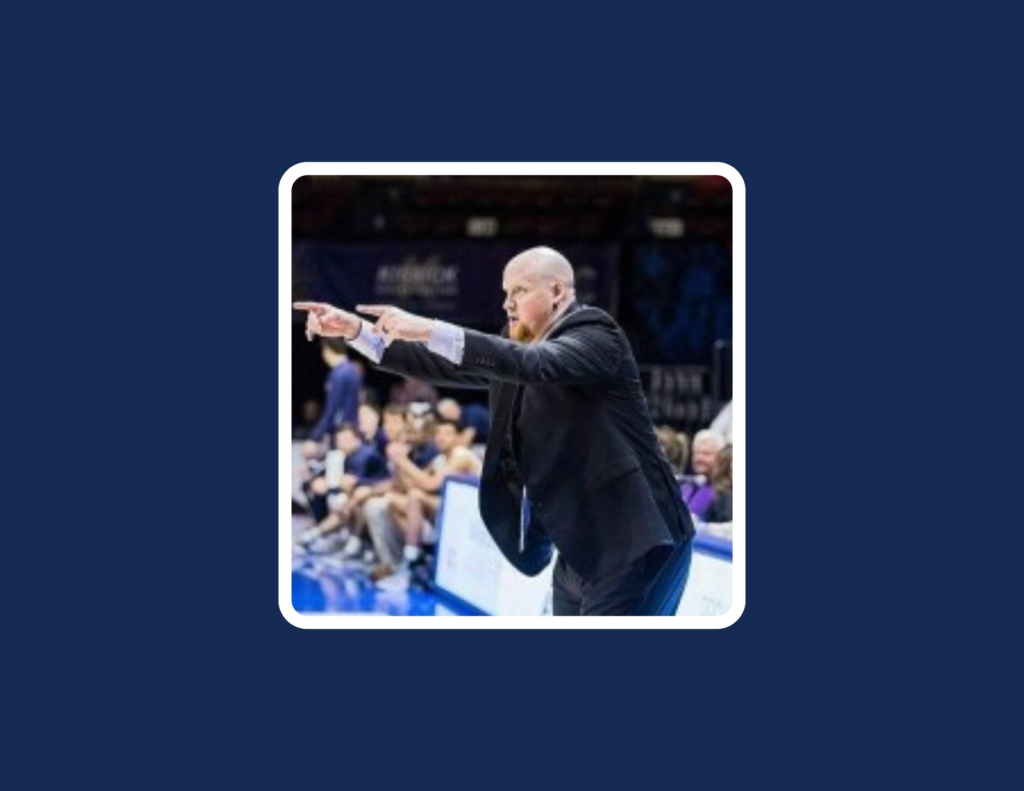
BOB LUDWIG – ST. LEO UNIVERSITY MEN’S BASKETBALL ASSISTANT COACH – EPISODE 1001
Website – https://saintleolions.com/sports/mens-basketball
Email – [email protected]
Twitter/X – @CoachLudwig

If you listen to and love the Hoop Heads Podcast, please consider giving us a small tip that will help in our quest to become the #1 basketball coaching podcast.
Bob Ludwig is a Men’s Basketball Assistant Coach at DII St. Leo University in Florida.
Prior to joining the staff at St. Leo, Ludwig was a varsity head coach at IMG Academy during the 2023-2024 season. Ludwig previously served six seasons as the head coach at NAIA Peru State College in Nebraska. Ludwig’s collegiate coaching experience includes stops at Nebraska Wesleyan University (2007-08), Bellevue University (2008-2011), Midland University (2011-15), Peru State (2015-16, 2017-23), and Central Wyoming College (2016-17).
Ludwig’s teams have combined to win five conference titles and eight NAIA tournament appearances including finishing as the national runner-up in 2014 with Midland. He has recruited and coached 13 NAIA All-Americans, 29 NAIA Daktronics Scholar-Athletes, and 35 All-conference performers.
As a player, Ludwig was a three-year letter winner at Nebraska Wesleyan.
Be sure to follow us on Twitter and Instagram @hoopheadspod for the latest updates on episodes, guests, and events from the Hoop Heads Pod.
Make sure you’re subscribed to the Hoop Heads Pod on iTunes or wherever you get your podcasts and while you’re there please leave us a 5 star rating and review. Your ratings help your friends and coaching colleagues find the show. If you really love what you’re hearing recommend the Hoop Heads Pod to someone and get them to join you as a part of Hoop Heads Nation.
Take some notes as you listen to this episode with Bob Ludwig, Men’s Basketball Assistant Coach at St. Leo University.
What We Discuss with Bob Ludwig
- The influence of his high school coach, Jason Ryan, in setting him on the right path
- His opportunity to play college basketball at Nebraska Wesleyan
- His first two coaching jobs at his two alma maters – Bellevue (NE) High School & Nebraska Wesleyan
- “It’s not where you start, but where you finish.”
- The unusual circumstances after he was hired at Bellevue University
- What he learned from sitting in on head coaching interviews at Bellevue
- “Even early in the game, I had an innate ability to relate to kids from different walks of life.”
- Talent on your roster may mask gaps in your knowledge
- The jump to Midland University and the relationships he built with players
- “Just seeing where all those young men are at in their lives is in their careers as fathers, as friends is pretty special.”
- “I always hate when people use the very broad term, like, Oh, it’s just a game. Like to me, it’s a heck of a lot more than that.”
- The journey that led to him becoming the head coach at NAIA Peru State
- The difficulties he faced during the COVID year and the factors that caused him to resign from Peru State
- “If you have a lot of success at any level of division one, everybody in the country knows who you are and you’re going to be able to be marketable about anywhere. And in Division 2, it isn’t necessarily that way.”
- Following his wife to Florida without a coaching job, and eventually landing an opportunity at IMG Academy
- Learning from Kevin Sutton at IMG and the “think tank” of coaches that helped him reset and refocus
- Getting back into college coaching at St. Leo and what motivated him to leave a great situation at IMG
- The deep talent pool to recruit from in Florida
- The balanced playing field in D2 compared to NAIA
- Being in the moment more and soaking in the experiences
Like this show? Please leave us a review here — even one sentence helps! Consider including your Twitter handle so we can thank you personally!

We’re excited to partner with Dr. Dish, the world’s best shooting machine! Mention the Hoop Heads Podcast when you place your order and get $300 off a brand new state of the art Dr. Dish Shooting Machine!

Prepare like the pros with the all new FastDraw and FastScout. FastDraw has been the number one play diagramming software for coaches for years, and now with it’s integrated web platform, coaches have the ability to add video to plays and share them directly to their players Android and iPhones via their mobile app. Coaches can also create customized scouting reports, upload and send game and practice film straight to the mobile app. Your players and staff have never been as prepared for games as they will after using FastDraw & FastScout. You’ll see quickly why FastModel Sports has the most compelling and intuitive basketball software out there! In addition to a great product, they also provide basketball coaching content and resources through their blog and playbank, which features over 8,000 free plays and drills from their online coaching community. For access to these plays and more information, visit fastmodelsports.com or follow them on Twitter @FastModel. Use Promo code HHP15 to save 15%

Your first impression is everything when applying for a new coaching job. A professional coaching portfolio is the tool that highlights your coaching achievements and philosophies and, most of all, helps separate you and your abilities from the other applicants.
The key to landing a new coaching job is to demonstrate to the hiring committee your attention to detail, level of preparedness, and your professionalism. Not only does a coaching portfolio allow you to exhibit these qualities, it also allows you to present your personal philosophies on coaching, leadership, and program development in an organized manner.
The Coaching Portfolio Guide is an instructional, membership-based website that helps you develop a personalized portfolio. Each section of the portfolio guide provides detailed instructions on how to organize your portfolio in a professional manner. The guide also provides sample documents for each section of your portfolio that you can copy, modify, and add to your personal portfolio.
Hey, coach! Want to take your team to the next level this season? Introducing GameChanger, the ultimate game-day assistant with tools to give you a winning advantage. With GameChanger, you can track stats, keep score, and even live stream games, all for free! Get the stats and crucial game video you need to lead your team to victory, all from the palm of your hand. Coach smarter this season with GameChanger. Download GameChanger today on iOS or Android and make this season one to remember. GameChanger. Stream. Score. Connect. Learn more at GC.com/HoopHeads
THANKS, BOB LUDWIG
If you enjoyed this episode with Bob Ludwig let him know by clicking on the link below and thanking him via Twitter.
Click here to thank Bob Ludwig via Twitter
Click here to let Mike & Jason know about your number one takeaway from this episode!
And if you want us to answer your questions on one of our upcoming weekly NBA episodes, drop us a line at [email protected].
TRANSCRIPT FOR BOB LUDWIG – ST. LEO UNIVERSITY MEN’S BASKETBALL ASSISTANT HEAD COACH – EPISODE 1001
[00:00:00] Mike Klinzing: Hello and welcome to the Hoop Heads Podcast. It’s Mike Klinzing here with my co-host Jason Sunkle tonight. And we are pleased to be joined by Bob Ludwig, assistant men’s basketball coach at St. Leo University. Bob, welcome to the Hoop Heads Pod.
[00:00:18] Bob Ludwig: Thank you so much for having me, Mike. I appreciate it.
[00:00:24] Mike Klinzing: We’re thrilled to have you on, looking forward to diving into all the things that you’ve been able to do in your career.
Let’s start by going back in time to when you were a kid. Tell me a little bit about some of your first experiences with the game of basketball. What made you fall in love with it?
[00:00:36] Bob Ludwig: Yeah. I mean, as much as I came up playing since I was a young kid through youth basketball, my dad was my coach for the most part.
It probably wasn’t until I was a senior in high school that it really took and then I really developed a passion for it. And that really, I credit that to my high school coach, Jason Ryan, he came in right before my senior year at a time where I was really struggling to, to put it lightly academically, socially wasn’t making very good decisions kind of really needed somebody despite having a really good base at home and two really active parents in my life really needed somebody to kind of, kind of shoot me straight and coach Ryan did that for me. And it certainly wasn’t because I could help him win games I wasn’t a very good player despite being around six, six, when I graduated high school, I was a stiff athletically wasn’t very talented.
And so it became clear to me, even at a young age, that this guy was really invested in me, wanted to see me do good things and really had no probably no thoughts of going to college until he brought it up told me he thought I might be a late bloomer that I could play in college.
Kind of got me intrigued through that communication and ended up reaching out to Nebraska Wesleyan, the division three school that I ended up going to. And so again, we really credit to him that it was pretty life changing for me. And I guess as I Ended up making the decision to get into coaching.
It had a lot to do with the impact he and, and some other coaches had on me in terms of just telling myself, man, if I can make half the impact that coach Ryan did on me, then, then I’ll really be accomplishing something. So he was really a big part of that, no doubt.
[00:02:32] Mike Klinzing: What do you remember about the conversations that you had with him as you’re first meeting him, as he comes in before your senior year?
Are those conversations taking place in his classroom? Is he just kind of talking to you in the hall because you’re the tall kid? Is he, is he bringing you into the coach’s office? One of those conversations, like, what do you remember about some of those first times you talked and interacted with him?
[00:02:55] Bob Ludwig: His passion and a lot of coaches are intense. But he, he had a way of being intense and really passionate without an ounce of negativity and just was really engaging like just drew me in. And. I appreciated how honest he was I mean, coming into the season about what I was capable of, what he needed out of me and what I clearly was not capable of.
And then really, as we got to the end of my senior year, brought me in, we were really struggling and, and at the time it was frustrating, but appreciated him being upfront with me in advance to kind of tell me that they were kind of moving on from playing some of the seniors and here’s why and how much he appreciated, you know our effort and our buy in, but wanted us to know in advance.
And you don’t always appreciate those conversations until you get older. But really, really helped me not just at the time, but as I moved on in the profession, no doubt.
[00:03:53] Mike Klinzing: So with a high school career and a coach that as the season’s coming down says, Hey, maybe you’re not going to play as much.
Cause I’m assuming he’s gone with the youth movement. Build for the future. Yet he tells you that, Hey, I think you have an opportunity maybe to play college basketball. So when he first told you that, are you looking at him? Like he’s crazy and thinking, Hey, I have no idea how to even go about making that happen.
And. If that was kind of the way it went, how did he guide you or did your parents help you? Just what was the process for you to be able to get an opportunity to go and play at Nebraska Wesleyan?
[00:04:27] Bob Ludwig: Yeah. I mean, he had talked about some schools and was pretty honest with me about how I was going to have to make some effort on my end because of my lack of production.
It wasn’t like people were going to be beating down my door, but I actually had a family friend who was a professor at Nebraska Wesleyan. As much as I think coach Ryan put in a good word on like the background check phone call contacted him, ended up getting in touch with Todd Reardon who’s now at Hastings College, but is one of the winningest division three head coaches and in the history of NCA division three, but just went up on a visit, fell in love with the campus it was just close enough to home. I’m an Omaha, Nebraska guy. It was Lincoln, Nebraska. So it’s an hour down the road. It was just far enough for, for me to kind of get away from some of the issues I was having and, and not be coming back every weekend because obviously being a student athlete there’s a lot of time commitment.
And so, yeah, I kind of through that professor reached out and, and got things rolling and really ended up being pretty life changing for me as far as I don’t mean to not give myself credit, but I really, at that time, like I needed the structure and the guide to help you go into adulthood that college basketball provided I really did.
I was very immature. Again, making a lot of decisions I shouldn’t have at that time. And so I think a lot about how that was a crucial time in my life and I’m not sure I even go to college, let alone obviously end up getting in this career path if, if not for coach Ryan and kind of what happened in that year or two.
Nebraska Wesleyan ended up being a pretty special experience for me and not because of any of my individual accolades my role very much transitioned. I didn’t start. I gave him until my senior year, probably wouldn’t have started any if an all American post player didn’t get hurt ahead of me, but I had a similar experience with my coaches there two years.
I was initially on the JV team worked my way up for coach Reardon there for two years. And then Mark Franzen and his assistant, Cam Shutnick, came in and really enjoyed playing for them. And when I graduated, I knew that I wanted to stay around the game. Really knew that in some capacity I wanted to coach.
So there wasn’t anything initially available there at Wesleyan. So coach Ryan back at Bellevue to my high school brought me back. Was a freshman head coach, got to be around the varsity as an assistant spent a year there. on the high school side of things. And then really that spring coach Shutnick, the then assistant when I graduated, took over the head job and contacted coach Ryan.
They kind of had a relationship. He said, Hey how’d Bob do for you? And one thing kind of led to another. And I ended up taking a stipend assistant position back at Wesleyan at my alma mater. So obviously that’s how, in this profession, things work. People help you get your foot in the door and just so thankful to those two for not just helping me get started, but a lot of coaches.
You coach so many guys, you end up sometimes losing track of guys if they don’t make really good efforts to stay in touch and both of those guys have just always been awesome about, I’m very close with both of them and really thankful for all they’ve done for me.
[00:07:46] Mike Klinzing: How long did it take you when you got on campus at Wesleyan before you kind of got yourself on the right path because it sounds like in high school, maybe you were kind of off the beaten path.
How long did it take you into that freshman year before you kind of realized like, Hey, I have to get things straight around in the classroom and on the floor with what you were doing from a personal standpoint.
[00:08:11] Bob Ludwig: It probably took me up until my sophomore year. there were times I was hanging on by a thread.
I didn’t make a really strong effort. initially to develop friendships with my teammates. I mean, we had a good relationship, but I was kind of still hanging out with some of the guys that were going to the bigger university in Lincoln to the university in Nebraska that were from back in Omaha.
But just that day to day and again, that structure there was a couple of times where I thought, you know what, I might not be good enough to play. Do I really want to do this? And I’m kind of thankful that my dad who didn’t off of nobody’s fault, but my own have the greatest relationship with growing up because.
I fought him on how great of a daddy was. I mean, he was a disciplinarian, he wanted the best for me. And I remember after my freshman year, I said, man, I don’t know if this is for me. I don’t know if basketball is for me. I don’t know if Wesleyan is for me. And he made it perfectly clear to me that, Hey, I could do what I wanted to do, but that there’d be no coming home that if you decide to drop out of college Hey, you go do your thing.
You get a full time job. I love you. I’ll be here for you anytime I want, but like that was a bit of a wake up call, like, okay, well, if, if this doesn’t work out what the heck am I going to do? And sophomore year, things just seemed to go in a better direction started doing a lot better academically started buying into things a little bit more, hanging out with my teammates a little bit more.
And then really Coach Fransen and Coach Shuttnick coming along there for my last two years. Just kind of gave me a boost they were awesome to play for. Not that coach Reardon wasn’t, but I was not as much of a factor, whether in practice or in the rotation. So got to know those guys a little bit more and really as much as I wasn’t a very good player.
Cam should have put in a lot of time with me to get better. And similar to my high school coach, just that care in terms of like, Hey, it’s not where you start, but where you finish was super helpful to me and Cam is one of the hardest working people in this profession that I’ve ever met.
Just an amazing coach. And so just, just kind of being able to spend a couple, couple of years around him ended up being huge and I knew that I wanted to be a college coach and after spending that year back at my high school was just thrilled to, to go to work for him. So really would have stayed there for a second year, but it was a stipend position.
I was probably in $60, 70000 student loan debt from just being at a private school. Didn’t come from a family with a ton of money. So I got my first full time. Coaching a job offer at Bellevue university, which was cool because I was right down the road from where I grew up, had a ton of really close friends that played there for Todd Eisner.
Knew a lot about Todd, just, just growing up in, in the Omaha area, moving to Bellevue as a young kid. Go into their open gyms during the summer because it was close and get my butt kicked by their NAI All American guys. So that was just like really I was lucky my relationship with a lot of his players, Todd didn’t know me didn’t have a really strong relationship with me per se, just we knew of one another and it had some conversations and some people.
Kind of vouched for me and he had an assistant, Wade Hawkinson, take a division one assistant job at, I believe it was Western Illinois. And really sat down with me and offer me the position after a half hour conversation. So at that point I was just on cloud nine because the athletic director there at Bellevue was a long time family friend of mine, Jerry Mosser.
I’m going to be working for Todd Eisner, who I have tremendous respect for. And then two weeks later Jerry Mosser retires and coach Eisner takes a job at Creighton as an assistant coach for, for Dana Altman. So I’m like, holy heck, do I even have a job? like what, what’s going to happen? And both of those guys really just owe them a ton because they sat down with the administration and said, Hey Bob’s probably too young to hire.
But you really should keep them on and whoever you do hire You know either require strong, suggest they keep them. And so that was a really cool experience because what the administration did is allowed me to sit down in the head coaching interviews. And as a, Gosh, I must’ve been 23, could, couldn’t have been older than 24 at the time.
I’m a couple of years out of college and to be able to sit in that head coaching interview committee process probably didn’t know at the time, but was really huge for me to kind of see how that unfolds. And obviously these head coaching interviews are such an extravagant process.
So didn’t probably appreciate it as much at the time, but was a really cool experience for me at such a young age.
[00:12:58] Mike Klinzing: What did you learn in those interviews or like, what are one or two things from that, that you were like, man, I had no idea that a head coach is going to be asked these kinds of questions.
Does anything stick out for you that you remember?
[00:13:09] Bob Ludwig: Yeah. I think you, you definitely start to learn that statements that you make can be over evaluated and that I think in an interview setting as you get to going like staying on point with the question, it might be harder than you might imagine.
And hey, maybe it was cause I was young, but candidates would leave the sessions. And I would think. Well, boy, what an amazing job they did. I felt like all the candidates did really well in the interview process, but then kind of how it was dissected by the administration made you think, wow, I mean, they’re peering into everything, not only that you say, but everything you don’t say, you know wonder why you didn’t bring certain things up and, or what have you.
So again, pretty, pretty eye opening experience for me. At such a early stage in, in my coaching career.
[00:14:02] Mike Klinzing: Those early few years, what’s something that you felt like you took to naturally as a coach, something that you were good at right out of the gate? And then I’ll come back and ask you the second part, which is what was something that you weren’t very good at, that you had to, that you had to grow in.
So let’s start with the positive first. What were you good at right out of the gate?
[00:14:23] Bob Ludwig: Yeah, no, I think just relating to players. Growing up in Omaha, I think a lot of people who are not from that area don’t realize that Omaha, Nebraska is a really diverse environment and then Bellevue, the area I moved to, it’s an air force town.
So you’ve got all types of people from all types of backgrounds. And I think that really assisted me. I mean whether it was at Bellevue at the time, coached at some different places with maybe very different type of rosters. And I felt like even early in the game, I had an innate ability to relate to kids from different walks of life.
And so that assistant coaching relationship, whether it was being the shoulder to cry on because guys things weren’t going well with their role. Or with a head coach that always came really naturally to me. And it was something I really enjoyed. And then, and then recruiting I felt like I could relate well to kids and figure out exactly what it is they were trying to get out of their college experience and identify whether we were a fit and so I think that kind of relationship and communication aspect was maybe something that came a little bit more naturally to me hat maybe didn’t to more rookie assistant coaches.
[00:15:39] Mike Klinzing: What about something that you’ve really had to grow into when you think back to those early years?
[00:15:44] Bob Ludwig: Yeah. I mean, I think that offensively in those years at Bellevue that first, Year of that first full time position at Bellevue as they gave that job to Shane Paben. He came in, it was an awesome experience for me to be able to be with a first time head coach. He gave me way more responsibility than I was ready for like came in like, Hey, you’re going to head up recruiting, you’re going to run the defense you’re going to do X, Y, and Z.
And I came in for Todd a veteran head coach who had been to almost a dozen national tournaments at the time. I was just thankful to be on staff despite being a top assistant. And so I probably had no idea how schematically and offensively behind I was because we were just loaded with talent.
I mean, the guys that coach Eisner left over we had guards who could just go and obviously as you know you get a false sense of where you’re at as a coach when you got guys who not only are talented, but unselfish. We had amazing young men on those rosters.
And as much as I had to, in year two and three at Bellevue, do a bulk of the recruiting, you know was very spoiled in that year one. I mean, we had dudes, we went to three straight national tournaments, a final four. I think two out of those three years, we won both regular season and, and conference tournament titles.
And that definitely gives you a false sense of what you believe as it relates to the game, as it relates to coaching. And I’m readily able to admit that. hey, when you got guys who you can spread it out and play, run dribble dry, run high ball screen, and it always goes right.
I was probably very ignorant to the fact that rosters weren’t always going to look like that. And even if you had a lot of talent, you might not have as much buy in. And so really had to learn a lot offensively. Defensively, I felt pretty good about the guys I’d worked under and, and, and learned from.
But definitely looking back offensively, had a ways to go.
[00:17:50] Mike Klinzing: Where’d you go to learn? Are you learning from mainly the other guys on your staff? Are you going outside of that to other coaches, other programs? Are you studying film? Are you, are you doing all the above? Just what’d you do early on to try to learn and, and grow in some of the areas that you felt like you needed to?
[00:18:13] Bob Ludwig: All the above. I mean, tried to go to a ton of coaching clinics tried to go to the local division one practices. Nebraska, Omaha, I guess they were division two at the time. But are now division one, Creighton, Nebraska. All of the head coaches that were there at the time and actually that are there now are just awesome about inviting in small college coaches, high school coaches.
So definitely it felt like I put a lot of time in. To try to learn as best I could. And then after the end of those three years coach Eisner gives me a call and I think that he had a great experience at Creighton, but he was itching to be a head coach had been a head coach for a lot of years.
And Midland university, another NAIA job in Nebraska comes open and he leads me to believe he’s leaning towards accepting it. And I’m kind of floored at the time cause Midland was one of the worst programs in the country at the NAIA level. And I guess I’m kind of thinking, okay, so you’re going to leave Creighton to go to Midland and you want me to come along for the ride?
Like so at first I was a little skeptical. But you kind of see where I’m going with this, as I got into kind of that interview process and met the then president Ben Satz, who’s kind of been around since, but he, he was the president there for the majority of the four years I was there, won the state Senate race, was a state senator in Nebraska did some work in Washington DC.
He’s now the president at the University of Florida as in the Gators. This guy was all in on men’s basketball and I could tell the alignment with him, the athletic director and coach Eisner, it was like, Hey, what do you guys need to be successful? and so that caused me to accept that job because, Hey, that was an opportunity to learn for Todd Eisner in terms of like, that’s what I intended to do by coming to Bellevue, had an awesome three years at Bellevue.
But I was like, this is the opportunity. to learn as kind of, you’re alluding to like, this is a guy who’s been doing this quite a bit longer than coach Pavin learned a ton from being thrown in the fire and, and having responsibilities that I probably wasn’t ready for. And I’m really thankful to coach Pavin for giving me that role in those opportunities.
But in probably the first two of the four years I was with coach Eisner, it was totally different. Had to take a back seat. I mean, he was hands on with everything and it wasn’t like coming in outside of recruiting. He gave me a ton of freedom as to the guys we signed, but like he was doing the majority of the on court work and outside of a couple of things, he was doing the majority of the scouting and it wasn’t because he didn’t trust me. It’s cause he, Hey, that’s how he had done it. He’d had a ton of experience. And so what may be at the time, those first couple of years where I was chomping at the bit, like, man, I wish he’d give me more.
As I look back, I mean, he’s been my primary mentor. He’s one of my closest friends. I mean, I learned so much from coach Eisner. I’m not sure I’ve ever seen a guy just get kids to play as hard as he does. And I know that sounds pretty vague, but like, I mean, the way he gets guys to play team defense how he motivates and holds guys accountable with, without being condescending or negative is something like I’ve never seen a coach do in just I have a ton of respect for him.
And those four years were, were some of the most special that, that I’ve experienced. I mean we’re actually getting inducted into their hall of fame here, here in October. I can’t wait to go back. And we had a team losing a national championship game there. And one of those four years I was at Midland.
I’m really close with a lot of the guys that I recruited all four years, but a lot of the guys from that roster that half of them, I got to see a ton being in Nebraska for so long, even the out of state guys kind of stuck around, started their careers there, but getting to go back and experience that since we got that call a couple of weeks ago, it’s pretty cool.
I mean, that’s kinda the older I get when you first start doing this, you’re so motivated just by the wins and the competitive aspect, but you know stuff like that just makes it all worth it. And outside of being honored for winning, just seeing where all those young men are at in their lives is in their careers as fathers, as friends is pretty special.
And time certainly flies. And, and I asked one of those kids recently I was embarrassed, like, man, have you. if you turn 30 yet, he’s like, Hey coach, I’m, I’m 35. Like time flies by and it does, you know? So super excited for that next month, no doubt.
[00:22:38] Mike Klinzing: Yeah, that’s awesome. I mean, I think that there’s a couple of interesting things kind of that I can play off of that.
So one obviously is, as you said, when you’re young, you, I think most coaches equate success and coaching with your one loss record, which obviously, depending on the level where you’re at, and certainly at the collegiate level, Your one loss record is what allows you to stay employed. So not that it’s not important.
It clearly is. But I think that as you sort of as experienced the shift from, yeah, winning and losing is still important, but there’s all these other pieces of it. Right. There’s the relationship with players. And again, when you guys go back, yeah, you’re celebrating because you guys got to a national championship game, but.
I’m guessing that the things that are going to be talked about are not necessarily going to be the quarterfinal win or the fact that you won this, be it whatever, it’s not going to be one game or, or this, it’s going to be all these little things, right? About what it was like on the bus and what it was like in the locker room and all those things.
And that’s stuff that, again, I think for somebody outside of sports who doesn’t know what it’s like to be in a locker room or to know what the intensity of a college basketball season is like, I just don’t think people can appreciate how intense of an experience it is and how much of a bond it can create.
Because you have to kind of go through all those trials and tribulations and, and the funny and the fun part, right? The fun part of being in the hotel or being in the locker room or hanging out in the dorm or having a, having a meeting or whatever. And you guys as a coaching staff and everything that goes along with that.
And so I think that there’s definitely a maturation when it comes to the coaching piece of kind of getting to, getting to that. And then I think the second thing that is interesting kind of about listening to you talk about that is you you’re sharing how those guys, they, They have an impact on you.
And I think we sometimes always think about, Hey, as a coach, we’re trying to impact our players and grow them and help them become better players and better people. And yet sometimes you look back and you’re like, it’s like those guys had an impact on me and helped me to grow and help me to become a better coach and a better person.
I think that’s a really interesting part of coaching that a lot of people don’t understand. Then the last thing, Chad. Crack me up that you said is when you’re, you, you see a former player and I do this as a teacher and I’ve done it as a coach. And I remember the first time that I sort of recognized this phenomenon that you don’t, it’s hard to put people in context.
It’s hard to put a player in context in terms of their age and what team they played on, whatever. But I remember this was probably Man, I think I was still dating my wife. So I might’ve been 25, 26 years old. And I ran into my high school assistant coach. And we’re talking after a few minutes. He’s like, now you played with, and he named some guy that was like, Seven years older than me.
Yeah. And I was like, I was like, no. I’m like, that guy was like I mean he was long gone. I’m like, how do you not like, how do you not know who our team was and who I played with? And then as I got into my career, both as a teacher and a coach, you realized that like, obviously you remember the kid and there’s certain things that you remember, Hey, this guy maybe played with this guy, but, but to put it all together.
Yeah. Like, what year was that? A lot of kids, lot of years. This guy. Yeah. Right. Like how close are they? And so I, I had a lot more tolerance for the, the, the looking back on that conversation. Cause in the moment I was like, how’s he not, how’s he not know? That’s crazy. And then as you get into it, you realize you’re like, yeah, I like there’s players to your point that somebody could tell me like, Hey, they’re 40 or they’re 28.
And I’d be like, yeah, I could totally believe it. Like my first year of coming into this, this would be my, 30, this is my 30th year of teaching. And so my first year when I coached a kid who was a senior. So I came in when I was 25, I’m 54. So like a kid who was a senior when I first coached him is like 47 years old.
It’s hard to wrap your head around that kind of stuff. So it’s just, it was, I got a kick out of that story of like, you’re 35 now you’re 30. It’s just like, you can’t as a coach, it’s hard to players don’t always understand that. But man, as a coach or a teacher, you really do understand what that’s, what that’s like.
[00:27:14] Bob Ludwig: You do. And as the years go on, you coach a lot of kids, and but no, I mean, you mentioned those dynamics outside of winning in terms of like in the locker room, hotel bus that you mentioned, I mean, there’s nothing like it and, and definitely will admit that I took a lot of that for granted early in my career.
You’re so concentrated on what you think your goals are, where you should be professionally that sometimes I think feel really good about like my interactions with and the way I treated people, but definitely have thought a lot about how, man, I don’t know if I was in the moment enough and realizing like how special some of that was, and I always hate when people use the very broad term, like, Oh, it’s just a game.
Like to me, it’s a heck of a lot more than that. And I understand why people say that in terms of it’s, it’s importance relative to. So to other big things, family, what have you, but a lot of the people I’m closest to in life I met through basketball. And again, what it’s done for me in my life that is a lot more than just bouncing a ball in a game. So definitely agree with you there.
[00:28:23] Mike Klinzing: Yeah, that is so true. And I think that what I would say is that you get an opportunity as a coach to be able to use something that you love, the game of basketball, to be able to have an impact on lives and That goes far beyond the results of a game. And like I said, that’s not to say that wins and losses aren’t important because we all know that it’s really important.
You start talking about your mood during a season and the more, the more you win, the better, the better that mood is. But at the same time, again, when you start talking about here, you are going to get a chance to go back and reunite with guys that you coached 10 years ago that you went through such a special season with, and, You’re not going to be super excited that, hey man, we produced guys who are playing 10 years in the NBA or had 10 years overseas careers or whatever.
You’re going to be excited that you produce guys who are good citizens, who have good families, who are, who are good people. Exactly. And ultimately like that’s kind of where You end up judging the success. And so it’s like this, it’s kind of like a two pronged attack. Cause like I said, you got to win games to keep your job and to, to do all those things.
But at the same time, so much of what coaching is and has become over the years, especially, I think it’s, it’s transitioned to where, again, those relationships are, are so critical to, to having success. And so from Midland, You go to Peru State, talk about that transition, how that opportunity comes to you, why you felt like it was a good career move for you.
[00:29:56] Bob Ludwig: Yeah, well, it kind of it was actually with some adversity and this was the point where things got tough. I, coming in before the fifth season at Midland Coach Eisner got the opportunity to go to Winona State, a Division II school. They had an assistant in place that they wanted coach to keep and that he had had a great experience with when he went there.
But flashback a couple of years before that I had had, I was involved in a head coaching search and felt like I was, I’m going to be a priority for school and coach Eisner just being the awesome guy. He was kind of got the administration rounded up, got president Ben Sass rounded up and they put a really good foot forward to keep me there at Midland.
And I was very much under the impression that if coach Eisner ever left that, that I’d be the head coach there. That was a big part of me staying, not becoming, I loved working for coach, but when you. Or at some place you’re having a great experience and you feel like, Hey coach ever leaves and I’ll get my shot.
Then I was no longer worried about applying for jobs. And so flash forward that couple of years heading into year five, school’s getting ready to start when coach took that job. And Ben Sasse isn’t there anymore. He won the state Senate race. We’ve got a new president. And that was kind of my first experience with, had just been spoiled as it relates to administrations, ADs, presidents, and just phenomenal alignment with the men’s basketball programs I was a part of.
And the president came in, I mean, she had no higher education experience, was a long time CEO. And she was honest with me said, Hey, you don’t have any head coaching experience. I’m looking for somebody who does. So I got kind of a I’ll call it an interview, but they knew what they were going to do.
That was really tough feeling like I recruited every last one of those kids we went from one of the more struggling programs to not just being successful in the court, just phenomenal young men national awards academically in those four years we graduated all but one player.
To staying there and not looking at other things because I feel like I’m really valued and then to be told they’re going to go in another direction, but, Oh, we’d love for you to stay around and continue to recruit these talented players. That was tough, man. that and I think that people who aren’t in the profession or having been around basketball, you, you, you put so much more than the nine to five type hours in I was floored. And so because school had already started I didn’t have an option to go get a full time assistant job or obviously couldn’t get a head job with the majority of colleges starting.
So they hired a guy named Oliver Drake was a great coach, great person. My conversations with him were excellent, but I just didn’t feel like I could grow by staying. I’m like, what, what else could I do here to make you, you folks feel like I’m worthy to be a head coach. So at that point I’m really blessed that my wife was on board with understanding that I probably wasn’t going to get a full time job.
Eric Barron’s was the head coach at Peru state, had a longtime relationship with him just from recruiting the state of Nebraska. He won like eight state championships as a high school coach and, and 10 or 11. In a 10 or 11 year span, he coached longer than that, but just a phenomenal high school coach and felt like we could be successful.
He called me up like, Hey, I don’t have a full time assistant job. so I went down there for next to nothing and God bless my wife. We moved from one part of Nebraska to another down to Southeast Nebraska so that I can stay in coaching. And that year, despite Eric giving me that lifeline and that opportunity, and despite us Winning a conference championship and going to a national tournament was a really tough year because I really went to a place where every last part of me was tested as to like, Hey, why are you in this? what and who are you doing it for? Would be lying if I didn’t tell you, I thought about hanging it up on, on more than one occasion, as far as like, Hey, I’ve been in this thing around 10 years at that point.
And I don’t even have a full time job. Like that, and I know that people who’ve been in coaching might understand that. again, my wife was, was very supportive, but that year was really tough, not having a full time check rolling in being dependent upon your wife to pay the bills that was hard.
And despite having a good year there, I had to look for jobs after that one year, because again, they didn’t have a full time assistant job at Proust State at the time. Eric was still there. So that process at Midland and kind of how the next few years unfolded afterwards, man, they really tested me.
For a very short time, accepted a full time kind of second assistant position at a division two in North Dakota at Minot State and didn’t get However many weeks into that before Jack Nelson who was the lead assistant there when I accepted the job, a longtime friend of mine accepted a head coaching position at a junior college in Wyoming.
So another shout out to my Saint of a wife. I move her up to Minot, North Dakota, and then look her in the eye, like babe, I, I think that this is a better career move for me. I think I’m really comfortable. With Jack, I think we work really well together and told her at that, like, Hey, if you want to move back to Nebraska, if this is getting to be ridiculous, I wouldn’t blame you, you have been so supportive.
And Hey, she believed in me and, and we packed a fair in a matter of weeks. And at that point, that’s when I had friends and family my dad, people reaching out. kind of expressing concern, like Hey, we love you, but this can’t be easy on Kathy. Like what, what the hell are you doing here?
And from my standpoint, I felt like, Hey, I never bailed on a school. I feel at this point, man, am I going to get a reputation for being a job hopper? But I never left anybody hang out to dry. I always just felt like I took the path that was laid for me, felt like I did things the right way.
So. But that that process ended up being really big for me working for Jack. We had a great year at Central Wyoming a few of those kids. Then the following year I get the call and then that’s when everything kind of came full circle as far as. Steve Snyder, the athletic director at Peru state I think saw kind of what I had sacrificed and my wife had sacrificed being there without a full time job interviewed for that head coaching job and was fortunate enough to get it.
And so when I originally had gone to Peru after what happened to me at Midland, just kind of broken and feeling beat up that ended up being the reason that I probably got that job. I don’t know that Steve has the connection or relationship with me. Even if I did get an interview to be comfortable hiring me if I don’t have that year there.
And so I was so thankful to, to Jack for, for bringing me on with them giving me a ton of responsibility amazing kids that we had on that roster. Again, a few ended up coming with me to Peru and, and helped me look like a lot better coach than I, than I probably was. But that as simple as it might sound just sticking with things.
And when I had every opportunity to walk away, try to do something that paid more money, try to do something that was less hours and you know more normal, for lack of a better word, knowing that this profession is anything but I’m really glad that I didn’t because finally kind of got that head coaching opportunity that I was looking for. And so that was a cool process for me.
[00:37:21] Mike Klinzing: You’re really selling the glamor of college basketball, Bob, I got to tell you.
[00:37:25] Bob Ludwig: Yeah, I’ve been told I’m kind of a glass half empty guy sometimes, so I’m trying to work on that.
[00:37:31] Mike Klinzing: No, no, it’s just, again, your story is far more typical than what I think the average outsider who doesn’t understand the coaching profession realizes.
There’s so many guys that have gone through a similar career path to the one that you’ve been on in terms of just again, starting out making nothing and having to go from one job to another and just being at different levels and having to work for, for nothing and dragging a spouse along with you who you just hope is, is willing to stick it out and get to the other side of it.
And so that’s a really a common story. And I think it’s a good educational process for young coaches who are starting out who sometimes I think. I’ve said this a couple of times, if you went and you talked to high school players or college players and asked them about, Hey, what, what would a coaching career look like for you?
There’s not very many of them that would tell your story or a lot of the stories that we hear on the podcast, there, there’d be a lot smoother entry into the profession. And they would, they would advance a lot quicker than. What the reality says would happen. So I think it’s very informative for people to be able to hear again, what it’s really like to try to make it as a college basketball coach.
And so as you finally get this opportunity as a head coach, what was the transition like? Was it what you expected? What were things that were maybe different than what you thought? What did you love about it? Just give me an idea of what that transition was like from going from the assistant to finally being able to run your own program.
[00:39:13] Bob Ludwig: Yeah, well, the first two, three years were absolutely amazing just in terms of Hey, just felt super supported. I was about an hour and change away from Omaha where I grew up and don’t get me wrong, like Southeast Nebraska is, I don’t know if you’ve been to Omaha, again, people who haven’t been to Nebraska just think it’s all corn fields and where I grew up is not the case Omaha is very much a city, a lot going on there.
And so you’d think that me growing up there, I’d be used to Maybe what small town Nebraska outside of that looks like, but I hadn’t really been like Fremont was basically a suburb where Midland was of Omaha. So now you move down to Southeast Nebraska and Hey, great people there, but I mean, it’s country, it’s small town, like you’re talking 30 minutes to the nearest Walmart for those kids.
You’re talking the gas the Casey’s gas station closes at night. And so when that cafeteria shuts down, like, and the gas station ain’t open, you ain’t got nothing to eat. Like it was a different type of place than I had been, but it was still a great place for me in those first three years.
We won more games than any coach in the history of the institution did in their first three years. I think coach Gentry is about to surpass that. He’s got it rolling. Since I left, but we went to back to back national tournaments. We had several, I don’t know the number right off the top of my head, but boy, in the five years I was head coach at Peru State graduated all but two kids.
And I, and I think at least 10 kids signed professional contracts. Several of them played are still playing. Some of them just played for a couple of years. Obviously, you know how difficult that can be particularly for a small college player to climb that ladder overseas. But the first three years, we’re fantastic. And as we kind of got into, to year four the COVID year was really tough for me, you know got COVID a couple of times. My health went sideways in a hurry gained a bunch of weight, had a really tough time bouncing back from COVID, had a lot of kind of long hauler symptoms that were pretty scary.
And while I don’t mean to make excuses that was to coach college hours and do the college grind as I was going through that in, as I look back in retrospect, I should have took some time off and what was not doing well and felt like that had a little bit of a trickle down effect.
We had our first losing season there at Peru in year four, the COVID year where we played short in games. And that was the only losing season I’d ever experienced as a coach. And so you’re kind of spoiled, you’re used to winning. And then when things don’t go as well and you’re struggling from a health standpoint.
Had kind of a difficult time bouncing back from that. We did get things moving in a lot better direction as far as had a winning season, had a bunch of guys returning. My athletic director moved on. My president moved on. And a lot of people are there now who were supportive.
I think how, how that kind of, Hey, when the guys who bring you in, it’s a little different and so got a lot of things going on at the same time and that my wife is getting ready to sell her software company built up a small software company and she wants to take a job in Florida down near Anna Maria Island in an entirely different career field. And we’ve got a little less than a year notice where she’s like I love you, babe, but I’ve done everything you’ve asked as it relates to your coaching career. And I remember it like it was yesterday. She, she’s laughing. She was like babe, I love you. I ain’t going to divorce you, but I’m taking this job and moving to Florida with or without you.
So if you want to have a long distance marriage we would, did long distance when we were dating. She’s like, I can do that. But I just want you to know I’m taking this job. So that kind of gave me the, the season in advance to know administration was adamant that I didn’t tell the kids, which I think that Hey, we might’ve all overthought it as far as those guys weren’t going anywhere, probably without I was there or not, but And so got done with year five headed into year six really felt like I needed a reset, you know felt like I wanted to coach long term, but knew that if I was going to do that that I needed to get healthy, you know and had some problems with my immune system mentally, physically was in a bad spot.
And so that fall I resigned and we weren’t moving down until that spring. That’s a decision I’ve kind of gone back and forth and struggle with. I think that the one thing I probably didn’t think much about is how that would look in the coaching community had a lot of people reaching out to me like, Hey, what the heck are you doing?
Pretty much everybody figures you get fired. Right. And. Hey, coaches get let go in this profession all the time. I voluntarily resigned and that was kind of more difficult to explain. I think when you’re not in somebody’s shoes and don’t understand what they’re dealing with. And so there were a lot of people coaches that are friends of mine, family members that were concerned, but again, I needed that reset.
And as hard as that was, and to see that we built back and it made the decision a lot easier knowing that the administration was going to pass the program off to Roman Gentry an assistant I hired, had a strong relationship with, who had been a Division I player, had been a Division I coach, had been a small college coach.
He was more than ready. The kids really liked him and so that made it a lot easier. He, he did really, really well. That season and since, but as in coaching, you usually go where the job takes you. And so now I’m sitting here, I’m getting into a better place.
I’m healthier. I’m working out. Some months have gone by and I’m like, okay, if I want to coach we’re going to be living on Anna Maria Island there near Bradenton, Florida. I’ve got to find something within drashing distance of there. And that’s not usually how it works, right?
Like usually you go where the job takes you and I don’t have that ability anymore. And so I was scared, man. I was like, am I going to be able to keep doing this? And I moved down. My cousin had a place in St. Pete. And she was like, Hey, you can stay in my place while you’re kind of looking for jobs.
And so I moved down there I think it was February, but I’m literally just going to games down the stretch of the division two and NAIA season. Right. And like trying to meet coaches and half of them were really receptive. Half of them were like, who the hell is this guy? I’m going to your game, introducing myself, talking about how Hey, I’m looking for a job down here.
Well, that’s very odd in this profession. Right. Cause again and so but I was just trying to meet people and network as you probably know, like small college is a lot more regionally based than division one. If you have a lot of success at any level of division one, everybody in the country knows who you are and you’re going to be able to be marketable about anywhere.
And in Division 2, it isn’t necessarily that way. I think that unfortunately a lot of people have a very false look at what the NAIA is in terms of understanding the talent level and the coaching. And so as I got down there, I wasn’t able to find anything initially from a college standpoint.
But I think that was probably the best thing that could have happened to me because I got in touch with, with Brian Nash at IMG Academy and was hitting Brian up months before he finally got back to me. I was beating this guy’s door down. Finally kind of found some people that knew I’m sure he just gets.
Hundreds of, if not thousands of calls or emails from people who want to work there, it’s a special place. But I owe so much to Brian for sitting down with me. Offer me a job. My year at IMG last year, man, it just, it, it helped me get really refocused. I learned more in one year than I probably did in the previous several combined, just cause it is a think tank of coaches.
I mean, you’re talking about 30, give or take coaches with an extensive background, several guys who had a 25 plus year division one background. And when you’re on a regular coaching staff, you’re learning, right? You’re learning on the fly. You’re learning from your mistakes.
You’re learning from your assistants, from your players, but like, where else can you coach where you have that many guys around you who have extensive way more experience than I did had been through more than I ever had. And so I just can’t say enough about IMG Academy and Brian. Kevin Sutton was a guy, I think he’s been on your podcast at least once. I listened to one of those, but Kevin was really helpful for me in terms of just me talking to him about all this and what I’d been through and his experience and in terms of, it was probably the first time I realized that I was really playing the comparison game in a manner that like, I’m beating myself up.
Like, man, I’ve won. I felt like I’ve won the right way. Like, we’ve graduated our kids. We’ve had great cultures. Like, why am I in a situation where. I’m kind of scrambled why am I in a situation where people are telling me I’m a job hopper or that I don’t stick in one place when I always felt like I was loyal to the people at the places I was at.
And so I don’t think Kevin has any idea how much he did for me in that year. Just being able to talk to him and him being vulnerable with me and vice versa and kind of talking about some of the things that he’s been through in coaching and his really primary. Or one of his primary duties at IMG is just coaching development.
And he would sit in my practices regularly and give me feedback positive and things I could work on. And you don’t really have that when you’re in college coaching, unless you’ve got maybe a buddy or something that, you know comes in. You don’t have somebody evaluating you. In that manner and so like that was really big for me to get that feedback from him Brian Nash, Mike Gillian, guys who just been through a lot more than I have was super humbling and just I’ll always owe those guys so much.
No matter what I do, how long I coach, just a special group of people at that place. There’s actually a recruiting event there this week and I can’t wait to go see those guys it ended up just being a really cool experience for me at ING.
[00:49:29] Mike Klinzing: Was there any thought to staying there longer, depending upon again, what opportunities obviously get the opportunity at St. Leo, but just what was the thought process as that year was winding down in terms of, Hey, how aggressive I going to be looking for another job? Should I double down on what I’m doing here at IMG? Just what was your thought process?
[00:49:52] Bob Ludwig: Yeah, I mean, what I had to take a look at is that I knew if I wanted to coach college basketball again, it had to be in this area.
And that’s cause my wife and I absolutely love it here. I think when you’re from where I’m from man, like I love saltwater fishing the weather, my wife loves her new career. She started a property management company. Doing vacation rentals on Anna Maria. All of a sudden all your friends and family who you barely ever gotta see because , nobody wants to visit Omaha are coming.
Right, right. Coming to see you, coming down to see you regularly. And life is really good. But what I had to kind of, it was a hard decision because what the pros and cons I had to weigh is like, man, I have the best work life balance at IMG I’ve ever had. I have amazing people here, but. If I want to coach college basketball, it has to be within a reasonable driving distance of where I’m at.
And there’s only so many schools there’s only two or three schools. And it just so happened, I had two cousins that I’m really close with that I kind of see as sisters who both graduated from St. Leo. That was one of the schools I came down to before I went to IMG. Lance Randall was the coach at the time got to meet my now boss, Spencer Hankey at a recruiting event at IMG, but kind of put a bug in their ear.
Like Hey, your league is awesome. The level of competition the campus at St. Leo, I mean, it’s just absolutely beautiful. And so it’s one of those things I think that if I was a little bit later in my career and not that I’m young anymore, but if I was 50, 55, then I felt like maybe I would be a fool to walk away from the awesome situation I had at IMG, but I’m not getting any younger and I think that as my health deteriorated at Peru I want to make sure if I ever walk away from college coaching, that it’s on my own terms and that I’m ready to be done.
And I’m just not ready that competitive, I guess, itch and as great as the experience was at IMG, you’re coaching under 200 boys basketball players we had in the program. So you are not only heading up I, I was one of the varsity head coaches. We had several varsity teams, but you’re in several other practices and workouts throughout the day.
And you certainly have an opportunity to develop a relationship with kids, but it’s a lot different than at the college level where you are around a smaller group of guys day in and day out. And you grow together in a manner that’s a lot different when you’re dealing with 175 plus guys. And so I just wanted to experience that again.
Also wanted to experience another level, again, great league as far as the Sunshine State Conference. And then really what put it over the top for me was the interview process with Coach Henke, with Spencer Henke, my boss. Like I kind of went into it Hey, I’m just going to feel this out.
I’m going to see what kind of opportunity this is. Spencer’s a young guy, I think 25, maybe just turned 26. And he, it was crystal clear that he was 10 times as ready for this opportunity as I would have been at his age. And like this dude’s like work ethic, just the way he’s wired how passionate he is about this place.
Getting being able to get on campus and meet people took me from a mindset like, man, do I really want to jump back in the grind to absolutely like I’m all in on this and really each week that, that I’ve been here, that’s grown. I’m really excited about what I feel like he’s going to build here.
We’re going to build here and just super pumped to have this opportunity. And so again, just knew that if I said no in, in this business, as it might not ever come again. And that might sound like, well, what do you mean it’ll never come again? Well, coaching is just so much different than I think people realize who haven’t been in the profession as far as how difficult these jobs are to get how, how likely they are to come open, how likely you are to know somebody that can get you connected with somebody who can even get you involved.
And so just felt blessed to be considered at a place that has had success and that checked a lot of the boxes that that I was looking for. So I’ve been, I mean, these last couple of weeks as we’ve gotten back in on four workouts with our players, like I’m like a kid in a candy store. I’m just super pumped to be back at it at this level.
[00:54:12] Mike Klinzing: Tell me a little bit about just the adjustment from a recruiting standpoint, when you go from one area of the country to another in terms of building your contacts and just kind of getting a feel for what it is to recruit. And obviously with the portal, things are a little bit different than they might’ve been 10 years ago, where, yeah, then you’re doing primarily your high school recruiting.
Now you can be recruiting out of the portal, but just Making that adjustment geographically to a new area and building up contacts. How have you approached that over the course of your career and how are you approaching it at St. Leo?
[00:54:49] Bob Ludwig: Yeah, that was really part of the big intrigue in doing this here at St. Leo was that as much as I recruited nationally at the NAIA school as I was at really the four year kids we recruited were Nebraska or Midwest because, hey, let’s be honest. Why is a kid from California or Florida who’s really good going to come to an NAIA in Nebraska, right? Like, so I recruited a lot of junior college kids, a lot of transfers nationally recruited some international kids but really had zero high school contacts in Florida.
You know what I mean? Coming into this. And so that was part of the. Intrigue is just getting an opportunity to, to meet new people and network in a really talent rich area. And to do that while living in a state that both my wife and I really enjoy and wanted to be.
And so it’s definitely been a change as far as like when you’re in an area, as long as I was in and around Nebraska every all the high school coaches all the junior college coaches every kid who’s any good Just because you’ve been in the area so long and if you don’t know somebody, somebody’s gonna fill you in real quick.
And so it getting down here, it’s a lot different. I mean, there’s a lot more volume of kids, obviously, than there is in Nebraska. You got two quote unquote cities in Omaha and Lincoln and down here, I mean, just the volume of players is very different, but I’m really excited for the challenge.
It’s the Florida association of basketball coaches put on an awesome June event. The way that a lot of the States do as far as showcasing their high school talent in June, and they did two full weekends where almost every program in the state was here. We were at both of those sessions and that was big for me to play catch up on the local talent coach Hankey’s recruiting philosophy.
It, it’s kind of up my alley. It’s a little bit more old school. And now we’ll certainly look at a transfer if they’re a great fit for our program. But he did an awesome job of recruiting a, a really good foundation of four year kids. He’s from Wisconsin. We’ve got some really good players from Wisconsin from Illinois.
So some of those Midwest connections that he had really paid off. And then we’ve taken a couple of senior transfers from really strong division two programs that we’re excited about. And so that was a big draw for me and a big opportunity for me to get to know people. In a different fashion in this business, when I felt like at, at a lot of the stops at the NAIA level, I was kind of forced to recruit predominantly transfers because of where we were at.
I mean, the level of player we had access to, there were some big time players in Omaha, but again, the ball, you so like you might only have three division one kids in Nebraska. Right. On any given year. Right. And so then, Hey, every kid wants to play division two after that, all those things you deal with.
And so there’s a lot bigger pot of talent down here. And then the draw, because let’s be honest, going to school in Florida is a lot different proposition than going to school in Nebraska. And I say that, Hey, it’s my home state. I love Nebraska, but you can talk to kids from all around the world and come into school 20 minutes outside of Tampa on a beautiful campus like ours.
It is a big recruiting job. And so that was one of several reasons why I felt like we can be really successful here. They’ve had some really good years here in the past. And again, believing in. in Spencer’s vision to get it done. I have not had access to a campus that just aesthetically, I mean, has what we have in an area like this.
So it has me really excited to, to feel like that can help us in recruiting.
[00:58:19] Mike Klinzing: What about just the transition to Division II? What do you like about Division II basketball, what you’ve seen so far, just in terms of whether it’s level of play, sort of the differences in the rules, the things that, things that you like that you’ve seen so far?
[00:58:36] Bob Ludwig: Yeah, well, I mean, a lot, let’s just start off with the fact that there are rules, right? Like, I mean, I’m an NAIA guy, so I’m not disrespecting the NAIA, but NAIA is not every athletic department has a true compliance officer. And so whether you’re. University follows the NAIA rules. It’s just like, everybody was just doing their own thing.
And at the institutions I was at, we’d follow the rules. And so you had a certain amount of weeks in which you were allowed to be on the floor for a preseason workout. And I’m getting on Twitter, which you can still, to this day, it’s incredible, like you see teams just openly posting videos of like practices the first week Of September, last week of August, whatever first, second week of school, and you can’t be in your you know at anything besides in the weight room with your guys, I always felt like I was at a disadvantage because our administration followed the rules and that sounds weird, right?
Like we’re getting the raw deal because we’re actually following the rules, but the NAI is, it’s really the wild west as it relates to some of that, because it’s so institutionally policed rather than like universally and yeah, I’m sure the NAIA administrators won’t like me saying that, but that’s the way it is.
And so now to be here where we’re on a level playing field as it relates to what we can do with our guys we’re in a timeframe now where we get four hours a week on the floor. That feels really good. as much as we’re going to work our butts off here in fundraising. I have been at places where I had to fundraise $50, 60,000 a year just to operate, just to have the scholarships to compete that was part of what really put me in a tough spot is spending so much more time on things like that, rather than coaching and rather than, you know doing the things that helped you build the relationships that got to be total burnout for me I’m all about spending hours and the time to do the things you need to do to be successful.
But I felt pretty strongly there for a while that, and I was kind of had an unhealthy work balance because I was spending so much time just trying to keep my head above water financially to give our program a chance to be successful. And so that is a gigantic weight lifted off my shoulders at a division two school in general, but in a league where for the most part, everybody is, is got enough to give themselves a fighting chance.
As I went through the interview process with Spencer, it became clear that St. Leo has the resources that we’re going to need to, to be successful, whether in the league or nationally. And so to, to hear that you have access to a situation like that and you don’t have to go fundraise a hundred grand to put yourself over the top was a relief.
And so feeling like that, that’s been the primary change so far after we start games, you can ask me more as far as level of play, but I’ve watched a lot of this league. I definitely think that the skill level and size stick out. I think the NAIA has elite athleticism, but the bigs are a little bigger guards a little taller, longer, and then just the skill level as far as how many teams have so many guys who can make shots kind of sticks out as to some of the differences in the personnel.
So I’m really excited to experience that. And can’t wait to get rolling here. Preseason now, but as official practices start. Late first week, October.
[01:02:09] Mike Klinzing: It’s coming quick, man. It is going to be here before we know it. All right. To go along with that one final two part question. So part one goes directly to what you were just talking about.
So as you look ahead over the next year or so, what do you see as being your biggest challenge? So that’s part one of the question, your biggest challenge. And then part two. When you think about what you get to do every day and obviously you’ve shared your story and sort of some of the Trials and tribulations that you’ve gone through to get where you are today.
What brings you the most joy? So your biggest challenge and then your biggest joy.
[01:02:47] Bob Ludwig: Sure. Yeah, hat’s a tough one, I think and I say this jokingly when it’s serious, I think I feel like a grandpa on this staff sometimes because coaches younger are two stipend assistance, I think are about 25 and maybe 23 I could be off.
And so like, Hey, I’m cool with that. I love it. It makes me feel like more energized. Hopefully it’ll keep me younger. But like. I also feel like, man, I’m getting old. That’s probably just a mental blockade. I got to get over. These guys have just been awesome to work with. I think we’ll have great chemistry on our staff.
Definitely not as far as the joy long term, do I want to be a head coach again? yeah, maybe, but, but right now this is exactly in the coming years, what I needed, what I’m looking for, as I mentioned early on, like those relationships that you have as an assistant I feel like it’s more my strength to help kids in that role.
I feel like all those years spent working for different guys with different coaching philosophies and what have you. And, and as I talked to you about like taking some of those years for granted, I’m excited to be back in a situation where I’m not taking that for granted. We have amazing young men on this team.
I feel like we have enough talent and selflessness to be very competitive. And so I’m sitting there now a little older, like, man, that, that brings me a lot of joy because I feel like I’m a lot more in the moment than I, than I was like, Hey, if I end up coaching for 20 more years, great. But if I only end up coaching for five, like soak it in Bob, because a lot of people would love to be in your shoes.
And so I think I’m going to get a lot of joy out of being able to kind of take a step back, not feel the pressure you feel as a head coach be able to help. My boss in any way that he needs is something that I’ve really enjoyed in the short time. And, and I’m very much looking forward to here at St. Leo.
[01:04:48] Mike Klinzing: Before we get out, I want to give you a chance to share how people can reach out to you, get in touch with you, learn more about you, your program. So you want to share social media, email, website, whatever you feel comfortable with. And then after you do that, I will jump back in and wrap things up.
[01:05:03] Bob Ludwig: Yeah, for sure. My Twitter is just @CoachLudwig. Can be reached via email [email protected]. I’m perfectly comfortable with people contacting me on my cell phone. Probably can, somebody can DM me, reach out for that. But definitely looking forward to building relationships in this part of the country.
And any coaches who are local who want to come check out practice, Coach Henke would love to have them. So we’d definitely be open to talking to anybody about coming to check us out.
[01:05:38] Mike Klinzing: Awesome. Bob, cannot thank you enough for taking the time out of your schedule tonight to jump on and join us.
Really appreciate it. And to everyone out there, thanks for listening, and we will catch you on our next episode. Thanks.