
Basketball used to be deciphered through box scores and gut instinct. Today, the game’s story is told through layers of data that illuminate what the eye can miss and what coaches can’t track in real time. Advanced analytics have reframed how we evaluate players, build lineups, and make in-game decisions, pushing the sport into a new era where context matters as much as counting stats. For sophisticated fans, analytics have turned basketball into a dynamic, information-rich puzzle where strategy, psychology, and probability converge in every possession.
The analytics boom has also changed how dedicated fans follow the game off the court. The same factors that decide results on the floor, like lineup chemistry and shot quality, now shape what fans expect before tip-off. Well-organized platforms with clear, transparent markets let informed fans put their reading of a game to work, whether that’s pace, matchup quirks, or how a player’s role changes his usage. For fans who enjoy that extra layer of strategy, basketball at Tonybet offers a way to test those insights: maybe an opponent’s strong rim protection will limit points in the paint, or a team’s improved spacing will lead to more three-point attempts. The key is to stay grounded and responsible by understanding the context, looking for edges based on consistent, repeatable patterns, and accepting that variance is always part of the game.
The Rise of Advanced Basketball Analytics
The first wave of modern metrics challenged the box score’s narrow focus. Instead of raw points or rebounds, possession-adjusted numbers began to show how efficiently contributions were made. True shooting percentage contextualised scoring with free throws and three-point value. Usage rate quantified offensive involvement, revealing how efficiency scales — or breaks — under increased responsibility. On/off splits and adjusted plus-minus approached the holy grail: isolating a player’s impact independent of teammates and opponents.
From there, analytics matured. Shot-quality estimates began to disentangle good process from hot shooting, helping teams see when make-or-miss luck disguised flawed schemes or masked elite execution. Lineup-based impact models offered clarity on synergy—how a floor-spacer’s gravity raises a driver’s efficiency, or how a rim protector reduces opponent shot frequency at the cup even without recording a block. Defensive evaluation progressed beyond steals and blocks to include rim deterrence, screen-navigation proficiency, and the value of shrinking space off the ball.
The result is a multidimensional lens. A player’s value is no longer tethered to volume scoring or gaudy rebounding totals. Instead, it’s constructed from efficiency, role fit, lineup compatibility, and how skills scale within a system’s objectives.
Tactical Innovations Driven by Data
Coaches once leaned heavily on traditional sets and intuition to shape lineups and late-game calls. Now, tracking data and possession models reveal not just what works, but why — and for whom. Consider the modern shift toward five-out spacing. The intuition is clear: open driving lanes. The data adds precision — corner spacing expands expected possession value by altering help responsibilities and boosting second-side attack efficiency. Empty-corner pick-and-rolls, once an occasional twist, have become staples when analytics show how removing the strong-side corner forces longer tags from low help and improves reads to the short roll.
Defensively, the numbers have redefined risk tolerance. Aggressive nail help may stunt drives but surrender kick-out threes; analytics calibrate that exchange by opponent personnel and cut timing. Switching is no longer a blanket philosophy but a matchup-by-zone calculation — switch the ghost screen, fight over flare actions, scram out the mismatch before the post touch. Teams also deploy “x-out” rotations on the weak side because models quantify the incremental gain of running shooters off the line versus conceding a late-clock mid-range pull-up.
Lineup Optimization and Late-Game Management
The best unit isn’t necessarily the five “best” players, but the five whose skills compound one another. A short-roll playmaker next to a low-usage stretch spot-up might outperform a more talented but redundancy-heavy duo. Analytics expose micro-edges in substitution patterns too: staggering initiators to maintain paint touches per possession, pairing defensive anchors to maintain rim deterrence without compromising transition rebound rates, or deploying selective small-ball units only against bench lineups that struggle to punish smaller defenders on the glass.
In late-game management, win-probability models weigh timeout value against defensive-set integrity, or foul-to-give decisions against expected points allowed given matchups and shot profile. Where conventional wisdom once dictated, the numbers now inform bespoke adjustments rooted in opponent tendencies and in-the-moment context.
The Psychological and Fan Engagement Impact
Analytics shape habits. Players increasingly train to replicate the shots they’re most likely to take in games, tightening variability by focusing on movement threes, floaters, and short-roll playmaking reads. Progress is tracked in situational reps — transition pull-ups after two dribbles, corner catch-and-shoots with a middle closeout, pocket passes under light pressure — so improvement metrics mirror real possessions rather than generic drills.
Preparation has also become calmer and cleaner. Advanced scouting distils opponent actions into decision trees — top-lock this shooter, pre-switch the stacked screen, tag high on the roller only if the corner lifter doesn’t cut. This clarity reduces cognitive load and anticipatory anxiety; players can anchor on rules that reflect probability, not hunches. The mental edge emerges in pace control, fewer wasted dribbles, and more decisive closeouts.
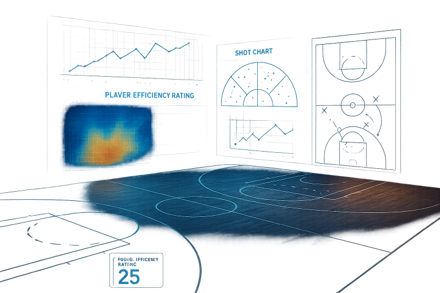
For fans, the game is richer when the process becomes legible. Possession-value charts and shot maps transform viewing into diagnosis: was that corner three created by a ghost screen that forced a switch, or by a deep drop that gave up the slot pull-up? Metrics reveal the difference between a great shooter and a great shooter-maker—whose gravity bends help, who relocates into higher-value windows, who punishes pre-rotations with quick swing passes.