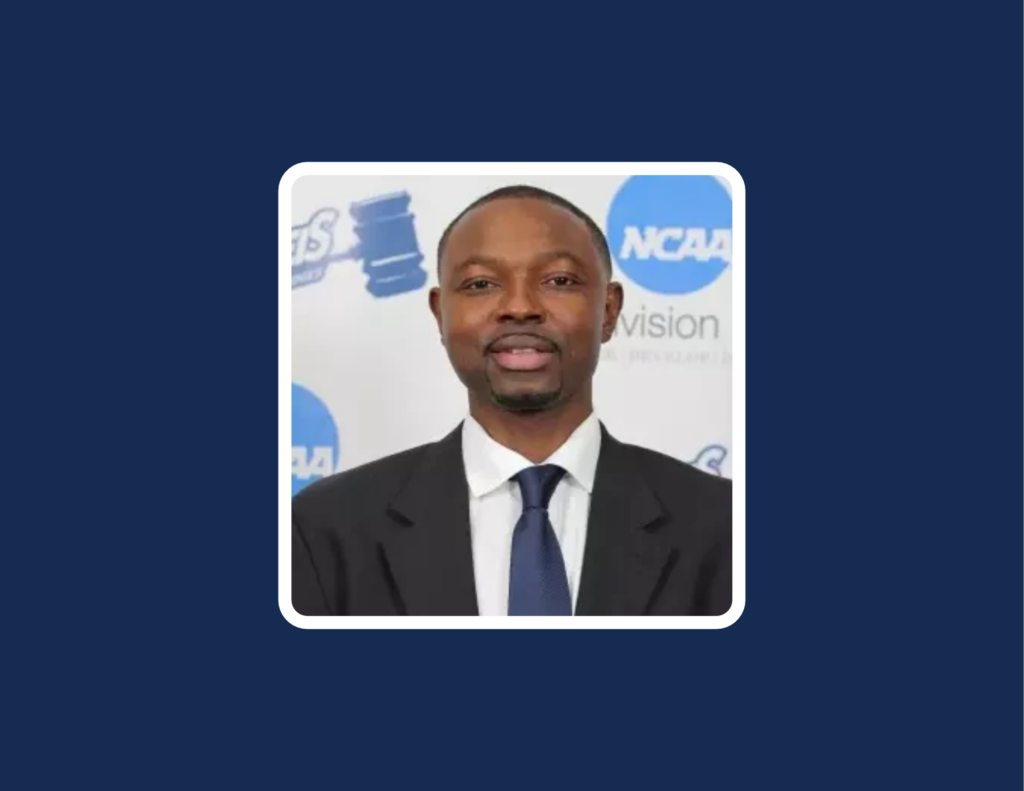
JEAN BAIN – BRANDEIS UNIVERSITY MEN’S BASKETBALL HEAD COACH – EPISODE 1318
Website – https://brandeisjudges.com/sports/mens-basketball
Email – [email protected]
Twitter/X – @JFBAIN5

Jean Bain is in his 8th season as the Men’s Basketball Head Coach at Brandeis University, compiling over 100 victories during his tenure. He previously held assistant coaching positions at Columbia University, Dartmouth College, the University of New Hampshire, and Worcester Polytechnic Institute.
Bain played college basketball at Northeastern University where he was named America East Rookie of the Year in 1999, served as team captain in his junior and senior years, and received All-America East honors in 2002.
On this episode Mike & Jean discuss how pickup games, mentors and years of unpaid assistant work shaped the coach he is today. The conversation moves from Medford parks, where older player Tom Blanchard brought Jean along, through prep school and Northeastern, then to WPI, New Hampshire, Dartmouth and Columbia before he landed the Brandeis job. Bain shares how he recruits nationally for academics and financial fit while looking for high character and selflessness, and how he builds player development and five-on-five practices at the Division III level. He also explains what loves about competing in the UAA, which has no conference tournament, unique travel, and often sends multiple teams to the NCAA tournament.
Follow us on Twitter and Instagram @hoopheadspod for the latest updates on episodes, guests, and events from the Hoop Heads Pod.
Make sure you’re subscribed to the Hoop Heads Pod on iTunes or wherever you get your podcasts and while you’re there please leave us a 5 star rating and review. Your ratings help your friends and coaching colleagues find the show. If you really love what you’re hearing recommend the Hoop Heads Pod to someone and get them to join you as a part of Hoop Heads Nation.
Have a notebook handy you listen to this episode with Jean Bain, Men’s Basketball Head Coach at Brandeis University.
What We Discuss with Jean Bain
10 Key Takeaways for Basketball Coaches
- Pickup basketball teaches role and reading the game.
Jean Bain learned at the Medford and Malden parks that older players wanted him to rebound, defend and pass, not score. He played five on five nightly and had to scout players himself. Coaches can build in unscripted five on five play and teach players to find their role.
- Mentors open doors.
Tom Blanchard saw Bain keep coming back and invited him onto his team. Bain says nobody achieves anything without someone helping them. Coaches should be the older player who pulls a young one up, and tell players they can reach a level before they believe it, as Bain’s own coaches did.
- Hold players accountable, then show care.
Bain’s high school coach Tom Riser pushed him hard on bad days, then put an arm around him and took him to eat after practice. Bain coaches the same way: “we hold guys accountable, we push them, we love them.”
- Teach players to think like coaches.
Bain’s coaches had him sit and watch film with them and asked him to put himself in their shoes. He sat in assistants’ offices daily, picking their brains, because “everybody sees the game different.” Invite players into film sessions and ask them why they made a choice.
- Do every job early in your career.
Bain volunteered, substitute taught, and coached JV at Medford. At WPI under Chris Bartley he spent days on the road recruiting and handled laundry, breakfast, film and scouting reports. He says “there was no job beneath me because I had already done it.” Young coaches should seek a role where they do everything.
- Build your philosophy by journaling.
Bain kept defensive, offensive and drill journals for every coach he worked for, noting what he liked and disliked. He then combined them into his own style, which is hard man to man defense and read and react offense that frees players. Take notes on each staff you join.
- Define culture as people plus a standard.
Bain says culture is who you bring in and the standard you set for the classroom, the court and the community. With 13 players meeting the standard, one who falls short is easy to hold accountable. Recruit to the standard first and enforce it consistently.
- Recruit character and reaction to adversity.
Bain takes selfless, high-character, hard-playing players over more talented ones, trusting his player development. He watches kids with their high school teams, especially how they react after a miss or when subbed out. A player who hangs his head or sulks is a red flag, while one who high-fives teammates is a good sign. He also calls high school and AAU coaches and even workout trainers.
- Build development into short practice windows.
With limited access in Division III, Bain plans practice intentionally. He runs 20 to 25 minutes of individual work at the start or end, and about 30 minutes of getting players better on top of roughly an hour and 20 of team work. He gives players workout “cheat sheets” like making 300 shots, so they own their development. He wants “six to three players,” meaning those who work after practice.
- Play five on five and let it flow.
Bain used to do heavy drill work but now plays more five on five. He stops play more in the first weeks with a young team, then lets it run and corrects at the end of a drill, on film or in the huddle. His assistant Dave Feinstein sends five-minute edits of practice. Showing film convinces players when words do not.
Like this show? Please leave us a review here — even one sentence helps! Consider including your Twitter handle so we can thank you personally!

XCIV.ai: Game planning for coaches, no film required. No video staff? No problem. Upload your opponent’s box score or a photo of the scorebook (or film, if you have it), and XCIV.ai builds a scouting report, a game plan, and a practice plan. It’s made for high school, middle school, and AAU coaches. Built in Colby, Kansas, XCIV.ai is a corporate partner of the Missouri (MBCA) and Indiana (IBCA) basketball coaches associations. There’s a free plan, and it’s on the iPhone.
Start free: https://hoopheads.xciv.ai
Your first impression is everything when applying for a new coaching job. A professional coaching portfolio is the tool that highlights your coaching achievements and philosophies and, most of all, helps separate you and your abilities from the other applicants.
The key to landing a new coaching job is to demonstrate to the hiring committee your attention to detail, level of preparedness, and your professionalism. Not only does a coaching portfolio allow you to exhibit these qualities, it also allows you to present your personal philosophies on coaching, leadership, and program development in an organized manner.
The Coaching Portfolio Guide is an instructional, membership-based website that helps you develop a personalized portfolio. Each section of the portfolio guide provides detailed instructions on how to organize your portfolio in a professional manner. The guide also provides sample documents for each section of your portfolio that you can copy, modify, and add to your personal portfolio.
Aiming to go D3? The D3 Recruiting Playbook gives you a clear, step-by-step roadmap to the recruiting process – what coaches value, key milestones from early high school through application season, and how to build a target list of schools that fit your needs.
We’ll demystify researching D3 programs and how to stand out without chasing every camp or showcase.
The modules cover things like writing emails to coaches, building an effective highlight tape, using social media well, planning ID camps and visits, and navigating application strategy.
You’ll get templates, checklists, and an outreach plan to communicate confidently, learn how to compare financial packages, and avoid common missteps. By the end, you’ll have a prioritized school list and a decision framework you can use to land your best-fit opportunity.

Give With Hoops is a groundbreaking initiative that fuses basketball analytics with modern sponsorship. Built for teams who see data as opportunity, from AAU programs to college powerhouses.
By tying on-court performance directly to community and sponsor engagement, Give With Hoops help programs raise more while deepening support from those who believe in the game.
Traditional fundraising disconnects donors from the action. Sell candy bars, wash cars, beg for donations, it’s exhausting and ineffective. Players perform better when their stats matter beyond the scoreboard. That’s why Give With Hoops was created.
Give With Hoops connects game performance to community support. Every basket, rebound, and assist becomes a chance to raise funds. Transparent, exciting, and proven to raise 3x more than traditional methods.
THANKS, JEAN BAIN
If you enjoyed this episode with Jean Bain let him know by clicking on the link below and thanking him via Twitter/X.
Click here to thank Jean Bain via Twitter/X
Click here to let Mike & Jason know about your number one takeaway from this episode!
And if you want us to answer your questions on one of our upcoming weekly NBA episodes, drop us a line at [email protected].
TRANSCRIPT FOR JEAN BAIN – BRANDEIS UNIVERSITY MEN’S BASKETBALL HEAD COACH – EPISODE 1318
[00:00:00] Narrator: The Hoop Heads Podcast is presented by Head Start Basketball.
[00:00:20] Jean Bain: College basketball is a long season. I always say the best teams always find a way to get through adversity, because at some point there’s going to be an injury, there’s going to be a losing streak, there could be something off the court. Does that group stay together and find a way to not let those things distract them?
[00:00:39] Mike Klinzing: Jean Bain is in his eighth season as the men’s basketball head coach at Brandeis University, compiling over 100 victories during his tenure. Bain previously held assistant coaching positions at Columbia University. Bain previously held assistant coaching positions at Columbia University, Dartmouth College, the University of New Hampshire, and Worcester Polytechnic Institute.
Bain played college basketball at Northeastern University, where he was named America East Rookie of the Year in 1999, served as team captain in his junior and senior years, and received All-America East Honors in 2002. Coaches, this episode is brought to you by XCIV.ai. You heard founder Zack O’Dell right here on the Hoop Heads pod.
Now, here’s what his team built. You’ve got a game Friday and no time to chase film. Take your opponent’s box score or just snap a photo of the score book and upload it. XCIV.ai turns it into a scouting report, a game plan, and a practice plan. No film required. It’s built in Colby, Kansas for high school, middle school, and AAU coaches.
And it’s a corporate partner of the Missouri and Indiana Basketball Coaches Associations. There’s a free plan, and it’s on the iPhone. Go to hoopheads.xciv.ai. That’s hoopheads.xciv.ai.
[00:02:00] Dr. Rob Bell: This is Dr. Rob Bell, sports psychology coach, speaker, and author of the book, Puke and Rally. It’s not about the setback, it’s about the comeback.
You’re listening to the Hoop Heads podcast.
[00:02:13] Narrator: Have a notebook handy as you listen to this episode with Jean Bain, men’s basketball head coach at Brandeis University
[00:02:22] Mike Klinzing: Hello, and welcome to the Hoop Heads podcast. It’s Mike Klinzing here tonight without my co-host Jason Sunkel, but I am pleased to welcome in Jean Bain, men’s head basketball coach at Brandeis University.
Jean, welcome to the Hoop Heads pod.
[00:02:35] Jean Bain: Mike thanks for having me. I’m very happy and ecstatic to be here and talk some hoops.
[00:02:40] Mike Klinzing: Thrilled to have you on. Looking forward to diving into all of the interesting things you’ve been able to do in your basketball career. Want to start by going back in time to when you were a kid.
Tell me about your first experiences with basketball, what made you fall in love with it and why did– why basketball, man?
[00:02:56] Jean Bain: Yeah, I think, growing up and coming from where I came from basketball was a means to create opportunities to get an education. That’s kinda how I first looked at it.
I got attracted to the game by kinda tagging along with my older brother, who’s a couple years older than me, and and he was– he picked up the basketball before I did, and I just started following him around and going wherever he went. And, once I started developing the love for the game, I never left it.
I was thinking about it today. I’ve been playing basketball since probably 10 years old and I’m 48 right now and I’ve either been a player or coach the last 38 years. It’s been truly a blessing to, to to enjoy the game and love the game the way I do.
It’s taken me pl- places I would probably never seen before.
[00:03:41] Mike Klinzing: Yeah, I always like to tell people, man, that the game– I could never give back to the game what it’s given me, in terms of just opportunity, both just professionally, when I think about the people in my life that I’ve been introduced to through the game of basketball.
It’s just I can n- I can never give back to the game what it’s give- what it’s given me, and I’m sure you’re the exact same way when it comes to that. Tell me a little bit about your experience better as a young player. When you’re a middle schooler, a high schooler, what does it look like for you?
Obviously, I’ve had this conversation with lots of people, Jean, that the way the basketball world is today for kids that you’re recruiting that are part of your team now, their experience growing up in the game looks much different than mine did, much different than you did- Yep … than yours did. So just talk to me- Yeah
a little bit about what your experience was like, and then we can kinda compare and contrast with the guys that you have on your roster today.
[00:04:35] Jean Bain: Yeah, coming up, I had two loving parents, older sister and an older brother, and and my parents, obviously we immigrated from Haiti to here when I was nine years old.
My parents weren’t really around didn’t really understand it why I played basketball. There was a lot of ind- being independent. But I think, like you mentioned it earlier, the people that came along the way were the people that really helped me get to where I want to get to.
For example, my, my, my middle school coach, my high school coach, these are all people that I can remember that had a truly an impact on my life. It was kinda up to me to kinda create a path as far as, wanting to be a player, developing as a player because, there was no workout guy.
There was no, th- there was no AAU yet at that age. It was so- solely on you to kinda, hey, fall in love with the game and just start, developing and working on it. And like I said, I was just fortunate to have really good coaches at a young age that saw something in me that I didn’t see in me, and I think that gave me a lot of confidence because, the coaches that I grew up playing for at a young age all told me, “Hey, you have the ability to be a Division I player, to get a scholarship.”
And at the time, I didn’t know what that meant until, obviously, you’re watching college basketball on Monday night, and you’re seeing all the all, all the players at Duke, Georgetown, Syracuse, and that’s when you start to realize, hey, even though I’m young, i- in order for me to try to get to this level I have to work on my game.
I was really self-motivated. Like I said, I had coaches that pushed me. But it was all kinda I had to kinda find my own path at a young age
[00:06:07] Mike Klinzing: So when you went out to do a workout, I’m going to give you an example from my life. So when I’m a kid and I’m trying to get better as a player, I always say I had two workouts, Jean.
I had one that I did by myself.
[00:06:18] Jean Bain: Yep.
[00:06:19] Mike Klinzing: And then I had one that I did if I was lucky enough to have somebody with me. There was no YouTube. There was no going and asking a trainer, “Hey, what kind of drills could I work on?” And I’m sure I got really good at the workout that I would do every day, but now I look back on it with just all of the resources that we have today- Yeah
and all the different things that players have to be able to try to get better. And I felt at the time that I was pretty scientific about what I was trying to do and how I was trying to do it, but now I look back and I’m like, “Man, I… Okay, so I have this workout.” And then I don’t know about you, but I just spent a ton of time chasing pickup basketball- Yeah.
Yeah … all over the city of Cleveland and, and-
[00:06:57] Jean Bain: Yep …
[00:06:57] Mike Klinzing: developing myself as a player, not just by myself, but also I just feel like the pickup basketball scene back when I was growing up, playing against guys who were, again, high school players, college players, older adult guys that kinda would take you under their wing and help you out.
And so I don’t know what the balance was for you in ter- terms of time in the gym or on the playground- … by yourself versus playing pickup and chasing good games all over, all over the community.
[00:07:24] Jean Bain: Yeah, I think that was the difference between, back then and now is just, we played the game five on five every single day.
I could remember, like you said, obviously I grew up in Medford, Massachusetts, which is 20, 25 minutes outside the city of Boston north of Boston. But I would play in Medford, I would play in Boston, I would play in Malden. I’d play all the neighboring towns five on five every single day. So I think that was the big difference, where you were able to work on your individual game in the morning.
I would go work on my game and get shots up and work on my ball handling, and then at night it was, like, from 5:00 till about 11:00 at night, we just found pickup games. I think now, i- it’s hard to find a park or a gym where you walk in and guys are just playing five on five. And I think that’s how you grow and get better because, you don’t know the players, right?
So you kinda have to be your own scout in terms of what a player’s strength are and what their weaknesses are. So you kinda have to figure that out. So I think that helps your basketball IQ grow. Where, coaches aren’t, coach is not telling me everything to do as far as taking this away, taking that away from another player.
So I think that really helped me grow as a player, just the ability to, I would say, we played six, seven days a week. We didn’t take days off. But we were playing, 9, 10, 11, 12 pickup games a night. So I think that really helped my game grow and develop at a early age, being able to have access to the parks and work on my game.
[00:08:50] Mike Klinzing: Who was your guy that was older than you besides your brother that took you under their wing- Yeah … and k- guided you, and he was the dude that “Hey, man, I’ll take Jean on my team. I want this guy, I want this young guy on my team. I want to have him be a part of it. I want to teach him the tricks of the trade.”
Is there a guy that kind of played that role for you in, in pickup basketball?
[00:09:07] Jean Bain: There is, man. It’s, to this day, I’m still friends with him. My family and his family are super tight. He’s a guy by the name of Tom Blanchard. He grew up in Malden, Massachusetts, which is a neighboring town. And I grew up in Medford, and there was a park in between Medford and Malden where, sixth, seventh, eighth grade, I would go to, and all the older guys would be playing.
And I would go get there early, and guys would look at me, and I had times when my ball was getting kicked to the baseball field. I would chase it. I kept coming back, I kept coming back, I kept coming back. And to the point where one night, Tommy invited me to play on his team. And e- ever since then growing up every single day when we went to play, I was with Tommy.
And he took me to every single park. So he played a big role in my development as a player because, he was able to help me get on the court and play- Yeah … against the older guys, as opposed to being, “Hey, who’s that kid in the, that wee kid over there?” Again, there’s always people that play a big role or a different role in your success.
There’s nobody that’s ever achieved anything without somebody else helping them. And he was a big influence, along with my high school coaches in my basketball career
[00:10:10] Mike Klinzing: I just think that those people that look out for you when they’re a little bit older than you have, a- and again, kinda bring you along, right?
They’re, they see something in you, they believe in you, they’re the type of person that wants to take somebody along with them. There’s nothing better. And I can think back on my own life to people who did that kinda stuff for me. Again, instead of Mike being down on court three, “Hey, Mike, you come and play up here.”
And- Yeah … maybe I wasn’t quite ready for that, but- Yeah, … hey, man, if I’m the fifth guy, and like you said, then I have to figure out what my role is and I have to- Exactly … figure out what I can and can’t do, and all that kinda stuff. And it leads to that. As you said, I think the basketball IQ is one of the things that I attribute, at least in my own career, to, to pickup basketball and just being able to- figure that stuff out for myself.
[00:10:52] Jean Bain: And you just touched on a great great word, role, right? I think, when you’re young and you’re trying to, figure things out and play with the older guys that are better than you, you have to make sure you understand your role, right? Th- they’re not looking for you to come in there and score points and do all the fancy stuff.
They’re looking for you to come in there and play tough, rebound the ball, pass them the ball, right ? So that’s, that’s something you learn early is, you can be a good player and have different roles. It doesn’t necessarily have to be about scoring the basketball or doing the things that, show up in the stat sheet.
So I was able to learn that at a early age,
[00:11:24] Mike Klinzing: how easy or hard is it for your guys right now to find pickup games in the summertime? When you talk to your guys-
[00:11:30] Jean Bain: Oh, man …
[00:11:30] Mike Klinzing: when they go back home, how easy or hard is it for them?
[00:11:33] Jean Bain: Oh, man, it’s extremely hard. It’s extremely hard. I think, more so because of the tra- the trainer Jeanration.
You find guys being with trainers more so one-on-one, two-on-two type of games. But it’s, it’s extremely hard. Unless there’s something that’s being organized in their local cities by a particular college that they live near there’s no just showing up and just playing five-on-five.
[00:11:55] Mike Klinzing: Yeah it really is almost impossible to find. My son is g- going to be … He’s a junior at Ohio Wesleyan- it’s impossible. You got a text chain of 30 college guys from here in the Cleveland area, and to try to find just to get 10 guys- Yeah.
[00:12:09] Jean Bain: Yeah …
[00:12:09] Mike Klinzing: to show up somewhere to play pickup basketball, and that’s organized.
Again, you and I weren’t organizing any of this. You’re just showing up at the park and there’s- Showing
[00:12:16] Jean Bain: up …
[00:12:16] Mike Klinzing: 50 dudes there. Yep. There’s 50 dudes there ready to play, and now it’s like you have to try to go through this whole thing to try to find those guys and get people to where they want to go. I can’t remember the last time…
it, it might be 15, 20 years since I actually walked by a pickup game and said, “Man, if I was still 22, that’s a game I would’ve wanted to play in.” For sure. Most of the games that… Most of the pickup games I walk by now- … I’m like, “Man, I wouldn’t have wanted wouldn’t have wanted anything to do with that when I was 21 or 22 years old.”
So it’s definitely changed, for sure. All right, let me ask you, you’ve mentioned a couple times your middle school and high school coach. Talk to me about the impact that those guys had on you, and then maybe even take it a step further with when you think about the characteristics that those guys had as coaches-
Is there something that you took from them that you feel like is still a part of you today as a coach?
[00:13:10] Jean Bain: Yeah. Most definitely. I think those guys the amount of confidence, the amount of toughness mental toughness that they ingrained in me as a, at a young age is something that, you don’t really see today, to this day I’m still friendly, I’m still friends very close friends with my high school coach, Tom Riser. Our as- our assistant coach at the time is Chris Bartley, who was the head coach at WPI. We were actually scrimmaging on Saturday. Those two coaches instill so much of who I am as a basketball player in me early.
In, a lot of it had to do with adversity ’cause I think that makes you, that helps make you who you are as a basketball player and as a human being. So there were so many different layers that, you know- They helped me with as far as growing up and being mature and understanding the game mentally, physically that I could never repay those guys.
But that’s kinda made me who I am as a coach because you can’t just be somebody different, right? As a coach or as a person, you have to be who you are. And growing up watching those guys coach and play, that’s what I knew. I’ve s- that’s how I am as a coach is, we hold guys accountable.
We push ’em, we love ’em. We want what’s best for them. We want them to grow as young men. We want them to grow as players. We want to make sure that they understand that not every single day is going to be perfect, but that’s okay. And I felt like that’s what those guys did for me when I was young is, even when I was having bad days, they were on me.
But, practice is over, they put their arms around me. Y- we go grab something to eat. To me, I felt like that really made me who I am as a player and as a person to this day
[00:14:44] Mike Klinzing: How much of a role did your high school coach play in the recruiting process? Because I’m just making an assumption here that with your parents being from Haiti, and as you talked about earlier that-
They were kinda wondering, “Hey why is Jean spending so much time with this silly ball and playing basketball?”
[00:15:00] Jean Bain: That’s
[00:15:01] Mike Klinzing: good. What was the pro- what was the rec- Yeah … what was the recruiting process like for you? What do you remember about … Again, obviously it’s different in your era than it is today.
Just talk a little bit about what that experience was like
[00:15:11] Jean Bain: through recruiting. Oh man, it was so different. I played AAU. We had a tremendous AAU team, but all my recruiting went through my high school coach because one, I trusted him with my life, two, he was like a second father to me, three, I didn’t know anything else but that-
and four, he always had my best interests. It wasn’t about, what he was looking for. It was about, he wanted me to go to school and get a good education. That’s the first thing that we talked about. So you know, my brother played for him. I had that luxury of playing for him, so I trusted with him with pretty much any decision that I was going to make, I was not going to make without him.
Now it’s so different where, you have kids that go through five, six, seven people helping them make that decision. But I was fortunate to have somebody that, you know, not only cared about me as a basketball player, but also cared about me as a, as, as a human being, and it just made the decision very much easier because, I didn’t have to worry about what school, was recruiting me for what.
He just knew all the schools. He knew all the coaches. He gave me the goods, the bads, and he kinda allowed me to make decisions. But the, at the end of the day, with somebody like that in your corner, it’s easy to make a decision because they have your best interests at hand.
[00:16:18] Mike Klinzing: So why Northeastern?
[00:16:20] Jean Bain: It’s funny.
So you know, coming up being from Boston and, Reggie Lewis, of course played at Northeastern. Jim Calhoun, of course, coached at Northeastern, so you had some legendary, some history there. When it was time for me to make a choice, my parents wanted me to stay close to home too, because, obviously my parents didn’t drive.
They didn’t own a license. They never flew. They wanted to see me play. Northeastern was very loyal. They were very, Eh, they recruited me the right way, basically. They stuck with me when, I hit some adversity going through the process on some personal level, and they just told me that I was their guy.
And I felt like the other schools that were recruiting me kinda started, going away. I’m one of these guys, I’m old school. Loyalty to me is the number one thing on the table. So when it came time to make a decision it was very much easy to pick them and stay on close to home.
[00:17:10] Mike Klinzing: What was the adjustment like for you going from high school to a college freshman, both academically-
…
[00:17:17] Mike Klinzing: Basketball-wise, socially? Just what was that like for you?
[00:17:20] Jean Bain: I was fortunate enough to go to prep school for one year. I went to Bridgton Academy for one year. And I tell people to this day that year changed my life in terms of the outlook of how I viewed college basketball.
I thought if I went in as a freshman, I’m like any other freshman. I’m going in, heh, they giving me the ball from day one, right? Prep school woke me up because there were so many different things that I had to learn about the college game, right? How fast the game is, how physical the game is, how, you have to take care of your body, you have to eat right, you have to sleep.
So you got and you have to balance and time management, right? So those things allowed me, going to prep school allowed me to do those things, and I felt when I went to Northeastern, my first year, I had a leg up on the incoming freshmen because as the prep school up here is, back then, especially back then too every school had eight, nine Division I players.
So the level of competition I was playing at was different compared to high school where most schools had one or two good players. The other guys were good, but when you’re playing against five legit Division I players nine in, nine out, you have no choice but to get better. So I felt like physically, that prepared me, and mentally, that prepared me ’cause we played 32 games, we’re traveling in vans in snowstorms, in, in, in the mountains.
And once I went to Northeastern it was so much, it was such an easier adjustment. It didn’t make the game easier. It was a easier adjustment as far as me understanding the game better physically being ready and mentally being ready. So that allowed me to play a lot my first year because of that one year at prep school.
[00:18:54] Mike Klinzing: What’s your favorite memory from playing at Northeastern? If you could pick out one thing on or off the court
[00:19:00] Jean Bain: Honestly, my favorite memories is the guys I played with. To this day we have a group text that we, we still talk about hoops and the NBA, college. We check on each other, how our kids are doing.
Just getting to know those guys and we’re all from different places, different backgrounds. And obviously, some of the coaches that I had there, I’m, I’m still very friendly with. So just those relationships to me meant so much to me, and it wasn’t about the basketball. And this is something I tell our guys all the time, you know, it’s not really about the four years that I’m coaching you.
It’s about the five, the six, the seven, the eight, the nine, the 10 years after you leave here that I still want to be part of your life. And I feel that’s the experience that I got at Northeastern is I met so many great people along the way that’s helped me, that’s helped me in my career that’s helped me in my personal life that I wouldn’t change anything in the world as far as going to Northeastern.
[00:19:49] Mike Klinzing: Yeah, it goes back to what we talked about earlier, right? The people, man, what the game gives you i- in terms of all of that. It’s just, again, you can never repay it. When you get to Northeastern, what are you thinking about career-wise? Is that something that is on your radar? Are you already thinking coaching?
Are you still focused on being a player? I always say there’s kind of two roads that you can get to with coaching. There’s the guy that has been drawing up plays on a napkin since they were in third grade and- … bossing people around and being a coach all the time. Then there’s the other guys that kinda get done with their playing career and they’re going to look around and be like, “Hey, man I have to stay involved in the game.
Now let me get into coaching.” So I don’t know if either one of those paths- Yeah … resonates more with you or kinda where you’re at.
[00:20:29] Jean Bain: When I got there, I was honestly, like every young man, I was thinking I want to go to the NBA because I had put so much time and work into the game. And, I had some, you know, setbacks with injuries and what so on, and so on.
But that was my main objective. That was my main goal when I first got there. And then I– if not, I wanted to continue playing professionally. But I knew one way or the other, I just wanted to be around the game of basketball for my entire life. It was, you know– There’s a joy that I get when I enter the gym.
I tell my guys all the time, I’m just a different person. When you meet me in my– When you come to my office and you see me walking in the hallways to when I step on the h- on the floor, it’s just it’s just the basketball’s done so much for me that there’s a certain level of respect that I have for the game that wherever I’m at, whatever gym I’m at, I’m always making sure that I’m paying that respect to the game.
Playing after is definitely something I wanted to do. And then obviously coaching, once that didn’t happen, coaching just felt like the right thing to do. As far as doing something that you love, it’s not working you’re helping people achieve their dreams just like my coaches helped me achieve my dream of playing Division I and getting a scholarship.
I want to be able to do that for all these young guys that, that came along the way
[00:21:40] Mike Klinzing: Looking back over your playing career, when you think about it now, do you feel like you were thinking the game already at that point like a coach? Were you looking at more than just what Jean had to do out on the floor?
Were you kinda trying to see the whole picture when you think back to what you did as a player?
[00:21:58] Jean Bain: Yeah, I think I was seeing it a- as a coach because I had good coaches that were teaching me that. They would always see- Yeah … they would always tell me, “Look at the game. Sit in this chair and let’s watch film together.
Let’s evaluate, why do you, w- why do you think you did that? Why do you think you did this?” And they said, “Put yourself in my shoes,” whether it was a good play or bad play. So I think the coaches that I had played a major influence in me wanting to be a coach because, th- again they w- they cared about me they had a vision and they wanted to be successful, and that’s kinda what I wanted.
Yeah, I think early on I was thinking like a coach when I, w- a- as I became older, especially by the time I got to a junior, my mindset was, like, really thinking like a coach on and off the court.
[00:22:43] Mike Klinzing: Did you end up having conversations with your staff and asking them questions that maybe a guy who wasn’t thinking about coaching might not have asked?
Do you remember going in, sitting down in the coach’s office and being like, “Hey, why are we doing this?” Or, “Hey, show me that.” Was that, were those conversations being had?
[00:22:58] Jean Bain: Oh, yeah, for sure. Every day. I was one of these guys that I I went to all my classes, but I was always in the gym, whether it be in the office.
‘Cause, back then it was watching film was tape to tape, right? So there was no really, it was no really breaking down the film. You had to legitly put the tape in and kinda watch the entire game, right? So I think me sitting in the offices every single day and picking the brain of each assistant coach, ’cause I think everybody sees the game different.
I don’t think everybody has to see the game the same to be a good coach. I think everybody… I love the fact that, I can learn from different perspective on how to play the game from different people. So I think me being able to do that as a young player allowed me to, again, see the game differently and kinda put my my, my sense on it when I became a coach and how I wanted things done a certain way.
So yeah, that definitely helped helped me grow and become a coach
[00:23:51] Mike Klinzing: All right. Tell me about the first job search and- … landing that first job. What was that like? What do you remember about the interview process? Oh, man. Who’d you talk to? Who were the guys that kinda hooked you up and connected you?
Walk me through that, that whole thing.
[00:24:03] Jean Bain: I’ll walk you through it. Coming out of college, I, again, I was trying to play after, so I went to a bunch of tryouts where I actually had something lined up to go to France, and it fell through for whatever reason. So now it’s September, and I’m like, “What am I going to, what am I going to do?”
… So again, like I talk about, it’s the people in your life that truly, make who you are. So I reached out to my high school coach. I said, “Coach, I really want to get into coaching. What are your thoughts?” So now he’s like come coach with me for a year. Come coach my junior varsity team in high school.”
So that was my first job. I was coaching junior varsity at Medford for two years. I did that for two years, and I coached the varsity. And it was fun. It was great to be back in that setting and great to be around, young people and try to help them grow, like we talked about to reach their dreams.
So after that my next step is I went to WPI where The old assistant coach at Medford is now the head coach. So I was there for one year learned a ton because, Coach Bartley’s a, a tremendous coach, tremendous mentor. And then after that, I was able to get my first Division I job at University of New Hampshire with Bill Herrion, who I knew because when I was in Northeastern, he was the head coach at Drexel.
So he knew who I was, there was a connection. He grew up in Worcester. So it’s like anything else in life. It’s all the connections. It’s all the, the people that you know within the circle. So that’s kinda how my first job started. And I would say my first three, four years, I basically was volunteering, right?
… I found other ways. I would substitute teach to make some money and, and to keep the, the, to keep it go- to keep it going. But I knew one day I was going to reach my goal, and I always wanted to be a head coach. And but I knew that, again, it’s going to take a lot of sacrifice, a lot of work, and a lot of patience.
So I was able to do that by, coaching high school, junior varsity, and taking a volunteer job at WPI as my first jobs.
[00:25:56] Mike Klinzing: You got to experience the glamour of college basketball- … that everybody sees, right? It’s as– nobody knows the real story, Jean, about how- No … most guys go through it, man.
That whole process of working for no money and going wherever there’s a job and an opportunity. And I think people outside of the profession just have no idea what it takes to be able to get to any kind of position, let alone the ones that everybody sees on TV. That when you say college basketball coach, the jobs that everybody thinks about.
[00:26:23] Jean Bain: Exactly right, man. I just remember being at WPI, ’cause Division III, there’s no limit to how many days you can go on the road. I remember being on the road, and I’m not joking, if we didn’t have a game, I was on the road. So I would say five, four to five, six days a week, we’re at a high school game.
And then you can see why WPI, Chris has been there 25 years. You can see why, he’s built such a, historic program there, taking over because there’s only one way to do it, and that’s to outwork, the next guy. And that was the mindset that– think about it, that’s my first job, and that’s the mindset I already have ingrained in me.
So when I got to the Division I level the number one thing was recruiting. You have to get players. Doesn’t really matter how good of a coach you are, but you have to have good players to be successful.
[00:27:08] Mike Klinzing: Ever since I founded Head Start Basketball in 1993, we’ve helped young players develop their skills, confidence, and love for the game.
Now we’re partnering with coaches and athletic programs to bring the Head Start Basketball camp experience to new communities. Our camps run for five days, three hours per day, and serve boys and girls in grades one through six. You or someone on your staff directs the on-court portion of the camp while Head Start Basketball manages registration, promotion, parent communication, T-shirts, trophies, website setup, and administration.
There are no upfront camp planning headaches, and the profits are divided fifty-fifty between your program and Head Start Basketball. If you want to reach more families or strengthen your youth basketball pipeline or just create additional revenue for your program, visit headstartbasketball.com to explore hosting a camp.
All right, so thinking back to those early years, what’s something that you felt like you took to naturally right away as a coach? What’s something that you were good at right out of the gate that you’re like, “Man, I got this part of coaching”?
[00:28:08] Jean Bain: I think connecting with the players right away was, obviously I was still at a young age, but a lot of the things that they were going through, I kinda knew, so when they would come to me, I would have answers for them right away.
So I think to me, that’s a huge part of coaching. If you can’t connect with your players on the court, off the court, then it’s really hard to be successful. So I felt from day one, I was able to be an asset to my bosses wherever I worked as far as, connecting with the guys, getting them on the court, getting them extra work in before class, after practice and kinda show them like a, a work ethic in terms of, how they want to go about doing it as far as being a really good college player
[00:28:48] Mike Klinzing: What about the flip side?
What’s something that you feel like, “Man, I had to really work at this to get my l- skill level or my knowledge to the level that I wanted it to be”?
[00:28:57] Jean Bain: Yeah, I felt like the technology part. I, I didn’t grow up with, cellphones, computers for me, the adjustment of the film stuff I had to learn.
And I was willing to l- learn. It was, hours and hours of being diligent about breaking down film, understanding, when you’re watching film, like what are you looking for and, how are you dissecting the film. So I think, early on, again, I had great mentors, working with Chris and working with Billy, who’s been a head coach at Division I for 45 years.
It was an easy transition because those guys were willing to take the time to, to show me. Because the one thing they told me, “Hey, if you want to be a good coach, you have to be good in all aspects of, the daily routines in the program. It’s not just about recruiting. It’s not just about coaching.
It’s not just about this. You have to have it all.” Having, again, having those guys and working with them really helped accelerate my career as far as a coach.
[00:29:50] Mike Klinzing: So do you think that working at WPI and at a lower level of college basketball, and where you have to do everything, right?
When you’re coaching at the Division III level, I don’t have to tell you anything you don’t know, that there’s a whole lot of responsibilities and oftentimes your staff is small, versus you start at the Division I level and there’s a lot more guys and there’s a lot more tasks that can be delegated out, and maybe you only get a chance to be involved in this little bucket over here.
But when you’re DIII, you have to do everything. So how much do you think that helped you, looking back at it retrospectively, in terms of becoming the type of well-rounded coach that can run a program like you’re running now?
[00:30:28] Jean Bain: Oh man, it was it was the total, the tot- it’s like it’s exactly what every young coach should have to go through, I feel like, because again, you just mentioned it, you’re wearing every single hat in a program.
You’re getting up, you’re getting the guys breakfast. You’re picking up laundry. You’re doing… you’re going to the equipment room, making sure their laundry’s done. Then you have to get up. You got, you’re getting guys shots in the morning. Then you’re watching film with a guy at 3:00 before practice.
Then you’re doing scouting reports. Again, you wear so many hats that when you get to that next level where you could wear all those hats but then everybody, like you said, there’s a bigger staff and everybody’s got a res- certain responsibility. But I feel like Without me going through that process, it would’ve taken me much longer to grow as a coach.
I fe- I felt like that allowed me to grow because there was no surprises when I got to the next level. There was no job beneath me because I had already done it. And, I think as a coach, you have to be willing to do anything, whether it’s sweep the floor, pick the trash up whatever you have to do to, to make sure that, your team’s ready to play, your team’s ready to practice.
And I felt like going through those things really helped develop me as a coach. So I sell– I try to, mentor certain young coaches and I, there’s certain young coaches that don’t want to start at this level for whatever reason it may be, but I feel like this level prepares you for the bigger picture that you might want to get to.
And you’ll definitely be ready if you start at this level.
[00:31:49] Mike Klinzing: Tell me what you learned over the course of your years as an assistant. Give me your top three characteristics of a great assistant coach.
[00:31:56] Jean Bain: Top three characteristics of great assistant– you have to take stuff off your head coach’s table or desk.
All right? Your job is to make sure that when he comes in every single day, the only thing that he’s really thinking about is coaching the team. You have to prioritize the players, all right? Players come first. You could be sitting in your office and you got two hours of film to watch, a guy comes through, you have to drop that.
You have to go meet with that guy. And you have to make sure that, you make sure the players understand why they’re there, right? Treat them not just as basketball players, treat them as as human beings, of course, but also, trying to help them get to where they want to get to.
That’s something we talk about with our guys all the time. I sit down with them as a freshman. I say, what do you want to do when you’re done playing here?” I said, “Let’s put… Let’s start to put a plan together.” So I think, all those three things will go a long way when you’re an assistant coach and just making sure your head coach is coaching basketball and, you’re taking care of everything else
[00:32:53] Mike Klinzing: You had two opportunities to coach in the Ivy League at Dartmouth and at Columbia.
What’s so special about the Ivy League? I always love hearing from guys who have- … worked in the Ivy, just again, hearing them talk about what made it special for them. Talk about what was special about it for you.
[00:33:11] Jean Bain: The thing that was special for me was I thought I was a driven human being because I had been through so much in my life as far as a basketball player.
And I had been through adversity, whatever it may be, and I kept pushing. But when you see these young people do what they do at the level they do it in the Ivy League, it’s amazing. And these young people are going to class every single day. They their s- their academic comes first and foremost, obviously, and the level they excel at.
And then for them to, show up on a basketball court and be focused and be ready and be sharp and do it day in and day out, day in and day out, was really impressive. And also the networking. The amount of networking that these young people do was really opened my eyes as to, what it meant to really truly go to an Ivy League school and play basketball.
Because I felt like those kids never took a day off. Every single day they were working towards something, right? On the court, off the court, they all had a vision. That’s what I see with a lot of them. They kinda knew the path they wanted to go, right? And their way of attacking it was they were going hard every single day.
That was really impressive. So when I got to Dartmouth, it really opened my eyes because I was just blown away by, how focused their work ethic was tremendous. Because before I got there, there was some people saying the Ivy League, the guys, they’re different.
They’re different. They…” But I didn’t see that. I just saw guys that were motivated to be the best version of themselves on the court and off the court
[00:34:48] Mike Klinzing: Does that change in any way how you approach coaching guys where motivation is never an issue? Does– how does that change your approach as a coaching staff?
[00:35:00] Jean Bain: It makes your job I wouldn’t– I’m not going to use the word easy, right? Because nothing’s easy about college basketball. But it just gives you a sense of purpose when you walk in the gym where you’re just focused on getting them better, right? I’m not walking in the gym trying to motivate you to play harder.
I’m walking in the gym and I’m trying to coach you X’s and O’s, being competitive, right? Because we’re all trying to win. And the only way we can do that if all 15 guys in the gym have that same mindset where if you come in and you got three or four guys you have to motivate it, it changes things.
And you’ve been around the game, I’m sure you’ve seen it. It just makes your job much more enjoyable as a coach. If you’re coming in every single day, you just know when you step on that floor, 14 guys, it’s not about making shots, it’s not about how pretty passes you’re going to throw.
It’s about every single guy’s going to give you effort, every single guy’s going to be focused. It just allows you to be a better coach, in my opinion
[00:35:57] Mike Klinzing: You have to meet their energy level, right?
[00:35:59] Jean Bain: Yeah. Yeah. Yeah. You have to meet their energy level. And I say every single day, I tell my guys, “There’s nobody that’s going to come in the gym with more energy than me.”
So I try to have them match my energy every single day, and that’s why my voice is a little- … a little off tonight because we had four straight days of practice. And we have a young team, and the number-one thing we’re t- we’re stressing is communication because that’s extremely important.
And I’m the guy that on every play, every drill, every, I’m communicating, so they know that they, they have to do it if I’m doing it,
[00:36:27] Mike Klinzing: y- your voice, you have to get it in mid-season form.
[00:36:29] Jean Bain: Yeah.
[00:36:30] Mike Klinzing: It’s not- I know it’s w- … it’s not quite there that- I know. I- I know how that is, man.
I retired last October. I’m used to being, I was used to being in a gym every day with my students- … and using that voice, and then I went this summer to camp, where normally my voice is in shape for camp. And man, after a couple days I was … could barely talk. I’m like my camp voice is out, my camp voice is out of shape.
I have to figure-
[00:36:48] Jean Bain: I know, right?
[00:36:49] Mike Klinzing: It’s- … I have to fi- I have to figure something out, so I can completely relate to, I can completely relate to that. Tell me about when you started thinking in your career that you might be ready to look for a head coaching job, and what you were doing leading up to that to prepare.
So how were you kinda gathering your ideas, thoughts, philosophy? Where were you putting all that stuff that you were kinda collecting that was going to become your portfolio that you were going to use when you were ready to try to pursue a head coaching job?
[00:37:22] Jean Bain: Yeah. I think every single person that you work for, you try to take, their way of looking at the game, their way of coaching the game.
And then, you piece all that together, and then you try to pull out one or two things from each coach, and then you put your stamp on it in terms of how you view the game should be played or your philosophies. That’s kinda how I went about doing it. I cr- I kept a journal f- with, for every coach I, I worked for I kept a defensive journal, an offensive journal, a drill journal in terms of all the things that we did and all the things that I liked and the things I didn’t like. And then once I became a coach, I just kinda pieced them all together and I knew there was a style of play that I wanted to play early on as far as offense.
Defensively, I grew up playing man-to-man defense in every single program that I, a player or coach, so that, that was not going to change. There’s going to be some tweaks in terms of, what we do defensively in the man to man, but we knew we were going to play a hard playing man-to-man defensive team.
And offensively, my mind was I want to, I want the guys to play basketball and not think the game so much as far as plays. There’s a lot of concepts in terms of what we do. There’s a lot of read and react in terms of how we play offense. It just allows the players to be free. I felt like as a player, that’s what I was allowed to do as a player and I benefited from it, where, we didn’t run a lot of set plays in high school or AAU or Medford, but there was a lot of organization and a lot of concepts in terms of how we wanted to do things on offense.
And I think that’s been the beauty of the f- my philosophy as far as how I see it. Some people don’t– might not look at it that way, but that’s kinda how I see it, and it’s allowed my players to, to grow and get better every single day and just to be basketball players.
That’s, that’s why I recruited them at Brandeis is to be players, and my job is to, develop them and get them to be better. So I– we try to put them in position where they’re just– they’re going to be very free offensively and play the right way
[00:39:18] Mike Klinzing: Taking stuff from everybody that you coached with, right?
And being able to pull those things and then thinking about, hey, how I, can I incorporate that into my philosophy, into my style of how I want to play. So when you go into the interview process at Brandeis, what do you remember about what they asked you both basketball-wise and then things not necessarily X’s and O stuff, but other things that they asked you about that were relevant to taking the job?
[00:39:47] Jean Bain: Yeah, the nu- number one thing that I can remember, ’cause I came in at a time where there was some, some stuff going on with the program as far as the culture. I think the number one thing that they talked about was, what kind of culture are we going to have in terms of the program. Not necessarily wins and losses, but the program, and I kinda knew what that meant.
I’m big into, we, every, you hear that word all the time culture. But to me, culture is the people that you bring in, whatever environment that you’re in, and then you set a standard. And that’s kinda what we’ve been able to do is go out and recruit really good kids that are good basketball players, and once we get them, we kinda set the standard in terms of our expectation in the classroom, on the court in the community.
And once that standard’s been achieved, it’s very hard to go below it, in my opinion. Because if you have 13 guys living up to the standard and one guy’s not living up to that standard, it’s easier to hold him accountable. So you know, that’s been the way I’ve built it here and and that’s kinda how when I interviewed for the job, that was the main thing they talked about.
So that has not wavered, it has not changed. And we’ve been fortunate to have good players along the way, guys that’s gone on to play after college. But also we’ve had tremendous young people come through here, and to me, that’s the part that I’m most proud of is you know, these guys are going out, getting big-time jobs, and they’re calling me Coach.
“I just got a job with a big AI company,” and you just hear the joy in their voice. And that’s the thing I remember the most when I took the job was I wanted to make sure that the kids we recruit, they go on to do those things when they’re done at Brandeis
[00:41:18] Mike Klinzing: What were the questions that you had for the administration at Brandeis that you wanted to know before you felt like it was the perfect opportunity for you?
What were those questions?
[00:41:29] Jean Bain: The number one question was academically, what type of students are we looking for? Because I was obviously seven years in the Ivy League. I had a great geographically, I had a great feel for the academic kids, the academic landscape. And also I wanted to know, obviously resource-wise, what type of resources would we be able to have to a- be able to build the program back to where, we can compete and win and, w- compete for a championship.
So those were the main things that, the questions that I had. But I was… again, when you get your first job as, as ex- as, as I did I was an assistant for 16 years you kinda “Man, I just want to go in no matter what it is. I’m going to figure it out.” That’s your mindset.
But you also want to make sure you have everything you need to be successful. They did a great job of giving me those things and, we were able to have some success, but also just have really good guys and really good coaches and it w- i- just enjoyable.
That’s what it’s been for me so far here and I can’t thank the, the people that hired me enough for that opportunity.
[00:42:32] Mike Klinzing: How close to the vision you had when you first took the job to what the j-job actually became? Again- … as a first time head coach- Yep … you’re stepping into something that you haven’t done before.
You’re stepping into a university that you haven’t been at before. How close did the vision end up to what you kinda thought it was going to be before you took the job?
[00:42:53] Jean Bain: It was a I think it was even, I should say, in terms of the vision that I had because- I didn’t know how good the league really was till I got here, right?
My vision was I want to build this thing slowly. May by, maybe by year three, we can compete as far as having a winning season. We were able to, start my first year in the league. We had a good year. Second year, good year. Then COVID hits. And I think once COVID hit, it changed the dynamic of our league because now the transfer thing became a huge thing in our league.
So now, where I saw us in year four, there were teams below us that kinda jumped us because of that, those opportunities of the transfers. It’s all about adjusting. It’s all about making sure that, you’re not falling behind. So we’ve been able to tweak some stuff. We’ve taken some transfers, and I think we’re right where we need to be ’cause, Brandeis has never won the UAA, and I thought by maybe year five, six we’d win a UAA championship.
But it’s, again, the league’s so competitive. It’s so hard to do. And now, we’re just taking it day by day, trying to piece it together. The biggest thing is we want to get to the NCAA tournament. That’s our number one goal, and we’ve been so close every single year. Because our league had, does not have a conference tournament, so every single game is literally a playoff game.
Getting the right kids, getting the right players as far as ability has definitely caught up and helped us because of the transfer thing. I think the vision that they had and the vision that I had are very similar in the sense that we’re right where we need to be in year seven or year eight.
I think the best is yet to come for us here in terms of, competing for the championship and going to the tournament and having long-term success, right? Having success year in and year out, which we’ve been able to do, but, the biggest thing is we have to get, we have to get to the tournament.
That that’s the next step.
[00:45:01] Mike Klinzing: I want to talk to you a little bit about recruiting in a second, but before you do that, just talk a little bit about w- the unique structure of the UAA from a Division III standpoint. Obviously, it’s a league that is geographically diverse. You guys travel in a way that most Division III schools, most Division III conferences don’t have the opportunity to travel the way that you guys do.
Just talk about what makes the UAA unique for maybe a listener that isn’t as familiar with it.
[00:45:27] Jean Bain: Yeah. Like you just mentioned it’s a league where, we’re traveling to major cities. The league comprised of NYU, Chicago, Wash U, Emory, Carnegie Mellon, Case Western, Rochester.
It’s a tremendous league. But also, every single school has tremendous academics so now, you’re asking the kids to travel and to make sure that they’re doing their work, which sometimes can be a little tough. But I think The two games in three days makes us unique, right? It’s similar to the Ivy where you used to play back-to-back, but the Ivy League, you’re– I’m driving to the next, school where, we play WashU in St.
Louis on Friday night. Saturday morning we get up, we’re driving or flying to Chicago because that’s a travel partner, and then we have to get up Sunday and play. So I think the mental piece, the mental toughness piece the physical piece comes to play as far as athletically. So I think that’s one of the reasons we’re very unique and again, we don’t have a conference tournament.
You have 14 league games and every team really believes they have a chance to go to the NCAA tournament, and it always comes down to one or two big weekends where it’s a injury, a sickness, or, a team gets on a roll for that final four spot. Always comes down that way every single year.
And we have four teams go in the NCAA tournament every single year, so there’s not a lot of, Division III leagues where that’s happening. So that makes us truly unique in that sense. Excuse me.
[00:47:00] Mike Klinzing: Walk me through your recruiting process from the very beginning of putting together your initial list of prospects, guys that you’re looking at.
Where does that initial list come from? How do you whittle it down? Obviously, you have the ability with Brandeis University and the academics and the UAA to be able to recruit nationally- … which is somewhat unusual at the Division III level, which tend to typically recruit more regionally or geographically close to the school.
So just walk me through the entire process from beginning, how a kid gets on your initial list to how you go through and vet them and decide, “Hey, is this kid the right fit for our program?”
[00:47:37] Jean Bain: There’s so many different ways at this level because there’s no set rules in terms of, how many times we can go see a kid, how many times we can be out.
So I think the AAU tournaments that we cover every single year is a huge asset to us. The NEPSAC tournament is a huge asset to us. Kids emailing us creates you could have 30 emails in one day, and you go through it, you might be able to find one or two kids that can play.
So now those kids go on your list and, by going to all these events, getting these emails, you kinda built your list that way. F- but first and foremost, you want to recruit your backyard, right? We try to recruit New England because of all the great, schools in New England, the great, prep schools in New England.
And then we try– and then we go national. Whether we’re in Texas Florida we get a lot of recruiting services as far as, lists of players that, one, academically good students. But the other piece is the financial piece, which plays a big role in terms of whether- a student athlete can attend a school like Brandeis or NYU or Emory.
Those are the three main things is can you get in academically? And then the financial piece, where do you stand with, from the financial aid process? What can you afford to pay? Do you want to pay? So you have to make sure you do your work early, as I like to say it in the process as far as coaches, ’cause what we don’t want to do is waste time on a recruit that can’t get in or can’t afford to attend a school like Brandeis.
We try to narrow those things down first and foremost and get right to the bone. We get the transcript, we send it to admissions, they evaluate it, they come back to us, then we send them the financial aid paperwork as far as ear- early read we call it, and then they’ll get that back.
And then if the numbers work, then you know, we’re good to go. But if they don’t, we have to go to that’s why we have to have a long list of players. We have to go to the next guy. It’s constant movement. Things change daily. One day they like you, the next day they might somebody else call them.
That’s the beauty of recruiting. But I think, when you have a particular recruit that you know, you’ve invested time in and put the time in and talk to the parents and talk to the kid you built that core that’s going to be hard to break if all those three things work out as far as getting in, of being able to afford it, and obviously being good enough.
If, if those, all those three check boxes check out and you have that relationship it’s very hard to break that that mold. That’s kinda how the process goes down. But there’s so many, as there’s so many different moving parts now when it comes to recruiting. There’s, in terms of services recruiting videos, AAU events.
So you kinda have to make sure that you minimize it and not get too far out and make sure that you have, the list that, of the guys that you’ve been on and stay on those guys.
[00:50:26] Mike Klinzing: What’s your favorite event to go to outside of your own elite camp?
[00:50:33] Jean Bain: I’m a big Hoop Group guy. I like the Hoop Group events because one, they have a lot of guys for our level that, it’s not EYBL, it’s not the Adidas circuit, it’s not the Puma circuit, but a lot of those kids have been playing together for a long period of time, whether it’s Jersey, New York, Pittsburgh, Cleveland.
And then you get a really good chance to evaluate them because, they’re playing two or three games in one setting. You’re not driving from this high school to that high school. You know what I mean? So you get a chance to really lay eyes on them on a weekend and get a ch- and get a good evaluation on them
[00:51:08] Mike Klinzing: Once they have those three boxes checked, what are the intangibles that J- Jean Bain looks for in a kid that maybe somebody else wouldn’t notice, or maybe there’s something that you feel is a really important piece for a kid to have in order to be a good fit in your program?
What are the intangibles you’re looking for in a kid beyond the requisite skill to be able to play at your level and help you guys to win?
[00:51:30] Jean Bain: He’s have to be– He’s have to have high character. That to me, that… He’s have to have high character, and he’s have to be selfless. We’ve taken guys that are selfless over a guy that’s probably more talented because we felt like that guy would fit into what we do better and fit with our culture better.
So if you have those two things and you play extremely hard, you, again, you might not have, talent-wise, your talent might not be where it needs to be, chances are I will take you because I feel like our player development has really been one of the better ones in the country as far as getting our kids better.
My assistant, Dave Feinstein, who’s been with me the last five years, him and I, breaking down film and breaking down guys’, workouts is kinda a big thing that we do in our program, and we feel if you have the right attitude and you’re all about the team, that we can help develop you as a player in the four years you’re there with us.
[00:52:21] Mike Klinzing: How do you evaluate that? How do you evaluate a kid for are they selfless? Do they have high character? Is that done through talking to them? Is that through– Is that done through talking to people that are around them? Is that done through direct observation that you guys are watching them when you’re seeing them play in person?
I’m sure it’s a combination of all that, but what are you looking– What are the specific things if a kid’s listening to this and they say, “Hey I want to be able to demonstrate these– I want to be able to demonstrate this for a coach.” What are the things that a kid should be doing that would catch your eye?
[00:52:50] Jean Bain: It’s a combination of all the things you talked about. But also, me, I’m big on going to watch kids play with their high school team because I feel like the high school team, the coach has been with them f- whatever, three, four years. Their te- but their teammates have been with them for a long time or their peers, whether they go to that school.
And how they treat those kids when you go watch them play, how they, when they come out of a game, how do they react, right? When things aren’t going good for them. Everybody wants to see when guys are, hitting a three and everybody’s… I want to see when guys, things don’t go their way, how you react, because college basketball is a long season.
I always say The best teams always find a way to get through adversity because at some point there’s going to be an injury, there’s going to be a losing streak, there could be something off the court. Does that group stay together and find a way to not let those things distract them? When I go to a game and a guy comes out the game, I want to see, let’s say he misses two shots and the coach goes give him high five.
Is he high-fiving that guy and just staying super positive, or has he got his head, head down and he’s sulking? If he’s sulking, chances are we don’t want that guy because, that’s going to be the bad energy that, he’s going to bring to our group. Those things are extremely important to our staff when we evaluate.
And obviously, w- we talk to the coaches, we talk to AAU coaches we talk to, we’ll even talk to the workout guys that work them out. Just try to get a good evaluation as for who they are is a big part of the whole process for us.
[00:54:18] Mike Klinzing: Let’s go back to what you said a minute ago about player development and taking pride in that and getting your guys better.
Obviously, at the Division I level, when you can have guys in all summer- … and doing off-season work, workouts, and all that kind of stuff, easy to see how player development happens at the Division I level. Much harder to do at the Division III level when you don’t have that access to your players in the summertime.
So how do you build that player development component into what you do day to day during the season while you do have the opportunity to coach your guy a- and get them better? What does that look like?
[00:54:56] Jean Bain: I think it’s have to be super… You have to be super organized. You have to be intentional with how you pr- your practice plans.
And I’m very intentional when it comes to that, that making sure that every single day we’re breaking down and working on the things that each guy needs to work on to get better. And then if he’s good at something, we keep working on that as well. So we’re very intentional with it, whether it’s at the beginning of practice we’re going 20, 25 minutes whether it’s at the end of practice, we’re going another 20 minutes.
So if I can get, an hour and 20 of, team, teamwork as far as, us getting better, and then I can get 30 minutes of getting you better, to me, if we’re doing that three, four days a week, and then you’re coming in the gym on your own you’re going to get better. And that’s something that we talk to our guys all the time.
We don’t want three to six players. We want six to three players, right? We want guys that practice is over, you already have the cheat sheet ’cause we’ve given you the workouts, come in, make 300 shots, make 400 shots. And the guys that want to be better players will usually do that, right? They’ll grow and they’ll understand that’s the only way to get better.
So we’ve been fortunate to have guys buy into that and get in the gym and actually, work on these things that are important, not just come in and just, shoot around. Like we tell them, come in 20 minutes, whether it be 20 minutes, 15 minutes, get something out of it. But that’s all, being intentional with the way we plan practice and the way we plan our workouts before we start practice, et cetera
[00:56:26] Mike Klinzing: Let’s take that intentionality into practice planning, which you talked about.
What’s your process for sitting down and planning a practice? Let’s talk about right now we’re in the pre-season and you haven’t played a game yet.
So you got practice tomorrow. What is it going to look like for you to plan tomorrow’s practice? Are you sitting down by yourself with pen and paper?
Are you getting together with your assistant? Are you on the computer? What does it look like for you, just how you go about putting together that practice plan on a daily basis?
[00:56:53] Jean Bain: Yeah, we we actually scrimmaged Saturday, so we went … Today was, we were off today, so now the whole thing in tomorrow and Friday’s practice is kinda getting ready for Saturday.
So we kinda, myself and my assistant will sit down we’ll break the film down from the previous four practices. We’ll clip it, and then offense, defense, we’ll figure out the things that we need to get to work on to get ready for Saturday. And, we’ll try to pick one or two things that the other team does offensively, defensively, and then we’ll throw that into the practice as well just to kinda, prepare us for the scrimmage.
‘Cause the scrimmage we kinda want to see them figure things out a little bit on their own because it’s our first scrimmage and try to get through things. But we also want to give them a couple things that if they do see, they’ll understand how to defend it how to work against it in the offense. It’s all about w- film this time of year.
We’re fortunate enough to be able to have a a, a huddle which films our practices and then we’ll sit down, we’ll watch it, and then obviously build practice around that. What do we have to work on, offensively, defensively? What showed up today and on, on each side of the ball?
So that’s kinda how practice is. We try to keep it where, we’re not doing a lot of drill work. Earlier in my career, we did a lot of drill work, but the last couple years what’s helped us, we’ve played a lot more five-on-five, and we’ve tried to teach how to five-on-five. I think that’s helped us tremendously in that aspect.
I think our players pick things up quicker in that setting. The film the meetings with the- my assistant all that stuff goes into putting together a, a, a good practice where, we’re getting better day to day out
[00:58:30] Mike Klinzing: Coaching out of the five on five, how do you balance st- stopping play to point something out and continuing the flow?
That’s one of the things that when- … I think about my coaching, when a team that I’m coaching is going up and down five on five, it’s sometimes hard for me to figure out- Yeah … okay, I have to stop it here because I want to fix that, but yet if I stop it too much, then I’m kinda killing the flow of what- i’m trying to accomplish with the five on five. So how do you think about that balance, keeping the flow of that going with still making corrections? Are you waiting till guys come to the sides? What’s your philosophy on that?
[00:59:09] Jean Bain: I think at the beginning of the year when you first start, especially with us, we got a lot of young guys.
So at the beginning of the year, I’m probably stopping it a little bit more than I’d like to, but I think by week two, week three, you let it play and then kinda at the end of the drill, you kinda point things out that we didn’t do well or, y- that way, like you said, where you’re getting a better flow the kids are getting, obviously not just playing some conditioning.
You’re not blowing the whistle every two, three seconds because the game of basketball is a game of flow, right? It’s not- … there’s stoppage, but it’s a game of flow. Yep … we try to mimic the g- the… we try to mimic everything that’s going to happen in a game in practice, and I think as you start moving forward, that’s kinda how it looks, right?
You’re just kinda letting them play and then, you address it in the film or you address it in the huddle, and then you go back to whatever drill is next. And I think our guys have really they like… I think they like that better than the old, the old stop it and teach and then they get cold and then they get…
You know what I mean? Yeah. So that’s been very helpful for us, like I said, the last couple years.
[01:00:11] Mike Klinzing: How different is the practices you had at Northeastern as a player? How different are those practices look compared to your practices today? I’m
[01:00:17] Jean Bain: just curious. Oh man, we don’t go four hours, man. We don’t go four hours, man.
Nah. We s- it’s obviously the intensity of the practices were different because of the athleticism and the physicality, where the practices were physical at Northeastern and, we did go a good three, three and a half where I don’t think now you need to do that per se, especially at our level.
A big thing is, staying healthy and keeping our guys, especially in our league, staying fresh. We try not to waste any single, a- any time. When we get there, we’re stretching, we’re warming up, we’re doing our pre-practice, then we’re going. There’s not a lot of, shooting free throws or, stop.
It’s we’re trying to every single second we’re in there, we’re trying to work and get better
[01:00:56] Mike Klinzing: There is no load, there was no load management back in the day, Jean. That did not exist. Nobody was strapping the heart monitor on you or the, Oh … the tracker to figure out how much exertion you were putting out there.
You were going your three, three and a half hours no matter what. That’s it. I remember those days really
[01:01:09] Jean Bain: well. You know that. You know
[01:01:14] Mike Klinzing: that. All right. How much film are you guys sharing with your players? Obviously you guys are breaking down and watching practice, and then when you get into games, obviously you guys are preparing for opponents and that kind of thing.
But just at this point in the season and then take it into once you’re into your regular season, how much film are you taking from what you guys are watching? How much do the players actually see with- … you guys as a staff? Obviously, I know they can watch as much as they want on their own- Right
but how much are they watching with you guys?
[01:01:42] Jean Bain: Right now we’re doing quite a bit of film because like I said, we’re young and there’s a lot of teaching that goes on with the stuff that we’re trying to teach them with our terminologies on defense and offense. So I think there’s a lot of stuff that we do as far as my assistant will take the practice, he’ll break it down.
He’ll send them like a s- five-minute edit on the offense and the defensive stuff for today, and they can all access it. And then typically because of, the classes and the times, at the end of the week we’ll sit down as a team. Like the other day we watched film on Saturday for about 35, 40 minutes on the previous three practices of the, the edits.
And then now, we’ve had these four days and now we got the scrimmage coming up, so next week will be a big film week because now we got actual game film of playing against somebody else. Same thing the following week as we head into our first league game. So the next two weeks will be a big film week for us because I’m a big proponent of that’s how that’s one of the ways of learning the game and understanding the game.
And sometimes, you have to sit down, you have to see it ’cause, whether it was good or bad, you have to see it. And a lot of times sometimes guys don’t, you’ll tell them something as they’ll be like, “Nah, Coach.” Then you sit down and you watch the film and you show it to them, they have a better, oh, they’re like, “Oh, okay Coach, I see what you were talking about.”
So I think the film gives them a better understanding of exactly what you’re trying to, instruct them to do on both ends of the floor
[01:03:07] Mike Klinzing: I think like you talked about earlier, when I think about my time as a player, and you could probably relate to this as well, right? That the ability to watch film now, and not just from a coaching perspective, but I even think about it from a player perspective, like to go back and watch film when you and I were playing and have to hit the rewind button- Oh
on the VHS tape and, “Hey, I want to watch that play again,” and then you hit the rewind and you’re like three minutes behind, and then it’s just like it… The efficiency level, I can’t even imagine what that was like for coaching staffs back in the day when you and I were playing. And now you just think about, again, how efficient you can be, and then as a player to be able to queue up whatever it is that you want to queue up and be able to watch that and see yourself or emulate another player who plays your position that maybe you want to take something from their game.
I just think it’s such a tremendous tool, and the technology allows you to be so efficient, both as a coaching staff, but also just, man, what the players have access to, to be able to learn-
…
[01:04:01] Mike Klinzing: Said from what they’re seeing. I just think that, comparatively the pa- to the past in the game, to me, that’s a huge development.
When we talk about basketball IQ that you and I feel like we developed it playing playground basketball.
I think the shift has been players develop their IQ as much from the film room as they do from the actual playing experience that they have, ’cause they just have so much more access.
[01:04:22] Jean Bain: One, 1000%. It’s you get… Practice is over, the film, you go to your computer, you pop it up, the film’s already there from the practice. Or the game’s over, you go to Synergy, the game’s already uploaded. Where you go back 10, 15 years ago you had to wait three, four days to get the film. The as- accessibility obviously that these guys have the technology that, that we all have, whether it’s our iPads, our phones.
We’ve been wa- We, when we travel sometimes guys are, they’ll watch the game on their phones from, on Synergy. I think that’s really helped. I think that’s why you see this, you look at the NBA now, man, the, the guys are so talented and, I think a lot of it has to do with, the access they have to all these things, trainers, film, everything, tr- treatments, just getting their bodies right, diet, all that stuff goes hand in hand with today’s guys
[01:05:07] Mike Klinzing: Yeah, it’s all stuff that I guess we kinda knew about back in the day-
but I don’t know how seriously anybody, anybody took it with the three and a half hour practice and the the trip after the Saturday morning scrimmage to Ponderosa for the- … for the chicken wings and steak and two liters of soda and everything else- Exactly … that was going on back in the day. Man, it’s crazy when I think about just how we all survived, but-
[01:05:28] Jean Bain: Exactly
[01:05:28] Mike Klinzing: man it’s wild. Let me ask you about just kinda to reflect on the overall tenure-
…
[01:05:36] Mike Klinzing: At Brandeis and as a head coach. At what point do you feel like, and again, I know that the game is always evolving, you’re always learning, but at what point do you feel like you had a solid handle on who you were as a head coach, where you really found your voice and you’re like, “Hey,” here in year three, I feel again, you never have it completely mastered.
Yeah. But when did you feel like you kinda had a handle on what it was going to take to be the kinda head coach that you wanted to be?
[01:06:06] Jean Bain: I think it definitely was early. I think it definitely was around year three or year two, when I really kinda was more comfortable. ‘Cause, your first year you’re still try- like you said, you’re still learning.
You never stop learning, but you’re still really learning- … ’cause it’s your first time sitting in that chair where you have to make decisions that affect everybody else. And I think the number one thing that you have to understand sometimes as a head coach, you’re not always going to make the decisions that everybody’s happy with.
And I think that’s the cost of being a leader is, you’re making decisions in terms of what’s best for the group that you’re leading. So I think by my second or third year, I started to understand that. Hey man you have to make some tough decisions and it’s for the betterment of the team.
Because some deci- a lot of decisions you make as a head coach are not easy. People think they are, but they’re not. Because- Excuse me. Sometimes there’s other people involved and, that they might not like decision you make. There’s people from the outside that might not like decisions you make, but again, you have to put the team first.
And I think once you start doing that as a head coach it, it becomes a lot clearer in terms of, what you’re trying to really accomplish, right? And I think once I did that, I became much more comfortable in my skin as a head coach
[01:07:24] Mike Klinzing: What’s something about being a Division III head coach that people outside of the profession or even the level might not know that is a responsibility that you have that people aren’t aware of?
[01:07:36] Jean Bain: Most Division III head coaches, I c- I shouldn’t say most, some we have to teach a an academic class throughout both semesters. That’s something that, I take great pride in, and I enjoy being around the students. That’s one thing I have to do. Like my assistant has to do game management, help.
Again, you have to wear different hats. We don’t have a lot of staff, just like you talked about earlier in the show. So I think just being able to help in any… It might not be your sport, it might be the equipment room, just, dropping whatever you- you’re doing, trying to help somebody else in, in their program.
That’s something that you have to do at this level, and it can’t be beneath you. You have to do it with pride, you have to enjoy it and you have to love it.
[01:08:18] Mike Klinzing: Absolutely. All right, final two-part question, Jean. Part one- When you look ahead over the next year or two, what do you see as being your biggest challenge?
And then the second part of the question is, when you think about what you get to do every single day, what brings you the most joy? So your biggest challenge, and then your biggest joy.
[01:08:36] Jean Bain: I think my biggest challenge is trying to s- consistently s- try to stay on top and win. I think that’s hard at any level, but it’s specifically hard obviously playing in the UAA.
But I think that’s the beauty of coaching. I say it all the time. People’s you got a new team da.” And I’m like, “Man, that’s the beauty of it.” I want to see what these guys, who can they become and how good they can get. And I’m going to have to live and with their mistakes and understand that they’re still learning, they’re still trying.
So to me, that’s something that I have to be mindful of. But my biggest… You said my biggest enjoyment, right?
[01:09:11] Mike Klinzing: Biggest joy, yep.
[01:09:12] Jean Bain: Yep. Biggest joy. The biggest joy right now is my son and my wife, man. I have a 11-month-old son, and before, prior to me having him, it was like, man, basketball was like everything.
And it still is, but it was like everything. Where now it’s like he’s everything and my wife is everything. So for me, being able to come home, like today, I got home, I had a meeting. I got home. There was nothing more I was looking forward to doing than playing with him. And that’s the feeling that I’ve had ever since he’s been born.
When I go to work, man I’m enjoying it more now than I ever did because I know what I’m coming home to when I get home. So that’s been the biggest joy in my life is having them both and understanding we talk about it all the time. Life has have to be bigger than you. And now I truly understand it what that means.
That’s been my joy, my biggest joy.
[01:10:07] Mike Klinzing: You’re going to have a blast having him around your program, wherever you’re at, running around the gym, man. I can already see the smile on your face- It’s already there … just thinking about what that’s going to be like- Yep … moving forward. We’ve all– I’m sure you’ve been around coaches, and sons, and families, and just, when you see those little guys running around the gym, man, it’s there’s nothing better than that.
Nothing. So really well said. Nothing better. Really well said. All right, before we get out, Jean, I want to give you a chance to share how can people connect with you, find out more about your program at Brandeis. Share email, social media- Okay … website, whatever you feel comfortable with and whatever you remember and and then I’ll jump back in and wrap things up.
[01:10:43] Jean Bain: I’m love– I’m a big email guy, so please, if you ever want to get ahold of me, I definitely will respond. My email is [email protected]. Just send a personal email, and I definitely will be a- will b- will get back to you.
[01:10:58] Mike Klinzing: Perfect. Jean, cannot thank you enough for taking the time out of your schedule tonight to join us. Really appreciate it. And to everyone out there, thanks for listening, and we will catch you on our next episode. Thanks.
[01:11:12] Narrator: Thanks for listening to the Hoop Heads Podcast, presented by Head Start Basketball.