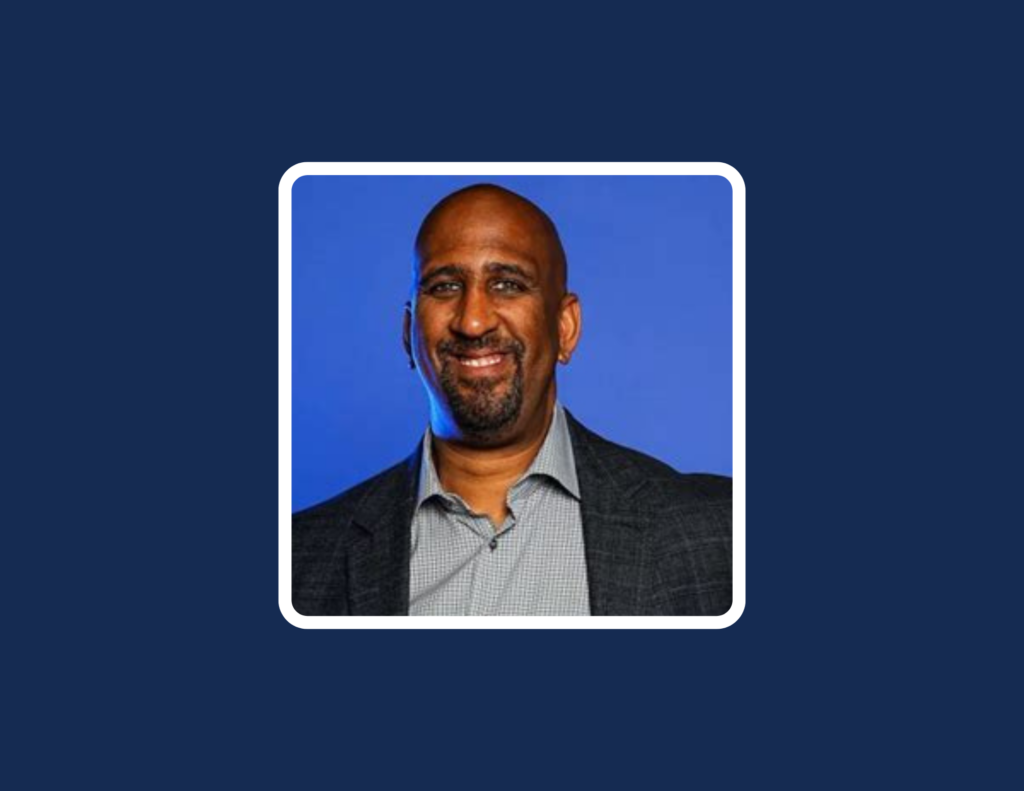
CALVIN BOOTH – FORMER GM OF THE DENVER NUGGETS & FOUNDER OF STANDARD FRONT OFFICE – EPISODE 1285

Website – https://standardfrontoffice.com/
Email – [email protected]
Twitter/X – @StandardFO
If you listen to and love the Hoop Heads Podcast, please consider giving us a small tip that will help in our quest to become the #1 basketball coaching podcast.
Calvin Booth is the Founder of Standard Front Office and the former General Manager of the Denver Nuggets where he helped build the 2023 NBA Championship Team. Standard Front Office is a real-time, expert-built evaluation of the college basketball player market that is delivered to every program on equal terms.
Calvin has served in NBA scouting and front office positions for the New Orleans Pelicans, Minnesota Timberwolves, and Denver Nuggets, eventually being named general manager of the Nuggets in 2020.
Booth began his front office career after playing 10 years in the NBA. He played his college basketball at Penn State University and was drafted in the 2nd Round (35th overall) by the Washington Wizards in 1999.
On this episode Mike & Calvin discuss his innovative new venture, Standard Front Office, which aims to revolutionize college basketball operations by offering a comprehensive evaluation platform for collegiate players. This service assists programs in navigating the increasingly complex landscape of college athletics, particularly with the rise of the transfer portal and the incorporation of NIL (Name, Image, and Likeness) considerations. Throughout our dialogue, Booth elaborates on the challenges faced by college coaches today, including the overwhelming task of roster construction amidst a talent pool that boasts over 700 players capable of contributing to elite teams. His experiences as a player and executive provide invaluable context as he discusses the need for a more structured approach to scouting and player evaluation, emphasizing the importance of fit within team dynamics rather than merely acquiring talent based on star power. In exploring the evolution of college basketball, Booth articulates the opportunities and challenges presented by the current recruiting environment. He reflects on the substantial changes that have occurred since his playing days, noting that the influx of financial considerations has altered the motivations of both players and coaches alike. The discussion highlights the imperative for programs to adapt and evolve in order to maintain competitiveness, particularly as they grapple with the financial implications of attracting top talent. By leveraging data, analytics, and old school, scouting Standard Front Office seeks to equip teams with the tools necessary to make informed decisions, thereby enhancing their chances of success in this dynamic landscape.
Follow us on Twitter and Instagram @hoopheadspod for the latest updates on episodes, guests, and events from the Hoop Heads Pod.
Make sure you’re subscribed to the Hoop Heads Pod on iTunes or wherever you get your podcasts and while you’re there please leave us a 5 star rating and review. Your ratings help your friends and coaching colleagues find the show. If you really love what you’re hearing recommend the Hoop Heads Pod to someone and get them to join you as a part of Hoop Heads Nation.
Be sure to take some notes as you listen to this episode with Calvin Booth, the Founder of Standard Front Office and the former General Manager of the Denver Nuggets.
What We Discuss with Calvin Booth
- How Standard Front Office offers real-time evaluations of college players, aiding programs in roster construction and strategic planning
- In college basketball, there exists a vast talent pool, with 700 to 900 players capable of contributing meaningfully to top-tier teams
- The integration of NIL into college sports has required coaches to adapt their recruitment strategies significantly
- Why coaches must learn to manage relationships with agents, navigating a more professionalized environment in college basketball
- The increasing involvement of player agents in college basketball necessitates that coaches adapt to a more professional recruiting environment
- Coaches face the challenge of managing both player development and financial constraints in an era where transient player roles have become the norm
- Basketball IQ among young players appears to be declining, despite an increase in individual skill levels due to modern training methods
- Prioritizing relationship-building with players, even in short-term engagements
- The difficulty of making informed player recruitment decisions
- Why aggressiveness is the key to great players’ success
Like this show? Please leave us a review here — even one sentence helps! Consider including your Twitter handle so we can thank you personally!
Your first impression is everything when applying for a new coaching job. A professional coaching portfolio is the tool that highlights your coaching achievements and philosophies and, most of all, helps separate you and your abilities from the other applicants.
The key to landing a new coaching job is to demonstrate to the hiring committee your attention to detail, level of preparedness, and your professionalism. Not only does a coaching portfolio allow you to exhibit these qualities, it also allows you to present your personal philosophies on coaching, leadership, and program development in an organized manner.
The Coaching Portfolio Guide is an instructional, membership-based website that helps you develop a personalized portfolio. Each section of the portfolio guide provides detailed instructions on how to organize your portfolio in a professional manner. The guide also provides sample documents for each section of your portfolio that you can copy, modify, and add to your personal portfolio.
Aiming to go D3? The D3 Recruiting Playbook gives you a clear, step-by-step roadmap to the recruiting process – what coaches value, key milestones from early high school through application season, and how to build a target list of schools that fit your needs.
We’ll demystify researching D3 programs and how to stand out without chasing every camp or showcase.
The modules cover things like writing emails to coaches, building an effective highlight tape, using social media well, planning ID camps and visits, and navigating application strategy.
You’ll get templates, checklists, and an outreach plan to communicate confidently, learn how to compare financial packages, and avoid common missteps. By the end, you’ll have a prioritized school list and a decision framework you can use to land your best-fit opportunity.

Give With Hoops is a groundbreaking initiative that fuses basketball analytics with modern sponsorship. Built for teams who see data as opportunity, from AAU programs to college powerhouses.
By tying on-court performance directly to community and sponsor engagement, Give With Hoops help programs raise more while deepening support from those who believe in the game.
Traditional fundraising disconnects donors from the action. Sell candy bars, wash cars, beg for donations, it’s exhausting and ineffective. Players perform better when their stats matter beyond the scoreboard. That’s why Give With Hoops was created.
Give With Hoops connects game performance to community support. Every basket, rebound, and assist becomes a chance to raise funds. Transparent, exciting, and proven to raise 3x more than traditional methods.
THANKS, CALVIN BOOTH
If you enjoyed this episode with Calvin Booth let him know by clicking on the link below and thanking him via Twitter/X.
Click here to thank Calvin Booth via Twitter/X
Click here to let Mike & Jason know about your number one takeaway from this episode!
And if you want us to answer your questions on one of our upcoming weekly NBA episodes, drop us a line at [email protected].
TRANSCRIPT FOR CALVIN BOOTH – FORMER GM OF THE DENVER NUGGETS & FOUNDER OF STANDARD FRONT OFFICE – EPISODE 1285
[00:00:00] Narrator: The Hoop Heads Podcast is brought to you by Head Start Basketball
[00:00:21] Calvin Booth: The one thing the college do have the advantage of and that they don’t have in the NBA is there’s a lot more players that can compete at every level of competition in college. There’s at least seven hundred to nine hundred guys in college that can play some kind of role on a top three team in a Power Four conference.
That’s an incredible number, right? So it’s just using that talent pool to your advantage and finding the best player possible.
[00:00:53] Mike Klinzing: Calvin Booth is the founder of Standard Front Office and the former general manager of the Denver Nuggets, where he helped build the twenty twenty-three NBA championship team.
Standard Front Office is a real-time, expert-built evaluation of the college basketball player market that is delivered to every program on equal terms. Calvin has served in NBA scouting and front office positions for the New Orleans Pelicans, Minnesota Timberwolves, and Denver Nuggets, eventually being named general manager of the Nuggets in twenty twenty.
Booth began his front office career after playing ten years in the NBA. He played his college basketball at Penn State University and was drafted in the second round, thirty-fifth overall, by the Washington Wizards in nineteen ninety-nine. Ever since I founded Head Start Basketball in nineteen ninety-three, we’ve helped young players develop their skills, confidence, and love for the game.
Now we’re partnering with coaches and athletic programs to bring the Head Start Basketball camp experience to new communities. Our camps run for five days, three hours per day, and serve boys and girls in grades one through six. You or someone on your staff directs the on-court portion of the camp while Head Start Basketball manages registration, promotion, parent communication, T-shirts, trophies, website setup, and administration.
There are no upfront camp planning headaches, and the profits are divided fifty-fifty between your program and Head Start Basketball. If you want to reach more families or strengthen your youth basketball pipeline or just create additional revenue for your program, visit headstartbasketball.com to explore hosting a camp.
[00:02:22] Kip Ioane: This is Kip Ion, founder of Teams of Men, and you’re listening to the Hoop Heads podcast.
[00:02:27] Mike Klinzing: Be sure to take some notes as you listen to this episode with Calvin Booth, the founder of Standard Front Office and the former general manager of the Denver Nuggets. Hello and welcome to the Hoop Heads podcast.
It’s Mike Klinzing here without my co-host, Jason Sunkel tonight. But I am pleased to welcome in Calvin Booth, NBA World Champion General Manager from the Denver Nuggets back in 2023, and now the CEO of Standard Front Office. Calvin, welcome to the Hoop Heads pod.
[00:03:00] Calvin Booth: Oh, thanks for having me. Glad to be here.
[00:03:03] Mike Klinzing: Excited to have you on. Looking forward to diving into this new venture that you’ve created. And let’s start with, give me the elevator pitch for Standard Front Office. What’s the idea behind it?
[00:03:17] Calvin Booth: College programs and c- college basketball in general is operating more like a professional league.
And we’re here to service college programs and act as a remote front office that helps teams with everything from roster construction to str- strategy on how to use your cap and things of that nature. So basically the bottom line is we’re here to help teams put higher quality teams together for the same price or maybe even a little bit cheaper than what they’re doing right now
[00:03:50] Mike Klinzing: So before we dive into how you do that, let’s talk a little bit about just the changing landscape of college basketball, which nobody could have foreseen five, 10 years ago.
You think about the time when you were playing at Penn State, or I go back to my time as an even older guy than you, playing college basketball from 1988 to 1992. The world of what we see in college basketball looks nothing like what you and I would have experienced as college basketball players. So just kind of give me your overall take on kind of where the landscape is and how that landscape contributed to you creating this idea and this concept for Standard Front Office.
[00:04:37] Calvin Booth: Yeah. I think it’s just it’s a landscape of extremes in, in, in my opinion. I think there’s a lot of good and there’s a lot of bad. I think it’s good for teams that don’t have traditional pedigrees of success. It’s, it provides a lot of opportunity. See Indiana football for that.
It provides a-athletes an opportunity to make money while they’re college s- while they’re in college and maybe kickstart their career in basketball or otherwise. And also, but at the other end of it, there’s less continuity. Kids don’t have to deal with adversity as much. The rules are all over the place.
They don’t know how to regulate it. And the college coaches are, they’re kind of overloaded with a lot of stuff to do. They have to coach the game and try to win the tomorrow, and they also have to prepare for the transfer portal. Their plates are full, and it’s almost too much to handle for them.
[00:05:31] Mike Klinzing: When you started looking at this as an idea, where was the first area that you felt like you could provide a ton of value? Was it, in evaluation of players? Was it dealing with the monetary side of it? Was it just helping coaches to balance all these things? When you first came up with the idea, where was the one area where you felt like, “Hey, I can add the most value here”?
[00:06:01] Calvin Booth: Yeah I think I got to go back a little bit. When I was a GM of the Nuggets, this is something like in our free time we’d kick around and talk about. It always intrigued me, and I think part of what I enjoyed about being the general manager of the Nuggets is the problem-solving aspect of it. And as we know, this is an enormous problem, right?
For college coaches a- and the NCAA itself. So I think the very first aspect it intrigued me about is just like, how do you organize and sort through an oversized talent pool? I think a lot of programs because of lack of time and energy and horsepower they just avoid it altogether because it’s intimidating.
You have three hundred and sixty-five Division I teams, and I think for the most part, the players that are going to have the most impact right now in the moment are the guys that are coming from other D1 programs, right? That’s why coaches have scaled back on their high school recruiting. I know a lot of coaches have really leaned into the international recruiting.
I do think there’s value there, but I think one of the reasons why they do that, this is a much smaller pool, and they usually have small circle connections that can point them in the right direction. Whereas when you’re looking at the NCAA talent pool, three hundred and sixty-five teams is just and four thousand players to evaluate because you don’t know who’s going to enter the portal, right? But at the end of the day, that pool gives you the most payoff, like in recent history with the Walter Claytons of the world, the John A. Brooms, the Jacoby Gilespies. The list goes on of all these guys who are matriculating up and having a huge impact at the D1 level, at the higher level when they go up.
And so I think even though it’s intimidating, coaches have to take on that challenge of trying to figure it out and find those, those guys at the lower levels that can have a real impact when they get deep into the tournament.
[00:07:55] Mike Klinzing: Talk a little bit about your background in professional basketball with the scouting side of it, and how the different positions that you had moving your way up eventually to GM of the Nuggets, how did that experience help to prepare you for what you’re trying to do now?
[00:08:15] Calvin Booth: Yeah, I had a lengthy NBA career, played for 10 years, and towards the end I started to gain a lot more interest in the front office side of things, and I started to delve into scouting college programs and I had some mentors and Tim Conley and the Tommy Shepherds of the world that really encouraged me to spread my wings and go to Chicago pre-draft or go to Treviso and network and meet people.
And so then I retired, I started my own AU program and I did some independent scouting, and then I got back in with, I got back in with the New Orleans Hornets as a pro scout. But, through all the years of experience in basketball, which is numerous at this point, over 20-plus years in the NBA as a player executive, and there’s just a lot of lessons that you learn from being in the locker room, being in the front office, and even being in coaches meetings.
[00:09:06] Mike Klinzing: What’s something that is underrated that the average basketball person, fan, even basketball coach, when you’re looking at somebody from an evaluation standpoint as a GM, as a scout, you’re trying to project whether this guy can be an NBA player, or now you’re trying to predict, hey, what can this kid who played at Stetson, now he’s going to try and go play at Michigan.
How do we translate what he did at Stetson to what he could potentially do at Michigan? The same way you’re trying to translate what a kid did collegiately to play in the NBA. Obviously, there’s a level of talent and there’s certain things, whatever. But what are– what’s the intangible? What’s something that you look for when you sit down and you talk with a kid, or you sit down and you’re watching film of a guy?
What are the intangible things that you look for that you think are key to having a guy being able to maximize and get the most out of his ability and live up to his potential?
[00:10:04] Calvin Booth: Yeah, there’s a lot going on in that question, but I think I have my– I have a sense of what you’re talking about.
I’m going to answer in two parts. The first part I would say is just how important fit is and the role somebody’s going to play on a team. Every year, these media sites come out with the top hundred NBA players or whatever, right? And they’ll… And it’s– they’ll have a guy that’s a star player on a losing team, and they’ll have a guy that’s a really good role player on a team that if they didn’t win it, they were in the finals or right on the door of it, doors of it, right?
And like For me, assembling a team, it’s all about like making sure that team fits around your best players, getting guys to know how to win. And I think sometimes those things get conflated when you do these rankings with it’s a talent versus like who’s going to play a better role, right?
So I think the question is, especially in the NBA, and this is where the NBA and college differs some. Like in NBA, if you don’t have a top five player, if you don’t have two of the top 20 players and, or another top 10 player, you’re not winning the championship. You’re just not. Where college is more about the college coach and his program and his system and what he does.
And I think the pieces, because the players are younger and they’re not their fully developed self, they’re more interchangeable. I’d like to say a guy like Walter Clayton who won a national championship at Florida, he’d be different at Florida than he would be at Georgetown, than he would be at San Diego State, than he would be at Marquette.
Everybody has their own way of developing and implementing somebody’s skill set into their system. So I think considering that when you’re putting together a team, who the coach is, who the best player is very important. Now, getting more to the college level for me it definitely was a difference.
I had to acclimate myself pretty quickly to some of the differences in college. And one of the things I’ve kind of used as a, a North Star for myself is, all right, if somebody’s one level below, if they’re mid-major plus or bottom half of a Power Five conference and they want to go up, it’s a little bit easier to project translation.
But the more you’re trying to think about somebody jumping one to three levels higher than they’re, where they’re at, the more I start to look at how physically mature the guy is how polished his game is from a skill standpoint, how smart he is, how tough he is. Is he productive, right? And if you have three or four, if you have three out of four, four out of five of those things checked, I feel very comfortable that you’ll be able to jump from Stetson to Florida.
Now, if you’re really skinny and I don’t know how skilled you are or how smart you are, I definitely don’t feel comfortable recommending that you to a co- coach at the top of a Power Five level that like this is the guy for you. So that’s kind of how I look at it.
[00:13:00] Mike Klinzing: How much does the idea of a player who has been a star at a lower level, whether you’re talking about a guy coming into the NBA or you’re talking about a player from a lower level in college jumping up to a higher level.
I always think about the fact that as you move up in levels of basketball there are very few guys, you talked about it you have to have one of the top five players in the league if you’re going to win a title. You have to have two of the top 15 or two of the top 20. And those guys get the opportunity to showcase all of their skills, right?
They have the ball in their hands. They can dribble it, they can pass it, they can shoot it. They’re play-making, they’re making decisions. But most guys have to fit into a role, and they have to be good at the things that, as you said, need to fit around that star player. But you also have to have the mentality to be able to make that adjustment.
I think about a high school kid jumping to college, or again, a college player at a lower level jumping to a higher level. The coach isn’t just going to give you the ball because, hey, you’re the guy at a mid-major Division I school. You’re not suddenly going to just be handed the ball at Michigan and be like, “Hey, man, go do your thing.”
And sometimes guys have a hard time adapting that and understanding that, yeah, you might have an all-around game at this level, but at the highest level, we’re going to need you to excel at these two or three things that are going to fit perfectly in our team. So is there a way, whether it’s through conversation with their current coaches, whether it’s conversation with the athlete themselves, is there a way or have you h- run into where you’re having those conversations even with guys who are maybe are already on your team, right?
That you have to say, “Hey, we need you to do X,” even though player, that player might want to expand their role. So I don’t know if the question that I’m asking is making sense to you. But basically, how do you assess whether or not a guy can fit into a role who may want to have a bigger role?
[00:14:53] Calvin Booth: Yeah this comment’s going to make me sound like a, like the age I’m getting up there.
But at this point I’ve, I had through my basketball journey, I was starting to get to the point where I realized that for the most part Guys, players, they don’t change that much. Th-don’t get me wrong, they get more experienced, they get physically stronger, their skills improve if they work really hard.
But make no bones about it, I was a great shot blocker when I was 16, and I played in NBA 10 years because I was a great shot blocker, right? Now, there’s things around that I filled in. So through that lens, I feel like every player is going to do some version of what they did the level below. The question just becomes level of impact, right?
And how you are able to apply those st-skills is some combination of aggression and basketball IQ, right? Like that’s the, the thing that they have to navigate ’cause, nothing gets done without being aggressive in sports. But like when you are being aggressive, do you have the, the know-how to know how to pick and choose your spots and where you’re supposed to be at?
And if you don’t have that know-how, you might struggle at the college level or higher.
[00:16:03] Mike Klinzing: Yeah, no, that makes a lot of sense. I do think that basketball IQ is something that Man it’s completely I think underrated, especially when you start looking at you go to an AAU tournament and you watch and basketball IQ being, not being on display in a lot of cases.
I think the skill level of players today is as high as it’s ever been. Sometimes I worry a little bit about the basketball IQ when you’re talking about about AAU basketball. But let’s throw it back to what you’re trying to do with Standard Front Office, and tell me a little bit about…
let’s focus first on just the helping coaches to be able to navigate, as you said, the number of players that are in the portal. How can Standard Front Office, how can what you’re doing help them to be able to sift through that sea of players and figure out who can help them? What’s the methodology?
How can you help a college coach and the program get a better roster and sort through all those players?
[00:17:02] Calvin Booth: Yeah, great question. We have a standardized system that, I modified from what I used with the Nuggets to apply to college basketball. And I’m going to… We have a database. We’ll have a network of scouts to go out and scout all over the place, including myself.
And we have a, a methodology that allows you to compare apples to apples, so to speak. So you consider that with the consulting piece and the history of front office work and success that I’ve had and the people I’ll have working for me will have themselves, and now we can now start to augment coaches’ efforts.
And I definitely realized in my last year of working with a couple teams that that again, the coach is the end all be all. He’s the one that’s going to make the final decision. He’s the one that’s going to be negotiating with the agents and deciding what to do. So having the coach absorb as much information as early as possible while not losing any of his edge or any of his preparation through a college season, that would be the goal.
[00:18:05] Mike Klinzing: When you talk to college coaches, and obviously guys who have been in the business for a while are having to adapt to a system that they didn’t grow up in when it comes to NIL, managing not just their team and coaching their team, but now you’re throwing the money aspect of it into college sports, which wasn’t a factor up until the last five, six, seven years when NIL came in.
Obviously, with your background in the NBA and putting together a team under The umbrella of a salary cap and having to match money and all those kinds of things and fit the roster, right? The pieces. You can’t just grab every player you want, you’ve got to fit them into a salary structure, which is something that college coaches have never had to do.
So when you’re talking to college coaches, how much of a concern is that for them in terms of trying to figure out how much money they can allocate to each particular spot on their roster? And where can you add value in that area?
[00:19:05] Calvin Booth: Yeah, I do think coaches always worry about the amount of resources and funds he has to field a good team, and I do think that is a worthy cause.
But I am of the mind as well, though, that there’s a lot of opportunity right now in the space, and as we go further along and teams get better at what they do the more the money will matter. But at this point in time, there’s so many different things going against college coaches in this landscape.
The lack of time and energy, the constantly changing NCAA rules and regulations. Contracts aren’t binding. Agents have experience negotiating contracts. A lot of these coaches don’t. The one thing the college do have the advantage of and that they don’t have in the NBA is there’s a lot more players that can compete at every level of competition in college.
Like there, there, there’s at least 700 to 900 guys in college that can play some kind of role on a top three team in a Power Four conference. Like that’s an incredible number, right? So it’s just using that talent pool to your advantage and, helping to keep the salaries down and finding the best player possible.
But if you don’t access that, that talent pool, you don’t use it, that’s when I think the overspending comes into play and the ADs are worried about the budgets and the school, the donors are like, might suffer a little bit with what I would call donor fatigue. So I do think there’s an inevitable, there’s an inevitable bubble that will burst at some point in time, and the teams that are proactive about trying to be, more more intentional about how they approach the portal, how they spend their money, what kind of players they get. They might insulate themselves from this eventual collapse of all the money being spent out there in the landscape.
[00:20:55] Mike Klinzing: What kind of mistakes do you see coaches making, in your opinion, when it comes to putting together a roster?
Is it just geographically only looking into certain areas? Is it only looking at certain schools? Is it only looking for a certain type of player? What mistakes are coaches making when it comes to identifying the talent that’s in the portal that you can help to kind of fill in those gaps for them?
[00:21:20] Calvin Booth: Yeah I think, oh, it’s getting kind of dark here. I don’t know what happened. But I think essentially it’s the system. It’s just a lack of time, a lack of horsepower to put into it. I wouldn’t really call it mistakes. I do think, coaches want to win and they know how to evaluate risk/reward.
So if they don’t have complete knowledge of the, the field, they’re going to go what’s familiar to them. What, who they recruited before, who’s played for ’em before, who maybe they played in conference or non-conference this past year. And at that point, the pool becomes so much smaller and you, at, at times you feel the urge to close and you get into that, maybe that, that overspending cycle a little bit
[00:21:59] Mike Klinzing: Yeah, it makes sense, I think, when you talk about the time crunch.
I know that from just talking to coaches on the podcast, Calvin, just the number of guys that talk about the hours that you have to put in coaching your team, and then you have the recruiting piece, and now you have the whole managing the NIL side or the business side and donors, and there are so many things that go into being a college basketball coach beyond just coaching basketball.
When you start talking about all those responsibilities, and then you’re trying to evaluate four thousand players who are in the transfer portal and figure out who fits your roster, who fits financially, who fits what you’re trying to put together actually on the floor in terms of positionally and style of play and all those things.
You can totally see where the challenges lie in trying to make that work. And so as you look at what you’re trying to provide a- and what you can do for a program, I’m assuming that what you’re going to be able to do with your network of scouts a- and your oversight is you’re going to be able to widen that talent pool that they can see and be able to compare those players, as you said earlier, apples to apples of it’s a standardized system where they can look at and say, “Okay, this kid, here’s why he fits here.
Here’s where he slots. I can compare him to this player over here.” That’s what I hear you saying. You’re putting together a, a streamlined way for coaches to be able to overcome some of those, those challenges that we just talked about.
[00:23:29] Calvin Booth: Yeah, exactly. I think you hit the nails on that exactly.
I think when I worked for Scott Layden in Minnesota, he used to say in San Antonio, would talk about eyes, ears, numbers. Eyes is objective scouting. The coaches and scouts like myself like to do. The ears is the intel and what you would hear about the player so you could put together who he is as a player, who he is as a person.
And the num… and the, the numbers are the analytics aspect of it, and that, that ends up becoming very important, too, right? Eyes, ears, numbers. So I think like having an, a, an objective basketball mind involved to augment some of the analytics, ’cause I do think there’s a place for the analytics in, in the game.
But I do think the problem is if you are outsourcing an analytic model or you have it internally, unless you adhere to it strictly and you don’t know the pool, you’re right back in the same place. So do people have the discipline to go work an analytic model and, listen to the recommendations that model has for them?
They can probably, do better than most, but people who’ve been involved in basketball for a long time have such a hard time with that, right? Just the, the numbers don’t get everything right
[00:24:44] Mike Klinzing: What’s an area where you feel like analytics does a good job, and maybe what’s an area where you feel like analytics hasn’t quite solved the equation yet?
[00:24:55] Calvin Booth: I think it’s just, I think there’s things that can be missed when you’re just watching with your eyes. There’s things that’s missed when you’re just doing it with your ears. And I think from an analytics standpoint, there’s a number of things that, that can happen. But one, I’ll give you an example.
One last year I went to go see a pretty much what I would call blue blood program practice, and they had a guy jump three or four levels. Very physically talented kid. His numbers were crazy at the place he was at, but the speed that he played the game at, the way he processed the game his habits and the way he did things just weren’t at the level where he was participating at now.
And he did not adjust well this past year, and he ultimately transferred to a level lower where he’d probably do better. But like you can’t quantify that in analytics, right? That’s something you have to try to pick up and project through a scouting and evaluation process.
[00:25:57] Mike Klinzing: Yeah, it makes sense, right? I think that there’s that balance between, as you said, sort of the old school eye test versus, hey, this is what the numbers say, and you kind of have to use both, right?
You can say, okay, this kid looks like he may project based on the numbers. Then I go and watch him play and I can find and talk, see some of those intangible things like we talked about a little earlier, that maybe only the eyes can detect beyond what those numbers are telling you. Let me ask you about something else that has become a factor in college basketball and how that relates to what you’re trying to do.
And I’ve talked to a number of coaches that have expressed to me how often they’re dealing with player agents now in the college game, which was never a factor in the previous history of college basketball. And now I’ve had several coaches tell me in conversations like, “Hey, a lot of times I’m barely dealing with…”
It used to be in recruiting, right? You’re trying to build a relationship first with the player, then you’re trying to build a relationship with the player’s family. Maybe it was, mom was the one who was going to help make the decision, so you had to get to know mom, or maybe it was dad, or maybe it was the uncle or whoever.
Now I’ve had a bunch of coaches tell me they barely talk to the families in some cases. In a lot of cases they’re just talking to agents. So what do you see on that front in terms of agencies and agents representing players and how that impacts the way that coaches go about the recruiting process?
[00:27:25] Calvin Booth: I just think it’s another step in in evolution towards a more of a profess- professional type of deal, right?
Like agents and representatives are involved in professional sports, so it’s just, it’s par for the course. It’s something to get adjusted to. It’s not all bad. It’s not all good. I do think that being able to neutralize agents by being informed is something that college coaches and staff should be, like, aware of.
Because, like, when you go into a, a market that you don’t have market knowledge of, now you’re dependent on my competitor A is going to– willing to play this guy a million dollars. Competitor B is also going to pay him a million dollars, and competitor C is going to do the same thing. And if, for sake of this conversation, for context, if Kent State is having that conversation No.
Is the kid worth a million dollars? If at a million dollars at Kent State, he’s have to be a player of the year candidate, right? In the conference and a first team, all-conference guy, and he’s have to be in the best team in the league, and maybe get some honorable mention all-American conversation, right?
And if he’s not, you shouldn’t be paying him a million dollars. Having the coaches be able to be in a position where they feel confident to make that judgment call instead of acquiescing or ceding to the market. Miami Ohio is going to pay him, and Akron’s going to pay him, and Toledo’s going to pay him, then we have to pay him as much.
So I think actually knowing and having confidence in that player’s ability that he can live up to whatever compensation level you’re going to award him is is a very important aspect of it.
[00:29:08] Mike Klinzing: Yeah. I think from your perspective, when I hear you just giving that answer, it makes a lot of sense to me.
If I’m a coach, again, at any level, but let’s just say I’m a mid-major coach and I’m trying to figure out, hey, where do these guys slot that I’m looking at in the portal? Maybe they slot, yeah, could they be a role player at a Power Five? Sure. Could they be a star at a Mid-American Conference school? Sure.
But it may be hard for me to figure all that out, and again, doing that all across the country with everybody. So when I think about the database of players that you’re creating through Standard Front Office, to me, I can see where if it’s standardized and I can compare across levels, I can compare kids from different parts of the country.
I can compare, hey, this is a kid coming from this level, this is a kid coming from this level, but you’re telling me those two kids have a similar potential or maybe a dissimilar potential, depending on how it is. I see the value in that. Walk me through what that looks like from you and somebody who’s working for you as a scout.
How do you go about putting those things together and making them standardized so that a coach can make those apples to apples comparisons that you’re talking about?
[00:30:18] Calvin Booth: Yeah. Basically what that looks like is you go watch a game, and the first thing you do is, identify what position he is, one through five, then an archetype.
And then then the very next thing you want to do is what would that guy project at? What level would he project at next, next year? And we pretty much have him broken down into three separate high major categories and then same thing with mid-major and a couple of low major. Once you put that label on, it’s pretty easy to say, all right, what role would he play at that level?
Would he be all-American, all-conference, all the way down to just a roster player. And then from that point you have a better idea of what compensation level that guy should be paid based on that categorization
[00:31:05] Mike Klinzing: How many times do you feel like you need to see a player in order to be able to have a feel for that type of evaluation from he’s a role player, he’s a star, he’s a starter?
How many times do you have to see that player? How much film do you have to watch on the player before you, you personally feel confident in what you’re seeing and what you’re putting out there?
[00:31:26] Calvin Booth: Yeah, and this is something I learned from the many mentors and stuff we have, but you go to see an individual game, just go off of whatever you thought that guy was that night.
And then the very next time, even position-wise, if you thought… If you watched Reed Shepherd in, in college and you didn’t know whether he was a two or a one, you might have watched him one time then said he’s a two guard. And then you might have watched him next time, say, “Oh, he’s a point.” And, hopefully you get enough views and different eyes on him where you come up with a, a consensus of what you think that is.
But once in person I like to see just more to get a feel for the size and athleticism and, some of the stuff that you miss on video. Then after that, video work is pretty good and just tracking them throughout the season
[00:32:11] Mike Klinzing: Yeah, it makes sense. Again, obviously the more times you can see them and the more different sets of eyes you have on them, it gives you an opportunity to bounce ideas and thoughts and as you said, then you start to fine-tune what you see that, what you see that first time.
When it comes to your organization and putting together the people that you’re going to work with in Standard Front Office, what’s that process been like just from a business building standpoint? Going from, “Hey, I got this idea. This is what I think I want to do,” how do you take that from the general idea to, to building an organization?
What did that look like for you?
[00:32:46] Calvin Booth: Yeah. I think I think it starts out with, basically I was building a business around my expertise and my experience. But transitioning that into a tangible product and a system and having a staff is a process that we’re going through right now, and I have, a lot of people that are, have a lot of exuberance about wanting to work in the space and willing to, willingness to help.
Just trying to figure out where these guys fit at as the business grows and develops. And as far as the scouting network goes I just one part of me wants to g- jump out there and have 10 to 20 scouts spread across the country, but I do realize, every business grows a little bit by little bit, but I have some … Now, I do think there’s some wiggle room there as far as I want to find coaches and stuff that are maybe not working for a team right now, that other coaches respect their opinion, and that are willing to, learn the standardized system. And ’cause at that point, I know the coach at Kent State, I know the coach at Miami, I know the coach.
They’ll read the reports, right? The whole goal is to help the program absorb information and make higher quality decisions. In whatever way we can get to that, I’m open to
[00:33:55] Mike Klinzing: So in your mind, the vision, if I’m a Division I college head coach, and I want to engage Calvin Booth and Standard Front Office and take advantage of your services, what does that look like?
When I engage with you, what am I getting out of that business relationship?
[00:34:14] Calvin Booth: You’re getting you’re getting detailed information from credible sources and twenty-four/seven access starting in October, November of the database, and that’s one aspect of the business. And the other aspect would be the consulting branch of the business where you can lean on me or whoever I’m working for to help with financial modeling contra– advice on contracts roster construction, whatever.
Again we’re trying to be there to– It’s like fractionaliz- fractionalized ownership of a front office, which in the NBA costs anywhere from eighteen to thirty million to put together, and that’s not really including the number one salary, right? So if you can get that at a fraction of the cost, we feel like it’s a good bargain for the school.
[00:35:01] Mike Klinzing: Yeah, absolutely. To be able to, again, streamline the processes of what you have to do anyway, to be able to have somebody like yourself with your experience, to be able to jump in there and provide that kind of value, I could totally see where, again, a school that is trying to figure out, “How do we do this,” right?
Everybody’s kind of in this new world of Wild West. Putting together a roster used to be just recruit and build those relationships, and you can put together your team, and now it’s basically year to year, you’re having to put together that roster. And as you’ve said multiple times, we’re coming closer to a professional model of what college basketball looks like, much more than the amateur model that that we certainly, that we used to have.
GiveWithHoops is the first platform turning basketball analytics into fundraising impact. Every stat tells a story, and now every story drives sponsorship, engagement, and team growth. Programs nationwide are transforming basketball stats into funding power. Learn to use performance data to attract sponsors, engage fans, and raise more with every play.
GiveWithHoops will help you raise three times more money for your program, as their stat-based pledges consistently outperform traditional fundraisers. Visit givwithhoops.com/hoop-heads-podcast to learn more and take your fundraising to the next level. GiveWithHoops.
Are you or an athlete you know planning to go D3? Check out the D3 Recruiting Playbook from D3 Direct. Their playbook gives you a clear step-by-step roadmap to the recruiting process, what coaches value, key milestones from early high school through application season, and how to build a targeted list of schools that fit your needs.
The playbook demystifies researching D3 programs and how to stand out without chasing every camp or showcase. The modules cover things like writing emails to coaches, building an effective highlight tape, using social media well, planning camps and visits, and navigating application strategy. You’ll get templates, checklists, and an outreach plan to communicate confidently, learn how to compare financial packages, and avoid common missteps.
By the end, you’ll have a prioritized school list and a decision framework you can use to land your best fit opportunity. Click on the link in the show notes to get your D3 Recruiting Playbook from D3 Direct.
When you think about the contract side of things, which you’ve mentioned as something that coaches don’t have a ton of experience figuring out, “Hey, how do we write a contract?” And I know that’s one of the things that I’ve talked to guys that played college basketball kind of in my era that, may have made donations to their program in the past and, “Hey, I’m making a donation, and that’s going to fund the new practice facility,” or, “That’s going to fund a new set of uniforms,” or, “It’s going to buy us a new shooting machine.”
And now that money’s going to fund essentially NIL money for whatever the team might… for a player ro- for players on the roster. What how do you help coaches to be able to negotiate a contract that is fair for both sides? ‘Cause it feels like, again, you have professional agents who, as you said, have a lot of experience maybe negotiating contracts, again, for agents who are experienced.
There are also a lot of agents, I think, in college basketball now who don’t have much experience at all, which is a whole ‘nother thing. But just talk about the contract side of it and how you can add value there.
[00:38:39] Calvin Booth: I don’t think you can really talk about the contract side of it until you acknowledge the aspect of a lot of teams that are trying to be serious about competing and doing better are hiring general managers.
And one of the issues I see with that is they don’t have anybody to manage. They give them very little staffing. Every now and then they might have one analytics intern or whatever, but they’re basically… they’re, like, left to deal with all this on their own, and it’s a lot to handle.
So one of the things that I think really needs to be highlighted here is that we’re here to augment and support and, give these general managers some more horsepower and ability to do their job in a better manner. And, I think through my experiences with colleges as long as they’re getting the information, we’re willing to do whatever the college wants.
But I think the phase that we’re in right now, I don’t know how many schools actually want you heavily involved in their negotiations and stuff like that. But leaning on us for advice I do think there’s a space for consulting on contracts once you come to an agreement and helping you redline it and decide what things are absolutely essential to put into the contract and what, what things that you can do without.
[00:39:58] Mike Klinzing: What are some things that you would like to see in an ideal world in a contract between a school and a college player? Are there specific clauses or things that you think would be important to be included?
[00:40:09] Calvin Booth: I do think the language when you’re dealing with these international guys to, to, to have some kind of…
these contracts aren’t really binding, but have some kind of language where they feel like it’s a little bit harder for San Superita leaving Gonzo-zaga and leave them kind of holding the bag with no point guard late, very late in the summer. So protections for guys, like, trying to get away without earning their money whether through injury or maybe they’re transferring out of a two-year deal.
Whatever, whatever can help protect the school. Again, these contracts aren’t binding. That’s where it becomes tough.
[00:40:45] Mike Klinzing: Yeah, it’s tough to have a contract that i- that isn’t binding on either side. That makes it it makes it barely worth the paper that it’s printed on. You talked a little bit about the GM side of a lot of these programs are bringing in somebody and giving them that GM position.
If you were going to write a job description for a GM of a college, let’s say a Power Five conference, what are some of the bullet points, some of the things that you think would be important for a GM of a program to do? Which, again, consequently would be some of the things that maybe you could add value to that general manager of that school.
[00:41:21] Calvin Booth: Yeah, I think it’s I think a lot of kids are young and they want the opportunity to do the job as I did in Denver. I don’t know if it’s exactly that opportunity right now. I think a lot of times it’s having that relationship and that trust with the coach to go out there and act on his behalf, to build relationships with agents.
Obviously, to do some work and try to, to the best of your video ability through video, figure out this market. It’s a lot of work and, from my standpoint, I think if I was recommending an AD or coach that was going to hire a GM in this kind of, through this kind of lens that, maybe they have to have a superpower.
Is their superpower raising money for the program? Are they, do they have a background in analytics and are they going to use that analytic modeling to, to to help them out? It’s a little bit harder for the sheer basketball guys right now because there’s so many rules and regulations that, you can’t have your own scouting staff, at least in basketball.
I’ve seen some reports in football that I get kind of confused about maybe the rules are a little bit different. But from what I know about basketball, you cannot have an internal scout in your building going to watch other college teams play, play throughout the season, right? Which is something where we’re positioned at, we’re allowed to do by NCAA rules
[00:42:37] Mike Klinzing: Yeah, that’s a huge thing that I guess I never really thought about when you start talking about guys in the portal, right?
And that goes to what you spoke to earlier, that you go back to what you’re familiar with, right? Maybe you get a guy in the portal that you played against, or maybe it’s a guy in your league, or whatever it may be. Guy that you’ve never seen, you haven’t had anybody on your staff out there watching that player live, so then you’re stuck with either just talking to somebody that maybe you trust in the business, another coach from another league and, “Hey, what do you think about this guy?”
Or you’re watching him on video. And as you well know, a- as you said yourself, like, when you’re scouting a kid you want to go and see that. You want to put your own eyes on him in order to be able to evaluate. You can use some other things, and you got the, the ears and the hearsay and that kind of stuff, but ultimately you want to be able to put your eyes on that player.
And when you’re not able to do that again, that’s a good point that I had never really thought of in terms of, you’re trying to make sense of everybody that’s in the portal, and you haven’t seen 98% of those players ever play in person. That’s tough to make a good evaluation
[00:43:42] Calvin Booth: Yeah, with the amount of money involved it’s not something I would recommend doing in a professional landscape.
We don’t do that in NBA. A lot of times somebody in the senior executive circle is going to see a guy play and probably multiple times, especially the higher you go in the draft.
[00:43:58] Mike Klinzing: Yeah, absolutely. There’s no doubt that you want to be able to put eyes, and then you can, again, see multiple sets of multiple people watching that player, and then you have the whole analytics piece, and then you talk to l- lots of different people to be able to get their background and have an understanding.
And again, scouting is such an inexact science. You can look at the draft in any professional sport, right? You can look at just the whole process of players that seemingly come in and they’re can’t miss, and five years later you’re like, “How could that guy have been picked number two?” Or, “How could that guy have been picked number six?
What did we all miss?” And it goes back to, I think, that initial question that I asked you about what are the intangible things that you look for that make a player successful ultimately, right? And there’s lots of guys with physical tools and talent and skill, but there’s lots of guys that have those things, but then there are some guys who just excel beyond those physically obvious traits that they might have.
And those things, I think are the hardest to evaluate. And it always seems to me that guys like yourself, who have had a tremendous amount of experience and have worked their way up from scouting for a team and then eventually you get to the position that you were in and able to win a world championship, you just develop a feel for, hey, is this guy– does this guy have it?
Like however you’d want to define it, that’s going to allow him to excel at the, again, in your case, with the NBA at the highest level, but for a college coach to excel at whatever their program is. And I just think, again it’s an inexact science, and it’s something that you have to keep trying to figure out and hone your own ideas of what makes– what’s going to make a player successful.
[00:45:39] Calvin Booth: Yeah I think to add on to that, I think the difference between the NBA and college is you’re drafting somebody based on their projected career over a ten-year period, hopefully or longer. In college, you’re just– you’re spending you’re making a commitment for a year to get a guy that’s to try to help you win games.
And in doing that, I just don’t– It’s very hard. We all try to make sense of it as we’re in the business and maybe have some kind of quote-unquote rankings, but it’s probably more like just does a player fit into a tier, right? Prior to last season, there could have been a lot of vigorous debate ala-along amongst people in the business whether Jeremy Fears belonged in the top tier with Donovan Dent, Bennett Sturtz, and all these other guys that were coming back to college.
And lo and behold, he may have been the best of all those guys last year, right? So I think that’s what’s interesting about college. And, not just for a one-year period, like maybe over a ten-year period he’s not going to be better than Bennett Sturtz. But like for one year, like as long as a guy’s in the tier, like that’s why it goes back to how much you should overvalue.
Is anybody… They have to be really good to be worth five, six million dollars, I think in college basketball because what I just described. They’re younger. They’re not as much as a commodity yet. There’s many comps in, in, in that, in their level so that you could probably have for maybe a lesser price.
So that’s the thing that I think colleges will start to figure out over time
[00:47:16] Mike Klinzing: Yeah, and it’s difficult to project right over one year. I think you make a great point there that especially the way the college landscape is, that’s really what you’re looking at this point is what can this guy give us for this year?
‘Cause after that, there’s no guarantee as to whether or not that guy’s going to be back on your roster or be back in the portal and trying to go somewhere else. And then you have the whole thing of you’re trying to help– As a college coach, I’m trying to help my guy be as successful as possible ’cause that’s going to help my team be as successful as possible.
But if this kid has an unbelievable year and develops, guess what? He may leave and go to … maybe he goes to the NBA or maybe he just goes to a higher level program that can offer him more money, and you have that whole development. So again, you’re looking at, as you said, like a one-year thing as opposed to in the NBA you can look at projecting that guy over the length of his entire career.
Let me ask you about this, and I don’t know that it directly applies to college basketball. It’s just something that I want to get your thoughts on. When you look at the guys that you’ve been around in the NBA as a player, as a scout, obviously as a GM. You have Jokic in your building. You have Jamal Mo- Murray in your building.
You have two guys who are tremendous players. Jokic obviously one of the best players in the history of the game. What are some of the things that set those guys apart? And again, I’m not talking about their basketball skill or their basketball talent, but just in the way that they approach what they do day in and day out over the course of your time in the NBA and all the different roles that you’ve played, what are the things that set aside the best players that have allowed them to excel when you’re talking about the 400 best players in the world, and yet you have some guys who are able to ascend into that All-Star, All-NBA level?
What sets those guys apart?
[00:49:02] Calvin Booth: Yeah, I think going back to that, that point earlier, that starts– all starts out with aggression. How aggressive can you play the game? And it sounds easy on paper, but to be aggressive you have to be in great shape. To be aggressive you have to be smart, as we talked about.
To be aggressive you have to work on your skill set and work on your game, so when you are imposing your will in a game, you can execute. Nobody’s going to… Your teammates or your coaches aren’t going to allow you to take 20 shots that you’re not capable of making, right? Or that you’re not in shape of making.
So I think there’s just a whole ‘nother level. I think everybody that makes the NBA has some level of work ethic or whatever, but I feel like the guys end up being transcendent. They just have a whole ‘nother level of discipline, work ethic, intensity, stamina. We had Russell Westbrook in our building, and he was in our, practice facility every night with our young guys.
I was in there most of the time watching our young guys work with our shooting coaches and our night crew, and Russ was in there in his 15th year in the league or whatever, 16th year in the league, like every night shooting threes and getting shots up. And then he goes and plays with that same intensity and ferocity in the game.
[00:50:15] Mike Klinzing: So day to day, that shows up just in the amount of time and effort that guys are putting into it. I’m assuming that it goes along with, too, just the focus of being single-minded in what they do when they step on the practice floor. That those guys have a plan o-of what they want to do and how they want to improve and get better.
[00:50:33] Calvin Booth: Yeah, and I think the thing about a guy like Nikola Jokic, I think there’s times in every game where he might be tired, and he can make that decision to maybe not get run as fast down the floor, or maybe not go after a tip-in or a post position. Every single time he makes the decision to push himself and go hard, and I think that’s what makes him really special
[00:50:56] Mike Klinzing: Yeah.
I- it’s just when you look at the very best guys at whatever level, right? There there’s something beyond their physical tools that sets them apart. And I think that work ethic and that ability to have y- what you called a basketball IQ earlier, it– you combine those two things and that’s where you get to guys that are the best of the best.
When you’re evaluating as you started to look at the college marketplace a- and players at this level, where do you think we are in terms of basketball IQ comparatively to maybe the past? I always feel like the skill level today is as high as the, the players today, just the skill level that they have is just off the charts in terms of the number of guys that can shoot the ball, can handle it, that kind of thing.
Where are we in terms of basketball IQ? When you’re evaluating and watching players, where– do you think we’ve made as big of a leap in basketball IQ as we have in skill level? Or do you think that there’s maybe a little disparity between the two? I’m just curious.
[00:52:04] Calvin Booth: I think anybody that’s played basketball at any high level has the same exact thoughts that you do.
The– I feel like the kids today are way more skilled from an individual standpoint, but they have no feel for the game compared to the, players from the past. And I think a lot of it’s the system they follow. And I just don’t think it’s AU. I think I’ve seen somewhere online, somebody made this distinction.
There are some, man, well-run AU programs in all three circuits, especially EYBL that are run like college programs and they do a great job. But I just think… I was telling somebody recently, I felt like the next step for me in draft workouts was going to be, we had the six guys in at the very end of the workout.
I was going to have every guy have to take at least a shot, and I was going to have them volunteer like, “All right, player one who wants to volunteer? Set up a flex offense.” And I don’t think they would’ve been able to set it up. “All right, player two, set up America’s play. All right, player three, set up floppy.”
I don’t know that these guys that are playing now can do that, right? Every player in our era that played had to run flex in middle school. And probably even in college, right? I don’t– Some of these kids, I don’t even think they know what flex offense is. And I, I feel like my basketball journey’s come full circle because here I am advocating for flex offense when, a lot of times in my career, I’ve been like, “I can’t believe we’re running this offense.
It’s like this is dumb,” right? But I think there’s too much of trying to emulate what they do at the NBA level at the youth level. Like I watched the Cleveland guy actually a w- a number of years ago, Steve Ganzi, he was coaching the G League at the time, and he put on a five-out clinic and, it was pristine.
I was like, “Oh, okay, that’s how you play five out.” But I think a five-out offense is so hard to execute, and if you don’t have the ability like as Steve Ganzi did to coach that, I don’t think you should be trying to run it in eighth grade, honestly. How do you balance a floor out? Where are the kids at?
Who’s skilled enough to play in that? Who’s smart enough to play in that? Shouldn’t they just be running some simple offense that you were running, that we ran back in, in middle school where we were that age? That’s my my rant right there. Sorry about that.
[00:54:26] Mike Klinzing: No, you’re good. All right, so here, I’m going to give you my old man rant.
So my old man rant in relation to this is, and I’m sure you were the same way, that when you grew up playing, you didn’t have a trainer. You were probably working out on your own, working on your game. But a lot of your game developed by playing pickup basketball, and playing pickup basketball with guys who were much older than you, in a lot of cases, probably better than you when you were younger.
And from doing that, you learned some of the tricks of the trade from the old guys, and you also learned that you had to play a role and fit in and figure out “Hey, I might be the fifth guy on this team as a 14-year-old. I want to stay on the court. I have to figure out that I shouldn’t be taking,” to your point, right?
“I shouldn’t be taking 20 shots in this game. My teammates aren’t going to like me, and we’re going to be sitting out and we’re going to be watching the game for the next hour and a half until we can get back on the floor.” And I always feel like that from a feel of the game standpoint and from a basketball IQ, that’s where I think we’ve lost some of that basketball IQ.
‘Cause kids today grow up playing with their own age group all the time. There’s always a coach with them. There’s always usually a mom or a dad in the stands, and there’s almost always a scoreboard turned on. And I think about the m- the amount of driveway, playground pickup basketball that I played, first with my buddies when I was younger, and then as I got older and was able to drive around and play with high school and college a- and adults doing that.
That’s where I feel like my feel for the game and my IQ came, and that world has disappeared. My son is going to be a junior in college. He plays Division III at Ohio Wesleyan, and I probably played more pickup basketball in one year of my life than he’s played in his entire basketball career, just because even if he wanted to, those games just aren’t there in the same way they were when you and I were kids.
So when I think about basketball IQ, that’s what I think about. I don’t know if that makes any sense to you or rings true in any way.
[00:56:25] Calvin Booth: It makes all the sense in the world. I think of a guy like Larry Bird, one of the smartest players to play. I think it’s a lot of one-on-oh in your driveway in French Lick, and it’s playing when you can, and it’s it’s a combination of all those things.
That’s how your imagination comes into play and your creativity. And no, I absolutely agree with that premise that if you don’t have to play against older players, if you don’t ever have to feel the pressure of losing a game and having to sit out five games and having a older player yell at you for making a mistake I think you do lose some of that nuance and feel that you gain through that experience
[00:56:59] Mike Klinzing: Growing up, did you always know you wanted to work in basketball beyond your playing career?
What was your thought process as you were growing up? Were you thinking maybe you wanted to coach? Did you know you just wanted to stay in the game? Or were you just focused on trying to play for as long as you could? What was your mindset as you were kind of going through your basketball career?
[00:57:18] Calvin Booth: Yeah, I was one of those kids. I’m rare for a seven-footer probably, but I was a basketball junkie. I was the kid that was getting the newspaper out of the driveway at seven, eight years old and checking box scores. I probably knew that I wanted to play at the highest level possible, and I probably wanted to be involved as long as I could in the game,
[00:57:35] Mike Klinzing: coaching at all, was that at all on your radar at any point in, in your journey?
[00:57:41] Calvin Booth: I do like the player development aspect of it. I think that’s forever linked to the player evaluation process. I think coaches, man, just have such a, a hard life, man. And it’s– I think it’s gotten to the point where, you know, and like just some of the decisions that are made across levels that you…
It’s just all about winning the game and I, I just wouldn’t enjoy that. I enjoy the development of a- of athletes and young people and helping them achieve their dreams. And I feel like if you can maximize that, you’ll win. But I think a lot of the time, a lot of times the pressure of the situation makes coaches just have to focus on winning any way they can.
[00:58:23] Mike Klinzing: I think coaches are really struggling with that, Calvin. When I talk to guys on the podcast I hear a lot of guys just talking about, again, the decline of their ability to build relationships with kids, especially at the college level, right? There was a time where you recruit a kid and you felt fairly confident that kid was going to be with you for four years, and you could develop them, build a relationship with them, mold them into hopefully what was eventually going to be a better person when they get into adulthood.
And now, just to the point of our entire conversation, oftentimes this is now a one-year relationship and I’ve talked to coaches who have said, “I- I’ve had to shift my mentality where I can no longer count on four years of impact. I have to figure out, how can I have a positive impact on this kid if I’m only going to have him in my building for nine months?”
And let’s face it, i- it’s much more difficult to have that kind of impact like you’re talking about in nine months than it is over the course of four years. Oh, absolutely. And I think that’s, I think that’s one of the things that coaches are struggling with today in the college game, especially guys who have been around it under the old system and now are trying to transition to the new system.
I think that’s one of the areas that they’re struggling. When you talk to guys, do you hear that same sentiment?
[00:59:41] Calvin Booth: Oh, absolutely. I do think coaches struggle a lot with it, and I think a lot of coaches that have been around forever come back right to square one. It has to be about relationships, and relationships become even more important in shorter windows and developing that, that bond because, to get the best out of a player, you have to have a relationship.
I know the first initial instinct is if all a kid cares about is the money or the family cares about is the money, like why build a relationship? But I think a lot of coaches that have a lot of experience or realize that once they overcome that initial feeling that they have about the money being involved and what it’s doing to the game, that they’re– they try to do the best they can to have the best relationship they can while they have the kid on campus
[01:00:20] Mike Klinzing: Yeah, I think that’s the way that the coaches who are having success and are kind of turning and figuring it out, I think that’s exactly the attitude that they’ve taken on is, “I’ve have to get past what I maybe don’t like about the system and still figure out how I can have that positive impact like I was having before.”
And I think that makes complete and total sense. All right, I want to ask you two more questions. One related to the Nuggets- Oh, yeah … and then one related to to Standard Front Office. So let me ask you the Nuggets question first. So one of the things that I always think is a challenge for me, and I found this as a coach, that even though as a coach I could have an impact on the game, I didn’t feel like I could have the same impact on the game that I could as a player.
And now you as a general manager are even one more step removed. By the time the game’s being played, you as the general manager have done your you’ve done your part, you’ve done your job. So as you guys are going through a playoff run with the Nuggets, and obviously you had some that didn’t end with a championship and you had one that did end with a championship.
As you’re sitting there and you’re watching those games play out What’s going through your mind? What does your body feel like? How do you handle, I don’t even know if it’s stress, but how do you handle watching those games knowing that you’ve already done your part of it, and now it’s up to the players and the coaching staff to see what that end result is going to be?
What, what’s that feel like as you’re watching those games take place, good and bad?
[01:01:54] Calvin Booth: Yeah, I think during the regular season and early in the playoff series, especially earlier in the playoffs, I think I handle it fine. to your point, I, a lot of the work I, that I have to do has been done, and you just sit there.
But the later you get in the series or the later as you get in the playoffs and a and a game, the more you start to feel like that, that tension, that energy that like you’re sitting on the edge of the seat. And, to your point, you’re don’t have as much control. You just have to be like a fan almost and go with the ups and downs of the game.
But it does become challenging after a while. So this, that, that’s my that’s my take on it.
[01:02:30] Mike Klinzing: Yeah, I would think it would be very difficult to sit and watch. I know it’s difficult even sometimes just as a fan with no stake in what happens other than being a fan of a team, that it’s difficult and tension-filled to watch your team play.
And so I can imagine with as much as you have tied up into the success of your team as a, as an NBA ge- general manager, how difficult it is to just sit and watch that watch that transpire in, in front of you, as you said, especially as you get down to the to the opportunity to win a championship, which again, is really hard to do when there’s 30 teams all competing as hard as they can for that for that ultimate prize.
All right. Before we finish up, I want to give you a chance to tell people how can they engage with you, reach out to you, find out more about what you’re doing with Standard Front Office. Just give people the way that they can connect with you to find out more about what you’re offering
[01:03:22] Calvin Booth: Yeah, I-I’m on the verge of having a website go live, so look for that any day now.
And on that site you’ll have, a form to be able to get feedback and get in contact with me directly. [email protected] if you want information right away. I have a pretty good presence on LinkedIn, trying to build us some other platforms, but LinkedIn is probably the best way to find me.
And I think other than that, I’m always available a phone call away. So that’s pretty much the best way to go about finding me right now.
[01:03:54] Mike Klinzing: Perfect. All right. Final two-part question. Part one, when you look ahead over the next year or two, what do you see as being your biggest challenge?
And then the second part of the question, when you think about what you get to do every day, what brings you the most joy? So your biggest challenge and then your biggest joy.
[01:04:11] Calvin Booth: Biggest challenge I think is going to be is ’cause, you have the whole process of getting early adopters and getting people like, “I’m way ahead of this.”
And it’s like being a pioneer. You have to, you have to get people to believe and buy into what you’re trying to do. And I was telling somebody recently, the hard part about is there’s a dis- level of discretion I believe is necessary in having clients and working with them. And there’s some clients I worked with last year that I think were very happy with their experience, but I’m not going to, say to another school like, “Hey, call such and such at X University.
They work with me.” So that’s something I have to overcome. But I just feel like if you handle it the right way and people start to hear enough st- good stuff, then you’ll get clients anyway. But I do feel like protecting from my end at least the integrity of the relationship and having that team be able to pres-preserve that competitive edge as long as possible is important.
I think the thing I enjoy the most and what I’ve enjoyed in life the most is I just like seeing people do well and achieve their goals. And even from the outside, if I can just augment or assist somebody or a program achieve something they haven’t achieved before, that, that would be really fulfilling to me.
That’s… I couldn’t do this job, I wouldn’t be pursuing that if that wasn’t, if that opportunity wasn’t there. That’s why I enjoyed scouting and running front office. That’s why I enjoyed player development. That’s why, I enjoyed helping my kids with their athletics because, it’s always good, whether athletics or anything other a-aspect in life to help people fulfill their potential.
[01:05:39] Mike Klinzing: Yeah, being able to pour into people, especially doing it with something that you love. I always say getting to use basketball as the vehicle to be able to pour into people, there’s nothing better than that. So really well said, Calvin. And again, tonight cannot thank you enough for your time. Really appreciate it.
And to everyone out there, thanks for listening, and we will catch you on our next episode. Thanks.
Your first impression is everything when applying for a new coaching job. A professional coaching portfolio is the tool that highlights your coaching achievements and philosophies, and most of all, helps separate you and your abilities from the other applicants. The Coaching Portfolio Guide is an instructional membership-based website that helps you develop a personalized portfolio.
Each section of the portfolio guide provides detailed instructions on how to organize your portfolio in a professional manner. The guide also provides sample documents for each section of your portfolio that you can copy, modify, and add to your personal portfolio. As a Hoop Head’s Pod listener, you can get your coaching portfolio guide for just $25.
Visit coachingportfolioguide.com/hoopheads to learn more
[01:06:53] Narrator: Thanks for listening to the Hoop Heads Podcast, presented by Head Start Basketball