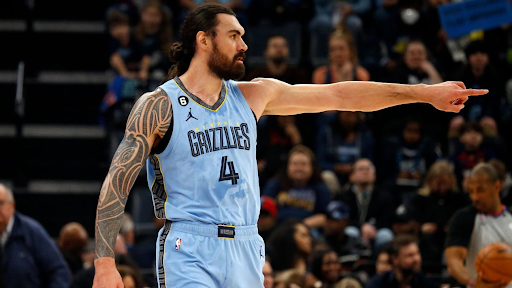
Steven Adams views the sport as more than a job. After Sid Adams died when his son was 13, basketball gave the teenager structure, supportive relationships and a renewed sense of direction. His story offers valuable basketball information about development beyond scores and trophies.
The Steven Adams NBA career took him from Rotorua to Pittsburgh and across several franchises, but his influence cannot be understood through points alone. Screening, rebounding, physical defense and selfless play turned him into a trusted center beside some of the league’s biggest stars. Players like Adams – consistent, physical and always present in the paint – are exactly the kind of performers that make following the NBA so compelling. For fans who want to go deeper into the game, understanding how to bet on NBA games adds another layer of engagement to every possession and pick-and-roll. LEON Bet App makes it easy to follow Adams and his teammates with live odds and in-game markets available throughout the season.
Losing His Father and Finding Direction Through Basketball
Adams was raised in Rotorua, New Zealand. His father was a former Royal Navy serviceman and an active sportsman. His mother, Lilika Ngauamo, was a nurse who died from cancer in 2000.
The loss of his father in 2007 left Adams without a stable parental figure. He has acknowledged that he lost his way for a period. His family recognized that he needed a different environment, dependable people and something constructive to pursue.
Basketball did not erase his grief. It gave his days a purpose. Training offered routine, measurable progress and a community that expected him to return.
The Family Support Behind His Recovery
His older siblings helped him find a better path. Among them was Valerie Adams, who became a two-time Olympic champion in the shot put. The family’s decision to intervene was as important as the sport itself.
American player and coach Kenny McFadden became a central mentor. Adams did not initially love the game, but he enjoyed physical training and followed McFadden’s instructions. Interest came gradually as he learned about positioning, strategy and tactics.
This distinction matters. Natural size opened a door, but consistent work allowed him to walk through it. His development was supported rather than accidental.
From New Zealand Basketball to Pittsburgh
The pathway from New Zealand basketball to the National Basketball Association is less direct than the traditional American route. Adams needed suitable coaching, competition and academic eligibility before NBA scouts could evaluate him.
Basketball NZ is the national governing body, while domestic teams operate within separate competitions. Adams played for the Wellington Saints in New Zealand’s NBL. He remained unpaid to preserve his eligibility for American college competition.
Wellington, College Eligibility and the United States
Adams attended Scots College before moving to the United States. After time at Notre Dame Preparatory School, he joined the University of Pittsburgh for the 2012–13 season.
The freshman started all 32 regular-season games. He averaged 7.2 points and 6.3 rebounds while shooting 57.1% from the field. He also earned Big East All-Rookie Team recognition and helped Pittsburgh reach the NCAA Tournament.
His route to the professional league had four defining stages:
- He developed physically and personally in Rotorua.
- McFadden introduced disciplined daily training in Wellington.
- The Wellington Saints provided experience against senior players.
- Pittsburgh gave him exposure to elite college competition and NBA scouts.
Adams entered the draft after one college season. His production was modest, but teams saw mobility, size, defensive potential and a willingness to perform difficult interior work.
NBA Draft 2013 and the Oklahoma City Thunder Years
The Oklahoma City Thunder selected Adams with the 12th pick of the NBA Draft 2013. He joined a contender rather than a rebuilding team, so his early responsibilities were narrow and demanding.
Steven Adams in the NBA quickly became known for absorbing contact, contesting possessions and creating space. He made the All-Rookie Second Team in 2014. His minutes and offensive involvement grew as his positioning improved.
Learning Beside Kevin Durant and Russell Westbrook
Kevin Durant gave Oklahoma City an elite scorer who needed room to operate. Adams supported him through screens, extra possessions and interior defense. Russell Westbrook benefited from hard picks that opened direct driving lanes.
Adams also gained significant NBA Playoffs experience during his early seasons. Postseason basketball exposed him to tighter rotations and more targeted tactical attacks. Later, Chris Paul brought a slower, highly controlled approach that highlighted the center’s timing in two-man actions.
The arrangement involved a clear compromise. Adams rarely controlled the ball or accumulated star-level scoring totals. In return, the team received a durable interior presence willing to improve other players’ possessions.
His Teams and the Logic Behind Each Trade
A trade does not always indicate declining value. NBA centers are moved because of contracts, timelines, injuries and tactical fit. Adams’ transfers reflected teams changing direction as much as individual performance.
| Period | Team | How He Arrived | Main Role and Context |
|---|---|---|---|
|
2012–13
College season at Pittsburgh before the NBA Draft
|
Pittsburgh |
College recruitment | Starting freshman and developing center |
|
2013–20
Seven seasons — his longest stint with one franchise
|
Oklahoma City |
12th draft pick | Screener, rebounder and playoff starter |
|
2020–21
One season with New Orleans after the OKC rebuild
|
New Orleans Pelicans |
Trade from OKC | Interior support for a young frontcourt |
|
2021–24
Three seasons as a veteran presence in Memphis
|
Memphis Grizzlies |
Offseason trade | Veteran starter and offensive-rebounding specialist |
|
From 2024
Current team — Houston Rockets
|
Houston Rockets |
Trade while recovering | Experienced depth, physical play and mentorship |
New Orleans, Memphis and the Partnership With Ja Morant
His season in New Orleans was brief. The roster already had young interior talent, and limited spacing created an imperfect offensive fit. A subsequent trade sent him to Memphis, where his strengths matched a fast, athletic team more naturally.
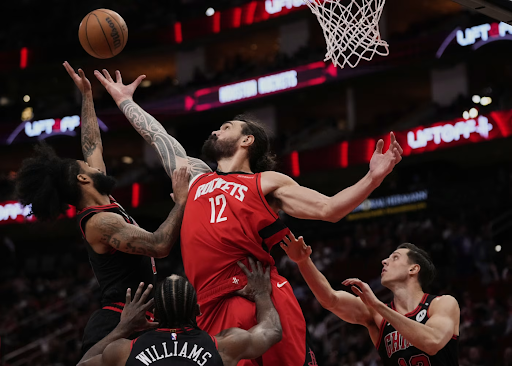
Ja Morant used Adams’ screens to attack the paint through the pick and roll. If defenders stopped the drive, Adams could pursue a missed shot or make a short pass. His willingness to box out also allowed quicker teammates to collect rebounds and begin transition attacks.
A serious right knee injury disrupted that partnership. Adams missed the 2023–24 season after surgery, showing the risk attached to a role built around repeated physical contact.
Houston and the Value of an Experienced Center
Houston acquired him while he was rehabilitating. Once available, the veteran offered lineup flexibility, toughness and guidance for younger frontcourt players. Managing his minutes remained important because availability could be more valuable than a heavy regular-season workload.
James Harden is strongly associated with Houston but was not Adams’ teammate there. Harden had also left Oklahoma City before the center was drafted. Treating them as former teammates would create a false career connection.
Steven Adams Stats and the Skills Behind His Impact
Statistical totals change after every appearance. The following profile uses listed physical measurements and the supplied source’s career averages across the stated 12-season sample.
| Category | Figure or Assessment |
|---|---|
1Position |
Center
Traditional paint-dominant center
|
2Height |
6 ft 11 in · 2.11 m |
3Listed weight |
~265 lb · 120 kg |
4Draft position |
12th overall · 2013
Selected by Oklahoma City Thunder
|
5Career scoring average |
9.7 pts / game |
6Career rebounding average |
8.0 reb / game
One of the best rebounders of his generation
|
7Career field-goal rate |
58.4%
Elite efficiency near the basket
|
8College averages |
7.2 pts · 6.3 reb |
9Core strengths |
Screens · Positioning · 2nd possessions
Consistently among the NBA’s best screeners
|
10Main limitations |
Shooting range · Free throw % |
Why Screening and Rebounding Matter
Screen setting is difficult to capture in a traditional box score. A legal, well-angled pick forces a defender to change direction. That brief delay can determine whether a guard reaches the rim.
Adams also creates possessions through anticipation rather than jumping alone. An effective box out removes an opponent from the ball’s likely path. His central skills include:
- Offensive rebounds: extending possessions after missed shots.
- Defensive rebounds: ending attacks before opponents receive another chance.
- Physical play: establishing legal position against large frontcourt opponents.
- Rim protection: using size and positioning without chasing every blocked shot.
- Short passing: finding cutters when defenses collapse near the paint.
This approach carries a price. Constant collisions increase fatigue and injury exposure. It also places Adams near the basket, limiting shooting range and reducing opportunities to produce high scoring totals.
Is He One of the NBA’s Best Centers?
Adams is not an all-around superstar. His main value comes from screening, physical defense and creating second chances. The Steven Adams rebounds data highlight that specialty. He led the NBA in total offensive rebounds in 2018–19 and 2021–22.
His box-outs also allow teammates to secure the ball and start fast breaks. On offense, his hard screens create driving lanes for guards without earning him a statistic. Limited shooting range and inconsistent free-throw accuracy reduce his scoring role. Still, at his best, Adams has been among the league’s most effective role-playing centers.
Contract, Salary and the Cost of Availability
Adams signed a four-year, $100 million extension with Oklahoma City in 2016, then among the largest deals for a center. After his trade to New Orleans in 2020, he added a two-year,$ 35 million extension. His most recent Steven Adams salary came from the deal he played out in Memphis and Houston, worth about $12.6 million in 2024–25.
In October 2025, Houston reportedly agreed to a new three-year, $39 million extension, an average of $13 million per season. The Steven Adams contract reflects a clear trade-off. He missed the entire 2023–24 season after knee surgery and played only limited minutes upon returning. Teams are paying for screening, rebounding and mentorship, while accepting the injury risk of a center past age 30.
Famous Teammates and Career Connections
Adams has played with several influential guards and forwards. Their different styles demonstrate why a low-usage center can remain useful across changing systems.
- Durant: received additional space and possessions from screens and rebounds.
- Westbrook: attacked openings created by forceful picks and quick handoffs.
- Paul: used timing and passing to organize controlled half-court actions.
- Morant: combined explosive drives with Adams’ interior positioning.
- Harden: represents a notable historical connection, but not a teammate relationship.
Steven Adams became a fan favorite without chasing celebrity status. His long hair, mustache and imposing frame earned him the nickname “Aquaman,” thanks to his resemblance to actor Jason Momoa. Adams usually responds to the comparison with the same dry humor that defines his interviews.
Strength, Humor, Gaming and Charity
Stories about his strength have circulated throughout the league. Jimmy Butler once called him “strong as hell,” while other opponents have described his screens as some of the hardest in basketball. Adams rarely adds to the mythology himself. He tends to answer praise with a shrug, a laugh or his familiar “mate.”
His interviews are especially popular when reporters expect controversy. After Draymond Green struck him below the belt during the 2016 playoffs, Adams calmly observed: “It’s happened twice in the last two games, mate.” He also recalled struggling to understand Kevin Garnett’s trash talk, joking that Garnett was speaking English but still sounded incomprehensible.
Away from the court, Adams enjoys video games and has discussed playing titles such as Dota 2. He also returns to New Zealand for youth camps, giving children access to coaching and organized competition. His 2018 autobiography, Steven Adams: My Life, My Fight, recounts his unconventional journey from Rotorua to the NBA.
Several details have helped shape his public image:
- “Mate” appears so often in his interviews that it has become an unofficial catchphrase.
- He usually redirects praise toward teammates instead of discussing personal statistics.
- His “Aquaman” appearance is among the NBA’s most recognizable looks.
- His deadpan delivery often makes ordinary postgame answers unexpectedly funny.
- His youth camps maintain a practical connection with communities across New Zealand.
FAQ
Did Adams Play for Melbourne or New Zealand’s Senior National Team?
He has no recorded club tenure with the Australian organization mentioned earlier. Despite his importance to his country’s sporting identity, he has not built an extensive record in New Zealand’s senior national side.
How Tall Is Steven Adams?
Adams is listed at 6 feet 11 inches (2.11 meters) and approximately 265 pounds (120 kilograms). His size, strength and positioning make him especially effective at setting screens, boxing out opponents and collecting offensive rebounds.
Where Did Steven Adams Play College Basketball?
Adams played one season for the University of Pittsburgh in 2012–13. He started all 32 regular-season games, averaging 7.2 points and 6.3 rebounds while shooting 57.1% from the field. He entered the 2013 NBA Draft after his freshman year.
Does Steven Adams Have a Famous Sister?
Yes. His half-sister, Dame Valerie Adams, is one of New Zealand’s greatest athletes. She won Olympic gold medals in the shot put in 2008 and 2012, as well as four outdoor world titles. The siblings are part of a large, highly athletic family raised by their father, Sid Adams.