
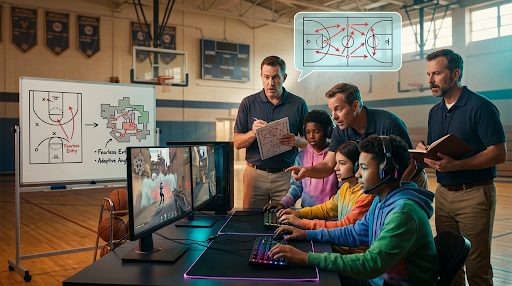
Walk into any gym during a competitive season and you will hear the same words over and over. Talk. Move. Trust your read. Own your spot. Those words are not basketball words. They are team words. They belong to any group of five people trying to beat another group of five people who want the same thing just as badly.
That is why tactical esports like Valorant feel so familiar to people who grew up in real sports. The court is a map. The ball is a spike. The scoreboard still does not care about your excuses. Here is the part worth a coach’s attention. The game your players load up every night runs on the same principles you drill in practice, which means it has plenty to teach you back, about them and about coaching itself. Let me show you the overlap.
Five Players, Five Jobs
Basketball runs on defined roles. Your point guard runs the show. Your center protects the rim. Your wings space the floor and knock down shots. Nobody wins by having five players who all want to do the same thing. Balance wins.
Valorant works the exact same way. A team of five carries defined roles, and each one covers a gap the others cannot. The duelist is your scorer, the aggressive one who takes the first fight and creates space. The controller is your big man, blocking sight lines with smoke so the team can move safely. The initiator is your playmaker, gathering information and setting up the opening. The sentinel is your lockdown defender, holding a flank so nobody sneaks in from behind.
Sound familiar? Ask a coach to explain a good defensive rotation and then ask a Valorant player to explain how their team covers a site. The language is different. The thinking is identical. Cover for your teammate. Rotate early. Do not leave a lane open.
Communication Is the Whole Game
Here is a hard truth every coach learns fast. Talent loses to communication. You can have the most gifted group in the league and still get run off the floor by a team that talks better, calls out screens, and trusts each other under pressure.
Tactical shooters expose this even faster because you cannot see the whole map at once. You depend on your teammates to tell you what they see. One player calls out an enemy position. Another confirms a rotation. A third asks for backup on the weak side. If that chatter stops, the round falls apart in seconds.
Good teams keep their calls short and clear. They do not panic-talk over each other. They pass information the way a point guard calls out a play, quick and clean so everyone can act on it. The best in-game leaders in Valorant do exactly what a floor general does in basketball. They read the situation, make the call, and keep their team calm when the pressure spikes.
If you want your young athletes to understand why you keep yelling about communication, hand them a headset. They will feel the cost of silence within one match.
Discipline Beats Highlight Reels
Every gym has that one player who wants the poster dunk every time down the floor. Coaches love the energy and hate the turnovers. Winning teams learn to slow down, run the set, and take the shot the defense gives them.
Valorant punishes the highlight hunter just as hard. A player who pushes forward alone for a flashy solo kill usually ends up dead with no backup, and now the team is playing four against five. The disciplined move is often the boring one. Hold your angle. Wait for the smoke. Trade the fight so your death is not wasted. Save your economy for a round you can actually win.
This is the part that surprises people who think esports is all reflexes. Reflexes matter, sure. But the top teams win with patience, structure, and clean execution under pressure. That is coaching. That is the stuff you drill in practice until it becomes instinct. The scoreboard rewards the team that makes fewer mistakes, not the team with the loudest individual moments.
The Ranked Grind Mirrors the Season
Basketball players understand the climb. You do not start as a starter. You earn minutes. You grind through the offseason, prove yourself in scrimmages, and work your way up the depth chart. Progress is slow and it is honest.
Valorant has a ranked ladder that feels just like that grind. You start low, you climb through the tiers, and every rank you reach reflects real games won against real opponents. It rewards consistency the same way a long season does. But the ladder shares one more thing with sports. Once you have outgrown a level, staying there stops teaching you anything. A varsity starter does not get better by scrimmaging the freshman team.
That is the real catch with the early climb. For someone who already thinks like a competitor, a coach, an athlete, anyone who has lived inside a team, the lowest ranks are not a test. They are a waiting room. The very lessons this article is about, spacing, communication, and discipline, only show up once the opponents are good enough to punish their absence. Some players would rather reach that level of competition without spending months in lobbies that no longer stretch them, which is why a valorant account for sale exists. Think of it like a transfer who arrives ready to contribute instead of repeating a season in the development league. The goal is not to dodge the work. It is to spend your reps where they actually make you better, against players who make you earn every round.
What Coaches Can Take From This
You do not need to love video games to see the value here. The habits that make a great basketball team make a great Valorant team, and the reverse is true too. Roles, communication, discipline, and the drive to keep testing yourself against real competition all carry over.
If you coach young athletes, this crossover is a gift. A kid who tunes out during a film session might light up when you frame a rotation as something they already do online every night. The strategy lives in both worlds. Use whichever door gets them to walk through it.
Competition is competition. Five players, one goal, and a scoreboard that keeps everyone honest. The court and the map are closer than they look.