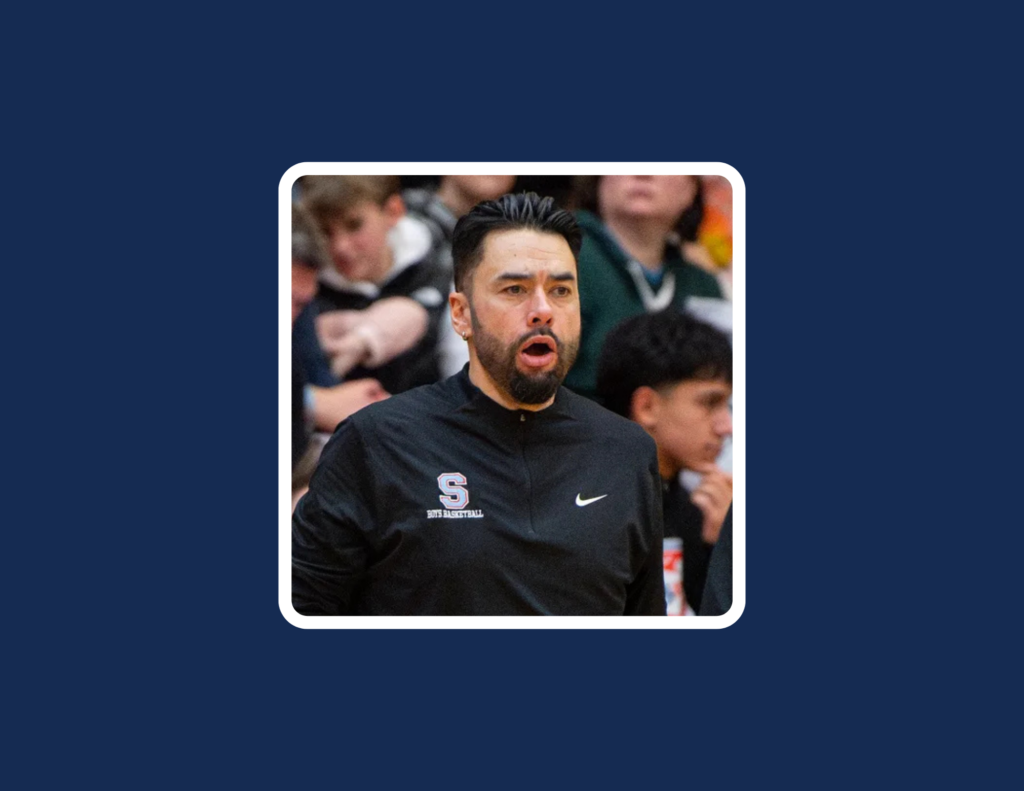
KIP IOANE – FOUNDER OF TEAMS OF MEN & BOYS’ BASKETBALL HEAD COACH AT SOUTH SALEM (OR) HIGH SCHOOL – EPISODE 1259

Website – https://www.teamsofmenmembership.group/
Email – teamsofmen@gmail.com
Twitter – @kipioane @teamsofmen
If you listen to and love the Hoop Heads Podcast, please consider giving us a small tip that will help in our quest to become the #1 basketball coaching podcast.
Kip Ioane just completed his second season as the Head Boys’ Basketball Coach at South Salem (OR) High School where he has led the Saxons to a 34-19 record . Ioane previously served as the head coach of the men’s basketball team at Willamette University in Salem, Oregon for 14 seasons and as an assistant for 8 seasons.
Ioane also attended Willamette as a student-athlete and played for the Bearcats from 1997-98 through 2000-01. He was a two-year captain who earned a total of four letters while playing at Willamette.
Ioane’s Teams Of Men Character Development program has garnered national recognition for its work in developing a healthy version of manhood with teams, coaches, and players around the country.
On this episode Mike and Kip discuss the transformative impact of the “Teams of Men” program on high school basketball coaching and player development. We explore how the integration of emotional fluency, vulnerability, and authentic relationships fosters a culture of trust among players, which, in turn, enhances their performance on the court. Kip shares the importance of creating a supportive environment where young men can engage in meaningful conversations about personal growth, thus challenging traditional notions of masculinity in sports. Throughout the discussion, we emphasize that prioritizing character development and emotional intelligence is not merely beneficial but essential for achieving sustained success in both athletics and life. By the episode’s conclusion, we aim to inspire coaches to embrace this holistic approach, recognizing that the foundation of winning extends beyond the scoreboard to the cultivation of resilient, well-rounded individuals.
Follow us on Twitter and Instagram @hoopheadspod for the latest updates on episodes, guests, and events from the Hoop Heads Pod.
Make sure you’re subscribed to the Hoop Heads Pod on iTunes or wherever you get your podcasts and while you’re there please leave us a 5 star rating and review. Your ratings help your friends and coaching colleagues find the show. If you really love what you’re hearing recommend the Hoop Heads Pod to someone and get them to join you as a part of Hoop Heads Nation.
Get ready to take some notes as you listen to this episode with Kip Ioane, Head Boys’ Basketball Coach at South Salem High School in the state of Oregon.
What We Discuss with Kip Ioane
- The importance of trust and vulnerability in coaching and their role in building a successful team culture
- Developing character and life skills is crucial
- The necessity for coaches to engage in meaningful conversations with their players about emotional well-being and personal growth
- How integrating life lessons into sports can enhance players’ commitment and performance during critical moments in games
- Winning should not be the only focus, but rather the growth and development of young men should also be prioritized
- A coach’s influence extends beyond the sport, shaping the players’ futures and their roles in society
- Integrating emotional fluency and vulnerability
- Implementing the ‘Teams of Men’ framework necessitates consistent communication and engagement with players and parents
- Fostering open dialogue about personal issues can lead to improved communication and trust within teams, ultimately benefiting their performance
- The necessity of intentionality in coaching practices, ensuring that relational skills are prioritized alongside technical training
Like this show? Please leave us a review here — even one sentence helps! Consider including your Twitter handle so we can thank you personally!

Your first impression is everything when applying for a new coaching job. A professional coaching portfolio is the tool that highlights your coaching achievements and philosophies and, most of all, helps separate you and your abilities from the other applicants.
The key to landing a new coaching job is to demonstrate to the hiring committee your attention to detail, level of preparedness, and your professionalism. Not only does a coaching portfolio allow you to exhibit these qualities, it also allows you to present your personal philosophies on coaching, leadership, and program development in an organized manner.
The Coaching Portfolio Guide is an instructional, membership-based website that helps you develop a personalized portfolio. Each section of the portfolio guide provides detailed instructions on how to organize your portfolio in a professional manner. The guide also provides sample documents for each section of your portfolio that you can copy, modify, and add to your personal portfolio.
Aiming to go D3? The D3 Recruiting Playbook gives you a clear, step-by-step roadmap to the recruiting process – what coaches value, key milestones from early high school through application season, and how to build a target list of schools that fit your needs.
We’ll demystify researching D3 programs and how to stand out without chasing every camp or showcase.
The modules cover things like writing emails to coaches, building an effective highlight tape, using social media well, planning ID camps and visits, and navigating application strategy.
You’ll get templates, checklists, and an outreach plan to communicate confidently, learn how to compare financial packages, and avoid common missteps. By the end, you’ll have a prioritized school list and a decision framework you can use to land your best-fit opportunity.

Give With Hoops is a groundbreaking initiative that fuses basketball analytics with modern sponsorship. Built for teams who see data as opportunity, from AAU programs to college powerhouses.
By tying on-court performance directly to community and sponsor engagement, Give With Hoops help programs raise more while deepening support from those who believe in the game.
Traditional fundraising disconnects donors from the action. Sell candy bars, wash cars, beg for donations, it’s exhausting and ineffective. Players perform better when their stats matter beyond the scoreboard. That’s why Give With Hoops was created.
Give With Hoops connects game performance to community support. Every basket, rebound, and assist becomes a chance to raise funds. Transparent, exciting, and proven to raise 3x more than traditional methods.
THANKS, KIP IOANE
If you enjoyed this episode with Kip Ioane let him know by clicking on the link below and thanking him via Twitter/X.
Click here to thank Kip Ioane via Twitter/X
Click here to let Mike & Jason know about your number one takeaway from this episode!
And if you want us to answer your questions on one of our upcoming weekly NBA episodes, drop us a line at mike@hoopheadspod.com.
TRANSCRIPT FOR KIP IOANE – FOUNDER OF TEAMS OF MEN & BOYS’ BASKETBALL HEAD COACH AT SOUTH SALEM (OR) HIGH SCHOOL – EPISODE 1259
[00:00:00] Narrator: The Hoop Heads Podcast is brought to you by Head Start Basketball.
[00:00:20] Kip Ioane: We’re winning a lot of games, and we haven’t cheated a single second of Teams of Men. We haven’t removed a single thing. If anything, we’re looking to add more. So I think that part has been really helpful and eye-opening for coaches to be like, “Okay, I think I’m a pretty good tactician,” or, “I think I ha- I have a good culture of hard work that I’ve instilled in these dudes.
This might be more important than a new out of bounds tree. It might be that we need more of this actual trust and vulnerability-building to take the next step.”
[00:00:50] Mike Klinzing: Kip Ioane just completed his second season as the head boys basketball coach at South Salem High School in the state of Oregon, where he has led the Saxons to a 34 and 19 record.
Ioane previously served as the head coach of the men’s basketball team at Willamette University in Salem, Oregon for 14 seasons, and as an assistant for eight seasons. Ion also attended Willamette as a student athlete and played for the Bearcats from 1997 through 2001. He was a two-year captain who earned a total of four letters while playing at Willamette.
Ioane’s Teams of Men character development program has garnered national recognition for its work in developing a healthy version of manhood with teams, coaches, and players around the country.
Give with Hoops is the first platform turning basketball analytics into fundraising impact. Every stat tells a story, and now every story drives sponsorship, engagement, and team growth. Programs nationwide are transforming basketball stats into funding power. Learn to use performance data to attract sponsors, engage fans, and raise more with every play.
Give with Hoops will help you raise three times more money for your program, as their stat-based pledges consistently outperform traditional fundraisers. Visit givewithhoops.com/hoop-heads-podcast to learn more and take your fundraising to the next level. Give with Hoops.
[00:02:17] Hannah Dewater: Hi, this is Hannah DeWater, head girls basketball coach at Union Mine High School, and you’re listening to the Hoop Heads podcast.
[00:02:27] Mike Klinzing: Are you or an athlete you know planning to go D3? Check out the D3 Recruiting Playbook from D3 Direct. Their playbook gives you a clear step-by-step roadmap to the recruiting process, what coaches value, key milestones from early high school through application season, and how to build a targeted list of schools that fit your needs.
The playbook demystifies researching D3 programs and how to stand out without chasing every camp or showcase. The modules cover things like writing emails to coaches- Building an effective highlight tape, using social media well, planning camps and visits, and navigating application strategy. You’ll get templates, checklists, and an outreach plan to communicate confidently, learn how to compare financial packages, and avoid common missteps.
By the end, you’ll have a prioritized school list and a decision framework you can use to land your best fit opportunity. Click on the link in the show notes to get your D3 Recruiting Playbook from D3 Direct.
Get ready to take some notes as you listen to this episode with Kip Ione, head boys basketball coach at South Salem High School in the state of Oregon. Hello, and welcome to the Hoop Heads Podcast. It’s Mike Klinzing here without my co-host Jason Sunkel tonight. But I am pleased to welcome back in for the third time Kip Ione, currently the head boys basketball coach at South Salem High School in the state of Oregon, and from Teams of Men.
Kip, welcome back, my man.
[00:03:59] Kip Ioane: Man, thanks, Mike. Hey, three times, you guys have to start having the Saturday Night Live four-time host sh- jackets. You guys have to start doing something. That, that- I am very honored. Thank you, sir …
[00:04:09] Mike Klinzing: that’s actually a good idea in that- … I have to come up with something because it’s funny, when I have somebody like you that’s been on multiple times, I always try to make a big deal about it, and I probably should go formally and figure out exactly how many times, who’s been on a real episode.
Rob Bros probably has the record because he and I have done our little- Yeah … triple double episodes, and he’s prob- I don’t know, I think we’ve done close to 20 of those. Yeah. So Rob’s probably the winner. But we got a lot of guys in that three, four range. So I have to start working on that and see if I can come up with something.
We need like
[00:04:38] Kip Ioane: a badge that certifies us- Yeah … as HoopHeadz O- OGs or something like that, right? I like that.
[00:04:44] Mike Klinzing: I like that idea a lot. All right. Kip, let’s start out by just giving people an update of kind of where you’re at in your career as far as coaching-wise. You’ve been at South Salem for two years, is that correct?
You got two years- Yep … under your belt. So just kind of give us- Yes, sir … an idea of how you ended up there, how things have been going, and then after we do that- Yeah … we’ll dive into more of the Teams of Men stuff.
[00:05:04] Kip Ioane: I appreciate you, sir, and it’s always fun to be able to brag about the Saxons. Most of the folks that have listened heard me before.
I previously spent 15 years as Division III head coach i- in Salem, Oregon, Willamette University. I was seven years assistant coach there, so 20-plus years at the D3 level. Had a year in between the college to high school transition. It just so happened timing-wise, where I was really focused on Teams of Men with no team my the high school here, South Salem High School, it’s the biggest school in Salem.
About 2,300 kids. The job came open and my son was going to be a senior at the time. My daughter was going to be a sophomore at the time, and it just made sense to Dad to want to be around them a little more, and also get back in the fray. As, as much as I, I believe in the Teams of Men stuff and helping other coaches to that vision- I’m a competitive dude that loves basketball as well.
So fortunate enough to be able to get the job here, credit to the administration, Tara Rom I, Brian Armstrong for trusting me with the program here, which has historically been a pretty good Oregon high school, li- largest classification 6A. It’s got two state titles in the rafters, so to speak.
And, we’re coming off a year where we went 21 and six, led the state in scoring. And the kids really get all the credit, right? Your kids and your staff, Mike, you know this as much as you’re… We can be the forward-facing person that has to yell and scream all day. The kids and the staff get all the credit for, making the vision a reality.
So I’ve been fortunate enough to– we’ve been in the postseason both years done a lot of up and down, high tempo, high octane, and really brought a lot of passion back to the gym. Like I mentioned, we had a good group of seniors that embraced this lunatic, weird new guy from D3 that was coaching high school, and it’s been fun, man.
And like you and I talked about, and we’ll get into, being able to d- deploy the basketball part alongside the Teams of Man that I’ve been on before to talk about at the high school level and have to do it myself, not just in theory to other high school coaches, whether it was basketball, but just experience the high school ecosystem myself was really transformational and really helpful in, I think, leveling up what Teams of Man is about.
[00:06:56] Mike Klinzing: Tell me a little bit about, in your mind, what are the biggest differences between being at the college level- Yeah … and being at the high school level? You don’t have to get into things you like or don’t like, but just what are the differences- Yeah … that you found?
[00:07:08] Kip Ioane: I think on the court, I really appreciate quarters, man.
Four quarters is such an improvement over two halves in my opinion. In, when I was at the D3 level, obviously the women’s game moved to quarters, and I always was kind of intrigued by it. I just think the ability to start and end quarters multiple times gives you more reps and pressure especially if you value those last two minutes like we all do.
That part was great. I think there’s an energy, it might be a naive energy with high school kids, right? And college kids are a little wiser, right? Especially in the ecosystem that is college now. There’s more things pulling at their focus, pulling at their buy-in, and high school kids are still… I’m fortunate enough here, there’s still a lot of we grew up together.
It’s still our block versus their block. And some of the buy-in here was really fun, right? And when I mention naive energy, some of that can go sideways and where Teams of Men comes in and all coaches have to bring them back focus-wise to what’s important. But, I think navigating three programs.
So in Oregon, you have freshman level, JV level, varsity level that’s different, right? Than high– than college. Even at D3, the years we would run a developmental JV team, it’s not the same as, oh, you got practice. We got three practices. You’ve got two different staffs underneath you that you need to make sure there’s synergy and find cohesion between the levels so they don’t feel siloed.
How do you build this family when there’s 40 kids? It’s not just 16 kids, right? So those things were all challenges Basketball-wise, and then I do think there’s a difference in how the kids arrive, like the bell schedule. “I’ve been here all damn day, coach, on this bell schedule.” Versus your college guys, your juniors and seniors, those dudes might not even have had class for two days coming to a practice.
So navigating all those new realities was challenging, right? You don’t know what you don’t know till you get in it. But I’m fortunate here my colleagues on the women’s basketball side, the volleyball team coaches, I have the head varsity football coach as one of my assistants, Josh Van Loo, and that synergy from multi-sport athletes has been phenomenal.
I wouldn’t want to do this any other way than having the football guy with me to get kids to do both, and also calendar and schedule together and try to avoid conflict. So I’ve been real lucky here, man.
[00:09:11] Mike Klinzing: Tell me about style of play. As you said- Yeah … leading the state in scoring. That- Yep … obviously requires an up-tempo style of play.
Yep. So how do you get your kids to buy into that? And then to go along with that question, then how do you implement that in a practice setting at the high school level? Yeah. What do you have to do to get kids, A, to buy into that, and B, to be able to play that style- Yep … the conditioning, just the drill work?
What does that look like- Yeah … to be able to play that style at the high school level?
[00:09:44] Kip Ioane: Yeah, man. Everybody wants to run till it’s time to run. Yep. Everybody says it’s, “Oh, hey,” everybody wants to play fast till you’re sweaty and tired. I think it starts with terminology. I think it starts with repetitive focus on the things that matter, and for us, that’s all out, all the time together, and that together we swarm, right?
That’s our mantra. We play a swarm system of basketball, and I do think you’re completely right. If you don’t… Your incoming freshmen, much less even your seventh, sixth, eighth, if you’re fortunate enough to have youth program, they’ve have to understand that we don’t do anything slow here.
Literally, we do nothing slow. And I’m going to honor, you’re going to be exhausted, but that’s why we’re legion. That’s why we play 12 deep. That’s why we play 10. And it, it does take repeated reps in that’s us. That particular thing that feels so weird, like we’re not going to outlet. Outlet slows us down.
Outlet can be stopped. You get a rebound, you’re gone. You’re bust out of dribble. All these things that are antithetical to how you’ve been taught. How you were taught was not wrong, but it doesn’t work for the swarm. And for the swarm, we all have to sacrifice. We’re, we, you’re doing everything from pre-practice circles about bees and sh- and fish swarming for protection, and bees swarming to, to attack.
Like, all those different nuanced things that we use as visualizations all the way through, “Hey, in practice today, we have to have all three programs together in the main gym on two side courts because we want the young kids to see what trapping rebounds looks like. We want the young kids to see the older guys, how we’re going to s- initiate off the bounce rather off an action.”
All those different little technical things that we try to do to speed it up. But you’re right I think there’s a part of it too that what gets measured gets done, and we have measurables that we want the k- and we share with the kids after every game, like this many possessions, this many set.
We don’t want to guard more than eight sets of an opponent’s system. They might score 60, 70 points, but we’re not guarding their stuff, because they… If we are, we’re not playing as fast as we want to go. Assist ra- all the different things. Coaches have different metrics they value, but ours are rooted in tempo.
Ours are rooted in pace and, we don’t have anybody in the program that’s over 6’4″ and a half. So if we don’t play fast, we’re going to get buried. So I think for us to get to where we’ve been with almost 40 wins in two years is really a testament to that buy-in from the kids that this unique style, this swarm, is the only way we can be successful together.
And the best part is we can actually feel it. I can feel my contribution as the ninth guy, because I trapped and fell down on a charge as the 11th guy. I went in there and took two threes before coach said, “That’s great. Come back out. It’s his turn. Go do the same thing.” All those things that, that you try to build into the culture and the climate.
[00:12:15] Mike Klinzing: Key to playing a system like that is you’ve have to get every single kid believing it, making sure that everyone’s on that same page, and that it’s a constant emphasis. I think it’s really easy for coaches to talk about, “Hey, we’ve have to play fast,” and then there’s possessions or multiple possessions or a practice or multiple practices where that goes away because, hey, we have to work on this other aspect of the game, or we’re doing this.
And then all of a sudden, that emphasis on playing fast, instead of being 100% committed, teams are 70% committed. And I’m not telling you anything that you don’t know, but if you’re 70% committed to playing, as you termed it, swarm basketball, you might as well be 0% committed.
[00:13:04] Kip Ioane: You’re… I think you’re… that’s spot on because the kids will sniff out inauthenticity.
They’ll sniff out that you claim fast, but then we just stood here for 12 minutes in practice and ran a set to 64 times, right? They’ll sniff out that you don’t really, when it gets in the crunch time, when it gets tough, you don’t really want to be fast, Coach. Suddenly you’re calling everything or you’re slowing us down.
Like we even– I would put up, I think we can validate a lot of s- a lot of learning with visuals, right? In, in 2026. So we put up mo- moments where I had my hands up like this, which is a no-no. We don’t slow down nothing, but I did it. And then you put that up as an example. Look at Coach. Why did I fail on swarm, right?
What am I doing? We don’t slow down nothing. Mike, it goes all the way through with something we’re going to do next year is we’re going to hand out to parents because I… And I know in your pod, I’m sure everybody’s talked about parents, whether it’s good, bad, or in between, and we’ll get into some of the stuff we want to talk about later.
But I got a lot of parents that really want to support their kids, right? And they’re going to be loud. I grew up with a mother that got three technicals in the stands. There was no shutting her up, right? But what we’re going to try to do is give our verbiage to our parents “Hey, you’re going to be loud.
Here’s what I’d love you to try to transition from saying get back-” We don’t get back for nothing. We trap rebounds, right? So you can say that or set it up. We don’t set up nothing, right? We get to our spacing, right? We get to our tree. You can say that. Find your man. We switch everything. We don’t give them mem, m- men, ma’am.
We switch it all, right? So find the first threat. So trying to help meet parents where they want to be supportive, but let’s also infuse some of that swarm language so it’s everywhere. So the ecosystem is we only know this. Like it’s weird for people to run traditional basketball in our gym. We don’t even know what to do with that.
Once again, not that it’s wrong, it’s just not what we do.
[00:14:47] Mike Klinzing: So let me ask you about the verbiage, and we’ll get into this too when we talk about teams of men. I know it’s something that you and I talked about- Yep … yesterday on our call before the podcast, but let me ask you about it in this context where you’re talking about, hey, now we’re going to start to involve the parents and having them understand the language that we’re using with the kids during practice.
How do you make sure that the kids know that language? Obviously, you’re repeating it day after day. Yeah. I’ve talked to some coaches, Kip, who have put together like the program dictionary, right? That has all those things. Yeah. Yeah. And then they pass that out physically on a piece of paper that the kids carry around with them or whatever it may be.
Yeah. So how do you take the language of what you want to coach and make sure that your kids understand that vocaba-vocabulary? Yeah Is that just a daily repeat that they’re hearing from you all the time? Or is it a more- Yeah … formal “Hey, here’s a handout with all these different things that you can refer- Yeah
back to when I’m talking or after practice- Yeah … or whatever?”
[00:15:47] Kip Ioane: I think you’re speaking to four ways people… You try to break mind wandering, right? And I might have talked to you about this or you’ve had other guests. It’s from the language of coaching, right? And they talk about to break fo- people– to bring people back to focus.
We use repetition a lot, which is a thing, right? We’re going to say, with the way we move around dribble drive, we call it wheels and locks. So they’re going to hear wheels non-stop. But eventually, repetition wears out, right? Eventually, repetition becomes “I’m so sick of you saying that word, coach. I might intentionally forget this because I don’t want to hear your ass anymore.”
So you s- you use repetition a little bit. Intensity is a thing, so I might say it louder. We might go to our coach voice about wheels and locks. But then the two that really move the needle and stay fresh, especially for the age groups we’re talking about, right? Say it’s fourteen to eighteen or eighteen to twenty two, you want to go novelty and context.
So what’s new ways we can get to wheels, whether that’s in a segment on the floor, coach wore a wheel shirt, coach put wheel graphics on the film Right? He changed the color of wheels from blue because we’re blue and red, to now it’s red and it’s blinking. And then context, like where does this help you get a bucket?
Where does wheels and locks matter to you? So it’s really all four of those things. And I think what you mentioned with coaches and the handouts, that’s absolutely we would try that. I just wouldn’t do handouts in 2026 because I don’t want to be furious when I see them on the floor of the team room because they don’t go home, right?
But I definitely would deliver that graphic. I definitely would text that to the team thread. I definitely would have that in and out of the film. As I’ve gone to our defenses are all Batman villains, Joker, Freeze, Bane. So if we have a clip up of a Joker fail, it’s going to be a big-ass comic book Joker right next to that clip, and that might move four kids, right?
And the other five, they move by the video, and the other three are moved because I said their name. So I think as a coach, we’re always trying to hit as many of those four strategies as possible to get them to focus. because otherwise they’re just, they’re out there doing what they do with their eye rolls.
So at that’s what we’ve really tried to infuse, and I’m cr- I’m lucky I got a great staff. One of my coaches played for me at Willamette, Kyle McNally. He’s got a great feel for Kip language, but also Kip, we have to… “I know what you’re saying, Coach, but as a former player of yours, that’s getting lost in translation.
Let’s try this,” right? And then I think football, once again I talk about Van Loo, but that football, football’s used to this with more bodies and more diagrams and sets the kids got. So football color codes priorities on their reads, right? Why aren’t we doing that? If we’re reading something A to B versus a rotating low hole, why aren’t we color coded, right?
So just some of these ideas from across sport that I think can really help us try to meet the 21st century athlete, because they do want to learn, too. They I think they get a bad rap sometimes. No, they’re not that different than us. They just have different inputs that they’re used to. I would’ve been totally fine with Coach giving me a handout.
I would’ve been expecting that. But now he’s “What is this? I don’t get a handout, Coach. What is this?” “You want me to do what with this? Send it to my phone, man.”
[00:18:43] Mike Klinzing: I love the idea of putting, again, just thinking about your Batman reference and having the villains- Yep … and being able to flash that onto the film.
And now again, it’s just a quick visual, right? It doesn’t take very long- Yep … for them to see that, and all of a sudden they’re dialed back into, “Okay, now we’re going to see- Yep … Joker, or now we’re going to see Penguin,” or whatever it might be. Yep. Yep. That you put that in front of them in a way that-
[00:19:03] Kip Ioane: And I think it trains their lens, sorry to cut you off, it trains their lens in the game even.
I think you know as a coach, you can self-check this, you know as a coach that you’re getting through to them when they start coming up to you like, “Coach, that was a lock right there, huh?” Or, “Coach, that… Oh man, he, that should’ve been a taco right there.” They start seeing your verbiage in the setting that it’s appropriate, then you’re like, “Oh, we got a chance.
We got a real chance to really have this be the truth that we live to.” And I, mean, as coaches, that’s all we can ask.
[00:19:34] Mike Klinzing: Absolutely. All right, let’s talk a little bit about- The teams of men stuff that you and I got into a little bit- Yep … in our pre-podcast call. And since we’re talking about language, let’s dive right into that part of the conversation.
Yep. And think about how the language that we use, how that can impact the young men that you get a chance to, that you get a chance to interact with. Just give us- Yeah … a thought process of how you think about the language and how that can impact the youth that you’re working with, hopefully positively- Yeah
which is the direction that you’re trying to go, but conversely- Yeah … if you’re not doing some of these things, how it could adversely affect somebody.
[00:20:14] Kip Ioane: Yeah. No, and I appreciate you so much, man, because you’re one of the original places that we could platform the vision of what we think coaching should be about, and that’s, transform-transformational experiences for young men.
Not… Even if they can’t make layups, even if they can’t score touchdowns, they go into your program, and they find a new version of themselves that’s rooted in emotional fluency, high integrity, authenticity all those things that I think coaches do care about, but gets lost when we’re, we’re worried about high te- up-up-tempo, right?
But I think it starts with words matter. I think that’s one of the core principles that we try to i-infuse, not just in my program myself, but a- anybody we help. We really have to be cognizant in the details, right? W- any-anybody installing an offense, installing a scheme is going to be yelling at their kids some version of details matter.
The words you use and the tone you use and the way you address people, that’s a detail. And so just a quick example. We used to say in our offense, we want to initiate attacking the basket from a corner isolation. We’d call it corner kill. When I was in college, we called it corner kill.
This person is a corner kill. We’d call him a Kuzma. Kyle Kuzma can’t guard nobody, so we’d say, “We’re going to corner kill. This is, these are the three Kuzmas we corner kill.” And I really started to self-reflect, mirror train. Man, you’re the guy that’s trying to get these kids to be emotionally fluid and not choose violence when they’re in the midst of em- experiencing certain emotions.
So y- but you can’t have violence-infused language then everywhere. So we changed it to, “Guys, here’s why coach is changing corner kills to corner Brunsons. You guys watch Jalen Brunson? He cooks one-on-one. So when you get a corner Brunson, we want you to cook one-on-one.” “But that, coach, why are we do, why are we changing?”
That leads into the conversation and the presentation of words matter. I forever, all of us have the little lines across our courts that somehow magically jump up and tackle our players at the worst possible times, and they fall down. They trip on their own feet. I used to yell sniper out in gyms I was coaching, and everybody would laugh, and I thought it was hilarious.
I was playing too much Call of Duty as a 35-year-old man, right? But then I thought to myself that’s violence-infused language.” So we changed it to timber. The same thing, we’re still going to laugh. We want to have humor. Hopefully we’re not embarrassing this poor kid too many times. If he’s having a lot of timbers, we better get some skill development on our agility Mike?
But we change it to timber, and once again, the guy’s “Ah, Coach, I know why you’re saying that. Guns, right?” Yes, we’re trying to go away from that. So just those types of little I don’t want to call them tricks of the trade more like intentional adjustments that are bathed in the idea that if I’m a transformational coach, maybe he’ll remember this.
He’ll eventually won’t be able to run or do a crossover to a two-foot stop. He’s going to be too damn old for that. But he might always remember, “Man, my coach changed from corner kill to Brunson,” because that matters. We don’t want to, we don’t want to swim in violence-infused language our whole life.
[00:22:54] Mike Klinzing: Makes total sense, right?
I think when you just think about, again, if you can make a small tweak that can just change someone’s perspective and take one thing out of their mind and put something else more positive in, to me, there’s no downside to that whatsoever. And then that leads- Yep … into sort of the overarching question or situation that you presented to me when we got together and talked about coming on this episode, and that is that there’s always, I think, been a disconnect with coaches in terms of, hey, some of the things that Kip’s talking about with teams of men, or some of the things that we think about Phil Jackson and Zen and the- Yeah
those things that we might consider soft skills or things that are not- Yep … tangible basketball things. There’s a lot of coaches that will push back on that and say that doesn’t help us win, and in some ways it takes away from us winning because instead of spending time on the floor with my team teaching my pressure defense or running through my offensive sets, instead I’m taking this time to do X, Y, or Z and talk with my players about things that may or may not be directly related to their performance on the basketball court.”
And I think what you’re seeing, and what many coaches have seen, is that there is a connection between the two. Yeah. And in fact, it’s not negative. It’s actually positive on the- Yeah … outcomes that you’re trying to get as a coach as far as winning games. And then we’ll also dive into just the personal benefit to the players- Yep
who are involved a- and get through a- and participate in what you guys are doing with teams of men. So just take the overarching- Yeah … picture and then we’ll dive further into the details.
[00:24:44] Kip Ioane: Yeah. No, I have to bring you on the road with me, clearly, to help sell this stuff, right? But no, I think what you’re mentioning is it is an additive, right?
It’s not a subtractive. So really not just my curriculum as much as I believe in it and have repped it, but just the overarching idea that if I got into this business to help move young men to better, and I feel like sport is my medium for that, then this is the only way to coach, right? Because I think we would all say teams that trust win more, right?
Teams that are connected and have authentic relationships Are more likely to succeed when it’s stress, when it’s, when th- when those connections and the bonds of our team get tested by the biggest moments in our season. If there is trust and authenticity and connection, then they’re more likely to win.
And I think that only comes from the skills we talk about in Teams of Men, emotional fluency, vulnerability, curiosity. All those things lead us to not just the quality human I think we all got in this business to help produce, but it does help you win. And I think for– I’m so fortunate you, you brought me back on this platform this timing.
For a long time, I had to remove myself from being able to prove the scoreboard part with what, how my record was in college. I think we did the Teams of Men and the off-the-court stuff to the best anybody can possibly do, but we didn’t have the success to validate what some coaches need.
And I understand in 2026 at the D1 level, the professional level, you have to win or your ass is gone. I get it. But having done this the last two years, completely infused the program, and had the level of success, and I recognize I’m– we’re not coaching the Lakers versus the Thunder, but it’s still a high level of basketball where people give a damn, and we’re winning a lot of games, and we haven’t cheated a single second of Teams of Men.
We haven’t removed a single thing. If m- if anything, we’re looking to add more. So I think that part has hopefully not, it’s not a brag about me, it’s a brag about the work does not take away from your competitive passion, which we all have or we wouldn’t be in the sport, right? So I think that part has been really helpful and eye-opening for coaches to be like, “Okay, I think I’m a pretty good tactician,” or, “I think I ha- I have a good culture of hard work that I’ve instilled in these dudes.
This might be more important than a new out of bounds tree. It might be that we need more of this ac- actual trust and vulnerability building to take the next step.”
[00:27:04] Mike Klinzing: I think it’s 100% right, and I think that there is always the challenge of people who see it a different way. Especially- Yeah … people who are old guys like me who grew up in a certain style of coaching, right?
The way that I- Yeah … was coached in many instances was not my coach coming and talking to me and putting his arm around me or not having- Yeah … a direct conversation about something outside of the sport. It was, “Hey, this is what we need you to do on the floor. This is just the way it is.” And so I think there’s that resistance from that older generation.
Yeah. And then I think it goes back to, and I want to dive into some discussion a little bit with the parents and one of the statistics that you sent me- … that I found to be pretty interesting. Not surprising in any way, but certainly interesting. And I know that- When I was coaching my son and my daughter’s team when they were in elementary school, right?
I used to do this thing that I stole from the Positive Coaching Alliance, a lot of it, and then I added some of my own stuff. And- Yep … I gave every kid a three-ring binder. Again, old school, not on the phones- Yeah … but we had the actual three-ring binder and a piece of paper and pencils and whatever, and we would go through, and there were some activities that the kids would do.
And a lot of times we’d take, again, we might have two practices a week, and we’d take maybe 15 minutes before practice if we had a cafeteria outside- Yep … the gym, or maybe we’d take 10 minutes on the court if we didn’t have access to another space. And I would get some pushback and from parents, right?
Saying, “Hey, you only got- Yeah … an hour and a half of practice time to work on basketball. Why are you taking some of the time to go through and talk about what it means to be resilient or what it means to be a good teammate and having the kid…” W- I don’t see the val- Yeah … people didn’t see the value- in that, right? Because so many people just want that result that you talked about. They just want to see- Yeah … on the scoreboard. That’s all they care about, and they don’t see the connection that we- Yeah … talked about, that these things do help you win. They do help you- Yeah … to be more successful on the ultimate scoreboard, r- right?
And when we’re keeping track, but they also help you in so many other ways beyond the scoreboard. But there’s such a… I always feel like there’s a, there’s an education gap- Yeah … on all the constituencies that you have to talk to. And so the stat that you- Yeah … shared with me is that 5% of the kids in this survey from from Aspen, right?
Said that the- Yep … Aspen Institute said that they had never experienced negative parenting around their sport, and then you flipped it around and said yeah, 5% have not. Guess what? That means 95%- Yeah … have.” So how do you, when you come into, again, a high school program- Yep … how do you sell it to the parents?
Yeah And what are the feed- what’s the feedback that you’ve gotten from parents and players thus far- Yeah … in the two years that you’ve been doing this? What do people like about it? Have you had any pushback? Have you had one of those conversations with somebody who’s like- … “Eh, yeah, I don’t know, I don’t know about this”?
Yeah. Just where are you at- Yeah … with that piece of it?
[00:30:12] Kip Ioane: Yeah. No, I really appreciate you sharing that story, where you mentioned people asking you, “Why are you wasting time on this?” because I’ve gotten that question, whether it’s an email and then I, I offer to meet some dads at a Star- at Starbucks and say, “Hey, I would love to talk to you about your hesitations and your reservations.”
I think there’s an alignment, there’s a lack of vision of the alignment between exactly what you talked about, resilience, accountability, all these skills that are presented in man box teachings as soft skills. In sports, we can’t be soft or we’re going to lose, when really they’re not soft skills, they’re connected skills.
If you’re accountable, emotionally fluent, you’re more likely, and vulnerable and trusting, you’re more likely to listen and c-connect with a teammate that needs your help to be better, or listen and deploy what the coach asks because you trust him. And sooner ra- we don’t need 30 minutes in shell. We need 12.
We already bought in. We already know what we’re doing, right? So w- that some of that stuff you mentioned really had me thinking of all the conversations I have had to dispel some of the worry that it’s it exists as an anti rather than an add, right? And then I think some positives we’ve had, whether it’s my own two years in high school or the partner programs we’ve worked with across the country, notification letters in the summer to potential parents and/or notification letters after you make your teams after cuts.
This is going to be a repetitive in an intentional calendared thing that happens every two weeks in this program. For freshmen, maybe it’s every three weeks or every month. Just it kind of depends on what level you’re at. And these are the topics. This will never affect your son. Attendance to these things won’t affect your son’s playing time, but failure to live to these ideals absolutely will.
And failure to live to so many ideals that I think every program in the country would put up on a board as their most non-negotiable, the kid violates those, you don’t have it. Whether it’s a suspension or he’s gone, you don’t have it. That affects winning, right? So even if it was your buy-in to this was surface level availability of my guys, and I want to be risk avert, or I want to be risk deploy some risk aversion for them off the floor, then you should deploy, you should buy into some of these skill sets and these trainings and these teachings to keep his butt with you and in a uniform at the very bare minimum, right?
But I think like we’ve mentioned so many other times, once parents understand that you, the alignment you have with them is the benefit and the growth of their son. The alignment you cannot have with them is the playing time and the shine of the player. You are in it our program core model is growth is the goal.
And if growth is the goal, then there’s no such thing as failure. It’s all information. Whether that be in playing time, shooting percentage, wins, losses, all those things. But I think that’s where I’ve been fortunate enough, and I give a lot of credit to the community here at South Salem. They’ve a lo- for the most part, been really receptive to thank you for the information up front, and I send it as well to my administration, the principal and the athletic director, so they know what is going to happen in case a parent does.
We know parents love to go over your head to somebody they feel can contain you, whatever it is you’re doing. But I give them the, “Hey, here’s the goals of the teams and men this year with the basketball program.” I think it aligns pretty well with what the school stated is the school’s mission statement or the school’s core focus point.
Whatever your district or admin is doing that particular year, then you’re all aligned towards we’re moving young men to better. These just happen to be the tools and the convos that we’re doing. And I tell you what, Mike, was another great thing this year, that the m- after your first year of teams and men where it really does have to be kind of coach-focused deployment You start getting upperclassmen that are versed in your stuff, upperclassmen that have lived your model, now you give them the floor and you say, “Hey, I got…”
This year, we had seven seniors, so we had groups of two and a group of three. “You guys have Teams of Men on locker room consent. What does the boundaries in the locker room look like about our stuff? You two have it. You two have words matter in our program. Why aren’t we allowed to say certain words?
Why are there consequences for certain words? You two have that with the freshmen. You three, you have this with the freshmen, harm versus account versus restorative justice. You have that convo.” And it’s really hard then for a parent to say Kip, you’re preaching this, or you’re doing all this.” Actually player-run program.
The players have set the standard that this is how they want each other to exist with one another. So I think those, I don’t want to call them tricks, it’s just like the evolution of getting to a place where we recognize we’re all pushing for better versions of our sons, basketball be damned. But if they take on these traits, I think the basketball player can’t help but get better, right?
[00:34:40] Mike Klinzing: Exactly. All right. So for people that maybe didn’t listen to either of your other two episodes, which if you haven’t- Yeah … please go back and listen to those. But just to give people a little bit of a background and idea of- Yeah … how do you institute the Teams of Men program? What does that- Yeah … look like on the ground day to day in the- Yeah
program for somebody who’s trying to understand, okay, I kind of what these two guys are talking about, but I don’t really understand how this can get implemented into what I’m already doing. So just kind of give people the- … bare bones idea- Yeah … of how you implement the
[00:35:13] Kip Ioane: program. No, I love it. And I appreciate what you mentioned earlier because I think it ties in here.
When you said, “I made it my own. I had stuff from X, Y, Z, and then after I got comfortable with what kind of it was talking about, I made it fit me.” That’s really what we’ve evolved to at Teams of Men is licensed tiers. So there’s various license. A license might be just for a single coach that wants to upload and learn more about, hey, what is it that’s really facing young men in 2026?
What are some pain points? What are some things that we’re seeing? And that’s a very basic, we’re just going to help you learn. You don’t have to do nothing with your guys. You just have to help yourself eva- evaluate where you want to be. Second level would be, oh, your team is ready. You would like to have some rollout, some curriculum, some 10 to 12 minute sessions that you want to do with your team.
Maybe that’s three times this year, maybe that’s five times this year, all the way through where we have whole schools, whole athletic departments that every team is running and evolving with Teams of Men lesson plan. And really what it looks like, Mike, is we’re having conversation. We’re creating space for open dialogue about topics that matter, right?
And I think those topics that matter is really where a coach, they can really embrace some agency. What is it that I’m seeing? Like you and I connected about this Aspen Institute. What is it that I’m seeing or the world’s providing my men, my team, the guys on my team that is really some problems They’re either behavior-inducing problems or the reactions, and my guys are wearing this stuff, and they’re showing up in just these either emotional outbursts of super high, super low, super angry.
Where’s all this coming from? And then we’re– if we can address those, we reduce the amount of behaviors where our guys are causing harm with their words and their bodies. And that’s really always been the theory of we could say no. Please be nice,” or we could really dive into what they think they have to do to be a man in twenty twenty six, and that’s where we find the man box.
That’s where we find these rigid ideals that men are trying to live to and really get policed and executed in team spaces if we’re not careful. And when they’re trying to be something they’re not is when they do stupid stuff that all of us would say, “What the hell? That’s not you.” Imagine how many times you’ve had coaches in your life or yourself as a coach say, “That’s not him.
What the heck was that?” That’s him performing because he wanted to score man points today. And so that’s what we try to break kids free from, break coaches from, break programs from.
[00:37:28] Mike Klinzing: Really well said, and I think it gives people an idea of what it is that you do with teams of men. And I think what’s interesting is hearing you say that last little bit there, is that some of those statistics that you sent me from the Aspen Institute talked about how kids say that sports improves their mental state.
It improves their social connectedness. It helps them to better control their emotions. And those are reasons why kids want to play sports, right? In some ways- Yep …it can be an outlet. It can be a place for them to be connected. It’s a place where they have friends, whether you’re in high school or you think about your program at Willamette, right?
And your guys- Yep …the connectedness that your guys had on the campus. It’s a group of people that you can go to. It’s a group of friends that you’re probably going to be connected for the rest of your life with those guys because the intensity of what it means to go through a, particularly a college basketball season, just the length of it and the intensity and everything- Yeah …that goes along with it.
But I think what’s interesting here is that, as you said, there’s, if you look around the world, right? And you think about what we see every day on social media, and you think about how much the mental state of people in general, but certainly athletes- and the way that they’re trying to handle the pressures and the stresses in their life.
And if we can somehow utilize, and you said it earlier, utilize the sport of basketball to be able to have an impact on the people that we’re interacting with day in and day out, whether that be our players, our staff, people around the program- Yeah …whatever it may be. If we can utilize that to have a positive impact on them from that social connected piece, that mental state, it, if we can be the kind of coach that provides that type of haven, for lack of a better way of saying it- …then we’re really doing something.
And again, I think- We have to understand that by giving kids that kind of space to connect with each other and to connect with themselves, right? Sometimes– I say this all the time, and I don’t know how you feel about this, Kip, but I had this conversation with my son when we were driving back from college a week or two ago, and just saying, “It feels like a lot of times during your day that I have so many tasks that I’m trying to do.”
And dude, I’m retired now, man. Like I, I should have, I should have more ti- I should have more time than any human being alive. And yet at the same time like there are days where I go through and I rarely have time to stop and just think for 30 seconds about- Yeah … okay, what am I going to do?
Or like I, I have a little journaling thing that I try, I try to do every day. That’s awesome. And to find like- Yeah … but to find five minutes sometimes to do that- Yeah … I’m like, I- I’m like, “I don’t know, man. I have to get this done instead of…” Yeah. And so I guess my point here is that what you’re doing is you’re giving kids a space to be able to connect with themselves and connect with others, and that’s where I think there’s just tremendous value in that for the kids as human beings.
But then you think about how it bonds them as a team and as teammates- Yep … and that’s where you get the exponential benefit of this helps us to win games.
[00:40:40] Kip Ioane: Yes. It’s c- so many things came up because y- you were spitting fire there. I love it. First of all, and I think a lot of listeners especially if they’re male coaches, you’ve heard of third space.
Where in your life is your third space? Your one first space is home, second space is your job. Where’s your third space? because your third space and a lack thereof can really define your mental health, your emotional health. For our players, our third space, hopefully from school and home, is our team room.
It’s the court, it’s the field with their boys. So what does that third space look like? And you said a great thing. You said haven. And I think a lot of the older generation of coaches, indoor coaches that really respect who they were coached by, and maybe they were coached by a grit and grind mother, F-bomb dude.
What w- when you– they hear haven, they think you are going to let kids get away with nonsense, when really what we’re saying is this third space haven is where they know they’re going to get pushed to better and loved while doing it. W- right? And I think that’s one of the things we’ve tried to address better with coaches is this is not a soft landing space where a chi- a kid isn’t forced to grow.
He’s asked to grow daily. He’s asked to look at himself in the mirror every single day. So are you, Coach. That’s what we’re saying. We’re doing this alongside them. And I think w- from we, we mentioned the Aspen study. The studies point out that the top two things kids said in their survey, on a scale of five, would be like, “This is what I want out of sport.”
A four point six nine score was, “Teach me life skills. Develop me life skills.” It didn’t say, “Help me win.” Win got three point nine. But I think kids are much more likely to want to work and sacrifice for your vision, the program’s vision, if they feel valued and seen as the human being they are, and then part of that group that you just mentioned, right?
Ev- coaches love to talk about leadership and culture. I can lead teams through a sweaty workout, great leadership and culture. But if that kid, the climate, the kid feels invisible, he will not lay down his body for us when we need him to take a charge, to box out, to make that tackle on third down, if he is invisible or feels unvalued.
And that’s in life too, right? You don’t get the buy-in and the stuff we need to have successful friendships and social groups. So I think all this is we’re building that third space where a kid can feel like, “You know what? I really like going there. It’s hard sometimes, but I think everybody else there feels it’s really hard with me, and we’re doing it together.”
And that’s what we’re trying to ask guys to do, to take it from running 16s to, yeah, that’s part of it, but that’s not… And maybe they’re running 16s because they said one of the worst things you’ve ever heard, and now they’re going to get lessons from it. because I think some of the time too, and then I’ll be quiet on my tangent, they, like some of this is Coach, you have to interrupt some of this.
You have to use that whistle, not just when he travels or when he has a turnover. You have to interrupt when they cosign and laugh at a joke using the R word about a special needs kid. You have to learn how to interrupt things that you haven’t interrupted. You always do it for pass interference. You always do it for, we took a bad swing on the big at bat.
You have to interrupt other nonsense, and then tell them why you’re starting to interrupt that now.
[00:43:46] Mike Klinzing: That’s a great point there, too, is we oftentimes we, we recognize and want to correct technical mistakes. Yep. And sometimes we let things go that we’re like, “Eh, do I really want to step in there,” right? Say, “Eh, because I don’t
[00:44:01] Kip Ioane: want that awkward interact- Yes, absolutely. We’ve all been there.
[00:44:05] Mike Klinzing: And let’s face it, there’s a lot of us, and I will admit myself included at times, you hear something and you’re just like, “Eh, it’s no big, it’s no big, it’s no big deal. It’s no big deal.” Yeah. And it’s easy to just turn and walk away, “Hey, I only heard it once,” or, “Hey, that thing only happened one time.”
But the reality is probably if you’ve heard it once, it’s probably happened more times- Yeah … outside of your earshot or outside of your purview. Exactly.
[00:44:33] Kip Ioane: Thank you for saying that. because what’s happening, if they’re willing to say some of this stuff or do some of this stuff in front of us- Yes … my goodness, what are they doing when there’s four of them together in a car on Friday night and they’re bored?
Yep. No, that’s spot on.
[00:44:47] Mike Klinzing: Yeah, I think that’s something that, again, it’s easy to overlook. And I think your point about a difficult or awkward conversation is always something that I think young coaches especially, and I know for myself even as a young coach, as a young teacher that there are things that you don’t want to have that confrontational conversation, right?
Yeah. You don’t want to have that discussion of, “Hey, your kid said X or your kid did X.” It’s much easier to just be like, maybe tell the kid, “Hey, don’t do that again,” and then you don’t- Yeah … have a conversation with their family- … or you don’t have a cons- conversation with the entire team, or what you don’t explain the what or the why behind it, and I think that’s always something that- again, as we get more experience and get older, I think people generally speaking, get better at those kinds of conversations and better at understanding. A lot of times we become parents ourselves- Yeah … and then we start- Yeah … to realize that if that was my kid that was saying- Yeah … or doing that thing, would I turn the other way and just ignore that, or would I immediately address it?
And the answer 99.9% of the time is if that’s my own kid, I’m addressing that. And so- Yeah … once you become a parent and you’re also a coach, I think you have a different perspective on what that looks like in terms of the relationship that you want for your players with you. Because you realize, I think if you’re a 27-year-old single guy, you don’t have that same perspective, right?
Yeah. It’s the go go or- Yeah … win at all costs. I can’t even tell you, Kip, and I know y- I’m not telling you again anything that you don’t know, but the number of conversations that I’ve had on the podcast with guys who have told me, “When I was 25, I was nuts. I was a psycho. All I wanted to do was win, and I would do whatever it took to win, and I would ignore this, or I would take this guy on the team-” Yeah
or I would just,” whatever. That was all I cared about. And then eventually you realize that either, A, you don’t win at the level you want, and then you’re like driving yourself cr- you know you become- Yep … insane. Or- Yeah … you do win, and you look around and you’re like, “This is all there is?” Like- Yeah
it all- That hollow feeling … if I win, all it comes- Yeah … all it comes is I got another game tomorrow that I have to win again.
[00:46:55] Kip Ioane: Yep. And what the- Just moving goalposts- … what’s it all about? … down yourself. Yep. I think you’re speaking… I thank you for naming the parent tie-in here, because I think we worry as parents of our own kids and as parents of our players what they’re bathed in all day.
What are they… Man, this world, man, these social media, all these things that are legitimately reasons for us to worry about our loved y- young ones out in it. What if you bathe them in better when you get the two hours with them? And then I think that also helps you, because you’re so right. As, as long…
I’ve been doing this for 12 years, teams of men version, right? 12, 13 years of this version of coaching, and I still have fatigue from I don’t have the juice today. But if we’ve coached to it, if we made it the norm, if we’ve done the same thing we talked about, making a team play fast across levels and the culture is fast, up-tempo.
If we’ve made it a teams of men environment, suddenly your older players, suddenly the peers of your t- of the teammate that is struggling or making bad decisions, they become other places that they can get corrected from It doesn’t have to be just you all the time. If you’ve trained your staff, you’ve brought your staff, you’ve brought them along with you, they can take some of those.
Some days we all need each other to carry the baton, so to speak, and I think when you’ve embraced and shown the kids that this is how we roll in general, every level, every bus trip, every road game, these are the behavioral expectations of what we want you living to, they can check each other.
And that’s what we both want when they’re 25 at a bachelor party in Vegas, and we’d love them to come home alive. But we’re also too damn old to go there and babysit them. So I think that’s where I really s- that’s when you know that like a, a scoreboard for the work is when your young men are telling you, texting you, showing you that they’re checking each other.
That’s when that courage you’ve tried to instill in them, “Hey man, don’t co-sign BS. BS only lives when people laugh like hyenas around it. Check your guy.” And I think that’s the ultimate where you know you’re doing something positive for your team, your community, your campus. That’s the rewarding part.
[00:49:01] Mike Klinzing: Yeah, and I think it ultimately comes down to that you said it earlier, that what you’re trying to do is have that kind of impact on young people. That’s why you coach. And again- Yeah … you use basketball as the vehicle to be able to do that, but ultimately you’re trying to have that positive impact on that player, that kid, whatever, that is going to not just translate on the basketball court and not just during practice, not just during team events, but as you said, when that kid goes out in the world, you want them to be able to fend for themselves and make good decisions.
Yeah. And all the things that we want as parents for our own kids, as a coach, we want those same things for our players. Yeah. And I think going back to what I was saying about just that idea that winning is all-consuming sometimes as a coach, right? And day to day- Yeah … it’s very easy to get focused on that win, right?
That performance, that next practice, that preparation for the next opponent. It’s really easy to get dialed in on that and let some of the things that we’re talking about tonight slip, right? Ah, I don’t know if I can take- Yeah … 10 minutes for this Teams and Men thing today because we have to get prepared- Right
for our conference opponent on Friday night. And- … I think when you fall into that trap, it’s because, again, you just, you don’t have that third space that you talked about- Yeah … where I don’t have time to really think about if I go back to my goals that I had at the beginning- … of my career, at the beginning of my- Yeah
season or when I thought about what I wanted to do, I probably wouldn’t say, “Hey, in the middle of the season, let me push some of this other stuff out of the way because I just have to do-” X, Y, and Z- Yes … to prepare for our next opponent. But sometimes- Yep … we get so caught up in that day-to-day stuff that we forget about the bigger picture stuff.
And I… Whenever I think about this, Kip, honestly, for me- Yeah … what I always go back to is, and I don’t know if you ever feel this way, but, like, when I was a player, honestly, what I felt like most important to me day to day was my performance and- … how my performance fit into our team, and how our team could win more games.
[00:51:08] Kip Ioane: Yeah.
[00:51:09] Mike Klinzing: And then I look back now at my time as a player, and I played, what, 110 college games maybe over the course of my career. Yeah.
[00:51:19] Kip Ioane: Same. Yep. If I can
[00:51:20] Mike Klinzing: remember details from eight of those games- … it might be a lot, people ask me, “Hey- Yeah … what about this game against, conference opponent X when you were a junior?”
I’m like, “I don’t know, man. Did we win?” “Did we lose?” I have no idea. Yeah. But what I do remember what I do remember is connections with teammates. What I do remember- Yeah … is the relationships that I built, and I was fortunate enough to kind of reconnect with my college coaching staff long after I was gone.
But while I was there, I didn’t feel like some of the things we’re talking about, I didn’t really feel like those things were present. And it’s funny because I had a conversation with my head coach, who passed away two years ago, but I had a phone conversation with him for two hours a couple years before he passed away.
Yeah. And he remembered and talked about things, like about my family, and asked me questions and stuff- Wow … that I had no idea. If you would’ve told me when I graduated that he would’ve known anything about me, there were times I he might not even known my first name, yeah in, in terms of the conversations that I had with him. Yeah. And it made me kind of reevaluate. And in a way, I was glad that he had that connection and remembered those things about me. And on the other hand, I was kind of sad because I’m like- … “Man, if he just would’ve let me and some of my teammates- Yeah
see that side of him, that he did care, he just- Yeah … didn’t necessarily know how to show that or didn’t want to make time to show that- Yeah … piece of himself.” And so it’s just, again- Yeah … I think what we have to do is, like you said, we have to make space for those kind of connections and conversations because going back to that survey, right?
That’s what kids, that’s what they want. Now, again, they want to win- They want it … they want to perform, but they want- Yes … but
[00:53:10] Kip Ioane: they want that. They do. That same survey, 43% of the kids said, “I would start playing because I wanted to have fun.” 26% with that, “I want to play with my guys,” “I want to play with my girls,” “I want to play with my friends.”
And then another 20 I want to play with a coach who cares about me. I want a trusted adult mentor guide. So that leaves, yeah, 13% winning, but I think people hear that stat and “Kip, we’re not playing club.” I know that. But if you feed that 70 with their friends, loved, guided, the things we, we’ve been talking about, they will have time then.
And then we always talk about, “Hey, free your mind. You want to go into the game, visualize success.” And then you mention, “I don’t got ti- my life is insane, coach.” But if you help them navigate and upload these skills, suddenly they can lock in on your game plan. Suddenly they can show up and be fully present Friday night when you need them to perform, rather than carrying all the baggage and the things they haven’t been taught.
Your story of your head coach, man, thank you for sharing because imagine the power, and I think we need to honor and I think you did a good job of this, but I want to honor my father, who I think was really loved the shit out of me, di- and my brother, didn’t have the toolkit necessarily to always show how much passion he had for us until later in our lives.
Imagine if he’d had the skills to model, or your head coach had the skills to model that he did care. You guys probably would’ve ran a little harder, slid a little farther, shot a little better. It’s just natural. If this dude gives a shit about me, this dude cares, my teammates care. Like you mentioned, I had the same thought.
I was really worried. My lowest moments were when I thought I let them down. That was my lowest. Like me be down, like I let us down. That’s that… And then every coach would say, “We got to five is one, defend.” How do you actually live to that, right? Like there, there’s a James Baldwin quote, “I can’t believe what you say because I see what you do.”
And how many of us fall into that as coaches? I’ve done it myself. I wear a T-shirt that says XYZ and then I do not live to that. Kids will sniff you out so fast. Parents will sniff that out so fast. So I think this embracing this version of coaching, whether it’s through our stuff or through just this, your own self-journey, alleviates a lot of these things that we all know get coaches to quit the profession.
It alleviates that. It fulfills you, it renews you, whether you win or not. But I do think you can win, dude. I just did it, right? Let me take the I out. We just did it.
[00:55:40] Mike Klinzing: I think that, again, the connectedness of all these things is what sometimes- Yes … gets lost, and how important each one of these components is to having a, quote, “successful program,” right?
There’s- Yeah … success on the scoreboard, and when you look at your schedule on a piece of paper and you see the wins and losses, there’s that kind of success, and then there’s the success of five, 10, 15 years down the road, what kind of human beings are you producing? And then there’s in- Yeah … the moment, what kind of human beings are walking around your school, walking around your community?
How can you have an impact on those? And to me, it all comes back to do we trust each other enough- Yep … that we’re all on the same page. And if we are, then all these things click into place because we trust each other and because we care about one another, right? So then- Yeah … yeah, I don’t want to let my teammate down when I’m out on campus on a Friday night.
I don’t want to let my teammate down when I’m, there’s two minutes to go in the game and I have to dive for this loose ball, or I don’t want to let my coach down because he told me to do X, and man, I don’t know if I completely buy into that I’m going to just- Yeah … I’m going to do my own thing on this particular play.
It’s funny, I had a conversation with a kid that I know who plays college basketball, and he was talking about his team this year and said that they had instituted and played a different style of defense than what they had played in years past. And this kid said, all year long we had guys that just didn’t trust and didn’t believe in that system.”
And he goes I think my teammates I think they were playing hard, but, they… in the locker room and they would talk about, “Hey, we we just don’t, we just don’t believe in this thing and we don’t think it’s, we don’t think it’s going to work.” And he- Yeah … asked me, he’s do you think that, do you think that they got the best out of themselves when they didn’t fully believe in what the system was?”
And I’m like, “Probably not.” Now, maybe it was 97% because they’re good kids and they wanted to play hard, but imagine if they really did have that connection and that belief and that everybody was rowing the boat in the same direction. And it’s just- Yeah … again it’s a s- it’s a very small subtle thing of getting guys to buy into it, like you talked about.
Hey, if we’re going to play this swarm basketball, it’s have to be… it’s, it can’t be 96.4%. It’s have to be- … we’re 100% in on this as a coaching staff, as players, whatever it may be. And I just thought it was an interesting conversation to think about- Yeah … “hey, we’re doing it, but are we- Yeah … but are we bought in?”
And my- Yeah … my college experience, my last couple years was somewhat similar to that. Like- … I, we had guys on our team that there were things… and again, at some point I was one of those guys that I looked at the way we pl- the style that we played, and I felt like the style that we played didn’t necessarily fit the personnel, but there was no opportunity to have- a dialogue to hear the why- Yeah … behind it. You know what I mean? I couldn’t share my why with the coaching staff, and the coaching staff never shared a why with us. And so then it just became- Yeah … two sides digging their trench, being like- Yeah. For sure … “We’re over here, and you’re over there,” and it, it’s- Doesn’t it make you
[00:58:56] Kip Ioane: think of vi- like vis…
It makes me think the story from the college player, and it makes me think of vision In framing, in activating. Like we, we talk about can you see it? Do it, right? Like rotation, that’s the kick, that’s the dunk. This stuff, once you’ve trained yourself… Trained is probably the wrong word.
Once you’ve immersed yourself in enough reps, enough repetitions, discussions, conversations on heavy topics, I think you can see a child, you can feel kids in a way you couldn’t before when it was just transactional robots, “Go do my stuff.” You can feel them either buying in or pulling back, reserving something.
Because you’ve been in a conversation about porn usage, you actually know and see what they’re like when they’re uncomfortable. So now when you see it, when you’re demonstrating something, you see they’re uncomfortable with this skill, you don’t delude yourself into thinking, “This is the best install I’ve ever done.”
You already had moments where you’ve seen them authentically themselves as learners, as adopters, as pushback, right? because you, in these teams of men spaces, I’m not telling them Kip’s model of masculinity is the only way to go. I’m asking questions. We’re having coaches share vulnerable moments for kids to be better.
You see what they look, feel, sound like when there’s disagreement, misalignment, angst. Now you can sense that better, and I think you’re more likely to sniff out what that player shared with you, what you felt in your experience. You’re more likely to say, “God dang, I don’t know if we can even grade the output of our defense,” because I see and feel the dudes.
I can feel them. There’s problem. And you’re more likely to go into, and they’re more ready for actually a real conversation, because you already do real conversations. It’s all, it’s really easy for a kid… let me say real easy. They would, only the players could do that. I’ve had many more conversations where kids come up to me like, “Coach, can I talk to you about something?”
Because he’s already talked to me about a heavy topic we said, and now he wants to talk playing time. But he’s more likely to at least broach the conversation. That doesn’t mean they all go swimmingly, and, but we all, we already have the reps, right? Once you see, you can never go back to pretending you don’t see it that way, right?
And I think that’s where that vision and the framing, like you just start seeing opportunities throughout your day, throughout your practice, throughout the school, throughout the world they live in. Like I watch a press conference where this coach that got eliminated in the playoff said this. Holy hell, that’s a teams of men moment.
Good, bad, or in between. And I think that’s what I would love to infect coaches with, is maybe we can see stuff sooner to be better at changing it later, rather… because I think we’ve, I’ve had, I’m sure I’ve had teams in the past where I didn’t accurately see or feel the pushback because I had no other course of, I’m just used to them yes, sir,” and then they go about their day, right?
And so I think that’s how I would answer it. I really appreciate the young man’s reflection and interrogation on the space But once you do that about, man, are we– how are we acting? How are we talking about intimate partners? Once you have that reflection of your space, it’s real easy to say, “Dude, you don’t like the offense.
We have to talk to coach.” It’s real easy to get to that next level. Absolutely. And
[01:02:11] Mike Klinzing: then, so look, we can tie what you just said back into this entire conversation’s theme, which is if I’m able to have a conversation with you about, again, my significant other. If I’m able to- Yep … have a conversation about how I show up in class, if I’m able to have a conversation about the type of language I use, then man, a basketball conversation- Low stakes
becomes that
[01:02:36] Kip Ioane: much- Easy … becomes that much- Yep, easy …
[01:02:39] Mike Klinzing: becomes that much easier, right? It’s much easier for me- Yep … then to approach you or for you as a coach to approach me as a player and say, “Hey, let’s talk about this. I’m seeing X, Y, or Z.” Or the player telling the coach, “Hey, I’m seeing X, Y, or Z,” or, “Here’s what we collectively as a team are thinking about,” or, “Here are some things that we have questions about.”
To be able to then do that from a basketball standpoint after you’ve done it with a, quote, “real-life” type issue, you’ve now built the relationship where those conversations are much easier to have, right? Think about the people- Yeah … that you have deep conversations with in your life- Yeah … whether it’s your spouse, your kids.
The people that you talk to, that you trust, that you love the most, those are the people that are easiest to have those types of conversations with, because you know it’s a safe space for you to be able to have that conversation. Yeah. And the relationship is going to remain intact regardless of what the topic of the conversation ends up being, and I think that’s something that, right- Yes
a lot of times, especially player/coach there are situations where we all know and have been around them where a player feels like, “I can’t go to Coach X with this because I’m worried- Yep … that coach is going to hold it against me, or it’s going to cost me something to have that conversation. So therefore, I’m just going to zip it.”
Yeah. “And I’m not going to have that conversation.”
[01:04:03] Kip Ioane: Two things. On that exact example, can you imagine, and you shared it. You weren’t sure some days your coach knew your name, right? Can you imagine what you would feel as a coach if he, if you found out a young man, let’s just knock on wood, committed harm to himself, and he had decided that day that he was going to ask you, but then because he didn’t think you saw him as a person, he could.
What you would, the angst that would put in you, the despair that would put in you. And then when you’re talking about so well about speaking and talking, like there, you’ve never had a guest on your great pod that said, “You know what? We play great defense. We don’t talk. We’re quiet.” Nobody says that, right?
Every single basketball coach that’s ever been on a podcast or a team demands we talk. We have to communicate. How many times, how many T-shirts in the world have been made about defense and communicating? But then we don’t want to communicate about real-life stuff? That’s like willful negligence, in my opinion.
We have these skills. Like basketball coach- coaches in general, uniquely situated to take that demand for your voice, that we want them all. “He’s too quiet, we can’t put him in, he doesn’t talk.” Okay, I get it. Can we put that same over here? Like when was the last time we talked to Terrell? When was the last time somebody…
Doesn’t have to be me all the time. Has anybody talked to Jordan lately? Like just five minutes, walk with him to class. All those things that I think we know inherently are important, but we’ve only associated them with importance for getting the stops for the scoreboard. We can stop some other stuff off the court in the same exact manner.
[01:05:36] Mike Klinzing: Yeah, it’s… Again, I go back to a word, intentionality of what I’m trying to do. And I think sometimes it’s easy, like I said, to get caught up in your day-to-day. And even though you might have a grand intention over here on this side of I want to do those things, I want to have those conversations, I want to walk with a kid to class, I want to talk to a different kid every day during stretching, I want to make sure that on the way out the door I fist bump every kid and tell them- Yeah
to have a great night on their w- on their way home, whatever, I have to then make sure that I commit to that- Yep. Yep … every single day and find the time to make sure that in my mind I’m continuing to do those things that I said I wanted to do when I had the time to focus in and create that space to, to do that, and then not allow it to just slip away during the day-to-day.
[01:06:33] Kip Ioane: And when you make it a regular, I love intentionality, when the kids know we do Teams of Men on a schedule. We do Teams of Men every two weeks. We do Teams of Men every Monday. Whatever programs that we work with, they start holding you to that. “Coach, we ain’t had a Teams of Men. W- what’s going on?
Why’d we skip Teams of Men?” They g- they’re on your ass, just like you’re on theirs to get to practice on time, get to practice early. They’re on you like, “Coach, you said Teams of Men. We s- we didn’t do it Wednesday.” Ah. And there’s another layer of accountability for ourselves. because you’re right, the season gets going, you get tired.
You’re a human being. And that seems like a heavy lift, but if you put it on the calendar, if you live to it, you made it the regular norm of your space, the team will make you do it, which is awesome, too. What’s
[01:07:16] Mike Klinzing: the biggest challenge that you found for yourself implementing Teams of Men at the high school level?
Like you and I talked- Yeah … before on our phone call- Yep … about, hey, you had an idea of how high school coaches might have used it prior to you becoming a high school coach. So once you get the job, you know you’re going to- Yep … implement it obviously. What was the biggest challenge that you had to overcome to put it in place- Yep
the way you envisioned it?
[01:07:47] Kip Ioane: I think there’s a fear That you will say something that triggers a parent to come after your job. And I think that’s real, and it’s okay to say it, it’s okay to name it, especially in the divided partisan tribal space that we occupy in this country in 2026. You are worried that if I say the wrong thing at the wrong time to the wrong person, you will get in trouble.
And I think that’s a real, yes, name that as a thing. It could happen. It could. But that’s why you, number one, you hire teams of men because we’ve done this in spaces forever and we know how to massage and/or correctly adjust terminology, wording, phrasing to prepare the space and the parents, so you have another layer of protection.
But also you always lead off with kids. You’re not preaching a single dominant version of being yours. You’re saying, “I want to open your eyes to all the possi- possible things you might not have been exposed to yet, that you might want to make part of who you are.” I talked to somebody great today from Champs Campus, Elise, the founder of Champs Campus, and she said, “Keep, adjust, discard.”
That’s awesome. There’s some things that you have learned from your pops that you should keep. That’s amazing. There are some things you want to tweak a little bit. You’re a little older, you go, you have a little bit… But there’s some things that you, “Little man, when I thought about that when I was 22, and I’m 32 now, I’m a dad, I’m dropping that.
That doesn’t serve me anymore.” So when you present it in those spaces to both parents and players alike as not a rigid, “Kip is right, be this,” more of, “Look at the vast opportunities of looking at things differently,” you’re less likely to be in a space where somebody can say, “You told my kid to be this, and that is against what we believe, our religion believes, our whatever.”
because you’re just presenting opportunities. You’re just presenting different things. Please choose. It’s your life, right? And that I think that’s been the main thing that we’ve been able to navigate that I know terrifies coaches, and rightfully but also, Mike, I’ve been fired from a college job.
We all take jobs, and we all say to each other at the convention every coach gets fired in the end.” And we all believe, we all accept the nature of the profession is you probably don’t get to go out like Coach K on your own terms. But then we all act towards that fear rather than, “I’m going to do it my way, the way I think best serves kids, and whatever happens.”
And maybe unfortunately, like you have to go, and it sucked being fired. It was awful. I hated it. But I’m I’ve ripped that scab, right? Like I’m going to be me at all times. I know that’s a maybe a thing, but it’s not going to prevent me from trying to help kids. And if I get fired for trying to help kids, I think I could take that better than, “You didn’t win enough.”
Yeah
[01:10:30] Mike Klinzing: That really strikes a chord with me because it goes back to, and I’ve referenced this conversation multiple times on the podcast, but I think it fits perfectly with what you’re just talking about. There’s a long time high school coach, he’s now an AD here in the Cleveland area. His name’s Sean O’Toole, and right now he’s the athletic director at Gilmore Academy.
He was a head coach at St. Ignatius High School, which has been a, one of the better basketball programs here in the state of Ohio. And what Sean told me, and he was, I think the third… He was maybe the third interview that I did, and I sat with him, and what he said to me was, he goes, “Mike,” he goes, “I’ve been in a lot of situations as a coach before, and what I’ve learned is that there’s no way for me to make every single person outside of my program happy.
It’s impossible.” Yes. “I can’t every AD and administrator happy. I can’t make every parent happy. I can’t do that. There’s no way that I can make everyone happy. And so what I’ve learned to do is I do and make decisions based on when I put my head down on the pillow at night, can I live with myself that I’ve done what I think is the best for my program, for our program?”
And I always come back and I always think about that because again, there are definitely times where you might think about a decision and be like, “Ah, maybe I take a shortcut here because I know I’m going to have to deal with parent X.” Yeah. Or, “Maybe there’s-” … “something that I should do, but I know I might catch some heat for it.”
And I think you make a great point, and I think it’s the point that Sean was trying to make back when I interviewed him, and that is that ultimately you have to do what you think is best for the people that you are serving. And the people that you’re serving- … number first and foremost is the kids who are on your team.
Yep. Then obviously you have other people that you have to- … serve and that you’re working with. But at the same time, I think ultimately you have to live with the decisions that you make, the way that you go about things. because as soon as you start trying to do something to appease this person or make this person happy, as soon as you do that for one person, you’re like, “Oh, I’m going to make this person happy over here.”
Guess what? There’s somebody else on the other side that’s going to be just as upset, and now you can’t possibly- Yeah … please them both because they’re diametrically opposed. Whereas if I just do what I’m going to believe, at least now if I have a conversation with the person on this side and the person on this side, I can have the exact same conversation with both of them.
“Here’s what we’re doing. Here’s why I believe that. Here’s why I believe that.” And then you’re telling them both the same thing as opposed to talking out of one side of your mouth over here- Exactly … and the other side of your mouth. You can’t keep up
[01:13:12] Kip Ioane: with your own bullshit yeah. Right But I think it also speaks to a part of this, if you’re tre- if you’re teaching emotional fluency to players, you’re really diving into the idea that emotions are information.
They don’t have to be guides to behavior. You start to turn that lens on yourself. I am feeling the fear and the fright of losing my job because I love my job. This is telling me that I really care about this job, but I don’t have to act in that fear. I can take the information and try to do things because I love my job, right?
So I think that’s another benefit to the work is coaches, we are the work. As much as we’d like, and we’re framing it as we are helping young men grow you can’t help but grow when you’re doing these conversations 15, 20 times a season. You can’t help but take- think to yourself, “Oh my goodness, I should probably talk with my wife about this,” right?
Man, like you mentioned, I got my– I got two sons at home. We just had a great hour with these 30 kids that are other people’s babies. I better go talk to my own. So I think it’s it helps you navigate exactly what so many coaches in, that you and I have talked to, and ADs and people that are just in, in the business that you can…
It is a performance related business. You can lose your way. And this helps you validate and refuel your inner compass to, “Now I’m going to, I’m going to do, I’m going to chart my path the way I feel best for kids.”
[01:14:29] Mike Klinzing: All right. I think it makes sense now for you to let people know how they can implement this, get in touch with you.
You mentioned that there are different ways- Yeah … that you can incorporate it into your program. So why don’t you walk us through a little bit of just how can people- Yeah … engage with the Teams of Men curriculum a- Yeah … and start to think about how they could implement it in their program if this conversation has touched a nerve for people.
[01:14:54] Kip Ioane: Yeah, I think there’s two entry funnels that are really easy. One’s free, completely. One is $16.99 on Amazon. One is I write Monday through Friday, it’s called the 30 Second Timeout Blog, and it’s just, we can, I can send you the links. You can just Google Teams of Men 30 Second Timeouts. And literally what I do is frame what’s happening in the world of sports or pop culture today, and how is this Teams of Men applicable?
Here’s the coach prompts you should use with your staff. Here’s the player prompts you should use. Like today I think we wrote about last week we wrote about Vrabel and Racine. That- that’s everywhere. But how does that… Your kids are talking, your guys are talking about this. How can you frame it for 10 minutes?
Stretching. Anyway, so that’s a free thing. 30 Seconds Timeouts Blog. If you like what we do on there, you’re going to start to develop a lens to look for this, and maybe that’s the best we can do with you, is you just get a help in lens and you have great conversations. Second thing, I’d start with my book, Mirror Training, which gives you at the end of every chapter, and it’s on Amazon just put in Amazon Mirror Training Kip Ion.
It gives you not just the origin story, but it gives you seven chapters worth of use this. If the book is your first season of Teams of Men, because every chapter ends in this is what you do with a set of players, whether they’re high school through college- Football, soccer, it don’t matter. Use chapter one first.
It’s sequence. Use chapter two second. If that goes well, you may be ready for license down the line. But I would start there. So worst case, you’re out sixteen ninety-nine and you got to read my book and deploy it. That’s pretty easy. It’s a hundred and ten pages on purpose because I know as coaches, we want to go use stuff right away, right?
We’re not trying to do three hundred pages, Kip. So I think those are the two main ones, Mike, to start. After that, you just go to teamsandmen dot com teamsandmenllc.com, and you can pick and choose what is the best way. Sometimes it’s Kip coming to campus. Sometimes it’s Kip, I’m going to get on Zoom with you.
You’re going to give me three things. I’m going to use them this season, and then I’ll follow up with you afterwards.
[01:16:48] Mike Klinzing: Perfect. All right. I want to ask you one final question here that- Yeah … I think relates to the overarching idea of what this thing is all about. When you think about your vision for Teams of Men and a Teams of Men team- Yeah
and what that looks like, give me the thirty-second, one-minute- Yeah … synopsis of if I’m running a high school basketball program or I’m running a college program, and I go and I get involved and I immerse myself in the Teams of Men curriculum, how is my program going to look different? What’s the vision of what you would- Yeah
see for an ideal Teams of Men program? Give me thirty seconds.
[01:17:31] Kip Ioane: Yeah. Layer one, young men used to gathering in spaces to talk about topics they don’t speak about ever because they’re embarrassed, scared, or uneducated and don’t want to sound like an idiot. But they’re used to in the basketball team, we talk about that stuff twice a month, three times a month, four times a month.
That’s number one. Number two, you should see and hear coaches with a fluency in things that you wouldn’t normally expect to find in a team room. You’re still going to see and feel coaches demanding kids be better at the sport, but in ways that are informed to meeting kids in a better way rather than a tyrannical top-down, right?
And number three, hopefully, you’re going to get feedback from the campus or the high school that they’re at, the ca- college campus, from other stakeholders, teachers, faculty, lunchroom workers, admin. “Man, I really no- I heard you guys talking about thing… I’ve never heard men talking about that. Hey, I noticed this kid did this or said this to me.”
That’s when you know you’ve established and started to try to break the chain of the normal interaction of a team of men on a campus, when you get that feedback.
[01:18:40] Mike Klinzing: Really well said, Kip. And for anybody who’s listened to the episode and, again, is intrigued, if you want to level up your team, if you want to multiply your impact, again, not just on your players as players, but on your players as people, and then have those people go out into your greater community and have that kind of impact Then this is what you’re looking for.
And again, I know from Kip our many conversations both on the phone and directly on the podcast, the passion that you have for the work that you’re doing and the impact that you’re having on the people that you get a chance to touch their lives every single day. So to anyone who’s listening to the episode, please reach out to Kip, go pick up the book, go find the 30-second snippets about pop culture.
Do your Google work. Find all that stuff. Get yourself… Dip a toe in, dip a toe into the water, and then hopefully you’ll be ready for more. because I do think that, again, when we talk about it, I say it all the time, the privilege of getting an opportunity to use the game of basketball as the vehicle to have an impact on people’s lives there’s nothing better.
And I always say, I, “I can’t give back to the game of basketball what it’s given me. It’s, it would be impossible.” But by doing things like this that have an impact beyond the game, we’re spreading the, we’re spreading the gospel of basketball beyond the walls of the gym to be able to have that impact.
And again I’m really fortunate, Kip, to be able to say that you’re a three-time, a three-time guest. I’m going to… You’re going to- I need
[01:20:15] Kip Ioane: my badge, Mike. I need my badge.
[01:20:17] Mike Klinzing: We’re going to get… I we’re working- We’re working on something now. You gu- you inspired me. I’m going to figure, I’m going to figure something out.
We’re going to, we’re going to get something going for our multi-time guests. I don’t know what it’s going to be. Maybe we’ll… The worst case scenario, we’ll get some stickers, some… I, we’ll figure something- I love it. I love it. We’ll,
[01:20:30] Kip Ioane: we’re going to stick- You said it. I’ll put it on my car, Mike. Two seconds- There we-
I’ll put it on my car.
[01:20:35] Mike Klinzing: We’re going to figure it, we’re going to figure it out. So again, Kip, can’t thank you enough for taking the time out of your schedule tonight to join us. Really appreciate it. And to everyone out there, thanks for listening, and we will catch you on our next episode. Thanks.
Your first impression is everything when applying for a new coaching job. A professional coaching portfolio is the tool that highlights your coaching achievements and philosophies, and most of all, helps separate you and your abilities from the other applicants. The Coaching Portfolio Guide is an instructional membership-based website that helps you develop a personalized portfolio.
Each section of the portfolio guide provides detailed instructions on how to organize your portfolio in a professional manner. The guide also provides sample documents for each section of your portfolio that you can copy, modify, and add to your personal portfolio. As a Hoop Head’s Pod listener, you can get your coaching portfolio guide for just $25.
Visit coachingportfolioguide.com/hoopheads to learn more.
[01:21:40] Narrator: Thanks for listening to the Hoop Heads Podcast presented by Head Start Basketball.