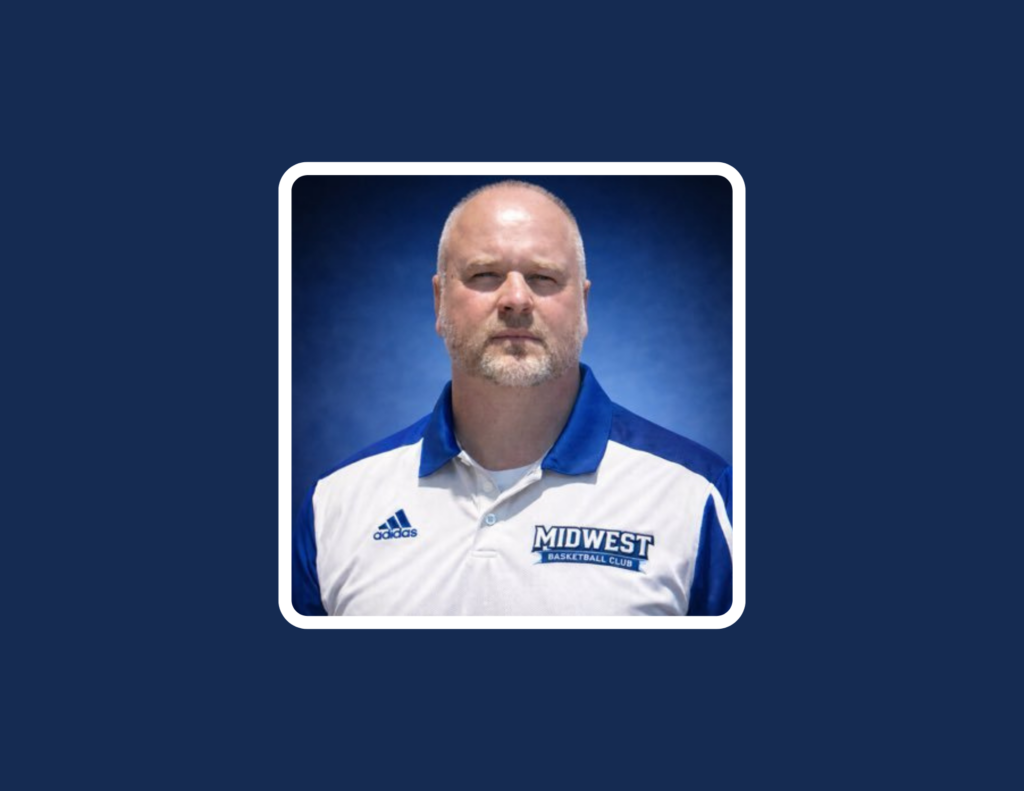
CHRIS HICKS – OPERATIONS MANAGER FOR MIDWEST BASKETBALL CLUB & EVENT DIRECTOR FOR BLEACHER PROSPECTS – EPISODE 1210

Websites – https://midwestbasketballclub.com/ https://bleacherprospect.com/
Email – chris.g.hicks.74@gmail.com
Twitter/X – @ChrisHicks513
If you listen to and love the Hoop Heads Podcast, please consider giving us a small tip that will help in our quest to become the #1 basketball coaching podcast.
Chris Hicks is the operations manager for Midwest Basketball Club in the state of Ohio. He also serves as the Event Director for Bleacher Prospects, which specializes in covering all levels of High School and AAU basketball while providing exposure for young athletes across the Midwest.
On this episode Mike & Chris discuss the vital role of advocacy in the development of young players and the need for dedicated support systems that empower youth players to navigate their athletic journeys effectively. Throughout the discussion, we delve into the intricacies of player evaluation, recruitment strategies, and the collaborative efforts required between coaches, parents, and players to foster an environment conducive to growth. Hicks emphasizes the importance of character and academic performance as paramount factors influencing recruitment opportunities. Ultimately, this episode serves as a comprehensive exploration of the dynamics within grassroots basketball, underscoring the transformative potential of effective mentorship and guidance in shaping the future of aspiring athletes.
Follow us on Twitter and Instagram @hoopheadspod for the latest updates on episodes, guests, and events from the Hoop Heads Pod.
Make sure you’re subscribed to the Hoop Heads Pod on Spotify or wherever you get your podcasts and while you’re there please leave us a 5 star rating and review. Your ratings help your friends and coaching colleagues find the show. If you really love what you’re hearing recommend the Hoop Heads Pod to someone and get them to join you as a part of Hoop Heads Nation.
You’ll want to take a few notes as you listen to this episode with Chris Hicks, operations manager for Midwest Basketball Club and the Event Director for Bleacher Prospects.
What We Discuss with Chris Hicks
- Why it’s essential for youth athletes to experience both success and failure to develop resilience and a genuine love for the game
- The landscape of youth basketball is increasingly competitive, necessitating a focus on personal growth and adaptability
- In his role, building genuine relationships with college coaches is crucial for players’ recruitment and opportunities in higher education
- Why AAU basketball needs to streamline its numerous circuits to facilitate easier access and visibility for college coaches evaluating talent
- Maintaining a strong academic record is a critical factor in student-athlete recruitment
- Parents should allow their children to develop their own love for the game without excessive pressure or intervention
- Building genuine connections with players and families is essential for effective coaching and player development
- The evolving landscape of youth sports requires constant adaptation from coaches to meet new challenges and opportunities
- Staying on top of the constant evolution of the college basketball recruitment processes
- The need for genuine connections between coaches, players, and families to foster trust and enhance player development
- The role of technology and social media in promoting youth athletes, allowing them to gain visibility and opportunities that were previously inaccessible
- The balance between parental support and letting kids navigate their own athletic paths
Like this show? Please leave us a review here — even one sentence helps! Consider including your Twitter handle so we can thank you personally!

We’re excited to partner with Dr. Dish, the world’s best shooting machine! Mention the Hoop Heads Podcast when you place your order and get $300 off a brand new state of the art Dr. Dish Shooting Machine!

Give With Hoops is a groundbreaking initiative that fuses basketball analytics with modern sponsorship. Built for teams who see data as opportunity, from AAU programs to college powerhouses.
By tying on-court performance directly to community and sponsor engagement, Give With Hoops help programs raise more while deepening support from those who believe in the game.
Traditional fundraising disconnects donors from the action. Sell candy bars, wash cars, beg for donations, it’s exhausting and ineffective. Players perform better when their stats matter beyond the scoreboard. That’s why Give With Hoops was created.
Give With Hoops connects game performance to community support. Every basket, rebound, and assist becomes a chance to raise funds. Transparent, exciting, and proven to raise 3x more than traditional methods.
Aiming to go D3? The D3 Recruiting Playbook gives you a clear, step-by-step roadmap to the recruiting process – what coaches value, key milestones from early high school through application season, and how to build a target list of schools that fit your needs.
We’ll demystify researching D3 programs and how to stand out without chasing every camp or showcase.
The modules cover things like writing emails to coaches, building an effective highlight tape, using social media well, planning ID camps and visits, and navigating application strategy.
You’ll get templates, checklists, and an outreach plan to communicate confidently, learn how to compare financial packages, and avoid common missteps. By the end, you’ll have a prioritized school list and a decision framework you can use to land your best-fit opportunity.
Your first impression is everything when applying for a new coaching job. A professional coaching portfolio is the tool that highlights your coaching achievements and philosophies and, most of all, helps separate you and your abilities from the other applicants.
The key to landing a new coaching job is to demonstrate to the hiring committee your attention to detail, level of preparedness, and your professionalism. Not only does a coaching portfolio allow you to exhibit these qualities, it also allows you to present your personal philosophies on coaching, leadership, and program development in an organized manner.
The Coaching Portfolio Guide is an instructional, membership-based website that helps you develop a personalized portfolio. Each section of the portfolio guide provides detailed instructions on how to organize your portfolio in a professional manner. The guide also provides sample documents for each section of your portfolio that you can copy, modify, and add to your personal portfolio.

Hey coaches — you’ve got a game plan for your team… but do you have one for your money?
That’s where Wealth4Coaches comes in.
Each week, they deliver simple, no-fluff financial tips made just for coaches. Whether you’re getting paid for camps, training sessions, or a full season—Wealth4Coaches helps you track it, save it, and grow it.
It’s time to stop guessing and start building.
Subscribe now at wealth4coaches.beehiiv.com/subscribe
And follow them on Twitter @Wealth4Coaches for daily money wins.
Your money needs a coach.
Start with Wealth4Coaches.
THANKS, CHRIS HICKS
If you enjoyed this episode with Chris Hicks let him know by clicking on the link below and thanking them via Twitter.
Click here to thank Chris Hicks via Twitter
Click here to let Mike & Jason know about your number one takeaway from this episode!
And if you want us to answer your questions on one of our upcoming weekly NBA episodes, drop us a line at mike@hoopheadspod.com.
TRANSCRIPT FOR CHRIS HICKS – OPERATIONS MANAGER FOR MIDWEST BASKETBALL CLUB & EVENT DIRECTOR FOR BLEACHER PROSPECTS – EPISODE 1210
[00:00:00] Narrator: The Hoop Heads Podcast is brought to you by Head Start Basketball.
[00:00:21] Chris Hicks: I can walk through most every kid that’s on our database, go pull up their stats page, know exactly where all of it’s at, be able to talk specifically to that player of their character, in most cases, their family, and be able to really promote them, in my opinion, at the level that they deserve. To me, if these kids are going to put in the effort and do the work at the level that they’re doing, they need an advocate in the background that’s pushing for them, that has tools and resources and knowledge to be able to potentially impact the rest of their life.
[00:00:54] Mike Klinzing: Chris Hicks is the operations manager for Midwest Basketball Club in the state of Ohio. He also serves as the event director for Bleacher Prospects, which specializes in covering all levels of high school and AAU basketball while providing exposure for young athletes across the Midwest
Hey Hoop Heads. I wanted to take a minute to shout out our partners and friends at Dr. Dish Basketball. Their Dr. Dish shooting machines are undoubtedly the most advanced and user-friendly machines on the market. Learn more at drdishbasketball.com and follow their incredible content @drdishbball on Twitter, Instagram, Facebook and YouTube.
Mention the Hoop Heads podcast and save an extra $300 on the Dr. Dish Rebel All Star and CT models. Visit drdishbasketball.com for details. That’s a great deal Hoop Heads. Get your Dr. Dish shooting machine today.
[00:01:52] Andrew Wingreen: Hey everyone. This is Andrew Wingreen, Head Men’s basketball coach for the New College of Florida Mighty Banyans, and you’re listening to the Hoop Heads Podcast.
[00:02:03] Mike Klinzing: Coaches. You’ve got a game plan for your team, but you have one for your money. That’s where Wealth4Coaches comes in. Each week, we’ll deliver simple, no fluff financial tips made just for coaches. Whether you’re getting paid for camps, training sessions, or a full season, Wealth4Coaches helps you track it, save it, and grow it.
It’s time to stop guessing and start building. Subscribe now at Wealth4Coaches.beehive.com/subscribe and follow us on Twitter at Wealth4Coaches for daily money wins. Your money needs a coach. Start with Wealth4Coaches.
You want to take a few notes as you listen to this episode with Chris Hicks, operations Manager for Midwest Basketball Club, and the event director for Bleacher Prospects. Hello and welcome to the Hoop Heads podcast. It’s Mike Klinzing here without my cohost Jason sunk tonight. But I am pleased to be joined by Chris Hicks from Midwest Basketball Club and Bleacher Prospects.
Chris, welcome to the Hoop Heads Pod.
[00:03:04] Chris Hicks: Oh, thanks. Appreciate you guys having me on.
[00:03:07] Mike Klinzing: Excited to have you on. Looking forward to diving into all the interesting things that you’ve been able to do throughout your basketball life. Let’s start by going back in time to when you were a kid. Tell me a little bit about some of your first experiences with the game of basketball.
What do you remember about those early years with the game?
[00:03:23] Chris Hicks: Sure. Just grew up in West Virginia. I mean, truly in the mountains of West Virginia and sports was a big part of my life. We didn’t, we didn’t have a lot to do other than sports in the area that that I grew up in. So football, basketball, baseball all a huge part of who I was growing up.
Basketball specifically was my love. It was probably the sport I was the best at. and carried it all the way from middle school all the way up to high school. And so fell in love with the game, fell in good love with the process. Watched a lot of basketball on tv and we’d go out in the driveway and try to replicate whatever it was that you saw didn’t have the advantages of video and recording and all of that.
So you try to remember the best you could and carry it out into the driveway and hopefully you see it on some kind of replay or something to be able to go back and replicate it. But I think I grew up in probably one of the best areas of basketball as well. I mean the eighties and the nineties I thought were just incredible.
The league was growing all the big names that kind of have really catapulted the the NBA, if you will, with Michael Jordan and Magic Johnson and Larry Bird, all of those guys. And to me it was just an incredible time to grow up and be connected to the game.
[00:04:37] Mike Klinzing: Who were your teams and players as a kid?
Who were the teams that you followed, the players that you looked up to the most?
[00:04:44] Chris Hicks: Well, huge Michael Jordan fan, which I think most every kid at that that time was Yep, absolutely. Got him right over my shoulder here too in a, and assigned a and a signed post over here. So every, everybody migrated to him, just, you’d be like Mike.
I mean, he was on every commercial and every cereal box and all of the other things that were associated with basketball. But as far as like other players that really enjoyed watching Nat, I’m, I’m six two and at, at the time that I grew up, I mean, six two was a pretty large person. It was pretty rare that you saw a six, six kid or, or taller.
And so I played point guard on the offensive side and center on the defensive side. So players like Akeem, Elijah won, and bill, bill Cartwright, and all of those guys intrigued me just because of. That being a different skillset than what I had on the offensive side and what I needed to do defensively in order to be able to match up on a night to night basis.
And gosh and when I say, I mean, you can go back to the birds, go back to the Johnsons magic Johnson, all of those players, Charles Bark, I mean, all of those guys brought something different to the game that I just thought was, was remarkable. And I didn’t try to tailor my game to any one specific player.
But I certainly took the thoughts, for example, Barkley and chasing rebounds. Now Hardy went after that side of the game and Elijah won, and really trying to be a strong defensive presence for his team, although he was a good offensive player as well. And then just Jordan, I mean, trying to get out in the driveway and dunk the basketball like him.
[00:06:17] Mike Klinzing: What’s funny is, is that growing up I loved Jordan and my first guy. I fell in love with as a player. So I’m born in 1970 and I loved Dr. J. He was the first guy that I, that I really started to follow. And of course, those are two guys that play above the rib, which was not something that I was capable of doing in my time as a player.
So I found myself always gravitating in terms of the players that I liked, sort of to a player archetype that I myself could never be. I grew up, for whatever reason, I hated Larry Bird and the Celtics when I was a kid, where if I look back on it now, it’s probably being a little bit more ground bound.
That probably would’ve been a better guy to follow and want to try to emulate. But instead I want to be Dr. J or Michael Jordan, or whatever the case may be. So it’s kind of interesting how. Again, when you’re a kid, where your fandom goes and just who you like to follow and the types of players that you, you try to emulate and be a part of.
And I know for me, like I said, I, I was, I don’t know if unrealistic, but just again, the guys that I liked were guys that maybe could do things that I was not able to do or guys that did things that I knew I would never be capable of doing. So that’s the NBA. How about on the college side? Did you have any college teams or players at that time?
Obviously college basketball has changed tremendously since the eighties and nineties. When you were growing. When you were growing up. When I was growing up, and now with the one and done and NIL and all the things, and I’m sure we’ll get into this when we talk a little bit more a, a little later about the A A U and the recruiting side of it.
But just from your perspective, was there any college teams or players that you really liked at that time?
[00:08:04] Chris Hicks: Yeah, Kentucky fan, I mean, where I grew up at, the, the closest college to us was actually in Kentucky, and so grew up, it was pretty consistent on tv. Had the availability to watch. West Virginia had a great football program at that time.
Nothing really on the basketball side. and then specifically when Rick Pitino came in to Kentucky, to me it was just such an incredible era of basketball. The fluidity of play, the style of play, the speed of play just absolutely was amazing, in my opinion, was a really great era of Kentucky basketball and players, Jamal, Mashburn, Pere, I mean, all of those guys had an impact some way or another on how I viewed the game and what I thought about the game and what I thought good looked like.
And so it was fun having the base that I had with the groups of teams that I followed. And then specifically even as you, you get into adulthood and you look back on all of those players, I mean, we all say it there’s never be another Michael Jordan, right? I thought that Jamal Mashburn at Kentucky was the epitome of what a player should look like coming into college and how they represent their team and then what the overall outcome for that player should be as they transition into the NBA game.
I just thought he was the pillar, if you’ll, for what a good college basketball player looked like.
[00:09:29] Mike Klinzing: Yeah. It’s kind of crazy that all those guys mashburn Jimmy Jackson and Jason Kidd. All ended up, all ended up on the Dallas Mavericks. And that somehow those three guys as great of certainly college players in the case of Mashburn and Jimmy Jackson, who were also very good pros and for whatever reason, didn’t quite, I think, live up to what people maybe thought they would be in college.
But the fact that those guys ended up on the same team and kind of never put it all together as one of the great mysteries to me in the game of basketball, because like you said, those three guys Mashburn at Kentucky was incredible. Jimmy Jackson, I saw him when he was in 10th grade. Me and my dad went to a game in Elyria and they were playing against Elyria High School.
And of course at that time there was no internet, no YouTube, no anything. And so we had just heard, Hey, there’s this kid that plays for Toledo McCumber that is really good. Let’s go see him play. And of course you go out there and we had no idea what he looks like and comes out for warmups and immediately like, yeah, that’s him.
He’s in 10th grade, he looks like he could be in the NBA with his body. So yeah, it’s just again, the era of. College basketball back in the day, eighties and nineties was just a, a very, very unique I think we, if you were a college basketball fat fan at that time, you don’t know how good, how good you had at being a fan of the college game back then.
And today it’s just different the way that again, players are in and out in teams and they’re going to have to get it sorted out. And we’ll talk about that here in a little bit. So as you’re going through being a player at the high school level is there a thought that, hey, at some point I want to stay involved in the game when I get to adulthood?
Where you thinking at all, Hey, maybe I want to get into coaching. Was there some other path through the game that you thought maybe you saw for yourself? Obviously at the time when you’re growing up, AAU is not nearly at the level where it is now, so that really necessarily wasn’t a viable path. An idea of what you were thinking about in terms of your relationship to the game as you went through college and then on into early adulthood?
[00:11:34] Chris Hicks: I mean, I was super fortunate. I had incredible relationships with my coaches, so I had those opportunities to talk about how they impact the game and what they see potential if you’ll for players or persons in, in future. Right. How can you, how can you apply what you’re learning here and be able to cascade it forward?
I, while I was playing in high school, I didn’t necessarily think about it, but once I got out of high school out into the real world, I played real high level sports, if you will, for I played on a travel softball team that was fully sponsored, played on a three, three on three basketball group that was fully sponsored.
So I had an opportunity to learn, if you will, just a little bit different. Differently on how some of those things come together even to the point of how our players recruited to those programs. And that piqued my interest at that time. I felt like I was a, a good evaluator of talent evaluator of players.
as often brought into discussions as we were having tryouts, which players should we look at, which ones do we think fit both in terms of skill and and culture. And that kind of probably started it at that point. Not long after that, we had our first daughter and a couple years later, of course heavily engaged in the youth, the sports programs, all the way up to her high school program.
And then kind of really took that and catapulted it back into the basketball world. So when she was six or seven starting over in basketball and softball, I was already asking questions. College coaches on how does recruiting work? What does this look like as kids are moving up through what’s the most important factors and and she, she was a softball player and I followed that pathway with her, with college recruiting and coaches and introductions and coaching the team, and then basically took everything that I learned there and then pushed it over into the basketball world.
[00:13:33] Mike Klinzing: What’s your best piece of advice for a youth sports parent who has a kid who’s six or seven years old, regardless of sport, who’s heading into that world for the first time? If you could boil it down and give them your most valuable piece of advice, what would it be?
[00:13:50] Chris Hicks: I mean, the very first thing, it’s great.
A hundred percent the academic portion is more important than any of the other pieces. Athletically, I think in today’s world, college coaches certainly look at that in grades as a, it’s an indictment on character. At the end of the day, those kids that are performing well in the classroom typically are high character, high quality kids that come from a great background support.
And for me, that was one of the very first things that the, the very first college coach that I talked to, he said, if you want to focus the right way with your kid, focus them on the academics and let it, the other one. The other one is, is don’t push. I mean, at the end of the day, your child needs to love the game.
And as a parent, you, you certainly want your, your child to do well. But sometimes that comes with failure and you have to allow kids to go through the failure, go through the hurdles themselves, not intervene, not influence that way. Allow them to feed off of both the successes and failures and figure out their own path.
Too often I see today you’ll, you’ll read or hear about the number one ranked fourth grader, fifth grader, sixth grader. Everything changes at puberty. And so I would rather have a kid personally that developed late and went through a lot of adversity getting to where they were trying to get to than to have that kid that was always successful and whatever happened that puberty, they, they stopped growing and now all of a sudden they’re trying to figure out how to deal with adversity as a much older player.
That’s never dealt with it. In a lot of cases, they dunno how to go through it. So allow them to develop at the pace that that fits the need and their need and to the skills that they have and stay out of the way. I mean, that’s, that’s what I would say. I mean, certainly encourage.
Allow them to fall in love with the game and all the other pieces will, will come into play.
[00:15:48] Mike Klinzing: Great advice. And I think it’s one that I’ve shared with parents a lot about the development in terms of getting to puberty and not knowing who’s going to be fast, who’s going to be tall, who’s going to be short, who’s going to be strong, who’s going to have this body type versus that body type.
And like you said, you don’t really know any of that until a kid reaches their, again, not necessarily physical maturity, but starts to change physically. And I think that’s where in a lot of cases, especially in basketball, right, oftentimes we do a disservice to kids who are younger because we get. A kid who’s a little bit bigger and put him on the block and don’t let him ever dribble the ball.
And then you might have another kid who starts out and is slow and a little uncoordinated and then grows into their body. And suddenly now they’re capable of doing more, but we’ve held them back because of their perceived shortcomings when they’re younger. And so I do think that there’s a, a big piece of that for parents especially to make sure that you get your kids involved.
Again, this is any sport, right? In a, in a position where with a program, with a coach who tries to develop the complete athlete and doesn’t try to pigeonhole them super early. And then the other thing that you said that I think is really, really good advice is to make sure that the amount that you’re pushing your kid as a parent is conducive to what your kid wants.
I always say that it should be kid driven as opposed to parent driven because again. Ultimately, in my experience, and I’m sure in yours too, Chris, the kids who have had the most success ultimately are the kids who find that drive within themselves to want to get better, to explore the game, continue to improve and and get better.
And that’s not to say that as parents, we don’t have to provide the kids opportunities, especially when they’re younger and they can’t drive and they can’t get to places. Certainly a parent plays a big role in providing opportunity, but we have to be really careful in terms of how much do we push versus again, the kid taking that initiative on their own.
And I know for me, and I don’t know if you found this at all with your daughter, but I know for me there are times that even though I know that that is the best route to take, that there were and are times where I still feel like. Am I pushing enough or should I push just a little bit more? And even though I know better and I still ultimately I end up taking a step back, but I still had that conversation with myself sometimes in my mind, it’s hard to follow that advice, even though I know it’s the right advice.
And I think parents out there who maybe don’t have as much experience as maybe you did or as much experience as I have sometimes fall into that trap. And so, I dunno if you ever found sort of that internal fight within your mind with your daughter in terms of how much do I push and how much do I lay back?
[00:18:42] Chris Hicks: No, I absolutely. And we, we were fortunate in the part that we really had two only kids is the way that it worked. Their kids have 10 years difference between them. So my daughter, a big time softball player internally motivated specifically as she moved into. Ace ninth, 10th, and on. And for her, I mean, she loved it and she wanted to be on the field.
It was, it was, the game was easy for her. She looked for different ways to have an advantage, and she wanted influence and what those things were, she would come to you readily and ask the question how can I improve in X and be willing to sit down and watch video and go through the whole the whole nine yards in order to have some different impact.
When she went back on, on the field and what we did with her early on is kids are parents they wanted the best shortstop or they wanted the best second base band those positions were more meaningful right in the game. And I was different than that. I wanted a utility player.
I wanted a player that could play short, that could play second, that could go into the outfield, that could pitch or play first base. And so our pathway was entirely different with her. We really created I mean, in my opinion, just such a well-rounded player that she fit a need no matter which team that she was on.
They always had a place for her to be able to play in Kentucky. And we lived in Kentucky for a little while. In Kentucky, you can play high school sports at any age, right? So she’s a starting shortstop as a sixth grader for the high school, and the next year she’s playing second base, and the next year she’s a third, and then she’s in the outfield and then she’s pitching.
So each year was different for her and she enjoyed that. but learning each one of those is difficult. It’s challenging with my son, basketball kid out of the gate. It’s same approach, really focused on different skills. He was one of the taller kids growing up and quickly hit the six foot mark by the time that he was in the seventh grade.
Ultimately ended up going to the six foot two range. And was it projected to be taller than that? But it was the same approach with him. How can we provide different, opportunities for you to develop different skills and play in different positions and impact your team in a different way no matter what the need of the team was.
And what we tried to create was selfless players that were willing to sacrifice pieces and parts of what they brought to their skillset in order to contribute to the overall value of the team. unfortunately he, he’s dealt with injury after injury after injury since his freshman year.
Things certainly didn’t turn out for him the way that he was projected to turn out. But man, what a great kid that it’s created. I mean that adversity and challenges the things that he’s been through, the things that he’s had to learn. And deal with has just probably been different than what most kids have to deal with.
But it’s been fun watching both of their watching both of their pathways and how, and they’re very different as far as personalities, but both of them ended up being very successful. And both deciding, laid on that my daughter was recruited by many colleges and chose at the end of the day to do an academic ride rather than playing college.
Heartbreaking for a dad especially after we’ve traveled the entire country together playing softball. But I was really looking at, at, at my son Josh, and thinking, okay, he’s, he’s going to have that opportunity and then ultimately it’s just derailed him with all of the injuries and he didn’t quite make it to where he wanted to make it to, but.
Extremely grateful for those experiences and has had a ton of joy doing it, but certainly is ready to end this basketball career at this point.
[00:22:36] Mike Klinzing: Listen, those two stories, Chris, that you just told about your kids sort of epitomize, what I think if you could take that and encapsulate that story or those two stories of each one of your kids and share that with parents who are, again, just entering the youth sports space, and I heard you say a couple things that stood out for me.
One was that you taught your kids how to be selfless and to be a part of a team, which when you talk to people, even though it doesn’t always come out this way, people often say that that’s what they want, right? They want their kid to be a part of something bigger than themselves. An important part of why people get involved.
Sports sports, and yet oftentimes we don’t see them acting that out on the sidelines as parents. And then the second part is just, you talked about your daughter ended up choosing an academic route and your son being able to develop the resilience to come through that some of the challenges that he faced with injury and just his path and how it was different maybe than what he might’ve expected or what you might’ve expected.
And ultimately, I think that sometimes there’s, it’s easy to lose sight, especially as a parent. It’s easy to lose sight of what are the real reasons why I have my kids playing youth sports. And I’ve been through this with my oldest daughter who’s now a senior in college. She stopped playing basketball when she was in ninth grade, played a couple more years of tennis, but at some point she came to me and said.
Just don’t like basketball anymore. It’s not fun. Practice comes around. I don’t really want to be there. And so you have the conversation, well then you shouldn’t be there, right? It’s not fun. Then what are we doing? Let’s find another activity that you’re going to enjoy and get something out of, and that I have another daughter who’s in 10th grade who’s currently playing, and my son’s at Ohio Wesleyan as a sophomore.
And all throughout their careers, there’s been things that have gone well. There’s been things that maybe haven’t gone so well, and your story of resilience with your son, not the same in terms of injury causing that adversity, but certainly adversity that’s gone on in their careers, that you have conversations with them and you hope that what sports does is it teaches them the value of resilience.
It teaches the value of hard work, so that. The ball stops bouncing, which is going to, for every kid at some point, no matter, even for LeBron here at some, at some point, the ball’s going to stop bouncing. And what are you going to be able to do with your life after that? And what you hope as a parent is that what they’ve learned through sports guides them into the rest of their life.
And I think that’s what happened for me. That’s what is happening for your kids. I think it’s what’s going to happen for my kids. And ultimately that’s where the value in youth sports lies. And I think sometimes we get caught up in all the other stuff that we see on social media and the comparisons and all this.
And it’s important sometimes to take a step back, whether it’s as a parent or as a coach, and just remember that again, there’s more to life than just a win or a loss, or did I make the basket or did I get a hit in this clutch moment? All that stuff sort of eventually fades away. And it’s What kind of person do you develop as a result of your.
Process of going through and in your development in sports. And I think that’s what, that’s what came through for me from, from your story of, of talking about your kids. So tell me a little bit about your then gateway into sort of the basketball world that you’re in now. How did that opportunity come to you?
What were the steps that led you into kind of the pr, the, the place where you are now?
[00:26:19] Chris Hicks: So when we were in, when we moved into Kentucky and in the el, my son was in the elementary school at that time, and I got involved in their youth program at the school level and started coaching there. I coached three years for the Pulaski County Youth League.
And then got transferred to Ohio directly after. And came into the school system here, we’re in Springboro, Ohio. Came into the school system here and picked up. Youth coaching, again with the Dayton Metro League at the, at the school level. And then got involved a little bit at the AAU scene with a couple different programs.
And then ultimately ended up planning at Midwest Basketball Club middle Ohio Pumas. When my son was in the eighth grade, the middle Ohio Pumas were expanding into the Cincinnati and Dayton area. And an an acquaintance made a connection with the person that was selected to be the director for the program, Dustin Kavanaugh.
And so Dustin and I made a connection, hit it off immediately. And then I helped him expand the brand here. We started out four years ago, maybe five years ago, started out with three teams at the ninth grade level and two at the 10th grade level. The very next year Midwest Basketball Club in mid Ohio.
Ended up joining they operated under the Midwest Basketball Club umbrella for the entire organization. Dustin asked me to take a larger role at that time as an operations leader for the, for the organization. And for that, I mean, it was overseeing recruiting both in terms of players into the organization, coaches as well development registrations, answering questions, really the logistics piece of getting players into the program and settled into teams.
And then from that, the logistics of where will teams play and how will we support them as they’re out and about playing. And then it, and this really happened happenstance. I really didn’t plan to coach again. I’d given that up several years ago. My son’s team in Midwest Basketball Club.
Just within probably two weeks to go before the season kicked off the coach that was going to coach the team ended up running into an issue and wasn’t able to coach. Dustin approached me and he, he said, Hey there’s nobody that knows these kids better. There’s nobody that knows the college coaches better.
I’m going to need you to step in here and run this team. And so for me, I mean, I wrote it down. I mean, I wrote it down as the, the final chapter and it was Josh and my final chapter together, one final season to go out and play basketball. And so I coached that group this past year. Had a phenomenal season with them.
We finished second on the grassroots basketball league circuit. I’ve got six of eight kids from that team that have varying levels of, of college opportunities at the next level. And just really enjoyed it so much that I decided to stay on coaching this year. I’ll coach two 17 year teams this coming year, both going to the Mays group circuit.
And so man, just a, a a really whirlwind over the last five years of starting out with just a couple of teams and now we’ve built it in. We’ve got, I don’t know, 39 plus teams in the Cincinnati, Dayton area teams at every level. Kids that can play at every at every level at at the college when they transfer to college.
It’s been phenomenal building it. I think from a, a program name brand, what we do how we operate I just, I’m really in love with what we do and it’s just such a great, in my opinion, honor to be a part of a part of that program and having the advantages that we have of helping kids make it to the next level.
[00:30:10] Mike Klinzing: Alright, before we dive into. The kids and your coaching. One of the things that you mentioned was as you’re growing the organization, and I think this is a challenge, whenever I talk to somebody who has a basketball business, AAU club training, whatever it might be, that there’s always the challenge of finding great coaches and people who can do things in the way that the founders, the directors of the organizations, want things done.
So can you talk a little bit about your process for finding slash recruiting coaches and then training them, helping them along the way so that there is a unified philosophy or way of doing things that you guys do with Midwest?
[00:31:03] Chris Hicks: Yeah, so, so very few dad coaches in the program. And really by design, I mean at the end of the day, we want, we want players to have the best overall experience that they can have.
And even for me, I had made a connection for my, my own son coming up through his middle school years. It was probably best for me to not coach him. Just the relationship. An opportunity to be dad rather than coach in my opinion, is a much more rewarding role than being coach. I think as, as kids mature specifically for him as he matured into his senior year, it’s a lot easier.
those criticisms, if you will, from a coach or a dad don’t seem to be as direct or as impactful. In a lot of cases they recognize that that feedback is meant as care and love and it’s meant to guide and direct, not necessarily tear down. But we do have some dad coaches, but for the most part we target active coaches that are assistant coaches at, at every level of school.
We just from from a building a brand perspective we know that a lot of those, most every assistant coach aspires to be a head coach at some point. This gives them an experience to be able to run their own team manage the workout specifically however they see fit interact with parents and all of those things and skills that you need to build when and if the time comes that you have an opportunity to serve as a a high school head coach or even a college head coach.
So we are very specific on targeting those type of, of coaches. And outside of that, I mean, we’re looking for high level players as well. I mean, if you came from a, a high level background, potentially played in college and maybe, maybe you’re not coaching at the, the high school or, or at any school level.
we’ll certainly target them as well. And we’re really focused on all of the right things. the program, the character who’s going to represent the brand appropriately. We do a lot in terms of training and education. We all go through different levels of certification from a coaching perspective, but those coaches know that they can reach out to any of us that are in the leadership role and ask questions and ask for input.
There’s, there’s never there’s never anything that’s off limits. I think that there’s a trust, trust and influence to the organization where people have confidence that if they come to you with an issue that you’re going to genuinely help them resolve the issue and help them get things back on track.
But we really we really want the next level or the next phase of up and comers. And we’ve seen it. I mean, we’ve graduated so many coaches from the a a U level that were once assistant coaches that are now. Super success, high school basketball coaches. and we feel like we had a part in it.
certainly not all of it, but we definitely played a part in, in their ability to be able to take that next step and be comfortable in it and lead their own programs once they get there.
[00:34:04] Mike Klinzing: Are you or an athlete planning to go D three? Check out the D three recruiting playbook from D three Direct. Their playbook gives you a clear step-by-step roadmap to the recruiting process. What coaches value key milestones from early high school through application season and how to build a targeted list of schools that fit your needs?
The playbook demystifies, researching D three programs and how to stand out without chasing every camp or showcase the modules. Cover things like writing emails to coaches. Building an effective highlight tape using social media, well planning camps and visits and navigating application strategy. You’ll get templates, checklists, and an outreach plan to communicate confidently.
Learn how to compare financial packages and avoid common missteps. By the end, you’ll have a prioritized school list and a decision framework you can use to land your best fit opportunity. Click on the link in the show notes to get your D three recruiting playbook from D three direct.
[00:35:04] Andrew Wingreen: What are some personal characteristics
[00:35:07] Mike Klinzing: of a great AAU coach? Obviously there’s some basketball things and everybody has a different philosophy in terms of how they teach or what style of basketball they want to play, but when you’re looking at somebody as a potential coach for your club, what are the personal characteristics that in your mind are going to allow them to have success?
Role a, a u coach for Midwest,
[00:35:34] Chris Hicks: For us. I mean, it’s percent connections and I mean, connections. Can this person form a relationship with the players that players families that they’re responsible for? I mean, to me, that’s, that’s the trust factor that that comes into play. And for me personally as a, as a, as a coach I have a great connection to all my players.
I know I watch their stats, I watch their games. I go on to huddle and look for different things that’s happening in their high school. And not to influence or to ask and to try to provide any feedback, but just to see how they’re doing, to check up on them physically and how are you feeling?
How’s the game going? What are the things that you’re struggling with? What are the things that you feel that you can improve that how is, how is everything around them interacting that’s allowing them to be their most successful? But that the genuine connection knowing the players, the ones that truly you can make it about you as a coach.
I mean, I’ve seen plenty do that. That this is about my opportunity and my potential flight upwards or opportunity to move into a different role. Or you can make it about the kids. And to me, the most successful ones make it about the kids and then ultimately you’re the recipient of success.
You should be successful as a result of their success. But certainly the skill sets, I mean, we’re looking for, for high character, knowledgeable coaches that’s played the game at a high level that knows how to influence kids in the right way. There’s right and wrong ways to do that. I mean how you say it, how you present things is extremely important.
But really we want people that are willing to pour into that kid and see each one of those kids potential and are, are really interested in helping them grow to maximize whatever that is, whatever that footprint would be for them.
[00:37:28] Mike Klinzing: How much do you try to build a connection with a player’s high school coach?
I know in some cases high school coaches are open to that relationship and sort of being collaborative in terms in terms of a player’s development. In other cases, maybe that’s not so much the standard, but from your perspective, the connection between the a a U coach and program and the high school coach and program, in an ideal world, what would that look like to you?
[00:37:59] Chris Hicks: Yeah, it, to me, it, it really should be hand in hand. I think the support factors on both sides the game’s different. I mean, it’s very different in some cases, but the support factor on both sides, in my opinion, is extremely important. I’m, I’m fortunate in a lot of cases I have high school coaches that recommend there players to me, and so it makes it really easy that they have a high degree of confidence in, in that player and their family.
So I already know what I’m getting, even if I didn’t know who that kid was. In a lot of cases, I know what they run, the type offense, the defense that they run. And so if they’re sending them to me, then, then they see that there’s things that I’m doing that can add value back to their program.
And I, and I have, I’ve seen it on both sides. I’ve seen high school coaches that readily accept and want to hear feedback on their players and how they’re doing and how they’re contributing, what their opportunities are for. For improvement. And I’ve seen the other side where completely hands off that they don’t connect to the a a U program scene at all.
They don’t want to even affiliate with that side. And so for us, we always recognize those barriers and we always, certainly make sure that we don’t overstep those. But in my opinion, if, if players, if the players are going to be their most successful, those two entities working hand in hand.
And I would throw in another piece, I mean, if a player has an in individual skills trainer, that person being involved with the three entities really in my opinion, catapult that kids opportunity to levels that maybe most people don’t have the opportunity to get to.
[00:39:42] Mike Klinzing: I agree with you there, Chris.
I think that the ability to collaborate amongst all the people who have. A hand in the development of the player. So a, a u coach and program, high school coach and program, and then individual skills trainer. If you can get all three of those groups on the same page and giving the player, maybe not the exact same, but certainly a similar message in terms of strengths, weaknesses, what they have to work on, how they fit into each particular one of those spaces.
I do think that you’re going to end up in a better place for the kids. So we talked a little bit about your recruitment and, and getting of coaches. Let’s talk a little bit about players. You mentioned that some of what you do is talk to high school coaches and build those relationships, and then as a result of that and your success, high school coaches start to funnel players to your program and recommend them to you.
But in terms of filling out roster space and the growth that you talked about, going from. Four teams to the high thirties in terms of number of teams. Obviously there’s some recruiting that you have to do. So tell me a little bit about that process, how you guys go about filling rosters and continuing to grow your club.
[00:40:57] Chris Hicks: Well, I, I think past success plays a, a huge piece in that. And so with Midwest Basketball Club our three SSB program, I mean, certainly everyone recognizes that as, as kind of the pinnacle of high school basketball in addition to EYBL and other. So for us, I mean it’s really at the grassroots to college pipeline stuff.
It’s, it’s really within Ohio and the entire Midwest scene. what we’re doing we believe is super impactful for players that are willing to do the work and chase the opportunities. And so highlighting past successes, keeping those out in front of the community through social media.
Assuring that they recognize the brand, the benefits of being a part of the brand. I just to me the, the opportunities that we offer I think most people recognize, allows players to move up to a next level. And so our entire focus is once you get into our system and more so when you’re coming in as a freshman is really when we talked a little bit about puberty and some of the other things, right?
The growth spurts. I mean, that’s really when we’re starting to really zero in on those players, players and promote. And so people see that out in the community. They recognize when they go tournaments, they play against our teams, the skill levels that of the teams that we have. So organically we get some growth, but we have a lot of social media push and there’s, there’s the the Midwest side.
Of the program is also influenced by Bleacher Prospect and we haven’t talked about that, but the Bleacher Prospect side that I’m engaged in. it, it’s really our entire mission is really simple. We’re creating opportunities for high school players, a EU players in the Midwest to get in front of college coaches.
And we are very focused on Ohio, Kentucky, Indiana Michigan, West Virginia, and really anything that touches that in order to promote and highlight kids and we host top tier exposure events. as you’re thinking. I mean, it’s a truly elite prospect camps and showcase tournaments.
We’ve partnered with groups like Bleacher Republic and Ohio basketball com. Had big weekends in Cincinnati just this past year, this past year, past fall we held a camp there. We had over a camp and a tournament. We had over 50 college coaches from Ohio, Kentucky, Indiana, Tennessee, West Virginia, Florida, Michigan, Pennsylvania.
We truly became the talk of the community that people took the brand of Midwest Basketball Club coupled on the exposure piece of Bleacher Prospect. And the two pieces are extremely powerful together. And so we’ve really become, in, in my opinion, specifically in the northern Kentucky and southern Ohio area, we’ve become the extension, the arm for college coaches throughout all of the states touch us.
The connection point everything from the camps to we have free recruiting databases where all of the players that come through our programs and or submit a a, a profile to us. We keep them in our database. That database is free to college coaches. They can go out at any point in time pull up a player’s profile, all of their measurements, GPAs highlights stats pages.
They can pull up anything and evaluate a player without having to go see that player. And so we just continue to build on those things. Dustin and I are Dustin being also in the Midwest basketball program. He and I are, are one third partner each and the other entity.
And we just continue to promote both sides and influence both programs through one another or through each other. And just continue to build both brands that, . So my projection for, for Bleacher Prospect, that whole banner it’s, I believe it’s going to bridge a gap that we see in our area.
Four kids to get college scholarships. I would suggest over the last probably two and a half years, we’ve helped a hundred kids. I just had a dad a couple weeks ago reach out. He’s like, man, he said, you helped my kid and we had very limited video. I have no idea how you did it. And there’s always somebody out there looking for a player.
You just have to know. And I think we do. We know the players in our community. We know the players that are coming through our camps. We know the players that are in our program and we make it a genuine we responsibility to know those players, to be able to represent them at any point in time that a college coach picks up a phone and says, Hey, I need a player.
This is what I’m looking for in skillset. Who do you have? And I don’t think there’s better people to call than us to be able to do that.
[00:46:06] Mike Klinzing: So how did the idea of putting those two concepts together of the a a u Basketball Club Midwest with Bleacher Prospects, where does the idea of that synergy come together and how do you and Dustin get involved in that?
[00:46:20] Chris Hicks: So the, so Bleacher Republic is a tournament side that really filtered off of Midwest Basketball Club as well. I’m not a part of the Bleacher Republic platform. However, the third partner Matt Morgan is, and Matt we had, again, connections through the organization of doing different things together and Matt approached Dustin and I about the exposure side of the business.
So Bleacher Republic was asking for that as well. They run extremely high level tournaments throughout the Midwest and they really didn’t have any about there promoting that other than themselves. And so they, they approached Matt. I asked the question how can we get better exposure on all of our programs and assure that we’re continuing to build our brand in the community.
And so Matt was the, the spearhead that kind of kicked it off, called Dust and I into it. And then we started the brand Bleacher Prospect. It’s grown. I mean, it, it three years ago we were doing exposure camps and articles and we’ve grown. I mean we’re this just this year we we’re partnering, last year we partnered with Bleacher Republic for the Bleacher Nationals.
That’s where we had all of the college coaches come in for that weekend. It was ata, it was such an incredible site at, at Spooky Nook in Hamilton, Ohio, to look up on the platform overhead and see college coach after college coach after college coach looking down on all of the floors and watching all of the players.
If you were a player in that event 100% you had more exposure in that day than probably most kids get in their entire high school career, playing career. And so we did that with Bleacher Nationals. We’ve had Ohio basketball.com come to us this year. They run the E 40 circuit for the Midwest region and partnered with NY two la.
They’ve asked us to tag on an exposure camp to them in late May and attach it to one of their tournaments. So people are starting to recognize that we can bring all of the pieces together around the table and put everybody in the same room and talking at the same language. With the ultimate goal again, is the exposure for the high school player as a potential to go into college.
. It’s been a, it’s been a, a whirlwind to get there. We keep branching off into other little entities and pieces. There’s, there’s other things coming that that I can’t quite talk about. But we’re going to continue to focus on our exposure camps, build continuity within our tournaments, continue to grow some of those pieces.
But again, it’s always to have influence at the college level and to be able to promote players coming through either Midwest or Bleacher Prospect is what our ultimate goal is. So
[00:49:20] Mike Klinzing: we’ve hit on the one side of the equation, right? The players, the coaches who are a part of your A A U program.
We’ve talked about how the events are going to benefit the high school players to get them that exposure to give them college opportunities. Now, the second part of this is how do you build those relationships with. College coaches, how do you build that trust so that when a college coach comes to your event, they know that they’re going to be able to see players that could potentially fit and be a part of their program moving forward.
So just talk to me a little bit about how you personally have gone about developing those relationships with college coaches. What does that look like for you?
[00:50:00] Chris Hicks: I, full transparency. I mean, as, as we have kids that register for our camps, we keep their profile and we push that out to, I think we’ve got roughly 1100 college coaches now in our database that we have direct connections with.
And so we push out our rosters at, at some interval, typically every two to three weeks. So they see who’s registering and they see the again, all of the, the, the stats, they see the, the measurements, and so they know who’s coming. And I think the, the next piece of that is, is, is we, we genuinely want to know about the players that are coming into our camps as well.
If there’s somebody that signs up that we don’t know, we do the research. And so some of that research may be doing our own search on social media and going and investigating what that kid potentially may bring to that camp. We’ve reached out to kids and had phone conversations no different than doing a regular interview just to try to understand what level is this kid at?
And if they come into our camps, how can we best promote them? But it’s being honest. I mean, it, it today I had a col, I had Jack Stevens from Wooster. He, he reached out to me. He, he cited our database and was specifically looking at 20, 26 kids. And he said, Hey Chris, walk me down through all of the kids that are on the page that tell me what you think about them.
Tell me what you believe that they do well, where do you believe that they fit, style how are they doing in high school and. I think Jack would tell you, I mean, I can walk through most every kid that’s on there, go pull up their stats page, know exactly where all of it’s at, be able to talk specifically to that player of their character, in most cases, their family and be able to really promote them, in my opinion, at the level that they deserve.
to me, if these kids are going to put in the effort and do the work at the level that they’re doing, they need an advocate in the background that’s pushing for them, that has tools and resources and knowledge to be able to potentially impact the rest of their life. And so we take all of this very serious, and it, it’s, it’s meant to be to pur, it’s meant to be purposeful, it’s meant to it’s not meant as a standalone push out a database and allow the coaches to do all of the work.
And probably once a month, every, once every six weeks or so. We’ll send that, send an updated reminder out to that same group of college coaches reminding them that our database is available. We’ve added X amount of players and certainly reach out to us if there’s, if there’s anything that they need or any player that they need information on.
Or or inquire about any of our events. The same thing when we’re leading up to events we promote our events at, at, at a routine basis. I mean, it, it all probably almost seems to be monotonous probably for a lot of coaches. as we get within five weeks of it, pretty much every two or three days they’re getting reminders about our camp and new registrants and of who’s coming and any kind of details, whether it’s where they arrive and where they’re going to sit and food available and all of those things.
But building what we’ve built with the transparency that we have. That’s built into it and being knowledgeable enough that when we speak and what they go see on video matches up. I believe that we’ve built a trusting relationship that most coaches that have interacted with us appreciate value and certainly come to us whenever they’re, when they’re searching for something that maybe they haven’t found themselves.
[00:53:49] Mike Klinzing: That trust piece, I think is the key, right? They have to be able to, as a college coach, come to you, ask for your opinion, and you have to be able to give them that opinion and have that opinion be accurate multiple times as you build that trust. So now they can come back to you and ask, Hey, about this player or that player, and trust that your analysis is going to be correct.
So to go along with that in your current role and understanding players the way that it’s obvious that you do, how long? Did it take you? Or when did you feel comfortable being able to see a player? And again, I don’t know how many times it takes you to see a player before you feel comfortable sort of placing them or saying, Hey, this kid’s a division three kid, or this kid’s division two, or here’s a place where he would fit.
Just how long did it take you to get comfortable with your own ability to scout, watch a player, and then be able to make an analysis of who they are as a high school player, who they potentially could be as a college player, and what level they might eventually fit at. How long did that take you and when did you feel comfortable with your ability to do that?
[00:55:00] Chris Hicks: A couple times. I mean, I definitely want to see a player a couple times in, in, in different settings. I think seeing them in their a a u setting is, is one part of the equation. Certainly seeing them in their high school setting is different. And sometimes it, it could be structure that’s better on one side or the other, or even a different style of play.
And then how does that translate skills or skills, all of the things that you, you see, you can tell talent when a kid has it. If a kid’s uber athletic, that automatically plays into it as well. But I definitely want to see them a couple times and I think in most cases after I’ve seen them a couple of times, I do know where they fit in a lot of cases, even down to maybe a couple of programs that they may fit in better.
It’s not abnormal for me to be on a college campus at a college camp. basically looking over the shoulder of a college coach and watching their practice and some of those things. First of all, just to learn, to continue to grow and develop myself. Knowledge of basketball, but just to see their players in the existing environment.
What skill sets do those players have? How can I pick up on what those, what the, the coach values? He can tell me, but if I see it, it’s different. And so I don’t know, last winter, not last winter, last fall I went down to University of Pikeville in Kentucky. I’ve had a great relationship with Ty Compton down there, and he invited me down and he said, Hey come down, watch our practice.
Look at our players. It’ll give you such a a much better advantage on helping me identify who in your system can help me. And we’d just love to have you down. So I went down and spent a couple hours, watched the practice. It was incredible. Came away with some great things, even for, for me to run this a, a u season.
But it was nice being able to make the connection. today Ty reached out to me. There’s a player that I’ve been trying to get him to take, and it looks like that’s going to work out, but it, it came through me observing and having the opportunity to see what they value to be able to make the connection back.
And to me, that’s it. I mean, you’re going to have to do the due diligence to not every college. And this is where I this is where I caution parents and where I caution players. you mentioned early in the podcast around comparisons and to me it’s a thief of joy.
And ultimately every program doesn’t, they don’t need a point guard. Not every program needs a, a small forward you’re going to get recruited by the program that needs what you bring based on skill sets and position and other, and too often I see that kids, there may be a kid that picks up an offer at as a certain program, and you’ll hear.
In the background, the rumblings of, well I don’t, I’m not sure why they took that player because X, Y, and Z players better. And by the way, X, Y, and Z player could be better. But the difference is, is that’s not the position that they were looking at you for. And so I think that’s where a lot of parents and players can get caught up in, in the wrong things.
And so by me being able to know a college coach, know specifically what they’re looking at, look at their current roster or their kids that maybe I saw a year ago or two year ago, how does, how does that person, what did I see from that player That allows me to assess any new players basically, that carry the, the same skills or, or operate under the same system.
That’s where the real advantage of being in our program at Midwest and the connection to Bleacher Prospect, in my opinion, that’s what gives us an advantage of, or gives the player the advantage. Because in most cases, we’re going to know where you fit. We’re going to know what the level that you’re at.
Now when I say that’s not agreeable to everyone, and in a lot of cases we may highlight a player as a certain level. Parents and or players may not agree with that. And certainly that’s that’s the prerogative to do it. But we very rarely miss on, on where we believe the level’s at.
And then ultimately where that kid ends up going is almost always exactly how we thought it would be.
[00:59:31] Mike Klinzing: Give with hoops is the first platform turning basketball analytics into fundraising impact. Every stat tells a story and now every story drives sponsorship engagement and team growth programs nationwide are transforming basketball stats into funding power. Learn to use performance data to attract sponsors, engage fans, and raise more with every play.
Give with Hoops will help you raise three times more money for your program as their stat based pledges consistently outperform traditional fundraisers. Visit give with hoops.com/hoop-heads-podcast to learn more and take your fundraising to the next level. Give with hoops.
There’s a tremendous amount of value in what you just talked about in terms of knowing both sides of the equation, having an understanding of the player, their skillset, making an evaluation of them. Then taking it to the flip side and having an understanding of what a particular college program needs, wants, style of play, positional need, right on the roster, which often plays a big part in how soon if you go there, you get on the floor, if at all.
And so a lot of that, if you can bring the knowledge on both sides of it, like you’re able to do, I can speak to you as the parent of a college athlete, that trying to make those evaluations and understand both what the athlete is capable of, but then also what program should they end up. And there’s a lot of factors that go into what makes a good fit, right?
There’s on the floor, there’s the school, there’s the academics, there’s the relationship between the coaches, there’s what type of players are a part of their program and do they have a good culture? And all of those things, the more pieces. Of that puzzle that you are able to understand as someone who can help a player to make that decision and help their family to make a good decision, the more valuable that becomes.
because I think even today, and it’s so interesting because if you go back pre-internet, so we’re talking 20 years ago, the amount of knowledge that was out there and available to players and their families in terms of recruiting and understanding all this stuff was very minimal. Now the problem is almost, there’s too much information out there.
And like you said, when people are comparing, you have, the comparison is the thief of all joy. And I think that’s a hundred percent true that you see kids and their families and they’re talking about, well this kid got this offer and this kid got this offer and this kid’s got this school interested in them.
And so you see a lot of that. And I do think that there is a, there’s a lot of people who are. Delusional when it comes to, again, the level that, whether it’s the player themselves, whether it’s their family, like you said, there are some people that don’t want to hear an honest evaluation of where they can play.
And I will say that that’s one of the things that I feel like in the journey that I had with my son in terms of the recruiting was we identified, and I told him pretty early on in the process, that if you’re going to be a college basketball player, I think you’re going to want to target division three schools that have really great academics.
And that’s what we ended up doing and we ended up finding a good spot for them. And so the ability to see both sides of it, to be able to accurately evaluate a player and then also understand on the program side what the coach is all about, the roster, the fit, the school, all that stuff that I talked about earlier.
I think when you have both of those pieces like you have, that provides a tremendous. Tremendous amount of value to the players who are your, who are a part of your program and come into your sphere. What kind of feedback are you getting from parents in terms of, again, you said that there obviously are always people that ignore good advice, but from the people that you’re helping, what are some of the positive things that you’re hearing from them in terms of people who have been interacting with you both through Midwest and through bleacher prospects?
[01:03:47] Chris Hicks: Yeah. Lemme hit on one other thing here just before that. I mean, we also have the advantage of being able to reach out to various college coaches at different levels and ask for their input as well. as we’re presenting a player, if we internally, if we agree that we believe this player is a D two player in AI player we have folks that we can reach out to and say, Hey, coach, I really need your help here.
Can you take 15 minutes, watch this film. Tell me where you think he fits, by the way. Not just in terms of level, but are there any schools that you would target for him that maybe we haven’t considered? So we’ve got an advantage of that as well. And we run a recruiting annual recruiting recruit seminar that we invite all of our parents and players into.
It’s not just Dustin and I leading that. We have college coaches that are a part of that as well. Parents and players have the opportunity to ask any question that they want. It’s, it’s been a great session of information. kids walk away from that knowing kids and parents walk away from that knowing it’s not just what we’re saying.
It’s, it’s what the college coaches are conveying to us. But then to answer the piece around parents and players and. I think it’s been phenomenal. I think most every parent and player really appreciates the level of effort that we put into what we do. I would venture beyond that and say that I think most a a u programs appreciate what we do.
when the Bleacher prospect arm of the organization, it, it, it extends to everyone. It’s just not a Midwest basketball club deal. we cover all the players, all the AAU programs. We put a spotlight directly on top of them. there’s game recaps, evaluations, I mean, all of those things, rankings.
So they get a lot of a lot of in or a lot of publicity as a part of that, and then their kids grow. As part of that, the same. Recruiting database. Our recruiting database is open. We don’t care which program you play for, wherever you’re at in the a a U world, you can be a part of our program.
all you have to do is, is ask us for the recruiting form, fill it out keep it updated at a certain interval that we ask you to update it, and it keeps your information out in front of college coaches. if we have an opportunity to build a relationship with you we will and promote you as we’re promoting our program or our players in the program.
We truly believe that we have in the areas that we serve, we truly believe we have some fantastic basketball players and all of them doesn’t play for us. And so even for that filling a pipeline to a, a college with a kid that may not be part of our program, we look at that as, as an opportunity that to create a relationship with, with that college and program.
Maybe the next one that they take is a Midwest basketball player. So we’re working every angle for every player, every program. We’re not, we’re not just a Midwest basketball club deal. We’re really looking at it as a regional thing and hopefully impacting way more kids than just the ones that we’re responsible for.
[01:07:14] Mike Klinzing: Alright. Big picture question. What is a a u as a whole getting right? And then what do you see as being a challenge out there in the a a U landscape that maybe collectively we can do better? So something that a a u is getting right and maybe something that we still need to work on to make it better.
[01:07:39] Chris Hicks: It’s super saturated. I think at today’s landscape, I just think that there’s too many too many entities trying to influence that. There’s, I think when the new circuits are announced and now all of a sudden there’s, you, you’re going to 50 different opportunities for circuits.
I think I think from that perspective, I think that it’s creating a model that’s very difficult to keep up with. I think it’s a model that is difficult for college coaches to keep up. maybe at one point in time they could have went to five or six different venues and seen all the players that they wanted wanted to see.
But now that’s starting to spread out more and it’s making it more difficult for them to get their eyes on kids, in my opinion, at probably one of the most critical junctures in their entire college book recruiting cycle. I think that needs to be cleaned up. I don’t know how it’s cleaned up.
I think I, there’s, I have my opinion. On what I believe that that, and I’m going to go the independent side, the shoe circuits are, are one entity in and of themselves, the best of the best play on those circuits. Typically, most of those kids are D one college players. So that supports an entire different entirely different group demographic than what I’m talking about at the grassroots level.
But if those organizations would come together, maybe, maybe they could build maybe there’s five entities and they’re bigger and better than they’ve ever been, and that there’s more talent within the four walls that they’re operating in. And it allows college coaches to go back to those venues.
But to me it, it’s made hoops in my opinion is, is the pinnacle of all things independent basketball. I think what they’re doing and how they’re bringing talent around the table, I think is different than everyone else. I think that the way that they promote the way that they ask for feedback and want and want to improve year over year, week over week I think is a little bit different than what everybody’s doing.
And so for me, that’s the top circuit independent circuit out there. And for any player or program that has an opportunity to play on that circuit I think you’re setting yourself apart from maybe some, some other groups. But there’s other ones that are really good too. I mean, I’m a huge fan of Hoop Group, NY two la I think the Ohio basketball do Com’s doing a great job with the E 40 circuit.
But you get deeper than that and now there’s another 15 layers below that that in some cases people haven’t heard of. And the not only the challenge with getting college coaches to go see that. But now you’ve got players playing in empty gyms that really and truthfully have no opportunity to be seen by anyone.
I just think that’s a huge miss and I think it’s just, in my opinion, it’s just wrong specifically to the players and the families that are a part of that. And what was the second part of the question?
[01:10:43] Mike Klinzing: Second part is what is it doing well? What are we doing? What are we doing? Well, I guess we kind of, I guess you kind of answered both in all honesty.
You talked about what we’re doing, what we’re doing, right. And then you kind of talked a little bit about
[01:10:54] Chris Hicks: for those, I’m for those that are promoting man, the, the ability to promote at the level that they’re able to promote at today with social media and video and just keeping things out in front is just incredible.
I mean man, and you almost see it every year. There’s, there’s kids that are. Blowing up that people have never heard of. And it’s all because there’s a, there’s a camera there, there’s video that’s going, it’s going out on social media. I don’t, from a kid’s perspective, I can’t imagine there’s more of an exciting time for them than what they’re seeing now.
To have those opportunities to just to be a part of the social media fanatics, if you will, and have their information pushed out and to stay in the spotlight and grow their brand when maybe they didn’t have one at one point in time.
[01:11:50] Mike Klinzing: Alright, final two part question.
Part one, when you look ahead over the next year or two, what do you see as being your biggest challenge? And then the second part of the question, when you think about what you get to do every day, what brings you the most joy? So your biggest challenge and then your biggest joy.
[01:12:06] Chris Hicks: I think for, for anyone, I think it’s going to continue to be growth.
And that’s growth in all things basketball. The landscape changes almost every day and in, in, in every way, by the way. Not just in terms of what we do as an organization, but the outward dynamics of recruiting and timelines and NIL and the portal and all of those things. Staying abreast of all of the developments with that and staying on top of the rules and timelines and how to best influence kids and parents is a bit of a challenge.
I think a couple years back they would’ve already been recruiting 20, 27 kids and those 2020 sevens would’ve been high on their radar already projecting forward of what their next couple of classes look like. And I talked to a parent today and I said unfortunately most college coaches.
They won’t even know what their next year’s roster is going to look like as far as who’s staying until April. And I said, so they don’t even really know what role they’re recruiting for and there’s probably roles that they’re going to have to recruit for that they’re not aware of now until that timeline.
And unfortunately the patients factor with players and parents of waiting for the best opportunity is challenging. And trying to direct and help them and guide them with the ever-changing landscape, 100% is the most challenging thing on a day-to-day basis that we deal with and is certainly the biggest opportunity or the biggest risk that we have as well, because I don’t think we’re done changing.
And so that’s concerning it, it’s it for a high school player. It’s really hard to get recruited nowadays and. I tell my parents and players all the time that no one’s looking for a reason to recruit you anymore. They’re looking for the reason not to recruit you. And you’ve have to be perfect in behaviors and mannerisms and support of your team and what you do and body language.
And you’ve almost have to be perfect now to have that opportunity. But that’s also what gets me up every day. And it’s something that we talk about, super passionate about it. I believe wholeheartedly that I can and do have a significant impact on the players and families that come to me for help.
Whether it’s a player that I’m coaching personally and I built a relationship with them, or if it’s someone that I’ve met organically through a Bleacher Prospect event or something like that I really believe that I give them an advantage and. It’s always great being a part of their story, of being a part of what they’re doing.
I believe that we create the stage to showcase the camps, the database, all of those things that allow them to focus on becoming the best basketball player that they can be and giving them the opportunity to step onto the next stage. I couldn’t be more proud of what we’re doing and how we’re doing it.
It’s just been, it’s, it’s been incredibly fun and rewarding. I tell my players the same thing every year. It’s like, guys, this is all I want from you, for anybody that I’ve ever helped. And I tell every parent and player that as I’m helping you. The only thing that I want from you is, first of all, I want your very best.
I want you to be successful in everything that you do. So put your all into this and chase it. But all I ask for is for whatever school that you commit to. You owe me a t-shirt, I wear an extra large, I want my t-shirt because one day I’m going to take the T-shirts and turn it into a blanket.
[01:15:51] Mike Klinzing: Nice.
That’s well said, Chris. And there’s nothing better than I think whenever you’re in coaching, right? What you want to see is your players succeed in however you want to define that and succeed on the floor, succeed off the floor, succeed in life, and build those connections. And it certainly sounds like that is what you’ve been able to do.
Before we get out, I want to give you a chance to share how can people connect with you, find out more about what you’re doing with Midwest, find out more about what you’re doing with bleacher prospects, share social media, email, website, whatever you feel comfortable with. And then after you do that, I’ll jump back in and wrap things up.
[01:16:30] Chris Hicks: Yeah, so bleacherprospect.com, that’s our website where we house all of the camp information player profiles, evaluations, and rankings. And then for Twitter it’s Chris s and then we’ve got Bleacher Prospect Twitter Link is also in my bio.
[01:16:56] Mike Klinzing: Chris, thank you enough for taking the time out of your schedule tonight to join us.
Really appreciate it. And to everyone out there, thanks for listening and we’ll catch you on our next episode. Thanks.
Your first impression is everything when applying for a new coaching job. A professional coaching portfolio is the tool that highlights your coaching achievements and philosophies, and most of all helps separate you and your abilities from the other applicants. The Coaching Portfolio Guide is an instructional membership based website that helps you develop a personalized portfolio.
Each section of the portfolio guide provides detailed instructions on how to organize your portfolio in a professional manner. The guide also provides sample documents for each section of your portfolio that you can copy, modify, and add to your personal portfolio. As a Hoop Heads Pod listener, you can get your coaching portfolio guide for just $25.
Visit coaching portfolio guide.com/hoopheads to learn more.
[01:17:59] Narrator: Thanks for listening to the Hoop Heads Podcast presented by Head Start Basketball.