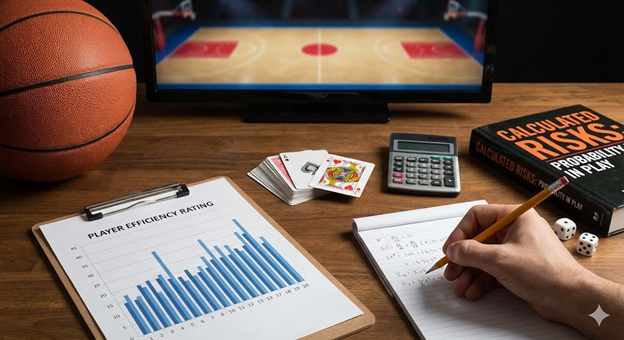
The professional gambler and the elite athlete have always been considered to be operating within dissimilar realms of influence. One of them plays in the stagnant yen of the casino and fights against the house odds with the help of mental arithmetic, the other is playing in the muscles of the basketball court, depending on the muscular memory and dynamism. But behind these conflicting environments, there is this basic truth: both fields are at the mercy of the brutal laws of chance.
The current development of professional basketball, which is commonly viewed as a subset of the broader term of analytics, is simply the introduction of the so-called Advantage Player (AP) mental framework, a theory developed on the blackjack tables, into a basketball setting. This article discusses how the geometry of the casino floor has turned the NBA into a revolution and turned it into an aesthetic bias game into an efficiency science.
The Advantage Player: A Shared Philosophy
The Advantage Player (AP) of a casino does not play conventionally. They are not dependent on intuition, chance, and magic. They rely on a system. They are aware that whereas short-term variance (luck) determines the result of one hand, the Law of Large Numbers is absolute and governs the result of a session, season, or career.
The AP turns the tables on the House Edge by determining cases where the mathematical expectation is positive and exploiting them to their benefit to make the House Edge the player’s advantage. This philosophy has revolutionized the game in the National Basketball Association (NBA). Its goal is no longer to just score, but to maximize the Expected Value (EV) of each possession, as the blackjack player aims to maximize the EV of each bet.
In the world of low-stakes conditions, many individuals seeking to learn these concepts prefer to play blackjack games online, where they can learn the basic strategy without the stress of having a physical pit boss. Similarly, young basketball players are now brought up based on a diet of efficiency measurements, and they learn early on that the process of shooting a good shot is more important than the outcome itself.
The Currency of Decision Making: Expected Value (EV)
One needs first to match currencies to even the distance between the green felt and the painted court. The chip is the blackjack money, and the aim is to maximize the profit on the bet. The asset in basketball is possession, and the objective is to maximize Points Per Possession (PPP).
Expected Value (EV) is a concept that is at the heart of this analysis. In probability theory, EV is the weighted average of all outcomes.
- Blackjack EV: $\sum (Probability \ of \ Outcome \times Payout \ of \ Outcome)$
- Basketball EV: $\sum (Shooting \ Percentage \times Point \ Value \ of \ Shot)$
Take a blackjack game where a player has 20, and the dealer has 8. The winning probability of this player is about 92%. The only logical choice is to stand since it will maximize the hand EV. A blow would be a mathematical disaster and reduce a close certainty of victory to a probable defeat.
Likewise, with basketball, a dunk is converted more than 90 percent with an EV of about 1.8 points. Conversion of a 22-foot two-pointer, which is disputed and has only a conversion rate of about 38, has an EV of 0.76 points. The margin of these two decisions is 1.04 points per possession, which is the edge. These two analogies can be used to explain why the choice with the lower EV would always result in a loss during a 100-possession gam,e just like how hitting on 20 would always give you a bankruptcy.
The NBA of today has embraced the philosophy of Moreyball, named after the executive Daryl Morey, that emphasizes three-pointers and rim shots and removes the mid-range jumper. It is not a matter of taste; it is the strict use of Bthe asic Strategy. The knowledge is that the 35 percent three-point shooter (1.05 PPP) is better than the 45 percent mid-range shooter (0.90 PPP). The mid-range shot rejection is the basketball analogue of the blackjack player declining the side bet, which is called Insurance. Though it appears to be an attractive bet, it is mathematically calculated to empty the player’s bankroll in the long run.
Basic Strategy: The Mathematics of Shot Selection
In blackjack, Basic Strategy is a chart that tells the mathematically optimum action on any combination of player and dealer up-cards. It is immutable. This does not matter whether the player feels lucky or the dealer looks weak. It merely computes the chances of busting or making a hand and the course of action that has the best expected payoff. The Basic Strategy card in the NBA is the Shot Chart.
The “Double Down”: Layups and Corner Threes
A blackjack player should have one of the most potent instruments, and this is the so-called Double Down. This alternative enables the player to multiply his/her bet, as the reward is the addition of one card only. Basic Strategy requires doubling down where the statistical edge of the player is great, which is the general case where the player is wound up with a total of 10 or 11 to the weak up-card of the dealer (2-6). The reason is easy to understand: the player has a high chance of making a good hand (19-21), and the dealer has a high chance of busting. This maximises the capital to be used when there is a positive expectation event.
In basketball, the Restricted Area (0-3 feet rim) and the Corner Three are the Double Down opportunities.
The Restricted Area: This area on the court is the highest percentage area. Over the last couple of seasons, particularly in the case of offensive initiators such as Luka Doncic, the EV of attempts in the rim had approximately 1.68 points per shot (PPS). This is the same as having an 11 versus a 6 of the dealer. The likelihood of success (scoring) is such that the offense is to be aggressive in seeking these opportunities.
The Corner Three: There is a geometrical inefficiency of the basketball court. The three-point line is not an ideal arc, but it flattens at the corners so that players can be free to stand within the bounds. This puts the corner three-pointer 22 feet off the rim, as opposed to 23.75 feet at the top of the key.
This difference of 21 inches amounts to a serious increase in accuracy. Corner shooting is always in the range of 38-40 percent, but above the break, three-pointers are in the range of 35-36. A 40 percent shooter on the corner produces 1.2 PPP. A player would have to make 60 percent to equate this efficiency with a mid-range jump shot. The history of the game reveals that practically no player maintains 60 percent shooting on mid-range jumpers of large volume.
The same way a blackjack player would be foolish not to double down when he has 11, a basketball team is foolish not to build its offense such that it creates corner threes. When mid-range jumpers are substituted with corner threes on the same team, those teams are projected to gain 3-4 points per gam,e which on many occasions is the difference between a win and a loss.
The “Sucker Bet”: The Mid-Range Jumper and Insurance
In blackjack, the players have the option of insuring against an Ace used by the dealer. The bet is 2: 1 in case the dealer contains a blackjack. Although it seems to appraise the player, the calculation proves that it is a trap. The percentage of non-10s to 10s in a deck implies that the fair payout must be greater than 2:1. Therefore, the insurance bet is awarded a house edge of about 5.9 percent and 7.5 percent. It is a sucker bet, which is based on risk aversion.
The basketball version of Insurance is the Long Mid-Range Two.
The 18-foot jumper is usually selected by the players since it is perceived to be safer or closer than a three-pointer. It is a fulfillment of the psychological desire to see the ball through the hoop (greater field goal percentage than the three), but it does not think about the point value. A player with a 42% mid-range shooting translates to 0.84 PPP. A player whose three-point percentage is 36 generates 1.08 PPP. The mid-range shooter loses more than 100 possessions by 24 points- a blowout.
The characteristic feature of the analytics era is the fall of the mid-range shot. The most prevalent shot in the NBA in the year 1997 was the mid-range jumper. As of 2021, it had turned into the least widespread. This transition reflects the change in the blackjack strategy from superstition to computer-based optimization.
The “Hard 16”: The Late-Clock Bailout
The worst blackjack hand is the “Hard 16” (e.g., 10 and 6) vs. 10 of the dealer. If you hit, you likely bust. Should you stand, the dealer has probably 20 and beats you. Basic Strategy is that one should hit (if given the chance) since hitting has an insignificant possibility of improvement, whilst standing has an almost certain loss. It is a negative expectation scenario in which one just aims at reducing the loss.
The Hard 16 is the Late-Clock Contested Jumper in basketball.
Once the shot clock has elapsed to 4 seconds and the offensive set has broken down, the ball handler is compelled to shoot a hard, step-back shot over a defender. This shot can get 0.70 PPP only. It is a dreadful, vacuous shot. Nevertheless, it is the mathematically correct play, as compared to a shot clock violation (0.00 PPP). Effective players know that it is better to shoot a bad shot than a turnover, but elite players never have to face the Hard 16 scenario by making an early offensive play. As an AP will evade bad situations by counting cards and paring back bets, so will an elite point guard evade end-of-clock bailouts by controlling the possession effectively.
Counting Cards: Situational Awareness
Whereas Basic Strategy is the fundamental level of decision-making, there is Card Counting, which brings about the dynamic factor. The concept of card counting is to keep a count of the high-cards to the low-cards, or cards of 10s and Aces to the remainder of the deck. The chances of the player achieving a blackjack are high when the remaining deck has a lot of high cards. The AP bets more to take advantage of this temporary advantage.
Basketball has its own “Count.” Clubs and diamonds are not allowed to compose the deck, but Fouls, Timeouts, Momentum, and Fatigue are. The elite gamer is a card counter who monitors these variables to determine when the deck is hot.
The Bonus: Playing a “Hot Deck”
The Bonus Situation is the most similar to a high True Count in blackjack. When a team has already committed five fouls in a quarter, all further fouls will give out free throws to the opponent.
The NBA average possession produces approximately 1.15 points. The Expected Value of a trip to the free-throw line (2 shots) of a 78% shooter is 1.56 points. This is a tremendous saving in efficiency. In the penalty of the opponent, the count is overwhelmingly positive. The example of a drive to the rim is of invaluable worth since even a defensive skirmish of any size can lead to a whistle.
Strategically, it is a failure to take a jump shot when the opponent is in the bonus. It rescues the defense and is similar to flat-betting in a hot shoe. The fouls generally have a far greater offensive rating on teams compared to the fouls that can be given. Elite players are keen on this, and they will do anything to create fouls, and this is when they are on a bonus.
“Deck Penetration”: Fatigue and Rotations
In counting cards, the depth of the penetration of the dealer into the shoe before shuffling is known as deck penetration. With more penetration, it will be possible to count and benefit more. In basketball, deck penetration is symbolized by the game clock and player turns.
Certain defenders also gain fouls or become exhausted as the game moves on. An intelligent player will be monitoring the number of fouls the opposing center commits. When the rim protector accumulates 4 fouls during the third quarter, they are virtually nullified. They are unable to challenge aggressively on the shots as they are afraid they will end up fouling. The offensive tactic changes to assaulting the paint since the deck is no longer occupied with Aces (defensive blocks/ stops). The AP pressurizes this vulnerability on and on.
The Defensive Bankroll: Risk of Ruin
Bankroll Management in gambling refers to the management of funds to survive the swings and prevent going broke (Ruin). A gamer may lose it even when he/she has a statistical advantage and bet too much on one hand. The scoreboard and defensive integrity of the team in a basketball game is his Bankroll. High-variance strategies, such as defensive chasing, which includes steals and blocks, are widely used as defensive strategies that can produce defensive ruin.
The most useful defensive action in basketball is the steal, which ends the opponent’s possession (saving an average of 1.1 points) and, in most cases, leads to a transition opportunity. The time-value of transition possession, leaving a live-ball turnover, is estimated at 1.36 points compared to 0.96 points caused by a regular half-court possession. This 2.5-point margin is the basketball lottery.
Such a jackpot, however, is hunted at a great risk. To create a steal, a defender has to lunge into a passing lane or cross the body of the dribbler. In case of a failure in the gamble (a “Whiff”), then the defender is removed from the field, providing the offense with a 5-on-4 advantage. The EV of a 5-on-4 scenario is much greater than the EV of a typical possession, and it will tend to result in a dunk or an open corner three.
This brings about the Kelly Criterion of defense. The Kelly Criterion is a mathematical formula applied by gamblers to calculate the best size of a bet to increase the growth. When the chances of success are very high, a defender needs to gamble and steal the ball in basketball. Historical analysis usually shows that great steals, such as Allen Iverson, are able to lead mediocre defenses since the points they generate through steals are overwhelmed by the points they give up through blow-bys. Elite defenders such as Jrue Holiday, on the other hand, can retain their steal rates without gambling and rely on position to take chances instead.
Managing Tilt: The Psychology of Performance
The psychological side of playing advantage is what tends to push the player into the break-even category or a professional. In poker and blackjack, Tilt refers to a state of emotional frustration when an individual loses their strategy due to a bad beat, whereby he/she bets recklessly to recover it.
In the basketball game, Tilt occurs in forms of Hero Ball or a frustration foul. The trigger can be a three-shot streak, or even a no-call on a drive (the Bad Beat). The amygdala also seizes the prefrontal cortex, which interferes with rational decision-making. One tends to respond by attempting to have a disputed pull-up three on the next swing, attempting to overwrite the bad feeling with one homerun. It is nearly always a negative EV trend.
The antidote to Tilt, which is preached by the legendary coaches, is the philosophy of Next Play. In probability theory, independent events are memoryless. The deck of cards is not aware that you lost the past five deals. The rim is not aware that you have missed the previous three. The AP is also concerned with only the decision and not with the result. When a player misses a wide-open corner three, the AP gets satisfied since the decision was the right one (positive EV). When a player steals an open mid-range turnaround and hits it, the AP is unsatisfied due to the wrong decision (negative EV).
Conclusion: The House Does Not Always Win
The House Always Wins is a true expression of the amateur gambler. It is not true to the Advantage Player. The AP triumphs since they do not see the game as a form of entertainment, but a chain of mathematical problems to be solved.
In basketball, the “House” is the opponent, the referees, the crowd, and the inherent chaos of the sport. An effective team beats House due to the ability to take only a few shots (Basic Strategy), take advantage of circumstantial factors such as the bonus (Card Counting), deal with defensive risk (Bankroll Management), and avoid emotional decision-making (Tilt Control).
For the aspiring analyst or player, the lesson is clear: study the math. It is the same whether you are examining the geometry of courts or are keen on playing blackjack games online to train your concepts on probability. The victory of the process over the outcome, of math over ego, of the long over the short run. When the shot clock runs out, and the tension is growing, the player, who believes in the math, does not simply hope that he will get a good result, but he has the calculation.