
ERIC BELL – FOUNDER OF PLAYERS DEVELOPMENT CLUB – EPISODE 1327
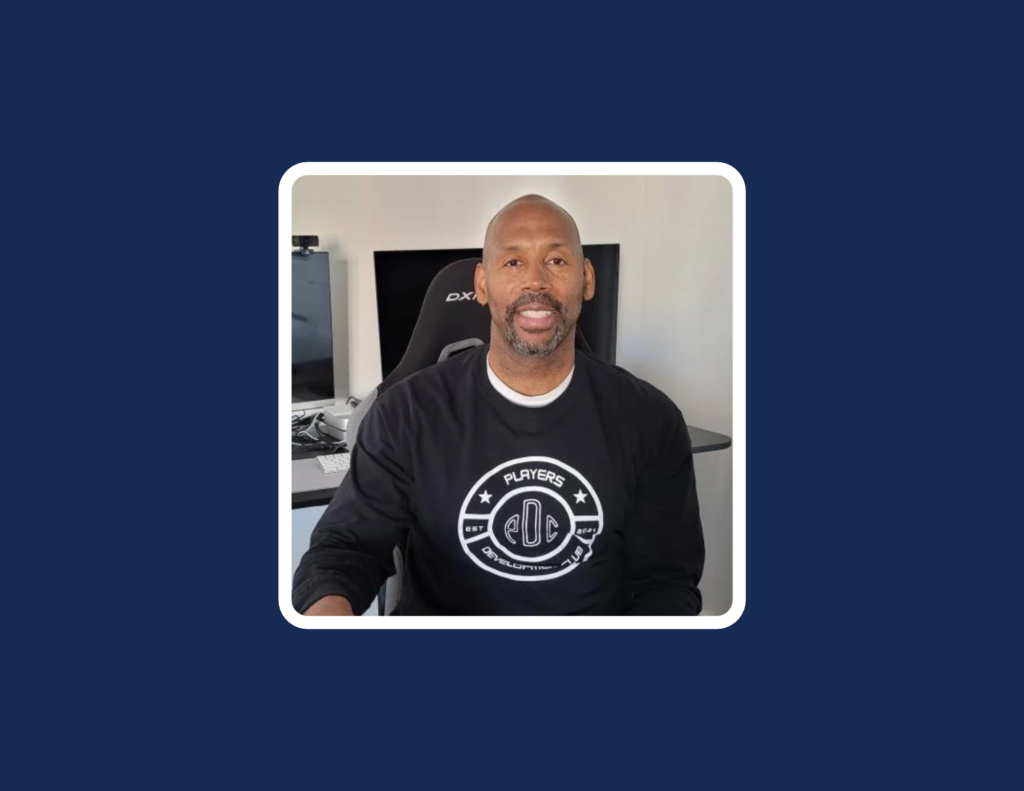
Website – https://playersdevelopmentclub.com/
Email – [email protected]
Twitter/X – @PDC_Hoops

Eric Bell is a former professional basketball player and the founder of Players Development Club, where he coaches young athletes and advises their parents. A native of Modena, New York, Bell played at SUNY New Paltz from 1992 to 1996. A three-time first-team all-conference selection, he finished his college career with 490 assists and 355 steals, both school records at the time of his induction into the Hawks Athletics Hall of Fame in 2016. As a senior, he helped lead New Paltz to its first conference tournament championship game.
Bell went on to play professionally for a decade in Denmark, Portugal, Estonia, Norway, and Germany, winning five championships and earning eight MVP awards. In 2018, he founded Players Development Club to help young athletes handle pressure, respond to setbacks, and grow into leaders. His work also addresses questions parents face throughout a season, from how to talk with a coach to when to encourage a struggling player and when to give them space. Bell is the author of The Blueprint for Young Athletes, a guide to confidence, goal-setting, and leadership for athletes, parents, and coaches.
Follow us on Twitter and Instagram @hoopheadspod for the latest updates on episodes, guests, and events from the Hoop Heads Pod.
Make sure you’re subscribed to the Hoop Heads Pod on iTunes or wherever you get your podcasts and while you’re there please leave us a 5 star rating and review. Your ratings help your friends and coaching colleagues find the show. If you really love what you’re hearing recommend the Hoop Heads Pod to someone and get them to join you as a part of Hoop Heads Nation.
When an idea clicks, hit pause and put it in your own words as you listen to this episode with Eric Bell, founder of Players Development Club.
The Hoop Heads Podcast was recently selected as #4 on a list of the 47 Best Basketball Coaching Podcasts. Check out the list here – https://podcast.feedspot.com/basketball_coaching_podcasts/
Feedspot is an RSS Reader that lets you follow your favorite podcasts alongside blogs and news in one place.
What We Discuss with Eric Bell
10 Key Takeaways for Basketball Coaches
- Make access to a court a priority.
Bell says having four or five nearby courts gave him plenty of chances to play and improve.
- Give players lots of game reps, not just individual drills.
Bell describes spending much of his early development playing pickup and “21,” while Mike notes how much players today may focus on individual training.
- Let players test themselves against stronger competition.
Bell moved from playing with neighborhood kids to older, bigger, faster players—and says those tougher games helped his game reach another level.
- Teach persistence through challenging matchups.
Bell says he kept showing up even when it was hard to earn a spot on the older players’ court; over time, he went from last pick to first pick.
- Use competitive games to teach reading defenses.
Bell says “21” put him against double- and triple-teams, forcing him to read the defense and find a way to get a shot off.
- Build toughness with demanding play, but coach it safely.
Bell recalls that the physicality of “21,” where fouls were rarely called, toughened him up. The coaching takeaway is to challenge players while still setting appropriate safety rules.
- Create a clear progression of opportunities.
Bell describes moving from playing at home, to neighborhood games, local leagues, summer leagues, high school and college. Coaches can help players see, and prepare for the next step.
- Pair informal play with structure and discipline.
Bell contrasts playground basketball with high school, where he encountered a coach, an official whistle, structure and discipline. Both kinds of experience can teach different skills.
- Make pathways visible; don’t assume players know what’s possible.
Bell says the NBA and even college weren’t on his radar growing up, and that professional play overseas only became a possibility after college. Coaches can share options early and connect players with guidance.
- Help players navigate exposure and recruiting changes.
Bell says moving from Harlem upstate cost him access and recognition, and he lacked people around him who could explain the college process. Coaches can help players find the right opportunities and understand how to pursue them.
Like this show? Please leave us a review here — even one sentence helps! Consider including your Twitter handle so we can thank you personally!

XCIV.ai: Game planning for coaches, no film required. No video staff? No problem. Upload your opponent’s box score or a photo of the scorebook (or film, if you have it), and XCIV.ai builds a scouting report, a game plan, and a practice plan. It’s made for high school, middle school, and AAU coaches. Built in Colby, Kansas, XCIV.ai is a corporate partner of the Missouri (MBCA) and Indiana (IBCA) basketball coaches associations. There’s a free plan, and it’s on the iPhone.
Start free: https://hoopheads.xciv.ai

Depth Chart: Find Your Fit. Know Your Next Move.
College basketball recruiting is more competitive than ever. Depth Chart helps high school basketball players, parents, and coaches navigate the process with honest,data-backed recruiting insights.
Using an algorithm that evaluates each athlete’s profile against five seasons of roster data from over 1,000 Division I, II, and III programs, Depth Chart identifies whichcolleges best match a player’s abilities and profile.
Athletes receive personalized school recommendations, comparable player analysis, a ranked list of 40 programs, and a 90-day action plan to help guide their recruitingjourney.
Stop guessing where you fit. Start making informed recruiting decisions.


Your first impression is everything when applying for a new coaching job. A professional coaching portfolio is the tool that highlights your coaching achievements and philosophies and, most of all, helps separate you and your abilities from the other applicants.
The key to landing a new coaching job is to demonstrate to the hiring committee your attention to detail, level of preparedness, and your professionalism. Not only does a coaching portfolio allow you to exhibit these qualities, it also allows you to present your personal philosophies on coaching, leadership, and program development in an organized manner.
The Coaching Portfolio Guide is an instructional, membership-based website that helps you develop a personalized portfolio. Each section of the portfolio guide provides detailed instructions on how to organize your portfolio in a professional manner. The guide also provides sample documents for each section of your portfolio that you can copy, modify, and add to your personal portfolio.
Aiming to go D3? The D3 Recruiting Playbook gives you a clear, step-by-step roadmap to the recruiting process – what coaches value, key milestones from early high school through application season, and how to build a target list of schools that fit your needs.
We’ll demystify researching D3 programs and how to stand out without chasing every camp or showcase.
The modules cover things like writing emails to coaches, building an effective highlight tape, using social media well, planning ID camps and visits, and navigating application strategy.
You’ll get templates, checklists, and an outreach plan to communicate confidently, learn how to compare financial packages, and avoid common missteps. By the end, you’ll have a prioritized school list and a decision framework you can use to land your best-fit opportunity.
THANKS, ERIC BELL
If you enjoyed this episode with Eric Bell let him know by clicking on the link below and thanking him via Twitter/X.
Click here to thank Eric Bell via Twitter/X
Click here to let Mike & Jason know about your number one takeaway from this episode!
And if you want us to answer your questions on one of our upcoming weekly NBA episodes, drop us a line at [email protected].
TRANSCRIPT FOR ERIC BELL – FOUNDER OF PLAYERS DEVELOPMENT CLUB – EPISODE 1327
[00:00:00] Narrator: The Hoop Heads Podcast is presented by Head Start Basketball.
[00:00:19] Eric Bell: There’s a difference between we understand things, we know things. It’s just a matter of executing. That’s the difference. The understanding is one thing, but the actually executing those things consistently over time to get some results, that’s the portion that’s missing.
[00:00:39] Mike Klinzing: Eric Bell is a former professional basketball player and the founder of Players Development Club, where he coaches young athletes and advises their parents.
Bell played his college basketball at SUNY New Paltz from 1992 to 1996. A three-time first-team all-conference selection, he finished his college career with 490 assists and 355 steals, both school records at the time of his induction into the Hawks Athletics Hall of Fame in 2016. As a senior, he helped lead New Paltz to its first conference tournament championship game.
Bell went on to play professionally for a decade in Denmark, Portugal, Estonia, Norway, and Germany, winning five championships and earning eight MVP awards along the way. In 2018, he founded Players Development Club to help young athletes handle pressure, respond to setbacks, and grow into leaders. His work also addresses questions parents face throughout a season, from how to talk with a coach to when to encourage a struggling player and when to give them space.
Bell is the author of The Blueprint for Young Athletes: A Guide to Confidence, Goal Setting, and Leadership for Athletes, Parents, and Coaches. Coaches, this episode is brought to you by XCIV.ai. You heard founder Zach O’Dell right here on the Hoop Heads pod. Now, here’s what his team built. You’ve got a game Friday and no time to chase film.
Take your opponent’s box score or just snap a photo of the score book and upload it. XCIV.ai turns it into a scouting report, a game plan, and a practice plan. No film required. It’s built in Colby, Kansas for high school, middle school, and AAU coaches, and it’s a corporate partner of the Missouri and Indiana Basketball Coaches Associations.
There’s a free plan, and it’s on the iPhone. Go to hoopheads.xciv.ai. That’s hoopheads.xciv.ai.
[00:02:33] Scott Deans: Hi, this is Scott Deans, founder and CEO of B1 Sports, and you’re listening to the Hoop Heads podcast.
[00:02:41] Mike Klinzing: When an idea clicks, hit pause and put it in your own words as you listen to this episode with Eric Bell,
[00:02:46] Scott Deans: founder of Players Development Club.
[00:02:49] Mike Klinzing: Hello, and welcome to the Hoop Heads podcast. It’s Mike Klinzing here tonight without my co-host Jason Sunkel, but I am pleased to welcome in Eric Bell from the Players Development Club. Eric, welcome to the Hoop Heads pod, man.
[00:03:02] Eric Bell: Thanks, man. Appreciate you having me, Mike.
[00:03:05] Mike Klinzing: We are thrilled to have you on. We are looking forward to diving into all of the interesting things that you’ve been able to do in your career, first as a player, and then what you’ve built as a coach, not only to athletes, but to businesses and to try to make the world a better place for people.
So Eric- yeah … let’s start by going back in time to when you were a kid. Tell me about your first experiences with the game of basketball. Who got– Who introduced it to you? How’d you fall in love with it?
[00:03:33] Eric Bell: My, my pops, he– every Christmas, every birthday, it was a Nerf or they call it, I think it was Jordan Jammers back in the day.
So I got that every Christmas, every birthday, and it was almost like, He made it a, an, a, a point to get me in basketball and keep me away from football because he was a football player. So every birthday up until, I don’t know, I don’t know, up maybe 12 or so I had that and then that’s when the love grew.
And then I went from playing in my in my apartment in Harlem to going outside with my friends. And then growing up I’m from Harlem and one of the I’m in a, I live in a project, so we, there’s a circle, there’s a, a historical playground tournament called King Towers, and now it’s King Dome.
So I lived in that projects, and while the main games were going on, we used to play in the side with garbage cans, iron garbage cans, and we used to cut out the bottom and we used to play back and forth. So that’s when the that’s how it started, and then after that it was like a slow progression.
I went from in my apartment to outside and then there was some coaches in my projects and they had little leagues that we used to go to. So yeah, that was like the path, and then we went from the leagues to like the summer leagues and then high school came, then college came.
So that was like the trajectory. I was thinking about that the other day
[00:04:58] Mike Klinzing: Tell me a little bit about, again, the play, the, the pickup basketball scene growing up in New York City when, during your era. This is a conversation that, Eric, I love to have with guys. It’s something that I’m passionate about because I feel like for me as a player, developing into the player that I became, so much of it I owe to pickup basketball and just being able to go and find a court or knowing where the best players were playing and just going and playing.
And it’s so different from how things are today. Yeah. But I’m just curious what your experience was like with pickup basketball in New York City back in the day.
[00:05:34] Eric Bell: So back then it was all about access, right? So we had at least four or five different courts that we can play on. So that’s a lot of games.
So if you love the game and you were trying to get better, you were playing at one of those, those playgrounds. And then it was all neighborhood kids, so you knew everybody. Everybody was really good at that time. S- just older guys, younger guys. It was no age cap, so you were going up against grown men.
You were probably going up against people your age. But the, the beauty was, like, you got those reps in, and that’s essentially how I got better because I played all the time. Maybe some of my peers didn’t play as much as I did, and I kinda leaped them and started to play with the older guys.
They kinda graduated me up. So yeah, it was just access and then crazy reps, and then playing against older guys, and then my game was like… Yeah, it w- went to another level.
[00:06:31] Mike Klinzing: Do you remember the first time you got onto the, quote, “main court” with the older guys and got away from the, got away from the kids’ court?
[00:06:39] Eric Bell: Yeah. O- One, one of my best friends in Harlem, a guy by the name Ronnie Ice Ronnie Cooper he kinda he’s like, “Oh-” You’re not playing with the your group anymore. You up here. And then around that time, I just remember it would be, it was extremely hard because they were all bigger, faster, stronger, smarter.
But one thing I did was I stuck with it. I never got deterred because of the competition or the challenges and adversity. I just kept showing up every, every time. Every, every time there was a game with that big group, I would try to… Somehow or that I would get on the court. And then it over time like everything else you get it you adapt, you get better, you figure things out.
And then I went from barely trying to get on to they, you the first, you the last pick, and then you kinda move up. And then at some point I was the first pick. So it was crazy to think about it.
[00:07:26] Mike Klinzing: Yeah. The hierarchy of pickup basketball is-
[00:07:30] Eric Bell: Yeah
[00:07:30] Mike Klinzing: amazing, and it’s something that I don’t think that player… I say this all the time. I feel bad for my own kids and my son, who, he’s a junior in college right now playing Division III basketball at Ohio Wesleyan. And I tell him all the time, I’m like, “Dude, I feel so bad for you that you didn’t get to experience this,” what you just described, right?
I worked my way up from, I’m playing on the third court, and then I get to move up. And then, like you said- … some older guy puts their arm around you “Hey, man I’m bringing this kid along as our fifth guy. But kid, you better not shoot. You’re just passing it to-” yeah … “Guy X.”
Yeah. “You better play defense.” Yeah. And then slowly you evolve and it just, again, the hierarchy of the way pickup basketball works is it’s just so much fun to have five dudes come together who May or may not know each other and have to figure- Yeah … each other’s game out, and the chemistry and the basketball IQ that’s built from all of that.
And again- Yeah … clearly it’s different from the way that things work today, right? With the amount of just training that players do with-
…
[00:08:24] Mike Klinzing: Individually, right? There’s so much more individual work than there is playing, just playing the game. And so when you think back to your experience, how much access did you be able to a- did you have to be able to get on a court by yourself and ever work on your game?
I’m guessing that the majority of your time, at least when you were younger, was probably just spent playing, correct? Or am I off?
[00:08:43] Eric Bell: Yeah, that, that was correct. It was e- it was… So there was two two lanes, right? I want to say two lanes. We played a lot of five-on-five, but we did play a lot of 21.
[00:08:52] Mike Klinzing: Yeah.
[00:08:53] Eric Bell: And that’s essentially you against everybody else. Yep. You against… So one thing, and I heard Carmelo Anthony and I think T-Mac talk about this that was so beneficial for the game because you get double team, triple team. So if you not, if you can’t read the defense and get the shot off and, that kind of elevated my game too.
So I got those two paths to essentially skyrocketing my game. But yeah, that was the early early years.
[00:09:18] Mike Klinzing: The physicality of 21, man. Kids today don’t understand what that looked like.
[00:09:22] Eric Bell: Yeah. Yeah. But you’re not getting, you’re not getting fouls. Like- … you’re not getting fouls.
So you, that, that was another thing that toughened me up. Oh oh, like you’re not getting that foul. You have to be bleeding or you have to be on the ground to like actually get a f- get a foul call.
[00:09:35] Mike Klinzing: No question about that. So- Yes … as a young kid, high school player, what’s your dream in the game?
What are you thinking about? Are you like most kids, you’re dreaming about someday getting to the NBA? Where’s your mindset? What… Or are you just, “Man, I just love the game. I’m playing.” What were you thinking as a, again, junior high- Yeah … high school player?
[00:09:56] Eric Bell: Yeah. That wa- that was a, that’s a great question.
I didn’t know, I didn’t know the NBA was possible. A lot of times they have people before them to give them a, a, a glimpse of what’s to be or what’s possible. I didn’t have that, and nobody in my neighborhood went to the league or was a professional athlete, so that wasn’t on my radar. My radar was just play as much as I can and get better.
And then junior high school, you’re starting to, develop a little bit, get some notice, and then I moved up. My parents moved me upstate with my grandmother, and then that’s when things started to make sense because okay you’re under, in high school team, under a, a, a, c- an official whistle.
You got a coach, and it’s all about structure and discipline, and Then I think I didn’t even really know, even in high school, I was like, oh I, the, the league wasn’t, or like even professional wasn’t on my mind. So I, it never occurred to me up until I left college and they was like, “Oh, you can not really go to league, but yo, you can definitely play overseas.”
So that’s when it started to… But that’s like really late, right?
[00:10:58] Mike Klinzing: Absolutely. Yeah. So tell me a little bit about the, just from a standpoint of college basketball. When did that get on your radar? And then who kinda helped you with that process to kinda figure out, hey, what is it that, what is it that I need to do in order to enable, be able to have that opportunity?
What did that look like for you?
[00:11:17] Eric Bell: Yeah. So not having the even college on my radar, it was like, “Oh, you, I’m about to graduate.” “Oh, you have to go to college.” I was like, “What?” And then, So it w- it was two things, right? One thing that kinda hampered my career was moving from Harlem to upstate, right?
So I lost all the access and the just the recognition and being in the mix of all of the great guards that were there. So you shipped away, you’re off on this little island, and you have to try to figure out how you’re going to make it to the big stage as far as D, D1 or whatever the case may be.
But I didn’t have that, I didn’t have that that, that talk and people in my camp wasn’t, privy to that information. When it was time to graduate the only, only offers that I got was a Division III school, which essentially you’re right down the road from my high school.
So I was like, okay, you got you have the ability to play and the school is right there. This coach wants you to play. So I just went there. Division III was tough, but one or two steps ahead. And then I think mentally and emotionally, that’s where I struggled because I had D1 talent, but I was stuck in, at a D3 program and I couldn’t figure out how to get out.
So that, that’s when things changed and the mental piece, the emotional piece, f- first year, second year, third year, spiraling, spiraling, spiraling. Then after my third year, got kicked out of school. And that was a blessing because it kinda woke me up to being grateful for my opportunities, right? And then I, I remember it like it was yesterday, my coach, like he say, “Hey they’re going to expel you.”
And then I had no idea what I was going to do. It was either go back to the city, but I didn’t have no options. But he made it clear. He’s like, “Oh, just go up the road to community college, just get your grades and come back.” Really simple. I did that and I came back and then we had a tier, got to the championship.
We eventually lost, but yeah, that, that was the path from high school to college and my wake-up call that essentially transformed how I was as a pro and when I went to Europe.
[00:13:17] Mike Klinzing: So let’s talk a little bit about the pro career, but let’s also talk about kind of what your mindset was. Again, obviously as a player, your ability, like you talked about- enabled you to be able to go on and have a long professional career, which we’re going to talk about here in a second. But from a, from an academic standpoint and kinda going through and taking care of business at the community college and then coming back What was your mindset beyond being a player?
Was there anything… again I know from talking to you the other day on the phone- Yeah … and just seeing what you’ve built, that-
…
[00:13:50] Mike Klinzing: There’s a lot more to you than just being a basketball player. Was it that way at the time, or were you more like a typical 18, 19, 20-year-old kid that you were just focused on being a player?
‘Cause I know everybody goes through things where you’re trying to figure yourself out, right? So I’m just curious what your mindset was at the time.
[00:14:07] Eric Bell: Yeah. It was all downhill those first three years. But I needed that. I needed that. And then when I went to the community college, it I say it transformed me because I went from being, like, lazy and just getting by, to disciplined, like extremely disciplined.
I was there for one semester, but I was on it. I was on it. Everything “Oh, this needs to be done.” I was efficient. I was, I w- I had a a, a product, a productivity pillar that I use. It was time management, planning, execution, and documentation. That essentially got me through, and I moved that over to my pro career.
But yeah, the, the community college was a blessing and then it woke me up and it got me ready for for the pros, but yeah.
[00:14:52] Mike Klinzing: So walk me through from Division III to getting an opportunity to play overseas. What are the steps that you had to take? Who are the people that helped you- to make that transition? ‘Cause that’s something that, again, if you don’t- Yeah … have the knowledge of how to make that happen- Yeah … lots of guys fall through the cracks that might have the talent to be able to play, but just don’t get the opportunity. So tell me about how that, you got that opportunity.
[00:15:17] Eric Bell: Yeah. It was a blessing. And back then it w- it wasn’t that many people going, At least from my neighborhood. But it was a blessing because towards the end of my end of my, my, my senior year, my coach is, and he knew some people in Ireland and some, some European people in Germany. Said, “Oh, you can play.”
So it was t- like, trying to f- find an agent, that was the toughest thing, and I never found the agent. But I, I got extremely lucky and blessed because one of the guys, he was from Saratoga, a guy named Pete. Pete Filo. We played in a lot of summer tournaments, and he was in Denmark my senior year.
So he called me up, he say, “Hey, I’m going to be leaving. I’m going to tell the owners and the coaches about you so maybe you can play here.” And then that summer they called me up. I was working at a sports academy up upstate New York, and I got on the phone with the coach. I had a maybe a 30-minute conversation with him, and I was just telling him what I was looking to do.
I was in great shape. L- all of that stuff. But Pete already put a plug in his ear, so- I talked to him and he sent me a contract right after we got off the phone, and that rarely happens. A contract from a referral So that, that’s essentially, that was the start of my first pro career on a phone call from a referral from a, a, a guy I played pickup ball with in the summertime.
[00:16:40] Mike Klinzing: What’s that like going over there culturally by yourself, figuring it out, again, as a young guy overseas? W- just what was that like? What was the first… Obviously, by the time you had more experience, you got used to that. But that first time, what do you remember about getting off the plane, landing, and then just trying to figure stuff out?
[00:17:00] Eric Bell: I was well prepared because one of the things that my parent did, my parents did was when they took me from Harlem to Upstate, they gave me a, a, a level of independence, right? I wasn’t really… ‘Cause when I went upstate, a lot of times my grandmother was away, so I had to cook for myself, clean.
I had to do a lot of stuff by myself. So that instantly gave me independence. So when I went over, when I went overseas, the, the, the being on your own and it wa- it was easy. Plus, I had the right mindset when I went over there because I want to be an elite professional, and I want to go in here and earn, earn my keep, so to…
so it… from that standpoint, it was pretty good. It was easy. I didn’t really have no struggles, and I fit in really well because I had did that in high school, going from h- from New Y- from New York to upstate, and those are two different worlds. So I had the training already, so to speak.
[00:17:51] Mike Klinzing: Yeah, that makes sense. What… Over the course of y- over the course of your career, what would you say were some of the biggest challenges to having a successful career overseas? If there’s a player listening who wants to pursue a professional career overseas, what are some of the challenges that you feel like you had to overcome as you went through your career?
[00:18:13] Eric Bell: I think it was the mental thing for me, and that was in terms of even when I went over to… I was in m- Denmark for many years. In that area of Europe, I was still one or two steps ahead, right? So I had to like… It’s almost like being back in three d- division three already, right? Okay, it was a little bit easy, so you putting up great numbers, but there’s no respect for the leagues, and you want to play at this higher league, and how do you get over there?
So I had to deal with that, and I also had to deal with me, like, finding an agent. For the most part, I didn’t have an agent, so that’s why I really didn’t get to play in leagues in the countries that I want to because I didn’t have great representation. So for the players, looking now make sure you have gre- great representation that has sources that, that can plug you in or get you different tryouts and stuff like that when you go over there.
I think that was the two of the biggest things that I struggled with.
[00:19:08] Mike Klinzing: Yeah, that makes a ton of sense. Let me ask you about just the places where you had an opportunity to play. What was your favorite City, country, you narrow it down to well, however s- however small you want to get to. Where was your favorite place that you got to spend some time while you were over there?
[00:19:24] Eric Bell: So I loved Denmark and I love Scandinavia, but my, my heart is, was in Portugal. So I played there half a year, and small country, but it’s one of the most beautiful places in the world. And when you get to travel, you have checkboxes oh, they got this, they got that, and that place had everything on that checklist.
The league was really good. Had great coaches, great leadership. So that, that would probably b- be my first, and then Estonia would be my second. Even though the weather is different, Estonia was, like, one of the beautiful places in the world. The, the league was really tough. The people were good.
It, those would be my two places.
[00:20:05] Mike Klinzing: Which country had the best food?
[00:20:07] Eric Bell: Oh, Portugal. Easy. Easy. Yeah. Yeah. So easy. Easy.
[00:20:13] Mike Klinzing: All right.
[00:20:14] Eric Bell: Yeah. Yeah.
[00:20:14] Mike Klinzing: This is my favorite question to anybody who’s played overseas. Keeping in mind that it’s a PG-13 rated story, what’s your favorite craziest story from playing overseas?
The craziest thing that happened to you while you were there. I’ve heard all kinds of crazy stories, so what’s your best one?
[00:20:32] Eric Bell: Crazy. Not as a professional, but we did go to Spain, and th- this is graphic but not in a bad way. So we were in Barcelona for New Year’s in Spain, which is Grand, just to say that.
A fight broke out. Everybody was drinking. As far as like– ’cause we were there as a team, And then one of the, one of the guys had like a– got hit in the head with a bottle, and he had the thing, like, sticking out of his head. And I don’t know if that was too graphic, but that was the weirdest thing- No that’s good
or the strange- the strangest thing I, I’ve seen in a place like Spain. The– it was, like, New Year’s, so everybody a lot, went out and crazy. But when I saw that, I was like, “Whoa.” But yeah, that was probably the most weirdest or the scariest thing I, I’ve seen in a year. But other than that it was really calm.
All the places I’ve been to were really nice. Really nice.
[00:21:20] Mike Klinzing: That’s awesome. All right, so long professional career. Obviously, the game has been tremendously good to you as a player over the course of your life as you go through your career as a professional. As you’re coming towards the end of your career, is that something that you realized, “I’m coming to the end,” or was it, “Hey, I get hurt and now all of a sudden I’m done”?
Were you starting to think about what you were going to do when you were done playing? What was that kind of interior inside conversation in your own head? What was that like?
[00:21:53] Eric Bell: Yeah. A- as I was getting close I had to go back to history, right? A lot of people, they you wait till the last minute to start planning, right?
And I didn’t want to be that, that athlete. So I think maybe two or three years I was supposed to start like I was going to stop, I was like, “Okay, like what’s going to be the next chapter?” And then I came up with training, like a personal trainer, and then it was technology. I started the personal training for a while and I was like, “Ah, I don’t know if this is it,” because this is a luxury Right?
This is a luxury. People people, if you don’t… So personal training is a luxury, but technology is constant. Business and the world is run on technology, and I knew that back then. So I went down the course of taking some classes while, before I stopped getting ramped up, and then I got my deg- m- d- I got my degree, and then went through the whole process of ramping up my tech skills and eventually c- becoming an engineer.
So yeah. So two or three years before I stopped, I had th- had that conversation “Okay, what does this look like?” And mapping it out and planning it out. But yeah, I was very intentional and deliberate about that process.
[00:23:08] Mike Klinzing: All right, so then talk about the evolution from that original thought and plan of technology, the intersection.
Obviously, somehow staying involved with the game of basketball was obviously appealing to you. Take me from that moment when you get done playing to the evolution of what you’re doing now.
[00:23:29] Eric Bell: Oh, so it was interesting when I retired, I didn’t want to have anything to do with sports. It was just I was sports fatigued, if that’s a word.
But so it was like, okay I’m going to sports and I’m going to dive in and I throw everything in. And plus, I don’t know, for some reason I was just fed up with just the game and I had done so many camps and all. I’ve done a lot in that, that timeframe. But I was living in North Carolina, and then I was in my office, and then, I don’t know if this was the Spirit or God, something touched upon me to say, “Hey, you had this great career.
You started from zero. You worked your way up at every level as a junior high school, college.” I I’ve been a successful athlete. I won as a junior high. I won in high school. I got to the, the finals for my college. I got two Hall of Fames. I got several championship trophies i- in Europe.
I got several MVPs in in Europe. I’ve been coached by some great leaders. I’ve seen the world. And it was like, you’re going to take these experiences with you? You’re not going to share them with anybody? And then when I had to think about that, it was like, it was even selfish to even like to have that mindset.
So that kinda essentially broke my heart a little bit be- and it was like, okay I’ll give back. But at that point, yeah, I was like, I- I’ll give back. And then the idea of working with players at a, like a business capacity or professional capacity, I had to step my way through that, like what does that look like?
And so that’s when the, essentially around the time when the Players Development Club was like starting to shape form okay like you’re not going to train them from a skill standpoint because that’s already maxed out. But my thing was here, the mental piece, the emotional piece, life skills, and that’s like a untapped market.
It was then and is still now to this point, right? So that’s how like the, the, the coaching and the Players Development Club kinda was like the birth of at that point.
[00:25:30] Mike Klinzing: So what was the first step then once you kinda come to that realization that you want to focus more on that mental side, that life skill side, that helping people to, again, just improve themselves as human beings?
How do you take that idea? What’s the first step in building that into the framework for w- for what would eventually become your business, Players Development Club?
[00:25:56] Eric Bell: Just figuring out how am I going to serve them, right? Trying to have some frameworks in place. So that was like one portion of it, and then the other portion is a lot of times you have to meet them where they are and be able to help them navigate to where they want to go.
That was another portion. And then also starting to the point like, okay who can you work with? And then that fell through with your network and people and your contacts. And then that was one portion is okay okay, n- now you’re going to start a business. Like what does that look like?
LLC, like where you’re going to be based out of. So I had to like… essentially like everything is for me is like strategy, systems, roadmaps, and execution. That’s how my mind works, so I had to step through it. But those were the, the, the phases that I had to walk through or think through to get started.
[00:26:47] Mike Klinzing: Who did you envision initially as being your dream clients when you started the business?
[00:26:55] Eric Bell: So at that point I was living in Portugal and m- my dream clients would be like four different teams in different countries. It could be like a, a men’s team or a boys team or youth team, but maybe like boys, girls and it would be spread out.
So it would be like a, a different different client set. That w- that would be my dream and I’m s- I’m still working on that now. Yeah, that was the ideal situation because the youth department a lot of times in, especially in Europe, like the the level of coaching is not what it is like, especially from this standpoint.
So that, that was my angle.
[00:27:33] Mike Klinzing: College basketball recruiting is more competitive than ever. With the transfer portal and constantly changing rosters, high school players need a smarter way to approach recruiting. That’s where Depth Chart comes in. Depth Chart uses an algorithm and five seasons of college roster data to help high school athletes understand which programs fit their profile.
The platform provides personalized school matches, comparable player analysis, a ranked list of college programs, and a ninety-day recruiting action plan. Whether you’re a player, parent, or coach, Depth Chart helps you focus on realistic opportunities instead of wasting time guessing. It’s not just about getting exposure, it’s about finding the right fit.
Check out mydepthchart.com and use code HOOPHEADS50 for fifty percent off a report or the yearly package, and follow @
[00:28:19] Scott Deans: mydepthchart on Instagram.
[00:28:24] Mike Klinzing: So when you start thinking about working with– let’s focus on working with a team.
If you’re working with… If I’m coaching a team and- … I come to you and I say, “Eric, I want you to work with my team,” what does that onboarding process look like?
What are some of the things that you’re asking me to find out more about what my team’s all about, what I’m all about as a coach, and then figuring out the plan for how you can help me with the things that I’m maybe struggling with. H- what’s the onboarding process?
[00:28:51] Eric Bell: Yeah. That’s essentially like a discovery call between maybe like the head coach and the assistant coaches, and figuring out what those pain points are and what individually they’re trying to do f- like from each player, and then from a team standpoint.
And then it would be like meeting with the team and having a conversation, let them know what I’m doing and my directions, and what they’re going to expect from me, and then what I’m going to expect from them. And then just breaking through, h- how are we going to be meeting, right? We’re meeting once a week for an hour and a half and everything is structured.
There’s a curriculum, there’s a syllabus that, that everybody’s handed. I say, “Okay, so everybody knows what, what time it is.” And then having maybe some one-on-ones, but also having some group chats in terms of me every day giving them value in terms of information on how they would need to get better.
So that would be essentially like the, the onboarding. And then also letting the coaches know that- Whether they want weekly reports or monthly reports, they will have some information in terms of how the the sessions are going.
[00:29:57] Mike Klinzing: Makes sense. So you’re taking– As you do a session, you’re taking notes, you’re putting that together, and then you’re creating a report that you can give back to the leadership of that particular team.
In this case, when we’re talking about sports, obviously we’re talking about a coach- Yeah … that you can then give them information based on the feedback that you’re getting from the people- Yeah … that you’re working with, in this case, again, the players or the other assistant coaches, whatever it may be- Yeah
and then feeding that back, which makes a ton of sense. One of the things that I want to ask you about, and again, we can go into as much detail as you want to go into, but I know that you sent me, and also it’s on your website in terms of just the framework of how you like to work, and you mentioned that you’re a big believer in systems and kinda how you put things together.
And so the, the four pillars of your system that you talk about are energy, frequency, synergy, and momentum. Talk a little bit about how each one of those things play into it. And again, we can go into as much or as little detail as you think makes sense so that people understand what your process- Yeah
is all about as you’re help- as you’re helping teams and helping players and coaches.
[00:31:05] Eric Bell: Yeah, so that framework just started. I’ve been curating that, that framework over the last month or two, and I’ve been having some of my former coaches like walk me through that process. And the reason why that started was because I was trying to break down the difference be- the difference between success and winning, right?
What does it takes to be s-successful as an athlete and what like, what it what’s, what winning looks like. So then I had to think back to f- from my career to every stage. Those, those pillars kept coming up. I remember on all my best years, whether individually or on a championship team, I had a certain energy.
We were on a certain frequency in terms of going after the trophy or try to getting to the playoffs. The players, the staff, everybody in the club had a certain synergy Right? And then every, within the games, there was momentum. When you build… it’s no different than the pr- the best example right now is how the Knicks won the championship last year.
[00:32:12] Mike Klinzing: Absolutely.
[00:32:13] Eric Bell: Going in, going into the finals, they won like 12 straight or 13 straight. I was like, “There’s no way San Antonio’s going to beat them. They just have too much momentum.” Their the, the synergy between them is incredible, right? So those, that’s how those, those pillars start. So now it’s to a point where now I’m going to work with my high school soon and getting players and coaches in that mindset because a, a lot of it is just states of being that we’re not really tapping into, right?
Everything is skill-based, but it’s a deeper level than that. And so that’s essentially how those pillars start based on my experience a- as a player on all of those levels. Now it’s getting to a point where can we implement this? So I’ve seen it, I’ve seen it done. Trying to get some almost like a proof of concept in a way.
[00:33:04] Mike Klinzing: No, that makes a lot of sense, right? To be able to pull from your own experiences and see what’s worked for you. And then to be able to take that and apply it to somebody that you’re working with or their team or whatever it may be makes- Yeah … a lot of sense, right? You can draw on personal experiences, you can draw on examples that you have from your life, and then you can go ahead and take that into account as you work with, as you work with a team, and I think that, that clearly makes sense.
Go ahead. I know you want to, I know you want to jump in there.
[00:33:31] Eric Bell: Yeah. No, I was… But a lo- a lot of what I do is based on leadership. So it’s going to take a certain leader to understand those, those pillars because ma- I don’t– many people will not understand those, those pillars. They won’t equate them to basketball or sports.
So I’m thinking, and I’ve been say- I’ve been saying this to everybody that I’m talking with about this, like making sure that I can tap in with the right leader who has a certain vision on, on, on growth, success, and winning, and building a winning culture. But I think it starts with having these pillars baked into what you’re doing already.
[00:34:14] Mike Klinzing: So let’s take them one by one and look at each of them a- and just try to give me an example from a team. If you’re working with a team and you’re talking about, hey, an area that they need to improve is their energy. What’s an example of how a team can improve their energy? What are some things that you’ve seen, hey, this group lacks energy in this area and we can help them improve here?
So let’s go through each of the four-
Okay … pillars one at a time and give me some real world types of things that you might be able to point out or look for, or things that you’ve seen in the past with teams that, and people that you’ve worked with.
[00:34:51] Eric Bell: Okay. So I’m going to pull on my experience last year.
I was in the Czech Republic and I was doing double duties. They had a professional team and they had a U19 team, and I can pull from one player that from an energy standpoint, every time he turned the ball over, he missed a shot His body language was horrendous. Missing a shot and then thinking about replaying that while a game is in motion, right?
So that’s an example of the bad energy. And that’s, that was at the pro level. It– Well, what happened for both teams w-with different players, but that was, that would be an example of bad energy or things are not going well with the players. They always, they got their head down and then their emotions are being taxed and you can see it.
And then what does that d- what does that do for the game? It slows the game down because the players are looking at this player and say, “Hey you have to get back on defense.” So from that standpoint.
[00:36:00] Mike Klinzing: Makes sense. All right, frequency.
[00:36:02] Eric Bell: The frequency is probably the same thing in terms of everybody’s on the same frequency in terms of from an offensive standpoint running the sets the right way.
Trying to get the, the, the best look, the best shot. Setting screens, moving the ball well. So h-having that frequency that I would say the frequency from that standpoint.
[00:36:24] Mike Klinzing: All right, synergy. Ooh.
[00:36:27] Eric Bell: I would say once, once the frequency in place, I think the synergy would comes in to making sure y- you are moving in the right direction, right?
You are moving… you’re going through all of those three steps where s- like individually with energy and then frequency. Then the third piece, okay, like we have a good synergy about us. Like everything is working, we comfortable every- everybody’s in pocket, so to speak.
And then I think the, the last piece is once you go through those phases, then the momentum kicks in, right? You get some stops in a row, you get some buckets in a row. Now everybody’s feeling good, thinking at a different clip. “Oh let’s just keep this going because we just stopped them and they don’t have no answer for us on offense.
So let’s keep building this momentum and see if we can get this win,” right? Least amount of mistakes. For, for momentum, everything is positive from that standpoint.
[00:37:23] Mike Klinzing: So I’m going to take it back to something that you said a couple minutes ago, right?
You’re a New York guy. The Knicks won a title last year. It’s a topic that I’ve talked about on the podcast before, that when you look at that New York Knicks team last year in the regular season, right? Good team. Nobody necessarily thought great team. Nobody necessarily thought title team. You look at the early part of the series against the Hawks, nobody saw it.
[00:37:50] Eric Bell: Yeah.
[00:37:50] Mike Klinzing: And then all of a sudden, I just think about those four pillars that you went through, and there are certainly some very specific examples that you could point to of each of those pillars in the Knicks’ run to the championship. And I think when I looked at that and watched it, and I’m not a Knicks fan, but I’m a fan of basketball, and as a result of that, you watch what the Knicks did, and they captured all of those pillars so perfectly, right?
I, it always- Yeah … feels to me like there’s a lot of intricacies in the game of basketball, but there’s also some pretty simple tenets that if you figure out those simple tenets, then you can fill in the other things. And to me, the simple tenets are, one, do you compete as hard as you can? Two, do you share the ball?
Three, do you not care who gets the credit? And- Yeah … I think if any basketball team at any level can capture those three things, then you have a pretty good chance. I don’t feel like the secret to basketball is really a secret. I think if you share the ball and you play hard and everybody works together, that it usually ends up working.
[00:39:00] Eric Bell: Yeah.
[00:39:00] Mike Klinzing: And so I’m constantly amazed that more teams, players, coaches… Again, look, I know it’s hard ’cause every- we’re all individuals, and everybody has- Yeah … selfish tendencies and wants to- Yeah … do things that impact themselves. But at the same time, I feel like, man, when you s- when you see the magic that Knicks team captured during that run and just, again, how guys played at the very apex of what their capability was, and everybody’s- Yeah
doing it at the same time, and nobody cares if Brunson takes the last 10 shots, or nobody cares if Mitchell Robinson’s in the game instead of KAT, or nobody cares if O- OG’s taking 10 threes and making nine of them or whatever he was doing during the, during that- Yeah … playoff run. So just kinda talk about in general how That Knicks team, wha- how inspiring it was, and then also how you can kinda take things from that into your practice of when you’re working with, when you’re working with teams, if that question makes any sense to you.
[00:40:03] Eric Bell: Yeah. I would add a fourth thing to your list. Sure … they made a least, they made the least amount of mistakes.
[00:40:09] Mike Klinzing: Yeah.
[00:40:10] Eric Bell: True. And that’s very important. True. They didn’t cough it up. Their rotations were pretty good. They found the open man pretty often. So I would add that.
But it was inspiring and something that you would, I would like you to pass on is at some point during the season, they, everybody bought in. Yeah. And maybe they were already, but it was evident then, right? They bought in. Again, like they were on the same frequency. Okay, like this is what we, this is who we going to be, right?
If he’s Brunson’s going to lead us, and then we got the some other pieces. Everybody’s going to do their job to the best of their ability. And they did. Everybody showed up even when San Antonio made runs, they still were good. Yeah. They still… They the, the composure was there, the poise was there.
That’s why I said going back to the the synergy, no matter what happens, they still was locked in. So from a buying, buying in standpoint just staying consistent. I think that was the other thing. They were so consistent. Going to move the ball, they’re going to try to get the best shot every time.
So I would say those, those areas to, as far as the inspiration and what teams need to be locked in and thinking about. Because like you said, like the game is real simple. It’s really simple, but nobody fights to keep it that way.
[00:41:30] Mike Klinzing: And it’s simple, but it’s not easy, right? There’s that old saying that it- it’s simple to understand what it is, but it’s not easy to get players to buy into that, right?
[00:41:40] Eric Bell: Yeah. But I… You bring up a great point. There’s a difference between we understand things, we know things, it’s just a matter of executing. That’s the difference. We know we should be eating whatever to keep working out. We know that, right? Everybody knows that. But who actually does it consistently?
Or does it or doesn’t. So the understanding is one thing, but the actually executing those things consistently over time to get some results, that’s the portion that’s missing in a lot of areas.
[00:42:12] Mike Klinzing: Yeah, absolutely. I could not agree more, right? That we understand. If I want to lose weight, I understand what I have to do.
I have to eat less and I have to exercise. Which again, that’s simple, right? Yeah. It’s simple to understand. There’s not a bunch of complex directions that go along with that, but it’s not easy to execute that, right? The, the- Yeah … frequency of when I have to do that is every day. It’s not I have to do that once a month.
I’ve have to do that every day. And so to be able to help people to, again, understand how those four pillars that you talked about fit into ultimately how their performance ends up being, I think is- … is critical. You and I talked on our call before the podcast a couple of days ago just about the basketball landscape just in general and I know that’s something that you’ve thought about and you and I talked a little bit about it.
So just, I want you to just kinda share your thoughts on the grassroots youth basketball landscape, what it looks like and kinda what you’re thinking about in terms of the people and clients that you have a chance to work with. What are the conversations you’re having with them around this topic?
[00:43:12] Eric Bell: So to start Players Development Club, there was like, it was one main mission, right? So again, leadership has been a, a great part of my life, striving to be an elite leader, right? So my first thought was, I can change the world just by helping to develop great leaders. That was the number one thing, right?
And then the, the process was, okay, like working with players and trying to take the focus away from the skill portion, because that’s essentially what the the biggest draw is. And so that was the thing w- with the players. But also and I’m seeing this now, I’m talking to international directors, having them have some structures around the mental piece, the life skill piece and then structure in general.
Those components are missing a lot in the US and definitely overseas. But having them start to think about that and having these conversations like, “Oh, before we start to talk about skills, like how are your players doing personally?” The personal… I said this, our personal development is the greatest gift that we can give to ourselves in the world.
So if they don’t have that as a foundation, how are you g- how are you going to have them doing these drills and trying to be a certain thing when they internally they’re struggling? That, it doesn’t make sense. So yeah, having those conversations.
[00:44:43] Mike Klinzing: When you think about your experience as an athlete I think about mine, right?
As a college basketball player and thinking about the stuff that we’ve learned about mental health and athletes struggling with pressure and just trying to figure things out. And and I think about my experience that at times when I struggled with things-
…
[00:45:03] Mike Klinzing: The only person I had to turn to was me.
Like- Yeah. Yeah … there was nobody else. There was no going and talking to your coaching staff. Maybe they would’ve been receptive to it. Maybe they wouldn’t have. Yeah. I have no idea. But there was, again, kind of that, for lack of a better way of saying it, right- … a stigma of, “Hey, I need help,” or, “Hey, I’m struggling with this.
Let me go to somebody and ask them.” It just wasn’t, it just wasn’t around for me during the time that I played, and I’m a little older than you, but-
[00:45:31] Eric Bell: Yeah …
[00:45:31] Mike Klinzing: for you and your experience, did you ever have coaches or anybody asking you like, “Hey man, like how you doing mentally?” Or, “How are you handling the stress?”
Or yeah, I mean you’re shaking your head so clearly the answer is no. So just-
[00:45:44] Eric Bell: Yeah …
[00:45:44] Mike Klinzing: talk about again then how’d you get, how’d you try to get through that on your own? What did you do, and then how did that kinda impact how you’re thinking today about your ability to help others?
[00:45:56] Eric Bell: Yeah. So going back to my college years when I struggled I was fortunate enough to be able to recover from that just on making better decisions moving forward, right?
So it was almost like- Yeah … if you- you’re spiraling out of control and that momentum, you’re spiraling out of control, at some point the momentum stops, and that’s when– it stopped when I got kicked out of school, and I was almost relieved “Oh, okay, now I don’t have to live this way anymore,” which was a relief, right?
So that, that was one portion. And just starting to have conversations. Like I didn’t have anybody to talk to. So for me, being a development coach, the first thing I– the first thing we do is have one-on-one conversations so I can say, “Hey, what’s going on?” “There’s no judgment.
I’m here as a… I want to be an elite co-pilot. I want to get you to whatever destination you want to go, but it starts with these conversations, you and you being open to what’s going on now and where you want to go,” right? So ha- having no- having those conversations. And then going back to the, the, I had a call with a superintendent the other day, and he was like, “Oh yeah, I’m expecting these things out of my coaches.”
I was that’s a tall order.” Like you can’t expect them to do all of these things because they might n- they may not have the tool set. They might have the bandwidth or the time to have these deep one-on… I’ll say deep, have these one-on-one conversations with the whole team. That’s just too much.
So you expecting him, that’s too much, right? So just having the conversations on how do you bring in this coach to be a outside resources to use him to elite to offload the responsibility of tapping into them consistently, right? Consistency. That that’s the angle and what I’m working towards now.
[00:47:42] Mike Klinzing: What do you see when you’re talking to people in your business? What are some of the challenges that you see for players, for coaches? What are some areas where players and coaches are struggling that you feel like the help that you can provide can make a difference for them? What are you hearing from people that you’re working with?
[00:48:04] Eric Bell: It’s all mental stuff. It’s all mental stuff and it’s all dealing with other people and dealing with change So the mental piece, dealing with other people and change. Like I’m talking to a, a baseball player right now. He got benched last season, and that kind of threw him for a loop.
So we had to walk back like, “Okay, what happened to get you to that point where they benched you?” So like walking through and then… But yeah, so the, the mental piece, dealing with the other people in terms of their feelings and dealing with other people’s feelings, right? So I think that would be like the, the, the top three that I’m consistently hearing.
And then coaching New Jersey, being a new coach and dealing with different players and their attitudes and their perspectives and their, just want to do everything, the selfishness and the entitlement. A, a, a rookie coach, I don’t say rookie, but a couple years in have to deal with this mindset, right?
So yeah, it was all the mental piece and the emotional piece. It’s been standard.
[00:49:09] Mike Klinzing: Do you find that, like I said, back in my day, there was a hesitancy on the part of particularly athletes to have those conversations of, “Hey, I’m struggling here,” or, “I’m having some difficulty with this piece of it here.”
Something that, again, whether it’s just I have performance anxiety or- … I get super nervous before a game, or I’m in a slump, or whatever it might be. How do you get somebody to open up and share that vulnerability? Are athletes, when you first talk to them, are they hesitant to share what’s really going on because they’re embarrassed, because it’s not tough to, you’re not mentally tough if you have to get help?
W- there’s a stigma, I think, still that kind of hangs around even if people don’t want to admit it. So how do you find in terms of getting people to talk about it, what’s the strategy for getting people to let that out and be able to help them?
[00:50:14] Eric Bell: I think w- a part of it is just that comes over time, them feeling comfortable and them knowing that they have a reliable, trustworthy source to talk to, to unload, offload.
I think that’s one piece. The other piece is they’re at a, I don’t want to say a desperate enough place, or they’re at a, a need place to open up right from the bounce, right? So I think those would be the two situations because A lot of them they never had that outlet. I didn’t have that outlet, and f- for the most part, everybody’s telling you to suck it up and move on, which is like the worst thing you could possibly do, but right.
So having them to spend time and make sure you’re consistent with the conversations that they feel comfortable to open up. And then the other portion is like a lot of them like, “Oh,” I just I’m ready now to talk to somebody to try to figure out how do I can… how I navigate better.” You know what I mean?
[00:51:09] Mike Klinzing: Once you get them to open up I think generally speaking on the mental side, at least this is the way I think of it, and maybe you think of it differently, but I think of the mental side of performance there being almost two pieces to it in that you have, on the one side, you have the athlete who is performing at an elite level physically and mentally, and that person is trying to grab at that last 1%, 2% of trying to unlock elite performance.
And then there’s another group that is at the other end of the spectrum where they’re really struggling. Maybe like the baseball player that you mentioned earlier who got benched and wasn’t playing as much, and now they’re trying to figure out not how to maximize their performance, but maybe they’re just trying to get back to the level that they were at before, or they’re just trying to get through a, a really difficult stretch of play where they’re not playing as well as they possibly can.
And so you have those two areas. And then obviously there’s a lot of athletes in the middle that can benefit from leadership and mental training and all that kind of stuff. But talk about kind of the top and the, not the bottom, but just again, the players who are trying to maximize being as good as they can be and people who are just trying to get back to their best performance.
[00:52:27] Eric Bell: And I think that the top performers, like you’re trying to like, essentially like master your craft, so to speak. And then as far as your preparation and a lot of self-reflection, a lot of studying, a lot of research How can I get a little bit better? Being able to try different things to get a better result, right?
So if you’re at the, the 80%, 90%, okay and the other thing is like figure out who can you mirror to get that last 10%, right? Who can you talk to get something that you may be not aware of to, to help you get to that to that point, right? So it– I think that’s just deep inner work and conversation you have to have your- with yourself and looking at your regimen and your routine and how you’re doing and looking at the results, looking at game, tapping with the coach.
It’s going to be a suite of things to get that twent- that 10 to 20%. And then on, on the other side, from the people who are on the other side of that, just like rehashing what they’re doing in terms of, okay, is it working? It maybe got you up to this point, but maybe you need a- another stack, another layer to get you to another point, right?
Do you need some some additional training or some conversations or a different routine or something else from your coaches to get you up? Wh- whatever that package is let’s put the package together and implement it. Let’s run it for a while and see what the results are. If we get some good gains, let’s keep it.
If not, then let’s try to mix that bag up again until we can get to a point where you’re comfortable, you’re feeling confident and good, and then, let’s get that and let’s run that a little bit. So I would say it in those, those two s- scenarios
[00:54:09] Mike Klinzing: Makes sense. And I think, again, like you said, if you’re at the top, you’re trying to figure out ways to be able to unlock that last small bit of percentage performance, right?
So you can go from, “Man, I’m doing great” to, I can capture that.” There’s those athletes that are motivated to capture that last one or 2% of performance. And then at the bottom end of it, again, we’re an athletes that’s struggling. I think you made a great point about being able to reflect, right?
And think about, “Hey, what is it that I’ve done?” Maybe you can go back to, “Hey, what were you doing while you were having success? Let’s revisit that and make sure you’re doing all those things.” Or, “Hey, in the time when you’ve been struggling, what are some of the things that you’ve been doing? Is there anything in that routine or in that, those practices that we can change to get you back and going in a direction that makes sense for you to get back to your level of performance?”
[00:55:03] Eric Bell: That’s a great point, and I just had this conversation the other day, and the self-reflection and self-awareness is almost a necessity for anybody- Yeah … especially an athlete. If you’re not looking back on what you did yesterday, you are doing a disservice to yourself and your career. So put– start to pay attention to what’s going on so you can get better.
Because if you’re not paying attention, you’re going to your skills are going to stagnate, and then your performance is going to lack, and then you’re going to be on a bench, and then you’re going to be off the team. That’s how it works for the most part.
[00:55:42] Mike Klinzing: Hey, coaches. Want to give kids in your community a great week of basketball and raise money for your program? I’m Mike Klinzing with Head Start Basketball, and we’ve been running youth basketball camps since 1993. And now we’re teaming up with Savvy Coaching to find camp directors for the summer of 2027.
You bring the gym, recruit your staff, and spread the word. Head Start Basketball handles registration and parent communication. Savvy’s Tyler Coston and Mark Cascio provide you with camp director training. You lead five days of camp, three hours a day for boys and girls entering grades one through six.
Under the Head Start by Savvy model, your program receives half the profit after expenses. Interested? Reach out to me at [email protected] or visit headstartbasketball.com
[00:56:26] Eric Bell: to learn more.
[00:56:33] Mike Klinzing: Absolutely. I think self-awareness is critical. I don’t care what your field is, right? I don’t care if you’re in athletics, I don’t care if you’re in business, I don’t care, I don’t care what you do. If you’re self-aware and you’re constantly looking to analyze what you’re doing and figure out if it’s working and how you can get better, I think that unlocks a whole lot of success if you’re able to do that.
And it leads to the point that I was going to make here with you, Eric, is one of the most inf- interesting conversations that I’ve had on the podcast was with Mark Hendrickson, who, he’s one of the few people that played in both the NBA and Major League Baseball. And he and I just got to talking, and obviously unbelievably unusual, unbelievable talent to be able to have the ability- Yeah
to play both in the NBA as a basketball player and in Major League Baseball as a baseball player. And one of the things that Mark said to me that has stuck with me since that conversation, it’s probably one of the most memorable things that anybody’s ever said to me on the podcast, is that what he felt like the difference was between professional athletes and college athletes or amateur athletes or players who don’t reach that elite level, is that a professional athlete has the ability to very quickly self-diagnose themselves and the mistakes that they make.
They’re almost realizing that in the moment. He was a pitcher if his release point as a pitcher was off, he could instantaneously, pitch by pitch, recognize that and make an adjustment. Or if he was in a slump as a shooter, as a basketball player, he could say, “Boy, I, the ball is too low on my…
Like, when I’m shooting well, my elbow’s up as I go up for my shot, and now it’s just a little bit lower and I have to make that adjustment.” And his point was professional athletes do that oftentimes in real time, and they can do it very quickly, and they can do it themselves. That’s not to say they don’t need coaching.
That’s not to say that- Yeah … coaching isn’t valuable. Yeah. But that goes to the point that you were making about being self-aware, right? And I don’t know if you experienced that personally or with any of the teammates that you had over the course of time or athletes that you’ve worked with, if that point rings true to you.
[00:58:46] Eric Bell: Yeah. That, and I, the same baseball player we s- talked about that. I said you have to make be able to make end game decisions very quickly. But also also in life as well. That’s what I became really good at ’cause I, I used to do it in, when I played. Whatever the defense gives you, oh, I got something for that, I got something for that.
And then for me in life if s- if something happens, I’m quick to pivot, I’m quick to start something, I’m quick to stop something. Just it’s it’s no different. But that’s a mindset That’s a mindset. And if you, again, going back to the awareness and say, okay, you have to have the mindset and you have to have the bandwidth to be able to change, right?
‘Cause you can be aware of something and know- don’t know how to fix it, and then I don’t know what good co- that, that can leave you stuck as well. So yeah.
[00:59:35] Mike Klinzing: So in your mind, how do you take those skills that we’re talking about? First of all, how do you build self-awareness in an athlete who maybe doesn’t have it?
And then how do you help an athlete who could benefit from the ability to self-diagnose and make changes, whether that’s in their mental approach, whether that’s in their technique, whatever it is. How would you work with an athlete who comes to you and says, “I get off and then it’s hard for me to get back on”?
What’s your advice for that? How do you fix that self-awareness and that understanding of your own limitations and how to make the corrections that you were able to intuitively understand “Hey, the defense is giving me this. I have to figure it out in real time”? How do you help people with that?
[01:00:21] Eric Bell: Maybe the simplest thing would be just to have them go through a day and having them make– like pay attention to what they’re doing and what’s happening, what they’re saying, what they’re hearing, what they’re doing, and how they’re responding. And then at the end of the day, writing that stuff down.
And then I would st- I would stack those days. And then after… I do all of my– I like Sundays is my reflection day. So then we talk about those and lead them up, and then I say, “Okay, y-y-you’re seeing a pattern here.” And then s- trying to get them into that groove, and then I would probably work from there.
But it’s like, okay, let’s start to pay attention. And then the, the, the critical… I don’t say critical, the important piece is to have them write it down. Because when it goes from here to something physical that you can see every day, then I think that’s a unlock. So I would… I probably would start there both with-
[01:01:21] Mike Klinzing: I love the idea of writing things down.
I think that’s something that I’ve become much better at as I’ve gotten older. When I was younger-
…
[01:01:28] Mike Klinzing: Let me say this. When I was really young, Eric, and I was trying to become the best basketball player I could be, and at like age probably, I’m betting from like maybe 10 to 14, I just used to have notebooks where I would write down-
[01:01:42] Eric Bell: Oh,
[01:01:42] Mike Klinzing: nice.
You got it early … every single thing I did. Like I would write down, shot 100 free throws, played one-on-one against my dad, played, did whatever. Oh, nice. And so I had all these things. I had the number of hours that I worked, all this stuff. Oh, man. That’s great. So I had that. That’s
[01:01:52] Eric Bell: great.
[01:01:53] Mike Klinzing: Then as I got older, all that stuff went away and I didn’t do much of any writing anything down.
And then in the last, I would say probably five or six years as I’ve gone back to something that you talked about earlier, which is again, being a lifelong learner and continuing to grow and hopefully become better at what it is that I do, writing again and putting stuff down on paper and being able to reflect.
And again, we all have ideas, we’re like, “Oh man,” and then two days ago, two days later you’re like I have no… That’s all gone. I don’t even remember what I was thinking.” But if you write that stuff down- Yeah … now you can go back and you can reflect on it. So I think the writing down piece is huge. I can’t remember now if I read what I’m about to say somewhere or if I heard it on a podcast.
I wish I could credit whoever I heard it from, but basically the general idea was- That if you think about your best performance, this is again talking about as an athlete, if you think about your best performance, try to go back and recreate what your day was like on that day. What are some of the things you did?
What were your thoughts? What did you eat? Where were you? What time did you get to the gym? All, as much detail as you can remember about your best performance. And then conversely, if you have a worse performance, do those same things. Write down those same things, feelings that you had, what your mental state was, all that stuff, and then reflect on that and look at it, and then try to see if you can spend your time trying to recreate what that best day was.
How can you incorporate some of those practices into your routine? And I thought that was really insightful, and it kinda goes to what you’re talking about, which is if you write things down and you’re self-aware, and like you said, as you go through your day and make notes of, “I’m doing this,” or, “This is what’s happening,” and now you have all that written down, man, what a great resource to be able to go back to.
And again, is it foolproof? Probably not. But does it help get you in the right frame of mind? I would certainly have to think so.
[01:03:51] Eric Bell: Yeah. It will be foolproof over time, depending on how you, It’s almost like a algorithm. Like-
[01:03:57] Mike Klinzing: Yeah.
[01:03:57] Eric Bell: … It goes through a couple times. Each, each iteration is going, is getting better, is getting better- Yeah
is getting better.
[01:04:03] Mike Klinzing: Yeah.
[01:04:03] Eric Bell: But yeah. I li- I like that idea, but also the point where when I talk about success, how many iterations do we need to to be able to score 15 points in a row? Like, when does that kick in? That’s what I’m thinking about now. Like, how many iterations How long does it take to, to be able to do this thing, right?
So I’m trying to break that down now. So yeah, that’s a good point.
[01:04:29] Mike Klinzing: So as you think about let’s take that point that you’re just talking about there that you’ve been trying to consider. When– I take that as I’m trying to maximize, I’m trying to maximize my performance, right? I’m trying to get the best out of myself, regardless of whether I’m a basketball player, I’m a coach, I’m a CEO.
I’m trying to get the maximum performance that I can out of myself. And we’ve talked about a few things that we can do to try to maximize that. So let me ask you about a conversation that you might have with someone that is trying to put their best performance out there, whether, again, they’re a business person, they’re a basketball player, they’re a basketball coach.
I want to put the best version of myself out there mentally, physically. What are one or two key things that you would tell them if I came to you with that particular question or that particular scenario?
[01:05:27] Eric Bell: I would try… I would say mentally, emotionally, physically, spiritually, creatively, you have to be unburdened.
I call it weightlessness. If you’re unbothered in those areas, and you’re going through life weightless, you’re open to greater things. There’s a level of clarity that you experience to help you make great decisions. That would be the first thing. Then I would also go off of another set of pillars where you’re open, neutral, flexible, and receptive I would start with those and I think that would be a good foundation to get going in the right direction.
[01:06:10] Mike Klinzing: If you have… I love the idea that you’ve used as a theme for your business in terms of, hey, I got- I have pillars, right? I have things that I can build upon, and I can keep going back to those same things, and I can analyze my actions, or I can analyze what I’m doing based on those pillars, and no matter what the situation is, I can go- I can go back to them. And to me, that makes a lot of sense because now I’ve put a framework in place where I don’t have to reinvent the wheel every time when I’m trying to- Yeah … figure out what’s working for me and what’s not. So I love the idea of I’m putting the- these pillars in place, and these are the things that I’m going to base my decisions on, or these are the things that I’m going to look at when I’m trying to analyze my performance.
All that makes just a ton of sense to me. And then you combine that with what we talked about earlier in terms of being aware of what’s going on and then writing it down so that you have an opportunity to reflect on it. To me, all that stuff makes, just makes a ton of sense.
[01:07:15] Eric Bell: But all of them essentially are tools, right?
[01:07:17] Mike Klinzing: Yeah.
[01:07:18] Eric Bell: We need the biggest tool bag you possibly get. You got a home, right? You probably got some good tools. So if something breaks, ah, grabby, hammy, then you have the tools. But that’s the thing that’s lacking in the sports world now. A lot of players don’t have the necessary tools to get them through, and they don’t have the mindset to solve problems, critical thinking.
Those are missing. So if we can just add those components and then let those w- run its course and see what the results are, man it’s, that’s a whole nother outlook for the sports landscape, just off those three things alone.
[01:07:56] Mike Klinzing: Yeah. So- I love the idea of having the right tools.
There is no question. Anybody who’s trying to do a home improvement project, and I can speak for myself- … that there’s things where you’re like, “If I just had that tool, suddenly- Yeah … it would be so much easier.” Instead, I’ll usually spend 45 minutes trying to-
Yeah … screw something in that I don’t have the right screwdriver for, instead of just going to Home Depot and getting the right screwdriver, which then it would take me like two seconds.
Ah. Or you watch a home improvement show on TV, right? And they make it look so easy- Yeah … and you’re like, “Yeah, but all I’ve got is this hand saw,” and they’ve got, like, six different kinds of saws, and they’re chopping stuff and doing all that. And so it’s a great point, right? Of if I have more tools in my toolbox, it allows me to have much more success.
And I do think that you’re 100% right from a standpoint of Athletes having the tools to be able to deal with the mental component of what is required to be an athlete today. And I don’t care what level-
[01:08:55] Eric Bell: Yeah …
[01:08:55] Mike Klinzing: we’re talking about. Yeah. There is pressure, there is stress at every level of basketball.
Every level, yeah. You can go down to watch an AAU tournament full of fourth and fifth grade teams, and you got moms and dads in the stands screaming and coaches going crazy, and those kids are under pressure. You go up into high school and you have kids who want to get scholarships, and there’s all the- Yeah
competition to figure out where you can go. And then now college, obviously completely different world from when you played or when I played with NIL and all that stuff. I can’t even imagine the pressure of playing college basketball with social media and just the scrutiny that you’re under from that.
And then the idea that you bring money into a college locker room and how much money I’m making compared to my teammate, and then I’ve have to live up to the pressure of the, I don’t want to call it a salary, but essentially a salary of- Yeah … I’ve have to live up to that as a 19-year-old kid and produce on the court, otherwise people are going to be mad at me because they spent all this money on me.
And it’s just the amount of pressure that athletes are under today comparatively I personally can’t even imagine, Eric, what that would be like.
[01:10:02] Eric Bell: Yeah. I I’m glad that I’m becoming a, I’m glad I’m a development coach, and I have the, that to look forward to working with because going back to the mindset, you can’t give a 19-year-old, 20-year-old a bucket of money and they to have, don’t have the right mindset.
Not even them, but their household. Imagine that. Absolutely. So it’s just I don’t know. Yeah.
[01:10:24] Mike Klinzing: Yeah.
[01:10:24] Eric Bell: But-
[01:10:25] Mike Klinzing: It’s tough.
[01:10:25] Eric Bell: It’s- It it will… Going back to the development piece from a mental state, emotional state, it will turn its tide once it becomes normal, right? I don’t know if that’s maybe people do it in Europe first and then NBA gets wind, or maybe the NBA try to tap in that level and then it becomes, oh you have to have this because they need it.
They’ve been missing it all of this time. So it’ll break at some point
[01:10:51] Mike Klinzing: I agree. I do think that the fact that it’s out there much more than it ever was, right? It was never- Yeah … talked about. You go back-
[01:10:59] Eric Bell: yeah …
[01:10:59] Mike Klinzing: 10, 20 years ago the mental side of the game. You just look at even, obviously on the N- in the NBA they have mental coaches and guys who are there to, assist with mental performance.
So many college programs have that now. It, that certainly didn’t exist in the college game 10 years ago.
Yeah. I think it’s becoming more and more commonplace, and w- we’re recognizing that it’s an area that we’ve been deficient. We have spent a ton of time improving the physical skill level of basketball players.
But to your point, and the need that you’re trying to fill is, how can we provide the same tools that we give players to work on their game physically? How can we give them the same tools to be able to work on their game mentally?
[01:11:41] Eric Bell: Yeah. Dave, no, no more skill work. We good. The w- skills are good now. Skills are- they’re good.
Very, they’re good. Let’s turn a page and let’s build, let’s get that foundation right. So then when you put the, that piece with the skill piece, like the game is different Players are con- players are confident. They’re t- they’re working their ways out of situations, right? They’re solving problems in real time.
The off the sc- the off the court feel, the off the field stuff is different. No more trouble, no more bad decisions. That changes immediately.
[01:12:15] Mike Klinzing: It really does. All right. Before I ask you my standard final two-part question, I want to ask you if there’s anything that we missed that’s part of your practice at Players Development Club, any key point that you want to hit on that we didn’t talk about before I ask you, again, my kinda standard two-part question to f- to wrap this thing up.
[01:12:37] Eric Bell: I don’t… I think we covered everything. I think one thing- Okay … is tapping in with the parents a little bit more, making them aware that this, this level of coaching is needed and for them to be aware, right? So I think that would be the only thing. But for the most part- Yeah, I do think
[01:12:49] Mike Klinzing: parents- …
[01:12:50] Eric Bell: I think we covered a great deal.
[01:12:50] Mike Klinzing: Yeah. I do think parents have to be involved in it, right? And again, in so many ways, probably much more so again than when you and I were kids, right?
[01:12:58] Eric Bell: Yeah.
[01:12:59] Mike Klinzing: I spent a lot of time, as did you, playing basketball where my mom and dad were not watching me. I mean- Yeah … obviously they watched me play when I was a high school player and when I was a college player, but I played way more games on the playground than I ever played as a college or a high school player.
And- Yeah … my mom and dad were not there watching any of that. Whereas now they’re probably- … sitting at practice, they’re probably watching every single game you play, and- … it’s a different, it’s a different world, and they’re involved, and then sometimes they put even more pressure on their kid and add more mental stress rather than relieve it.
So I think you’re 100% right. Yeah. Parent education is always a, a thing that I think is really important. So that’s a great point. I’m glad- … I’m glad you brought that up. My final two-part question for you. Part one, when you look ahead over the next year or two with your business, with the clients that you work with, what do you see as being your biggest challenge?
And then the second part of the question is, what do you get the most joy from when you think about what you get to do every day? So first, your biggest challenge, and then secondly, your biggest joy.
[01:13:58] Eric Bell: Probably the biggest challenge is talking to the right leadership that’s going to have awareness and need, and know that this level of coaching or structure is needed in their program.
I think that’s going to be the biggest challenge. The second part, the biggest joy is just changing lives. Changing lives, like transformation. That’s my biggest joy is because I’ve seen it over the time. So I had one, one mom in Denmark, she’s like, “Ah, man, I don’t know what you said, what you’re doing, but he’s showing up here different.”
I don’t know he m- I don’t know who he’s making the bed like, but, she saw a change, right? He, throughout conversations over the short period of time that we were together, like she saw a difference, and it touched her enough to mention it to me, which was great. But like that, that, that…
I want as many of those as I possibly can get.
[01:14:50] Mike Klinzing: Yeah. That is awesome. There’s no better feeling than that, right? That knowing… ‘Cause sometimes we make an impact, and we don’t hear about it, right? So-
[01:14:57] Eric Bell: That’s right …
[01:14:57] Mike Klinzing: when you do make an impact, and then you hear about it, whether from the athlete themselves or from a parent or- whatever it might be, there’s nothing more gratifying than getting one of those phone calls or emails or texts, right?
[01:15:09] Eric Bell: Yeah. It’s not necessarily the, like the, the results of the, the performance. That, that’s almost a given. That, that’s good. But-
…
[01:15:16] Eric Bell: The personal piece- For sure how are they trans- transforming internally? That, I think that’s the biggest- Yep … one for me.
[01:15:23] Mike Klinzing: Absolutely. All right, Eric, before we get out, I want to give you a chance to share how can people connect with you, find out more about what you’re doing. Share your website, email, social media, whatever you feel comfortable with.
And then after you do that, I’ll jump back in and wrap things up.
[01:15:38] Eric Bell: Oh, I’m at Players Development Club across, across all socials. IG. I’m o- all my stuff is on LinkedIn and Facebook, so you can reach me there. Yeah. Yeah.
[01:15:48] Mike Klinzing: Perfect. Eric, we cannot thank you enough for taking the time out of your schedule tonight to join us.
Really appreciate it. And to everyone out there, thanks for listening, and we will catch you on our next episode. Thanks.
[01:16:16] Narrator: Thanks for listening to the Hoop Heads Podcast, presented by Head Start Basketball.